Avatar

Sci-Fi movies aren’t the only place you’ll find the coolest gizmos and gadgets. Remember the face scanner from the movie Minority Report, or the mapping orbs from the movie Prometheus? I was recently at a Fleet Show in Sacramento, CA, where the show floor was filled with latest and greatest technology for Police, Fire and Emergency Vehicles. It was attended by officials and personnel from law enforcement, Police department (PD), Fire Department (FD) and emergency services across Northern CA. I was amazed to see the blurring of sci-fi and reality, when I saw the amount of technology being used by law enforcement and emergency services. One can immediately see the possibilities that Internet of Things (IoT)  opens up for this space, specifically around fleet capabilities to solve problems for officers, firemen and crew, on-the-go, in mission-critical situations and in hostile environments.

What are some of the challenges, and areas where they are looking to make investments, in order to provide enhanced public safety and fight crime? Time is money, and in case of an emergency, it is most vital – it is the difference between rescue and loss, life and death. These organizations are looking for ways to respond very quickly to incidents, capture all the incident-scene information and evidence (video, license-plate info, suspect’s image), and transmit it back to the central office, or instantly compare the face or license plate scans against their database. They are interested in increasing their fleet utilization, with a goal to optimize task force and reduce costs.

What if…police had a simple, integrated system inside the vehicles, which gave them access to all communications(voice, video, data), anytime, anywhere, and in a cost effective way? What if…ambulances could capture and transmit vital statistics of a critical patient in real-time to the doctor or the hospital while still in motion? What if…PDs could  analyze data gathered from past incidents, for predictive and preventive ways to reduce burglaries, robberies, theft and other crime.

Internet of Things (IoT) solutions for fleet hold the answers to the above questions, and without a doubt, law enforcement, fire and emergency organizations will adopt IoT to better serve and protect communities.

Cisco IoT solutions for connected fleet solves these challenges by automating key processes and providing highly secure and reliable connectivity to all sensors and devices on the vehicle. There are several devices inside the vehicle, such as Dash-cam, license-plate reader, gun sensor, tough-pad/PC, CAD/AVL systems and a separate cellular link for each device is expensive. Cisco’s Connected Fleet solution powered by Industrial ruggedized router IR829 provides a high speed, resilient and redundant cellular link for vehicles, while at the same time provides precise location and tracking.

Similarly, Cisco Connected Fleet solution  saves significant maintenance costs over the life of vehicles, ambulances and fire engines. Tracking the location, speed, fuel consumption and other statistics can be monitored to ensure all vehicles are running at their optimum levels.

According to me, solutions for public safety and emergency services is by far the best use case of IoT; after all, what is greater than saving lives and protecting communities!


For more information on Cisco’s IoT solutions for fleet and law enforcement, please visit Cisco Connected Emergency Response and Public Safety, and join Cisco Internet of Things Group at Cisco Live US.



Authors

Shilpa Kolhatkar

Senior Business Development Manager

IoT Group

Avatar

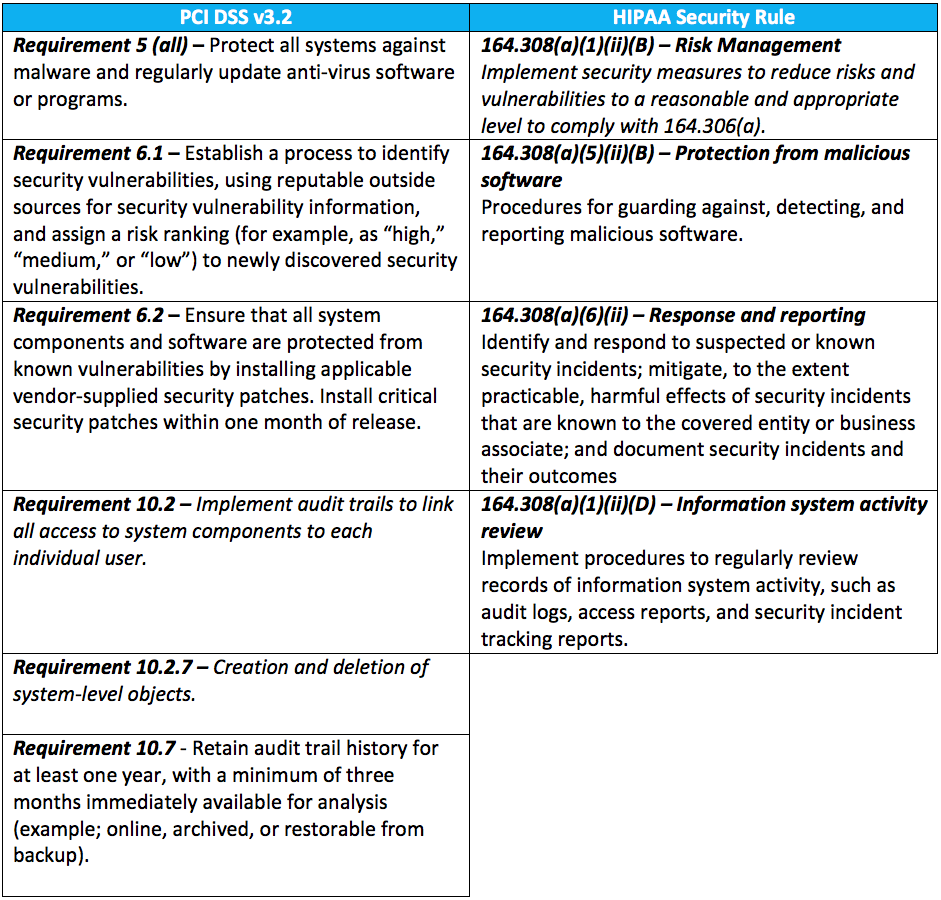
Cisco AMP for Endpoints was recently the subject of a thorough technical review and test to validate that the solution satisfies requirements in accordance with the Payment Card Industry Data Security Standard (PCI DSS) version 3.2 and the Health Insurance Portability and Accountability Act (HIPAA) Security Rule. The Cisco Security Team is pleased to report that as a result of the testing, it was concluded that the AMP for Endpoints solution meets and exceeds PCI and HIPAA requirements. Organizations, regardless of size or industry vertical, can confidently deploy this solution knowing that not only will their compliance needs be met, but from a risk management perspective, that their endpoint security posture will improve.

Cisco AMP for Endpoints meets and exceeds all of the following HIPAA and PCI requirements:


To learn more about the test and compliance validation, view the whitepaper here. For more information on Cisco AMP for Endpoints and how it can strengthen the security effectiveness of your organization, visit www.cisco.com/go/ampendpoint

Authors

John Dominguez

Product Marketing

Cisco Security Business Group

Avatar

As a partner in today’s competitive subscription economy, you have everything to gain and nothing to lose when you prioritize the customer’s experience and deliver maximum value at each stage in the relationship lifecycle. These principles are the fundamental tenets of Customer Success, and while they may sound clear cut, for many partners the challenge is implementing them across their entire organization. That’s where a Customer Success charter comes in.

When establishing a Customer Success practice, a charter plays a valuable role in uniting traditionally siloed business departments under a shared directive. It becomes the blueprint and company-wide go-forward plan, documenting the focus, key components and necessary actions toward establishing a full-on Customer Success culture. A charter not only aligns everyone in the organization with your Customer Success goals and objectives, but it also provides an overarching plan for achieving them.

If getting your Customer Success practice on the right track in 2017 is at the top of your list, then putting a charter in place is a great place to start. Later this month we’ll team up with the experts at TSIA to explore the process in detail in our webinar, “Working Together to Deliver Value.” For a preview of what we’ll cover, check out the overview below.

The Constructs of an Effective Customer Success Charter

The act of creating a Customer Success charter starts with exploring, defining and documenting what “customer success” means to your organization. According to ServiceSource, your charter should be made up of the following components:

  • A charter statement that defines the mission and vision, and provides context for all stakeholders. The charter should address why Customer Success is important to your organization, the problems it will solve, opportunities it can generate, and the expected consequences of doing nothing.
  • Your goals, objectives and the benchmarks and/or metrics you will use to measure your program’s ongoing success.
  • Key executive and team players, and their roles and responsibilities.
  • Your implementation roadmap and communications plans. Outlines the events, activities and messaging that will clarify your Customer Success charter internally, helping establish a personal connection with the people and departments that are critical to its success.
  • A list of the various factors that can positively and negatively affect Customer Success with risk analysis, assessments and recommendations for corrective actions.

A charter not only identifies the goals of your Customer Success practice and the metrics you’ll need to track process, but it also clarifies the cross-functional roles and responsibilities within your organization. Consequently, all contributors will gain an understanding of the big picture strategy along with how to tactically support Customer Success from their unique vantage point – be it for onboarding or billing.

The bottom line is that for Customer Success initiatives to be effective, all actors within your company should operate with the same goals in mind, and with a roadmap as to how they can influence the customer experience throughout the full lifecycle. When customers get everything they were promised and value realization is continuously achieved, their success will ultimately be your success.

Learn More

Join us May 30 at 2 p.m. EST for our next Customer Success Talk webinar: Working Together to Deliver Value.


Authors

Ed Daly

Senior Director

Global Customer Success

Avatar

To succeed in future, service providers will need technology that can meet increasingly sophisticated customer expectations

If you’ve ever found yourself becoming addicted to the latest online TV series, it won’t come as a surprise to learn that video is increasingly dominating the internet. In fact, Cisco predicts that by 2020, as much as 82% of IP traffic will come from video

The way people want to watch video is also changing. Rather than inflexible and restrictive bundles, they’re coming to expect personalised, user-friendly services. Services that make it easy to watch the film, TV and live streams they want. When and where they want.

And they want to be able to access this content seamlessly across the growing number of devices they own. They might pause a film on their laptop at home and then restart it on their tablet on the train the next day.

These expectations are only going to get stronger: Cisco forecasts that there will be 11 billion connected devices by 2020. And people under 25 watch twice as much mobile video as 25-39 year olds.

Supporting the agile video services of the future

The massive growth in online video is a big opportunity for telecoms, cable and over-the-top businesses. But more immediately, it’s something of a headache. The increasing, and increasingly sophisticated, demands for online video threaten to place an unmanageable burden on legacy systems. A fragmented infrastructure, providing video through separate platforms and distribution networks, is simply not up to supporting the services that customers now want.

Cisco’s powerful video solutions, like our Infinite Video Platform , can help service providers meet these expectations. The Infinite Video Platform’s integrated cloud infrastructure can create and deliver new services efficiently and cost-effectively.

The platform ensures unbeatable video quality. Its end-to-end visibility and powerful analytics enable you to manage complex operations smoothly, proactively identifying and resolving potential problems. It’s delivered as a service, giving you the ability to rapidly launch and refine new products. And it also allows you to publish content across multiple devices, offering customers a seamless experience.

Underpinning all this, our uncompromising security gives you the confidence to accelerate into the future.

Stand out from the crowd

With so many different providers competing for an online video audience, standing out from the crowd is hard. And since the market is developing so rapidly, no one knows exactly what kind of services will be the real revenue drivers of the future.

So alongside supplying a peerless viewing experience, it’s also important for providers to have the capacity to develop and trial new services quickly. This is one of the Infinite Video Platform’s key benefits. It deals with the technical side of service creation, so you’re free to focus on what’s best for your business.

The platform has many capabilities – but its real strength lies in bringing them all together into one place. This not only makes it easier to manage services efficiently, but also creates new business opportunities through providing better customer data. A deeper understanding of viewer behaviour can be used to drive increasingly important functions such as powerful analytics, personalised content discovery and targeted advertising.

And we add major new features every quarter, so it’s always getting better. No one knows what the future holds, but you’ll always have the latest technology at your disposal.

There are limitless ways in which Cisco’s next generation video technology can help service providers not only meet the challenge of online video, but use it to drive innovation and growth.

Are your systems ready to support the agile video services of the future? Find out more about how the Cisco Infinite Video Platform can help.

Authors

Yves Padrines

Vice President, EMEAR Sales

Global Service Provider

Avatar

This post was authored by Martin Lee, Warren Mercer, Paul Rascagneres, and Craig Williams.

Executive Summary

A major ransomware attack has affected many organizations across across the world reportedly including Telefonica in Spain, the National Health Service in the UK, and FedEx in the US. The malware responsible for this attack is a ransomware variant known as ‘WannaCry’.

The malware then has the capability to scan heavily over TCP port 445 (Server Message Block/SMB), spreading similar to a worm, compromising hosts, encrypting files stored on them then demanding a ransom payment in the form of Bitcoin.

Organizations should ensure that devices running Windows are fully patched and deployed in accordance with best practices. Additionally, organizations should have SMB ports (139, 445) blocked from all externally accessible hosts.

Please note this threat is still under active investigation, the situation may change as we learn more or as our adversary responds to our actions. Talos will continue to actively monitor and analyze this situation for new developments and respond accordingly. As a result, new coverage may be developed or existing coverage adapted and/or modified at a later date.  For comments and questions, please follow the link below to the Talos Intelligence blog, comments here have been closed to keep conversation in one forum. For current information, please refer to your Firepower Management Center or Snort.org.

Read more »

Authors

Talos Group

Talos Security Intelligence & Research Group

Avatar

Today’s news of the cyberattack affecting healthcare organizations—including the National Health Service (NHS)—in the UK, is sobering. Sources are reporting that the ransomware attack has “crippled the health system’s ability to treat patients.” Thousands of non-emergency appointments have been canceled, and ambulances have been diverted to other facilities, leading the NHS to declare the attack a “major incident.”

NHS employees attempting to log on to computers Friday were met with a pop-up message stating, “Oops, your files have been encrypted!” The hackers are demanding 415,000 pounds ($534,146) before May 19 or they claim they will delete the files.

The attack later spread to dozens of other countries and all types of businesses, according to the New York Times.

Ransomware isn’t a new phenomenon; it’s been around since about 2005. However, hackers themselves have evolved significantly. The “hacker economy” – estimated to be worth about $1 trillion – is more advanced than you might think. Today, cybercrime is organized crime. New methods of digital trickery are introduced almost daily, many that would fool even the most skeptical user. The ransomware attack on the NHS Friday was reported to be a particularly dangerous variant called the Wanna Decryptor.

Reports indicate that the malware exploited a vulnerability in Microsoft systems and may have links to the National Security Agency in the US. Microsoft created a patch for the vulnerability back in March, but hackers took advantage of the fact that “soft targets” like hospitals hadn’t implemented it yet.

“In healthcare and other sectors we tend to be very slow to address these vulnerabilities,” says Lee Kim, the director of privacy and security at the Healthcare Information and Management Systems Society (HIMSS). “But whoever is behind this is clearly extremely serious.”

For an in depth, technical analysis of the attacks, read the blog by Talos, Cisco’s industry-leading threat intelligence team.

Staying informed of new threats and attacks is a daunting task—but a serious one, especially where patients are involved. Interested in implementing a plan that protects your patients’ well-being? Read our new white paper about cybersecurity strategies for healthcare organizations.

Authors

Amy Young

Marketing Manager

Healthcare

Avatar

In the digital age, the security landscape only continues to become more complex, and well into 2017, we continue to witness the escalation of security threats across almost every industry. Especially, we are seeing a marked increase in the sophistication of security threats as they hit the front page news.

Why do hackers want your information?

Why are hackers working so diligently to obtain your customer information? The answer is simply “MONEY”. Hacking is a $450 billion to $1 trillion industry. [1] Just some examples of the market values of compromised data include:

  • Social Security Numbers ~ $1 each
  • Credit Card Data $0.25 – $60 per card
  • Exploits $1000-300K per incident
  • DDoS as a Service $7 per hour
  • Malware Development $2500 per app
  • Mobile Malware $150 per instance
  • Bank Information $1000 or more
  • Facebook Accounts $1 for account with 15 friends
  • Spam $50 / 500K emails

What does losing data do to your company?

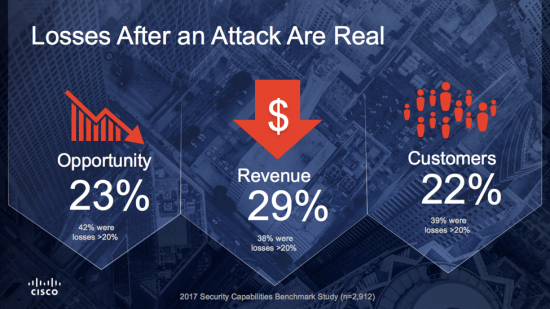
Right now, it is estimated that nearly 50 percent of organizations are under public scrutiny due to security breaches. [1] These incidents lead to huge losses for businesses and consumers, and can profoundly damage brand loyalty and customers’ trust. According to Cisco’s 2017 Cybersecurity Report, 23 percent of surveyed security professionals experienced a loss in business opportunity, 29 percent saw a decrease in overall revenue, and 22 percent said they lost customers after experiencing a breach in their companies.

What can you do?

Many security events are detected months after the event or sometimes not at all. Detection times may be over 200 days! This is mainly due to a lack of monitoring, analytics, and processes. Sometimes, this problem may occur due to the overall security architecture. Today 55 percent of organizations use anywhere from 6 to greater than 50 security vendors and 65 percent of organizations used anywhere from 6 to greater than 50 security products. [1] Some of this stems from the belief of safety due to stacking security products to close holes in a single vendor product. This creates a false sense of security. With this many companies and products in an organization, detection and reporting becomes nearly impossible.

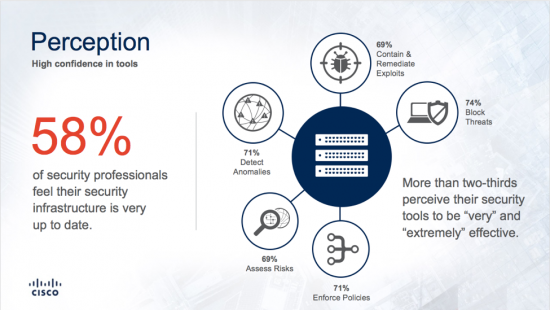
So, how do you detect and mitigate these threats? This is a tough question in today’s increasingly digital age. Areas that are growing rapidly in mobile, cloud infrastructure, and user behavior apps create increased vulnerabilities to your brand. One of the challenges is that more than 50 percent or security professionals view their security as adequate and their achievement of compliance standards as adequate. [1] This gives many people a false sense of comfort.

Due to the advanced weaponization of attacks, security will and should be a constant focus and investment. As far as compliance goes, it should be the minimum entry fee or the price to play.  By no means is it a security strategy. Traditionally, retail security teams have responded to security threats by building the firewall higher and stronger. And yet, in every store there will be a breach and it is only a matter of time. CISOs should therefore expand their attention to early detection, defense, and containment. This is in line with Cisco’s before-during-after strategy.

At Cisco, we believe that a unified security architecture that protects the entire retail organization – from the store to the cloud to the data center – is the most comprehensive and best security strategy.  In fact, our testing has shown that our average time to detection at 6 hours as of October 2016.  With today’s attacks usually doing recon work early, timing of detection and mitigation is everything.

Cisco further describes today’s threats in the annual 2017 Cybersecurity Annual Report.

Click here to learn more about Cisco Security solutions for retail.


[1] Source: Cisco 2017 Security Capabilities Benchmark Study

Authors

Kevin Wood

Industrial IoT Architecture Lead

Industrial IoT Americas Sales

Avatar

Successful businesses capitalize on opportunity presented by change. More specifically, our most successful partners – and most profitable – capitalize on the new opportunities digital and mobile transformation create by offering solutions that deliver the best outcomes for our customers.

It’s no secret that demand from end-users is the engine driving transformation in the technology world today.  Our partners are critical to both Cisco and customer success in this era.

By now, we hope you’ve heard about our APO go-to-market strategy for Cisco and partners under my 3 E’s – Engagement, Enablement & Evolution. A central piece of evolution, is our partnership with Apple and the enormous opportunity partners now have in the digital enterprise and mobile workplace.

Early Adopter WWT, Cisco and Apple

Cisco partner, World Wide Technology (WWT) based out of St. Louis, is investing heavily in the opportunity Cisco and Apple bring for businesses. As early adopters and an Apple mobility partner, WWT Asynchrony Labs will be leveraging their mobile app development expertise to build transformational business solutions, exclusively for iPhone and iPad.

In a recent blog post from WWT, Asynchrony Labs co-founder, Bob Elfanbaum, summed up their approach:

“Our innovative approach includes integrating Cisco technologies to build iOS apps with native video chat, voice and messaging; apps that offer easy-to-use interfaces with corporate databases; and customized apps that streamline workflows from business-to-business and business-to-consumer.”

Read Bob’s entire blog post for more details on what they have planned to help transform the workplace for their customers with Cisco and iOS.

How Can Cisco Partners Benefit Today?

The partnership’s first set of innovations involves three separate features that build upon each other:

  • Optimizing Wi-Fi connectivity
  • Prioritizing business apps (Fast lane)
  • Integrating voice and enabling collaboration with iOS and Cisco Spark

A Cisco IT team recently measured the improvements in a real world environment using Cisco Spark. The required software upgrade took approximately 30 minutes.  The result: an 83% productivity improvement.  Read more about the dramatic results.


https://youtu.be/QAeWxOms1d4


With joint Cisco and iOS solutions, you can lead the mobile enterprise conversation with customers, expand your current business relationships with apps and software, and uncover new customers.


To get started, catch the replay of Apple and Cisco Virtual Partner Workshop Series and tap into the wealth of selling materials on the Apple and Cisco Sales Hub on SalesConnect.

As always, for any questions or for more on how to take advantage of the Apple and Cisco partnership, reach out to your Cisco Partner Account Manager today.

Or, feel free to leave your feedback and questions in the comments section below.

If you are not a Cisco partner, here’s where you can partner with us today.


Authors

Rick Snyder

Senior Vice President

Americas Partner Organization

Avatar

Back in 1984 the desire to connect across campus gave birth to the first multi-protocol router, and to Cisco.  Much has changed since then, but one thing remains constant.  No, I’m not talking about my love of the New York Yankees – I’m talking about Cisco’s focus on the customer.

Putting customer first is what fuels our commitment to storage networking and continuous innovation when it comes to Cisco MDS solutions.  In fact, just last week we announced technology innovations for next-generation storage networking, including giving customers 32Gb fibre channel performance across a unified MDS storage director and UCS, among other things.

One has to wonder if other companies share that commitment.  Take Brocade Communications Systems, for instance…  When Broadcom announced its intent to acquire Brocade back in November, it vowed to “retain Brocade’s Fibre Channel SAN Switching business and divest Brocade’s IP Networking business”.  So far, that’s exactly what’s happening (most recent piece of business picked up by Extreme Networks).  Translation: we’re keeping the cash cow and letting go of the rest.

But with fibre channel SAN switching not being Broadcom’s core competency, what incentive does it have to innovate and invest in a robust roadmap?  And Brocade customers have to ask themselves, will their support be as good tomorrow as it is today?

Cisco’s answer is an unequivocal yes.  We are delivering cutting edge technology today to keep customers’ mission-critical data running, as we have for the last 15 years since Cisco’s Data Center strategy began.  Cisco storage networking solutions can help the network adapt to new storage trends such as flash, NVMe, and converged infrastructure workloads.  We continue to invest in our future storage networking solutions and provide ways to help customers manage their networks seamlessly.

Every week my team has many conversations with customers around the advantages of a Cisco Data Center solution.  Cisco MDS provides the best investment protection in the industry with our existing director able to handle 32Gb and beyond without a fork lift upgrade.  Our products provide multi-protocol functionality to enable networks to seamlessly transition to new technologies.  We are investing heavily in DCNM, our single pane of management, providing seamless management of SAN & LAN workloads, delivering operational efficiencies and additional analytics to customers to ensure their network is working at its best.

Cisco’s channel relationships are another reason to go with Cisco.  After all, making it easier for customers to stand up, run and upgrade their networks is part of our unrelenting customer focus.  Cisco also offers OpenPay, a financing structure  from Cisco Capital that takes a metered approach to monitoring usage of converged infrastructure, storage, routing and switching solutions.

So here at Cisco, we have our customers’ backs – today, and into the future.

Brocade customers – now that you’re on your own, we can have yours too.

Authors

Frank Palumbo

Senior Vice President

Global Data Center Sales