Avatar

Today’s mobile devices and applications not only demand tremendous amounts of data but the user experience must be superior regardless of traffic type, network type or user location. Network administrators desire to deliver this elevated user and application experience BUT not at the cost of added complexity and operational challenges.

Cisco is always ahead of the curve when providing all these capabilities without an exponential increase in cost—and we have it way before the competition. This trend continues with Cisco Digital Network Architecture (DNA). This solution offers the scalability, resiliency and ease of operation without compromising the security.

Configuration and operation of end-to-end Quality of Service (QoS) across the enterprise networks has always been a challenge. And with the growing number of apps and services, its becoming harder and harder to ensure high level quality of service across the network. Today’s massive enterprise networks are a combination of different type of devices like various tiered wired switches, wireless controllers, access points and routers. Moreover, these devices are often a combination of various operating systems and models with drastically different priority queuing structure.

It becomes the administrator’s headache to implement a consistent and reliable QoS across an end-to-end network. Administrators have to know all the devices, operating systems and queuing across platforms and go through thousands of pages of deployment and best practices guides to even get started. This often adds lot operational cost and delays in the deployment and upgrades.

Recently Miercom, an independent testing lab, released a report that evaluated the Cisco EasyQoS app which runs on the Cisco’s APIC-EM controller platform. This app simplifies these challenges by abstracting all the complexities involved in the QoS operations. It offers the administrator a simple-to-use dashboard to configure entire networks with just a click of the button. The EasyQoS app incorporates all of the Cisco best practices and Cisco Validated Designs (CVDs) to create the QoS policies based on administrator’s requirement and then translate those policies into configuration commands and programs every device in the network including switches, wireless and routers.
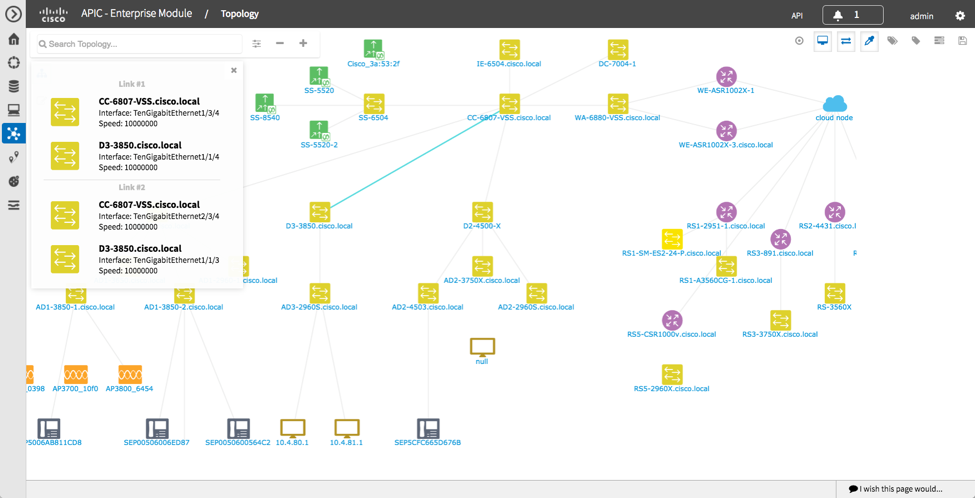
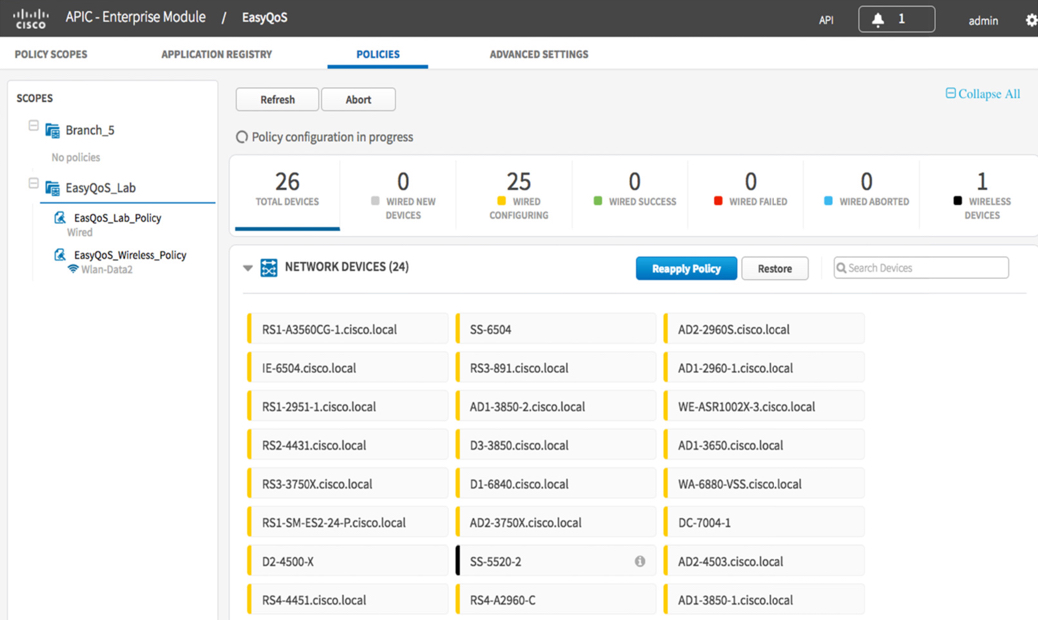
Miercom validated this powerful but extremely simple-to-use app against HPE-Aruba’s VAN SDN controller’s Network Optimizer app. HPE-Aruba’s entry claims to have similar functions, but it doesn’t.

In this report Miercom found HPE-Aruba’s Network Optimizer App is limited to only couple of real world applications, such as Skype for Business. This runs counter to Cisco EasyQoS which is optimized for over 1300 built-in business and consumer apps. Cisco EasyQoS also offers options to configure your own custom apps. Even if we consider prioritizing the Skype for Business app, HPE uses a VAN controller to ONLY configure edge switches. For applying similar policies on the wireless, an administrator has to re-create the policies on Aruba Mobility Controller and push it down to wireless access points. So essentially HPE-Aruba requires two separate controllers to apply QoS policies across wired (VAN) and wireless (Mobility Controller).

HPE-Aruba also cannot automate this process for the rest of the network devices, such as: aggregation switches, core switches, routers and WAN. Also, HPE-Aruba doesn’t provide support for rest of the critical applications like Salesforce, Oracle, Exchange and Jabber.

Cisco is the only vendor in the market who is offering this end-to-end QoS functionally which converts business intent into the actual network configuration without exposing the complexities involved.

Bottom-line: An independent testing lab has proven that Cisco APIC-EM offers real world SDN capabilities by offering apps for Day-0, Day-1 and Day-2 network operations. EasyQoS enables end-to-end orchestration of QoS in the Enterprise network making QoS policy simple and easy to deploy with an operator expressing business relevance for applications and the controller doing the rest under the hood.

Please download the complete Miercom report here.
Authors

Kshitij Mahant

Technical Marketing Engineer

Enterprise Networking Group

Avatar

Talos is disclosing the presence of two vulnerabilities in the Artifex MuPDF renderer. MuPDF is a lightweight PDF parsing and rendering library featuring high fidelity graphics, high speed, and compact code size which makes it a fairly popular PDF library for embedding in different projects, especially mobile and web applications. Both of these vulnerabilities, if exploited, could lead to arbitrary code execution of an attacker’s choice on the target device. Both of these vulnerabilities have been responsibly disclosed and Artifex has released software updates to address these vulnerabilities.

Vulnerability Details

Two memory corruption vulnerabilities exist within Artifex MuPDF render that could result in arbitrary code execution if exploited. These two vulnerabilities manifest as a result of improperly parsing and handling parts of a PDF file.

Read more »

Authors

Talos Group

Talos Security Intelligence & Research Group

Avatar

Last week’s stunning ransomware attack that crippled Britain’s National Health System and hit other organizations in several countries was certainly a dramatic, headline-grabbing event.

And it might not be over: According to the New York Times, the dawning of Monday in Asia brought reports of new cases in Japan, Taiwan and South Korea.

The malware, called “WannaCry,” appears to use technology originally developed by the US National Security Agency, according to reports. Like other ransomware, it encrypts the victim’s data, making it useless until the demanded fee (£415,000 for the NHS) is paid. Then the attacker removes the encryption (or at least, that is the promise) and disappears into the ether.

Image of two phonesFederal agencies can breathe a sigh of relief that — so far at least — the exploit hasn’t hit them. But don’t make it too loud, because there is still time. And even if WannaCry leaves the government unharmed, the next major attack might not. The Federal Government is a frequent target of cyberattacks and attempted intrusions, and a few high-profile cases in recent years drive home the point that agencies need security as robust as any private company.


The Defense Department is squarely in the crosshairs too. DOD reported experiencing 30 million attempted attacks in a 10-month period between 2014 and 2015, or an average of 100,000 a day. Every day.

To minimize the risk of being affected by the ransomware, check out some tips from the Cisco cybersecurity team.

For a snapshot of the state of cybersecurity in the government, download our new white paper that draws from the global 2017 Cybersecurity Report.

Where were we? Oh, yes. Ransomware. For an in depth, technical analysis of the ransomware attacks, read the blog by Talos, Cisco’s industry-leading threat intelligence team. And to learn ways Cisco can help with ransomware protection and ransomware prevention, check out this eBook about our Ransomware Defense solution, comprised of several innovative Cisco cybersecurity products.

As potentially devastating as the ransomware attack is, it’s not even the only serious cyberattack to happen recently. On May 3, an exploit that tricks victims into giving unknown attackers access to their Gmail accounts hit more than 1 million people, and analysis shows that other cloud-based systems are equally vulnerable.

In this attack, a malicious application uses the OAuth protocol and Cloud APIs to connect to Gmail accounts. Imitating a legitimate Google app, it requests permissions to read, send, delete, and manage users’ email and contacts. The victim sees no strange behavior after granting those permissions, but the attackers have access to the Gmail.

Google quickly shut down that attack and said no email contents were compromised. However, the attackers could have taken email contact lists, according to media reports.

Cisco cybersecurity experts will host a webinar on Thursday, May 18, to explain more about this attack and how you can protect yourself.

More than ever, agencies need to tighten their network and IT security. You’ve been reading for decades that cyberattackers are growing more devious and more technologically capable. You’ve probably heard the “arms race” analogy so many times that its mere mention causes your brain to start ticking off items on your mental grocery list instead of continuing to listen to whomever uttered the phrase this time.

However, those warnings have always been true. They haven’t changed in years because the situation hasn’t changed. Cyberdefenses evolve, attack techniques advance, and today’s hackers are more powerful than they have ever been, and after bigger and bigger gains.

Not all cyberattackers are after money, but those who are often find it. As my Cisco colleague Amy Young wrote last week: “The ‘hacker economy’ – estimated to be worth about $1 trillion – is more advanced than you might think. Today, cybercrime is organized crime. New methods of digital trickery are introduced almost daily, many that would fool even the most skeptical user.”

This month, the bad guys got a couple of wins. More often, smart organizations with robust security repel the attacks. It takes perseverance, though—and the right technology partners.


Authors

Michael Hardy

US Federal SME

Cisco Americas Public Sector

Avatar

Girls Power Tech (GPT) was an amazing experience this year. Through our sites around the world and unwavering support of our global executive sponsors, Kelly Kramer & Ruba Borno, a global team worked together to inspire the next generation of innovators, taking science, technology, engineering, and math (STEM) to the next level.

This year’s Girls Power Tech featured 90 Cisco offices in 50 countries across the world hosting nearly 6,000 students, 1,689 volunteers, and more than 15,000 mentoring hours! The impact continues to grow.

But none of this would’ve been possible without the employees who lead the programs at these locations. Over 200 volunteers donated their time and expertise to run GPT events at their offices across the world; all in addition to their day-to-day jobs. With hours of planning and coordination, it’s no small task.

Because of employees like them, Cisco was recently ranked 9th on Fortune Magazine’s list of the Best Workplaces for Giving Back. Our employees are what makes us great, and the 200+ who make these events happen are a shining example. Here are the stories of four of these individuals.


Aurelia Takacs, Brussels site lead & Global Delivery Partner Manager
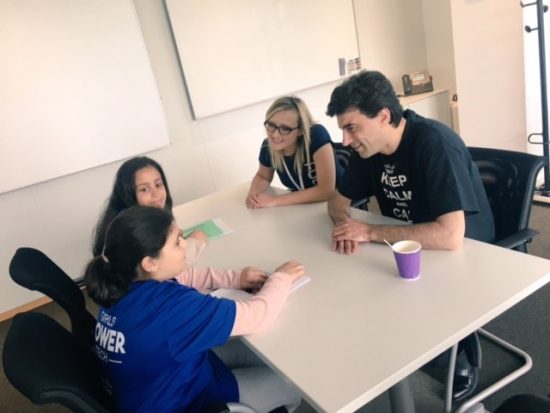

“In Belgium, we hosted about 40 girls who participated in a number of hands-on activities. We partnered with an NGO, Greenlight for Girls, which encourages girls to consider STEM careers through fun workshops. Each group completed three activities; one covered coding & design using Arduino Engineering kits and another was designed by a team in Belgium with inspiration from the movie “The Martian.”

Using Cisco TelePresence (TP), the girls had to bring “The Martian” back to Earth by working through hints and clues!  We also offered bilingual speed mentoring sessions in English and French. We closed our day with speaker Pastora Valero, VP, EMEAR Government Affairs, and handed out “Cisco Certified Future Engineers” CCFE certificates to all students.

We also partnered with an after-school activity center, the Young Moroccan Association. We arranged transportation for eight girls and conducted several special sessions in French for them, as this was their first time at Cisco. Many girls come from immigrant families and GPT offered them an opportunity to meet with a diverse Cisco employee volunteer group who helped inspire them to future ICT careers.

I really enjoyed working with these girls, hearing their stories, and hope to make this an annual tradition. It’s important that we reach further into our communities and provide these critical experiences to those who wouldn’t always get this exposure to STEM.


Louise Mills, Bedfont Lakes, UK, lead & Associate Virtual Sales Rep


“Bedfont Lakes hosted a speed networking session with several apprentices and graduates. Girls were exposed to many different business functions to learn about job roles in STEM. A TP session was also held with Ideal London, connecting students with local entrepreneurs and start-ups from this organization.

Students were split into three groups. One focused on TP, another about the Internet of Things and connecting the unconnected, and a third on effectively coding micro bits. Through “Dragons’ Den,” students also had to come up with their own app invention for the day and present to a panel of judges. More than 100 students in total; it was pretty manic!

The stand-out moment: having the 100 students up on the stage at the closing session in their GPT attire. It was inspiring to see them up there smiling with the knowledge that technology can be fun and can be a career. From my side, I did not always have that opportunity when I was a student. Having that opportunity at Cisco, that’s what I love seeing for these students.”


Bayan Barry, Saudi Arabia site lead & Regional Customer Service Advisor, EMEAR Middle East
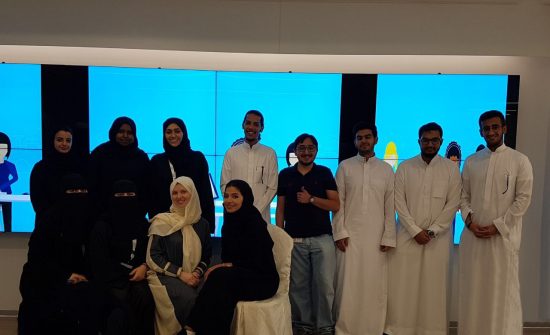

“Our GPT day is scheduled for early next year, with the target around 200 students. For the first time in Cisco Saudi, three groups—Connected Women, Cisco Networking Academy, and Country Digitization Acceleration—are collaborating with the goal of expanding the impact of the GPT day. We aim to encourage the students toward STEM, innovation and female empowerment.

We are planning to host several outstanding speakers, including the innovator who developed the “Bright Sign Glove,” which senses sign language and translates the movements into written text and speech. Another is Deemah AlYahya, Acting General Secretary from the National Digitization Unit.

We are also hosting one of  Saudi’s first female entrepreneur store owners, who owns a shop that fixes handheld devices and laptops and is staffed entirely by women. She will host a workshop on how to fix an iPhone. Finally, we will conclude with an awareness session by an Ethical Hacker and a student hackathon, which will teach the students the importance of problem-solving.

As a GPT lead, I am eager to make a change and create an impact to our community. The power of a promising future stands behind a well-directed and educated youth. Our ultimate goal is to drive these young ladies to explore strengths, think out loud, believe in themselves, motivate them toward STEM fields, and eventually prepare them for their next chapter. It’s the least we can do to inspire and be inspired!”

Cisco Saudi Arabia Girls Power Tech volunteer team: Connected Women, Cisco Networking Academy, and Country Digitization Acceleration

Shraddha Chaplot, San Jose, CA site lead & Systems Engineer, Cisco Customer Experience Center
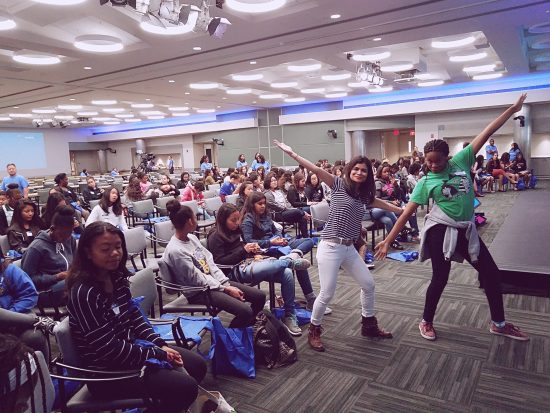
“I’ve been at Cisco for 476 weeks. I’ve built an Energy Efficiency Lab, helped design and launch a pilot program for Cisco’s global problem solvers, and created demos on Cisco technologies. Each of these contributions were amplified by a boundless imagination and the desire to be my full, multifaceted self. This is why I’m passionate about showing students how they can be their full selves to be anything during GPT!

I grew up loving mathematics, discovering patterns, and taking things apart. For the last five years, as emcee and content creator for San Jose, I’ve been incorporating this into GPT.

GPT at Cisco San Jose HQ featured 108 students and 200+ volunteers. I built a full day of activities focusing on hands-on building, empowerment, and curiosity. For example, I created an icebreaker called flashy stars, where the girls say their name and one thing they love about themselves. I used LED stars to symbolize STEAM. As girls get older, we tend to be taught to not love so many things about ourselves (including our intellect); this activity was meant to remind them what they’re made of.

I focused our design challenge, called “Got A Lotta Automata, Shraddha!” on building and creating – where engineering becomes art. I chose mechanical engineering as the theme, with automata—whimsical machines —as the project. I wanted the girls to see how simple mechanisms are the foundation of making things move.

By empowering these girls to be all the things they are, we get to inspire them to pursue a life that transforms themselves, their community, and their world for the better.”


Download our latest infographic and find out how you can be a global problem solver for women!

Authors

Megan DePorter Zeishner

Community Relations Program Manager

Avatar

The month of May holds a special attraction for me. Early in May, I was in Vegas covering a major Cisco Partner Event. Next week, I will be in Orlando to be part of all the excitement that Citrix Synergy 2017 brings to town. Several of the technology alliance partners I work with on Cisco ACI and Tetration Analytics front will be at the Citrix event. Amidst these synergies, I want to bring to your attention the significance of this year’s Citrix Synergy event.

The shift to digital business is disrupting every industry. How to turn that shift into competitive advantage is the focus of Citrix Synergy 2017.  At Synergy, you will learn how the workspace of the future can help us do more with our existing infrastructure and create more value for the business.

Citrix CEO Kirill Tatarinov kick-starts the event with his visionary keynote. Kirill will set the stage for our next chapter: the future of work. Kirill will share the Citrix vision, strategy and innovation that is powering the workspace of the future, which reimagines where and how work happens, enabling you to realize untapped potential for your business and say Yes to new opportunities—and make the extraordinary possible. Citrix Exec PJ Hough, SVP Products, is delivering the technology keynote and will share insights into how IT leaders can harness the power of an integrated portfolio of technology services that enables the secure delivery of apps and data to drive growth, increased productivity and efficiency for your organization.

Citrix Synergy 2017 is particularly exciting to me as our joint solutions featuring Cisco technologies ACI and Tetration Analytics and Citrix NetScaler have picked up considerable customer momentum since their market introduction. Okada Manila, YRC freight, Woolworth, DU and several other top customers have recently given testimonials on their positive experiences with the ACI-NetScaler joint solution, and I look forward to hearing more of these at the event. The most exciting news is, our valued customer, Okada Manila, has been chosen as one of the finalists for the Citrix Synergy Innovation Award. You can cast your vote today at www.citrix.com/innovation

In addition, technology training, access to industry’s top thought leaders and the customizable agenda and experience makes Citrix Synergy a valuable investment of our time year after year.

What’s top of mind from a Cisco Exec participation at Synergy? We’re excited to have Ish Limkakeng, Vice President, Product Marketing, Cisco Insieme Business Unit,  join Ash Chowdappa, VP & GM NetScaler at Citrix, for the Executive Directions track on Tuesday, May 23rd, 2017. The session will feature, among other things, how Cisco Tetration Analytics and Citrix technologies will deliver end-to-end solutions for our customers that make application deployments, both in the data center and cloud, more scalable and easier to operate. These integrated solutions will be focused around application dependency mapping, application segmentation, complete network and application stack visibility.

Next, our sponsored breakout session this year features high-energy speakers Robb Boyd and Lauren Malhoit, co-hosts for TechWiseTV, Cisco. Do not miss Robb’s session “SYN152: Powering your digital future with Cisco VDI solutions for Citrix on Wednesday May 24 at 9:30-10:15am located in Orange County Convention Center, West Concourse, Level III, W311E”. In this session, you’ll also hear from Cisco customers who have successfully implemented VDI and how that has benefited their business. Robb and his guests will also unveil what’s new in HyperFlex, Cisco’s one-year-old and 1,200+ customer–strong hyper-converged offering. So don’t miss this fun-filled yet educational session. You may walk away with a MacBook Air!

I do not want to take away all your excitement by divulging the full details, so I ask you to attend in person to get the full immersion experience.

After the keynote, the world of solutions beckons you with a wide range of technology showcase from industry-leading vendors, and I want to welcome you to the Cisco booth #202 where the action is unlimited. This year we are offering solution demos and Mini-Theater presentations featuring Desktop virtualization, Hyper-convergence, Networking Analytics (Tetration), SDN (ACI), and Cloud technologies to name the highlights.

In particular, check out our demos featuring the three modes of deployment we have introduced recently with the Cisco ACI- Citrix NetScaler joint solution. Read my blog on the flexible deployment modes.  In addition, we are pleased to bring to you a teaser Cisco Tetration-NetScaler demo that shows the breadth of capabilities in networking analytics between the two companies.

The Cisco ACI – Citrix NetScaler joint solution features prominently at the Cisco demo Pod and the Mini Theater this year. We have many mini-theater presentations on this topic alone.  We also have a demo and presentations featuring Cisco Tetration Analytics and NetScaler. Stop by our booth and get a live demo from our experts, and learn how to automate deployment of NetScaler L4-L7 services using ACI policy framework.  In fact, we can give you a modular walkthrough of the solution whether your interest centers are around the ACI Fabric, Cisco APIC policy controller, the newly introduced “Service Manager Mode of deployment”, Citrix NetScaler etc. In addition, we can provide you with a quick overview presentations at our Mini theater that runs round the clock. There will be daily presentations on the ACI-NetScaler, and Tetration-NetScaler joint solutions, and I hope the theater experience will complement the insights you gain via demos. We also have white-boards to dive deeper into cross-architectural discussions should you decide to explore further. There is never a dull moment at our Cisco booth this year as Cisco UCS and HyperFlex with Citrix desktop virtualization, Cisco ACI and Tetration Analytics, and Nvidia GPU demos offer the latest in technology innovations from Cisco and its Partners.

It is not all hard work and no play. In closing I want to touch on the entertainment scene that’s in store for you.

Get ready for an unforgettable Final Night Party; Citrix is taking over Universal CityWalk™ and the entire Universal’s Islands of Adventure™ theme park, with thrilling rides, tempting dining, and entertainment from live reggae to karaoke – reserved just for you! At 8:30 p.m., the party moves to Universal’s Islands of Adventure™, where you’ll enjoy snacks, dessert and drinks through the park. Featuring themed lands and cutting-edge rides, Islands of Adventure™ promises excitement around every bend. It’s a universe of action and excitement—and it’s all yours.

I look forward to seeing you all in person next week.

Related Links

www.cisco.com/go/acicitrix

https://blogs.cisco.com/datacenter/iconic-okada-manila-exceeds-customer-expectations-with-cisco-aci-and-citrix-netscaler

https://blogs.cisco.com/datacenter/cisco-aci-partner-ecosystem-packs-a-punch-65-partners-and-growing

https://blogs.cisco.com/datacenter/changing-the-game-with-cisco-aci-and-netscaler-mas-integration-customers-benefit-from-full-l2-l7-automation-and-native-operational-flexibility

Authors

Ravi Balakrishnan

Senior Product Marketing Manager

Datacenter Solutions

Avatar

“If a tree falls in a forest and no one is around to hear it, does it make a sound?”

As I walked around Enterprise Connect 2017 this year, nothing seemed more refreshing to hear company leaders gloating that their products have the best user experience.  This was repeated throughout the show — in product demos and panelist discussions about the future.

To me, this is an accomplishment. Only a few years back, people didn’t even talk about user experience for business software. I attended a panel session that helped me realize that we’re still not talking about a critical final phase of the users’ journey. Adoption.

Even though there is a strong race to ship products with a great user experience, what happens after the customer buys and deploys it is very different.

Being part of a product team, it’s common to receive feedback from the sales teams about feature gaps: “The customer won’t buy until this or that feature is available.” As a result, this often becomes the primary way you think about user adoption when designing products: Ship more features to drive adoption.

I attended a panelist discussion that had representatives from vendors and consulting companies. The very focus of the consultants is to help companies adopt the software they’ve purchased — in this case, workplace collaboration software. Imagine the challenge: After spending thousands of dollars on purchasing software, they need to hire dedicated professionals to achieve successful roll-out.

Halfway through the session, I started noticing two themes.

The importance of effective internal communication: When rolling out new software, it’s not enough to send out a mass email announcement and hope that everyone will adopt it. Internal communications should include using multiple modes and mediums to communicate the benefits of the new product. The panelists also focused on finding early adopters and champions. There’s great opportunity in sharing internal success stories to spur adoption and highlight use cases. If HR is an early adopter, share the story with your finance and legal teams.

The importance of staying close to the deployment, physically: Monitoring numbers from a distance will only help you quantify adoption progress. You won’t know the why and how behind the numbers unless you get close.  One panelist shared a story that illustrates this point. His team was receiving employee feedback that it was easier to schedule meeting in the old software. Working directly with an employee, the panelist explored the issue and discovered that company pop-up blocker rules were actually blocking the new software. They quickly changed the setting, which resolved the issue.

Since the panelist was actually present with an employee who was experiencing this issue, he was able to see the problem, resolve it, and remedy the user experience. If he had relied only on data, what would have happened? Probably what happens to hundreds of software rollouts to thousands of employees. Companies deploy new products, employees hit roadblocks and go back to the previous solution – or worse, find their own.

“If you a build product that users won’t use, does it exist?”

The billion dollar opportunity in user experience goes beyond the product itself. It is at the often-forgotten tail end of the customer’s journey: User adoption. This is especially important as companies are pinning their futures on new integrated solutions. When buying and deploying new products, make sure the user experience – of both the product and the adoption cycle – is part of your strategy. Even with the best products, change management is always part of the equation.

Authors

Ahmed Arshad

User Experience

Avatar

Do you have a great team? I do! It’s such a terrific group of people, that not only do we work together and innovate together, but we’re a team outside of work as well!

I came to Cisco through the Cisco Sales Associate Program (CSAP), which is a one-year program where we train together with other global Associate Sales Representatives (ASRs) – often using Cisco’s Webex technology – to help us learn how to go into the “real” business world and represent Cisco Sales!

It was a great program, tailored for students just getting into the work world. It really helped us to learn fast, and I feel that the program has a lot of support from Cisco, and positioned me for success in my current role.

Now, I’m in the Global Virtual Sales team, based in Shanghai, where you can usually find me in the pantry at 21F (See the Shanghai blog tour here.) Sitting here, I can see airplanes rushing into the clouds, as well as China’s tallest building, and it just helps me focus and gather my thoughts to help me be a better team player!

When it’s time to get to work, the amazing team (that I mentioned earlier) and I spend our time leveraging leading technology solutions to help our customers in new ways, thinking outside of the box from traditional methods, and cooperating together to present the best solutions. We work great as a team all day, think about new ideas and really support and value everyone’s input.

Bill's Team
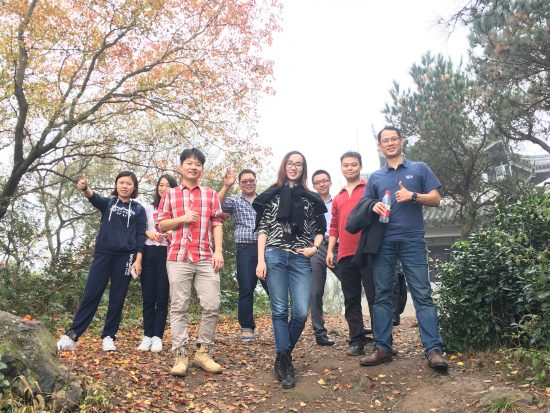
In Cisco, our relationship is far more than colleagues. In weekend, we hang out for fun. We climbed the hill together and took a photo on the top. Some said this picture looks like magazine cover, what do you think?

However, because Cisco employees are some of the best people around, we found ourselves getting together outside of the office as well. We connect in a way that blends our work into fun!

For example, we have a lot of good singers on this team, and who doesn’t love Karaoke? So we’ll find ourselves gathering after work and enjoying some music. Or, because we love the outdoors and being active, you can also find us riding our bikes together, hiking, jogging, golfing, boating – you name it! We enjoy just being together, but it also means we’re a better team for Cisco, because we’re building stronger relationships, which just means we can come together even more effectively when we head back into the office!

Maybe you’ll be so inspired by the great teams at Cisco, at a company that values input from talented people, that you’ll want to come work with us! If you ever come to Cisco Shanghai, I invite you to come sit with me and have some coffee in the 21-F pantry!


Want to be a part of one of Cisco’s great teams? Take a look at the Cisco Careers site for open opportunities!

Authors

Bill QIN

Associate Virtual Sales Rep

Avatar

Mission Critical” is a term bandied about far too often in our industry.   But in the case of SAP HANA it’s a fair description; if your core business operations backbone is not “mission critical,” what is?

That’s why Cisco is excited to be a major sponsor of SAP’s SapphireNow user conference in Orlando this week.  For Cisco, this year’s Sapphire represents a culmination of many years of investment and meaningful engineering work to make SAP “run simple” (to borrow SAP’s tagline) on Cisco Unified Computing System (UCS) converged infrastructure.

In fact, we believe SAP runs better on UCS than on any other platform.  Why?  Because only Cisco offers both superior flexibility and policy-based automation for SAP HANA applications such as SAP HANA, HANA Vora and S/4 HANA.


Cisco customers, who have chosen the Cisco UCS platform for their SAP deployments, agree with us.

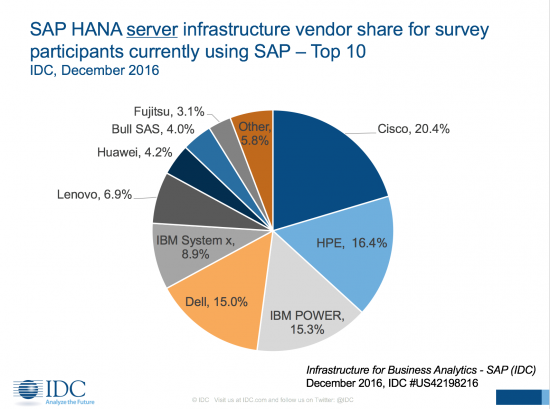
A 2016 IDC survey (IDC #US42198216, November 2016) of 300 respondents in N. America showed Cisco as the leading vendor for SAP HANA infrastructure.


Mohawk Industries, the world’s largest flooring company, chose a UCS VBlock solution to gain valuable real-time insights into their business.

“With SAP HANA, we’re bringing market data, machine data, and ERP system-based transactional data to one database so that all departments can get the information that they need instantly,” said Jevin Jensen, Vice President of Global Infrastructure.

Similarly, Valley Proteins uses UCS FlashStack solutions to gain a holistic view of customer purchases, supplier pricing, and individual factory performance, centralizing data from 25 remote locations to better understand the profitability of each customer and track materials and maintenance in real-time.

“With Cisco UCS, we have a solid infrastructure for SAP, enabling greater business insight than we’ve ever had before,” said Brad Wilton, Director of IT, Valley Proteins.

SAP Service Providers like CenturyLink, who sign client SLAs for secure, reliable infrastructure for HANA-as-a-Service, are also flocking to UCS.

“Our collaboration with Cisco and SAP to deliver policy-based HANA-as-a-Service for SAP analytics and other application suites, enables CenturyLink to deliver unparalleled agility, security, and governance, to enterprises via highly resilient and economical cloud services,” said Gary Gauba, Chief Enterprise Relationship Office and President of Advanced Systems Group, CenturyLink.


What’s behind Cisco’s SAP leadership position?  Innovation that enables more efficient operations
and lowers the Total Cost of Ownership for SAP.  For example, Cisco was the first SAP partner to certify:

  • Policy-Based TDI for efficient Management, Security, & Provisioning
  • A Reference Architecture and Implementation Guide for HANA Vora & Big Data
  • One-Click Deployment of SAP S/4 HANA and Vora
  • Software Defined Storage for SAP
  • 40 Gigabit Ethernet for SAP
  • Hyper-Converged Infrastructure for non-production HANA

Does this innovation make a difference for our customers in the real world?  In a blind study last year of SAP customers running on the Cisco UCS server platform, IDC found Cisco customers averaged 528% ROI and savings of $20.4 million over a 5 year period (IDC #US41084916 2016).


If you would like to learn more about how you can benefit from the value of Cisco’s converged infrastructure for SAP, please read our press release, visit the Cisco booth at SAP Sapphire in Orlando at booth #722, or go to the Cisco web site and read more about what analysts and users are saying about Cisco UCS for SAP.


Authors

Brian Ferrar

Enterprise Marketing Manager

UCS & Data Center

Avatar

Friday, May 12 looked like a typical day for most folks as they went into work looking to finish off their day and head into the weekend. But as the day progressed, many organizations across the globe quickly realized that their TGIF was going to be spent dealing with a ransomware attack known as WannaCry.

Some have called WannaCry the biggest ransomware attack ever. The attack was prevalent across the globe and was seen infecting telecom networks in Spain and constraining hospitals in the United Kingdom, many of which had to move emergency patients to other sites for care. The malware even moved through enterprise networks and affected operational networks, forcing a car manufacturer to shut down a factory to deal with the incident.

WannaCry Defined

So, what is WannaCry? This malware attack was primarily focused on systems running Windows XP, for which Microsoft ended support in 2014. Here’s what we know from our Cisco team over at Talos, which monitors global security threats:

“The malware…has the capability to scan heavily over TCP port 445 (Server Message Block/SMB), spreading similar to a worm, compromising hosts, encrypting files stored on them then demanding a ransom payment in the form of Bitcoin. It is important to note that this is not a threat that simply scans internal ranges to identify where to spread, it is also capable of spreading based on vulnerabilities it finds in other externally facing hosts across the internet.”

I highly recommend you read the full article here, which lays out advice for dealing with the threat, including what patches and ports to block.

Additionally, I recommend research articles on WannaCry at the following sites:

Why Ransomware?

Let’s look at ransomware by the numbers, according to Cisco’s annual cybersecurity report:

  • Ransomware is considered to be the most profitable malware in history
  • It’s growing at an annual rate of 350%
  • The FBI estimates the annual global market to be around one billion dollars

The WannaCry attack only emphasizes the growth in ransomware, with the way it spread across a variety of industries.

Ransomware in Manufacturing: 5 Ways to Reduce Your Risk

For those in the manufacturing space, the exploitation of Windows XP has to be very concerning, as many manufacturers still use older platforms to support their operations, with the philosophy of “if it ain’t broke, don’t fix it.” However, as more legacy automation systems become connected, security has to become more top of mind.

To minimize impact when attacks like WannaCry occur, it’s vital to know what your critical systems and operational priorities are. In case an incident occurs, here are some best practices to enact now, to expedite your return to “business as usual”:

  1. Make sure you have good backups. If you do weekly backups, transition to daily; if you do daily backups, consider hourly or real-time coverage.
  2. Develop a good disaster recovery plan. Test and update the plan regularly as your business grows and changes.
  3. Carry out security awareness training. Identify all the people, processes, and tools necessary to handle a critical disruption or event. Perform drills to test these plans on a regular basis.
  4. Develop a comprehensive baseline of the applications, system images, information, and your normal running network performance to give visibility into changes. These actions set a standard for detection of unusual activity.
  5. Consider using standardized images of operating systems and desktops, to allow for easy re-imaging to recover infected infrastructure.

To learn more about ransomware and how to defend yourself against it, take a look at our Ransomware Defense eBook.

And for guidance in assessing risk and setting a security strategy, visit our interactive security experience for manufacturing.


Authors

Eric Ehlers

No Longer at Cisco