Take a trip with me, if you will, back to the turn of the 21st century – when “digital transformation” was but a gleam in our eyes. Back then, we barely had email at work. The internet was still kind of a novelty. And social media had yet to be invented. (How did we survive?)
THIS was the highest-tech cell phone in the year 2000:
At the time, I worked as a Risk Manager for a professional liability (a.k.a. medical malpractice) insurance company. Among other responsibilities, my job was to advise our physician customers on legal and regulatory risks. And my phone was utterly lit up with calls about this new law called HIPAA. (It was officially passed in 1996, but because of the major operational shifts it required, organizations were given until April 2003 to comply.)
The most commonly asked question at the time had to do with the sign-in sheet at the front desk: Was having that in plain view a HIPAA violation?
Aw, weren’t we cute.
Nowadays, of course, our focus has shifted. We’ve mastered the basic tenets of HIPAA (I still remember the mnemonic device “TPO”: treatment, payment, operations), but we still worry about privacy breaches. Actually, we worry a lot more now, because unseen hackers are exponentially harder to control than a physical file folder. And although we love the internet, we don’t love the fact that breaches of protected health information (PHI) are posted on a website for the world to see.
All of this only underscores the need for a hard-working, automated security solution, like Cisco’s Advanced Malware Protection (AMP) for Endpoints. Not only does it help detect, block, and remediate advanced malware across all endpoints, but it’s now also officially validated to meet the standards for HIPAA compliance.
That’s a big deal. As you know, it’s not easy to pass that test.
Check out the blog from my friends in security detailing this milestone, including the specific HIPAA security rules AMP for Endpoints meets–and exceeds.
I’ll just be over here, recalling a simpler time, and reminiscing about the utter freak-out that was Y2K (we survived, you guys!).
This week at the Internet of Things World Forum, we’ve been hearing a lot about the transformational value of the Internet of Things (IoT) across many industries – manufacturing, transportation, agriculture, smart cities, retail, and finance. So many new solutions are on display that help organizations either save or make money. But in healthcare, IoT can actually do more than that, it has the potential to save lives.
You may be thinking, “Of course—wearables, remote monitoring, performance tracking. These concepts have been around for a while now.” And yes, these technologies and devices are already working to improve health and fitness. One recent development, however, has really captured my attention because of its potential to help with early detection of breast cancer. That’s the idea behind the connected bra—dubbed the” iTBra” by its inventor, Rob Royea, CEO of Cyrcadia Health. With embedded temperature sensors, this new kind of wearable technology tracks changes in temperature in breast tissue over time. It uses machine learning and predictive analytics to identify and classify abnormal patterns that could indicate early stage breast cancer. And women will be glad to know that they just need to wear the iTBra for 2 to 12 hours once a month as they go about their daily activities—there’s no painful squashing or prodding or radiation involved.
The iTBra fits comfortably under virtually any normal bra and can transmit results to a smartphone.
This technology marks a vast improvement over traditional mammography, which generally doesn’t detect the presence of cancer until it is in Stage 3 or 4. It is also much more accurate than mammography, which produces a high number of both false-positive and false-negative results. Currently, more than 70 percent of biopsies that are done as a result of a suspicious mammogram turn out to be non-cancerous tissue. And in women with dense breast tissue, mammograms miss the presence of cancer more than 50 percent of the time. Because the iTBra relies on different detection technology, its false negative rate has so far been 17.3 percent for all tissue types—an improvement for all women, but especially for those with dense tissue.
Connected bra technology is many times more accurate than mammography in detecting the presence of cancer.
“Detected” is a new short documentary film sponsored by Cisco that shows the development of the iTBra, from the seed of an idea to its acceptance for clinical trials. The power of this documentary is not only about the ground-breaking idea itself, but also about the innovation process. I have been a keen observer and practitioner of innovation and co-innovation for years, and therefore I appreciate how the film realistically depicts the entrepreneurial struggle—a great idea, some false starts, some wrong turns. We also see Rob Royea’s grit and determination as he doggedly persists through obstacles, builds a coalition of the willing across the globe, and spreads his enthusiasm and passion about the project to people around him.
Rob Royea, right, discusses circuitry design with a development partner in Israel.
The connected bra idea is already so powerful by itself; but this is just a start. As Rob Royea says in the film, “What if you can screen three million people in Asia in a single year? What if you can create this mega database through the Internet, that can analyze how some people, versus others, have cancer?“
This is where IoT, in combination with the cloud, machine learning, and analytics capabilities, can truly become transformative. Mammograms—and the radiology expertise needed to interpret their results—are still out of reach for billions of women, especially in poor countries. Now, with inexpensive, non-invasive technology, you can now screen millions of women who have never had access to screening before. And in the process you can gather massive amounts of anonymized data that can help us research and hopefully better understand what factors contribute to a woman getting breast cancer in the first place. In a world where more than half-a-million women die from breast cancer each year, such connected IoT solutions can not only help cancer detection, but also cancer prevention.
The connected bra is just one of the reasons IoT in healthcare is especially exciting to me. Combined with rapid advances in areas ranging from bio- and DNA engineering, to robotics, prosthetics, and remote care, IoT is poised to dramatically improve many aspects of our lives—enhancing not only how long, but also how well we live. This is why I believe it is so important to rally behind entrepreneurs such as Rob Royea. We should support the efforts of current innovators and create incentives and programs for new ventures in the IoT healthcare field. Because in healthcare, the stakes are not just about efficiency or productivity; they’re about our lives.
Have you ever wondered about how the everyday information available on your network could compromise your entire organisation?
I lead the Cisco Security Advisory Services team in EMEAR. We recently performed a “Red Team” exercise in which our client set us the objective of attempting to gain access to their client database.
For the uninitiated: “Red Teaming” can include many different elements as our assessments are uniquely tailored to our individual Clients. Generally speaking, it’s a goal-orientated security engagement designed to give a snapshot assessment of your organisation’s complete response to a simulated compromise (i.e. evaluate the success of the “Blue Team”). What it boils down to is that a Red Team simulates real-world scenarios, assessing genuine responses to a breach, as opposed to the `on-paper’, theoretical approach of a traditional audit; which will provide an accurate view if your breach runs smoothly like a training exercise.
Now, for many getting “hacked” means nefarious individuals in hoodies running cool exploits, dropping shells on boxes, breezing through firewalls and authentication mechanisms and lots of slow moving progress bars. However, these approaches make a lot of noise and are likely to alert the “Blue Team” to your presence. In a Red Team, we want to see just how far we can get before the Blue Team notices we’re there, so we used more subtle means to slip in undetected.
In reality, it’s not hackers blasting your carefully constructed access controls out of the water. It’s once people are already inside your organisation that you’re in trouble. The information made readily available to make employees’ lives easier is the information that can be used to compromise the organisation and steal your data. In this engagement, our Red Team achieved their goals using only information available to every employee in the organisation.
You may be shocked to learn that during the engagement, our Cisco Security Services team were able to:
Steal over 1,000,000 credit cards – at an estimated value of around $30 per card in Europe, this data would be worth $30M to an attacker.
Compromise Personally Identifiable Information (PII) and exfiltrate it from the network undetected.
Gain visibility of all financial transaction data and:
Change suppliers’ payment information to our own accounts
Access HR systems and Payroll to change the accounts to which employee salaries were paid
As you can see, the costs on a breach of this scale are incalculably high when you consider the devastating impact on the client’s brand, physical financial theft, and subsequent incident management. Although this use case was a simulation, it reflects real-world impact: the multiple costs of the recent Talk-Talk breach, including brand damage, have been valued at $70M. Additionally, a report from CGI Group and Oxford Economics identified a direct correlation between share prices and security breaches:
Average drop of 1.8% on a permanent basis
One company’s valuation was reduced by 15%
It is worth noting that, come May 2018 under General Data Protection Regulation (GDPR) being enacted in Europe, our client could have incurred fines of around €520M. UK firms are not currently required to issue notifications of a breach. When GDPR comes into effect next year, they will have 72hours to do so. It is suggested that this could raise the lost shareholder value across the European markets by a factor of 10. Under GDPR, organisations will be liable for fines of €20M or 4% of annual turnover, whichever is higher.
In this Red Team engagement, we replicated the actions of standard users, using information sources typically available on most corporate networks, such as intranet, departmental wikis, and network shares. Got any of those? These are rarely monitored closely enough to pick up on the odd “Access Denied”, which makes them perfect for a sneaky entrance.
Using only this information, the Red Team gained full access to the client database and their target data, along with multiple other restricted environments. Not only that, but we also compromised the HR systems and payroll and were able to alter their supplier’s payment information.
And the Blue Team?
Not a peep! They never saw a thing. We just slipped in under the radar using what was lying around available to anyone on the network. No network scans, vulnerability scans or any exploits. No anti-virus triggered and we didn’t brute-force any passwords or create new users – all actions almost guaranteed to set the alarm bells ringing.
Now we’re good, but not that good. Fort Knox’s security systems would have caught us red handed (pardon the pun). So what happened here? Were they sedated and hog-tied in the basement with gaffer tape over their mouths? No.
There were gaps in monitoring, security tools and procedures that allowed us to achieve our goals without being seen. The unfortunate truth of the matter is that these gaps and bad security practice exist in the vast majority of organisations; alongside issues with the real-world performance of organisations’ security operations, they are often only identified and evaluated off the back of objective-driven security assessments like Red Teaming.
It’s not all doom and gloom…
Once you know your weaknesses, you can close or mitigate vulnerabilities. We’re proud to say this particular client is currently strengthening their defences with the help of Cisco.
Wouldn’t you rather be prepared for a breach before it happens? Learn more about our Cisco Security Services team and how we can help you improve your time to threat detection and response. We can help you by running a Red Team exercise, conducting network penetration testing, preparing an incident response plan and much more.
Lumen is a Global technology company. Lumen Global IT Services group delivers a broad range of technology-enabled consulting and implementation services, including cloud enablement, big data-as-a-service, advanced decision sciences, digital commerce, managed security application development, and disaster recovery services. Its consulting services combined with extensive expertise in hosting, managing and optimizing SAP applications across business functions and industries, helps customers maximize their SAP workloads and reduce their total cost of ownership.
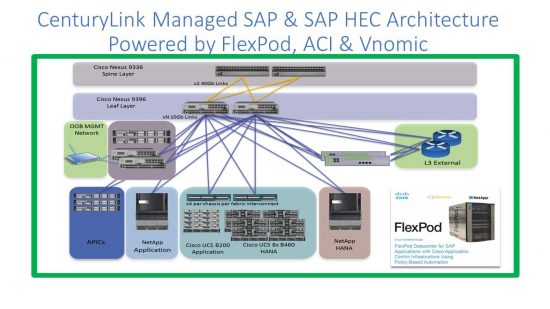
In this blog, I want to present the deployment successes experienced by Lumen running SAP HANA on a Flexpod infrastructure powered by Cisco UCS, Cisco ACI and Vnomic.
Lumen Challenges: Enterprise customers are struggling with how to respond to increased demand for SAP applications. Their IT organizations must deploy services quickly, then rapidly add or remove resources from already-running applications to meet user demand. In addition, while adhering to the security and governance requirements, they must meet time, costs and service level requirements.
Why Lumen looked at Vnomic and Cisco ACI as a favorable candidate? Being able to deploy instances of SAP HANA in just an hour vs. several months is a big deal for any organization. SAP BW on HANA deployments have all the attributes of complex, dynamic applications that can benefit from Cisco ACI and FlexPod. These include highly variable performance and scale demands, distributed users, virtual and physical resource requirements, different storage types, and 24/7 global availability. Configuring and deploying these landscapes can take months and involves manual layout of new infrastructure and connectivity. These long lead times limit the agility customers have to respond to variable business needs.
Traditional infrastructure, even in managed private hosting environments, doesn’t provide the speed and agility that a cloud hosted solution provides. Plus, it’s very expensive to operate an SAP environment.
Deployment environment at Lumen The ability to scale the infrastructure is only half the story. Customers need the ability to spin up new SAP landscapes, clone their systems/apps, perform refreshes, and instantiate development environments identical to production. A cloud hosted SAP HANA service offering enables Service providers to meet those demands.
The Flexpod based production environment brings flexibility, scale and simplicity of operations for Lumen. First, the Cisco validated designs reduces risk and ensures compliance and security. Flexpod’s UCS compute units enables seamless scaling of blade server capacity (B260 and B460 blades as needed). Vnomic further automates and simplifies migration across different OS versions of RHEL with its built-in mapping facility and one-click application deployment. Cisco ACI with its policy based network automation is a key enabler of Lumen Customer demands of fast realization of workloads and Cisco ACI+Vnomic make an ideal pair to achieving this business objective.
Lumen operates a true Multi-tenant production environment in which UCS-M and APIC are shared resources, while the compute blades themselves are dedicated on a per-customer basis. Customers run multiple (4 different flavors) RHEL OS versions and Vnomic makes the application deployment across these flavors simple with its mapping automation and single click deployment. APIC enables creation of policy based application network profiles, which brings agility to the provisioning and configuration of network infrastructure.
Benefits of Cisco ACI+Vnomic solution
Lumen realized significant benefits with the ACI-Vnomic joint solution. Foremost one is time-to-value, which enabled a new Customer BW HANA instance to be spun up in the order of hours from historical experience of weeks and months. Errors encountered in manual operations and downtime often cost anywhere from 10k to 10 million dollars in a typical SAP HANA operations environment. FlexPod based automation eliminated manual operations and reduced OPEX significantly.
“By partnering up with Vnomic and Cisco, we are able to solve a real problem in the market when it comes to enterprise level SAP deployments. With their revolutionary policy driven models, this enables Lumen to take the pain out of manual deployments in various areas of the stack, reduce or eliminate manual handoffs between departments, and have the peace of mind that our infrastructure, end-to-end, is fully within SAP best practices and can prove this with full auditability. For each VM or bare metal server we deploy, and Vnomic leveraging their deep level understanding of Cisco ACI, we are able to achieve 100% certainty that each image is fully compliant to SAP best practices. With the deep level expertise of Lumen, our wide network reach, not to mention the recent acquisition of SEAL consulting; we are uniquely enabled in the market to address any SAP customer needs at any level. By leveraging the partnership of Lumen, Cisco, NetApp, SAP and Vnomic we can now provide faster realization of investment to our customers and provide a fully managed, secure and private cloud solutions for Enterprise customers.” Craig Belics, Lumen Sr. Lead Product Manager
Cisco FlexPod offers unprecedented VM density and bare-metal performance capabilities and enables both physical and virtual workloads to co-exist on same blade server. Moreover, FlexPod’s Pre-tested, pre-validated Cisco validated designs reduces risk, and ensures configurations are aligned with SAP best practices.
Governance and auditability from application to infrastructure is simplified with Vnomic’s ability to use declarative constraint based modeling to enforce the policies and keep track of all the changes for auditability requirements. Moreover, Vnomic shows application and infrastructure dependencies. ACI’s contracts, service graphs, and system log files complies with SOX and enables compliance reports and forensic analysis required of enterprise-grade cloud deployments.
Conclusion
Lumen is delivering the next generation of SAP HANA landscapes solutions using FlexPod powered by Cisco ACI and Vnomic.
This innovative solution enables Lumento deliver complete SAP HANA system and landscape in hours rather than months, while meeting all of the SAP best practices as well as security, governance and compliance requirements, thanks to the innovative Vnomic declarative and constraint based modeling technologies that automates the SAP landscape delivery, governance and auditability end to end.
I regularly meet with customers – current and future – about their IoT initiatives. We discuss their successes, their struggles, where they are frustrated and where they are delighted. Very few have any problem telling me exactly what they expect from Cisco in IoT, and it usually has a common refrain – get me access to the outcomes I seek in the fastest, least complex way. And this informs our engineering and partnering strategy.
One of the beautiful outputs of connecting ‘things’ is unlocking access to real-time data. Next is turning that data into information and, more importantly, actions that drive business value. In trying to do so, companies are finding themselves deluged with data. So much so that demand for vast compute and storage needs have arisen, very nicely handled by public cloud providers. But the cost of transport and speed of processing has also increased, which is challenging for many uses cases such as mission-critical services (e.g. autonomous driving, factory line management).
As a result, many IoT initiatives are now distributing this computing power across the edge network, data centers, and public cloud. The benefits of local edge computing are clear:
Make fast decisions close to the point of action
Minimize latency in delivering data and reduce bandwidth costs
Route and deliver specified data to appropriate targets
Making this seamless transition between intelligence at the edge and intelligence in the cloud is exactly what we’re doing in collaboration with Microsoft.
Today at the IoT World Forum in London we announced that we’re working together with Microsoft to develop the hybrid IoT solutions that businesses need to ensure the scalable, economical and secure execution of their IoT services from the edge to cloud and all points in between. As a result, Azure IoT Suite will be able to connect to Cisco Fog deployments.
For the many businesses already using Microsoft Azure to build and run their IoT applications – and for those looking for a cloud platform to do so – this will enable customers to use the platforms they love, while bringing them added value through an integrated solution. And that will benefit customers by:
Enabling businesses to build and host their IoT applications in Microsoft Azure, while extending the power of those applications to the edge via Cisco’s leading fog computing solutions
Bringing intelligence and processing capabilities closer to where the data is originated so that critical decisions can be processed in real time
Optimizing costs by only sending the right data at the right time to target endpoints
Cisco and Microsoft already have a long history of collaboration in many areas, including IoT. The Cisco Jasper connectivity management platform has long been integrated into the Azure IoT Hub. In March, we partnered in the launch of the Microsoft IoT & AI Insider Labs. And earlier this year we announced the Cisco Integrated System for Microsoft Azure Stack, ideal for those who want the full benefits of the Azure cloud in an on-premise environment.
By working to ensure seamless interoperability between Azure IoT and Cisco IoT, we’re one step closer to fulfilling what customers are demanding – getting outcomes in the fastest, least complex way.
Every time a new technology comes along that shows promise for business, companies aggressively kick off studies and pilot projects. A proportion of these first projects fail. We saw it with client/server computing and again with data warehousing. It’s happening today with large-scale IoT projects.
The good news is that each failed project can still be a lesson, which will eventually lead to more IoT projects succeeding. We will get to a point where we have more robust and flexible technology tools and platforms, better teams in place to handle external upsets, and a much better understanding of how we should run enterprise-scale, business-positive IoT projects.
How to Not Kill Your IoT Project
We recently finished a survey of 1,845 business IoT leaders, and found that 60% of IoT initiatives stalled at the proof-of-concept stage. Of the 40% of IoT projects that survived into the pilot stage, only 26% were deemed successful by business leaders.
Based on hundreds of conversations with our customers, and analysis of their work, we’ve identified two main failure points for IoT projects:
1. Integration Complexity. IoT projects blend existing networking platforms, data-gathering tools, and computing resources in new ways. They also integrate completely new products and services. These new systems have to put the right data in the right hands at the right time, and they have to do that at scale and at speed. Some companies build their own fundamental technologies in this vacuum. I applaud the DIY mindset for these projects, but data shows that it’s a dangerous path.
2. Lack of Internal Expertise. To use new technology, your teams need new skills. For line-of-business projects that must combine with IT, you need new kinds of collaboration. We’ve found that the more diverse your team, the better the likelihood of a positive outcome. IoT projects today are complex and there aren’t a lot of experienced people around to support them. That makes the hand-off from project creation to integration a difficult transition.
Optimism Prevails
Over time, business will solve for these issues. It won’t be easy or simple, but the business advantages of strategic IoT projects will pull improvements through the process. In our survey, 64% said they took what they’ve learned so far from failed projects and accelerated their investment in IoT. And 61% of our respondents agreed that they have “barely begun to scratch the surface” of what IoT can do for their business.
That optimism makes a lot of sense. IoT tools will get more robust and easier to manage. More projects based on them will have positive business outcomes.
Cisco will help businesses get to this point by building more intelligence into the network itself, and by releasing tools that pull technology components and business processes together. And we’re going to do it in a way that’s manageable for the real world.
Announcing Cisco’s Solution
That’s what the Cisco IoT Operations Platform is all about. We announced this initiative earlier today at our IoT World Forum event in London.
There are three components to the new platform, which we’ll be rolling out to wide distribution later this year:
First, Connection Management at Scale: We’re building a platform to manage the exploding number of IoT devices that are coming online. Cisco is the leader in connection management – our very first product was a multiprotocol router – and we are working with several industry partners. These new tools will make it easier to spin-up and maintain huge fleets of connected devices from unified applications.
Second, Fog Computing to make sure that data processing and device control happens at the right place for each job, especially as the needs of jobs change in real-time. Cisco created Fog Computing years ago. Since then, we’ve been working to bring computing closer to the action when it is called for, to put data to work for your business where it can have the biggest impact.
Finally, Data Delivery: Once we give our customers a grip on their networks of devices, we’re going to help them collect, collate, and act on the data these systems are generating. Scalable tools for filtering and distribution will ensure the right data streams go to the right networks, applications, data stores, and people.
These three components are built upon a strong foundation of security through Cisco’s Threat Defense solution. And to round out the system, we looked at how communications between machines and humans could be integrated better into environments.
Without a coherent set of tools like this, the real world will continue to get in the way of IoT deployments. With current tools, there’s not enough technical talent to get most projects to make the leap from prototype to production. There’s often not enough capacity or reliability in the network, either. Our customers tell us that without tools that address these business issues, projects will continue to stall.
We’ve been working to solve these issues behind the scenes with automotive and industrial manufacturing partners for a while now. But it’s time to move our own projects from concept into the real world. General availability of Cisco’s IoT Operations Platform begins later this year.
The recent mega-outage in Amazon Web Services (AWS) knocked off a plethora of websites as well as various applications, security cameras, IoT gears etc. Cloud outages such as these have a huge impact on a global scale. With the rapid adoption of the cloud over the last few years, data centers are expected to be fully functional 24/7, 365 days a year with close to zero downtime.
To ensure minimal downtime, IT spends considerably on resilient network designs, and highly available maintenance technologies. Cisco has come a long way with evolution of software upgrade mechanisms with In Service Software Upgrade (ISSU) and the protocol extensions that facilitate ISSU for the Data Center Network Operating System (NX-OS). Some key features in this area include: separation of data plane and control plane, support for process restart-ability, ability to patch software, and support for non-stop forwarding.
ISSU is a comprehensive and transparent software upgrade capability. ISSU capability extends Cisco’s high availability innovations for minimizing planned downtime for data center networks. The ability to perform ISSU has always been admired and a prime customer ask since many years, so that they can update to newer software versions without having to take the network element offline. This significantly benefits the network administrators and operators with respect to serviceability and high availability of network resources.
Even though ISSU has significant advantages, achieving consistent and predictable behavior in a finite time requires sophisticated orchestration with high precision. The complexity is further amplified with the need to upgrade with zero packet loss in the data plane and minimal control plane downtime to mitigate any network wide disruption.
Cisco NX-OS has made tremendous strides over the years in providing the much needed ISSU support for data center network deployments. The entire spectrum is covered, starting with various form factors of the modular chassis with dual supervisor cards, to Top of Rack (ToR) switches with single supervisor cards. In the past, with dual supervisor cards, both zero packet loss in data plane and minimal control plane downtime was available. However, ISSU for ToRs only provided zero packet loss in the data plane. Control plane downtime ranged in the order of 50-90 seconds.
Starting from the October 2016 release, NX-OS supports minimal control plane downtime, even on ToRs. This has been made possible by using NX-OS with Linux containers. Support for NXOS in containers and using that for ISSU on ToRs is a unique and innovative solution that solves a real customer problem. Additional benefits of this container-based ISSU on NX-OS include:
The entire upgrade process is accomplished with a single command that is consistent across all NX-OS platforms.
Control plane downtime is bounded and independent of the configuration and scale.
No need to upgrade network elements in a different way depending on their role in the network.
Multiple nodes can be upgraded in parallel thereby providing considerable time savings in upgrading the entire network.
Container based ISSU has been shipping on the Nexus 9000 ToR platforms starting from the 7.0(3)I5(1) NX-OS release. The feedback for this feature has been overwhelmingly positive, especially from customers at the recent Customer Advisory Board and Cisco Live Berlin 2017 events. Among others, EBay and BMW have been actively engaged in this endeavour since its inception. See the following short video to get a brief overview of the container-based ISSU functionality on the Nexus 9000 ToR switches.
Today, cable operators support a broad range of last-mile networks — fiber, PON, and Ethernet. They’d like to use their substantial network assets to introduce new offerings and expand their business models, however with the current cable network infrastructure it can be more difficult to compete with fiber-only competitors. Although the HFC cable plant has continued to operate and scale, based on some savvy investments that transformed it into a full-service “everything pipe,” the limitations of yesterday’s access technologies are becoming hard to overcome.
The fundamental challenge is that cable access networks were originally purpose-built for consumer broadcast TV and Internet services and offer little flexibility to support new services and revenue models. Meanwhile, IP traffic volume continues to explode. According to the Cisco VNI Index, by 2020, global IP traffic to triple from the volume seen in 2015, and we can expect IP video traffic to account for 82 percent of all IP traffic, up from the 70 percent we see today.
The Analog Network & Legacy Integrated CMTS (I-CMTS) Platforms
Underpinning the technical and business challenges facing cable operators is the proprietary analog network. Once an integral component of the cable access architecture, it now serves as the Achilles’ heel – responsible for bandwidth limitations, complex management requirements, and a bottleneck on the overall inability to scale to manage future capacity. Analog bandwidth growth is expensive and with racks of QAMs stacked together to convert digital services for analog optical transmission, cable operators are also faced with a substantial operating expense.
Adding to the mix is the legacy CMTS platforms, which were not designed to support the wide range of services cable operators now support. With full-featured I-CMTS platforms at every hub, consuming space and power and requiring advanced onsite expertise to deploy and maintain, cable operators feel their profits squeeze from their substantial operating expenditures.
Gaining the Competitive Advantage
To compete with pure-fiber and OTT competitors, cable operators need an alternative to the proprietary optical HFC architecture. Expensive as both CAPEX to acquire and OPEX to maintain, the proprietary optical HFC architecture can’t scale or provide the flexibility, speed and operational efficiency needed for future growth.
The good news is that there is a way out. We’ll share our path to overcoming the obstacles of the proprietary HFC architecture and gaining the competitive advantage at ANGA COM in Cologne, Germany on Tuesday, May 30th. Stay tuned for more details.
Today during Citrix Synergy’s Technology keynote, Calvin Hsu – Citrix Vice President of Product Marketing – announced Cisco’s participation in the Citrix HCI Workspace Appliance program. The Citrix HCI Workspace Appliance initiative enables hyperconverged infrastructure appliances, such as Cisco HyperFlex, to connect to the Citrix cloud to automate the setup and maintenance of Citrix XenDesktop and XenApp deployments.
The Citrix Workspace Appliance program was launched a few months ago at Citrix Summit, and shortly thereafter the Cisco and Citrix teams started collaborating on a HyperFlex solution. As Christian Reilly, Citrix Vice President of Global Product and Technology Strategy, stated recently, Cisco and Citrix’s collaboration goes back a long time (in IT years) and is more than just a marketing relationship but is about the products and joint engineering work.
https://youtu.be/IX6EpdeKO4Q
Cisco HyperFlex
With HyperFlex, Cisco has one of the most differentiated hyperconverged architectures (HCI) in the market with joint engineering of the UCS fabric-computing platform with a data platform built from scratch specifically for HCI with virtualization options. The approach, with deep hardware and software integration across compute, storage, and networking delivers industry-leading proven performance and predictability. The recently announced HyperFlex 2.5 release innovates in next gen stand-alone management via HyperFlex Connect, which paves the foundation to a non-vtax hypervisor strategy.
Cisco HyperFlex joins the Citrix HCI Workspace Appliance Program
Cisco HyperFlex does a great job at automating the setup and provisioning of the hyperconverged infrastructure and provides users with ready to use pools of resources for their workloads. What Citrix HCI Workspace Appliance provides is a hybrid cloud desktop solution on top of the HyperFlex infrastructure. This way you get all the benefits of having flexible on-prem hyperconverged infrastructure in your own data center managed by Citrix cloud. In other words you keep your workloads safely on-prem with your data, and the control plane in the cloud.
We are excited about joining the Citrix HCI Workspace Appliance program. This announcement is just the beginning and we are looking forward to continuing our joint engineering work with Citrix to deliver the components needed to bring this solution to fruition. So stay tuned and come by Cisco booth 202 at Synergy to talk to our technical team about what Cisco HyperFlex joining the Citrix HCI Workspace Appliance initiative means for your business.