Avatar

I just wrapped my opening keynote at the DevNet Create, Cisco’s inaugural IoT and cloud developer conference at Bespoke in San Francisco. Over the next two days, the attendees here, as well as those joining via the live stream, will learn and experience first-hand how applications are meeting the infrastructure, making the network open to developers like never before.

At DevNet, our killer app is learning, and we are thrilled to be working directly with developers to pave the road for prioritized developer access and open APIs across all of Cisco. Apps have become the primary vehicle for reinventing entire workflows that transform businesses, and keeping those apps running and performing well has never been more important.

The advancements in both API technology and programmable infrastructure are creating amazing opportunities for developers to not just build apps to ride on top of the network but allow them to derive data directly from the infrastructure. There is a new definition of infrastructure – an infrastructure the provides not only network, compute and storage, but also critical value to applications.

At DevNet Create, we are launching our Fastlane mini-hack to support the recent Cisco Wi-Fi and iOS 10 partnership that provides developers with the ability to prioritize business critical applications and let the network do the work for them to provide optimized Wi-Fi connectivity.

Jason Goeke, vice president and general manager, Cognitive Collaboration & Cisco Spark Platform, joined me today for our opening keynote and announced the launch of the Cisco Spark SDK & Spark Widgets. Developers can now access the powerful collaboration features of Cisco Spark to embed messaging and calling capabilities into mobile and web business applications.

Business apps are all around us and can affect everything within the enterprise. They actuate manufacturing, security systems, HVAC systems, network policies, and even the vending machines on campuses. Todd Nightingale, SVP and GM of Cisco Meraki, also joined me on stage to share how Cisco Meraki APIs connect developers to place, presence, and things. During his keynote, Todd announced that Meraki will invest in our developer community with $1 million of free gear for developers!

Further showcasing our emphasis at DevNet Create on the important role that Cloud and DevOps play for building modern apps on a programmable infrastructure, I was joined this morning by three executives focused on the tools and open initiatives that will power provisioning and deployment of modern apps on a programmable infrastructure.

Dan Kohn, executive director of the CNCF, joined us to announce that the Cloud Native Computing Foundation Technical Oversight Committee (TOC) has voted to accept CNI (Container Networking Interface) as the 10th hosted project alongside Kubernetes, Prometheus, OpenTracing, Fluentd, Linkerd, gRPC, CoreDNS, containerd, and rkt!

Craig McLuckie, CEO of Heptio, discussed the emerging landscape of the major cloud providers and issues critical to all developers such as portability and consistency.

Abby Kearns, executive director of CloudFoundry, joined to discuss how developers are rebuilding the enterprise and highlight several open source concepts and technologies powering this trans-industrial transformation.

Developers have the opportunity to shape not only how applications can provide critical business value but also improve society –  a topic we will discuss in tomorrow’s keynote when we welcome Drew Zachary and Radhika Bhatt from the Department of Commerce. They will share details on why The Opportunity Project is partnering with DevNet to attract talented developers to the challenge of building practical resources leveraging open data sets for solving pressing social needs. https://www.esa.gov/content/opportunity-project-and-ciscos-devnet-create-conference-attendees-harness-open-data-create

I am inspired by the overwhelming turnout (we sold out!), the energy of those in attendance, and the exciting hands-on activities planned over the following days. Join via live stream and the many interactive learning opportunities via developer.cisco.com.

We are thrilled for you to join the transformation!


Authors

Susie Wee

SVP & CTO

Cisco DevNet Ecosystem Success

Avatar

One of the biggest frustrations in the financial services industry for both customers and employees are the multiple channels, handoffs, paperwork and processes that it takes to complete a complex transaction such as a new account opening, mortgage, insurance claims processing, etc.  From a customer experience perspective, these poor digital experiences lead to loss of sales and lower customer satisfaction.  From an employee perspective, these inefficiencies lead to a lack of productivity and higher costs.  Fortunately, there are new digital technologies such as Artificial Intelligence (AI), Natural Language Processing (NLP), and Voice Recognition that can solve some of these problems and bring banks into the digital era.  Chatbots are one of the newest ways that businesses are harnessing these technologies to lower costs and improve the customer experience.

Chat tools such as Whatsapp, Facebook Messenger, and others are some of the fastest growing platforms on the web today[1].  Amazingly, these tools are growing faster than social networking or other popular platforms, and not only do customers prefer to communicate via chat in their daily lives, but businesses prefer them as well given they are cheaper to deploy than traditional face to face or contact center channels. Research shows that many banks will start to deploy chatbots over the next few years to lower customer support costs.[2]

While chatbots have come a long way, many people still need human backup in order to handle the questions and concerns that a chatbot can’t answer.  That’s why at Cisco we’ve combined the best of chatbots and messaging with collaborative capabilities such as real-time voice, video, and content sharing to enable customers to start with one capability such as chat, but then escalate into a voice or video call with a live human when needed. This is what we call Cisco Spark and is what powers the next-generation of chatbots and collaboration for banking clients.

Imagine a client searching your website for mortgage rates or insurance quotes.  Many will find what they need, but others will get stumped and go to a competitor.  If there was a chatbot on the website they could talk to and quickly get an answer to their specific question, customer satisfaction would rise and more would engage with your firm.  Not only that, if the customer couldn’t find the answer on the website, the chatbot might deflect a call that would have went to a call center, driving down costs. This is a win-win for both business and clients.  Now imagine that the same chatbot, once the question was answered, referred the customer to a real-time chat with a live agent to help start the mortgage application or insurance quote process.  Now the chatbot is a sales machine sending qualified leads to a real person to help drive business.  Now imagine that the customer and agent escalate into a full video call to collaborate together, give advice and help with complex questions.

This is the vision we have at Cisco and why we built Spark.  McKinsey writes that across the Financial Services Industry, there have been little digital transformation to date, with less than 39% of respondents claiming any change at all. [3] What this means is that there’s a lot of room for your firm to innovate and compete on digital, and Cisco can help.

For more information on Cisco Spark please visit: https://www.ciscospark.com/

For more information on Cisco Financial Services please visit: www.cisco.com/go/financialservices


[1] The State of Messaging Apps in 5 Charts, Contently, 2015

[2] Financial Institutions Bullish on Chatbots, The Financial Banker, 2017

[3] The Case for Digital Reinvention, McKinsey, 2017


Authors

Steve Ridder

Practice Advisor - Wealth

Management, Americas Business Transformation

Avatar

See how our customers are enhancing their security posture with AMP for Endpoints

At Cisco we know that security teams are a critical piece of what’s possible in any organization and simplifying their job is of utmost importance to us. We believe that by allowing customers to see more, protect better and respond faster we can keep businesses more secure and make IT more productive.

We work hard to make AMP for Endpoints a powerful solution that provides our customers with the visibility and control they need to protect their organizations from today’s advanced attacks. We know there is no silver bullet when it comes to security technology and that with the expanding attack surface and evolving tactics and strategies of attackers, we’ve got our job cut out for us.

As we work to continuously strengthen and improve our AMP products, one thing we find incredibly important is user feedback. We make it a point to listen to and engage users early and often when we’re planning our roadmap and building product enhancements and integrations. Whether it be through our quarterly customer briefings, customer forums or various meetings and webinars, we believe the voice of the customer is an integral component to everything we do.

That’s why we are excited to share the results from our recent AMP for Endpoints customer survey! This survey was sent to 8500 global AMP for Endpoint users in numerous industries and of varying company sizes. We received 1060 responses.

Here are several quotations from customers and a few statistics from our recent survey that shows how AMP for Endpoints is making an impact.


These results are just a small view into what users had to say in our recent survey. To see more results and learn more about how AMP for Endpoints has helped organizations, visit the AMPlify Your Endpoint Security page.

Want to test AMP for Endpoints yourself? Sign up for a free trial here: http://www.cisco.com/c/m/en_us/products/security/amp/put-malware-to-the-test.html

Authors

Lindsay van Gemert

No Longer with Cisco

Avatar

OK, if you’re not thinking that I have lost my mind you are perhaps thinking, “How can my customers guide me with SDN and NFV?”.  If you look at it from the technology viewpoint, you are correct!  Your customers don’t specifically care about SDN and NFV nor any other technological mumbo jumbo and more acronyms.

But that’s not what I mean – look at it instead from the viewpoint of what you need to offer them.  What are the services and what are their critical attributes?  Your business customers know very well what they want from you in regards to the networking services they require for their businesses.  If you have doubts, read my earlier blog.

My colleague, Ben Bekele, referenced a study of 350 large, medium and small businesses globally in his recent blog here. In that same blog, he wrote that we commissioned a research study of several service providers. The latter study’s aim was to understand the progress and challenges that each provider faced in their respective SDN and NFV journeys.

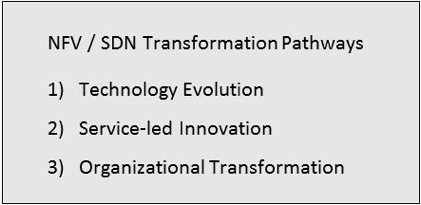
One finding from the service provider research was the emergence of three distinct pathways that you, a service provider, can take for your own NFV/SDN transformation.

You can read more about these pathways (and monsters) from another colleague, Sidney Kriger, in his recent blog.  Note that in your specific journey you will touch all three. One however, will be your primary driver.

In this blog, I focus on 2) Service-led Innovation.   Another way to think about this one is: be customer–focused!   What do your customers value and will pay for? Deploying your services to meet your customers’ needs will guide you along a good path of NFV/SDN transformation. And you don’t even need to mention SDN and NFV to your customers. Let’s take a quick look at some findings from the service provider study.

In addition to being customer-focused, the research report recommended developing a more cloud-like commercial model.  The underlying technology is still important in delivering that which your customers want, but it becomes secondary in the process.

With regard to new services, the providers surveyed are mostly exploring two services areas as their first foray into virtualized services:

1. 79% are either exploring or have launched a vCPE-based service.

2. 57% are either exploring or have launched an SD-WAN service.

This perhaps is not a surprise, because it makes sense to explore new services that let you use the expertise you developed for your existing services, such as VPN and managed CPE.   The two services above are also very much in the minds of business IT folk who want more from their WAN services – improved security, improved application performance and, of course, reduced costs.

While the above two services emerge as favorites, only 14% of the surveyed providers, have launched both of them.   Many are still in the exploratory stages.  You are not too late if starting now!

When launching these new services, providers typically provide a new customer proposition such as greater flexibility or IT agility.   For some markets, where solutions are less well established, providers have started at a basic entry level, which lowers costs for both provider and business customer.

A couple of important points that the report makes:

1. Service providers are typically relying on partners to speed entry for new services and secure market acceptance of them.

2. The drive to new services may be from a strategic initiative rather than via an extensive business case process.

Of course, there is a lot more to the report than my little snippets above.  Look out for more blogs in this series from my colleagues who will address other aspects in the report such as the other pathways described, the challenges that service providers face and overcoming them.

Meanwhile, find out for yourself when you download the report.

Wishing you much success in your NFV/SDN journey and as you delight your customers!

Authors

Wayne Cullen

Senior Manager, Service Provider Architectures

Avatar

Service provider networks are at the epicenter of digitization, affecting how businesses and entire industries will operate for years to come.  Today it seems as if every disruptive new business model shaking up an industry is reliant on the innovative use of applications based on network services. The sharing economy of Airbnb, Uber and AWS. Connected experiences and entertainment with Netflix, Pokemon Go and Peloton. Connected and driverless cars. Etailers. Business apps and data centers as services in the cloud. Examples abound.

Customer expectations are rising as industries are being transformed. That puts constant pressure on companies to keep innovating. And while communication service providers are the conduit for digitization, you too must transform yourselves and continue to innovate. Like the Darwinian theory of evolution sped up, you need to adopt the most favorable traits to survive and thrive.

  • The Need for Speed ― Time has become a key differentiator in your business. What’s needed is not only fast service delivery but fast service creation, changes and takedown. Spending a year or more to create and deploy a new service is not competitive. You need to measure time-to-market in hours instead of months. Some opportunities are short-term; without agility you’re out of the race.
  • Efficiency is Destiny ― Complexity is not your friend. It’s understandable that most operators have over time evolved a patchwork quilt of siloed, inflexible infrastructure and various ways of managing it that rely heavily on manual processes and the expertise of key personnel. But that’s no longer cost-effective or fast enough. Some estimates claim that for every dollar you spend in CapEx, $7 in OpEx is required. It’s time to switch to a newer, simpler paradigm.
  • Reach out to new Partners ― Disruptive companies are innovating. You must too. With the Internet of Things (IoT), 5G, video and cloud, there are numerous applications and markets that have yet to be addressed. Others are being conceived every day. You can no longer rely on outbound and inbound marketing alone for new customers. You need a more expansive strategy for growth. Why not create an ecosystem of partners―like developers, device manufacturers, vertical market innovators, content providers, and even other operators―to help you uncover new markets and opportunities?
  • Become Security Obsessed ― Your customers want it. It’s non-negotiable. Embrace security for services and data that is pervasive. Strive to become so good at it that you can offer security services to your enterprise customers on a consulting or subscription basis.

Transformational Components 

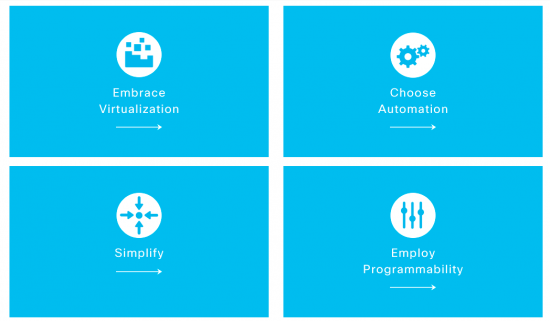
There’s a global consensus within the industry on how service providers can gain the traits listed above. You must embrace virtualization, automation, simplification and programmability for your foundational networks. Each contributes to a much better services environment that is prepared to handle the tremendous challenges and opportunities coming with pervasive digitization.

Virtualization adds speed, efficiency and a lower cost structure. You decouple network functions from hardware. You separate the control and user plane functions. Services can be created on-demand and with a lot less hardware, more flexibility and higher utilization of existing infrastructure.

Automation also adds speed and a more innovation-capable environment while reducing complexity and the potential for human error. You deploy faster with orchestration tools. Advanced telemetry and analytics aid you in optimizing the services. Now you’re able to customize the user experience in real-time.

Simplification is possible with this type of network services environment. Your admins don’t require years of technical training and experience anymore. Intuitive interfaces guide their way. Your quest to partner with others and forge new business models and services is simplified when all of those legacy technology silos are converged. A world of new services awaits you.

Programmability gives you real-time control over your network to anticipate problems and provide proactive fixes. It let you configure and reconfigure services, infrastructure and policies on the fly to keep customers satisfied and resources safe. Add data analytics and you have a powerful feedback loop that helps you keep quality of service and reliability high.


Taking Action Now

Like consumers who find reasons to upgrade their smartphones or laptops every few years, a major retooling of the service provider environment is now upon us. It’s being driven by challenges that are not being met by legacy infrastructure and practices. Faster time-to-market has been a challenge. So has operational cost efficiency.  Defining a growth strategy has also been a challenge for many providers while so much about the business is changing. And effectively protecting services and data has also been daunting.

There are solutions for all of these challenges, like those provided by the Cisco Open Network Architecture, which includes everything service providers need to address the requirements of digital business.

As cumulative changes rock our world, there’s no time to wait. As Charles Darwin said, it’s all about survival of the fittest.

Also, note, Cisco is participating at CommunicAsia 2017 where we will be showcasing how our industry leading Open Network Architecture enables network transformation successfully for 5G, Internet-of-Things(IoT) and beyond. Register now if you are at Singapore !!

Authors

Sanjeev Mervana

Vice President of Product Management

Emerging Technologies & Incubation

Avatar

Episode 1: Quality of Service Made Simple

Quality of Service (QoS) is a critical requirement to an optimal user experience on the network. Having the right priority across voice, video, and data traffic can be the difference between a good and great network. Yet ask any networking professional and they will tell you: QoS is tough. It is often expensive, difficult to deploy, and a pain to troubleshoot and update. It is a complex technology that is only becoming more complicated as additional devices and applications are added to the network.

QoS does not need to be this tough. It is at its best when the user doesn’t even notice it. It is one of the most important and pervasively deployed networking technologies because it can make a huge impact on both network performance and employee productivity. QoS may be complex, difficult and time consuming to manage, but it is something all network-reliant businesses need.

Cisco is fundamentally transforming the network through our Digital Network Architecture (you can read about it here). DNA is helping IT departments around the world focus on innovation and transformation, rather than on maintenance. It gives IT the agility it needs to keep up with the speed of change in today’s businesses.

The largest barrier to deploying effective QoS is not the infrastructure itself, but rather the operational complexity of management and configuration. DNA removes this complexity through Cisco EasyQoS. Instead of IT having to understand the inner workings of each networking device and how to prioritize individual applications, they just need to know what applications are important to their business. No more difficult configurations – it is now as simple as choosing which applications are business relevant and letting EasyQoS do the rest.

IT can be transformative given the time and the tools to do so. Cisco DNA and EasyQoS offer both.

Episode one of Cisco’s five-part innovation series, “New Frontiers: IT Innovations in 5 minutes,” will explore the benefits of transforming your network, starting with QoS. In this episode, you’ll meet Tim, who explains what EasyQoS is and how it makes network management simpler and easier, for a much better experience.

Authors

Scott Harrell

Senior Vice President and General Manager

Enterprise Networking Business

Avatar

Any university will tell you that its primary mission is to create opportunities for its students to achieve success. But student success looks quite different today than it has in the past – even as recently as a few years ago.

For starters, artificial intelligence and automation are already beginning to reshape labor markets around the world. As machines become increasingly equipped to perform jobs typically done by humans, new types of jobs will require skill sets that are different from those dominating labor markets today. This will reshape some industries more than others, but no field is immune. It’s estimated that 65 percent of children entering primary school today will work in job types that don’t even exist yet.¹

Somewhat ironically, it’s not technical skills that will best equip our students to thrive in this digital future, but actually those skills considered to be the most human. The blistering pace of technological change we are seeing means that specific technical skills and knowledge have a shelf life. A heavily cited study produced by the World Economic Forum estimates that nearly 50 percent of the subject knowledge acquired in the first year of a four-year technical degree program is already outdated by the time a student graduates.²

The United States’ National Academies of Sciences, Engineering, and Medicine have noted this shift, suggesting that “although encouraging more young people to pursue a college education and acquire the skills needed for service-oriented jobs or for STEM fields makes sense, these efforts will not be sufficient; strategies for strengthening social and other uniquely human skills and enabling flexibility in the face of changing circumstances will likely be important.”³

As Webby Awards founder Tiffany Schlain notes in a new Pew Research Center report, these skills are precisely “the skills specific to human beings that machines and robots cannot do.”⁴

Overriding any specific talent, skill set, or domain of knowledge in importance for those who will succeed in our future world is a single meta-skill – the ability to learn.

With future workers expected to pursue four or five different careers (not just jobs) over the course of their professional lives, they will need, above all, an aptitude for ongoing retraining and retooling.⁵ The National Academies echo this, highlighting three skills crucial to individual success in the future workforce:⁶

  • General adaptability (evidenced by critical thinking and flexibility of learning approach)
  • Capacity for lifelong learning
  • Social skills

Pew Research Center states explicitly that, moving forward, “the best education programs will teach people how to be lifelong learners.”⁷

Our students don’t need specific knowledge or a checklist of skills. What they need first and foremost is the ability to learn flexibly, adaptably, and continuously. They need to become actively engaged in learning, so that they can develop the skills necessary to adapt and evolve on an ongoing basis. They need to learn to think critically. To process and solve complex problems in a variety of disciplines. To collaborate and work together. To communicate effectively.

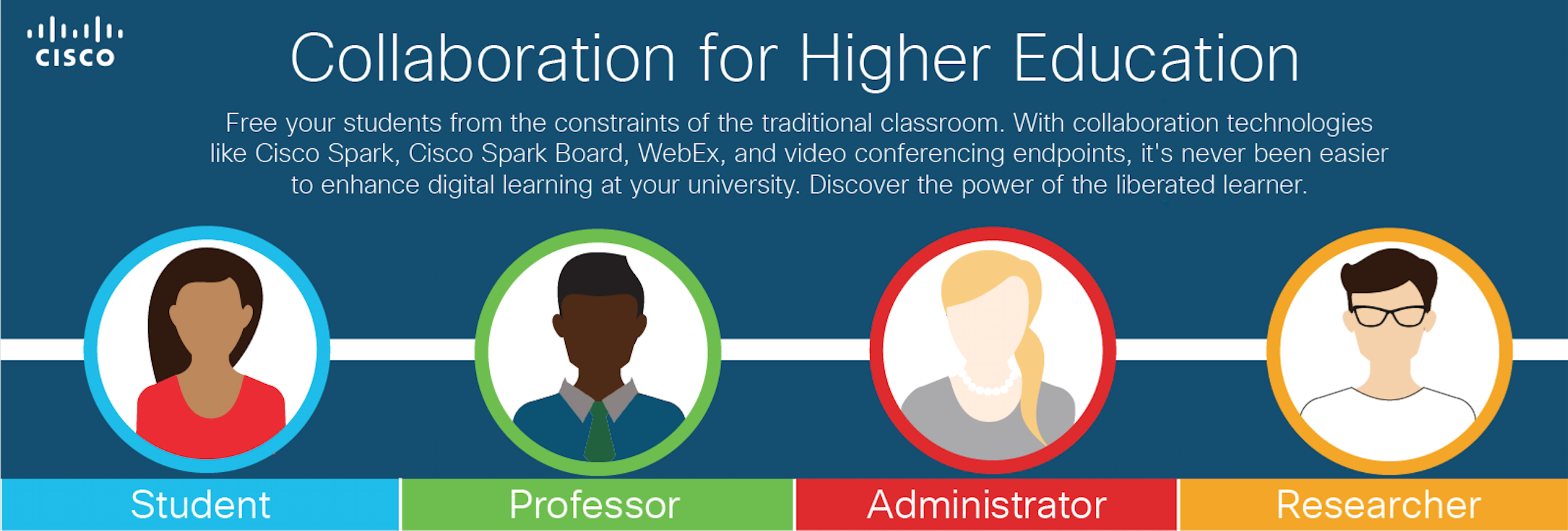
Collaboration tools like Cisco Spark, WebEx, and conferencing endpoints can facilitate the types of instruction, teamwork, and research that help students develop the skills they need to succeed today and in the future.

Take a look at the infographic below to see how Cisco Collaboration technologies free students, professors, administrators, and teachers from the constraints of the traditional classroom.


  1. Annunziata, M. and S. Biller, The Future of Work, GE Discussion Paper, General Electric, 2014 quoted in “The Future of Jobs: Employment, Skills and Workforce Strategy for the Fourth Industrial Revolution,” World Economic Forum, January 2016.
  2. Institut der deutschen Wirtschaft Köln, “The Effects of Digitalization on Employment – First Impressions from the IW Human Resources Panel,” IW-Trends 3/2015 (in German) quoted in “The Future of Jobs: Employment, Skills and Workforce Strategy for the Fourth Industrial Revolution,” World Economic Forum, January 2016, p. 20.
  3. “Information Technology and the U.S. Workforce: Where Are We and Where Do We Go from Here?”, National Academies of Science, Engineering, and Medicine, National Academies Press (Washington, D.C.), p. 114.
  4. Schlain, Tiffany in “The Future of Jobs and Jobs Training,” Pew Research Center, May 2017, p. 13.
  5. “The Future of Jobs and Jobs Training,” Pew Research Center, May 2017, p. 11.
  6. “Information Technology and the U.S. Workforce: Where Are We and Where Do We Go from Here?”, National Academies of Science, Engineering, and Medicine, National Academies Press (Washington, D.C.), p. 110.
  7. “The Future of Jobs and Jobs Training,” Pew Research Center, May 2017, p. 4.

Authors

Rob Lothman

No Longer at Cisco

Avatar

Streams of malicious emails Talos inspects every day usually consist of active spamming campaigns for various ransomware families, phishing campaigns and the common malware family suspects such as banking Trojans and bots..

It is however often more interesting to analyze campaigns smaller in volume as they might contain more interesting malware. A few weeks ago I became interested in just such a campaign with a smaller number of circulating email messages. The email, first of them submitted from Middle East, purports to be coming from a Turkish trading company, which might further indicate the geographic area where the attacks were active.

Analyzing malware is often like solving a puzzle, you have to do it piece by piece to reach the final image. In this case I spent more time analyzing the campaign than I initially planned. The campaign has many stages of the infection chain and all needed to be unraveled before the final payload level was reached. Furthermore, each of the stages used different development platform and was obfuscated in a different way. But let us start from the beginning.

READ MORE>>

Authors

Talos Group

Talos Security Intelligence & Research Group

Avatar

We couldn’t be more proud that the Cisco Spark Board has taken home the “Best of the Best” Red Dot Award. As product designer Torkel Mellingen discussed in his recent post, this award is a clear indicator that we’ve delivered on the promise we sought to make – a well-designed product that users would love to use. Great design is more than skin deep though. A well-designed product isn’t just about how it looks; it is also about how it feels to use it.

A well-designed product isn’t just about how it looks; it is also about how it feels to use it.

To achieve the amazing user experience you get with Cisco Spark Board required us to invest in a lot of technology that you cannot see directly. In many ways, this tech is the brains behind the beauty. There are three technologies that I’d like to call out which make the experience possible: voice track, space binding, and wireless sharing.

Voice Tracking
In traditional video-conferencing systems, high-quality audio is provided through puck microphones installed on the tables or by ceiling-mounted microphones. Both options significantly increase the cost and effort required to bring great collaboration technology everywhere. To combat this, we wanted to find a way to deliver great audio without any external microphones. This may sound simple, but technically it’s very challenging to solve.  This means that all microphones are embedded within the device, yet must pick up the voices that matter (and drown out the sounds that don’t) regardless of where they are in the room.

Our audio engineers worked hard on algorithms to do this, including using machine learning to train the system. The result is the voice tracking capability in the Cisco Spark Board. Voice tracking is a new technology that allows the Cisco Spark Board to “zoom in” on the active speaker in a conference room, picking up just that person’s voice. Background noise and reverberations are reduced so that the active speaker sounds great.

Space Binding
There are many digital whiteboards in the market today. But I think it is safe to say that digital white-boarding has yet to really take off in the workplace. When we looked closer at why that is, we saw that the biggest problem is that people could never figure out how to save the contents of the whiteboard. And even if they could, the number of steps involved made it far more complicated than taking a smartphone photo of the white board. This meant we needed to dramatically simplify the saving experience – taking it down to one click, or ideally zero. Enter space binding!

Space binding refers to the ability to associate the Cisco Spark Board with a Cisco Spark space. This does two things:

  • First, it makes all the content posted in that Cisco Spark space available on the board. Think of this as a physical extension of the Cisco Spark space into the physical world.
  • Second, it provides a digital location where the white board is stored and continuously updated.

Save problem solved! We then went one step further and integrated our Cisco Spark applications and associated cloud services with the Cisco Spark Board, so that the act of making a call or joining a meeting automatically performs a Cisco Spark Space bind for you.

The Cisco Spark app also has a one-click option to enable an explicit association so that you can walk into a room with a Cisco Spark Board and associate to it with a single click. All this development ensures that users can save the white board with zero clicks in many cases, one click in the worst case. (Read more about this in my prior post, “White Boarding in Cisco Spark: Always Yours, Always Live, Always Secure.”) 

Wireless Sharing
The final piece of brains behind the beauty is wireless sharing. Today, most people share their screen locally in a conference room by plugging their PC into the HDMI cable. This is fraught with problems and is a terrible experience. Its only benefit is that it works for anyone in the physical room – whether a company employee or a visiting guest. We wanted to eliminate all these problems by making this technology wireless. But – it still had to work for anyone in the conference room – including non-employees.

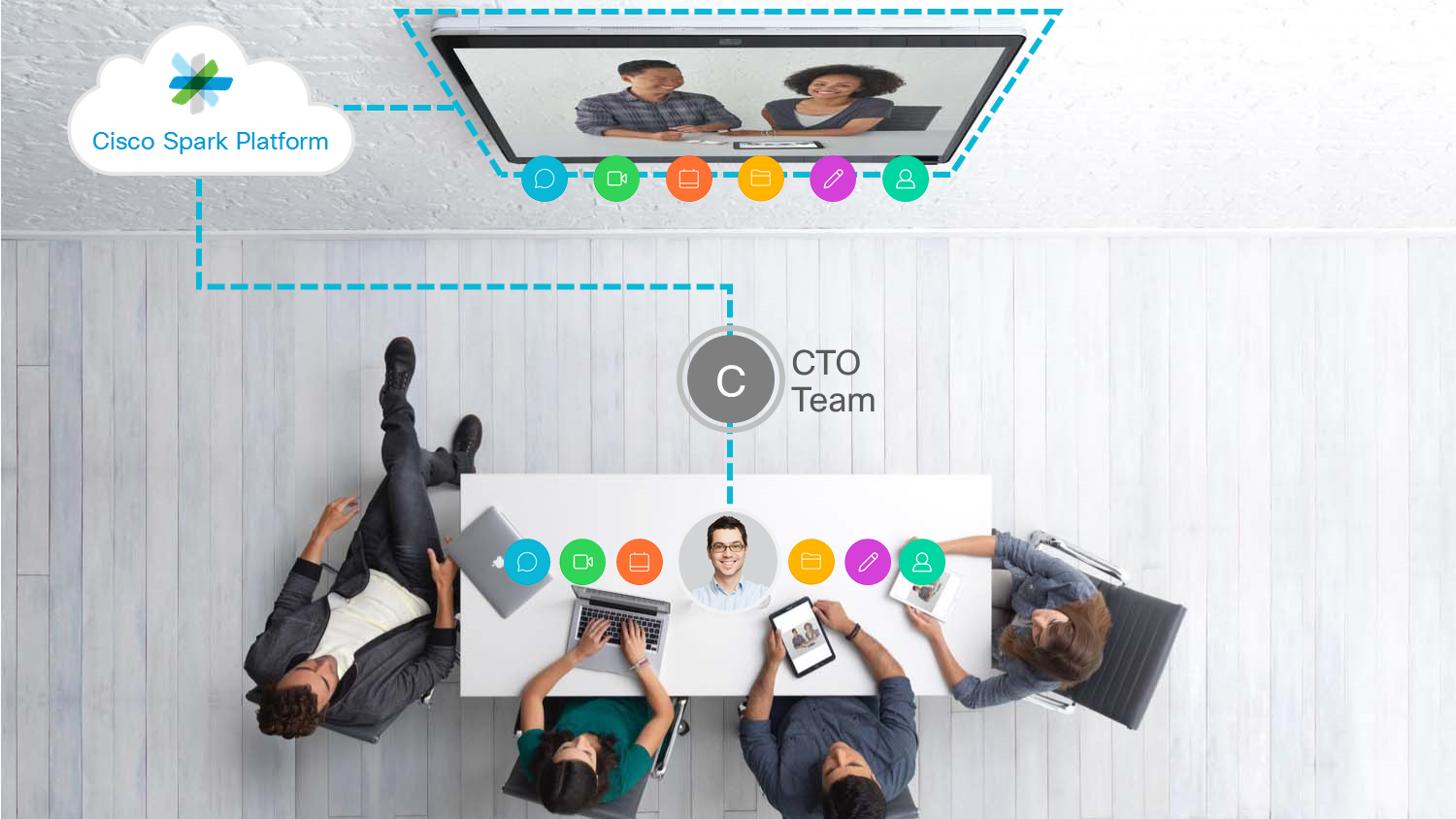
The solution is Cisco Spark’s wireless presentation sharing feature. This technology enables any Cisco Spark user, anywhere in the world, to hit the share button in the application, and present their PC screen onto the Cisco Spark Board – even if the user is on a completely different IP network. We made this magic work by leveraging the Cisco Spark cloud. In fact, when a user shares the screen, we’re basically setting up a meeting between the user and the Cisco Spark Board under the hood, using the cloud as a relay (as we would in any other meeting). This allows the system to work even when users are on totally different networks. Lots of complicated software has to come together to deliver this one-click of simplicity.

These technologies – voice track, space binding, and wireless sharing – are just three examples of the innovation that lies beneath the beauty of the Cisco Spark Board. Exceptional user experiences – magical experiences as my boss Rowan Trollope often says — happen at the intersection of industry leading design and technical innovation. Here, beauty meets brains.

Keep on sparking!

Learn more about the Cisco Spark Board.

Authors

Jonathan Rosenberg

Cisco Fellow and Vice President

CTO for Cisco's Collaboration Business