Most financial institutions today have quite a few branches, spread out across different counties, regions, and even states. Which means different teams in different places—often using different technology. And while each branch has some independence, one of WWT’s banking customers wanted their employees to work together—without having to call IT each time they tried to.
WWT says…
To do that, they needed to rethink their tech approach from start to finish. And they needed solutions that could help their employees collaborate and problem-solve in real time, minus the tech glitches and compatibility failures. They turned to our team at WWT to make it happen.
We’re a Cisco partner and pros at integration and collaboration. We didn’t just want to get our financial customer working with updated software and solutions, we wanted to rethink their entire maturation with technology—with tools that integrate and centralize solutions to simplify teamwork across every branch. We brought in Cisco collaboration technology so that their employees could connect easily, working as one team.
We recognized that new technology often presents challenges. So, we came up with a better way to train the team: a single app where employees can access on-demand training and support, as well as tips for how to use the new collaboration tools.
Today, this financial customer has seen a boost in both adoption and confidence, as employees are already using these tools to make cross-branch collaboration possible. And with easier-to-use tech, IT has a little more breathing room to focus on innovation. And maybe a lunch break too.
Electronic health records (EHR) are one of the most critical applications for many healthcare organizations. But having an EHR is one thing, making sure your EHR and other applications works for your healthcare organization, another.
New advancements in digital healthcare innovation – EHR, BYOD, IoT, Big Data to name a few – are driving increasing demand for computational power. To ensure safe, quality care and better workflows, it is critical these run without interruption.
Cisco Data Center solutions make it possible to deploy and run these mission-critical healthcare applications and workloads – quickly, securely, and reliably – even across the multicloud domain. By enabling hybrid IT transformation, you can:
With an architecture that constantly adapts and protects, healthcare organizations can now benefit from an infrastructure that is flexible, reliable, and secure.
Learn more about how Cisco Data Center solutions can help you ignite healthcare innovation at your organization.
This blog post is authored by James Spadaro of Cisco ASIG and Lilith Wyatt of Cisco Talos.
Imagine a scenario where you, as a vulnerability researcher, are tasked with auditing a network application to identify vulnerabilities. By itself, the task may not seem too daunting until you learn of a couple conditions and constraints: you have very little information to work off of on how the network applications operates, how the protocols work, and you have a limited amount of time to conduct your evaluation. What do you do?
In these scenarios, searching for and identifying vulnerabilities in network applications can be a monumental task. Fuzzing is one testing method that researchers may use in these cases to test software and find vulnerabilities in an efficient manner. However, the question that then comes up is how does one fuzz quickly and effectively?
Enter the Mutiny Fuzzing Framework and the Decept Proxy.
Get access to the latest Cisco innovations through an easy-to-use subscription bundle
Explaining the complexity of digital transformation is actually pretty simple: organizations need the latest technology to function at the highest possible level and stay competitive.
Sounds easy enough, right? However, addressing digital transformation can quickly become challenging and convoluted when weighing various business priorities, budget restrictions, and the accelerating rate of technology updates.
We saw our partners struggle with these challenges and decided that a simple solution would be the best way to address this complex problem. We created Easy Pay to make digital transformation as easy as possible and help solve many of the underlying capital expenditure challenges organizations face when acquiring new technology.
With Easy Pay, partners and customers can spread out the cost of hardware over three years, interest-free, with predictable monthly payments and no upfront costs. They pay 90% of the cost at 0% interest over 36 months and then decide whether to refresh their installed base having only paid 90% or pay the remaining 10% (with no interest added) and keep it. Through this tailored, transparent and flexible payment solution, partners can now give customers access to the latest technology while limiting up-front capital investment with a payment plan that aligns to milestones achieved throughout a digital transformation. By aligning payments to revenue or cost saving streams, for example, partners can help customers preserve cash by avoiding up front capital outlays previously required when paying for the full cost of a solution up-front.
With Cisco Easy Pay, organizations of all types and sizes can integrate financial agility into the core of their digital transformation strategy – while saving cash. Easy Pay offers customers a simple way to have ongoing access to the latest Cisco innovations such as security, collaboration and Meraki. In addition, it means no cash flow or currency fluctuation risks for the partner.
Equipping a global team with the tools to succeed
NRB, an IT solutions provider and Cisco Partner, provides an example of how partners can use Easy Pay and apply their learnings to help customers. NRB was faced with a challenge; they needed to extend their cloud computing services (in an effort to scale) while also minimizing the financial risk that this entailed. They wanted the best of both worlds – to grow without exposing their organization to the dangers of growth investment.
Easy Pay helped NRB get exactly what they wanted. By approaching their investment strategically, NRB realized they could bill their cloud-managed service on a monthly basis and use Easy Pay to align payments to the service delivery model. This gives NRB a predictable cost model and helps them price their offerings more competitively – ultimately helping satisfy the needs of their customers.
NRB was able to save money by not having to finance the cost of their offering over the term of the contract.
NRB turned a reactive financial plan into a proactive financial strategy that both preserved cash while opening up new technological flexibility for both their clients and their internal organization.
From a strategic perspective, NRB championed a financial tactic that ultimately morphed into a top-down organizational strategy. NRB’s team illustrates technological investment no longer needs to cause headaches as another outright cost, but instead can lead to dynamic strategic change.
Conclusion
The world is changing fast and, now more than ever, businesses need access to the latest technology to remain agile and stay in front of these changes. Similar to other consumer-focused subscription-model services, Easy Pay reduces upfront costs to zero and replaces these costs with monthly payments. It is all about keeping you, our partners, happy and growing your organizations.
With these principles in mind, digital transformation does not need to be difficult. In fact, we think we can help you transform your organizations much more easily.
Visit www.cisco.com to learn more or contact your account manager or partner representative to see how you can finance your Cisco technology.
He’s an ultra-marathoner, a highly respected tech industry reporter, and an angel investor (he’s not at all fond of that last label for its sheer pretentiousness, but I can’t think of any other way to describe what he does). He works a lot, but doesn’t really work for anyone—except himself. All of which makes Ben Kepes an unusual, and unusually valuable, voice in the tech space. He can speak the truth—as he sees it—without worrying about angering an investor, his employer, or anyone else. And he’s not a mysterious oracle making pronouncements from a remote hilltop. The man traveled 350,000 miles by air this year alone to attend (and often speak at) all of the important industry conferences, a lot of the less well-known ones. He invests tremendous time learning about the latest innovations and speaking with the innovators themselves. Bottom line: He’s more than well-informed when it comes to cloud—he’s got a breadth and depth of insight you could argue most people will never have the time or resources to develop. And this week he joined us to share some of what he sees on Cloud Unfiltered. Among other things, he explains why:
He ran 100 miles last weekend
OpenStack is not dead
The OpenStack Foundation is abandoning the Big Tent concept
Serverless computing is on its way to becoming the new hotness
We ignore eastern tech vendors at our peril
See the video podcast on our YouTube page, or listen to the audio version on iTunes. And if you like what you hear, we invite you to subscribe to our channel so you don’t miss any of the other exciting podcasts we have scheduled over the next several months.
Written by Craig Pasek, Product Manager, Transceiver Modules Group, Cisco
With the massive increase in demand for data, equipment providers are responding with 25Gbps edge devices that require more bandwidth than can be provided on a traditional 10Gbps interface. Whether it’s a server or a campus backbone, high speed data needs to be delivered cost-effectively in a small and low-power package.
In these bandwidth-intensive applications, the choice to go with 25G is clear. To get the same or better bandwidth, the number of 10G interfaces must be 3x (6x for redundancy) or the application needs to move to the larger, more expensive and power-hungry 40G QSFP.
SFP28: For 25G the dominant form factor is SFP28. The SFP28 standard relies on the 10G SFP+ (Small Form Factor Pluggable) standard for mechanical specifications, and the electrical specifications have been improved from one 10Gbps lane that operates at 10.312Gbps to one 28Gbps lane that operates at 25Gbps + error correction. 25G transceivers can be plugged into SFP+ sockets and 10G transceivers can be plugged into SFP28 sockets because they have the same electrical and mechanical pin-out, however the associated host needs to have the software support for associated devices.
These 25G devices are plugged into Cisco’s data center, campus and service provider switches and routers to provide high speed 25Gbps connectivity. See Cisco’s 25G compatibility matrix for currently supported devices .
Why DAC?
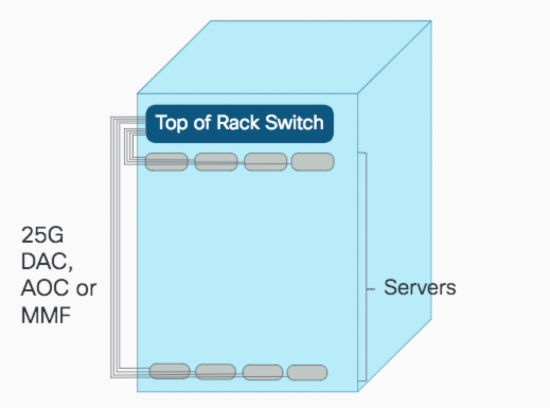
25G DACs are generally used in data center applications and provide the lowest cost fixed length interconnect for TOR (Top of Rack) switches to high-performance servers. Depending upon the bandwidth and distance, DACs can be either passive or active and are generally based on Twin-AX cable. For 25G, DACs can generally operate up to 5 meters without active components in the data path. Up to 2 meters, no FEC (Forward Error Correction) is needed. For 3 meters FC-FEC (Fire Code Forward Error Correction) is needed, and for 5 meters RS-FEC (Reed Solomon Forward Error Correction) is needed to correct errors. Generally, at 25Gbps beyond 5 meters, active components are needed in the data path to amplify and correct the signal. These components drive up cost which causes network designers to consider optical interfaces.
Why AOC?
25G AOCs also provide a cost effect solution for those same data center applications that require longer distances than 5m. Generally, AOCs are provided in standard lengths of 1m, 2m, 3m, 5m and 10m. However, they are usually limited to about 25 meters because of inventory stock and slack storage issues. Often a data center will be wired with only AOCs for consistency reasons, instead of a combination of AOCs and DACs.
Why SR?
25G-SR is used with standard OM3 or OM4 multimode fiber and is suitable for:
• Data centers that require up 100 meters over OM4 fiber or 70 meters over OM3 fiber for interconnect between TOR switches and leaf or spine switches.
• Breakout configurations in conjunction with 100G-SR4 transceivers where the distances are less than 100 meters for OM4 fiber or 70 meters for OM3 fiber.
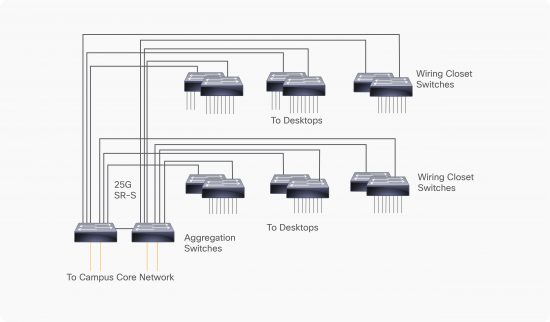
• Campus backbones, where the distances between distribution and aggregation switches are less than 100 meters for OM4 fiber or 70 meters for OM3 fiber.
Learn more about how Cisco’s 25G transceiver products are transforming the industry here .
I’ve never told this story before. I was set to join Cisco in July 2000. However, I had scheduled a vacation the week prior to joining the company. On the very first day of my vacation – actually, the first hour – I answered the phone in my hotel room, and the Chief Counsel of Cisco informed me that my to-be manager had just resigned from the company. The voice on the phone asked if I wanted to stay at Cisco.
In a moment that lasted just a few seconds, but has led to 18 years at this amazing company, I simply said, “of course.” I trusted my instinct in the moment that I had made a decision to work for a company, not a person.
Over the next seven days, I wondered if trusting my gut was a good idea, because I never bothered to ask who my manager would be, what I would be doing, or what I should be excited about.
Little did I know how I was about to be given an opportunity to build an entirely new career. It’s a well-known management mantra that individuals are ultimately responsible for their own careers; but companies have to do their part, too. Organizations need to create space for individuals to express their strengths and mold those unique attributes into meaningful roles within a company.
I’ve come to the conclusion that careers are managed by individuals, but powered by companies.
Want to work for a company that enables you to grow? We’re hiring!
When I got to work on Monday after my vacation, I had one meeting on my calendar: a 1:1 with then-CEO John Chambers. In his back office, John offered me a job. He told me how obsessed he was with getting the company to execute faster. He was convinced a new model was coming, likely from China. He also told me that the only things keeping us from going faster were people and organizational structures. He was convinced that communications could be a process for change management to drive greater transparency, speed, and responsiveness in the company, and he thought my communications background would make me the ideal person to lead this effort for him.
Here is how the conversation went:
Ron: What will I do?
John: You’ll have to figure it out.
Ron: How will you measure my success?
John: My direct reports will tell me you’re doing a good job.
I left his office agreeing to do the job.
Over the next decade, I worked with John to identify blind spots in how he worked with his team, and see if communications techniques could close those seams. I’d like to think my team helped Cisco work a little bit better together. 😀
The artifacts of this work are still found inside Cisco today: the obsession with common vocabulary; the executive communications function; the use of two-way virtual leadership meetings – like what we see with The Cisco Beat (our virtual all employee monthly meeting).
What I loved about my time in this role is that I got to express my own point of view about what to do. We invented and failed a lot. Cisco gives its employees the “space” to express their strengths, and fail forward.
John also told me, “Luck comes to those who are prepared.” So I got lucky when our then-president Gary Moore asked me if I’d like to join the sales organization. This is one of the benefits of working in a large, F100 company. Suddenly I went from working with our CEO to working with the account managers and systems engineers of the field.
Moving into sales has probably been the most important “moment that matters” for me at Cisco – because I’m now leading a team that is operations-oriented, and I genuinely believe it’s the best job I’ve ever had. I’ve learned things here I didn’t even realize I needed to know – like the day our now-CEO Chuck Robbins explained to me the difference between a fixed asset and a flexible asset.
I’ve met with half the Global 500 in this role over the past five years. I know more now about Cisco’s portfolio than I ever thought I would. I’ve learned how to lead a team of engineers. Best of all, I’ve had this opportunity without having to change who I am. My strengths are my strengths – and I’ve applied those same unique attributes of mine in my sales role as I did in my role with John.
When John Chambers announced he was retiring from Cisco, I smiled inside for him – and I smiled for every Cisco employee. John always said Cisco’s culture should “treat people the way you’d like to be treated yourself.” I know first-hand that a giant company can indeed care about every single employee’s health and any special needs for their families because I’ve seen that here at Cisco.
I don’t know if this is my last job at Cisco. What I do know is this: as long as I can remain authentic and my company gives me space to express myself (goals every single Cisco employee should have), I’m confident that the gut I trusted 18 years ago about this company will remain true for me and for all of us who work here.
12/21/17 Update: Pleased to announce that we have completed the acquisition of Cmpute.io. Welcome to Cisco!
More and more businesses are moving workloads to private and public clouds — and often to multiple public cloud providers — in order to gain more flexibility and agility. However, managing this multicloud environment can create complexity for IT and make it challenging to manage costs and uncontrolled consumption.
To help our customers optimize the consumption of cloud resources in this more complex reality and control cloud spending, Cisco is announcing our intent to acquire Cmpute.io, also known as 47Line Technologies. Cmpute.io is a privately held company operating in Bangalore, India, and incorporated in Delaware.
Cmpute.io’s software solution analyzes cloud-deployed workloads and consumption patterns, and identifies cost-optimization strategies. The solution helps customers right-size their cloud workload instances, minimize overprovisioning, and avoid paying for resources that don’t deliver business value.
With a multicloud strategy, customers need to budget, buy, and consume differently. Cmpute.io’s technology added to existing Cisco solutions will help our customers optimize their cloud consumption to ensure optimal business value.
Cmpute.io’s team and technology will add new capabilities to Cisco CloudCenter and accelerate our delivery of cost-optimization features for our customers.
We expect the acquisition of Cmpute.io to close in the second quarter of Cisco’s fiscal year 2018.
What’s more important, the destination or the journey? If you have time and energy for meandering, then by all means throw out the map and take the road less traveled. But, if you’re a customer seeking help, arriving at an end point quickly and easily is your ultimate goal. While no journey is ever completely linear, too many unnecessary stops and misdirections can be painful and severely impact customer experience.
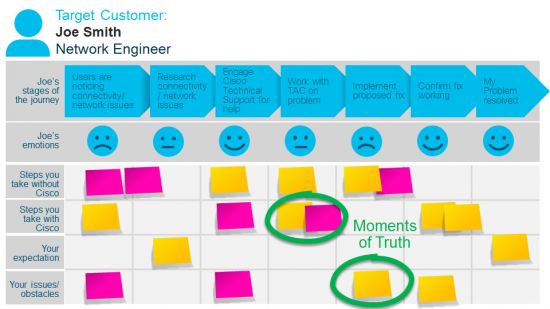
A challenge for us in Cisco Services is that we don’t always know when and where customers get lost or if they’re going in circles trying to navigate our systems and online support. Surveys are great for one-way listening and gathering feedback. But, to really understand what customers encounter when they engage with us, we have to travel with them. We do this by journey mapping, where we walk end-to-end with the customer from their first encounter of a technical issue to having an online interaction with Cisco all the way through to issue resolution.
Tracking each stage of the journey and documenting customer interactions with people and functions helps us identify weak and strong points and any obstacles that prevent transitioning to the next step. We also do an emotional check to see how customers are feeling along the way to fully understand expectations and areas where we may be under delivering.
Kurtis Yang, Senior Director of Customer Experience for Cisco Services heads up the team leading our journey map initiative and over the past 18+ months they’ve engaged with more than 200 customers and partners all around the world. Journey mapping is a time intensive exercise, and we truly appreciate our customers’ participation. We also want to make it worth their while by implementing process and behavioral improvements based on their feedback. I’ve asked Kurtis to share a few highlights about what we’ve learned and done as a result.
Guest author: Kurtis Yang, Senior Director of Customer Experience, Cisco Services
For Cisco Services, journey maps are a critical component of our customer understanding strategy. They serve as an outside-in tool to listen, truly understand, and learn from the customer and partner point of view. The maps provide an end-to-end view of a customer’s experience with Cisco and help us see that experience holistically, instead of in silos or channels.
Journey mapping allows us to go beyond the boundaries of standard surveys to gain unfiltered insights and connect with customers in real time through in-depth conversations. During these interactive discussions, we use sticky notes and markers to create a visual representation of the steps, interaction points, and emotional states that a customer goes through over a period of time to accomplish a specific goal with Cisco.
To date, we’ve explored journeys related to Solutions Support Delivery, Proactive Device Diagnostics, RMA, and General Technical Services Support Delivery. Based on roadblocks and pain points uncovered during the mapping exercises, we have several improvements underway.
Customers told us that opening an online request for services support is not always easy, so we’re reimagining the entire experience. Currently in pilot phase, our goal is to drastically simplify the process by reducing touch points and requests for repetitive input, and ensuring customers gain access to support as quickly as possible to resolve their network issues.
We also learned of instances where being a diverse global business can lead to communication barriers in our support centers and cause unnecessary frustration at times for our customers. In response, we’ve initiated a program to increase consistency in language standards across geographies. This will ensure our support centers speak the same business language and deliver a more seamless customer experience.
Finally, the last and most important part of journey mapping is identifying the “Moments of Truth,” which are determined by asking our customers to call out areas where Cisco has to get it right, and areas where Cisco must improve in order for them to accomplish their goals. We then elevate and prioritize these areas internally to ensure that we improve what YOU, our valued customers and partners, feel is most important.
If you’re interested in becoming part of our engagement program for future journey mapping discussions, early prototype projects, or pilot design reviews, please reach out to us at ciscoservices-cx@cisco.com. We welcome the opportunity to partner with you to better understand your journey with Cisco Services and the areas that truly matter – our goal is to enable your business success and we look forward to supporting you better in the future.














 Why AOC?