We are proud and honored to have the Cisco Catalyst 9000 family of switches recognized as CRNs 2017 Overall Network Product of the Year.
Every year CRN awards “Product of the Year” for a variety IT-related technology categories specifically looking for products that solve important problems for customers. Those products are then evaluated by over 4,000 judges on how the products rate on technology, revenue and profit opportunities, and customer demand.
While being selected as a top five finalist among the 20 IT technologies categories is an honor in itself, we feel truly grateful to receive the highest award as overall 2017 Network Product of the Year!
Catalyst 9000 switches are designed to be part of an intuitive network that can recognize intent, mitigate threats through segmentation and encryption, and learn and change over time. As a key foundational element of the Cisco Digital Network Architecture, Software-Defined Access and Encrypted Traffic Analytics (ETA – also chosen as a 2017 CRN Finalist), Catalyst 9000 switches can operate as part of one fabric, for faster, more secure network access. No more constant cutting, pasting and tweaking switch by switch. Create once, apply network-wide using cross domain policy enforcement and automation.
This award reinforces our vision of a new era in networking and recognizes the potential that Catalyst 9000 switches can unlock providing greater monetization opportunities, while enhancing security, business agility and operational efficiencies.
As a leader at Cisco in the virtual sales space, I have a front row seat to the fast pace of disruption and change that is hitting the industry. Digital disruption is one of the most often used phrases in business over the last couple of years. And rightly so, because the disruption is real.
It is hard to think of an industry that has not been changed by the unstoppable march of technology. Brand new business models have emerged. Decades old companies have been left behind or failed spectacularly because they missed the market transition or were unable to keep up with fast pace of change.
Technology is playing such a pivotal role in commerce and society, and is showing no signs of abating. In fact, today’s version of the industrial tech revolution sees the rise of machines and the impact of automation and artificial intelligence. It makes me think about how digitization, AI and the data tsunami is impacting the role of sales?
Changes are happening quickly and the business of sales has not been immune to the impact of digitization. There are millions of people who make their living in sales, and in the IT industry alone, the dazzling array of new technologies means the role of the sales person is probably more critical than ever. The customer will always need help to decode things and navigate complexity. However, things are changing. An abundance of online content means that anywhere north of 70% of all B2B sales cycles start online with research and comparison before a sales person is in any way engaged by the potential buyer. This puts power into the hands of the customer, who is now more informed than ever.
There is an upside for the seller in all of this. If information is everywhere, so are the customer’s digital footprints. The ability to profile your prospect’s company, their individual interests and issues is now possible. You can track what prospects are looking at on your website, and which competitor they are engaging with. By overlaying this information with available data relating to purchase history you can identify refresh or cross-sell opportunities. These data-led insights are like magic and if you use them correctly it can accelerate the sales process. In the near future, qualification and pre-sales will get even easier and faster via AI.
Having the right tools in place and using data to its full capability in a surgical way can curate rich insights about your customer over time.
Digitization has made our life easier in so many ways, information and commerce is at your fingertips every day every moment. What does that mean? It means we want solutions right away. Instant results. Making buying easier is a requirement these days. Ecommerce is not a new concept but its impact in B2B markets is transformational. Why do you need to speak to someone to buy a standard SaaS solution when you can purchase it on your credit card for a small monthly fee? Increasing numbers of low touch sales will happen without a customer ever having to talk to a human being. Virtual contact will become more and more the norm. In fact, Gartner predicts that by 2020, 85% of all B2B customer engagement will happen virtually. It’s up to IT vendors to fully enable that.
So if these are the main requirements that will determine success in the era of digital, who is doing it well today?
This is where millennials are winning hands down. Digital natives are comfortable with adapting new technologies and tools to help sell. Keeping up with the constant change feeds into their insatiable curiosity to learn and further develop themselves. Trying out new ways to sell and making things simple is second nature. The virtual sellers at Cisco are reacting intuitively and leveraging the blueprint described above. The reality is that the future sales force is already here and it is flourishing. That means that digital disruption has now morphed into digital empowerment, and that is great news for everyone. The opportunities are endless, so fasten your seat belts; it’s going to be an action-packed ride!
I would love to hear your thoughts on the future of sales. What features do you think are most critical?
New Cisco Threat Grid dashboard yields faster malware analysis and response
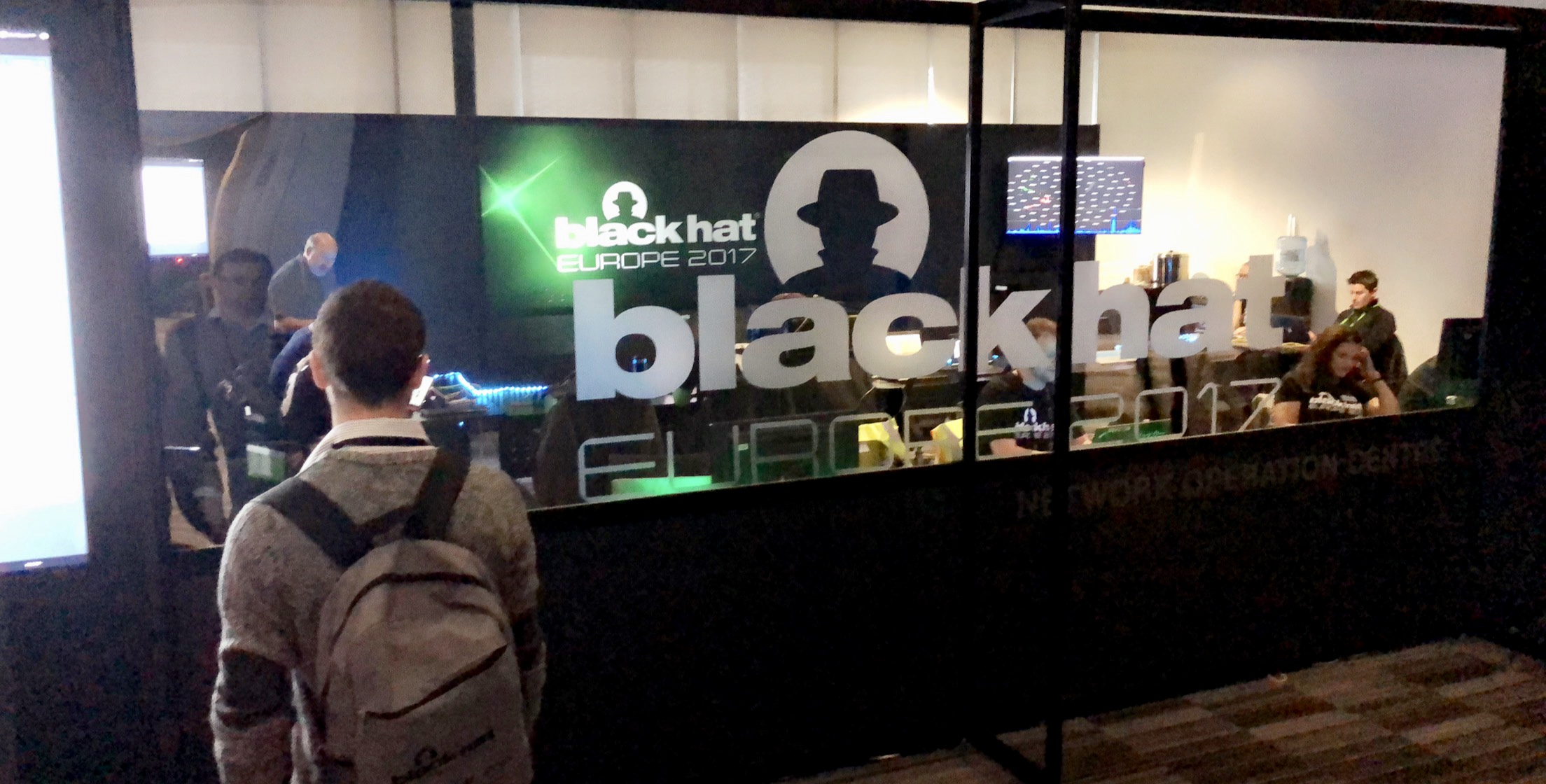
Black Hat Europe kicked off just after the X Factor series finale was recorded live at the London ExCel Center, briefly mixing the Network Operations Centre (NOC) and Security Operations Centre (SOC) staff with hordes of teenaged fans. A few team members confessed to knowing who won the next day. 🙂
The NOC team quickly deployed a secure wireless network for the conference, with Ruckus providing the access points; while the SOC team set up security to protect the network from attacks and provide deeper visibility; Palo Alto Networks on the firewalls and RSA NetWitness 11 on identity and network forensics. New in the NOC/SOC this conference was the recently released Threat Grid Dashboard and Sample Manager.
New Threat Grid Dashboard
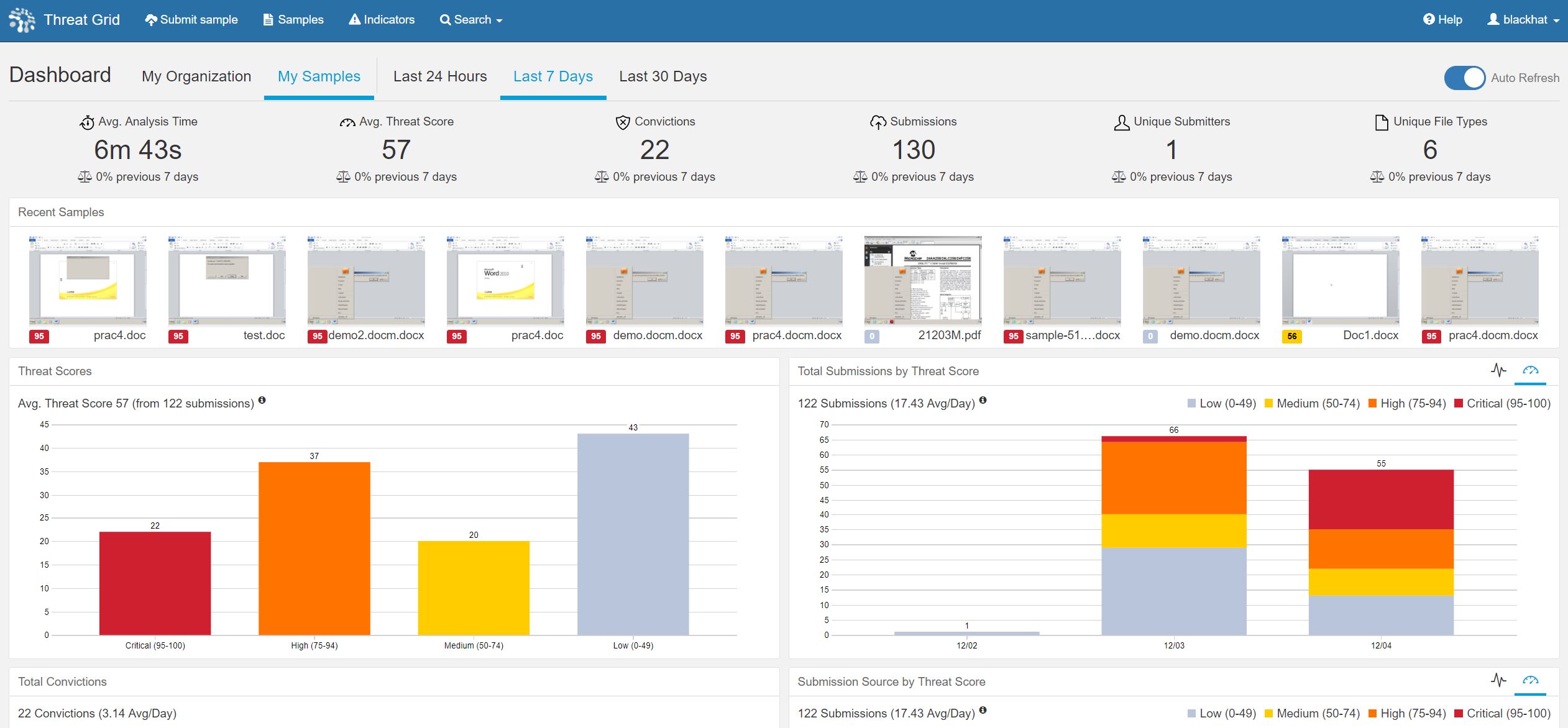
The redesigned dashboard made the malware analysis and response in the SOC so much more efficient than past conferences. The dashboard displays aggregated analysis data through a metrics bar and multiple, user configurable interactive visualizations.
The dashboard can be one-click configured to view My Organization or My Samples by the last 24 hours, last 7 days and last 30 days. An Auto Refresh control pulls the latest data, which we enabled for the SOC, along with the last seven days to have visibility for the entire conference.
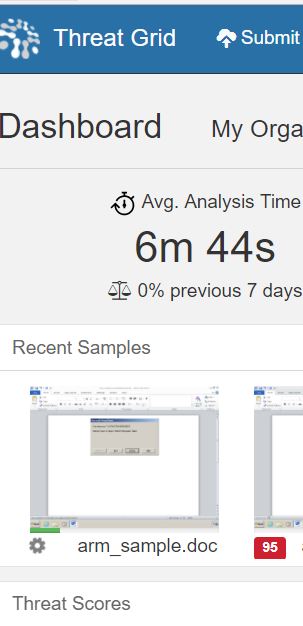
A really helpful addition in the SOC was the Recent Samples section, which showed animated thumbnails of running samples. We could see immediately when training classes were pulling down malicious files, like document files exploiting VBA.
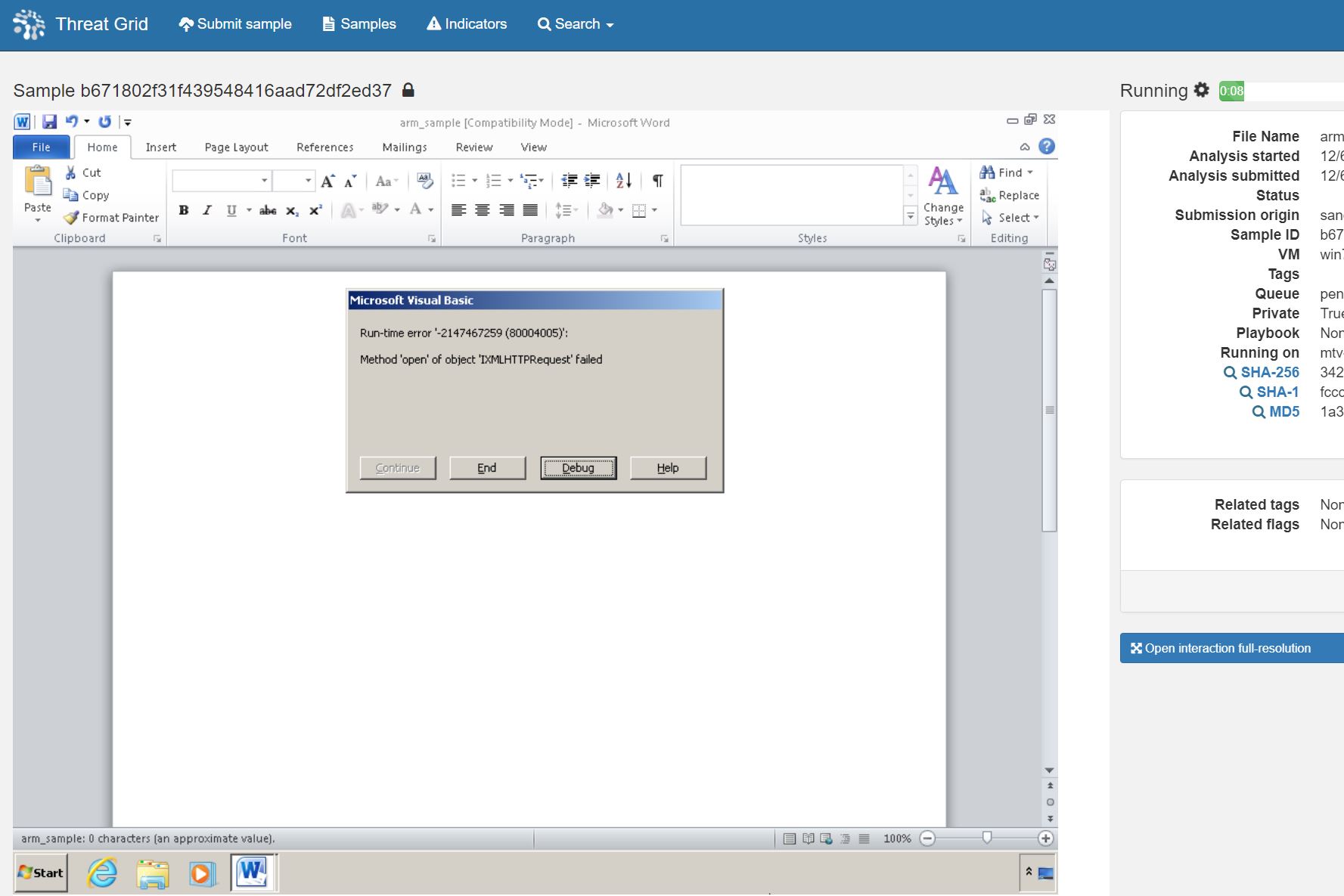
The thumbnail allowed us to see Word loading to launch the documents, as well as any pop-ups. Clicking on the thumbnail while the sample is running gave us accesses the unique Interact with Running Sample feature, also known as Glove Box.
Inside the Glove Box, we could interact with the sample, work with popups, browse to webpages, reboot the machine, etc.
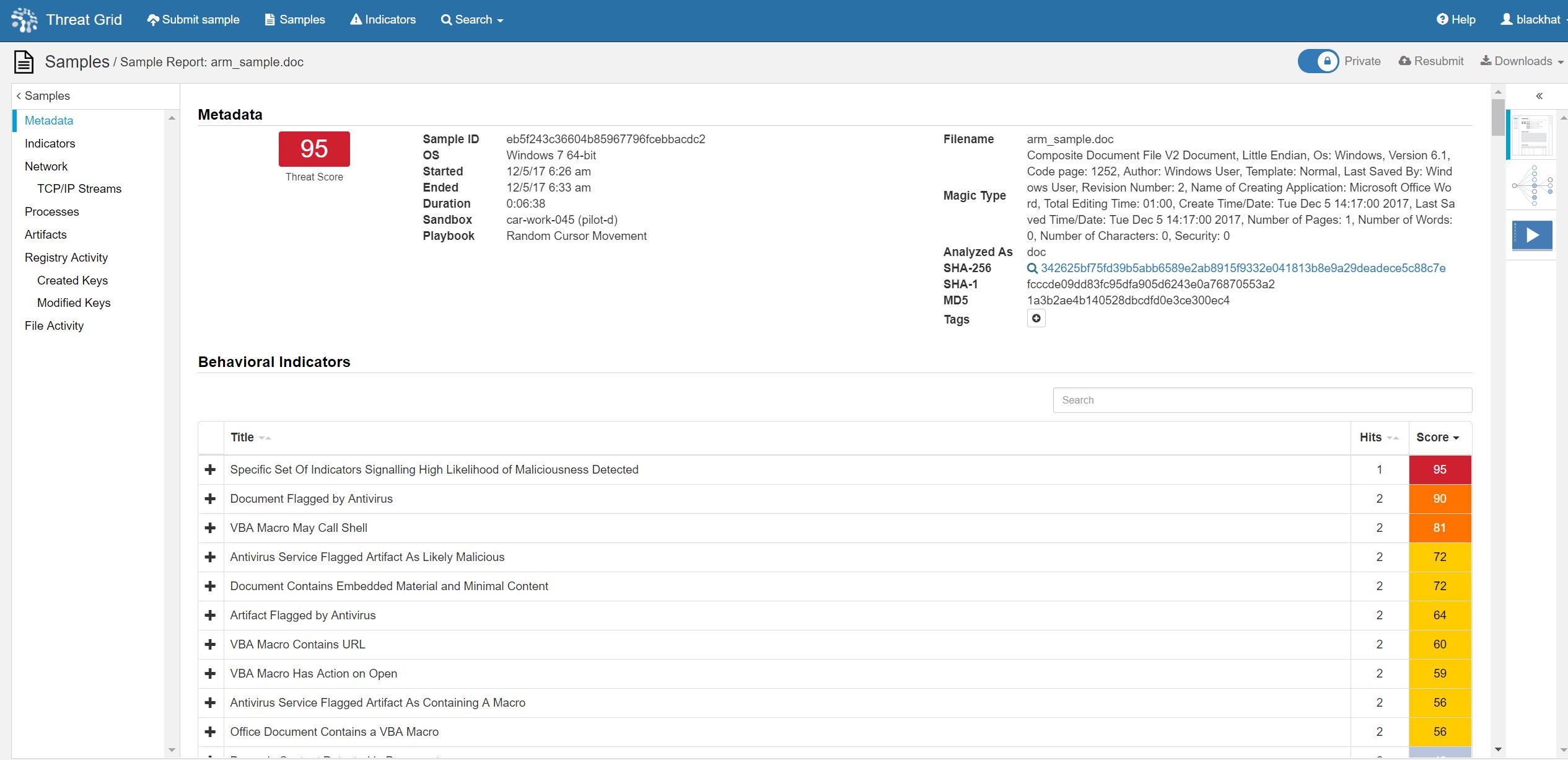
When the sample is finished running, the analysis report will automatically display if you are still in the Glove Box. If you are still in the Dashboard, when the Threat Score displays beneath the thumbnail, clicking on it will open the analysis report instead of the Glove Box.
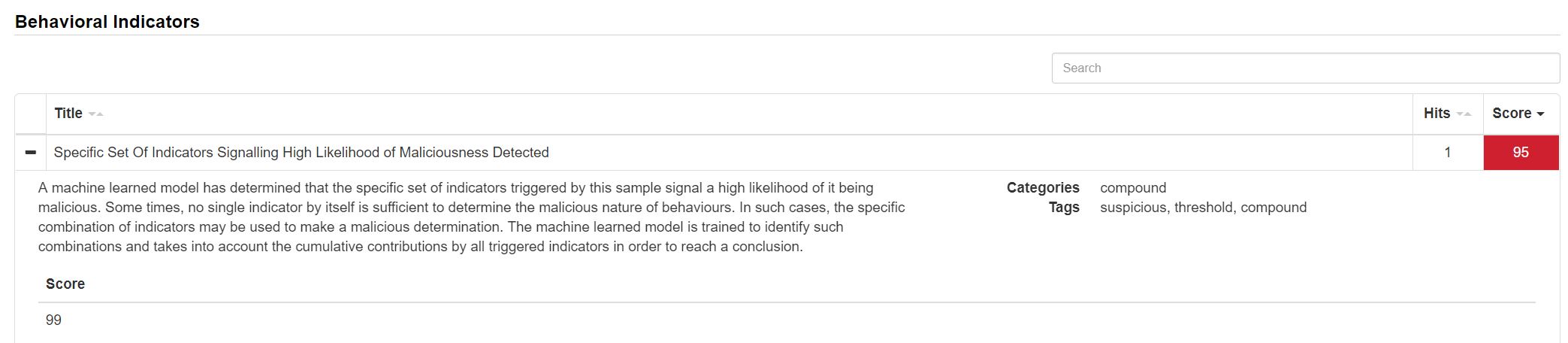
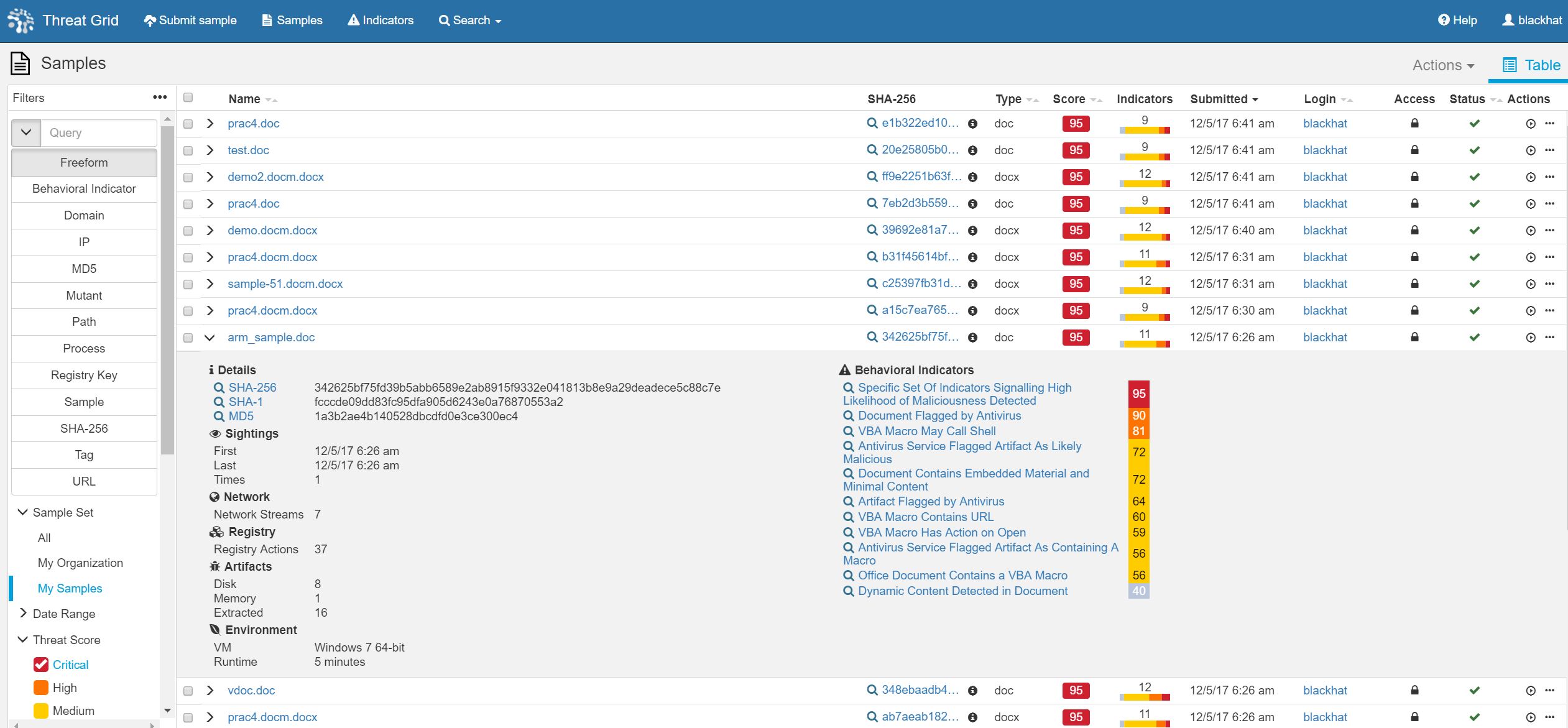
In this case, the document was flagged by our integrated anti-virus partners, raising the Threat Score to 90, High score, but not enough for a conviction for the purposes of automated remediation with the Integrated Threat Defense of the Cisco Advance Malware Protection security architecture. However, the Cisco Research and Efficacy Team built a machine learning model for when a single Behavioral Indicator does not reach the automated conviction level of 95+. It goes deeper and looks at combinations of Behavioral Indicators to make a malicious determination. This is called Specific Set Of Indicators Signaling High Likelihood of Maliciousness Detected, the result being a Threat Score over 95 and a conviction.
These samples came into Threat Grid through our integration with RSA NetWitness Packets, and I reported the cluster of files to my SOC team mates; so we could ensure it was a training exercise and not a danger to the network.
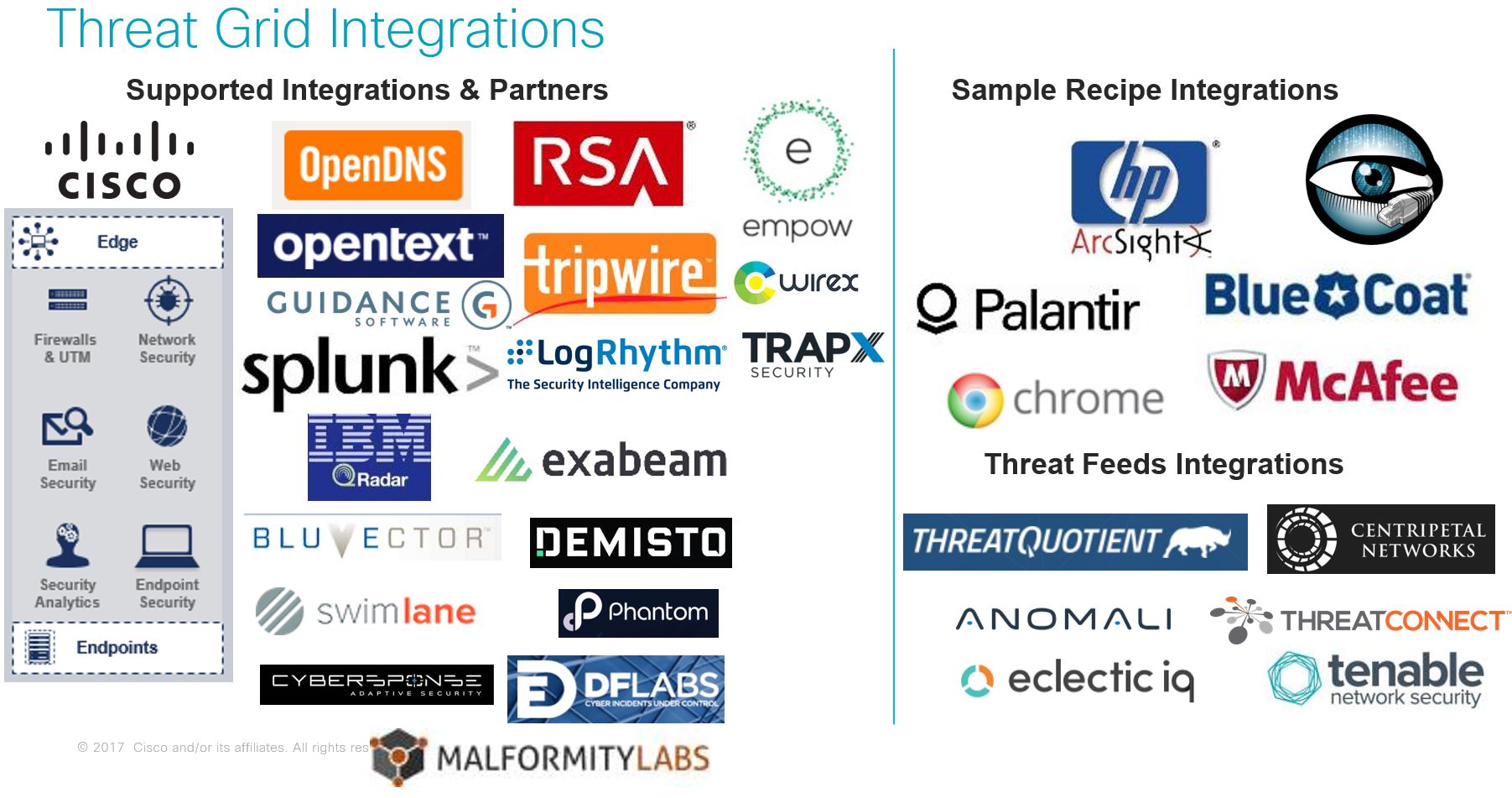
The mission of Cisco is to deliver Effective Cybersecurity that is Simple, Open and Automated. In my daily work at Cisco, my team and I execute on the Open and Automated mission pillars every day, building our ecosystem of technology partners with the Threat Grid RESTful API. Cisco has a Solution Partner Program, where member partners are able to create a Marketplace page with information on the integration and submit their solution for compatibility testing. Several partners have undergone the process of verification, with more joining the program every quarter.
The SOC team placed NetWitness Packets into Continuous Monitoring mode, where .exe, .dll, .pdf, .doc, .rtf and other potentially malicious payloads were carved out of the network stream and underwent Static analysis, Network intelligence and Community lookup; before sent to Threat Grid for dynamic malware analysis and additional static analysis. RSA customers can register for a no-cost Threat Grid account within NetWitness, for up to five samples per day for ad hoc analysis.
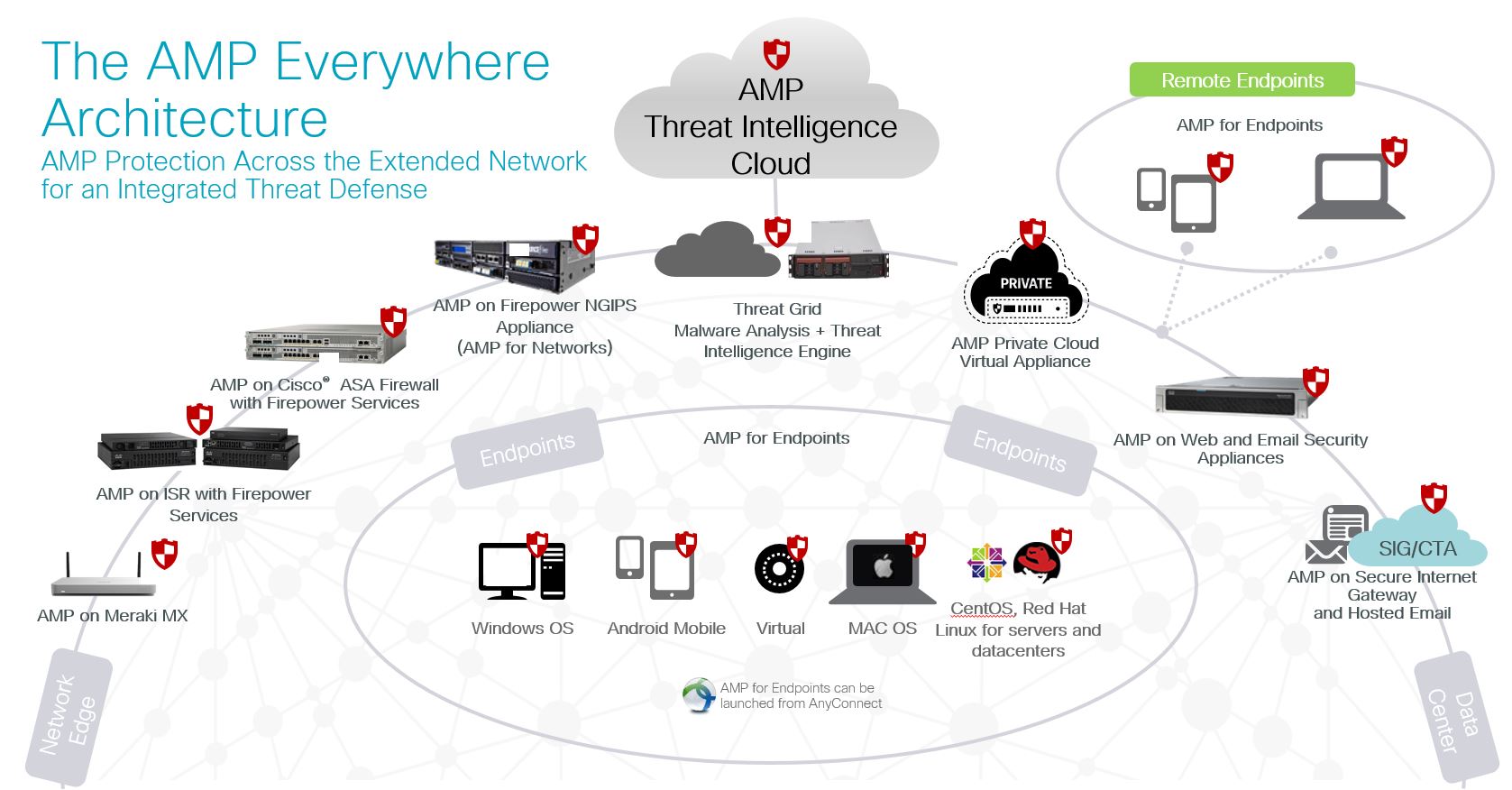
Were this a production environment, the hash value and conviction of the file would have automatically been recorded in the AMP Threat Intelligence Cloud, shared with all Cisco AMP security technologies. The result would be to quarantine the document on the endpoint, dropping the attachment on Email Security Appliance, blocking the download on Web Security Appliance and network packets containing the file would be dropped by Cisco ASA with FirePOWER Services and any lateral movement tracked by AMP for Networks. Any DNS queries and TCP/IP streams are also correlated with Cisco Umbrella with the integration of the Threat Grid threat intelligence feeds.
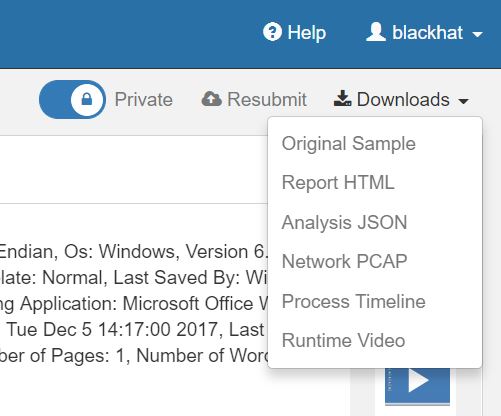
The contents of the document file remain private to the Black Hat organization, because by default all samples submitted to Threat Grid cloud via AMP products or RSA NetWitness Packets are marked as Private. The user can manually choose to share the sample with a simple toggle switch. You can also download the sample, the analysis report in HTMP or JSON, the full PCAP of network communication process timeline and watch the runtime video (both automated and/or manual interaction).
Back in the new Dashboard, several visualization widgets sped the analysis time in the SOC, including.
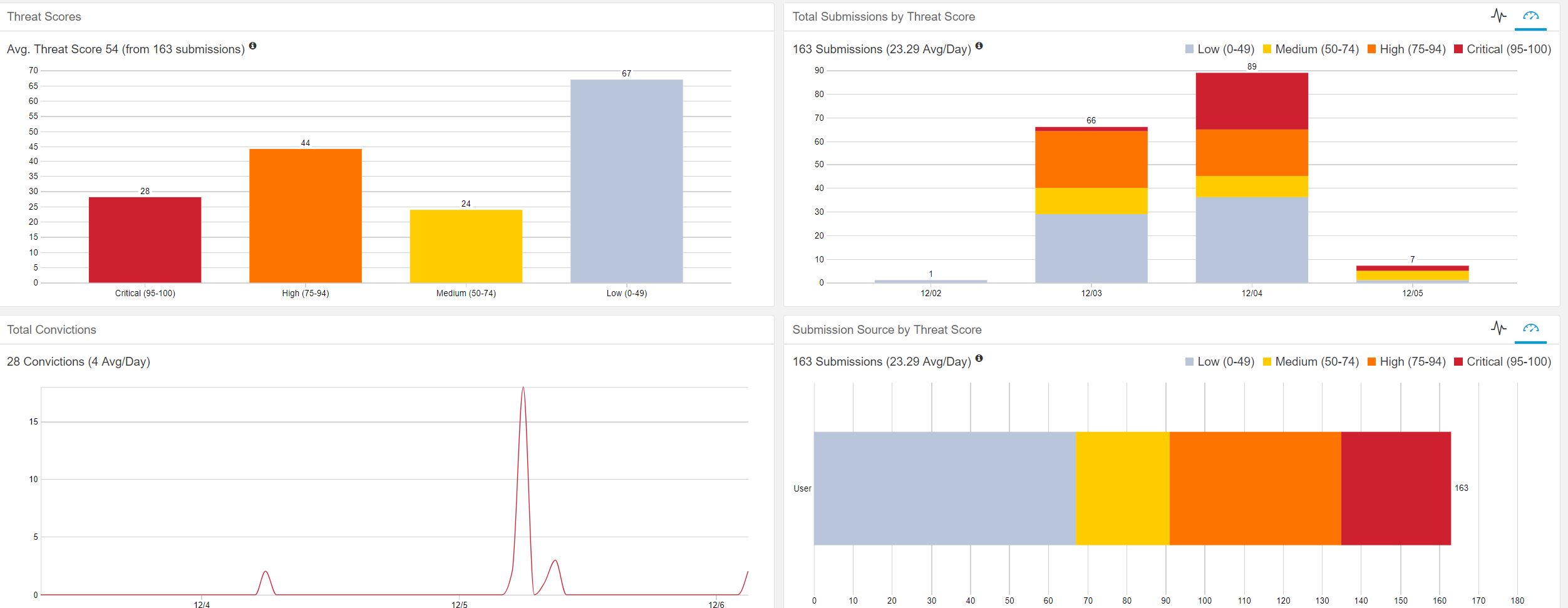
Threat Score bar chart: Samples grouped by score and graphed by count over a configurable time period
Total Submissions stacked bar chart: Samples grouped by submissions, graphed by count over a configurable time period, and stacked by status or threat score
Total Convictions line chart showing conviction count (samples scoring 95-100) over a configurable time period
Submission Source stacked bar chart: Samples grouped by submission source, graphed by count over a configurable time period, and stacked by status or threat score
Submission Environments bar chart: Samples grouped by environment (VM on which they were run), graphed by count over a configurable time period, and capped by conviction count
Submission File Types doughnut chart: Samples grouped by file type and graphed by count over a configurable time period
API Sample Submissions gauge and line chart: Last 24 hours API-based sample submissions graphed via gauge; last 7 and last 30 days of API-based sample submissions graphed by count with vertical bar indicators calling out API submission limit reached
Top Tags: Top tags correlated with the average threat score of all samples that are associated with the tag and displayed with the corresponding threat score color; visualized as either a bar chart with count or a tag cloud with count-based sizing
Top IP Addresses: Top IPs correlated with the average threat score of all samples that referenced the IP address and displayed with the corresponding threat score color; visualized as either a bar chart with count or a tag cloud with count-based sizing
Top Domains: Top domains correlated with the average threat score of all samples that referenced the domain and displayed with the corresponding threat score color; visualized as either a bar chart with count or a tag cloud with count-based sizing
Top Indicators: Top behavioral indicators correlated with the average threat score of all samples that referenced the indicator and displayed with the corresponding threat score color; visualized as either a bar chart with count or a tag cloud with count-based sizing
The Threat Grid dashboard is backed by a new database, redesigned APIs and a streamlined, component-based front-end giving it huge performance gains. Dashboard settings (date range, auto refresh, tile view states, etc.) persist within and across sessions allowing the user to save their preferred view.
Clicking on the Critical bar under the Threat Scores opens the Sample Manager for the samples with scores 95+. The original Sample Analysis section was moved from the Dashboard into a dedicated page that offers a new interface to support rich filtering, Search, updated data, and much more.
In the SOC, we could see all of the Microsoft Office documents, with the VBA exploit.
The new Sample Manager improvements include:
Sample filtering by Set (All, My Organization, My Samples), Date Range (including last 90 days and custom range), Threat Score, Submission Source, Status, and Access
Search by keyword, Behavioral Indicator, Domain, IP, tag and more
Sort based on Name, Type, Score, Date Submitted, and State
A new SHA-256 column with one-click SHA-256 search and copy to clipboard
A new Indicators column with stacked bar chart showing the sample’s behavioral indicators grouped by score and sized by score occurrence
A new Actions column offering one-click access to the sample’s runtime video and a more actions button providing access to key functions like Mark Private, Download Analysis and more
Sample Manager settings (filters, search terms, sort order, and items per page) persist within and across sessions allowing the user to save their preferred view
Cisco Umbrella
After joining the Black Hat NOC in Las Vegas last July, Cisco Umbrella was again used for DNS visibility and investigation. We added in the Network ranges provided by Gigamon for the conference, and DNS visibility began within an hour. We also enabled the Cisco Threat Grid intelligence feeds integration, by adding in the Black Hat’s Threat Grid API key.
This imported the ~15 curated feeds included in a Threat Grid premium subscription from DNS queries and network streams of malicious samples seen in the last day, including:
· Autorun Registry Changes
· Ransomware Communications
· Banking Trojans
· Remote Access Trojans
· DGA Domains
· Stolen Certificates
· Documents with Network Connections
· Modified Windows Host Files
· Samples Downloading Executables
· Checking for Public IP Address
By default, Umbrella will begin blocking DNS traffic to sites known to host Malware, to Command and Control Callback servers and Phishing Attacks. At Black Hat, we always want to enable all traffic, so the trainers and briefers can show the latest exploits, and we kept the settings from Black Hat USA.
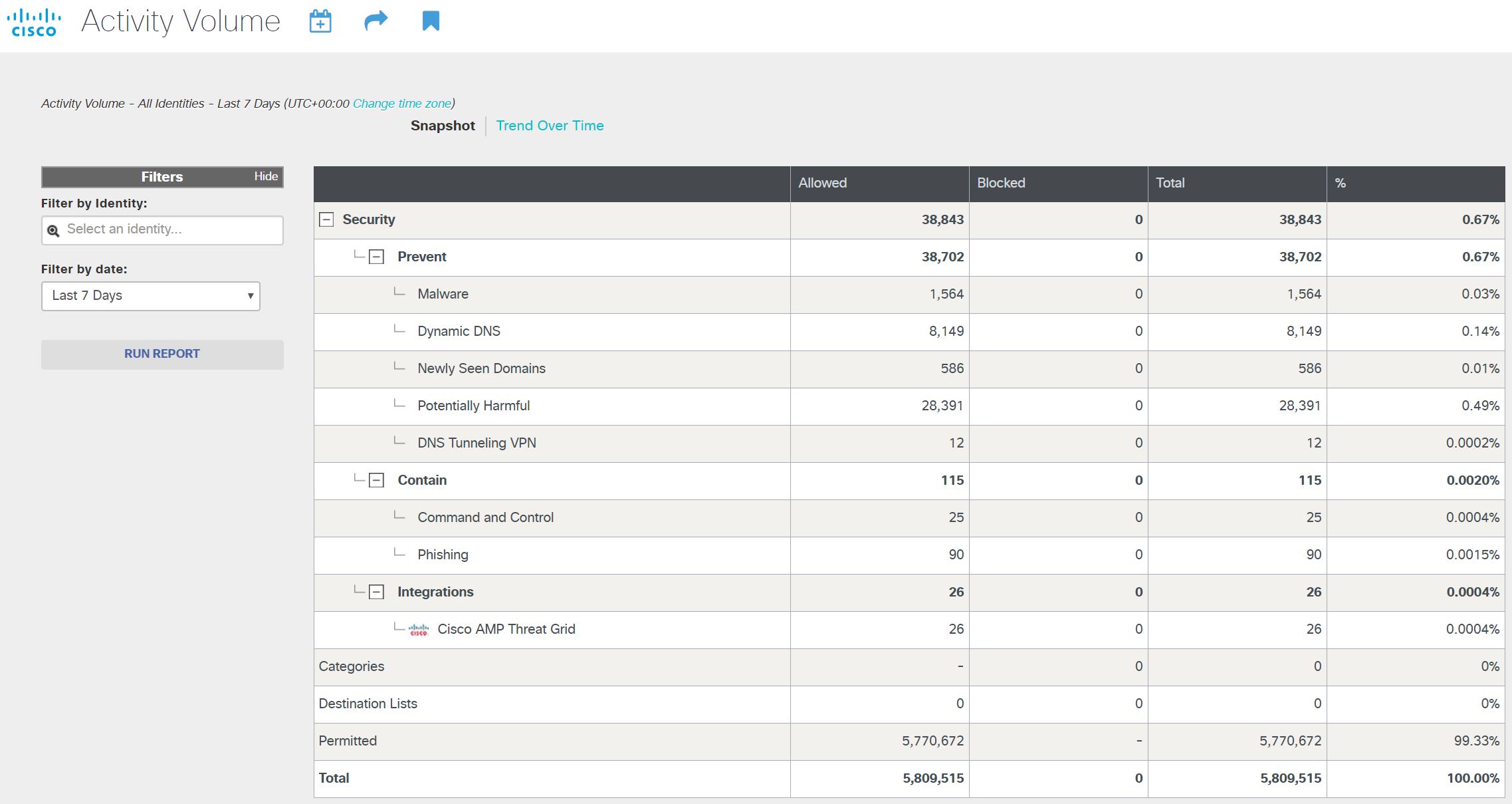
Many presenters set up new domains and simulated malware expressly for the training. There were 5.8m DNS queries during the four days of the Conference. A little over 1,500 would have been blocked as Malware with known exploits, with many of the training destinations flagged as Potentially Harmful.
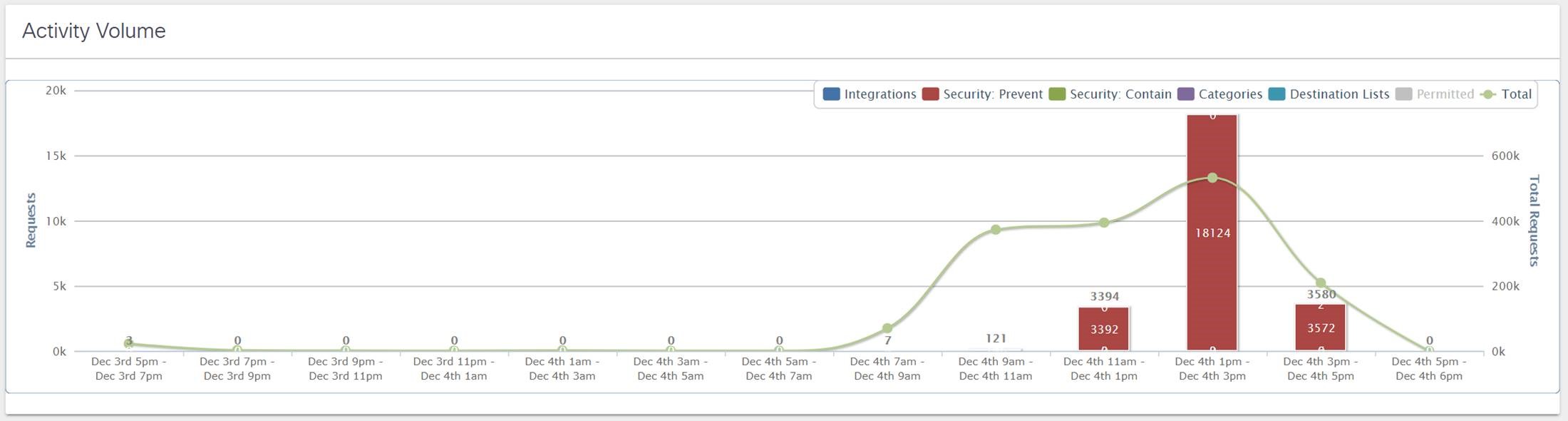
Security related DNS activity spiked in the afternoon of the first day.
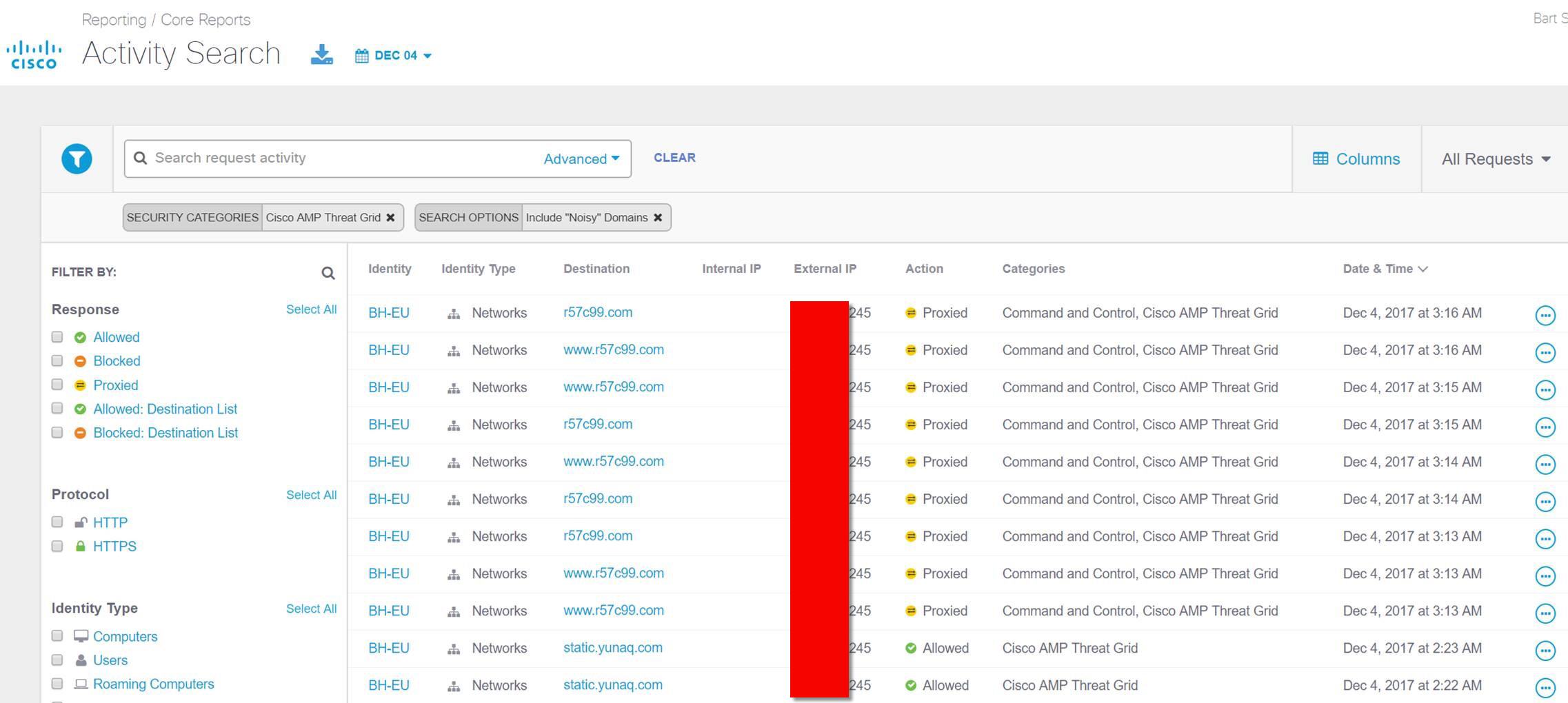
We had a ransomware alert that would have been blocked, from the Threat Intelligence feed from Threat Grid.
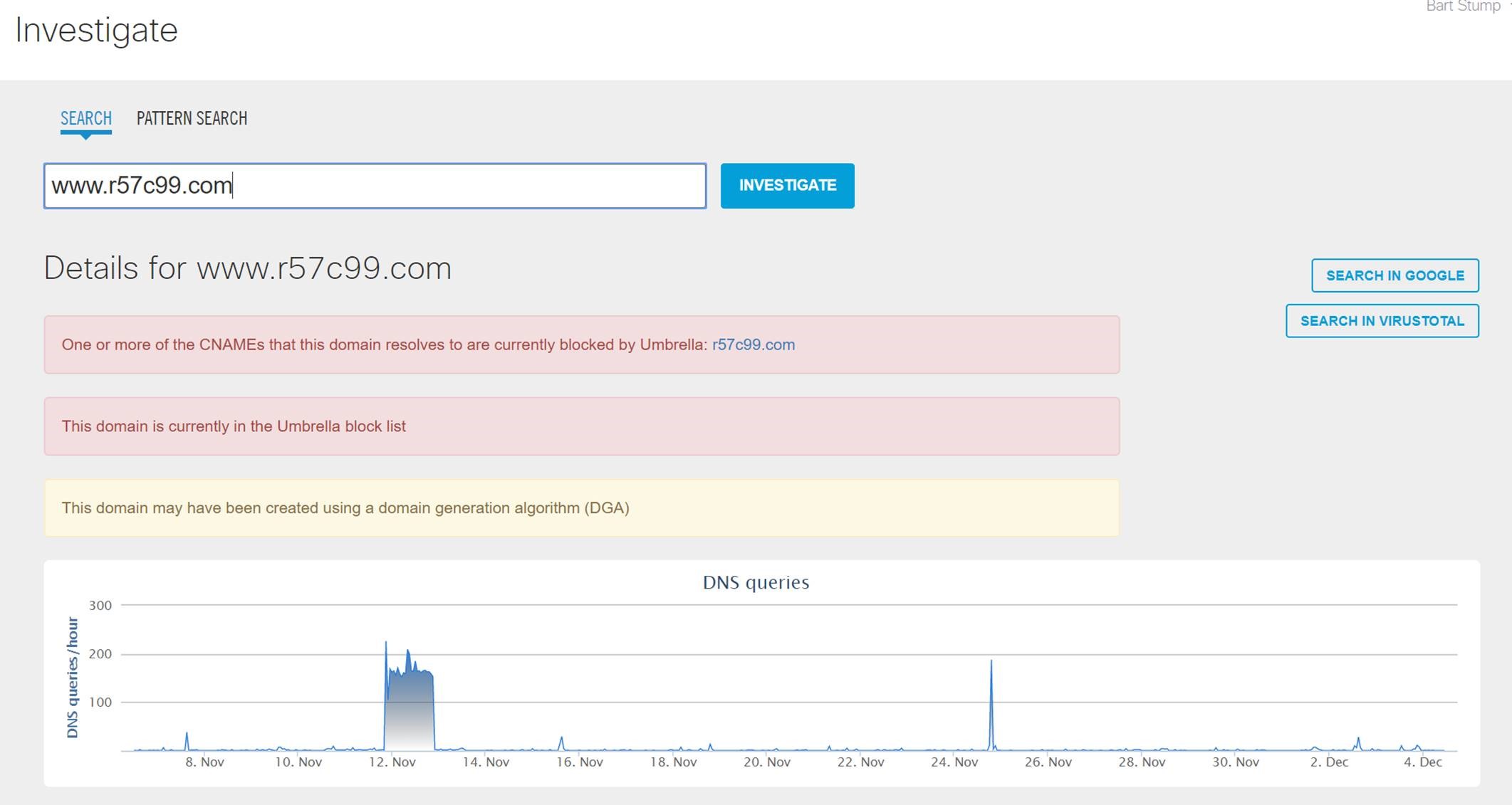
Following the alert into Umbrella Investigate, we were able to understand greater context.
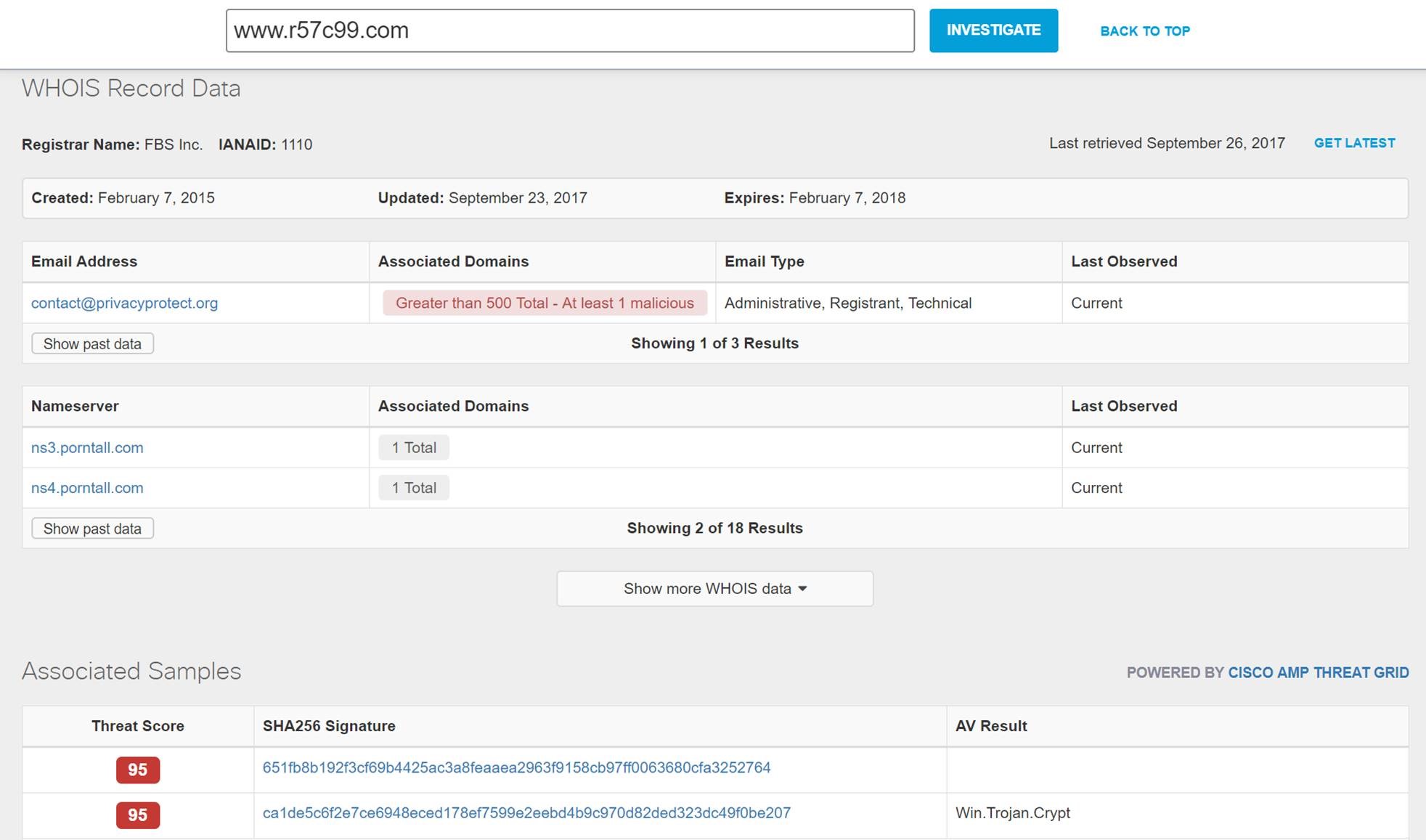
Scrolling down, we could see the associated Threat Grid samples and follow the link to a summary malware analysis report in Investigate, and the full Threat Grid report (with a subscription).
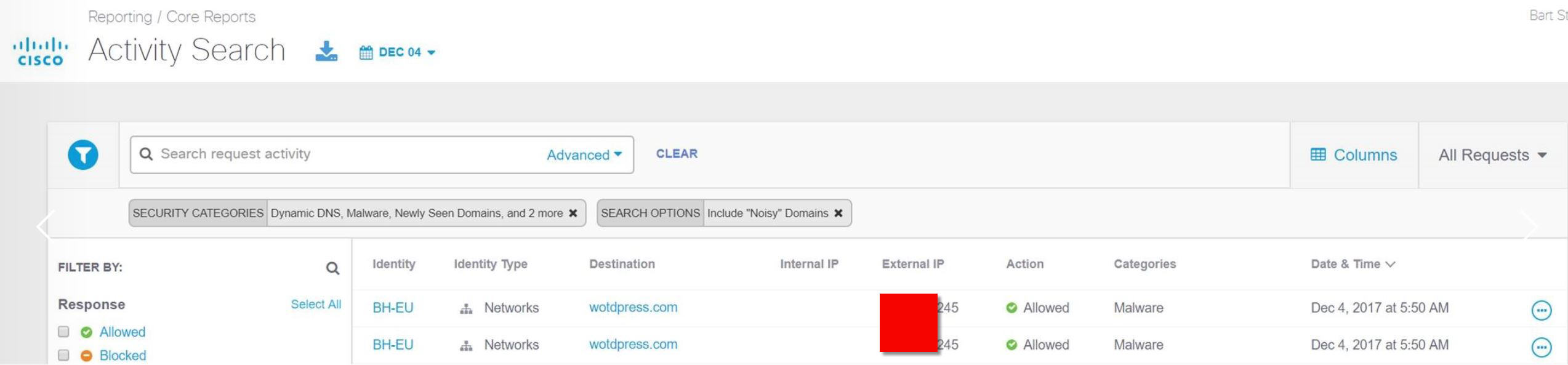
Another interesting attack vector was a malformed “wordpress” URL.
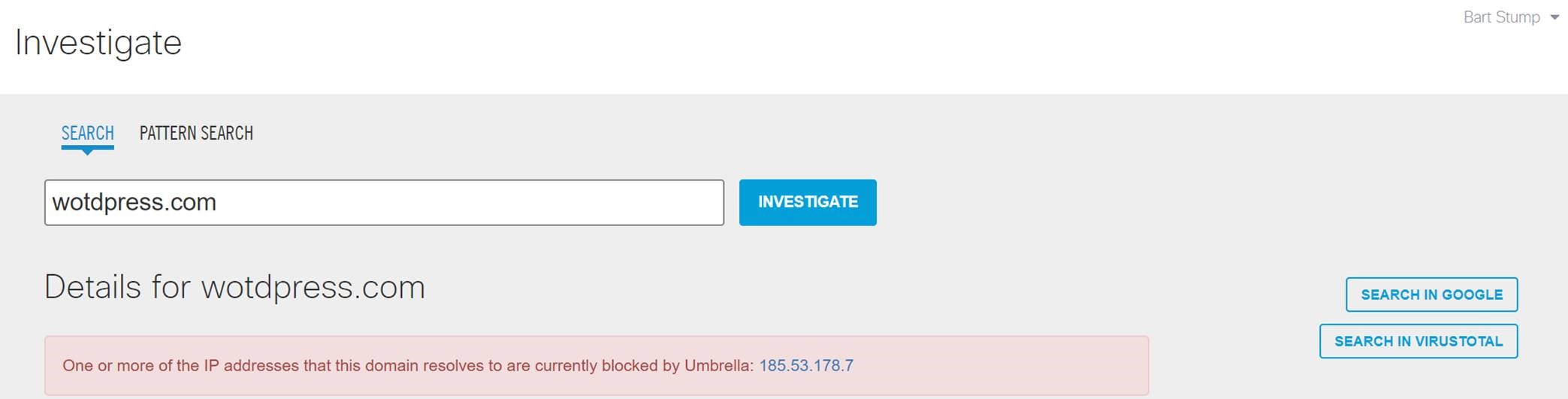
Had Umbrella enforcement been enabled, the malicious site would have been blocked. Pivoting into Investigate, we learn more about the domain.
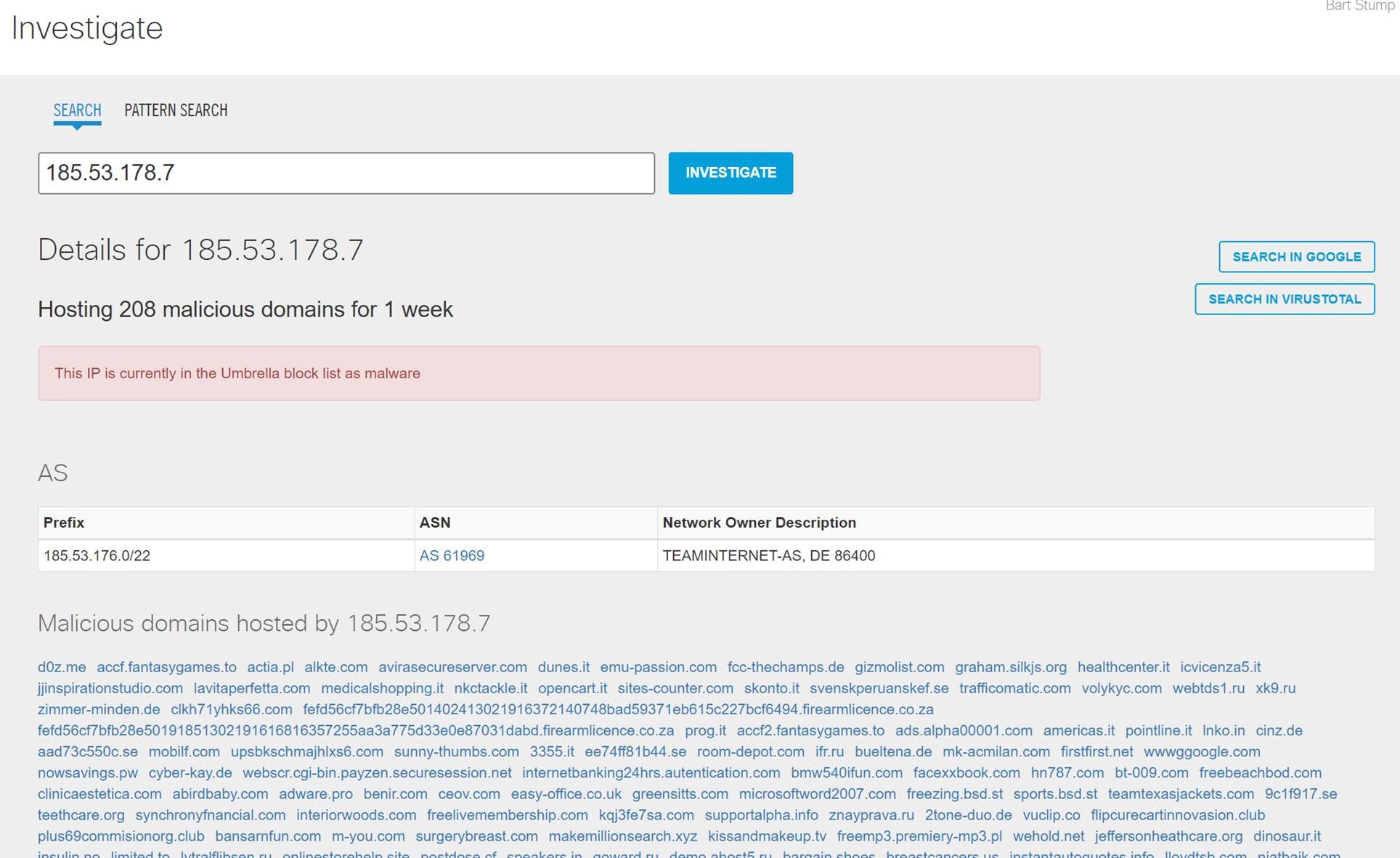
Click on the IP Address, we can see the plethora of malicious domains hosted.
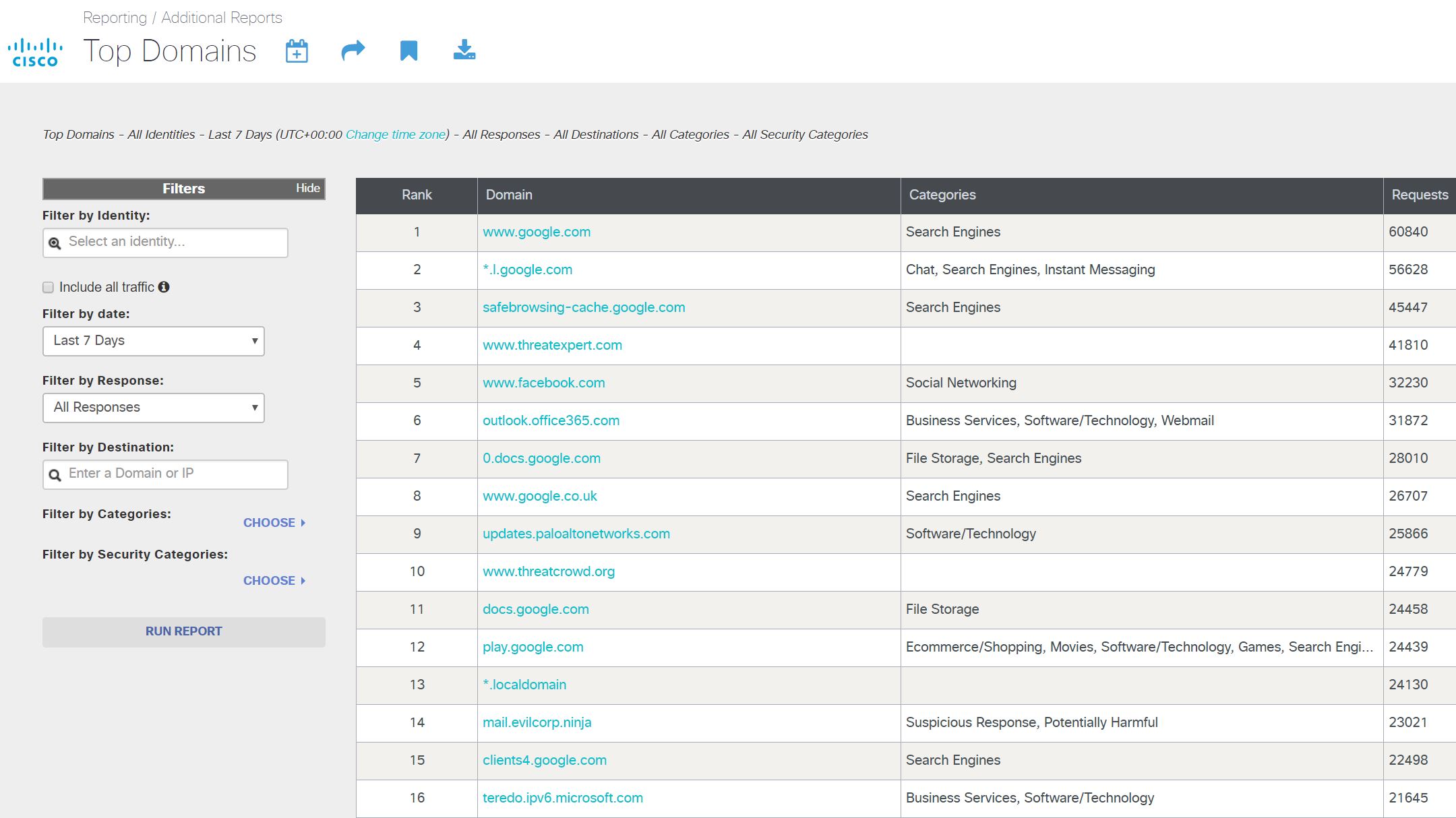
Top Domains that first afternoon, after search engines, were two training domains. The evilcorp.ninja was responsible for most of the Potentially Harmful alerts.
We also had SOC investigation into coinmine.com traffic at the conference. A joint investigation by the Palo Alto Firewall team, RSA Netwitness forensics team, and myself with Cisco Umbrella, determined the attendee machine was likely infected before the conference to mine bitcoin for an attacker.
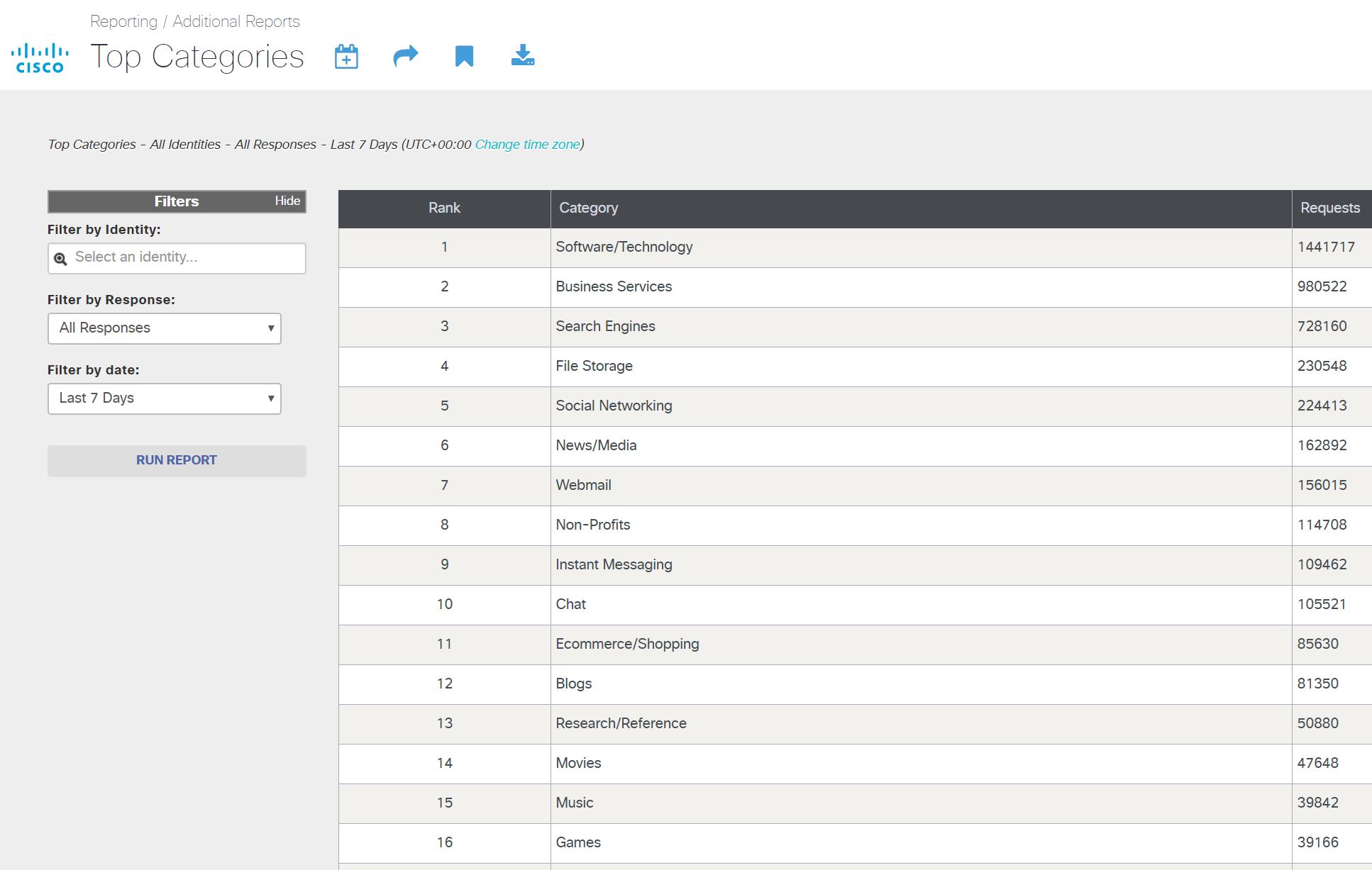
At Black Hat USA, Malware quickly rose to one of the Top Categories, peaking at Number 3, before settling in at Number 7. For Black Hat Europe, Malware never broke the Top 10 Categories.
It was an amazing experience to be in Europe with the team and I’m looking forward to returning to Singapore in March, for Black Hat Asia 2018.
During the Technology Services Industry Association (TSIA) – the world’s leading organization dedicated to advancing the business of technology and services conference on 25 October 2017, Cisco was awarded the Star award for Innovation in Expand Selling Programs.
To win a STAR Award, nominees undergo a rigorous evaluation process, with the winners selected by TSIA’s service discipline advisory board members. Since its inception in 1990, the STAR Awards have become one of the highest honors in the technology services industry, acknowledging the contribution of companies of all sizes to the continual improvement of technology services delivery industry-wide.
This award clearly highlights the ability that Cisco has in helping enterprises identify and adopt the right technology solutions to get the business outcomes that they seek. With this mind, we have taken it one step further by providing new levels of support and guidance to help customers adopt digital network solutions.
Customers need a strong, optimized and efficient network foundation to evolve to and benefit from a digital network and with Cisco’s Digital Network Architecture (DNA) customers have the perfect foundation to build their digital business.
That’s not all, customers have struggled to evolve to digital networks and adopt the right solutions for their business outcomes, at Cisco we have aligned our product management and marketing to help make these choices easier for customers. Our services delivery teams have aligned to drive adoption, as well as overall business outcomes. To that end, we have empowered their service delivery teams to take ownership of the customer problem beyond just the simple fix, and utilized gamification techniques to drive home the change in culture
So what is Cisco DNA and how can customers and partners benefit from it?
Cisco DNA is an open, software-driven, services-centric network architecture, while Cisco ONE software is the key interface to manage the network hardware. Together customers have access to analytics-based insights that enable better digital adoption and allow them to fine-tune business models using technology.
In addition, both customers and partners see an increase in devices, applications, users and cyber threats, built in automation supports information technology teams to simplify the network management.
Some of the immediate benefits of this software-driven approach, is that it speeds up innovation through insights and experiences, reduces costs and complexity through automation and lowers risk through security and compliance.
There were additional benefits, as customers needed to understand the value of the digital network that is managed through software applications – and train them to use the software. Training was required which made them pick up new skills that made them relevant to the business.
Customers and partners also began to see the value in a single touch point for technical support versus a multi-vendor model for priorities like security and mobility require a different support teams.
Also, this means that instead of having engineers just fixing immediate problems, our engineers identified solutions and recommended services to drive network improvements for customers. This has resulted in customers appreciating the support and proactive approach demonstrated by engineers.
Why? Simply because customers state that our recommendations to improve their networks are helping them to optimize cost, comply with industry regulatory requirements and more importantly grow revenue.
By focusing on goals that revolve around the evolution of support models and go beyond break-fix, we’ve managed to identify customer challenges and offer tailored solutions that helps both the customer and Cisco to meet their digital goals.
As Cisco continues its transition towards Software and Services, the TSIA Star award is a good reminder that we’re on the right track as a company and together with our expanded partner ecosystem we’re helping our customers reach theirs digital goals through a mix or software, hardware and services, making us a truly integrated technology solutions provider.
For more information about the TSIA awards, please click here.
Talos has discovered a remote code execution vulnerability in the ACDSee Ultimate 10 application from ACD Systems International Inc. Exploiting this vulnerabilities can potentially allow an attacker to gain full control over the victim’s machine. If an attacker builds a specially crafted .PSD (Photoshop) file and the victim opens it with the ACDSee Ultimate 10 application, the attackers code could potentially be executed with the privileges of the local user.
We now live in a “disrupt or be disrupted” world where no industry is immune.
From caring for the sick or the homesick to manufacturing the next spinners or the next genius, your business and the network that drives your business will need to change.
We all know why. An explosive growth of network use is underway and with that growth, an ever-expanding threat – and that is no hype. But as networks grow so too does the complexity and the cost to operate grow.
The Operations Challenge Most enterprise networks are complex, error-prone, hard to customize and change, and slow to provision and maintain. Why? Because today we live in a CLI-driven world where over 90% of all IT activities are manual. This often means your IT staff has little time to do more than simply keeping the lights on.
What if you could give time back to IT? What if you could close the IT-skills gap created by cloud, virtualization and IoT? What if you could provide network access in minutes for any user or device to any application? What if you could trouble-shoot problems in half the time?
Simplify and Automate Do more in less time. With Cisco DNA Center and Software-Defined Access (SD-Access), Catalyst 9000 switches can operate as part of one fabric, for faster, more secure networking. No more constant cutting, pasting and tweaking switch by switch. Set up your network once, apply network-wide using cross-domain policy enforcement and automation. Automate your mundane day-to-day provisioning and maintenance operations. You can reduce errors, improve network uptime, and dramatically reduce your operational costs. Now you and your IT staff can focus on training, creativity and design.
Return on Investment There is always an expense to transitioning to the latest technology, so we know that the real measure of success of SD-Access is when your operational savings exceeds the expense of time and investment. Return on investment, or ROI, is a very popular metric because it can used as a gauge of an investment’s profitability. ROI can help guide you as you make decisions about the future. While ROI can be very easy to calculate and to interpret for a wide variety of investments, it can be a little more complex when applied to investments in technology. We have created the Cisco DNA ROI Calculator to help you understand the value of automation and the tremendous time and cost savings that you could reap by taking the next step in the evolution in networking.
The Mechanics of ROI
For any ROI calculation, the basic formula is a comparison of the net gain to the cost (ROI = net gain/cost). So if you are deploying a new switching architecture that costs $200,000 but saves you $300,000 over the first 3 years in labor costs, the ROI is 50% à (300,000-200,000)/200,000.
But of course the devil is in the details. The Cisco DNA ROI Calculator takes into account a large variety of factors to develop a cost model. It includes the time to provision and maintain the network, from network hardware and user and IoT devices, to designing and setting QoS, and setting access and security policies. To simplify the analysis, the DNA ROI Calculator models eight examples to provide you with a broad view of differing sizes of deployments in differing environments. While the underlying model has over a hundred inputs, we have exposed a few of the most important inputs to allow you to customize the analysis to better match your network. The result, an in-depth report based on the unique aspects of your network showcasing how much your business can save.
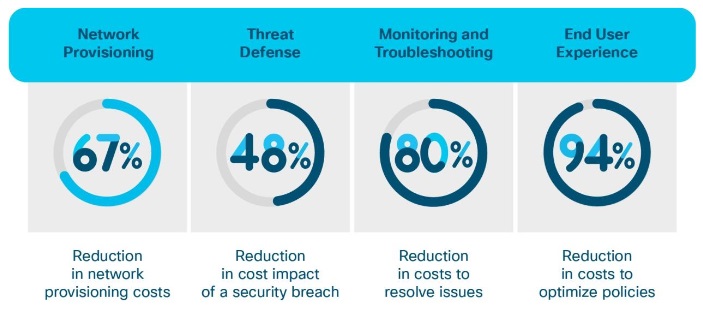
Sometimes you may not be able to show a positive ROI depending on the size or complexity of your network. But we have found that on average the design, provisioning and maintenance time for IT staff can be reduced by over 67% with a payback period of under three years, and with downtime reduced by over 80%. And that’s pretty significant.
Our Catalyst 9000 switches constantly adapt to help you solve new challenges. Their integrated security helps you to address ever-changing threats. They simplify and automate the management of your evolving mobility, Internet-of-Things (IoT), and multi-cloud networks. They could even save you money.
See how an intent-based network built on Cisco DNA and the Catalyst 9000 switches can take your network beyond the hype.
The growing 5G momentum promises tremendous commercial opportunities for service providers, with estimates that the global 5G market will be worth US$12.3 trillion by 2035. To pursue these new untapped opportunities, service providers need to ramp up their network capabilities to support future 5G services.
As we move closer towards mainstream 5G adoption, mobile networks are increasingly expected to handle more data-intensive applications and deliver low-latency connectivity to more devices. How can service providers keep pace and get a leg up on the competition?
In our view, a network architectural transformation is fundamental for service providers to make the next leap forward:
Across the industry, 5G standards are being developed to address the need for greater capacity and scalability. As 5G standards are being defined, service providers need to establish a 5G network architecture to support the demand for new services in the fastest and most agile way possible.
Flexibility in the mobile network is key to providing access to new technologies and protocols in a manner that is simple and broad. Technologies such as Network Functions Virtualization (NFV) and Software-Defined Networking (SDN) play a prominent role in the strategic blueprint for service providers, enabling the scalable network configuration demanded by 5G requirements.
These new approaches require service providers to rethink how their mobile networks are designed. By making 5G core flexibility a priority, service providers can achieve operational efficiencies and address current network limitations.
Cisco is already working with customers and partners across the mobile ecosystem to unlock the commercial potential of 5G mobile networks. Here’s a snapshot of the progress we have made.
Rewiring Connectivity with a 5G Game Plan
In the APAC region, mobile service providers are taking steps to upgrade legacy network infrastructure to meet market demands for mobile traffic capacity, and build readiness for future 5G services. Cisco’s network technologies enable them to establish a next-generation mobile core network platform—to meet scalability demands and unlock the dynamic provisioning capabilities realized through 5G networks.
Here, virtualization and network automation are the game changer. Leveraging the Cisco Virtual Topology System and Cisco Network Services Orchestrator (NSO) enabled by Tail-f, we have helped mobile service providers to overcome previous obstacles, improving time-to-delivery by 70 percent.
To create a more flexible network fabric, several forward-looking mobile service providers are now adopting Segment Routing technology advocated by Cisco. This allows them to enable the provisioning of advanced network services, such as low-latency—and differentiate its service delivery in the 5G era.
Empowering Digital Lifestyles Today
At Cisco, we believe service providers have a pivotal role to play in driving nationwide initiatives such as Digital India. Reliance Jio is leading the charge to realize the Digital India vision for 1.2 billion Indians, and create a broad ecosystem of network, devices and applications to transform digital services on a national scale.
Jio partnered with Cisco to build a first-of-its-kind, 5G-ready network to deliver inclusive, affordable broadband to transform how people leverage technology in their daily lives.
As the world’s largest all-IP network, Jio enables the massification of infrastructure services such as broadband connectivity, mobile video, and high-quality communications at 5G scale. Jio’s network also forms the foundation on which future solutions for smart city, IoT and other vertical services are developed.
Taking Advantage of the 5G Momentum
Many service providers have already made the first step towards a future-ready network, and these success stories point the way towards the new possibilities that 5G brings.
I foresee exciting times ahead for the whole industry, and am confident that Cisco is best placed to help you make the most of opportunities in a hyper-connected world—with solutions that are simple, scalable and flexible.
More news and resources for Telecom Service Providers available here.
On 25 September 2017, Vodafone, in collaboration with Cisco, Ericsson and a number of auto technology partners, successfully drove a BMW car around a test track in Düsseldorf by remote control, connecting the operations of a remote driver to the car over a cellular network. As we reach the end of the fourth decade since the first commercial cellular network was trialled in 1978, the proof that we can deliver the low latency and high bandwidth networks to make tele-operated vehicles possible is a significant achievement.
The goal of building a tele-operated vehicle system raised a number of challenges for our team. From a network perspective, Vodafone wanted to develop a low latency Mobile Edge Compute platform as part of their 5G readiness initiative. A number of networking innovations went into Vodafone’s MEC platform. Segment routing, which Cisco has pioneered, was one of the key ways of scaling the network with the flexibility to handle very dynamic traffic patterns. We were able to extend segment routing from the IP core through to the mobile backhaul and aggregation domains to achieve the low latency that was required for the car trial. The next step will be to implement SDN-based automation to reduce latency even further by making the network capable of creating the fastest, shortest, secured path for specific applications and services.
5G tests and trials continue at a high pace in our industry. Cisco is playing a very active role helping our customers evolve their network platforms and business operations to be ready to take full advantage of 5G.
Vodafone is setting the pace with challenging use cases, which will accelerate development across every domain from radio access through to the core, devices (not only smartphones but IoT devices), and the APIs and software that enable application and service developers to flourish. At Vodafone’s Innovation Days, Vodafone Germany CEO Dr. Ing. Hannes Ametsreiter said: “It’s best to work together to shape the future, that’s why we’re driving innovation with strong partners. The Innovation Days showcase technologies that will revolutionize road traffic, industry and everyday life.”
This gives an exciting view of a 5G future that can deliver amazing benefits and experiences to both businesses and consumers.
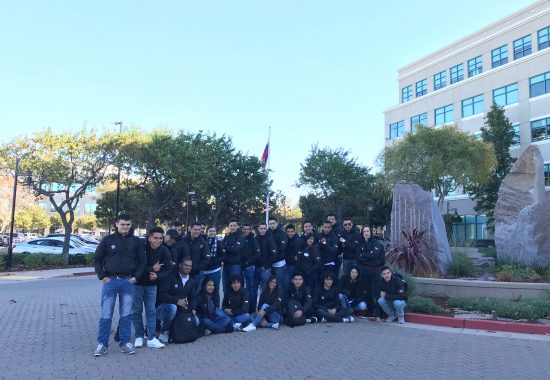
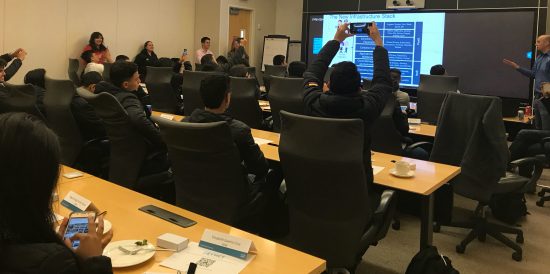
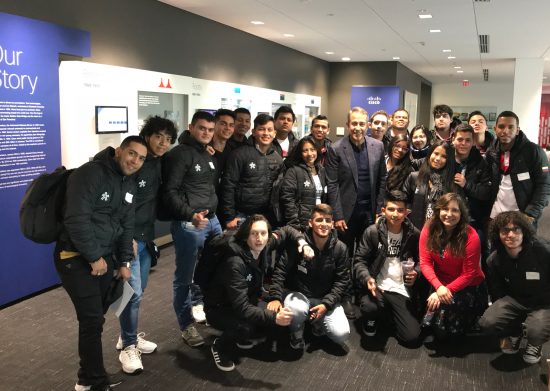
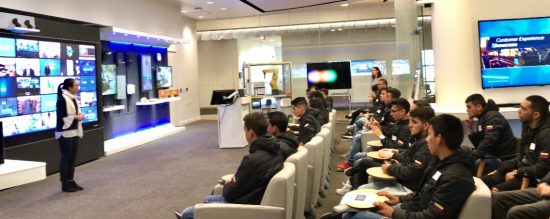
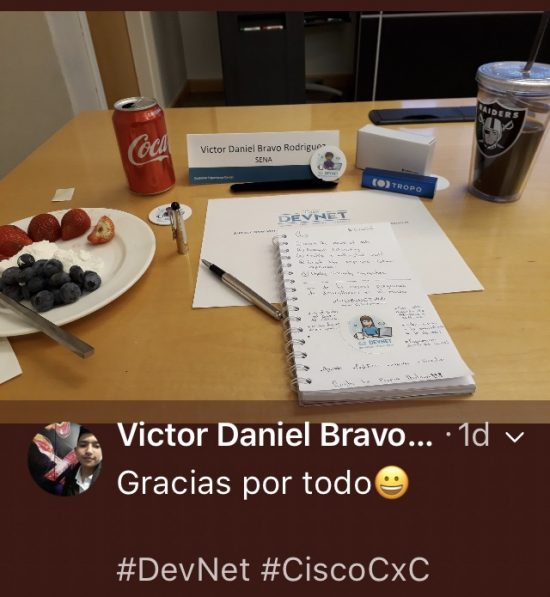
This week at Cisco headquarters in San Jose, California, we’ve had the pleasure of welcoming the winners of the eighth edition of the SENASoft competition. SENASoft is organized by the National Training Service (Servicio Nacional de Aprendizaje – SENA) which is a national public institution ascribed to the Ministry of Labor of Colombia. Its function is to provide professional training and formation to workers, youths and adults within the areas of industry, trade, agriculture and mining. This year the winners of the IT competition embarked on a trip to Silicon Valley and toured some of the biggest companies in the world to discover what the jobs of the future will be and how they can prepare for them.
For Cisco, SENA is the largest education partner in Colombia delivering around 30% of the NetAcad training in the country. We cherish this partnership very much, invest a lot of resources in it and want to make it as successful as possible. In DevNet, for more than a year now, we’ve started working much closer with NetAcad so when the opportunity arose to present what we think the jobs of tomorrow will look like to an audience of young, talented and determined students, we wholeheartedly agreed.
DevNet and NetAcad partnership – Be the bridge
When the collaboration between DevNet, the team I’ve been a part of now for 3 years, and NetAcad started to take shape I was the first person to sign up and help out as much as I can. Having been on both sides of the fence, I know how NetAcad is set up and working, and the challenges they are facing. I also know the vision behind DevNet and the resources it brings. I was in a position to make suggestions and bridge the gap between NetAcad and DevNet, and I am very grateful for being given the chance to contribute. So far we’ve made tremendous progress with our collaboration from events, hackathons and packathons that we have organized together, to webinars, blogs, communities of interest, customized educational content, workshops and the list goes on and on. Be on the lookout for more news about the collaboration between these two teams. There will be many more surprises next year!
As a NetAcad graduate myself, seeing the energy and excitement in the students’ eyes reminded me of the time when I was in their shoes. Like them I was trying to see how I could differentiate myself in a competitive world and what skills I would need to secure the job I wanted. Wide-eyed and optimistic, having completed all 4 CCNA courses at the time I was ready to take on the world. Little did I know then how valuable those courses would turn out to be for my career and personal life! I believe the knowledge that I’ve gained through the NetAcad courses was integral and a differentiating factor for a large amount of projects and jobs I’ve held in the past 15 years.
I felt priviledged to be able to share my experience and lessons learned so far with my NetAcad peers from Colombia. My first piece of advice was just this: If you have the time and resources available, enroll in a NetAcad course and create a free DevNet account. Both of these decisions will pay dividends for years to come. You can actually log-in to DevNet with your NetAcad account, and be sure to specify in your DevNet profile that you are a NetAcad student or instructor so that we can better construct our message to you.
Network engineer and software developer – Be the bridge
I believe we are at an incredibly important point in the evolution of networking. I have not witnessed something of this magnitude in the past 15 years. Yes, the industry as a whole has changed a lot in these past 15 years but nothing like this. We’ve learned a lot of important lessons during all these years and decided that adding additional complexity as our networks grow is just not feasible. So we went back to the design board and started thinking about the networks of tomorrow that will have to connect billions of devices seamlessley, that will have to dynamically adapt and learn, that will have to be smarter, simpler and more secure. And we have come up with the network intuitive.
As a network engineer if you have not yet seen what the network intuitive brings to the table I would encourage you to start investigating and look into SD-Access and DNA Center for the enterprise as well as ACI for the data center. As a software engineer I would look at the APIs that the network intuitive provides, how can I use all the data that the network makes easily accessible to improve how I design, develop and maintain my applications.
As the lines between network engineers and software developers are blurring and skills from one domain migrate into the other, with the advent of DevOps and NetDevOps, the network engineers of tomorrow will have to be able to program the network and treat it as code, and the software developers of tomorrow will have to see the network as the biggest software development platform out there, similar to the Apple and Google mobile platforms. I am currently also improving my coding skills and making the migration to this programmable age.
My second piece of advice was: Learn coding if you are a network engineer, and learn networking if you are a software engineer. We have to break down silos and be able to discuss and understand the limitations and requirements from each other’s point of view.
The Latino connection
Speaking Romanian as my first language, I am fortunate enough to be able to understand to a certain extent when people speak Spanish around me. This has been both a blessing and curse over the years, as I would be able to understand converstations in Spanish but not be able to express myself. It was the same situation with the students from Colombia. Personally I found it to be much easier to find documentation and answers to my questions in Shakespeare’s language especially in relation to IT matters. I cannot emphasize enough the importance of speaking a second language! Being comfortable with and understanding English constitutes an advantage to anyone trying to differentiate themselves in a very competitive world. This would be another piece of advice for my NetAcad peers. Specifically for my Latino peers, please do not be scared or ashamed: ¡Hablen Inglés, chicos!
Cisco has been building bridges for 33 years. I mean, even the logo of the company is a bridge, go figure! From routing and bridging traffic between IP, IPX, AppleTalk in the early days, to bringing voice, video and storage onto the network to the biggest challenge of them all now: bridging the gap between the network and the application.
This brings us to my last piece of advice for the Colombian NetAcad students: Do not be afraid, there will always be change. Be passionate and adaptable, love what you do and there will be no limits to what you can accomplish.
¡Gracias por la linda visita!
We’d love to hear what you think. Ask a question or leave a comment below.
And stay connected with Cisco DevNet on social!



 We are proud and honored to have the Cisco Catalyst 9000 family of switches recognized as CRNs 2017 Overall Network Product of the Year.









 k the dynamic provisioning capabilities realized through 5G networks.
 towards the new possibilities that 5G brings.