Everyone has an #IChoseCisco moment – the one where you knew, “This company is speaking my language!”
It’s exciting when you find a place to call your own, where you feel like you belong and are accepted while you’re being challenged to take the next steps in your career. We recently asked a few of our interns in Canada if they’d like to share their #IChoseCisco moment – here’s what they had to say:
Tianyi Zhang – Vancouver, Canada
Sales Development Intern – Commercial Sales
“#IChoseCisco because interns get to work on real company projects together with top company talent.”
Mark Henderson – Toronto, Canada
Partner Sales Development Intern
“#IChoseCisco because… the views. Okay maybe not, I chose Cisco because as a first year university student, I get to be enrolled in an all-encompassing business experience that will provide valuable skills applicable to all of my future endeavors. Plus, this technology is changing the world and who doesn’t think that’s awesome?!”
Kirthi Maguluri – Toronto, Canada
Product Manager Intern – Women Entrepreneurship Circle
“Cisco is the hotbed of innovation and cutting edge technologies. I was amazed from the very first moment when I visited Cisco’s new innovation hub in Toronto. I wanted to be a part of it and couldn’t wait to learn about their technology. Moreover, after learning about their great mentorship and DevNet programs for interns, I knew that this company would provide me with invaluable work experience and skill-set to conquer the tech world. Cisco is more than an internship, it’s a lifetime of an unparalleled experience.”
Rika Tatami – Ottawa, Canada
Public Sector Sales Intern
“#IChoseCisco because I want to be in a workplace where I’m surrounded by challenging problems every day and be able to contribute to projects that have real business impacts!”
Why did you choose Cisco? Let us know in the comments below – or on social media by sharing your story and tagging #IChoseCisco!
Want to start the process in choosing Cisco? We’re hiring!
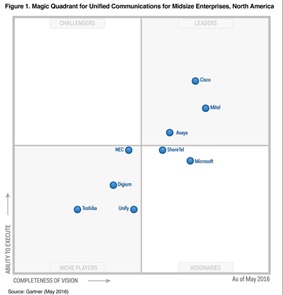
For the second year, Gartner has positioned Cisco as a Leader in the 2016 Gartner Magic Quadrant for Unified Communications for Midsized Enterprises, North America.
We believe this is a significant achievement. Gartner puts a lot of analysis into these reports. Last year was the inaugural publication of this particular report. We’re pleased in our leadership position for the second year running.
In the 2016 report, Gartner analysts evaluated Cisco and eight other vendors. Again Cisco was placed highest for ability to execute. As Gartner states in the report:
“Vendors in the Leaders quadrant have UC portfolios that are specifically positioned with features and functions to meet the needs of midsize businesses.”
According to Gartner, leaders:
Have user and management interfaces that are integrated and generally intuitive and easy to use
Balance the need for customization with end users’ desire for simplicity in their licensing structures, sales demos, and UC solution portfolio
Have mature channel programs with distinct processes for presales and postsales support.
BE6000 packaged solutions are for midsize deployments from 35 to 1,000 users. They feature comprehensive on-premises capabilities in single virtualized appliance that is easy to deploy, manage, and use. This means you can prioritize use cases, selecting from applications for:
VoIP telephony
Mobility
presence and chat
video conferencing
omnichannel customer care
But what if you want the flexibility to deploy some UC services on premises and to consume others as cloud services? We believe in offering choice, without compromising on consistent, simple and delightful user experiences. Cisco Spark Hybrid Services allow you to combine BE6000’s on-premises call control with Spark’s next-generation, mobile-first business messaging and meetings.
Congratulations and thanks to the development teams, customers, and partners who continue to help us to improve our midsize UC offers. Thanks also to the customers and partners who helped the Gartner analysts with their research.
We continually evolve and improve our offerings. BE6000 continues to get even better. Available in late July/early August, the Collaboration Systems Release 11.5 build of BE6000 will feature the latest versions of our UC infrastructure applications. The updates will also include a new license option for Prime Collaboration Analytics Business, which provides cost-effective monitoring, diagnostic and reporting option. Meanwhile, we’re working with our partners to further simplify installation of BE6000 solutions.
This graphic was published by Gartner, Inc. as part of a larger research document and should be evaluated in the context of the entire document. The Gartner document is available upon request from Cisco Gartner does not endorse any vendor, product or service depicted in its research publications, and does not advise technology users to select only those vendors with the highest ratings or other designation. Gartner research publications consist of the opinions of Gartner’s research organization and should not be construed as statements of fact. Gartner disclaims all warranties, expressed or implied, with respect to this research, including any warranties of merchantability or fitness for a particular purpose. You may not use “customized” graphics from Interactive Mag Gartner: Magic Quadrant for Unified Communications for Midsize Enterprises, North America, Megan Marek Fernandez, Bern Elliot, 25 May 2016.
Don’t get me wrong. I’m looking forward to faster mobile internet as much as the next person. But the significance of 5G goes much further than that – particularly for mobile network providers. Here’s why:
The 5G mobile broadband connected society
Last September, the United Nations’ information and communication technologies agency ITU shared its vision of a 5G mobile broadband connected society of the year 2020. It “brings together people along with things, data, applications, transport systems and cities in a smart networked communications environment.” This grand-sounding concept relates to an idea we’ve heard a lot about lately: the Internet of Things. By 2020, it is predicted there will be some 3.1 billion machine-to-machine connections live. That’s a lot of things in the Internet of Things (IoT). ITU says that international mobile telecommunications (IMT) is “increasingly becoming the sole means for accessing communication, information, and entertainment” and that it “continues to grow at unprecedented rates and supports connectivity, applications, and services that were not envisioned even a few years ago.” And we need a new kind of technology that’s capable of being the foundation for all of that.
Not just faster 4G
So 5G isn’t just 4G with a new high-speed air link interface. It’s the next step toward the mobile broadband connected society of the future. It needs to support tomorrow’s services using a range of different connectivity and provide unprecedented scalability – not just of bandwidth but also of connections and devices. Because tomorrow’s world will be focused on connecting things as much or more than connecting people, or even people to things. ITU describes the current situation by saying that “systems, technologies, and architectures supporting mobile broadband continue to evolve to improve on spectrum efficiency and utilization. They are adopting new deployment architectures which help but are not the total solution.” They continue to state that operators “must continue to seek new ways to advance the capabilities and push out the boundaries of the technology.” The agency adds that this “requires adequate spectrum if these society benefits are to continue.” 5G plays a key part in ensuring that we can keep going down the road we’re headed.
Getting 5G-ready
But what can we do now to prepare for this future? Anticipating what’s next, Cisco is helping mobile service providers to realize the vision of an analytics-driven, dynamic, knowledge-based, 5G-ready network. It’s an elastic and programmable mobile architecture that leverages virtualization and the cloud to capitalize on the Internet of Things and network knowledge. And it allows providers to quickly and easily innovate services like Voice over LTE (VoLTE), Licensed Small Cells, Voice over Wi-Fi (VoWi-Fi), Service Provider Wi-Fi solution (SPWi-Fi) and mobility analytics. That’s all possible using Cisco’s Universal Intelligent Access, combined with an industry-leading packet core, orchestration and additional mobile capabilities anchored into the Evolved Packet Core (EPC). And what’s more, Cisco has already partnered with Ericsson, as well as teaming up with Intel and Verizon, with the aim of creating a next-generation 5G router. It’s vital that mobile network operators start putting the foundations in place now, to make the most of what’s coming.
Related topics: What’s new with Service Provider Wi-Fi or VoWiFi? See more point of view here.
Learn what Cisco service provider solutions can do for mobile network operators here.
Digital trends like mobility, IoT, cloud, and analytics are changing the way the world does business.
As a leader, you know these trends offer you the opportunity to innovate, automate, and deliver better experiences to your customers and employees. But you also know these trends create fresh challenges for your network because only the network connects all things digital and must be ready to support the goals of your business.
At Cisco, we realize digital means something different to every industry and organization. And we recognize that all businesses are moving toward digital at different speeds with unique goals. No matter what digital means to you and wherever you are in your digital journey, you need a digital-ready network to get there.
From retail to entertainment, mobility is transforming industries across the spectrum. It’s part of the wider digitalization that is transforming our world and bringing new opportunities for businesses to get the edge over the competition.
Or they could get left behind: it’s sink-or-swim. All kinds of organizations are making the most of the rapid changes taking place. And the ones who actually operate the mobile networks themselves also stand to benefit.
And to do this they need to take advantage of the big technological advances that are coming, reinvent themselves and think about new business models and ways of doing things.
5G is on its way
According to Cisco Visual Networking Index (VNI), internet traffic is increasing at a massive rate of 53% per year.
Along with this demand for mobility comes the next phase of mobile technology: 5G.
It’s not expected to really take off until 2020, but the change will be dramatic. 5G isn’t simply faster than 4G.
As the VNI states, it will be mostly be driven by the Internet of Things (IoT), with resources allocated based on “awareness of content, user, and location.” The bottom line of this: services. 5G is really about facilitating new services, each with unique needs, delivered by integrating a range of different types of connectivity into unified service delivery networks, offering the unique characteristics the services require. Not just speed.
How mobile network operators can benefit?
This is all great news for organizations that are harnessing mobility and the IoT to provide new mobile apps and services.
But what about the ones who actually provide mobile internet to users?
In contrast to the 53% annual rise in mobile traffic, mobile network operator (MNO) revenue is growing disproportionately less, at only 2% per year. This begs the question: what’s the opportunity for them?
5G isn’t just a new technology for operators to upgrade their network a notch. It’s the next step on their digitalization journey.
It can help them run better and better serve their customers. If they adopt 5G, it can differentiate operators and their customers from the competition. And importantly it also enables them to transform their own business propositions via innovations and new business models.
Running more efficiently
New software technologies allow operators to reduce operational expense (OpEx) in their networks.
Cisco’s Ultra Services Platform is just such an advance.
It virtualizes all the functions required in mobile service cores, automates the deployment and provisioning of services and uses SDN techniques to distribute packet processing while centralizing control. And this can cut OpEx by as much as 50%.
Getting the edge over competitors
These new technologies allow mobile network operators to deploy services faster.
They also make it simpler and cheaper to create and trial new services such as the ones Orange, Deutsche Telekom (DT) and South Korea’s SK Telecom showed at Mobile World Congress 2016.
Redefining your business and how you do things
Mobile network operators are looking transform their businesses by entering new expanding segments, using technology to disrupt markets and competitors and get new services to market quickly.
Until now, operators have mostly sold services to consumers, but now enterprises are major engines of growth.
Cisco can help mobile network operators enter this new market, because we have the best relationships with enterprises in the world, and great expertise in building the products they want.
And what’s more, Cisco cloud services also help operators get new services to without having to put massive investment into their own data centres and infrastructure in order to accommodate them.
That means they can be a lot more flexible, responsive and innovative.
Transforming for the 5G world
So it’s clear that there’s a huge opportunity for mobile network operators as well as their customers.
And to realize that opportunity, all it takes is for operators to rethink what 5G means to them and how best to capitalize it.
In the future, it will be evident who manages to make the shift and who doesn’t.
Related topics: What’s new with Service Provider Wi-Fi or VoWiFi? See more point of view here.
Find out more about what Cisco can do for mobile network operators here.
This is the third of a series of blogs dedicated to explaining how to use ACI Micro Segmentation capabilities. In the first blog we described how to use ACI micro segmentation to implement a 2-tier web application using Apache Web servers and a MySQL database. In the second blog we illustrated how to leverage the APIC API to dynamically create a sandboxed environment for Development and Testing, and how to leverage VM-attribute based micro segmentation to easily transition workloads from Dev to Test to Production environments including L4-7 services automation.
In this post, we will look at the advantages of implementing micro segmentation in Cisco ACI from an operations point of view. We will be concerned with how to view the impact of physical network failures, evaluate the status of the application from a network standpoint and how to troubleshoot connectivity problems.
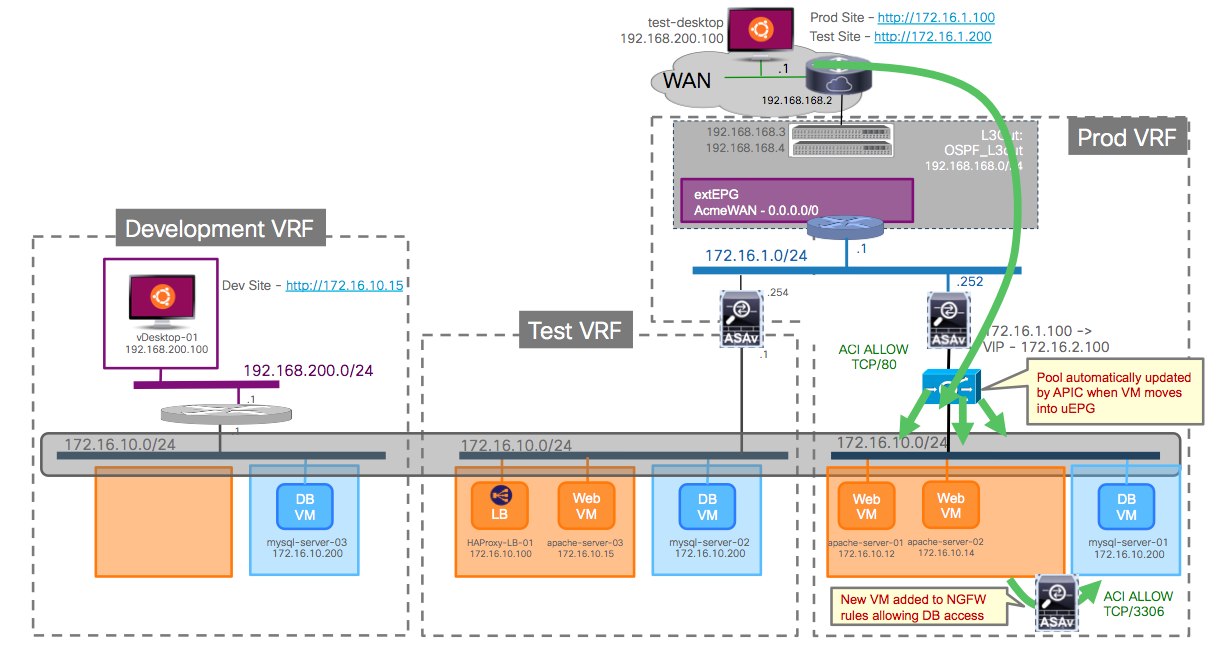
We will do so with a demo, working on the dev/test/prod environment from the previous blog post. If you want to skip the blog and go to the demo you can do that too. A quick reminder of the environment is shown on the picture below:
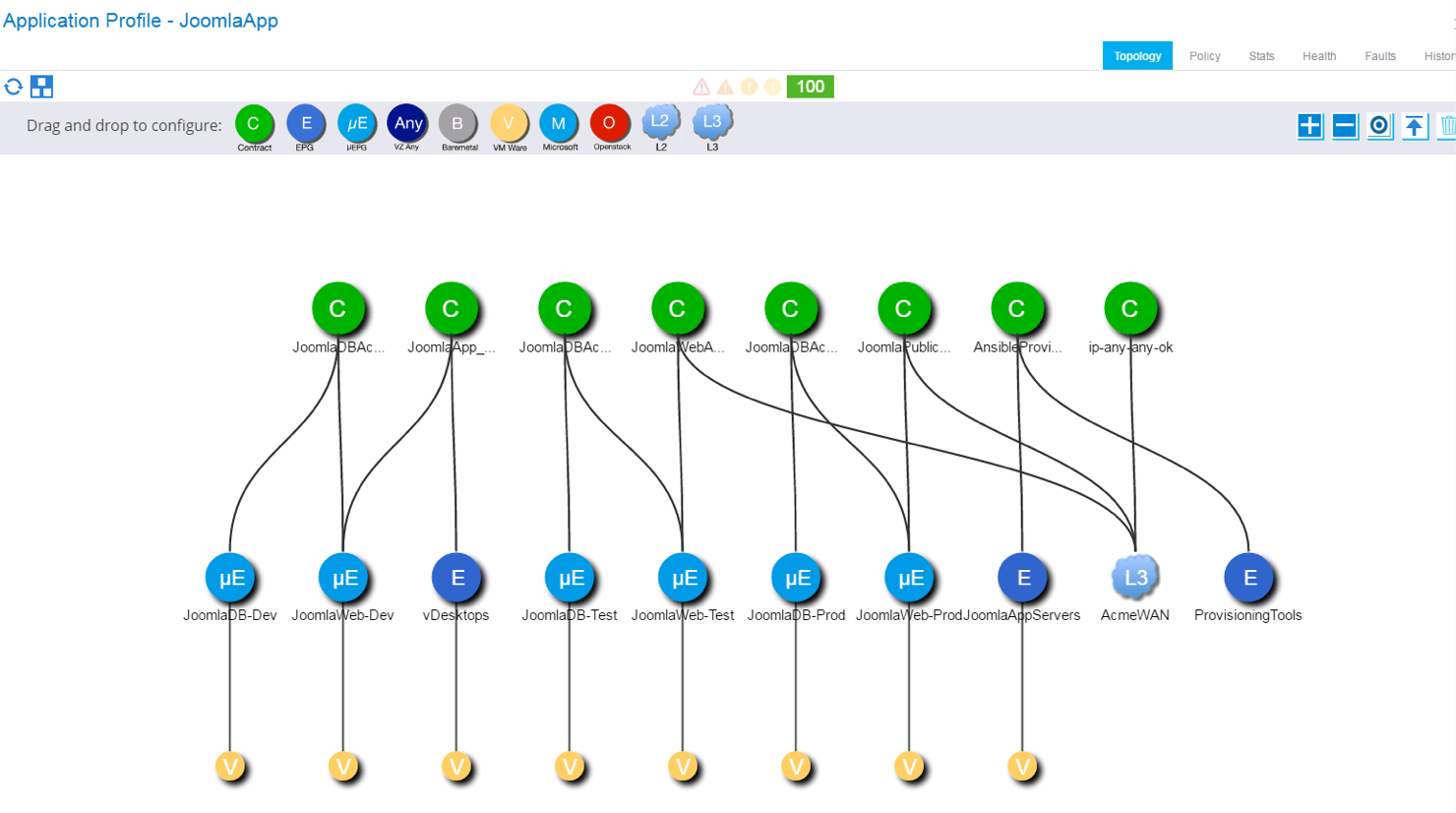
We can see the three VRFs (Dev, Test and Prod) and uEPGs for Web and DB on each of the environments. Virtual Machines connect always to the same dvPortGroup, and depending on their attributes they will be placed on the right uEPG.
This environment is seen in the APIC GUI in the following Application Profile, showing the various uEPG used for Dev, Test and Prod environments along with the contracts that establish relations between them, and with external networks (via the L3Out and external EPG AcmeWAN).
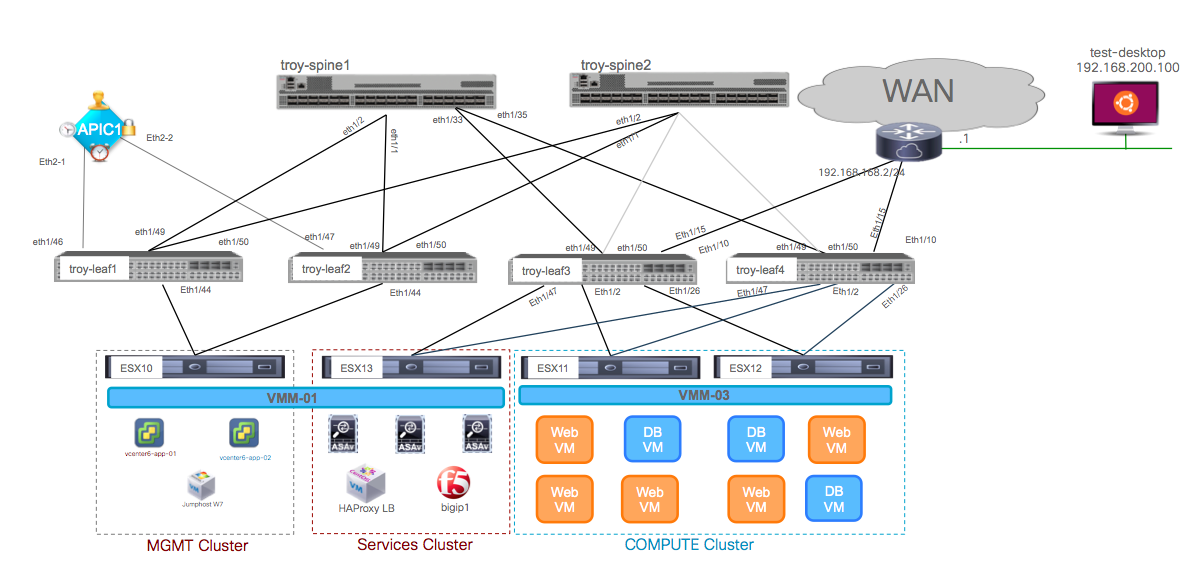
Now it is also time we look at the physical topology of the lab we used to build these demos:
It is a very simple environment where I have a vSphere DRS cluster of two servers (ESX11 and ESX12) where all user Virtual Machines are running. Then there is a “cluster” of one server (ESX13) where I am deploying all virtual services (ASAv, BigIP-VE, HAProxy …) and finally there’s connectivity between two of the leafs that are acting as border leafs (troy-leaf3 and troy-leaf4) and a WAN router to simulate the Acme WAN/Internet access.
Application Visibility and Impact Assessment
One of the advantages of ACI is that network virtualisation (i.e. network overlays) is integrated with the underlay fabric and under a single policy and management controller, the APIC. Therefore, when any endpoint, be it virtual or physical, attaches to the fabric it does so by connecting to virtual networks that are created for the applications that run on that endpoint (via Application Profiles). The fabric has visibility at all moments of where those endpoints are running (where they are connected), and in addition it also has a context of what application, application tier and tenant they are part of and to whom they can communicate with.
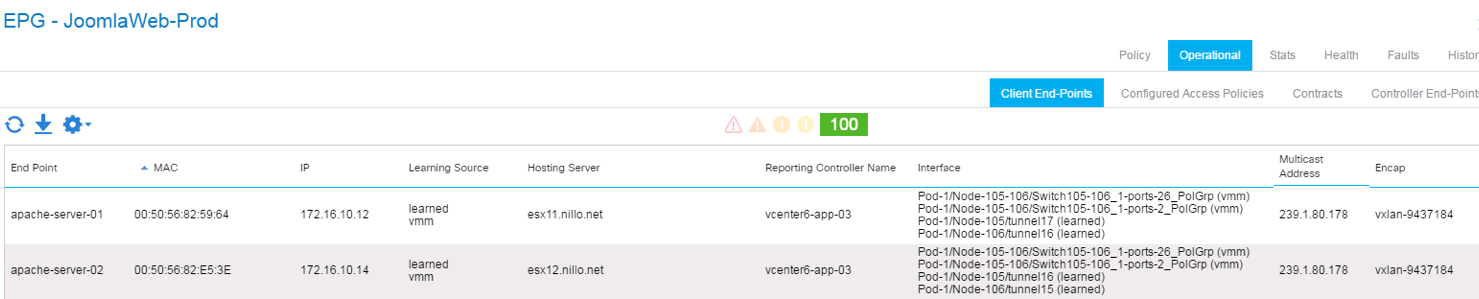
For instance, if we look at the endpoints inside the JoomlaWeb-Prod uEPG, we can see the endpoints in there, including the VM name, the physical hosts on which they are running, the vCenter that manages those hosts and the vPC and VXLAN details we are using to connect that host and the endpoint to the fabric. For instance, below we see that the vPC using port 1/26 on nodes 105 and 106 (troy-leaf 3 and troy-leaf 4) is used for connectivity to endpoints part of the JoomlaWeb-Prod uEPG:
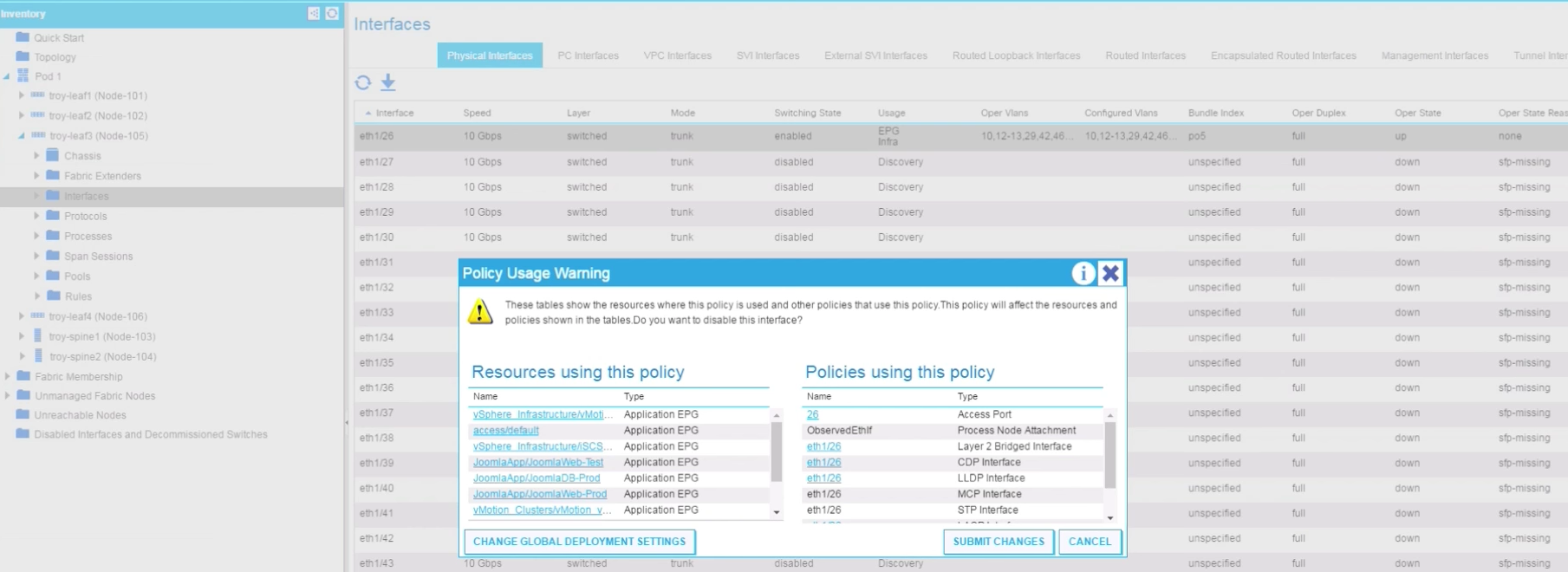
And this is true in both ways. We can also go the other way around and find a specific port and see what applications are running behind it. If the fabric administrator would try to disable one of those ports, say port 1/26 on troy-leaf3, it would get a warning telling it not only the network protocols running on that port, but also the applications and tenants impacted as you can see below:
This is very interesting because it provides a simple, effective and easy way to assess the impact on actual applications ahead of any network changes.
Also, this information is automatically updated and always on-synch, because if the workloads would move to another Cluster in the vSphere environment connected to other leafs, the APIC would learn that move and update the information accordingly. The policy also follows the VM as it moves of course.
Now let’s assume that port 1/26 on troy-leaf3 did go down one way or another. Clearly that would trigger an event/log/trap coming from the corresponding leaf. But does that long alone help us assess what the impact is? In ACI it does, and an easy way to do that is through Application and Tenant Health Scores.
ACI Health Scores
In ACI, the APIC is keeping track of all events, configuration changes, statistics and faults. Faults are handled as a managed object that is a child of the affected object in the MTI. For every fault, a record object is created in the fault log. The Health Scores are built based on rolled up faults between related objects, and provide a quick overview of the health of the system, modules, tenants, applications, etc.
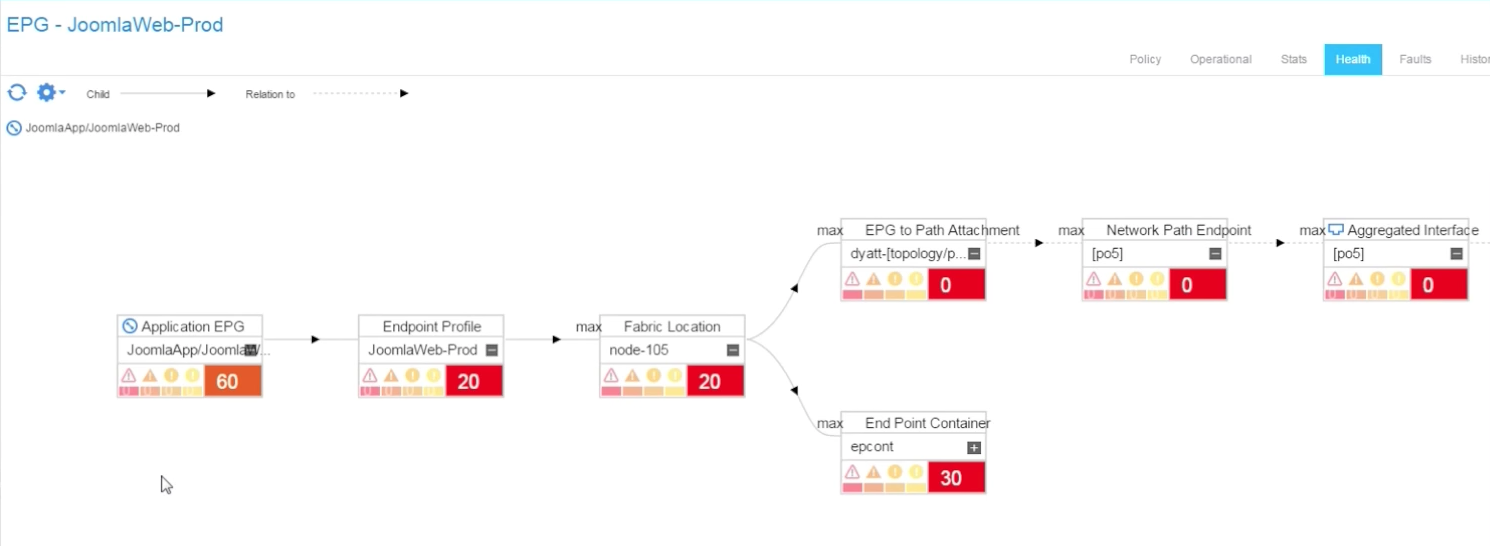
The health score has a range of 0 to 100, the perfect health score. Each fault reduces the health score of the affected object based on the severity of the fault, and the health score is propagated to the container and related managed objects. Discussing the detailed implementation of the Health Scores is beyond the scope of this post, but suffice to say that when the port 1/26 went down, this triggered a downgrade of the Health Score of the port to zero, and consequently this rolled up to the Health Score of the JoomlaApp application to that was downgraded to 68. It is important that not all uEPGs of the application were impacted. For instance, some had no endpoints connected on the affected ESXi host. JoomlaWeb-Prod however was affected, and by clicking on the health score value of this uEPG we can quickly move to the health score tree and identify the root cause problem, as seen below:
In this case, we already knew what the source problem was (because, we created the problem for the demo). But I hope the reader can see that this is very useful, since a single glance at a tenant’s dashboard can help identify issues by looking at the tenant’s health score. Then, very quickly you can see specific application and/or EPG health scores and soon after expand the view, as we did above, to root cause the problem.
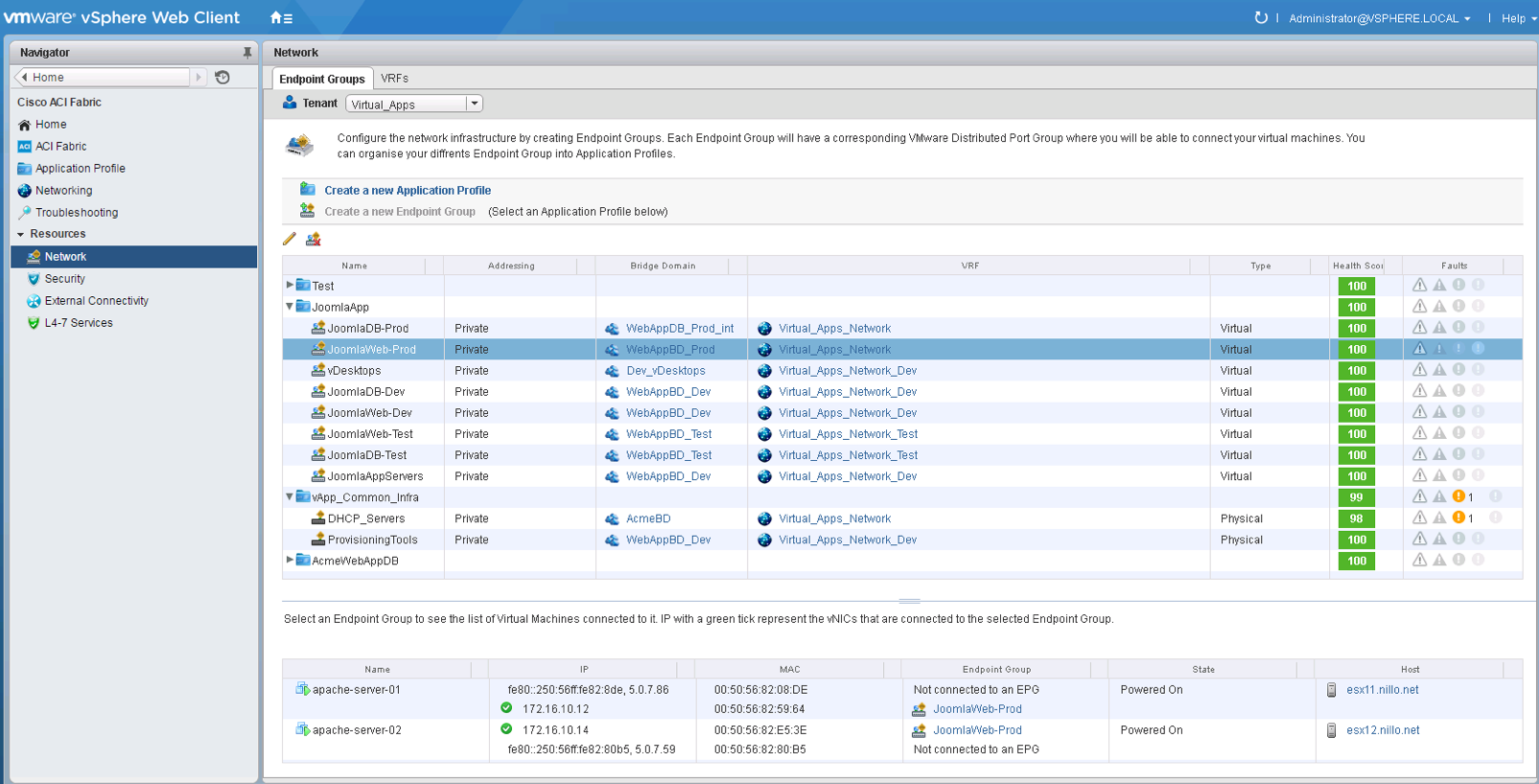
In the demo video we also show how these fabric health scores are exposed to the vCenter admin via the ACI vCenter Plugin, like you can appreciate on the screenshot below:
The ACI vCenter Plugin is supported since APIC 2.0 and is an entirely optional component. When used, it provides the vSphere administrator with an option to manage and/or view elements of the fabric. As you can see in the screen shot from above, you can see the health scores of each application and EPG and the associated fabric events and faults, if any.
This works for regular EPGs and also for attribute-based uEPGs, like the JoomlaWeb-Prod above.
Troubleshooting Connectivity Problems
But what happens when things break at a point in time and then they are back to normal. That is, a transient failure, where you try to identify what went wrong?
We can’t provide a definitive answer to every such scenario, but we can certainly contribute to solving a number of those. In the demo I simulate a human error. I imagine that while the application is in testing stage, someone made a configuration mistake on the filters of the test environment, then realised the mistake and fixed it a few minutes after. This broke the connectivity for a while, affecting a script testing the application.
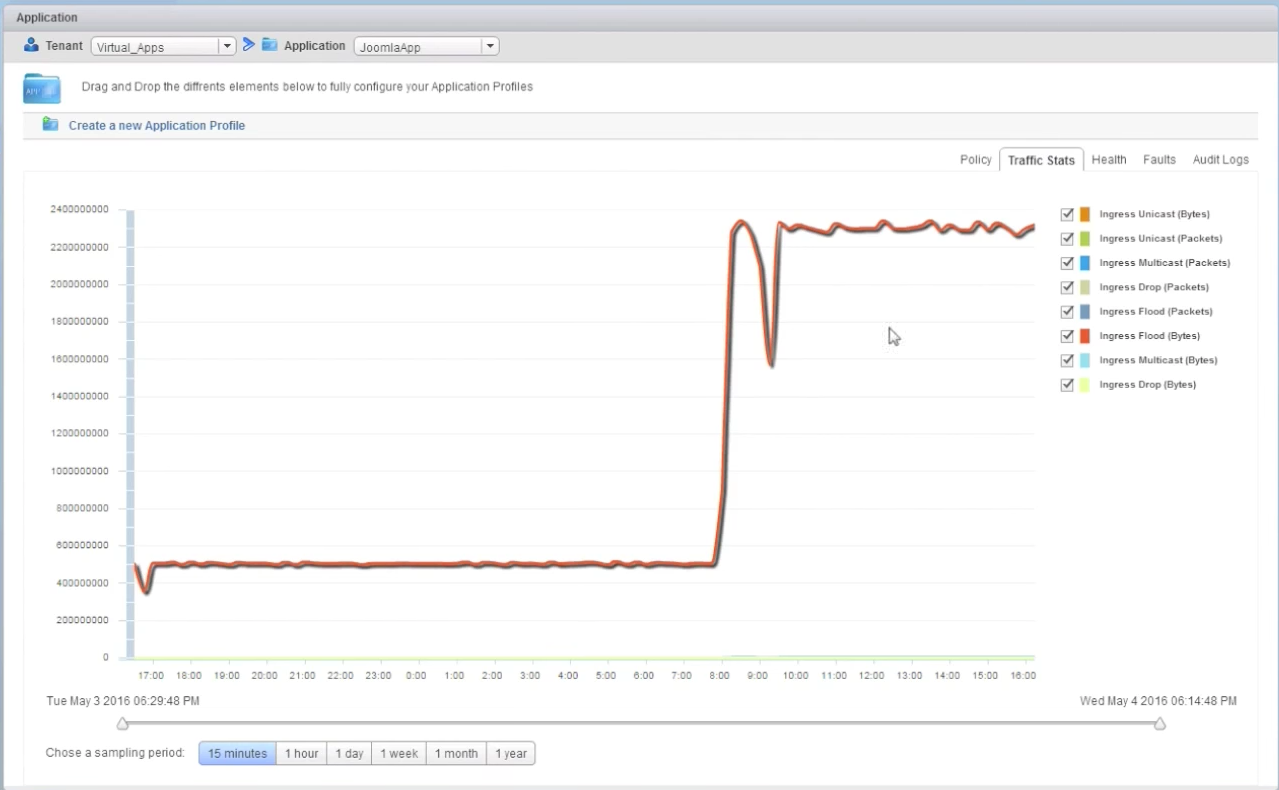
Then on the demo, I pretend that another engineer reviewing the results of the running test discovers a problem: the script testing the new version of the web page failed at some point. This engineer looks at the traffic stats on the ACI vCenter Plugin and notices a glitch in traffic at the time when the script failed. Therefore the engineer is assuming the problem was with the network:
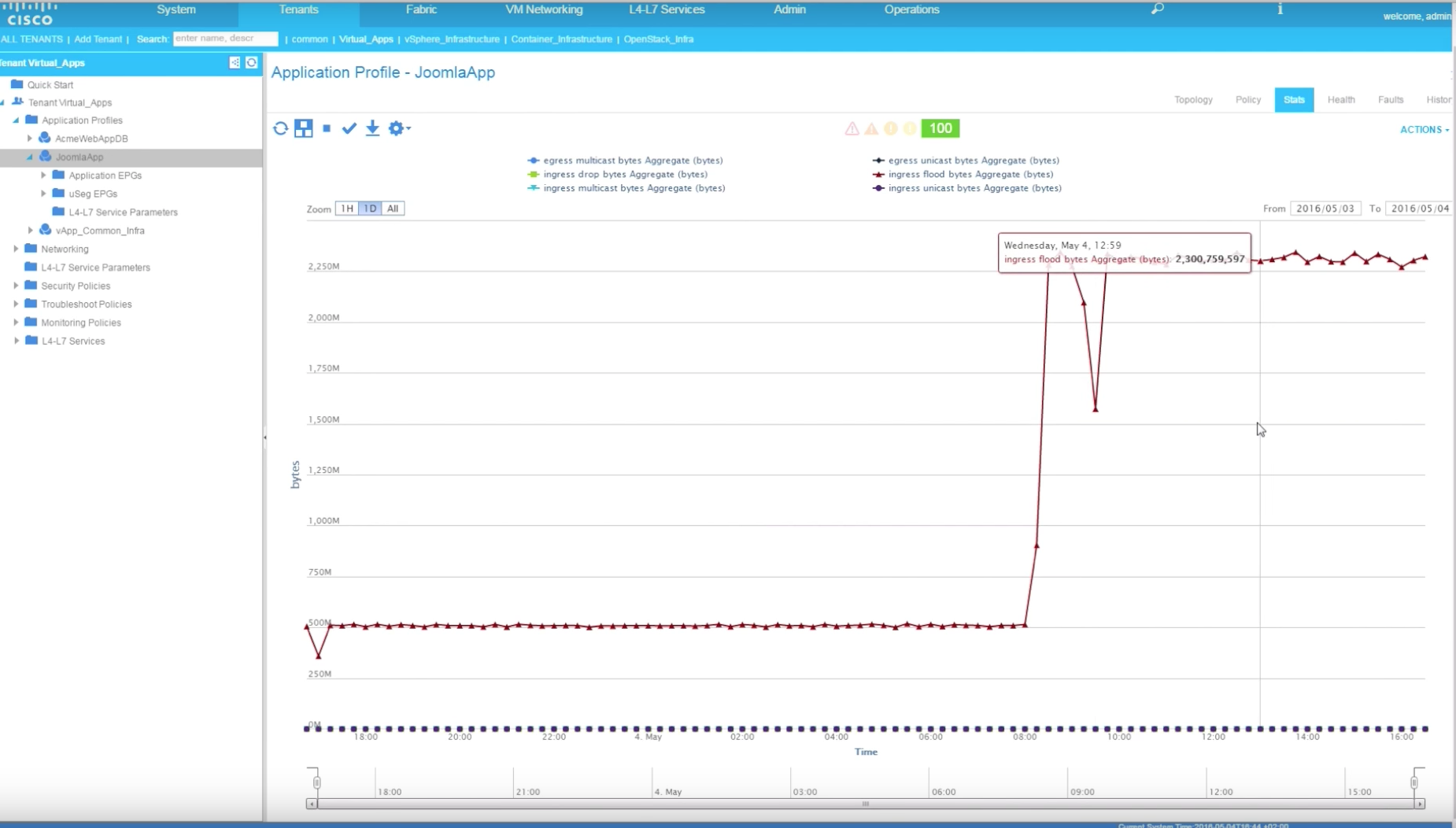
When the network team is contacted about it, the fabric admin can see the exact same glitch looking at the stats of the application. This in itself looks very simple, but on a traditional network that is managed box-by-box based on VLANs and ports, just correlating the statistics of the right ports, VLANs, SVIs, etc. can take quite some time to actually get to the same level of information (to begin with, you need to know the ports involved!).
In the event, we also know the specific VM involved in the testing, and now it is easy in APIC for the fabric administrator to search for the names of the specific VMs that are involved, and quickly find out where they are in both terms of vCenter and physical connectivity.
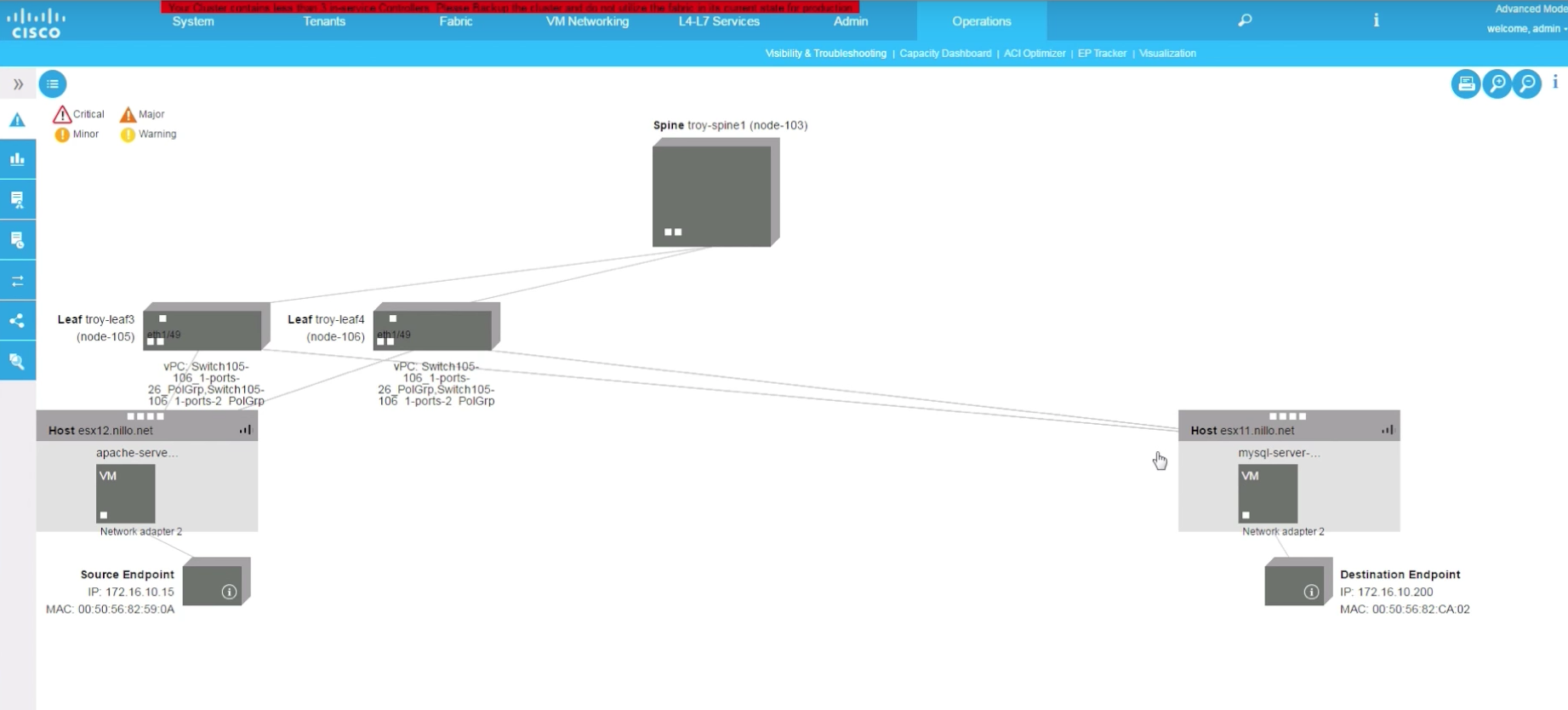
Also, once this is known, and since we know the time window when the problem happened, we can use the ACI Visibility and Troubleshooting Tool to have APIC draw for us the path between the endpoints involved, as below:
This gives us a lot of information for troubleshooting. We know in one view all network devices involved, the path between the endpoints (including L4-7 service appliances if there are any in the path), their IP/Macs, on which hosts they run, etc.
We can also quickly pull in all information about the contracts that is relevant for the communication of those specific endpoints, and similarly pull in the statistics, logs, events and faults that are relevant to that pair of endpoints during the time window we selected. All is already filtered out for us.
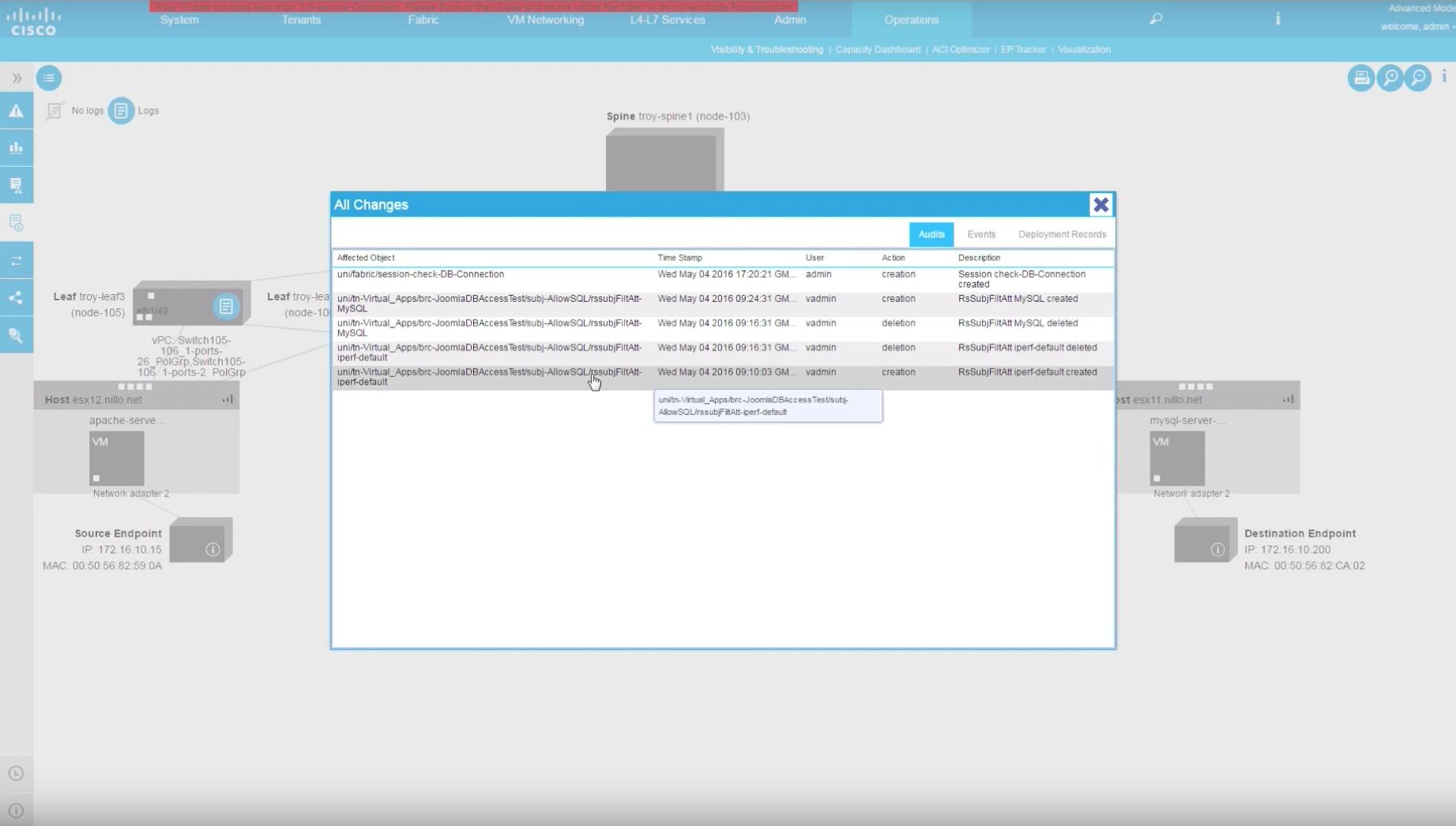
And in addition, we can also see a detailed Audit of all network changes that could have impacted that communication path during that selected time window. In the event, it is easy to spot that a filter was removed from the contract, thus breaking connectivity, right at the time of the network glitch and quickly added back a few minutes after. We can see what filter was removed and added back, and we can also see who made that mistake … ehem … change.
Conclusions
The examples above show the advantages of ACI in terms of simplification and the visibility when it comes to day-2 operations and troubleshooting. These advantages, exposed through the examples above, come from the fact that the underlay and the overlay are automatically correlated and under a single policy and management controller. Of course, this is also true when using Micro EPGs as we have seen already.
Using Micro Segmentation to enhance the security posture inside the Data Center and/or to simplify dynamic policy changes (like when moving from dev to test to prod) is great, but it is very important to do this in a way that is operationally simple.
If you reflect about what we did here, and you imagine a traditional box-by-box managed network combined with a traditional software-only network virtualisation solution, you can see the great advantage of the ACI model.
To quickly see what the impact that network changes have on specific applications, or in the reverse way, to see the application health from a network perspective and quickly see the specific events affecting it. To have automated correlation of every possible network or policy change, audit it, and see the impact it has on applications … To do these things in a traditional underlay with a separated overlay you would need to pull logs, stats, audits and event information from a lot of different systems. But that is not it … you would also need a lot of different tools to process that information, and more important, you would need to provide the intelligence to be able to correlate what information is relevant to one another. Furthermore, every time you make changes, every time you provision new applications, you would need to update all of that intelligence across a number of different tools.
In the case of the ACI, a single tool is required: the APIC. And at the same time, all that information is ready and at hand for other tools if/when needed through a single, open and well documented API.
Finally, you may want to checkout the demo. If you read through the blog you may skip the intro and go directly to minute 2:30.
During the lastfewweeks I’ve used this blog to talk a lot about how the Cisco Identity Service Engine (ISE) Express License Bundle is the perfect security complement to your wireless network. I’ve written about the ease of set-up, the very reasonable pricing and how it doesn’t matter about your organization’s size, you need robust, enterprise-level security.
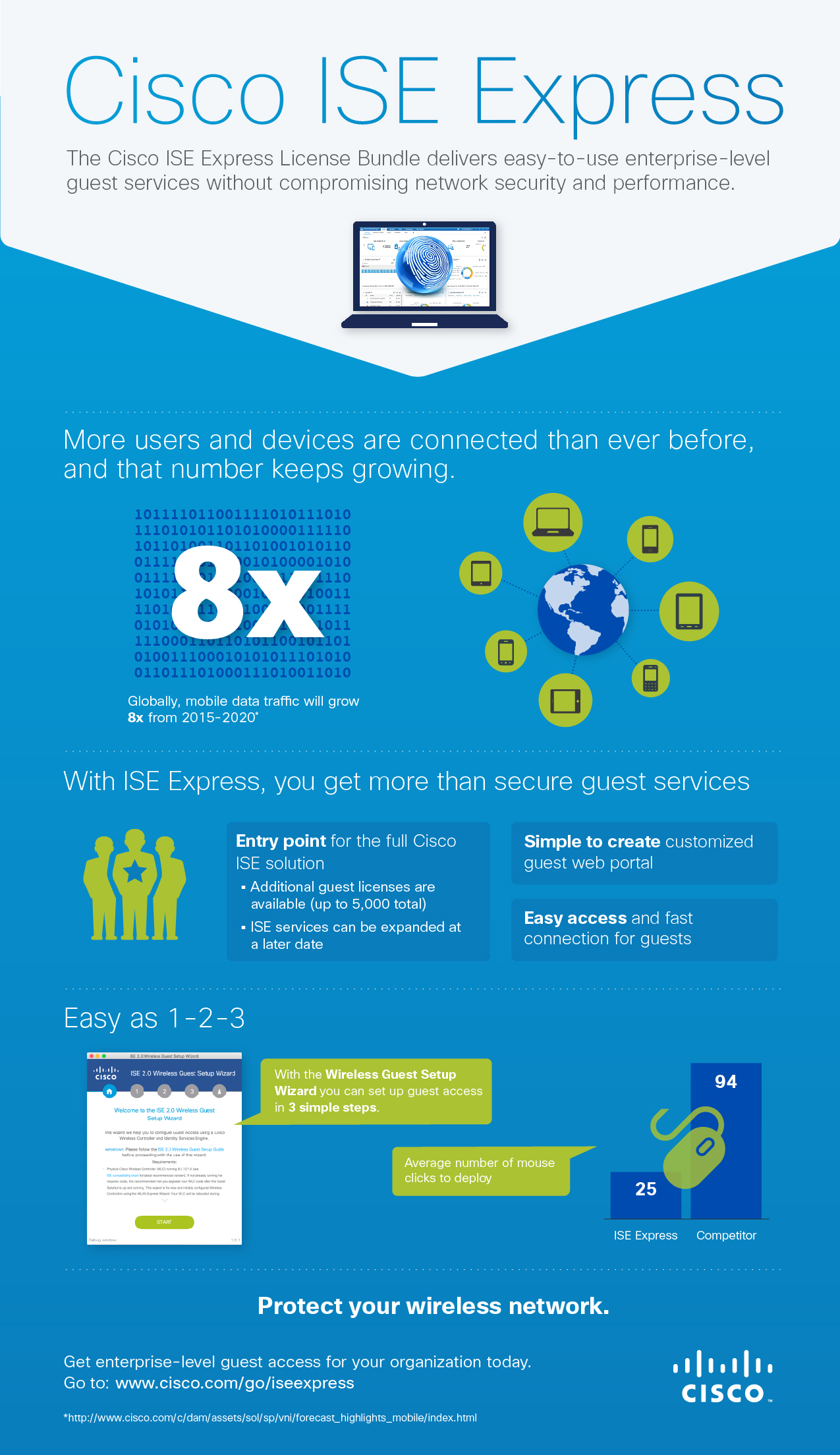
It has often been said that a picture is worth a 1,000 words. In that regard, I give to you Cisco’s newly minted ISE Express infographic explaining all of the concepts that we’ve been discussing since the beginning of June:
After you read it, head on over to the Cisco ISE Express homepage to find out more information.
Summer is my time to play catch up with TV. There is a huge list of TV shows and movies that will be streamed on Netflix and Hulu from the past year. Netflix may even allow you to download its videos, according to recent news. Over a gigabyte of data is consumed to watch an hour of “Game of Thrones” or “House of Cards” on Netflix via a device like Roku. Imagine if the whole world watched an episode together! According to the latest Cisco VNI Complete Forecast, global IP traffic will reach 194.4 Exabytes per month by 2020, up from 72.5 Exabytes per month in 2015. That’s an equivalent of watching 189 billion episodes up from 70 billion episodes in 2015! Once a full season of my favorite TV shows are on Netflix, I sometimes try to catch up with them in a single sitting. Binge watching is defined as 2-3 episodes of a single TV series in one sitting. If all global internet users binge-watched their favorite episode of TV today, it would generate over 10 percent of monthly IP traffic!
A lot more happens on the home broadband connection besides TV episode viewing that can cause Internet traffic spikes and surprises. We use nanny cams, pet cams, social media, online gaming, thermostats, home security solutions and much more. Besides the smartphone and tablets many of us now have, even our beloved furry friends have wearables, not just their owners.
On the business front, applications such as video conferencing, video surveillance, virtual desktop infrastructure (VDI), cloud storage, disaster data recovery and more with the focus on the many verticals. What seemed like nascent concepts such as smart cities, connected transportation, community hotspots and homespots are becoming mainstream.
The underlying need for all of these applications and services to be experienced in high quality by end users will drive improvements in broadband performance and reliability. Globally, the average fixed broadband speed will grow nearly two fold from 2015 to 2020, from 24.7 megabits per second (Mbps) to 47.7 Mbps. Faster connections mean faster downloads, which enable better experiences. For example, with a 10 Mbps connection, it would take 22 minutes to download an HD movie, and with 25 Mbps it takes 9 minutes. Whereas, for ultra-high definition (UHD) or 4K content, with a 10 Mbps connection, it would take 2 hours to download an UHD movie, and with a 25 Mbps connection, it takes about 48 minutes.
User experience illustrates the importance of broadband for high-bandwidth applications. However, the key to these experiences is not just download speed (typically measured in Mbps), but also upload speed (Mbps) as well as latency, which is measured in milliseconds (ms).
Lower latencies provide better experiences. Latency was characterized by Nielsen as follows:
0.1 second gives the feeling of instantaneous response – that is, the outcome feels like it was caused by the user, not the computer.
1 second keeps the user’s flow of thought seamless. Users can sense a delay, and thus know the computer is generating the outcome, but they still feel in control of the overall.
10 seconds keeps the user’s attention. From 1–10 seconds, users definitely feel at the mercy of the computer and wish it was faster, but they accept it. After 10 seconds, users start thinking about other things, making it harder to concentrate on the task once the computer finally does respond.
Real-time voice and video communications require network latencies between 100 ms. and 170 ms. Loading web pages typically involves multiple requests to multiple servers, which results in network latency requirements lower than 50 ms. Today’s networks are supported by DSL, cable, partial deployments of fiber, 3G, 4G, 802.11 b/g/n and similar technologies that enable users to experience applications such as in the following figure.
Figure: Applications of today and the future: Speeds (Mbps) and Latency (ms) requirements
Advanced apps like cloud gaming, remote office, real time video services streaming, virtual reality, touch response applications and others can push latency requirements down to single digit milliseconds. Autonomous or driverless vehicles that are remotely controlled or high frequency stock trading need single digit millisecond latency or even lesser. These applications require access to the computing and storage distributed across the globe and also in close proximity of the user, therefore reliant heavily on not only fast but also low latency network connections. 5G, 802.11ax, pervasive fiber deployments and others will provide the next iteration of major connectivity improvements, with many of these technologies slated for ratification and/or commercial deployment 2020 and after.
There are many applications today that are well poised to take us into the future, Facebook supporting 360 degree videos, Periscope, Twitch, VR with Oculus and others, as well as the new and very trendy augmented reality game Pokémon GO and the like. I can’t wait for the immersive experiences that future broadband innovations will bring. But in the meantime, I’m simply looking forward to several seasons of TV shows that I’ve been too busy to watch. Ahh, Summertime….
The world has never been more connected, and there’s never been a better opportunity for co-innovation, co-development, co-marketing, and even co-funding.
The time is right for the co-economy—a trend that is reshaping how we work, live, and conduct business.
Granted, some aspects of the co-economy have been around for years. I remember the idea of “co-opetition” surfacing back in the 1990s, for example. But now the co-economy is going mainstream, changing our fundamental assumptions about how to get things done. It is redefining how companies build products, culture, and processes. It is redefining employee skill sets and how we measure their success. It is redefining business relationships—changing how we thing about who is the vendor, who is the customer, and who is the partner.
The co-economy is happening now, in a big way.
Over the past few months, I’ve been focusing on co-innovation and co-development in this blog series, exploding the myth of the lone inventor, and exploring why this trend is happening now. I’ve talked about the dos and don’ts of co-innovation, which can set the stage for success or doom a project to failure. I’ve also talked with customers, partners, and startups about their co-innovation experiences and lessons learned.
What is clear from all of this is that co-innovation is becoming the way to bring new products and services to market.
Gone are the days when customers provided input into the product requirement document then faded into the background until the beta test stage. Today, customers want to be partners in solving their own business problems. The co-economy requires different skills, behaviors, and business processes. And that is having a ripple effect on employees, companies, and industries.
Employees need more than technical know-how and business acumen to be successful in the co-economy. They need to be able to collaborate in virtual teams. They need to be able to work across organizational boundaries to contribute to open-source efforts and new standards bodies. Creativity and “EQ”—emotional quotient – are becoming more important factors in hiring and promoting employees who can work in this new “co-environment.”
For companies, the skills required to navigate the co-economy are even more complex. The new co-development models are customer-centric—and it’s not just customers’ IT departments that are looking to co-innovate. Lines of business also want to partner on solutions that deliver specific business outcomes. So vendors need to form ecosystems of partnerships focused on a customer’s business challenges—not their own technical offerings. No one company can do it alone. We need to co-innovate with customers, other vendors, and startups—each bringing our own skills, expertise, and relationships to the table. When the customer is at the center, the whole ecosystem benefits.
Entire industries are also being reshaped by the co-economy. Developing a game-changing innovation like the self-driving car blurs the lines between manufacturing, transportation and technology. These industries used to exist in separate universes, but now they are chasing the same pools of talent to work on different sides of the same innovation effort.
Now is the time to embrace co-innovation. You can start by becoming the co-economy champion in your organization. Work to change processes and culture around co-development. Dismantle silos and develop strong ecosystems of partners who can complement your organization’s strengths.
And lay to rest, once and for all, the “not-invented-here” mentality. Companies that work in isolation, focused on one-company, end-to-end solutions are in danger of being out-innovated and out-operated. But those that understand the power of the co-economy will be the new winners.
Begin now. There’s never been a better time to enter the co-economy.