So much inspiration (and action) came out of Cisco Live this week. Who better to recap it than our very own Nirav Sheth and Rick Snyder? This week let’s look back by hearing Nirav’s perspective on Cisco Live.
>> Fast Forward: Rick joins us next week with his takeaways and highlights: what you need to know and what everyone is talking about.
What’s next?
I’ll be back next week with our regular Rewind and Fast Forward.
The partner weekly rewind and fast forward is designed to give you a snapshot of what you missed and what’s to come. Tell us what you think and what you want to hear about in the comments. And come back next week for more!
You might remember a blog from our own Todd Brannon called “All about that BaaS” which outlined a jointly tested reference architecture for “Backup as a Service” with Commvault software. That engagement advanced Commvault to preferred solution partner status to deliver our joint customers a solution that is fully tested for compatibility with Cisco UCS servers and also comes with a 24/7 support model. The solution is targeted for enterprise and cloud service providers and consists of Commvault software running on the Cisco UCS S-Series storage servers providing high capacity secondary storage. A lot can happen in a year when participating in Cisco’s Solution Partner Program and I am excited to share with you the latest developments around Data Protection and our continued partnership with Commvault.
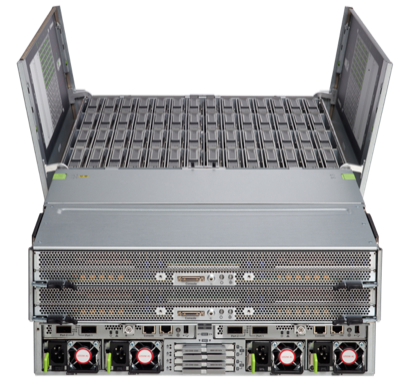
On the Cisco side of things, we launched the new S-Series line of storage storage servers, starting with the Cisco UCS S3260. This new storage optimized server is modular by design to maximize a customer’s investment protection as their storage requirements scale up over time.
Most high capacity storage optimized servers are fixed configuration, meaning their main system boards are physically screwed to the chassis requiring a fork lift to upgrade. A modular system architecture provides flexibility for end users to upgrade server nodes, networking and storage components as each respective component’s technology evolves without the need for data migration during maintenance windows. The new Cisco UCS S3260 offers dual-node support for two socket Intel Xeon processors, 40Gb connectivity provided by a Cisco VIC 1300 enabled system I/O controller and support for a number of storage protocols such as FCoE, NFS, SMB, SMB Direct and iSCSI enabling centralized mass storage for heterogeneous data centers.
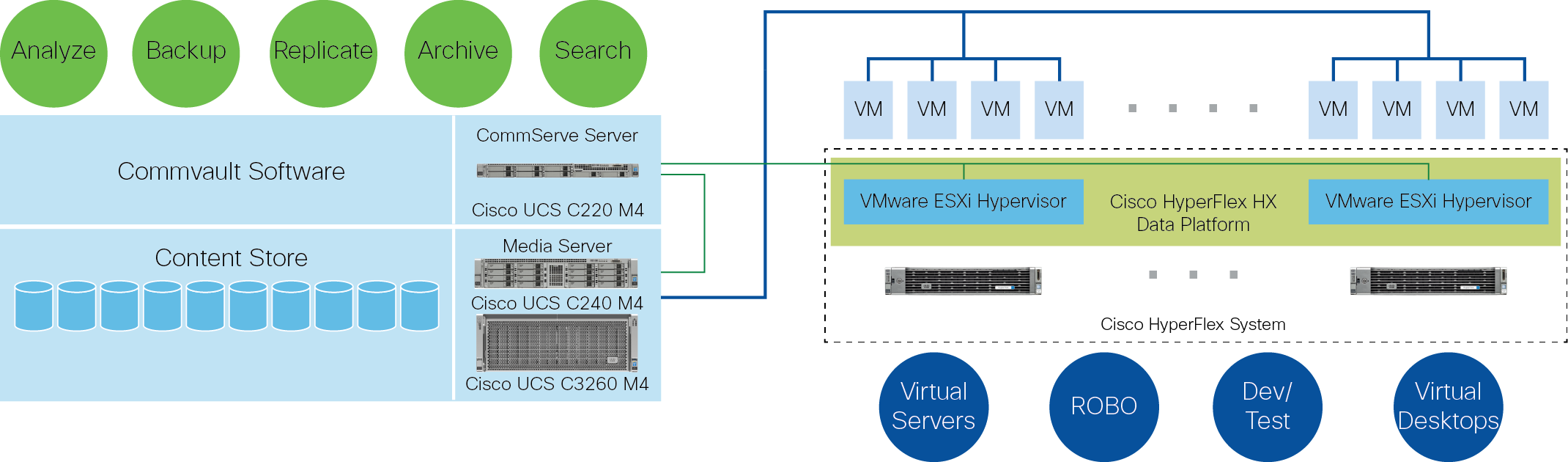
This brings me to where we are at with Commvault as Cisco UCS servers are the key underpinnings of our joint solutions. Creating the Commvault “Backup as a Service” solution enabled us to offer a proven reference architecture that is validated in our labs and backed by Cisco UCS Compatible status to reduce risk for our customers. We took it a step further and focused on the relationship between primary and secondary storage to further reduce risk and complexity. This week at Cisco Live, Commvault unveiled a new reference architecture enabling customers looking to hyperconverge their infrastructure a proven backup solution for Cisco HyperFlex HX Series.
If you have been under a rock you may not have heard that hyperconverged Infrastructure is the hottest thing to hit data center computing since blade servers triggered a wave of data center re-stacks in the early 2000s. These new hyperconverged environments just like existing rack mount or blade systems will need backup services just the same. We have had huge success working with customers across all markets deploying converged systems and now see major interest in hyperconverged for virtualized environments, remote office and branch office (ROBO), development and test, and of course VDI. As these environments vary in size and could scale incrementally over time customers will need a data protection strategy that scales similarly. Cisco and Commvault have have worked closely to validate a wide range of capacity based data protection solutions ranging from the Cisco UCS C240 server all the way up to high capacity options like the Cisco UCS S3260 for web scale storage needs. If you are interested in learning more please take a peek at the new reference architecture by reading our new Data Protection for Cisco HyperFlex with Commvault Software Solution Brief.
If you liked this blog please stay tuned for more on data center storage solutions at Cisco and be sure to follow me on Twitter.
It’s Thursday and the sun has set in Las Vegas. That means it’s still hotter than blazes outside, but we’ve closed the books on Cisco Live 2016. It was a busy week of summer camp for geeks. How busy? CMO Karen Walker threw some mighty stats at the closing keynote crowd:
The Cisco technical team built the network from scratch in 4 days
The show network supported 37,000 wireless users a day.
We sent 34 terabytes of data across the network during the show.
Innovation Talk for Collaboration
Collaboration Technology Group execs Rowan Trollope, Jonathan Rosenberg, and Jens Meggers successfully took on the challenge of the morning session. Proof of attendee interest in collaboration showed clearly in the gathering outside the auditorium more than 30 minutes in advance of the 9 a.m. start time. More proof? The session went over the expected time. The audience stayed.
Rowan opened by talking about the group’s philosophy when designing products: simple, magical, and open. “We have a deep belief that systems should be open,” he explained. He also acknowledges that it’s not always about the newest innovations: “The technology has to work with whatever you have – but it also needs to make it work better,” he said. “Cisco Spark, when combined with the technologies you already have – can make your existing things better.”
Jonathan focused on business messaging and showed off something simple: a green button. The significance is that it simplifies joining meetings. The green button replaces the manual entry of a litany of phone numbers and meeting passcodes.
Jens started with “there’s more to Cisco Spark than just messaging.” He announced the capability of all our desk and room systems to natively connect to the Cisco cloud — today. This brings everything to the cloud with no infrastructure required.
He also focused on how well the portfolio works with the network — and why it’s so important to the video experience. “Every millisecond matters,” he said. “When it comes to video, network latency becomes your biggest enemy.” He also announced the Spark Video SDK, which will roll out in a limited beta in the next few months. I like the way he explained it: “We are committed to openness — why should we keep all this technology to ourselves?”
Also on the horizon is the newest member of the collaboration team: Monica. Who is Monica? Monica is a digital assistant who functions within Spark. “Digital assistants work great in the consumer world to make things easier – why not in the business world?” Jens asked. In essence, the team has optimized digital assistant technology for business – trained it with directory and schedule info. Monica can take on tedious tasks so people can get back to their meetings. Expect to hear more about Monica in the coming weeks.
Watch the Collaboration episode of the Cisco Live Backstage Pass. The first half includes an interview with Rowan and Jonathan, the second gives you a tour of the latest gear in the Collaboration booth.
Attendees kept our booth crews busy doing demos and answering product questions all week. Every time I went to see the booth, it was buzzing with people. Some of the busiest kiosks were for Cisco Spark, Acano, the 8821W wireless IP phone and the 8865 color video IP phone, Presenter Track, and the Apple iOS integration. People were enthusiastic in particular about the ability to register endpoints to directly to Spark, which provides more options to smaller organizations or enterprise looking to do cloud-prem hybrid deployments.
Bring on the Bots
If you ask me, the idea of “there’s an app for that” has gone too far. I don’t want an app for this, that, and the other thing – let alone 17. Instead of all those apps, chat bots provide an opportunity to take advantage of messaging apps to deliver more functionality. In case you missed it, Wednesday’s #botchat included great insights about everything you can do with bots these days and a peek into Built.io’s integration software and how it can connect pretty much anything to Cisco Spark. You can read the conversation on Twitter.
Hello Watson
I stopped by the IBM Watson booth to learn more about how we’re bringing together our respective collaboration solutions. I got a great overview of how we’re bringing together Cisco Spark and WebEx with IBM’s Verse and Connections – and how Watson will join the fun to make my life (and your life) much easier going forward. The IBM team shared some great research and stats to show what we’re working to solve:
Currently, the average employee is distracted once every 11 minutes and needs an average of 25 minutes to refocus on tasks.
People compensate by working faster (but not necessarily more effectively), and experience more stress, higher levels of frustration, and greater time pressures.
I haven’t used a stopwatch to time distractions, but it all rings true to me. So I’m on board. Let’s fix it.
Apple + Cisco The Apple + Cisco booth was a good place to get more insight into our relationship and efforts with new iOS APIs. Cisco Spark will use new iOS APIs to directly integrate VoIP calling capabilities with iPhone and iPad. But that’s just part of the story. Learn more in the video about integrated voice and collaboration and on our Apple partnership page.
Closing Keynote: Kevin Spacey on Storytelling
In the midst of great impressions and amusing anecdotes, actor/producer/writer/musician/etc. Spacey shared great insight on storytelling. It was a quote fest and a laugh fest. Just to keep on message, I’ll share some of my favorite soundbites from his views of storytelling:
“Stories are at the center of what we all share together.”
“[With technology] there are more ways today for all of us to tell stories than ever before.”
“Now that we’re all talking, who is listening?”
“No one ever breaks new ground by playing it safe…. We should all be in a battle with mediocrity.”
Cisco Champions Rock the Twittersphere
The Cisco Champion program is a group of customers and partners who are enthusiastic about technology — including ours. They’re techie, they’re social, and they’re opinionated. At least five of the top ten active Twitter users this week are members of the program – including Zoe who attended (and tweeted) remotely from the U.K.. The top tweeter of the week was @collabsensei, also known as Dennis.
Some may consider it ill-advised, but someone handed me a microphone to moderate a panel about using social media to build your personal brand. Cisco Champions and panelists Justin, Dustin, and Ed provided great insight about how blogging and tweeting have helped them build credibility and make contacts in the technical worlds. Biggest advice for those looking to join the fray: be authentic. (Let me know in the comments if you want me to put together a blog post with their thoughts!)
Other Nuggets from the Week Attendees, partners, and Cisco teams came together exceed the goals for the Stop Hunger Now and Clean the World volunteer projects. This year’s hats blink. A lot. My Fitbit hates me. I’m surprised it didn’t burst into flame.
Special Shout Outs
In addition to the Cisco teams, some pretty amazing groups helped make CLUS run smoothly. I want to express gratitude to the Mandalay conference center and catering staff, orange-shirt information gurus, bus wranglers, security, and all the other groups that contributed to a smooth event. Extra thanks to Ryan and Miranda in the booth, Rita with catering, and JR from the orange-shirt crew for sharing their amazing positive energy within the chaos that is CLUS. Your efforts stand out – and made a difference to me and many others.
That’s all folks. @ciscokima has left the building.
What did you think of Cisco Live? Whether you joined us in Vegas or followed online, please share your feedback in the comments.
I have been privileged throughout my career to work with and for service providers. And these days, it’s particularly exciting to be a service provider. Nearly every aspect of our lives is being impacted by the explosion of IP devices, apps and services. We believe this creates a $2 trillion opportunity for service providers over the next decade. Can you imagine what that means for service providers around the globe? The possibilities to transform the service provider business and consumer experiences are endless.
My passion lies in mathematics and engineering, specifically in determining how technology can become a catalyst for business and experience transformation. I’d like to share with you how I believe Service Providers can thrive in the future. It comes down to five integrated principles that service providers need to take to transform their networks: virtualize, automation, simplification,and-programmability, to reduce total cost of ownership. Let me explain briefly what I mean by each.
We are in the midst of an exciting technology transformation – digitization. Digitization will enable countries to maintain global competitiveness, increase GDP, foster innovation, and create new jobs. It’s predicted there will be over 50 billion connected things by 2020.
In order for countries to embrace the opportunities this digital transformation can bring, they need people with the right the technology skills. However, as the technology landscape is changing so rapidly, new and more complex skills will be needed for current and future jobs. These include both technical and non-technical skills, such as:
Network management
Digital security and privacy
Analytics
Application development
Device management
Problem solving
Collaboration
Creativity
Business knowledge
(Gartner, 2015)
Employers worldwide report having difficulty filling jobs, up from 26 percent in 2014 to 38 percent in 2015, and the gap between supply and demand for technical skills remains an issue for all countries. A new study from IDC supported by Cisco shows that, when it comes to the skills needed for digitization, many countries are not ready. Latin America faces a shortage of over 400,000 full time equivalents (FTES) now and through 2019. The gap for essential networking skills, which includes security, is 30.8 percent in 2016. This is alarming because security plays a critical role for companies, and 86 percent of those surveyed report having a strategy for cybersecurity. In addition, for emerging technologies such as cloud and data center, the skills gap is even higher at 43.3 percent. This means that about one third of jobs involving these emerging technologies could go unfilled.
Around the world, organizations across all industry segments and markets are faced with the task of adopting digital technologies. Business leaders realize they must begin their digital transformation journey now, or risk fundamental business disruption and, potentially, business obsolescence.
Unfortunately, many organizations are missing out because they lack a comprehensive and effective security strategy. Recent research shows that concern about security can cause organizations to either delay or stop digital initiatives, which puts them at a competitive disadvantage. Those that excel embrace security as an enabler of innovation and growth.
64% of senior business leaders recognize that cybersecurity is a vital foundation for their digital growth strategies, citing it as a “significant” driver of success for digital products, services, and business models.
71% said that concerns over cybersecurity are impeding innovation in their organizations.
39% said that their organizations had halted a mission-critical initiative due to cybersecurity fears.
Organizations that lack adequate security capabilities will experience slower adoption of digital technologies, resulting in smaller realization of their intended business benefits.
This is why we’ve introduced Security Advisory Services specifically focused on helping organizations navigate the security aspects of their digital transformation journey. Our new Security Services for Digital Transformation helps our customers develop and implement a customized digitization strategy with security as the foundation, optimized for their industry, and designed to balance their organization’s appetite for risk with its desire for innovation and growth. These services are delivered as a customized engagement, tailored to each specific organization’s needs and desired outcomes.
An engagement may include services in the following categories:
Business strategy and advisory Our security experts help organizations assess their current and desired states within the security services lifecycle. Using a framework for planning digital transformation, we’ll work together to construct a roadmap to achieve the desired organizational outcomes.
Design, build and remediate
Leveraging vertical specific architectures such as those found within Cisco SAFE, Cisco Digital Healthcare Architecture, and Cisco CPwE (Converged Plant-wide Ethernet), we’ll help organizations design and implement integrated architectures to achieve their security objectives for digitization. Services may include preparing a threat management strategy; assessing and deploying secure applications; securing mobile and cloud technologies; and meeting regulatory and industry compliance requirements.
Maintain, optimize and operate
We’ll help ensure continuous security across the organization to enable full value capture from a client’s digitization strategy. Services may include 24×7 threat monitoring, advanced analytics and threat hunting; converging IT/OT security management and operations; and optimizing security investments to reduce complexity and cost.
Our team has been actively helping customers secure their digitization strategy. A recent engagement was initiated when a global oil and gas customer needed to gain deeper visibility into its production operations to reduce security risks. We provided a solution that allowed the customer to obtain an accurate baseline of its critical assets and reduce the operational risks of cyber threats. The customer gained new insights into its real-time security posture and is on track to achieve significant cost savings over time as a result.
Digitization and security together will serve as a major force in driving growth and innovation across all industries. With our new Security Services for Digital Transformation, we help organizations develop and implement a customized digitization strategy with security that is built in, optimized for their industry and business outcomes, and designed to enable business innovation and growth.
In September of 2014, Cisco announced its intent to acquire Metacloud. For those of us working at Metacloud, it was an exciting day. There were so many things we wanted to do to create the ultimate Private Cloud as a Service offer that would delight our customers by removing the complexities of deploying, managing, operating, and updating their OpenStack-powered private clouds. Our team was comprised of great leaders from Ticketmaster and Yahoo!—leaders who had a wide range of experience in operating distributed systems at scale.
In June of 2015, Cisco acquired Piston to enable greater business agility and help lower costs as organizations shifted from a primarily on-premises IT structure to hybrid IT. At this point, our team (and our expertise) grew substantially. Working with other business units at Cisco, we assembled an offer that combined software, hardware, and expertise into an easy-to-consume, production-ready platform that can be deployed quickly and is backed by a 99.99% uptime SLA.
Since then, we’ve seen a four-fold customer increase, and our momentum is only growing, with 60% socket growth YoY for the latest quarter end.
Today, we’re announcing the Metapod 4.0 GA Release, based on Red Hat OpenStack Platform 8, an open source foundation for cloud deployments co-engineered with Red Hat Enterprise Linux. This represents an important shift in how we plan to deliver greater customer experiences moving forward. As curators of OpenStack, responsible for building and operating a platform long term, the underlying software matters. And based on our experience with customers and partners, we believe that more enterprises trust Red Hat for Linux and OpenStack software over other distributions.
Combining Red Hat’s expertise in packaging a production-ready OpenStack distribution and our expertise in curating, managing, and operating it can result in a number of benefits. First, the collaboration with Red Hat will enable our teams to focus more on bringing OpenStack enhancements to customers. Up until now, our Cisco Metapod team resources have been devoted to stability in the form of testing, bug fixes, and evaluating features from trunk for readiness. The product and engineering coordination now allows us to utilize Red Hat for their expertise in these areas, helping to enable our teams to accelerate our roadmap and tackle customer feature requests around networking enhancements, multi-cloud management, support for storage devices, upstack capabilities around containers and microservices architectures, and more self-service capabilities.
Finally, our collaboration will help us to continue to meet our industry-leading SLAs and create new models for different types of use cases, all while providing upgrades and proactive monitoring, response, and resolution. As demand for Metapod continues to grow, we’re now working to create offers aimed at Service Providers, as well as those who have regulatory compliance needs.
And in case you’re wondering: No, this change won’t impact our pricing at all. Metapod will continue to be an outstanding value, with a compelling ROI and industry-leading SLAs—available at exactly the same cost as it was before we shook hands with Red Hat.
Here are some of the technical benefits customers can expect in this release:
Cloud administrators can define QoS at the port level for projects and instances. This gives customers more granular control of network bandwidth based on application requirements.
Faster instances booted from a volume, thanks to a new caching system in place for the block storage system.
Orchestration becomes more efficient thanks to parallel resource provisioning. New logic added to the orchestration service will allow for the creation of instances, networks, and key pairs. The Liberty release also supports many new resources for provisioning through the orchestration service.
Access and Security gets more fine-grained role-based access control with new domain support. Now, customers can use domains to collect similar projects and users together and isolate them from each other. Different domains can also use different backing technologies for authentication, like LDAP or Active Directory.
If you’d like to learn more, visit Red Hat’s blog on the release here. Have a question? Leave a comment or tweet me at @nikiacosta.