Avatar

Cloud platforms are increasingly a viable option for a growing set of enterprise applications and workloads.   Application teams are uncompromising in their desire to build and deploy new applications into public cloud environments that deliver speed and choice. Industry analysts tell us that almost 50% of enterprise organizations are starting to build private clouds which means that data center professionals need to maintain an increasingly hybrid mix of cloud resources. This has lead to leadership teams asking “who is going to manage this hybrid mix?”

YOU can with Cisco CloudCenter.

Cisco CloudCenter expedites hybrid cloud outcomes by modelling, deploying and managing applications across approximately 20 different data center, private or public platforms. This application centric approach abolishes the duplicative coding efforts of other hybrid cloud solutions resulting in a reduction of up to 60% of developers time spent on these activities. Best of all, each application profile contains a “bill of materials” for the configuration and type of infrastructure needed to support that profile.  Cloud orchestration solutions, such as Cisco ONE Enterprise Cloud Suite; as well as other private or public cloud orchestration tools automatically set-up the infrastructure to the exacting requirements of the application profile.

ZackKielichWould you like to go deeper and learn more about CloudCenter?   Join TechWise TV’s Robb Boyd and cloud expert, Zack Kielich, for a deep dive conversation and live demo of how CloudCenter makes hybrid cloud management a whole lot simpler.    Register now.

Authors

Joann Starke

No Longer with Cisco

Avatar

The mobile revolution has only just begun…

The number of terminals is growing exponentially and the use of video is an ever-increasing trend. A growth of 53% of the yearly mobile data traffic is forecast by 2020. In a context of deeply changing consumer habits, half of the service providers we know today will have disappeared in ten years’ time. It is therefore down to service providers to reinvent themselves ahead of the impending 5G revolution. 5G isn’t just a mere technological advance but rather a brand new chapter in the digital era.

Cisco has already embraced the challenge to deliver innovation. What about you?

The new ultra services platform from Cisco virtualizes all the key functions for mobile services and automates their deployment thereby allowing operations to be fully optimized. By focusing on strategic development areas such as voice over Wi-Fi (VoWiFi), virtualization and orchestration of the packet core network. Cisco solutions allow a flexible infrastructure which is both powerful and secure. Cisco delivers tools for tomorrow’s competitive landscape by inspiring new business models which will encourage the creation of new services with high added-value. With Cisco’s secure cloud-based services, operators are able to build innovative and fully rounded package offers. Cisco also helps service providers to conquer further markets in the Internet of Things, in fields as varied as manufacture, public services, banking services, or even being part of tomorrow’s urban landscape with fully connected cars. Many people already trust Cisco to help them build tomorrow’s mobile services. Cisco offers you a reliable, innovative and unmatched portfolio of services, to help you achieve your goals for sustainable development and deliver a unique user experience. Together, let’s ready the world for 5G!

Related topics: What’s new with Service Provider Wi-Fi or VoWiFi? See more point of view here.

Learn what Cisco service provider solutions can do for mobile network operators here.

Authors

Jamila Moutaouakil

Marketing Manager

Service Provider Marketing, France

Avatar

Earlier this month, I attended a unique, one-week program at the IMD Business School in Lausanne with 400 executives from all over the world. The program was named “Orchestrate Winning Performance: How to survive and win in today’s digital world.”

The ice-breaker question on Monday morning was eye-opening for all attendees: What is the impact of digital transformation? The answer was consistent across all participants and quite alarming: “We understand that something is going on, but don’t know how to respond or what to do.” This is totally in line with my observations in countless government and customer discussions across Europe. The digital transformation impacts every business around the world. It is becoming the norm, not the exception, and it’s the number one concern for executives. However, only a few companies and countries are truly prepared.

The Global Center for Digital Business Transformation (DBT Center), an IMD and Cisco initiative based in Lausanne, Switzerland, provides world-leading research, analysis and roadmaps to accelerate digital business transformation. It helps organizations seizing opportunities and evaluating threats.

The DBT Center estimates that four out of 10 companies will be displaced by digital disruption in the next three to five years. However, only twenty-five percent of companies are actively responding and building a digital plan. The vast majority is doing nothing—because either they don’t know what to do or they don’t think they’re at risk. The dangers are real. Disruption comes from unexpected places and completely different industries—such as Apple entering the watch market. Start-ups can easily turn incumbents upside down with more innovation, greater agility, and higher propensity to experiment and take risks.

Digital business models provide three fundamental types of customer value: cost value, experience value, and platform value. Digital disruptors use these business models to undercut the price, improve the customer’s experience, or use platforms to expand their reach exponentially. Masters of digital disruption combine all types.

The heart of the DBT research is the Digital Vortex, a model describing which industries are most likely to be disrupted. The closer an industry is to the center of the vortex, the greater the likelihood that all value that can be digitized will be digitized. The media and entertainment and retail sectors are popular examples for digital disruption. Being on the exterior of the vortex doesn’t mean an industry is safe. Disruption is happening everywhere.

How would our world change if self-driving cars became pervasive? The automotive industry wouldn’t be alone: public transportation, airlines, and current disruptors like Uber would all be impacted. We would see effects on the hospitality and leisure sector. The insurance industry would have to define new business models. The impact across the economy would be as big as the combustion engine or the Internet. All of a sudden, nearly every industry would find itself at the center of the vortex.

The DBT Center suggests 4 strategies, encompassing defensive (“retreat” and “harvest”) and offensive (“occupy” and “disrupt”) strategies. These dictate how a firm creates new customer value through digital channels and how it maximizes revenues and profits. Defensive strategies are used to fend off aggressive value vampires, as well as more modest disruptive threats, and to maximize the useful lifespan of businesses under attack. Offensive strategies are associated with the pursuit of value vacancies.

There is certainly no magic formula or “one-strategy-fits-all” approach for organizations to succeed in the Digital Vortex. Instead, we must acknowledge that we live in a world of constant change, driven by digitization. Success requires that we be ready with a digital plan whether our organization is big or small, public or private. The roadmaps the DBT Center provides are an excellent insight into what is possible in a digital world—and how to exploit the endless opportunities.

We at Cisco are building the infrastructure and solutions for the digital era, but we don’t stop there. We support our customers throughout their digital journeys. Our partnership with IMD is an important cornerstone. Hot off the presses, The Digital Vortex is a result of our partnership and joint research. It is a must-read for executives on all levels. Powerful reading—not just for the summer break!


Authors

Michael Ganser

Senior Vice President Central and Eastern Europe

Avatar

Vulnerabilities discovered by Tyler Bohan of Cisco Talos.

Many of the wide variety of file formats are designed for specialized uses within specific industries. Apple offers APIs as interfaces to provide a definitive way to access image data for multiple image formats on the Apple OS X platform. Talos is disclosing the presence of five remote code execution vulnerabilities in Apple OS X related to processing image formats: TALOS-2016-0171, TALOS-2016-0180,TALOS-2016-0181, TALOS-2016-0183, TALOS-2016-186.

Read More>>

Authors

Talos Group

Talos Security Intelligence & Research Group

Avatar

Technology changes like the weather – often. Today’s IT environment is ever evolving and vastly different than it was just five years ago. Data and analytics dominate the conversation and everybody is still trying to figure out how best to leverage their data with approaches to better serve the business, and the complexity that comes with data.

So, I’m sure you won’t be surprised when I say that with each passing year businesses grow more complex and the need to connect and communicate accurately and in real-time inside and outside your business requires something more than a good communication plan. It requires an effective workload automation solution.

Workload Automation

Simply put, workload automation is the process of managing and automating business activities virtually and in the cloud to help businesses:

  • Increase productivity
  • Eliminate tools and resources that are no longer required
  • Reduce time and errors by doing away with manual procedures
  • Improve business intelligence
  • Realize faster and better business outcomes

AN91712

Integrating Your Data

With the explosion of data and applications today, the need to integrate and share data across systems in a coordinated and automated fashion is extremely important.

Cisco Workload Automation (CWA), formerly known as Tidal Enterprise Scheduler (TES), is an enterprise software tool that manages IT jobs that support critical business processes, schedules and manages dependencies across regular IT operations tasks, ensures jobs run in the proper sequence, and confirms housekeeping tasks like backup are done properly.

We worked closely with a large entertainment and gaming company that had ~14,000 employees in 18 different locations. The customer selected CWA to solve its accounting and marketing workload issues. We were able to use a single interface to create, manage, and monitor all interdependent workloads across the entire business giving the company improved accounting accuracy in all offices as well as better marketing results for targeted campaigns.  Now, how’s that for improved processes?

Value Delivered: Workload Automation

Keeping pace with the continuing changes occurring in IT and DevOps drives Cisco to find new ways to deliver more value. Our upcoming CWA 6.3 version will help customers to further simplify the management of increasingly complex IT environments.

The new release will provide an enhanced platform for end-to-end Hadoop operations and allows developers to focus on building data applications without having to worry about integration challenges.  Also, it improves productivity through easy workflow modifications for new experimentations – an essential value of using infinite data.

In addition to Hadoop enhancements, the 6.3 release will deliver feature enhancements that enable development teams to focus on writing creative and optimal workflows rather than worry about the nuances of promoting workflows to production. As IT evolves and new technologies are introduced into organizations, we will continue to find new ways to simplify and improve customers’ business process issues.

Download our At-a-Glance brochure to learn how Cisco Workload Automation can help improve your business’ bottom line.

Authors

Kevin Ott

No Longer with Cisco

Avatar

#CiscoChampion Radio is a podcast series by Cisco Champions as technologists. Today we’re recapping Cisco Live and Lessons Learned.

Cisco Champion 2016Get the Podcast

  • Listen to this episode
  • Download this episode (right-click on the episode’s download button)
  • View this episode in iTunes

Cisco Champion Hosts
Priscille Oppenheimer (@PRISCILLAOPPY), Solutions Consulstant
Bill Carter (@CCIE5022), Senior Solutions Analyst
Tim Miller (@BROADCASTSTORM), Senior Engineer
Brad Haynes (@GK_BRADHAYNES), Client Solutions Specialist
Dennis Heim (@COLLABSENSEI), Solution Architect

Moderator
Lauren Friedman (@LAUREN)

Continue reading “#CiscoChampion Radio, S3|Ep. 19: Cisco Live Recap & Lessons Learned #CLUS”

Avatar

Cybersecurity provides the foundation for innovation in a modern hospital; it is the underlying capability that enables the safe sharing of information.

The free availability of information, where and when it is needed, is a powerful force for enabling new, more effective and efficient models of care to be created. But, in the highly confidential and risk-sensitive environment of a hospital, the initial tendency is to isolate and confine information in an effort to secure it.

However, developing the capability to secure information on an individual user, location and device basis enables information to be precisely targeted to where it is needed, dramatically expanding the availability of information throughout all the staff and patients.

AL28348

The implementation of Cisco’s Identity Security Engine (ISE) at Sydney’s Westmead Children’s hospital highlights the impact of this type of capability. With the hospital’s implementation of Cerner’s medication management product, the question raised was how they could best make use of this service.

The response was to make the medication management capability available wherever it is needed, so that clinicians could truly transform clinical process, improving both patient outcomes and staff convenience. To do this meant making information available not only on hospital terminals, tied to fixed desks, but also on hospital and non-hospital owned mobile computing devices. In doing this, the medication management process could be truly formed around the needs of the patient, rather than being limited by where the information is available.

Having enabled this capability for the secure and precise delivery of information, the hospital is now looking at using the ISE service to innovate in other key areas, including the delivery of patient portals and clinical video conferencing.

HAG55089

From this experience, it is clear that the focus of cybersecurity is not just about protection and risk mitigation, but it is about driving innovation. It is about creating an agile hospital better able to evolve to meet the needs of the community that it supports.

To learn more about Westmead Children’s Hospital’s implementation of Cisco technology, see the full case study here.

Authors

Brendan Lovelock

Health Practice Lead

Cisco Australia

Avatar

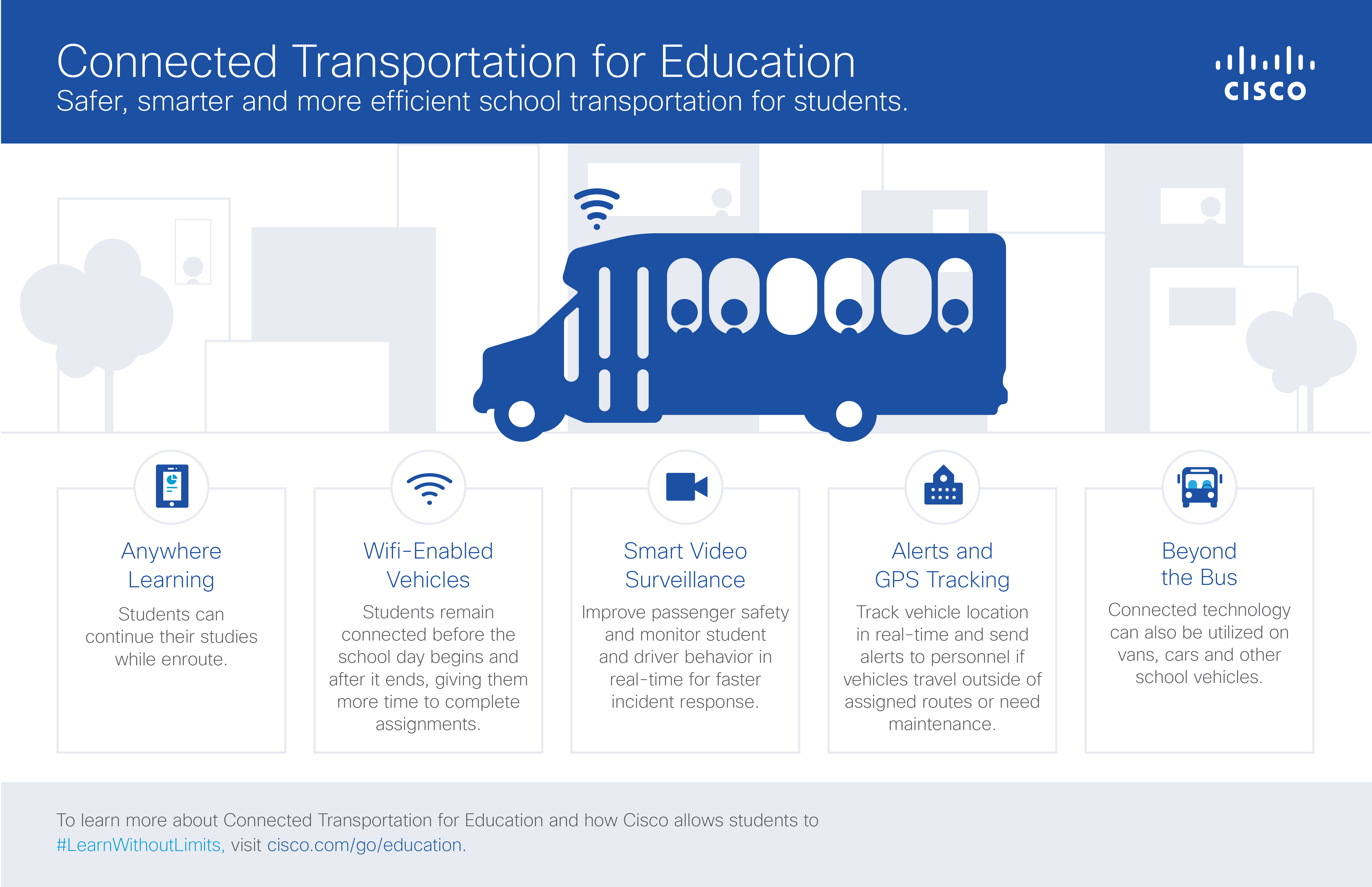
What if students could stay connected online even after they’ve left school? What if they could continue to work on and complete assignments while en-route? What if administrators could receive real-time alerts about the status of the vehicle transporting their students, from the maintenance needed to whether the driver is operating safely?

All of these things are possible with Connected Transportation for Education. Take a look at this infographic to see all that a connected school vehicle can do, and visit our site or read our At A Glance to learn more.

Connected Transporation Infographic_Final1

Authors

Alexia Crossman

Senior Cross-Portfolio Messaging Manager

Cisco Marketing

Avatar

Submitted by Kelsey Kusterer Ziser, the Editor of Upskill U at Light Reading.Kelsey Profile

As service providers seek to implement virtualized services and operate them on commodity hardware, they face the challenge of planning for a service mix requiring more than the typical IT data center infrastructure. In the near future, operators may need a more distributed approach to data center infrastructure as many functions will be virtualized, but many will not. The rising demand for always-on content and greater need for high-speed pipes is resulting in rapid changes to content delivery networks – another factor requiring a shift in traditional telco data center strategies.

Starting July 20, Light Reading and Cisco are launching a Telco Data Center series at Upskill U, a free online university delivering must-have education on themes relating to the overall business transformation taking place in the communications industry. In this four-part learning module, speakers from EdgeConneX, Equinix, ON.Lab and Windstream will examine how telecom is restructuring its data center strategy to maintain service standards while quickly incorporating virtualization and provisioning for future services.

Tune in to Upskill U for these lectures in the Telco Data Center series:

  • Telco Data Center 101 (Wednesday, July 20, 1:00 p.m. ET): Jeff Brown, Director, Product Management & Marketing, Windstream, explains how telcos are evolving data center strategies to support virtualization while maintaining service standards and supporting future services. This course prepares students for subsequent courses on the telco data center.
  • The Future of the Metro Data Center Interconnect (Friday, July 22, 1:00 p.m. ET): Phill Lawson-Shanks, Chief Architect & Vice President, Innovation, EdgeConneX, explores the future of metro data center interconnect and covers lessons learned from web-scale service providers.
  • The Changing Face of the Data Center World (Wednesday, July 27, 1:00 p.m. ET): Rodney M. Elder, Senior Solutions Architect, Equinix, examines the changing face of competition in the interconnection world and who can capitalize on new opportunities.
  • The Central Office Re-Architected as a Data Center (Wednesday, Aug. 3, 1:00 p.m. ET): Guru Parulkar, Executive Director, Open Networking Research Center, Open Networking Lab, explains how telco central offices are being re-architected to look like data centers, why the transition needs to happen now and what the new central office will look like.

NFVI Landing Page

The convergence of virtualization with traditional service functions challenges operators to rapidly rethink their business models. Upskill U is here to help service providers and enterprise decision makers navigate these changes in 45-minute online sessions delivered by industry experts. Students can ask questions, interact with other students with similar business and technological challenges and expertise and download a wealth of additional learning materials. Secure your seat for the upcoming Telco Data Center series at http://www.lightreading.com/upskillu. I’ll see you on the chat boards!

Authors

Greg Smith

Sr. Manager, Marketing

Cisco Solutions Marketing