Avatar

The healthcare system continues to rapidly evolve, but it is not just healthcare organizations, hospitals, and private physician practices that are impacted.  Private and public payers must also adapt quickly to ensure that they manage funding gaps for providers while offering the best possible customer experience for members.

Members are more informed and have more choices for how and where they receive care than ever before. It is important to build strong relationships with members that encourage them to stay loyal to your plan while also delivering services that are easy to understand and trust.

At the same time, your healthcare providers are investing in solutions to advance their use of technology and their ability to collaborate more proactively with patients and payers.  They are looking to you to become an active partner in creating a highly connected, highly visible web of information that helps drive better outcomes and personalized member experiences.

Cisco is here to help you make the best choices.  Cisco offers a vision for Connected Health that includes exciting new opportunities for payers, enabling an approach that treats every member and provider as an individual, in a system that knows who they are and anticipates what they want. This allows you to provide an experience that is simpler and more transparent, leading to a better quality of care.

The Rise of Connected HealthRead our new white paper, The Rise of Connected Health, to learn how Cisco can help payers to:
•    Personalize member and provider interactions with high quality video
•    Securely share information and data between doctors, clinics, hospitals, and pharmacists
•    Use big data analytics to target problem-specific populations
•    Transform from a wholesaler to a retailer mentality

To learn more about Cisco in the payer industry, contact a Cisco Health Plan Specialist now.

Authors

Joyce Perrelli

Healthcare Program Manager

America’s Field Marketing

Avatar

Agility pays. Look around you. Businesses that are thriving today are “agile.” Agility is becoming a true differentiator for business success. Agility creates a stronger environment for innovation and adaptability — and creates a cultural shift in doing things. Think about this. Why did Blockbuster and Kodak go bankrupt? What happened to Compaq? Why did Nokia disappear from the mobile phone business?

New research from McKinsey describes agile companies as follows:

“Agile organizations appear to be powerful machines for innovation and learning. What makes agile companies special is their ability to balance fast action and rapid change, on the one hand, with organizational clarity, stability, and structure, on the other.”

Consider the dizzying rise of businesses such as Uber, Airbnb, Spotify, Alibaba, Baidu, and Flipkart. How did they do it? Quite simply, they emphasize innovation and agility.

The world is fast changing. The desire to be nimble and to stay ahead of competition is rising. And it demands both a swiftness and a consistency in process and product innovation that we before considered exceptional.

Agile is the new normal. So, how do you embrace it?

Collaborate to Innovate
Business leaders are increasingly recognizing that agility thrives only on a foundation of innovation. But innovation does not happen in isolation. Innovation needs an engine within the business organization to feed it. That engine is Collaboration.

Harvard’s Linda Hill explains that “Innovation is not about solo genius. It’s about collective genius. It’s a journey. A type of collaborative problem solving, usually among people who have different expertise and different points of view.”

Smart ideas stem from collaboration. More than sharing information, collaboration is fundamental to the creative process of connecting ideas. And innovation often emerges from great ideas through novel connections. Think about your organization’s last significant innovation.

Chances are it gave your business a boost. Wouldn’t that be a welcome competitive advantage in today’s world where technological changes can easily make the slow movers irrelevant?

Do you now see the connection? Aspirations of success compel organizations to become agile. But agility thrives upon perpetual innovation. Collaboration helps you create that perpetual machine for innovation. And Collaboration technology itself has transformed into an exciting portfolio of possibilities.

“In the long history of humankind (and animal kind, too) those who learned to collaborate and improvise most effectively have prevailed.” – Charles Darwin

New Age Collaboration
Technology is constantly changing how we interact and collaborate. And in today’s knowledge-based economy, even basic communications have changed dramatically. These fast-moving changes are challenging. They challenge organizations to:

  • Support a generation of remote and mobile workers
  • Battle to attract talent from a highly mobile global pool
  • Connect a worldwide ecosystem of employees, partners, customers, suppliers, and more

Even as individuals, the way we work is changing. You no longer have to be within office boundaries to be productive. Combined with workstyle preferences, technological advances are influencing significant change in workplace dynamics.

Frost & Sullivan estimates that millennials will make up 75% of the U.S. workforce and 30% of the world’s total population by 2025. And this generation relies heavily on mobile tools for sharing information, getting answers quickly, making decisions faster, and improving communications beyond organizational boundaries.

The new norm is shifting from momentary collaboration — short instances of people coming together — to continuous collaboration, in which teams work together on an on-going basis. And it requires a different collaboration environment with very different tools. One that is:

  • Always-on: Bringing global teams together to work collaboratively in creative styles
  • Live or real-time: Enabling people to meet over video technologies anytime, anywhere
  • Asynchronous: Allowing people to work in collaborative virtual spaces from any device
  • Mobile-first: Empowering people to collaborate when and where they please

With this, it’s no surprise that organizations are redesigning physical workspaces that encourage creative interaction and a more free flow of ideas.

Are You Ready?
As we move rapidly toward a future of digital transformation and agile businesses, collaboration is emerging as the most compelling enabler of innovation. As such, we certainly need more than “good enough” collaboration tools and processes to make the leap. It’s time to make collaboration count in your organization.

Learn more about improving your organization’s agility and innovation through better collaboration.


Authors

Smita Dave

Sr Marketing Manager

Collaboration Solutions Marketing

Avatar

This blog authored by Nick Biasini.

Exploit kits are a class of threat that indiscriminately aims to compromise all users. Talos has continued to monitor this threat over time resulting in large scale research and even resulting in a large scale takedown. The focus of this investigation is on the tools and techniques being used to drive users to the exploit kits. This blog looks at the anatomy of a global malvertising campaign and how users interact with exploit kit gates, regardless of the sites they visit and the countries they reside.

Talos observed a large malvertising campaign affecting potentially millions of users visiting sites in North America, Europe, Asia Pac, and the Middle East. The research culminated in a joint effort with GoDaddy to mitigate the threat by taking back the registrant accounts used to host the activity, and taking down all applicable subdomains. This is yet another example of how organizations work together to stop threats affecting users around the globe. If you are a provider or online ad company that would like to work with Talos, please contact us.

Online advertising is a key component of the Internet today, especially for sites that provide content free of charge. In this blog we will be discussing a global malvertising campaign that has affected a wide array of websites. These websites don’t bear responsibility for these malicious ads; it is just the nature of online advertising. As security organizations get better at identifying and shutting down malicious content, adversaries are going to continue to move and stay agile. The advantage to malicious advertising is if you visit the same site twice you are unlikely to receive the same content from an advertising perspective. This is where protections like ad blockers, browsers with advanced sandboxing technologies, and detection/prevention technologies are paramount to ensure protection from this type of content.

Read More >>

Authors

Talos Group

Talos Security Intelligence & Research Group

Avatar

Off To Amsterdam and IBC with Infinite Video For Mobile Operators

IBC16_650x200_V2D

What’s Driving the Interest in Mobile Video?

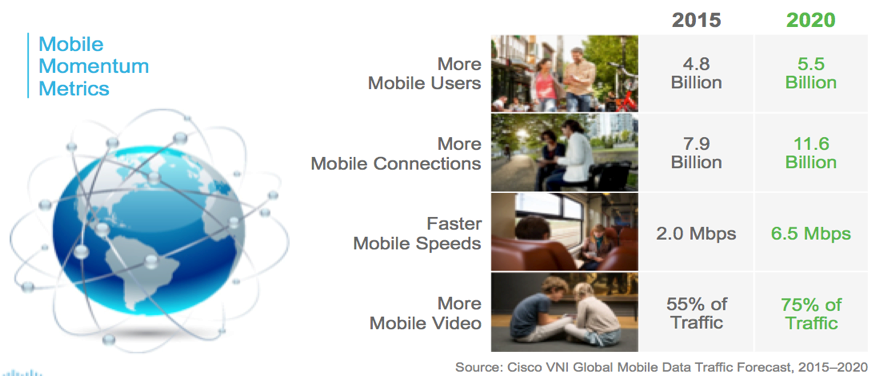
According to the 2016 Cisco Mobile Visual Networking Index, mobile is the #1 consumer device and Video is driving the next wave of Mobility. At IBC this year we will discuss our Infinite Video For Mobile Operators Solution, where we highlight mobile video offerings today from T-Mobile, Verizon Go90, and many more operators.

Global Mobile Data Traffic Drivers mobile data traffic

Cisco IBC 2016

With IBC 2016 less than 9 days away, I wanted to make sure you are up to date on Cisco’s presence at the show so you get the best experience for yourself.

Our Booth Location

We are in the same location as last year, at the entrance of Hall 1 Stand A71.

Demonstrations

This year we’ll show our customers why NOW is the time to Transform Entertainment. As well as showing momentum with several key deployments and customer announcements, Cisco will demonstrate its leadership in:

  • Cloud-based innovative experiences and services with the Infinite Solution platform combined with our Mobile Core, for customers on the go.
  • Security solutions with the launch of a comprehensive offer to protect infrastructure, services and content.

Hope to see you there, and for further information:


Authors

Jim O'Leary

Sr. Manager Mobile Solutions Marketing

Avatar

In recent weeks, I had the opportunity to attend F5 Agility US and Australia, and meet with several customers and partners of Cisco and F5. It was evident from these events that there is an increasing momentum in deploying F5 application services with Cisco ACI. There are several customers in production already who are benefiting from the automation and agility the joint solution provides. In particular, we showcased the recently announced F5 iWorkflow – Cisco ACI integrated solution at these events. What is so unique about this solution to which customers are drawn in big numbers? This blog will unravel all the excitement.

How the F5 iWorkflow-Cisco ACI joint solution works?

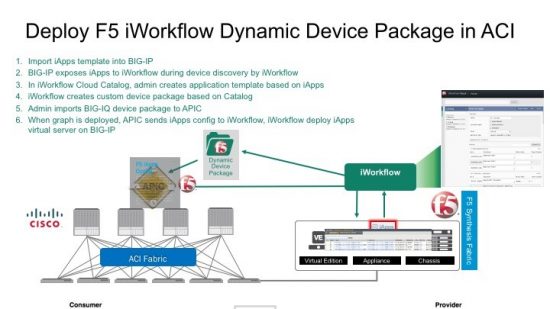
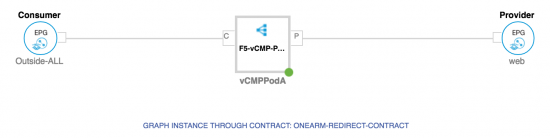
One of the key differentiators in the iWorkflow based solution is the dynamic nature of device package generation. F5’s iWorkflow lets cloud and DC admins dynamically define the F5 device package based on F5 iApps technology. Different flavors of device package can be generated dynamically based on required L4-L7 policies, thereby providing cloud & application teams the option of integrating F5 BIG-IP in Service Manager Mode (hybrid/partially managed) mode as described in my blog posted a few weeks ago. F5 iWorkflow acts as the F5 Service Device Controller and the device package is required to integrate F5 BIG-IP into Cisco APIC and expose L4-L7 policies to its tenants. Through self-service catalogues, iWorkflow tenants deploy highly-configurable and administrator-defined application services templates, a.k.a F5 iApps. Deploying services in a template approach provides the tenant an abstraction from device-centric operational complexity.

The benefits of such abstraction and simplification are twofold:

(1) Greatly reducing the learning-curve for deployment staff unfamiliar with complex application delivery services

(2) Simplifying the integration of application-delivery policy into 3rd party management and orchestration systems

In addition to presenting configurable services templates, the services catalogues also enforce user, group, and role-based access control, thus providing a platform that simplifies the journey to an integrated, self-service architecture. With the implementation of application-delivery services templates, operational risk, delay, and complexity are avoided, while increasing the speed of business.

iworkflowblog-1


Screen Shot 2016-08-29 at 9.43.15 PM

Cisco ACI – F5 iWorkflow solution benefits

  • Leverage best of breed for L2-L7 (Cisco+F5)
  • Dynamic Device Package: Increase Services Coverage (beyond just load balancing)
  • Collaborate effectively with app architects/teams
  • Agile delivery: Present L4-L7 services to app teams in an intuitive fashion
  • Reduce operational expense by enabling the rapid deployment of performance, high-availability, and security policy
  • Simplify architecture through the abstraction of complexity
  • Reduce exposure to operational risk that comes with manual configuration and processes. 

Leveraging centralized policy management and smart templating technology, Cisco ACI – F5 iWorkflow integrated solution keeps application services provisioning simple, flexible and reduces operational risks, while enabling effective collaboration between network, security and application teams.

This app-centric architecture also opens up the possibility of future integrations between Cisco and F5 technologies, such as analytics & security to further bolster all the aspects of application delivery in a platform agnostic architecture, leading to efficient and complete services and applications’ lifecycle management.

We are also pleased to invite you to attend detailed technical webinars on this topic, one for US based customers and a series of webinars for European customers.

Register here for US webinar: https://interact.f5.com/2016Q4W-Cisco-ACI-SEP14_Social-Reg-Page.html

Register here for European webinar: https://interact.f5.com/2016Q4WEMEAWebinarCiscoACIENSEP21_2-RegistrationPage.html?regsource=cisco

Related Links:

www.cisco.com/go/acif5

www.cisco.com/go/aci

http://blogs.cisco.com/datacenter/choice-and-flexibility-in-deploying-l4-l7-services-with-cisco-aci-and-cisco-cloudcenter-an-in-depth-journey


Authors

Ravi Balakrishnan

Senior Product Marketing Manager

Datacenter Solutions

Avatar

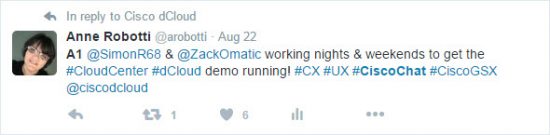
When the dCloud team (@ciscodcloud) moderated the August 22nd #CiscoChat about #CustomerExperience, we asked some simple questions and got some complex, well thought out answers. One thing we learned is that people love to talk about the #CustomerExperience, at Cisco and beyond! Here are our questions, and some of our favorite answers!

Q1: Share your favorite example of an unparalleled #B2B #CustomerExperience.

Favorite customer experiences were plentiful and varied. Some of the answers were about using Cisco technologies to connect people.

CiscoChatA1-1

Cisco groups collaborating to achieve excellence were on some people’s minds.

CiscoChatA1-2

Some people pointed out other companies, in other industries, that are doing a great job!

CiscoChatA1-3

And never to miss a chance to turn a support issue into an opportunity.

CiscoChatA1-4

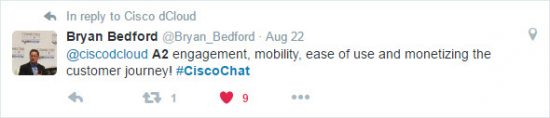
Q2: What does #CustomerExperience mean to you?

There are as many answers to this question as there are people, but we definitely identified some common themes – Excellence in behind-the-scenes processes, and true engagement help us in the journey.

CiscoChatA2-1

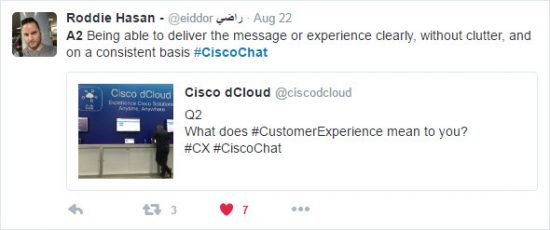
Clear messaging and uncluttered branding got a nod – let the customer know what we stand for!

CiscoChatA2-2

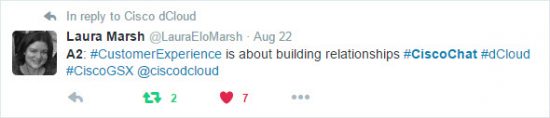
In the end, in a lot of people’s minds, it boils down to relationships

CiscoChatA24

CiscoChatA23

CiscoChatTweets

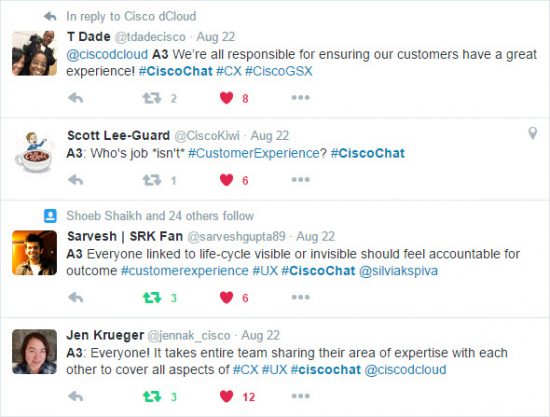
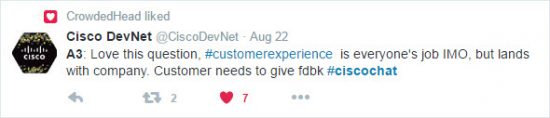
Q3: Whose job is it to ensure a great #CustomerExperience?

Whose job is the customer experience? A resounding EVERYONE’S met this question!

CiscoChat3-1

With reminders that excellence in customer service is culture-driven…

CiscoChat3-3

… and that there’s some customer accountability in the process!

CiscoChat3-4

Q4: How do you put the Customer first?

There are a lot of people working to offer the customer a great experience out there…

CiscoChatA4-1

CiscoChatA4-2

… possibly with a bowtie

CiscoChatA4-3

… and a lot of people working to do the same for their team!

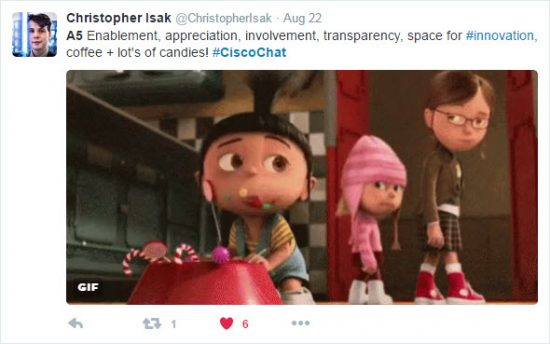
Q5: How do you help your Team succeed?

Shout out to @sarveshgupta89 for summing this one up with the seven C’s!

CiscoChatA5-1

And a spot of candy never goes amiss!

CiscoChatA5-2

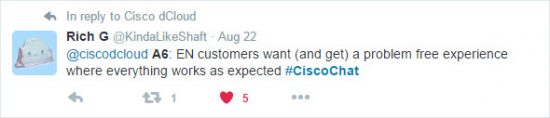
Q6: What matters most to you, when you are the Customer?

You know what people really want in a customer experience? A quality product and a good relationship.

CiscoChatA6-1

CiscoChatA6-2

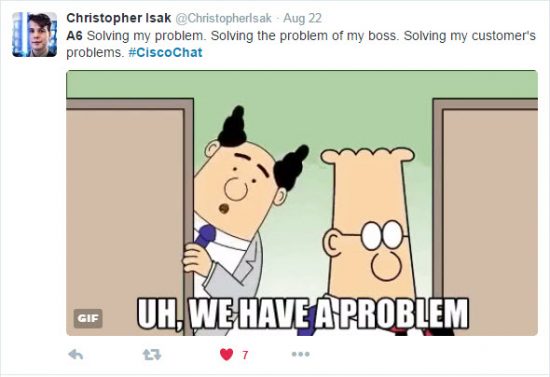
And we can’t do anything without Dilbert!

CiscoChatA6-3

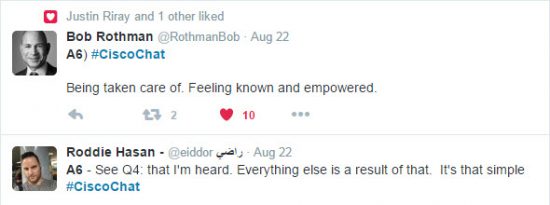
Being heard is a key driver for many, and the basis for building a great relationship.

CiscoChatA6-4

Q7: What is your all-time favorite Cisco #CustomerExperience?

The integration of Cisco into daily life, called out first –

CiscoChatA7-1

And the personal touch!

CiscoChatA7-2

And lastly, we took some dCloud love in answer to this question!

CiscoChatA7-3

CiscoChatA7-2

Love you back, guys!

What we learned might not seem groundbreaking, but it was a good touch point – validating that our team culture of listening to learn and make every member feel valued is what we need to take us into the future. And of course, some common-sense reminders:

  • Internal and external #CustomerExperience are equally important – give your Cisco customers, and your own team, the same level of service that an external customer would receive.
  • #CustomerExperience is about relationships, not products. The best products won’t make the customer happy if they’re not backed up by integrity, good communication, and accountability.
  • Everyone has a part to play in a great #CustomerExperience.
  • People love dCloud. (That’s not a reminder. We just like saying it.)
  • Nobody ever forgets the first time @ChuckRobbins likes their tweet!

Watch this space for more from Cisco dCloud, and check out our new, user-friendly UI at dcloud.cisco.com!

Authors

Anne Robotti

Senior Technical Writer

eXperience Services - dCloud

Avatar

Telemedicine is having an enormous impact on the quality of life for Latin Americans. Nearly 83% of the 423 million people who live in South America reside in urban areas. 72 million people occupy rural areas. Both groups find it difficult to access specialized medical care in a timely fashion. According to the World Health Organization (WHO), the largest state in Brazil (Amazonas) has 4,000 doctors to tend to 3.5 million people (1.1 physicians per 1,000 people). WHO recommends a minimum of 1.4 doctors per 1,000 residents. Other states in Brazil, and other Latin American countries fare slightly better: Uruguay has the most favorable ratio, with 4 doctors for every 1000 inhabitants.

Additionally, the vast majority of Latin American medical specialists (i.e.: cardiologists, oncologists, mental health specialists, pediatric specialists, and subspecialists) are concentrated in the big cities. And within those cities, most specialists congregate in one small area. In a 485 square mile city like Rio de Janeiro, it could take someone on the outskirts of the city a long time to get a consultation with the right specialist in residence in the right hospital.

The access to medical specialists for the people who need them is problematic. When a child in a remote area gets very ill, the family has some hard choices to make. Often the child ends up missing school, a parent must miss work, and the family members are separated for long periods of time in order to receive treatment in faraway places, making it difficult for them to provide support for each other. Getting a specialist consultation, a second opinion, or specialized treatment is simply unrealistic for most remote residents.

The solution is not more specialists in remote areas – that is almost impossible. But, through Cisco’s HD Live Interactive Telemedicine System, specialists can stay in big city hospitals AND serve suburban and rural hospitals at the same time. This system is based on a platform that integrates video solutions and communication software to allow hospitals to communicate with each other through telepresence.

Gustavo Menéndez Bernales, Business Development Manager for Cisco Latin America, is excited by telemedicine’s potential: “At Cisco we have a commitment towards programs with deep social impact because we believe technology can help bridge the gap in ensuring services such as those in healthcare reach the entire population. Simply stated, telemedicine programs provide ’Equal and Timely Access‘ to healthcare for all citizens.”

Telemedicine increases access in multiple ways — it can actually be less expensive than conventional treatment. A program in Argentina allows infectious disease specialists to support HIV patients and family physicians remotely via WebEx. The cost? USD $49.99/month.

Telepresence technology allows doctors to communicate not only with patients, it also allows them to communicate with other doctors, to collaborate and to receive continued medical education. As an example, remote physicians can participate, listen in and learn from “tumor board” conversations, where experts from big cities around the country, or even around the world, discuss cases and treatment options. And they aren’t just listening – they are seeing images of what the physicians are discussing.

What does this mean for Latin Americans? For one boy in Argentina, it means he got to keep his leg. The child’s local doctor saw no alternative to removing his leg, which was dangerously infected. But when the physician consulted via telepresence with a specialist at the Argentina Pediatric Center of Excellence, he learned about a different approach using a new type of medicine, and was able to save the boy’s leg.

A college student in Chile is alive today because of telemedicine. After suffering a heart attack, he was transported to a local hospital that lacked a cardiologist on staff. His local doctors managed to save his life with the support of a remote cardiologist from Concepcion Hospital, connected via telepresence. After stabilizing the situation, the cardiologist, who was trained at Vanderbilt University in the United States, conferred with Vanderbilt to get a second opinion. The young man was diagnosed with a congenital heart condition, and immediately started to receive the correct treatment. Within 48 hours, he was able to return to college, instead of spending months in the hospital waiting for someone to figure out what was wrong with him.

And two babies in the middle of the jungle in Peru had zero chance of survival without telemedicine. The girls were born joined as Siamese twins at a tiny hospital in Pucallpa. The hospital immediately contacted the National Pediatric hospital in Lima and shared the situation via telepresence. Within 12 hours, a team of 13 specialists, including extremely specialized cardiovascular surgeons, a plastic surgeon, a neonatologist, two anesthesiologists, and a medical imaging specialist, had been assembled to assess the situation remotely, and prepare for the arrival of the babies in Lima, where an ambulance waiting at the airport took them directly to the operating room.

Cisco is supporting telemedicine programs like these in countries throughout Latin America. Thanks to Cisco’s technology and mission to make the world a better place for everyone, more and more people in suburban areas and impoverished rural villages in Latin America are getting the same access to specialists as residents of the biggest and wealthiest cities.

Authors

Jordi Botifoll

No Longer with Cisco

Avatar

I’ve written in the past about the opportunity for Hadoop-as-a-Service (HaaS) – providing self-service provisioning, elastic scaling, and support for multi-tenancy. But in my discussions with customers over the past year, it’s become clear that the opportunity is even bigger than Hadoop. The next big thing in big data is Big-Data-as-a-Service (BDaaS).

There are three key trends driving the evolution and emergence of this new BDaaS opportunity:

Apache Spark and the evolving big data ecosystem. Hadoop recently celebrated its 10th birthday and continues to gain widespread adoption. But in recent years, other new big data frameworks and tools have also gained in popularity. Foremost among these is Apache Spark, the most active open source project in big data. We’re also seeing increased interest in Kakfa, Flink, NoSQL technologies such as Cassandra, and much more. And there continues to be rapid innovation in the commercial software market for big data – including analytics, ETL, search, log analytics, and other BI tools. Hadoop is still at the forefront (and many of these tools complement and extend Hadoop), but BDaaS is much more than Hadoop.

Enterprise adoption of containers and microservices. Container and microservices technology (Docker in particular) has taken hold in the enterprise, and the pace of adoption has accelerated over the past year. Like Spark, Docker has become one of the fastest growing open source technologies ever. Application developers have embraced the simplicity and agility of containers, and microservices are a foundation of the DevOps model. Enterprise IT teams have made containers part of their architecture strategy. And the container revolution is now being extended to big data applications.

The cloud experience for big data, with no compromises. Until recently, big data deployments were almost exclusively bare metal on-premises. But now data scientists, analysts, and developers in the line of business want the cloud experience; they want self-service, on-demand clusters, elasticity, and DevOps agility with all their big data tools. There are several public  cloud services for Hadoop and Spark, but there are important factors that prevent many big data workloads from moving to the public  cloud – including performance, security, compliance, and data gravity. Data gravity means that data that already resides on-prem is likely to stay on-prem due to the cost, risk, and challenges of moving very large volumes of data. Using container technology and next generation big data infrastructure, customers can have the BDaaS cloud experience and the enterprise-grade performance, security, compliance, and high availability required for big data workloads on-premises.

To learn more about Big-Data-as-a-Service, register for our upcoming joint webinar on September 15th with BlueData, a software company that provides an innovative platform for BDaaS using Docker containers, and a Cisco Solution Partner: http://bit.ly/2bH3EJA

Authors

Raghunath Nambiar

No Longer with Cisco

Avatar

If you are like me – all the cloud management tools sound the same. Vendors all use the same words to describe very different solutions. Hybrid. Platform. Automation. Service.

So to help you figure out what the words mean, I’ve recorded a short webcast with product manager Zack Kielich (@zackOmatic), that shows how Cisco CloudCenter stacks up to Gartner’s Cloud Management Platform feature taxonomy.

So why is a CMP review on the Datacenter Blog?  CloudCenter deploys and manages applications in datacenter or cloud environments.  It’s both a cloud and datacenter solution.

Some highlights:

Access Management

  • Multi-tenancy – CloudCenter has a service provider class multi-tenant architecture that offers great value for enterprise IT. It saves money by reducing the solution footprint for organizations with multiple business units. It supports a centralized IT service strategy with a flexible mix of sharing and isolation.  Central IT can offer standard services. Each tenant can consume those services but also add or customize their own, and even skin the UI for different user groups.
  • Governance – A tag-based governance scheme makes it easy for IT to help users make the right decisions. Compliance can be automated by using tags to enforce policies.  Users add simple tags when they deploy applications. IT can hard code tags if needed for compliance.  The tags link to policies that direct placement, deployment and run-time decisions. The tags make it easy for users to make the right choices. And they don’t have to understand the policies.

Service Management

  • Logical service modeling – This is where CloudCenter really shines. You can model a deployable application blueprint with ease in a drag and drop interface. Each component represents a service like OS, or application or web server, database, etc. You can use out of box, or easily customize or add your own. It supports configuration management tools, PaaS and cloud services, as well as containers. Multiple IT groups can put their configuration finger print on the building blocks or fully modeled stacks before releasing for users. IT maintains control. Users don’t get stuck in the infrastructure weeds, and get an on-demand self-service experience.
  • Usage and cost control – With usage and cost plans, you get a variety of options to create boundaries for self-service on demand deployment. You want to limit developers from a certain group to a pool of 200 VMs in a vCenter environment? No problem. You want to keep AWS costs for a BU to $2,000 per month? No problem. You want to allocate costs across the SDLC for dev, test, staging, and then production. Again, no problem.

Service Optimization

  • Monitoring and auto-scaling – CloudCenter lets you horizontally scale legacy applications in your datacenter. That’s right! Cloud-like scaling without rewriting applications. Set performance triggers and scale out by deploying additional instances of the whole stack or individual tier, with just enough resource to minimize cloud costs and optimize infrastructure utilization. You can even burst to cloud by scaling out to a cloud for periods of heavy usage.
  • Usage Visibility – IT executives love the consolidated reporting of costs and usage from any of 20 supported datacenter, private and public cloud environments, all in one platform. View usage and costs by tenant, by user group, by application, by cloud. Roll up or drill down. And allocate or charge back costs as needed. You get data needed to make effective decisions.  IT can add use-based economics to traditional datacenter and legacy applications, just like in the public cloud.

External APIs

  • CloudCenter has mature, documented APIs. Everything users can do from the UI, you can access via API. This facilitates easy integration with development tools like Jenkins, ITSM catalogs like Cisco Prime Service Catalog or ServiceNow, existing ITOM tools like IPAM and DNS. Read the integration guide.
  • SDN like VMware and Cisco ACI are supported. So you get the security and operational efficiency of zero trust, white list communication between tiers, via fully automated integration. Application owners get confidence in case of a security breach. Network teams don’t need to hand craft port settings or configure firewall runs for each deployment.
  • CloudCenter abstracts the cloud. CloudCenter supports more than 20 different datacenter, private and public clouds. But the APIs are hidden and abstracted by the CloudCenter Orchestrator. Users don’t need to learn each cloud. They get the benefits of Software defined datacenter and cloud, without the cost of learning APIs specific to each platform.

There’s more.  Check out the webinar to find out about benchmarks, bursting, automated end-of-life actions that all cut your cloud bill or improve datacenter resource utilization.

Read about how CloudCenter is now part of the revamped Cisco ONE Enterprise Cloud Suite.

Authors

Kurt Milne

Marketing Manager, US

CloudCenter Marketing