Avatar

For the athletes competing at the Rio 2016 Olympic Games, the global event served as the culmination of years of hard work, dedication and sacrifice. Likewise, for the Cisco Rio 2016 team, the Olympic and Paralympic Games represent more than three years of dedication and 34,000 engineering hours to plan, design and support a network built with more than 60 tons of equipment.

No prior Olympic Games has required the amount of networking equipment or manpower to support the connected operations on the ground as Rio 2016. The Olympic Family – including 15,000 athletes and their family members; 70,000 volunteers; 25,000 accredited media; and 3,000 people working tirelessly on the ground and behind the scenes – all relied on Cisco’s network. And thanks to our fabulous team of engineers and technicians, Cisco delivered a secure network that was more than just reliable – it was flawless!

  • Nearly 150,000 devices connected to the Cisco network
  • More than 1.4 petabytes (PB) of data crossed our network during the Games. To put that into perspective, 1.4 PB is equivalent to 620,000 hours of HD video, which would take someone more than 70 years of nonstop streaming to watch.
  • More than 4 million security threats, ranging from simple policy violations to Distributed Denial of Service (DDoS) incidents, were detected and mitigated by Cisco’s security infrastructure
  • In protection of all official Rio 2016 public websites and mobile apps, Cisco and Rio 2016 security partner solutions detected 40 million security threats, blocked 23 million attacks and mitigated 223 major DDoS attacks

https://youtu.be/v8A5A86tJu0

While providing technology is at the core of our support of the 2016 Olympic and Paralympic Games, it is certainly not our only priority. Cisco has been invested in Brazil for nearly three decades now, committed to digitizing the country and bringing more technology, education and digital opportunities to Brazilians.

At the heart of our Rio 2016 program lies a desire to connect the unconnected. And nowhere is this more apparent than our work in the Porto Maravilha region of Rio, where we installed free public Wi-Fi for residents and visitors in the area to utilize; incubated entrepreneurs to bring their IoT solutions to life; and collaborated with various organizations to foster ideas, action and digital transformation in Rio.

As part of an initiative developed by Cisco, the Olympic City Technical Program provided network training to more than 300 local students, better positioning them for future employment in the IT sector. For people like Edna Felix, this was an opportunity of a lifetime.

https://youtu.be/SJXIxTgqbuQ

And it must be mentioned that part of Cisco’s legacy to Brazil is Cisco House itself! Our team worked tirelessly over the past several years to ensure that Cisco House was an incredible showcase of the work that Cisco is doing to digitize Rio de Janeiro, Brazil and the Games. With some of the most amazing and iconic views in Rio, Cisco House hosted more than 3,100 customers, partners, employees and guests during the Games, and will continue to do so throughout the Paralympics. This fully-renovated facility will be handed back as part of our Olympic legacy after the Games are complete.

I enjoyed my time in Rio de Janeiro immensely and was reminded of the incredible value that opportunities such as the Olympic Games bring to our company. And with the Paralympics beginning tomorrow, we are excited to keep that momentum going. I could not be more proud of our team in Rio and around the globe who made this project such a success. There has truly never been a better time to support the Olympic and Paralympic Games!

NBABT Brazil karen_G0A8599_cc_rev


Authors

Karen Walker

Senior Vice President and Chief Marketing Officer

Avatar

This blog originally appeared on The Huffington Post

Two years ago, I stood on stage in Gettysburg, Pennsylvania, with a quote on the screen behind me. It read, “All it takes is one big idea to change the world.”

I was speaking at the Franklin Project’s Summit where General Stan McChrystal called upon 350 leaders in the private sector, higher education, technology, government, the military, faith communities, philanthropy, and nonprofits to come together to make a year of full-time service — a service year — a common expectation and opportunity for young Americans of all backgrounds.

The Franklin Project envisioned a day when all young people had an opportunity to spend a paid year serving in a community, developing essential skills and addressing the nation’s biggest challenges. The Summit at Gettysburg was our chance to put the idealism of the entire service year community into action.

While the idea of service is not a new one — service is integrated in our culture from the military to our local communities — it is not yet ubiquitous.

Similarly, the concept of a service year — a full-time, paid position where young people can develop skills and build change from the ground up — is also not new. Programs like AmeriCorps, the Peace Corps, City Year, Teach for America and YouthBuild have been around for decades harnessing the energy of young people to address and impact pressing challenges in our local communities. Not only have they had impact in their respective communities, these service corps members have also grown into the leaders our country needs.

Despite this widespread ethic of service and the existence of thousands of programs, nearly seventy percent of young people are unaware that service year opportunities exist. Meanwhile, research from the Case Foundation shows that ninety percent of millennials think young people like them can have an impact and make our country a better place to live.

How do we take those critical programs to scale while also harnessing the idealism of the next generation of young people who want to make an impact?

When our team at Cisco initially sat down to explore the barriers to taking service years to scale, being a technology company it was no surprise that technological barriers were top of mind. That’s why we committed our support and expertise behind the Service Year Exchange — the first-ever service year marketplace.

SYA1

On stage that day in Gettysburg, I was honored on behalf of Cisco to make a commitment in the form of a $3 million matching challenge grant to help answer that question and support the organizations that were working every day to make this vision a reality.

Over the past two years, Cisco has continued to support the development of the technology platform, which enables young people who want to serve to search for service year opportunities based on their interests, while also allowing organizations to certify service year positions, recruit service year corps members, and thereby power their organizations.

The Service Year Exchange technology highlights the tens of thousands of service year opportunities — from AmeriCorps to YouthBuild to privately funded service year opportunities. And it continues to grow every day, with a bold goal of hosting 100,000 service year opportunities by 2019 — growing the field from the currently available 65,000 opportunities.

We are proud to see our commitment to this platform come to life this week with the official launch of Service Year Alliance — an organization merged from the Franklin Project, the Service Year Exchange, and ServiceNation.

I have seen first-hand this movement adapt and grow over twenty years from a handful of pioneer programs to a robust network of innovative organizations. Today, for the first time, they can be connected to learn and grow together with support from Service Year Alliance, truly representing a new day for the service year community and America.

Service Year Alliance and the Service Year Exchange have set the stage for a scalable marketplace that can evolve over the coming months and years. By advocating for federal funding, developing new programs, incorporating service years in higher education, and partnering with companies to support corps members throughout their year of service — Service Year Alliance is putting the bold idealism of the service year community into action.

At Cisco, we believe everyone has the potential to become a global problem solver. We strive to inspire, connect, and invest in opportunities that accelerate global problem solving by empowering people everywhere to work toward eradicating poverty, unemployment, climate change, and hunger. Everyone has a role to play, especially young people who are equipped to harness the power of the digital revolution to not only solve problems in their communities, but also to grow as leaders and innovators.

We are honored to have been an early supporter of Service Year Alliance and the Service Year Exchange and are proud to support a new challenge grant that will help enable Service Year Alliance to realize our shared vision — every year, one million young Americans engaged in a service year, solving important problems while transforming their own lives.

A big idea is great, but putting that big idea into action has the power to change the world.

Authors

Tae Yoo

No Longer with Cisco

Avatar

For cloud service providers, the market landscape can look like an ocean of new opportunities—or an obstacle course with one difficult challenge after another. Both perspectives are legitimate: Network services have never been more in demand, and cloud providers who capitalize can unlock major new revenue streams. But customer expectations have never been higher. They want custom services tailored just for their business, and they want them now, not six months from now. If a cloud provider can’t answer a new market need fast enough, a competitor surely will.

The only way to gain the necessary speed is through network automation. But traditionally, the more network functions were automated, the less flexibility a service provider had to change them. That’s because traditional automation relies on hardcoded functions that require extensive custom development efforts, complex operational overhead, and long lead times. Add to this the challenges inherent in most service provider networks—underlying network equipment from multiple vendors, hybrid environments with both physical and virtual resources—and the challenge only grows.

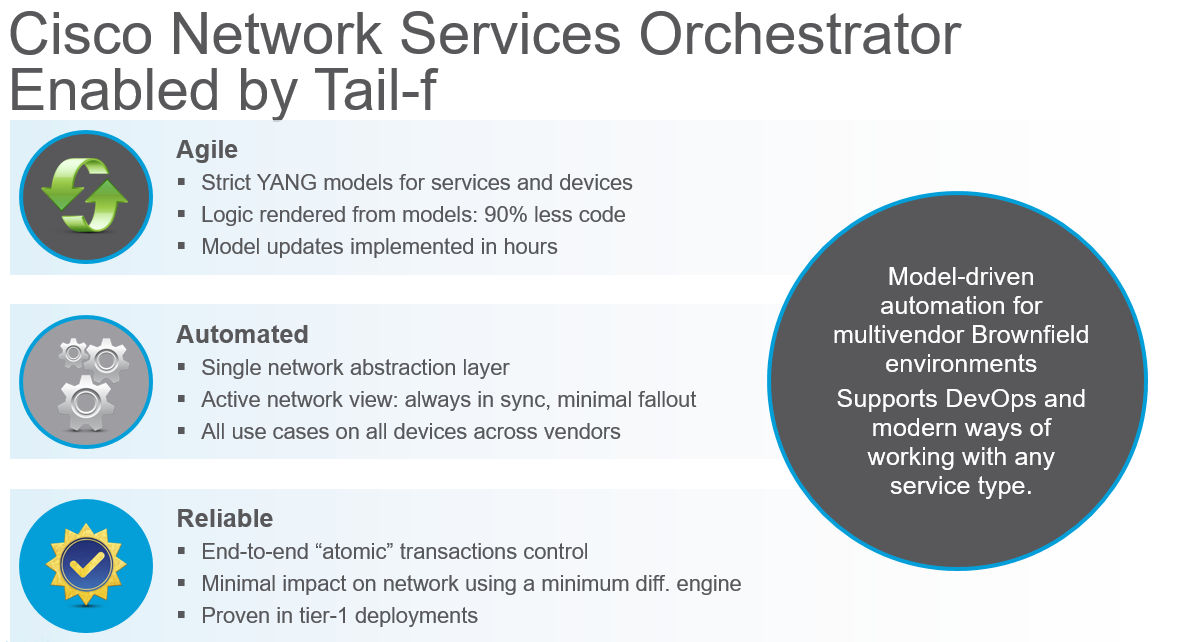
Fortunately, cloud service providers don’t have to choose between speed and flexibility. With the Cisco Network Services Orchestrator (NSO) enabled by Tail-f, they can have both.

cisco nso 1

Automate Across the Service Lifecycle

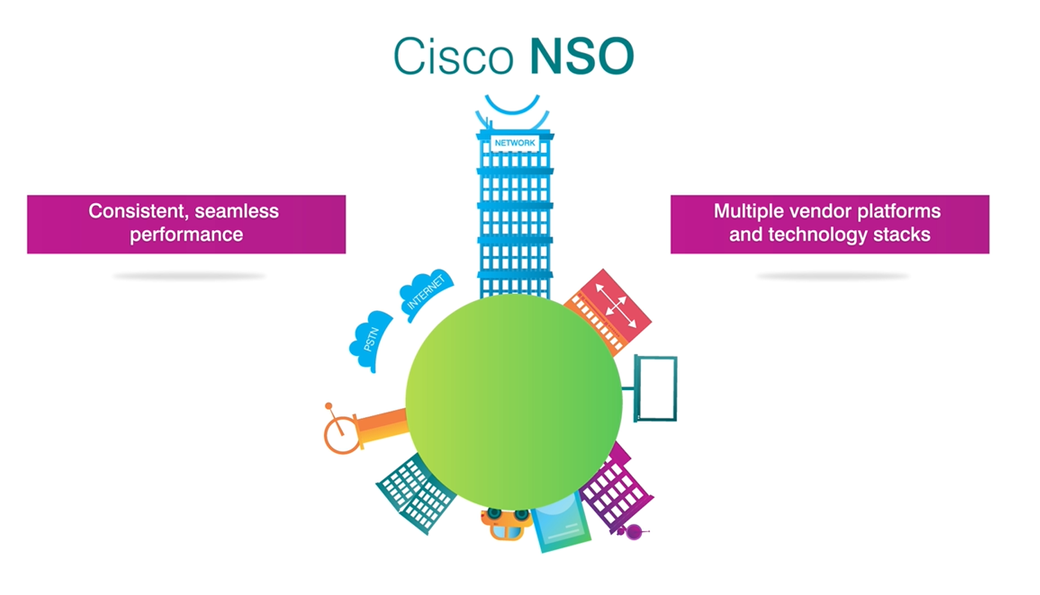
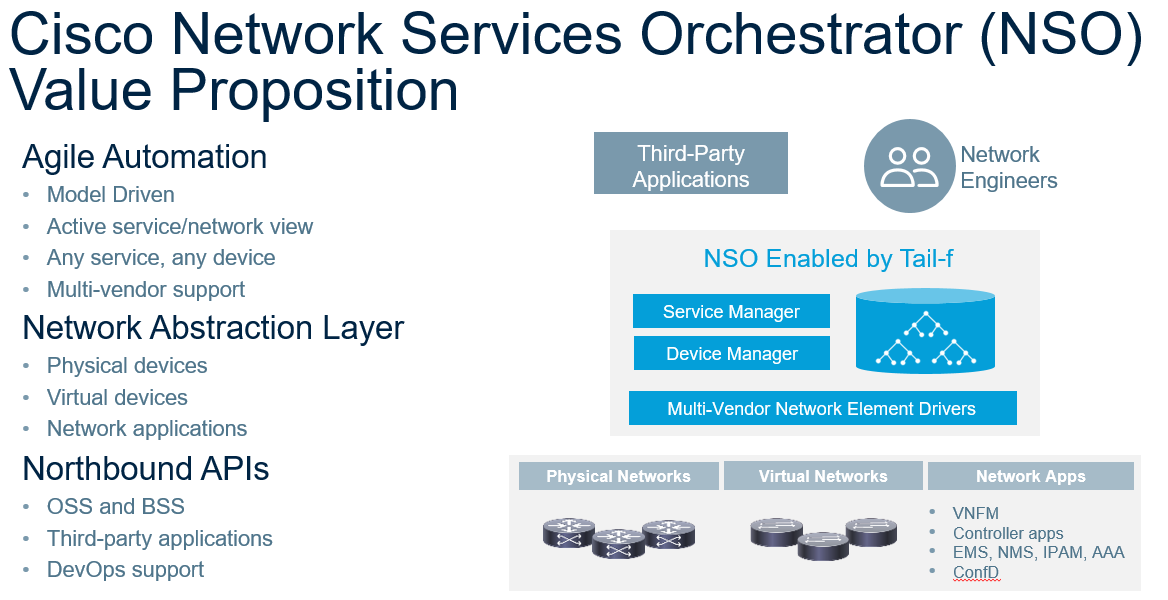
Cisco NSO provides full lifecycle service automation to provision, manage, and assure services end-to-end across hybrid networks. It provides a streamlined abstraction layer that lets cloud service providers model services at a high level in the standardized YANG modeling language, and have the network automatically execute them. Effectively, cloud providers can say, “This customer needs a service that does X.” Cisco NSO then looks at the real-time status of the network (across both physical and virtual network elements from practically any vendor) and makes it happen—without operators having to spell out every step along the way.

Best of all, Cisco NSO does this across the entire service lifecycle—designing a new service, provisioning, making changes to services or the underlying network, and even activation testing and ongoing monitoring and assurance. So cloud service providers get the speed of automated carrier-class services, and the agility to make changes as fast as new opportunities arise.

https://www.youtube.com/watch?v=0drSahZweXg

cisco nso 2

Cisco NSO in Action

These capabilities may sound like something out of an interesting lab experiment. But leading cloud service providers around the globe are using them right now in real-world networks, and gaining real competitive advantage.

  • Telefonica’s network serves 320 million customers across 130 countries. The company is using Cisco NSO to move from time-consuming manual workflow-based processes to automated service provisioning. They’ve reduced manual provisioning steps by up to 90 percent and can now deliver new services in minutes instead of months.
  • Level 3 uses Cisco NSO to power network-as-a-service (NaaS) solutions for customers worldwide. The platform abstracts away the complexity of different multivendor networks in different markets, so the company can use the same service models across multiple continents—more than 75,000 network devices in all. Customers can access the same suite of automated self-service network solutions, with the same scalability and high availability, anywhere, regardless of underlying infrastructure.
  • Equinix provides interconnection and data center services for thousands of customers across 15 countries. They used NSO to support their new Cloud Exchange offer, which securely links customers with a wide range of cloud service providers. With Cisco NSO, they can now provision and activate new services in one tenth the time. And they were able to build and launch the new offering—from procurement to live production—in just 90 days.
  • Softbank is letting customers design their own smart VPN solutions, selecting from a range of multivendor network devices through a self-service portal. Cisco NSO automates service provisioning across both physical and virtual network elements. And Softbank has reduced deployment times for new enterprise services from weeks to minutes.
  • Telstra uses Cisco NSO to automate both provisioning and assurance of IP network services for its business customers. Instead of relying on manual processes and physical network probes, they can deploy “virtual” probes as part of every new service as part of the same service model that handles provisioning. They’re assuring carrier-class services to meet service-level agreements (SLAs) with a fraction of the time and effort.

cisco nso 3

Learn More

Ready to find out what Cisco NSO can do for your business? Watch the video above to learn more.

Or, for a deeper dive, check out the Cisco Knowledge Network webinar “The Four Pillars of Orchestration: Making End-to-End Service Automation a Reality in Dynamic Networks.” You can watch it live on September 7, or view the recording here.

Authors

John Malzahn

Senior Marketing Manager

Service Provider Cloud Solutions

Avatar

Imagine that you have been diagnosed with leukemia and you will be going through cancer treatment for the next year. Now imagine receiving this news as a 12-year-old child, and realizing that you will no longer be able to attend school with your friends and peers.

This is the exact situation that Niki Fassler, a young student with Down syndrome in Vienna, Austria, found himself in.

In 2012, Niki was diagnosed and treated for leukemia. Then in August of last year, he was diagnosed for the second time. During this round of treatment, Niki was unable to attend school due to the severity of his illness and potential risks associated with being present in a classroom.

Niki, however, wouldn’t let cancer stop him from continuing to learn and engage with is friends at school.

Screen Shot 2016-09-02 at 9.59.27 AM

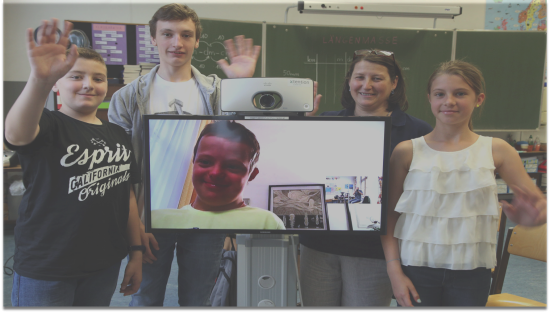
Using Cisco collaboration technology, he is able to connect with his class at NMS Neubaugasse. He is now able to attend lessons virtually, which has had an incredibly positive influence on his mental and physical health.

According to Niki’s teacher, Martina Hrubesch, “When the students saw Niki for the first time, it was a very emotional moment. The children were crying tears of joy after seeing him again, and after seeing his joy over seeing them again.”

The technology is simple and secure, allowing Niki to call into his classroom by himself, speak and engage with classmates, and see the entire classroom with a panning camera.

Untitled2

Plus, Niki isn’t the only one who is benefiting from this collaborative technology. By learning alongside Niki virtually, his classmates have increased empathy for Niki’s situation, a new level of social competency, and an overall motivational boost to perform on a higher level.

Watch this inspiring video of Niki’s story to see how technology is enabling him to maintain normalcy with school and friends, giving him more energy and strength to fight his illness.

https://www.youtube.com/watch?v=RRDgd4L_1v0&list=PLE9603246C9094F72&index=1

Authors

Cecile Willems

Director, Global Public Sector

Global Sales Organization

Avatar

A perfect storm has been brewing over the last decade and a half. A work day today is not what it was even as recently as at the turn of the century. We’ve experienced a fast pace of growth, technology innovations, and the blurring of lines between work and personal time.

Focus on What, Not Where
The notion of “going to work” has taken on new meaning. It’s no longer about commuting to a specific location. It’s about choosing when and where we work – and with whom. Boundaries are fading. We’re opting for flexibility. Telecommuting, hot desking, smart working make “work from anywhere, anytime” ring more true. Organizations across industries are reaping the benefits.

Take the case of the U.K.’s Top Right Group. Based in London, Top Right Group’s four knowledge businesses have used collaboration technology to transform operations and increase efficiency. Employees can communicate and contribute from any location. The Group has drastically reduced real estate costs, accelerated average help-desk resolution times by over 50%, and reduced telecommunication costs by moving to a converged IP backbone.

“We wanted to give employees the tools to work from anywhere, including any office, a coffee shop, the train, or home.” –Sean Harley, Top Right Group

Similarly, Instituto Zaldivar, an eye care institute in Argentina, pioneers innovations in ophthalmology. Expanding patient consulting and care, clinicians treat people hundreds of kilometers away with high-definition video conferencing. Most important, 100% of patients rated the medical attention received this way as “very good” or “excellent.”

Meanwhile, the organization has lowered costs, reduced travel by 500,000 kilometers, and expects to increase remote consultations 40% year-over-year.

“Using innovative technologies, we’re changing the way that we do business to reach more patients.” –Maria Gabriela Batiz, Instituto Zalvidar

Connected Work
New trends are determining the nature of work. We’re utilizing collaboration technologies to focus on results rather than how, when, and where. Frost & Sullivan identifies seven key factors of “Connected Work”:

  • Mobile
  • Collaborative
  • People-centric
  • Agile
  • Customer-driven
  • Environment-friendly
  • Contextual

Explicitly focusing on these factors or not, we’re integrating collaboration technology as part of broader workforce initiatives. Organizations across industries are looking to technology such as video conferencing and group workspaces to:

  • Eliminate physical barriers
  • Share real-time information within groups
  • Extend interaction to include customers and partners
  • Build iterative processes for quick decisions and production

New Tools
Enabling these shifts are tools remarkably better and less costly than previous generations. They deliver new teamwork capabilities including affordable video conferencing for all, web conferencing, smart whiteboards, and digital team workspaces, with more on the way.

Global agricultural equipment manufacturer AGCO Corp has harnessed the power of new collaboration solutions. The company has improved communications among geographically dispersed employees, between its sub-brands, and for partner support.

Add to that cost savings of $45,000 per month, improved productivity, and simplified infrastructure management. It amounts to more time and funds to invest in developing the next generation of products and services in a competitive market.

“We’re giving employees more opportunities to communicate and share insights globally.” –Nikhil Narvekar, AGCO

This level of collaboration is the crux of agile business. Last year’s “good enough” tools aren’t enough in the future. It’s time to invest in the collaboration capabilities that take you on the path to innovation and agility.

This post is the second in a four-part series. Read part one, “Collaboration: The Foundation of the Agile Business.

Authors

Smita Dave

Sr Marketing Manager

Collaboration Solutions Marketing

Avatar

It is clear Collaboration has become a strategic driver for Cisco. We are contributing more and more to the company’s profitability, and collaboration is a top priority for Cisco as was apparent from the recent earnings news. We did that together! Thank you for our seventh consecutive quarter of growth.

THIS is the Year to Pivot to Cloud

Now it is more important than ever to go where Collaboration is going, and in FY17 that is to the cloud. The time is now because everything in the collaboration suite – video, conferencing, and calling – is converging into a single experience powered by the Cisco Spark cloud platform.

Plus, Rowan Trollope, SVP and GM, IOT and Applications, recently previewed with our sales team a breakthrough development that will further bring Cisco Spark into the meeting experience (more on this at Partner Summit). Cloud is where our customers will get the best experience.

Lead with Spark

If you have been leading with UC, video conferencing, WebEx, or Jabber, now is the time to lead with Spark. We have evolved Spark into a complete collaboration suite delivered from the Cisco Cloud that includes message, call, and meetings, and supports our full line of video room systems. With the growing availability of Spark cloud and hybrid services around the world, there is no doubt the Cisco Spark platform will move you faster to recurring sales with cloud and software selling. Be sure to adopt Spark and use it daily within your practice.  Use it, know it, sell it.

Cisco Collaboration Subscription Is the Bridge

Don’t worry, we are giving you the tools you need to move your customers to the cloud. As you know, our cloud connected hybrid strategy already offers customers a bridge to the cloud. That bridge is about to become even easier to cross with the new Cisco Collaboration Subscription coming soon! For the first time, we are bundling our industry-leading meeting and calling experience into a single offer that gives your customers complete deployment flexibility and investment protection.

What to do next

Our plan has been to radically reinvent business communications and put it in the hands of billions. Moving full-speed to the cloud by leading with Spark is the next step required to take us there.


Authors

Gary Wolfson

Director, Global Partner Software Sales

Avatar
So many books. So little time.

My bookshelf is mixed with I-can’t-put-them-down-books and read-them-slowly-books. Despite my love to read – and the plethora of offerings right in my office — sometimes I need a quick “fix” for learning. TED Talks, webinars, and our own courses give me what I crave when I don’t have time to curl up on the couch with a good book.

Our sales and marketing teams are filled with people just like me. People that want a quick refresher or learning on the go. Which is why we offer so many options for your teams. Here are three resources:


Sales training in a SNAP

A new sales person starts. They need to learn about your company, your customers, and all about Cisco. That could take months! Combine that with stats that indicate it takes 5, 8, or even 12 months for a new sales person to ramp up and you quickly realize how much time and money drain each time you bring on someone new.

Enter SNAP, our new online training course with short modules for your sales team to learn “how to speak Cisco”, “use presentations to drive results” and all about our architectures.  Find out more about SNAP in Karin Surber’s blog.


Creating customers for life

The needs and demands of your customers are changing at a rapid pace. SuccessHub helps you build successful business models, stay ahead of the changing market, and educate your sales team. Access on-demand webinars, articles, syndicated content, white papers and more in the SuccessHub Resource Center. And learn more about SuccessHub from Kelly Crother’s blog.


Stand out from your competitors

Sales and marketing are blending together to better serve customers and bring more results to your business. Creative, skilled marketing teams can unlock bigger sales and drive revenue for your company.   Continuing to learn and develop is what keeps us ahead of competitors which is why we have a library of on-demand training that can help your marketing team build new skills or brush up on fundamentals. It’s all available through Marketing Velocity e-learning on SalesConnect.

Which are your favorites?

Which trainings are your go-to when you need a sales or marketing snapshot? Share in the comments.


What’s next?

>> Fast Forward: Install base, collaboration, and more about profitability. Come back for more!

Authors

Jill Shaul

No Longer With Cisco

Avatar

Start Your Engines:

Considering all the benefits emerging with the technology innovations of the digital age, it’s surprising that we see few changes to roadways, streets and vehicles that truly improve the driver experience and make roads safer. As a German, I more than appreciate the beauty of good driving. But how can we truly leverage innovative change and take advantage of technology to help keep drivers safe, maximize road quality, help cities better plan and prepare us for a future that promises driverless cars so near on the horizon?

Continue reading “Cruising to Safer, Smarter Streets”

Authors

Cecile Willems

Director, Global Public Sector

Global Sales Organization

Avatar

By Miro Pinkas, Information Security Engineer, Operational Security, SPVSS, Cisco

Methods of video piracy have changed over the years — that’s for sure. What hasn’t changed is the motivation to do it in the first place. For one thing, consumers are price-motivated, and “free” is an enduringly popular price point. Viewers are inspired to see titles they may not be able to watch otherwise, usually as a function of geographic rights restrictions.

Pirates are motivated partly by the challenge, and partly by the economic upside: Many sell bootlegged video content at a fraction of legitimate Pay-TV prices, or generate financial upside through advertisements.

The first blog in our series on video content security discussed the changing face of piracy. Next we would like to share our research into the (very!) dramatic shift from “card sharing” to “content sharing.”

Here’s a quick backgrounder: For the past decade, video piracy was largely a matter of “card sharing,” which also goes by “control word sharing” — a reference to the Control Words that allow decryption of content in conditional access systems. Extracting the control word enabled video pirates to sell or otherwise share bootlegged content.

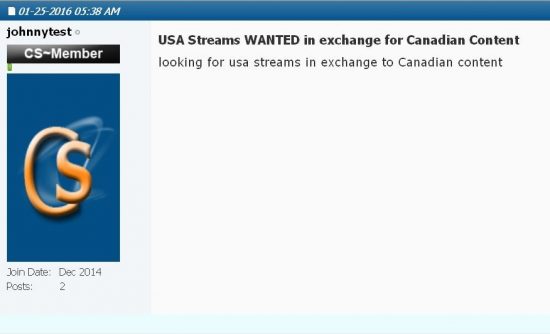
usa-for-canada

Over the same 10-year timeframe, security technology providers (ourselves among them) have consistently made it harder for card sharing to occur, which is good. Except there’s a much darker piracy cloud at hand, and it is directly overhead: Content sharing. Pirates are using the same exchange platforms that served them for card sharing, except that now they are sharing and trading actual content rather than, or in addition to, control words.

With history as a reliable guide, it’s only going to get worse. Right now, we’re in the rise of online forums that host “IPTV exchanges.” For example: Pirate Pete swaps his spoils with Pirate Patty, who has video assets he doesn’t. And vice versa.

Here’s a friendly explanation of how we found evidence of content sharing, in our research into not-so-friendly video piracy: Pete purchases one illegal subscription from a Greek provider, and Patty buys another, from an Italian provider. Both subscriptions contain some of the same channels, from all over Europe.

Aha! One day, one of the Italy-sourced channels displays a set-top box error — and the very same channel goes dark on the Greece-sourced channel, with the same error message. Conclusion: The same video source fed both illegal services. If nothing else, this proves that video pirates are sharing illegal feeds amongst themselves.

We spend a considerable amount of time looking “under the hood” of contemporary piracy techniques. In the course of those observations, we uncovered several disturbing advantages of content/stream sharing, over card/control word sharing: Continue reading “Same Pirates, New Means: From Card Sharing to Content Sharing”

Authors

Michal Brenner

Marketing Manager

Service Provider Video Marketing