Avatar

Organizations differ — often radically — in the kind of collaboration solutions they need. And the solution today needs to be flexible to adapt to what comes tomorrow. Agility in technology is key to agile business.

Your organization’s IT customization levels evolve. It’s not just about bringing in the latest products or plugging in simple off-the-shelf solutions. Most important is to establish a foundation with which you can work to best suit your evolving and unique needs.

As new options pervade the market, employees expect work technology to be simple, natural to use, yet easy to customize. In the end, it’s the user experience that counts. And especially in a world where we measure IT against modern online consumer experiences.

Cisco has a unique ability to fulfill these needs. That is the Cisco advantage.

When it comes to foundational business technology, it’s about a pedigree in innovation. Cisco was an early enabler of the Internet and creating connections – not just between machines but between people.

As the Internet progressed to become the great unifier of the digital world, Cisco identified more ways to help people connect and collaborate. It’s a constant cycle of innovation that benefits from the convergence of hardware, software, and the network.

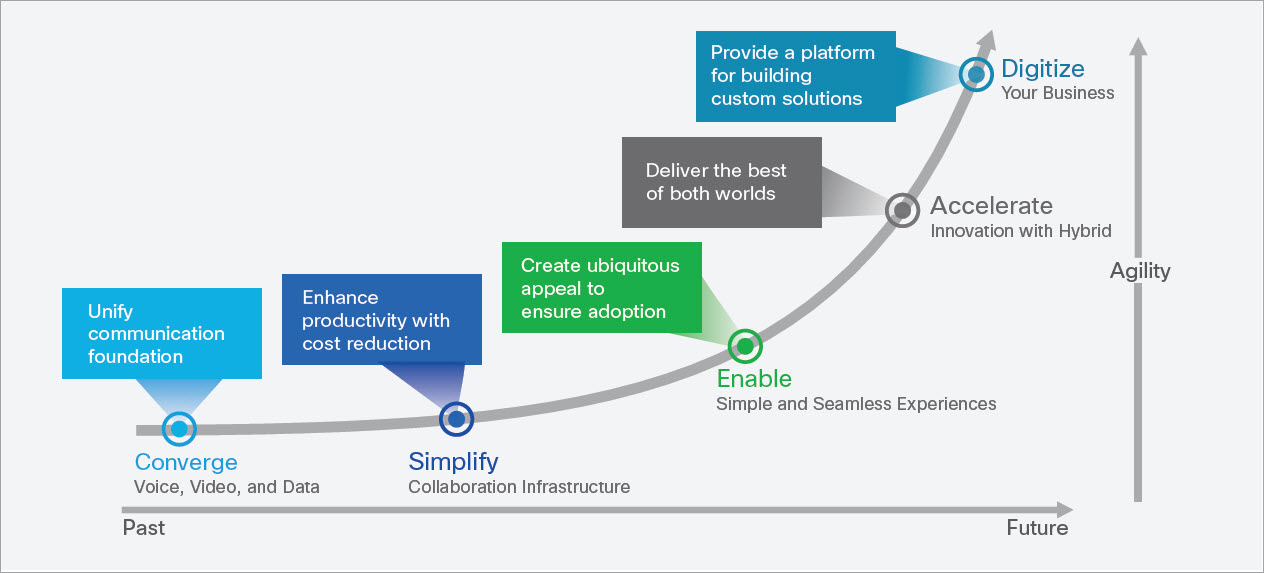
When it comes to collaboration, Cisco’s journey has progressed quickly. It started with the convergence of data, voice, and video, then moved into simplifying the collaboration infrastructure. This paved the way for high-quality video, making web conferencing and video conferencing accessible beyond the executive boardroom all the way to the device in your pocket. As these elements evolve, they continue to contribute toward dramatically simplifying and improving the way we share information, evolve work styles, and advance productivity.

As we continue to evolve, our focus is on delivering agility through better collaboration, taking advantage of:

  • The depth and breadth of our product portfolio
  • The integration of software, hardware, and the network
  • An interoperable, open standards-based platform paired with shared services and elegant applications
  • The cloud collaboration platform with capabilities of unified communications, contact centers, big data and analytics, and the Internet of Things
  • Extraordinary partnerships

Our collaboration portfolio unifies these elements with an architecture engineered for a delightful collaborative experience.collab-evolution
When it comes to collaboration technology, only Cisco offers the combination of hardware and software engineered from the first bit to integrate with the network. And that makes business sense because it provides you with:

  • Simplified procurement decision making
  • Significantly lower vendor-management expense
  • End-to-end solution design without complex multi-party integration
  • Avoidance of vendor lock-in due open architecture and standards-based implementation
  • Competitive pricing and future-proof solutions for every business need
  • Access to easily customizable, award-winning support

Cisco’s integrated approach protects your investment, while also making it personalized and controllable. It embraces the basic principles of communications, while providing flexibility as your organization – and technology — evolves. These make it easy to design, buy, implement, deploy, and to use.

Let’s be real: Collaborating effectively is not easy.
It comes down to this: user experience.

That means we’ve focused on creating a delightful user experience across the board. And not just the end user. You can create a beautiful end-user experience, but if it’s hard to implement, manage, and adapt, you haven’t succeeded. We’ve designed the experience to be delightful to the IT architect, the IT operator, the developer, the help-desk professional – and, of course, the end user. Everyone is included in the broader Collaboration ecosystem of users.
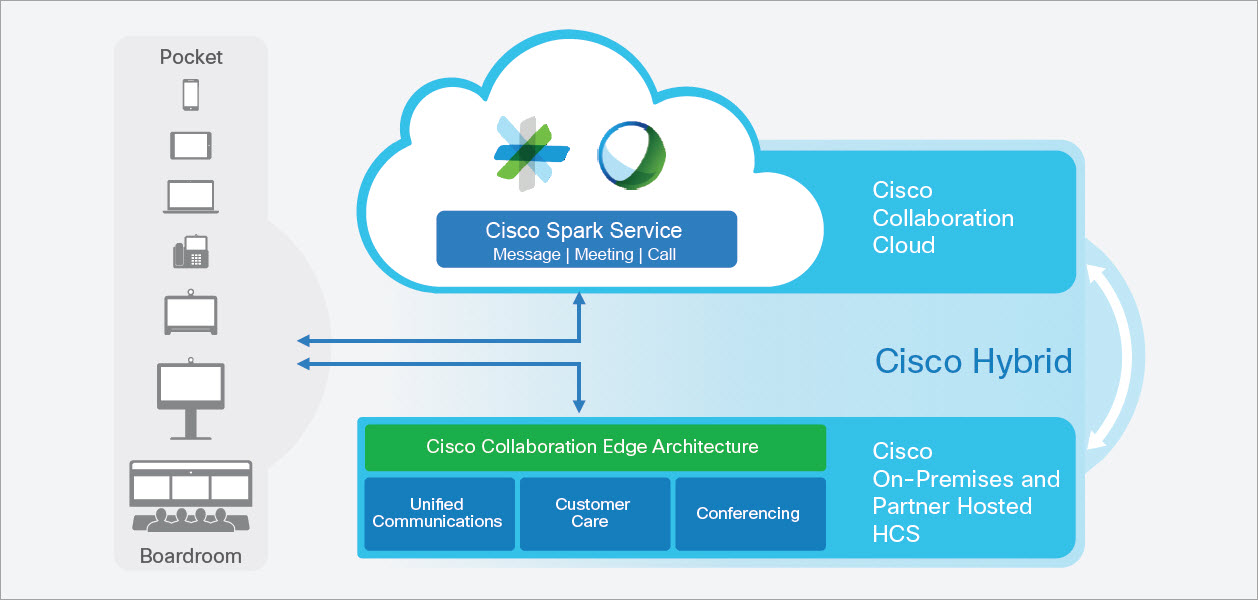
collab-arch


More than 200,000 organizations worldwide use Cisco Collaboration solutions – whether in the cloud, on premises, or a hybrid. Cisco is a partner of choice across industries. Support from Cisco and its well-established partner ecosystem can help you gain fast time to value from our portfolio.

Industry leaders and analysts like Gartner, IDC, and Frost & Sullivan continually recognize and award Cisco’s leadership in collaborative technologies. Products across the portfolio have also received multiple Red Dot awards for high-end design. These represent a small sampling of our global pedigree.

Now Is the Time to Act
Collaboration is the key to delivering solutions that drive business outcomes. Demands are changing constantly. Digital transformation, social networks, mobility, the Internet of Things, and whatever comes next are defining the future workspace – today.

People are using technologies to create new connections and approaches to collaboration. Cisco helps you cut through the noise with integrated solutions that are flexible to your needs, how ever and wherever you communicate. It’s all about transforming tools into conduits for innovation, letting you focus on what you’re doing, not the tools you’re using to do it.

“The most inventive places are hives of activity where people get together and share ideas.” —Steven Johnson, author, Where Ideas Come From

In its research, Dimension Data reports a strong emphasis on collaboration in businesses today:

  • 88% of enterprises say collaboration has improved decision-making process in their organizations
  • 81% say collaboration has enhanced their ability to engage with customers and improve customer service
  • Productivity enhancement stands out as the most important goal of enterprises’ collaboration strategies

Ensuring sustained innovation across your organization is critical. And that means putting collaboration at the core of your innovation strategy.

It always comes back to collaboration. Collaboration is a journey, not a destination. This journey itself is the path to agility. So are the opportunities for your business.

Next Steps
Explore more about how Cisco Collaboration technology can help create a more innovative, agile business environment.

This is the fourth post in a four-part series. Read the previous posts here:
Collaboration: The Foundation of the Agile Business
The Way We Work is Changing
Cornerstones of Agile Business

Authors

Smita Dave

Sr Marketing Manager

Collaboration Solutions Marketing

Avatar

headshotBy Ted Rose, Operational Security, Service Provider Video Software and Solutions, Cisco

Many (if not most!) service providers identify illegal streaming as the next big threat to their business. The problem is that in the multi-faceted, continuously expanding landscape of illegal streaming, it’s hard to define the enemy and even more difficult to choose the most effective response.

With this as the third in our IBC series about digital piracy trends, we’ll take an inside look at streaming piracy operations, and discuss the efficacy of piracy prevention methods in use today — in particular, takedown notices and site-blocking.

Illegal Streaming Operating Models

Clearly, illegal streaming is not a small problem. Multiple available methods allow many different segments of the population to participate — be it the old, the young, the technically savvy, those with expendable income, and those with nothing but a cheap device and an Internet connection. Based on what we’re seeing, many such demographic groupings are taking regular and full advantage of such illegal offerings — in some cases without even realizing that they are not using a legitimate service.

Different streaming piracy models have emerged, some offered for free and some as paid services to consumers. As it turns out, and it probably doesn’t come as any great surprise: The vast majority of the illegal streaming activity is for pure commercial gain. Even the “free” websites usually aren’t there to be free — they exist as part of a money-making ecosystem.

Four main models account for most of the illegal streaming of live content found on the Internet to date:

  • Direct web streaming is a growing operating model for illegal streaming, attracting millions of viewers. As part of a study done by Zubair Rafique and others from Stony Brook University (2015), 23,000 related streaming webpages were identified, corresponding to 5,685 different domains. In the immediate future, we anticipate that direct web streaming — sites offering free, Flash-based broadcasts of live streams — will continue to be the most popular method of viewing illegal streams (at least for the general public).

direct web

  • P2P (peer-to-peer) streaming is another model, similar to P2P file sharing. P2P streaming networks are limitless in size, with each user adding system capacity by way of bandwidth, storage space and CPU power. In fact, audiences of over 30,000 viewers have been observed on selected streams on a regular basis. The quality of streamed content on P2P networks is usually noticeably higher. On the other hand, they do require download of P2P clients, which may explain why direct web streaming is used more commonly.
  • Closed streaming networks are subscription-based IPTV networks offered as full services with complete channel lineups, sometimes requiring a hardware device installed in the subscriber’s premises that is either provided by the pirate or purchased separately by the subscriber. Subscribers of these networks don’t have to suffer through countless ads as they do with open Internet streaming. Many of these closed networks offer HD quality video.

closed network

  • Open source streaming clients are software-based clients that offer users a centralized interface for live channels and VOD content. The most popular example of this is Kodi. Kodi is a completely free and open source media player which is available on multiple operating systems and hardware platforms. While Kodi offers no illegal streaming content, it allows third parties to create addons; as a result, a vast quantity of pirated live channels and VOD content (movies and TV episodes) are available.

In short, pirates are continually expanding and exploring new ways of streaming content illegally over the Internet. With the scope and sophistication of such operations only expected to continue to grow, media and service provider businesses need to adapt the anti-piracy measures they use.

Current Anti-Piracy Measures for Illegal Streaming

Takedown notices have been used by copyright owners to fight piracy of their content assets for many years. The takedown notice grew out of the Digital Millennium Copyright Act (“DMCA”), in 1998. DMCA-backed takedown notices remain a popular tool to this day.

But are they working? Their sheer volume could suggest otherwise.

Consider: In 2013, copyright owners issued notices concerning more than 6.5 million infringing files, on more than 30,000 sites, every month. That comes out to more than 78 million notices per year. Over a 6-month period in 2013, the Motion Picture Association of America sent notices to search engines for approximately 12 million files, and notices to site operators for over 13 million files. Google reportedly receives more than 10 million takedown requests a week. It goes on and on, with little impact on the desired result.

Anti-piracy firms all make use of takedown notices to combat streaming piracy. However, there are several problems with the takedown notice approach, particularly as it applies to illegal video streaming. Here’s the short list:

1. Takedown notices and removal requests are highly ineffective for live content (like sporting events), which last for a matter of hours. Unless infringing streams are removed during the event (which is rare), the efficacy is zero.

2. Many of the sites that host, index or support illegal video streaming are covered under the DMCA’s “safe harbor” rules. As a result, sites like Google and YouTube (among many others), which actually act as gateways to infringing content, can’t be touched as long as they can prove that they’re playing by the rules.

“Playing by the rules” means responding expeditiously when notified by copyright owners of infringement. It follows that “expeditious” is undefined in the law, and different entities respond with different degrees of urgency. YouTube has an automated mechanism to respond, for instance, and can handle requests almost immediately. Others can take more than a day, and still be covered under safe harbor.

3. Some content delivery networks (CDNs) used to distribute live streams claim to respond to takedown notices, but this is questionable, at best. The effectiveness of the process is entirely dependent on the good will of the CDN. This is especially true of the many CDNs operating in geographic regions untouchable by DMCA-related legal actions.

4. While Google is responsive to takedown notices, its processes may actually enable users to find these sites in a more effective way. That’s because when Google removes links, it adds a result at the bottom of its results page, informing users that a site was removed from the search results due to a DMCA complaint. One can click and view the complaint, which, of course, contains the actual URL of the website — and the desirable content — that was removed from the results. In addition, Google does not de-rank sites that are notorious for pirated material. Pirated material still ranks highly on Google, and is the source — particularly for newcomers to the world of illegal streaming — for finding illegal streams.

5. Not all takedown requests result in actual takedowns. For example, Twitter reports that of the 14,694 removal requests they received in the first half of 2015 (not including requests related to Vine and Periscope), material was removed in only 67% of the cases. This is because they “carefully review each report received” and follow up with the requestor, as appropriate. That methodology helps to manage issues of false positives, like competitively-motivated and false copyright infringement complaints (it happens.) But the necessity for human involvement in such a takedown process slows it down, which makes it an unattractive option for knocking down live streaming piracy.

Beyond takedowns, another mechanism used to fight illegal streaming is site blocking. However, site blocking is not an option in all parts of the world. Nonetheless, the efficacy of site blocking can be studied in those regions where it has been used for some time. The United Kingdom started blocking copyright infringing sites more than 4 years ago; studies have shown a definite impact on the amount of traffic to blocked sites.

To wit: According to a study from March 2015, on average, blocked sites in the U.K. lose 73.2% of their Amazon Alexa-estimated usage, following the site block. However, the studies don’t address whether or not site blocking, as a policy, produced an overall decrease in streaming piracy. Even in regions where site blocking is a legal option, limitations and obstacles exist that can make it a less-than-ideal anti-piracy tool. Disputes can erupt, for instance, between operators and ISPs, about who should cover which costs. Other questions emerge about how mirror sites, proxies, and VPNs should be handled. Should only domains be blocked, or IP addresses as well? And so on.

Now What?

In reality, and especially when it comes to illegal streaming of live events, takedown notices and site blocking are really only partial solutions, and far from 100% effective. Streaming sites are resilient and pirates are motivated (both ideologically and financially) to recover as quickly as possible.

In our opinion, both take down notices and site blockings need to be supplemented with education and awareness – and new technological prevention mechanisms. Some service providers are already beginning to use termination technology that “kills” the stream of the infringing video source, but such efforts are nascent.

  • Read Part One of our Security for Video blog series here
  • Read Part Two of the series here


Authors

Michal Brenner

Marketing Manager

Service Provider Video Marketing

Avatar

What do you get when you have 17,000 students and 2,000 staff accessing the network across 28 buildings?

A. Reliable, high-density wireless
B. Visibility across the entire network
C. Cloud based management and control
D. Stress-free 2-person IT team
E. All of the above

With Cisco Meraki, the answer is E, all of the above. Our cloud managed access points make managing the wireless network simple and seamless for Oyin Idowu, Network Administrator at Waukegan Public Schools in Illinois. From preconfiguring devices in the Meraki dashboard before they’re unboxed to creating special event SSIDs in seconds, just 2 people are able to do it all.

Don’t believe it’s that easy? Listen to Oyin share her experience deploying over 1,200 high-density 802.11ac Meraki access points live on a webinar. On Tuesday, September 20 at 11 am PT, she’ll join a Meraki Product Specialist to chat, demo the Waukegan PS dashboard, and answer your questions.

Register Here!

Authors

Tania Spezza

Marketing Campaigns Manager, SLED & E-Rate

Cisco Meraki

Avatar

A soccer ball without a player is useless. A violin without its musician is just a bit of wood and wire.

And a beautiful new security deployment, no matter how advanced, needs skilled people to configure and operate it properly. That deployment must be operating at maximum effectiveness. It also must be tuned to the organization and assets it is protecting and to the priorities and risk environments that an organization is facing.

People with the most current skills and knowledge are the future of security. We as an industry, and as a company, must invest in those people—to turn them into the world’s most highly trained professionals—if security deployments are to be effective.

People and security controls are two sides of the same coin, and both are critical to keeping organizations safe in today’s high-risk environments. Properly trained people understand and write more nuanced policies, implement more effective controls, and thoroughly understand reporting from security systems and new or external requirements. I wrote about these issues and their impact on the market recently for Cyber Defense Magazine, but I wanted to take a closer look at what we at Cisco are doing about this challenge.

Organizations need visibility into the network

As new digitization trends such as IoT, Cloud, network programmability, and Big Data disrupt the market, it’s critical to ensure that the organization’s security measures are evolving to keep pace. Without it, companies risk exposure to crippling security breaches.

These new technologies can lead to massive productivity gains, but they should be deployed with a measure of risk analysis and security controls and procedures in place. Otherwise, they could inadvertently lead to the creation of new business risks—the low-hanging fruit for somebody looking for the opportunity to profit from a system compromise.

Vendors are beginning to deploy IPS and security sensors throughout their information systems, analyzing that sensor data with analytics to detect security breaches. The many non-PC systems unable to incorporate IPS and security sensors, coupled with the inherent untrustworthiness of having targeted systems report their own security status makes it difficult to fully protect these non-PC systems from within themselves.

Would it make sense to trust possibly compromised systems to report their own security status? Of course not! One solution is to monitor devices of all types from the very network infrastructure used to interconnect this growing collection of systems.

It is imperative that organizations have visibility, security intelligence, and analytics to sift through this sensor data to identify anything unusual and concerning. 

Increased visibility can deliver a massive amount of data to sort through. Then the challenge is to find the needle in the haystack and to connect the dots through thousands or even millions of transactions that are likely to sweep an organization downstream.

Two things help us here. First, intelligence feeds tell modern security systems what to watch for. Second, analytics engines sort through data; they filter out unusual events, patterns, and trends; and then they conduct further analysis to determine which ones are security concerns and which ones are merely unusual items.

Cisco is a valuable partner

Fortunately, technology that gives organizations better and timelier visibility is at hand. Cisco is the leader in creating infrastructure that connects all these devices, and it can enable consistent security data to be collected from nearly any device connected to the now-ubiquitous network. It can also carry embedded security. This delivers more consistent security coverage than expecting those 600-odd companies that are building endpoint systems to deliver consistent and built-in security.

Cisco’s core value here is security-enabling as much of the IT infrastructure as possible and gaining maximum visibility throughout the network. That visibility comes from using the network itself as a sensor for information flowing between systems and devices. These security sensors built into the network are analogous to CCTV cameras throughout a secured building. They grant security personnel the visibility into relevant security incidents throughout the building, allowing them to respond in a reasonable amount of time.

Without this visibility, the industry average time to detect (TTD) a security incident is in the order of months. With this increased visibility, and with the power to analyze and monitor the information from these sensors, Cisco can reduce that TTD by an order of magnitude. To maximize detection of security incidents, Cisco has focused on acquiring key security technologies to reduce TTD, including:

  • SourceFire – FirePOWER Next-Gen IPS, Advanced Malware Protection (AMP)
  • ThreatGRID – dynamic malware analysis and threat intelligence
  • Lancope – StealthWatch context-aware security analytics
  • OpenDNS – advanced threat protection delivered via cloud for any device anywhere

In this post, we’ve covered the technology that delivers the visibility, security intelligence, and analytics into sensor data.

In the second part of this blog post, we’ll talk about the other side of that coin—the trained security personnel necessary for organizations to leverage that technology to the hilt.

Authors

Tom Gilheany

Product Manager

Learning@Cisco

Avatar

Globally, cyber crime is skyrocketing. No matter what business you are involved in; cyber criminals are looking for ways to infiltrate your business for profit. Retail establishments are targeted for credit card theft, motion picture studios have had unreleased films stolen, and hospital databases have been infiltrated to steal patient identities. Organizations like the DNC were hacked causing political embarrassment and broadcasters like TV5Monde and Charter Communications were used to transmit nefarious messages. To combat a 1000% increase in cyber threats seen over 2015, global telecoms giant, BT, embarked on a partnership with Cisco to strengthen BT’s network and advanced threat protection capabilities. As a result, BT combined their cyber security expertise with Cisco threat-centric security solutions to secure their own business and included the same technologies in BT Assure Cyber Managed Security Services portfolio to protect their customers.

Screen Shot 2016-09-08 at 9.28.16 PM

Businesses small and large are concerned about cyber security but often they lack the expertise or the desire to acquire in house capability. To enable their customer’s business and accelerate digital business transformation, BT helps their customers safely participate in the digital age by providing best-in-class cyber security as a service. BT Assure Cyber helps protect BT’s customers from new, highly targeted, and constantly evolving threats from well-funded, organized cyber criminals. Included in BT’s portfolio is next-generation Cisco security technology including next-generation firewalls, next-generation IPS, and Advanced Malware Protection. Customers trust BT to help them stay ahead of cyber threats. Using their unique insight into the latest threat intelligence, gleaned from their global customer’s security installations coupled with the Cisco security infrastructure, attacks across their customer base can be thwarted.

And this strategy is working. BT’s IP Connect Global Network operates in over 197 countries and is built upon Cisco networking, telepresence, and security technologies enabling them to service large multinational customers in diverse metropolitan locations or remote reaches of the planet. De Beers Canada, the world’s leading diamond miner by value, manages mines, exploration technologies as well as retail operations across the globe. The BT infrastructure, powered by Cisco, enables De Beers to securely locate personnel and manage operations from a central location. James Ross, Head of Information Management, states that “BT and Cisco play a big role in our cyber security approach in the sense that they helped us build our network with an eye on security to protect ourselves, and to protect the information of the people that work with us and our partners.”

Mobile and online banking is continuing to grow significantly and so are threats to IT and network security. Recent high-profile cases have highlighted the need for banks and other financial services institutions to be super-safe when it comes to security. Nationwide, the world’s largest building society with 15 million members and 17,000 employees, turned to BT to protect Nationwide both now and in the future. “We regard it very much as a partnership. That’s made stronger by the fact that the two organizations have similar cultures. And we know BT has the capability and expertise across the globe in an area that Nationwide doesn’t.” – Debra Bailey, Chief Information Officer, Nationwide Building Society

In an uncertain global threat landscape, here are examples of two large multinational companies, both leaders in their industries, have chosen to outsource cyber security to the leaders they trust.

Authors

Sam Rastogi

Senior Product & Solutions Marketing Manager

Avatar

As consumers, we’re aware that we live in an increasingly connected world.

It’s all around us. More and more we just expect things to work.

So why shouldn’t we expect the same in our business relationships? Why should we wait for integration to take place when we just want two things to work together?

We shouldn’t need to build bridges from one technical platform for another. These things should just work together.

With apologies to John Donne, no technology should be an island.

At Cisco, we’ve always seen our partners not just as a means to extend our own capability, but as a way of bringing the best technologies to our customers. And when we do this, our customers benefit, by delivering the best possible services to their consumers.

Our Infinite Video Platform employs the best of cloud technology to ensure we can provide the best partners to our customers. But having a partner network is one thing, ensuring they all work together is something else.

evergent 2

We know that the only way we can deliver value to our customers is by making sure our partners are seamlessly integrated with our own Infinite Video Platform. That’s why we’re really excited about our recently announced partnership with Evergent.

A provider of subscriber and account management solutions, Evergent offers carrier grade cloud-based software to bring a wide range of capabilities to service providers. These include account and billing management, customer self-care, catalog and offer management, all with associated administrative and workflow tools.

By partnering with Evergent, we’re ensuring that our Infinite Video Platform customers have access to the best technologies out there so they can generate more revenue and delight their consumers, whilst making their back office functions more efficient.

And because we ensure that our integrated solutions always work together, there’s no need to go through the challenges and delays of integration, or deal with managing multiple roadmaps.

Learn more about our Infinite Video Platform, or visit us at IBC 2016 where we’ll be showcasing our integrated solution. We’ll be happy to give you a demonstration.

Authors

Adam Davies

Technical Leader, Engineering

Service Provider, Video Solutions

Avatar

There has never been a better time for the Media and Broadcast Industry. As viewers demand more compelling and engaging live productions, broadcaster’s workflows continue to become more complex, whether live or in the studio. You need tools that can help you tell better stories with the flexibility and creativity that keeps viewers watching across multiple platforms. Live production technology has enabled media studios to acquire, produce, and playout content, via powerful networks connecting studio locations and live events. And with the move from SDI to IP workflows, these advancements have had a tremendous impact on the media industry but they come with a host of troubling security concerns.

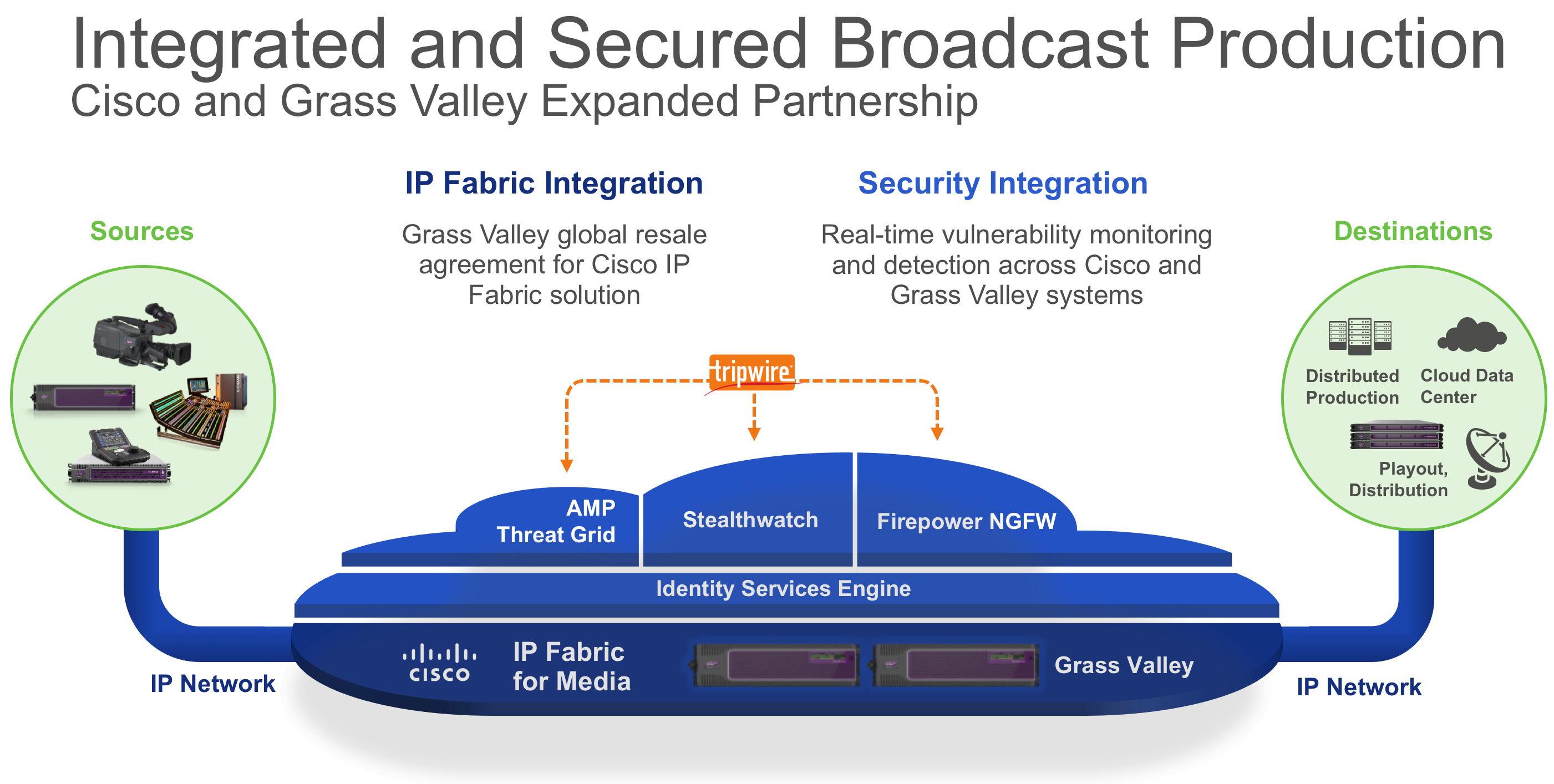
That is why Cisco has enhanced it’s partnership with Grass Valley and Tripwire and have detailed their end-to-end solutions to enable media and broadcast providers to move towards digitization and deliver comprehensive protection of their media broadcast and production environments.

grass valley 1

At IBC, Grass Valley announced a new global resell agreement with Cisco’s IP Fabric solution, integrated with Grass Valley broadcast production systems. As part of the agreement, Grass Valley will sell Cisco Nexus 9000 Series Switches together with their GV Node platform to provide a non-blocking, highly scalable core networking solution necessary for a complete media workflow and form the basis for Cisco’s IP Fabric for Media. GV Node Real-Time IP Processing and Edge Routing Platform, GV Convergent IP/SDI Router Control & Configuration System and the IPG-3901 SDI/IP Gateway make it possible for users to build a true IP workflow built around COTS IP switches.

Cisco and Grass Valley are integrating their solutions to secure broadcast production.

Cisco Identity Services Engine (ISE) helps to lock down the control and management plane into the Grass Valley GV Node infrastructure with granular role-based access control.

In addition, security integration across Tripwire and Cisco solutions provide real-time vulnerability monitoring and detection to increase visibility, reduce complexity, and speed the time to detect and mitigate threats.

Tripwire IP360, adds vulnerability and risk assessment that monitors the entire production network. Vulnerability data and events are sent to Cisco Firepower Management Center (via Cisco Event Steamer or eStreamer API) for enhanced security visibility. Firepower Management Center maps Tripwire vulernability data with it’s threat intelligence and automation to intelligently detect and mitigate against threats.

When suspicious files are detected in the network by Tripwire Enterprise, it works with AMP Threat Grid’s content driven security analytics to dynamically analyze submitted files, executing the sample in a safe environment, examining the behavior, and correlating the results with hundreds of millions of other analyzed malware artifacts. In less than 10 minutes AMP Threat Grid reports back and works with Tripwire Enterprise to tags the file with a result. Similarly, when suspicious or malicious network activity is identified by Stealthwatch it reports back and works with Tripwire Enterprise to start an incident response investigation to quickly detect and repond to advanced threats.

Security integration with Cisco AMP Threat Grid, Cisco Stealthwatch, and Tripwire Enterprise, enable media and broadcast providers to quickly prioritize actions for changes on systems with threats identified by AMP Threat Grid and initiate workflow actions for quick remediation.

The Grass Valley – Tripwire – Cisco partnership delivers a secure, state of the art media broadcast platform. Visit us at IBC and find out how we can help you deliver uninterrupted content to your customers.

Authors

Sam Rastogi

Senior Product & Solutions Marketing Manager

Avatar

For more than a decade, Cisco has tracked and projected global Internet traffic growth and associated networking trends through the Visual Networking Index (VNI). From day one, the Zettabyte has been a benchmark that our analysts have targeted as a major networking milestone.

When will global Internet traffic reach an annual run rate of one Zettabyte? Well, that day has finally come. According to our estimate, the world’s collective Internet use will reach the Zettabyte threshold for this calendar year on September 9, 2016. Finally… Consider the fact that the Internet essentially began to scale for global consumer and business use in the early 1980’s (see Wikipedia for an independent Internet history). It’s taken nearly four decades of global innovation and expansion to reach this digital peak.

AS91675

A Zettabyte is a whole lot of traffic (to put it mildly). So, since we’re counting, here’s how big a Zettabyte is:

  • A zettabyte is a measure of storage capacity and is 2 to the 70th power bytes, also expressed as 1021 (1,000,000,000,000,000,000,000 bytes) or 1 sextillion bytes.
  • One Zettabyte is approximately equal to a thousand Exabytes, a billion Terabytes, or atrillion Gigabytes.

But thinking in terms of bytes alone doesn’t really do this milestone justice. Just for fun, each VNI analyst developed a non-networking Zettabyte equivalency to help visualize and quantify the ushering in of a new era.

shrutiFrom Shruti Jain: arielleIf each Terabyte in a Zettabyte were a kilometer, it would be equivalent to 1,300 round trips to the moon and back (768,800 kilometers).

From Arielle Sumits: If each Petabyte in a Zettabyte were a centimeter, then we could reach a height 12 times higher than the Burj Khalifa (the world’s tallest building at 828 meters high).

ushaFrom Usha Andra: If every Gigabyte in a Zettabyte were a meter, it could span the distance of the Amazon River (the world’s longest river at 6,992 kilometers) more than150,000 times.

taruFrom Taru Khurana: If each Gigabyte in a Zettabyte were a brick, 258 Great Walls of China (made of 3,873,000,000 bricks) could be built.

And while it took nearly forty years to reach the global Zettabye annual run rate, it won’t take nearly that long to reach two Zettabytes. Based on our current projections, the world will reach 2.3 Zettabytes of annual Internet traffic by 2020 (in just four years!). I predict that this little world wide web thing might have a future. To see more projections from our 2016 VNI Complete Forecast, check out our Highlights Tool.

Authors

Thomas Barnett, Jr.

Director, SP Thought Leadership

Worldwide Service Provider Marketing Group

Avatar

Recently, Gartner named Cisco a leader in its 2016 Magic Quadrant for Unified Communications. For this report, Gartner measured both the ability to execute and completeness of vision for unified communications amongst ten top technology vendors in the communications space, amongst which, Cisco was named the top performer in both categories.

According to the report, Cisco received the highest scores across all the use cases Gartner defines as critical for unified communications, including full UC with strong telephony, full UC with strong collaboration, full UC for midsize organizations and ability to offer hybrid solutions.

Screen Shot 2016-08-29 at 2.30.44 PM

So, how does this recognition relate to education?

Just as collaboration and unified communications are imperative for the enterprise space, they are also crucial in education. Both K-12 schools and higher education institutions are realizing the value of increased communicative effectiveness amongst staff and administrators, as well as the value of collaboration tools to create new pedagogies and improved student outcomes.

Ranking highest in full UC with strong telephony and collaboration means that Cisco is well-positioned to provide the best unified communications to students and teachers at schools and universities around the world.

That means that administrators, teachers and professors can stay in constant communication with video and telephony services that are simple to use and high-quality. They can use collaboration tools like Spark and WebEx to meet virtually, communicate seamlessly and continuously innovate.

AQ44538 (1)

Our Unified Communications platforms also allow students to learn in new and more effective ways. They can attend classes virtually using WebEx. They can meet with and learn from experts around the world through TelePresence. They can even communicate with teachers and peers out of the classroom using Spark.

The possibilities and benefits are truly endless for unified communications in education, and Gartner’s recent recognition further solidifies Cisco’s role in the UC market while driving our mission to create the best user experience for learners and educators worldwide.

Want to know more? Check out this blog post by Thomas McCafferty to learn about the process of participating in Gartner’s analysis, the collaboration team’s post to see some of the recent developments that contributed to this prestigious recognition, and the Cisco education website to learn more about our UC use cases.

________________________________________________________

Read the full Gartner Magic Quadrant for Unified Communications 2016 report.

________________________________________________________

This graphic was published by Gartner, Inc. as part of a larger research document and should be evaluated in the context of the entire document. The Gartner document is available upon request from Cisco. Gartner does not endorse any vendor, product or service depicted in its research publications, and does not advise technology users to select only those vendors with the highest ratings or other designation. Gartner research publications consist of the opinions of Gartner’s research organization and should not be construed as statements of fact. Gartner disclaims all warranties, expressed or implied, with respect to this research, including any warranties of merchantability or fitness for a part.

Authors

Lyanne Paustenbach

No Longer with Cisco