Avatar

No, this is not a greeting card holiday for which gifts are given (at least not yet)… but it is quite a milestone of IP traffic growth. The Internet and all things IP have become ubiquitous in our lives over the last 20 years with seemingly everything either being connected or planned to be.  And how we use it has dramatically changed as well.  Things like fold out maps, video recorders, and board games have taken on an aura of nostalgia as they are replaced by GPS-enabled apps, smartphones, and Pokémon Go.  Such a transition puts more and more loads on networks worldwide.  Even when we aren’t doing something on the network, our devices are.  From software updates and connected backups to our favorite shows being recorded to watch later or the security cameras monitoring freeways, all of these have effects on the network, and all of them really start to add up.

WebExMeetingsHero1

When we started our Visual Networking Index more than a decade ago, we initially measured everything in Petabytes, then Exabytes and now Zettabytes, which is 10 to the 21st power number of bytes (so huge, it is simply hard to fathom).  For example, if each byte were a liter of water, a zettabyte would fill up approximately 7080 Pacific oceans.   And even that isn’t a full representation of the amount of traffic we forecast for 2016 as that total to be even higher at 1.1 Zettabytes.  However, before that total can be reached, first a milestone that has never been reached – the Zettabyte milestone – is met.  Based on our assessment of the run rate of the current level of traffic, that date is today, September 9th, making 2016  the official start of the Zettabyte era.

Congratulations and please take pause to celebrate (perhaps by connecting a few more devices to the network?).  And on behalf of all of us at Cisco, know that we’re continuing to not just track the latest trends and growth in networking but also continuing to innovate to enable greater speed, efficiency, growth and security for our service provider customers so we can celebrate this and other networking milestones together with you.

Learn more in our Service Provider Network Intelligence Hub.

Authors

Doug Webster

Vice President

Avatar

Instead of increasing the volume of new product announcements coming out of IBC 2016, this blog will focus on what’s really happening in the IP video marketplace.

With some obligatory background: A few years ago, our broadcast and service provider video partners asked for a way to transition from hardware-based to software-based, from fixed to cloud, and from device-specific to virtualized — all with a vigilant focus on video quality and operational simplification.

The result was our flagship Virtualized Video Processing platform, or “V2P” as we like to call it. V2P covers everything we’ve built to compress, transcode, orchestrate and distribute live, linear and on-demand video, over IP.

Here’s what happened since, in use-case terms: In the U.S., the Federal Communications Commission issued a mandate for cable providers to include descriptive audio services as a “second audio program” (SAP) to the airing channel. Devised to assist the vision-impaired, the accessibility requirement stipulates a way to read aloud what’s happening on the screen.

In developing its compliance strategy, Altice USA opted to deploy our V2P platform to ingest, prepare, record, and deliver the SAP streams for a mix of about 800 live and on-demand channels.

We’ve worked with Altice for more than a decade, on everything from CCAP and DOCSIS 3.1-based access platforms, for faster Internet speeds, to CDNs, 4K VOD, and the Altice “Zive” subscription VOD service. So the addition of V2P capabilities, to help meet the FCC mandate, was a natural extension — and it positions them for broader and deeper service expansions.

IBCgraphic3-IGSo that’s pretty cool, for them, and for every other operator contemplating a compliance strategy. (Hint hint!)

Swisscom used our Ultra HD (UHD) live encoders to distribute the 2016 European Football Championship. As the leading Swiss digital TV provider, with 1.4 million customers, Swisscom started with a sort of encoder bake-off, and ended up picking a V2P production direction. It included our HDR-ready 4K encoders, and integration with our virtual DCM (Digital Content Manager.)

It’s already pretty cool to be a technology player in the media and entertainment industry. But to be part of a project that involves the European Football Championship? Bonus!

Lastly, a bright and new feather in the cap, were software able to wear caps: Our first-ever V2P deployment in India, with Videocon d2h — one of the country’s biggest conglomerates and DTH operators. Specifically, Videocon selected V2P for the flexibility it enables them to scale horizontally to multi-screen, cloud-DVR and on-demand offerings — while preserving crucial bandwidth needs.

There’s more to the story, and it goes like this: Videocon also needed a disaster recovery strategy, which they built in software using our Virtual DCM. Ultimately, the same platform will mirror across both hardware-anchored and virtualized environments. This gets them to high-quality next-gen services, and reduces the complexities associated with failover techniques.

So: One customer using V2P to take their customers into the dazzling world of 4K, and another solving a key failover protection goal. Stay tuned for the V2P momentum continue! #neverbetter

Authors

George Tupy

Market Manager

Service Provider, Video Solutions

Avatar

In the race to detect and contain ransomware on their networks, many organizations fail before they are out of the gate.  The reason has very little to do with technology, and more so a great deal to do with process.

“But we bought all the good tools!”, such organizations protest. Good security technologies implemented and optimized properly are certainly one piece of the puzzle, however organizations, with large or small budgets, can use good processes and procedures to narrow their attack surfaces.

As discussed in a previous blog, organizations can be rated on their overall Threat Management Maturity by what level of capabilities they have in the categories of People, Process and Technology.  Without documented processes and procedures, IT departments frequently rely on tribal knowledge and react to incidents in an ad-hoc fashion. Time to remediation is longer due to lack of assigned roles and responsibilities, and little or no pre-written and rehearsed action plans.  In the case of ransomware, the time to remediation for some organizations can be the difference between being in business and going under.

The question then is, how best to prepare for ransomware infections that are becoming a daily occurrence for a majority of organizations? The answer is a Runbook, which is focused specifically on detecting, containing and remediating ransomware. At its simplest, a runbook is a series of steps to undertake when a specific incident occurs. This is considerably less complicated than developing a full Incident Response Plan (which doesn’t necessarily tackle the heart of the incident) and there are a number of good resources on the Internet to assist with the development of one.

To be effective, a ransomware runbook should address the following:

Inputs

The ways in which a ransomware incursion could be identified on a network. For less mature organizations, this is usually an end-user notifying the helpdesk or local IT support person.  It may also include IT team members recognizing an abnormal condition on a system they are responsible for. As organizations mature, this may also include alerts produced via security technologies, or via centralized monitoring platforms (e.g.: SIEM).

Identification

Ransomware comes in a wide variety of types these days. To effectively contain a ransomware threat, it is imperative that it be identified properly. Actions in this section of the runbook would address the attributes of the suspected infection (e.g.: file extension, infection vector, files created, file owner). While time is of the essence during a hunt for patient zero in a ransomware investigation, improper identification can lead to incorrect containment steps.

Containment

This is commonly referred to as “stopping the bleeding” and involves making sure the active infection is contained or terminated so damage to network systems is halted. In the case of ransomware, ensuring the executable responsible for encrypting files is no longer able to run or communicate out are common containment steps. The runbook should consider both host-based and network containment steps.

Analysis & Remediation

The inclusion and level of analysis in a runbook will largely depend on the level of capability an organization has. While full forensic analysis on a host is possible for some organizations, many do not have the skill set or time to engage in this level of investigation. Once containment has been validated, analysis may be as simple as running additional anti-virus or anti-malware scans on a host. Indeed, analysis may not even occur and the remediation step may simply be a re-image of the affected host.  A runbook should also include host and network remediation steps that address the initial infection vector, as well as how the malware was able to run on the host in the first place.

A ransomware runbook, like any other runbook written to address a specific and known threat, should be written with the organization’s actual capabilities in mind. It should also be reviewed frequently and updated based on new tactics, techniques and procedures that attacker may use as ransomware continues to evolve. A runbook will not stop all ransomware attacks, however it will enhance an organization’s ability to respond and remediate faster and more efficiently.

The following is a list of prevention, mitigation and safeguards that organizations can take to reduce their impact to Ransomware based threats and incorporate into existing process, procedures and architecture.

Ransomware Prevention, Mitigation and Safeguards

  • LAYERED HOST AND NETWORK-BASED SECURITY DEFENSES – Each system should be protected with DNS layer protections to prevent devices from connecting to sites hosting ransomware and endpoint protection for detecting and preventing the latest ransomware variants. At an organizational level, strong email and web threat protections in addition to network security (Intrusion Prevention Systems and Next-Generation Firewalls) should be utilized in also detecting and preventing the latest ransomware variants.
  • PATCHING LIFE CYCLE– A patching level cycle should be utilize to deploy updates to all systems for known Common Vulnerabilities and Exposures (CVE) in commonly used software such as but not limited to: Adobe Flash, Adobe Acrobat, Microsoft Silverlight, Oracle Java, Microsoft Internet Explorer, and Microsoft Office; where exploits can take advantage of programmatic errors and unsecure code.
  • REMEDIATION/UPGRADE PLAN FOR UNSUPPORTED OS (Operating Systems)- Develop a remediation/upgrade plan for unsupported and unpatched OS, such as: Windows XP, Windows 2000 and 2003 systems or consider the use of application white listing.
  • BACKUPS/CONTINGENCY PLANNING- A backup policy/contingency plan, procedure, and technology for systems should be developed and utilized in the event that the loss of data on a system occurs.

Authors

Shelly Giesbrecht

Senior Incident Responder

Security Incident Response Services

Avatar

Hackers are in the news every day. If it is not Hillary or the DNC emails from WikiLeaks, we hear about racist hate speech appearing on unsuspecting Charter cable subscriber’s screens in Texas. These latest breeches are on the heels of very high profile attacks at TV5Monde where live streams were hijacked and Talk Talk’s 170k subscriber data thefts. The Internet is wonderful technology but unfortunately it is also fertile ground for all types of cyber crime. That is why the largest global enabler of the Internet, Cisco has made cyber security its top strategic priority. We’ve invested over $5 billion in security in the last 3 years both organically and through acquisitions of industry-leading technologies. Our architectural approach integrates best of breed technologies to tackle our customers’ top concern: security.

As everything in their world becomes digital, our customers want a trusted partner with experience across the board. We believe no one is better positioned than Cisco because, in our view, the only way to protect enterprises is via the network. Our strategy in security is to embed threat-centric security everywhere across the extended network. And Service Providers that provide Video, Mobile, Fixed, and OTT services to their customers are a key beneficiary of our strategy. Cloud and IP transition brings business benefits of agility, flexibility and scalability and there is no question that our customers must transform to be successful but then they also have to deal with new security challenges. Cisco’s architectural approach to security is one that is simple, open, and automated to help service providers effectively protect their business, protect their customers, and monetize new business opportunities enabled by the digital revolution.

Service Providers need a solution that will enable them to launch new services and features quickly and securely reach all brands of consumer devices. Our customers are implementing security to get studios’ approval to deliver their premium content and to protect opportunities for new revenue streams.

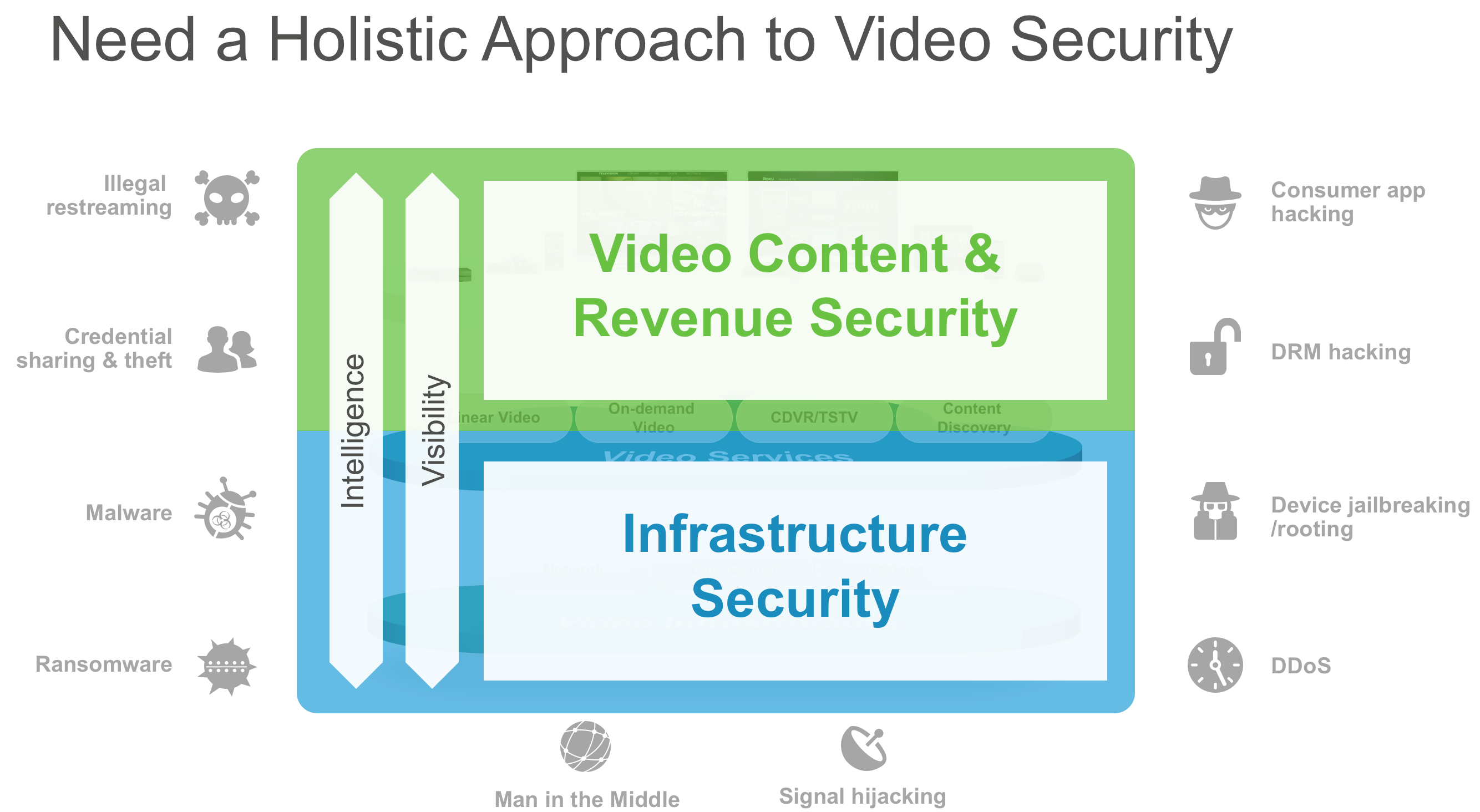
Take video content protection for example: content can be stolen in a number of new ways – via cyber attacks on the video backend infrastructure, illegal live capturing of video from consumer viewing devices, device and app hacking, and more. To be one step ahead of the hackers, one must consider and be on the lookout for what pirates might do next and continually close the weakest links. We leverage industry-leading threat intelligence from our Talos organization and integrate that with cross-network visibility, and best-of-breed security technology and services to deliver highly effective protection from cyber crime. It is not enough to defend the network perimeter. You need a multi-layered approach to security. Your security solution must continuously monitor the entire IT environment in case unknown threats get in. Only then can you quickly detect, contain, and remediate breaches before they damage your business. We are #1 in both video security and Data Center security, and now these fields are converging for the next generation of video delivery.

video security

Cisco’s Threat-Centric security approach to video headend and media data center security safeguards video content, broadcast infrastructure, and critical business systems. Our security solutions work together to protect your business from advanced cyber threats before, during and after an attack. BEFORE the attack, our solution strengthens the network perimeter, enforces secure access, and safeguards media content across networks, systems, users, and data. DURING the attack, it provides real-time detection and mitigation from known threats. And AFTER the attack, it helps you to quickly discover malware that gets in and resolves these unknown attacks to prevent your business from being compromised.

With VideoGuard Everywhere, we moved from distinct products to a single unified solution for Conditional Access (CA) cardless CA, and multi-DRM based protection. Our new solution can be deployed and managed from the cloud; it is easy to integrate with other backend systems and is used for service development with open APIs. With VideoGuard Everywhere Streaming Piracy Prevention (SPP) we are taking the next step to stop the growing issue of online piracy. For live events, like sports, time is critical. SPP combines multiple technologies like web monitoring and watermarking and adds the missing ingredient of real-time termination leveraging CA and DRM.

To learn more about our latest Cisco Security for Video solutions, stop by our booth at IBC and see it catch the bad guys in real time.

Authors

Sam Rastogi

Senior Product & Solutions Marketing Manager

Avatar

AR76087

Spain’s University of León was slowly starting to fall behind the country’s other universities. The reason? An outdated wireless network was making it tough for communication and idea sharing. Both the teachers and the students were equally frustrated by the speed of the network and consequently it wasn’t being used much anymore.

This is not a good position for a modern university to find itself in.

The University of León did what any organization would do when faced with the same problem: after testing three vendors, they chose the best: Cisco.

“We found Cisco access points were the easiest to manage and the most robust with the same solid performance as our wired infrastructure,” said Francisco Pérez Laorden, University of León’s Head of Communications.

Creating a wireless network infrastructure that employed Cisco Aironet 1700 Series and 2700 Series Access Points with Catalyst 2960 and 6500 Series Switches allowed for a much faster and more robust wireless network. Now the university can support 5,000 concurrent users with 100 percent coverage across the campus. The students and staff have noticed that the network is stronger and they have responded. There has been a spike of 70 percent more wireless traffic.

Now that the WiFi is working properly, professors are able to use online resources while teaching. These resources make for a more rich educational experience adding depth to the professors’ classroom lectures. In the future the school is going to deploy more on-demand applications and add more devices now that their bandwidth has grown.

Click here to read the entire case study.

Authors

Byron Magrane

Product Manager, Marketing

Avatar

Picture yourself as the guy at the big trade show who works for a well-known technology company, yet is representing (for them) a relatively new line of video technologies. He’s there amongst 54,999 others, who work for or with storied and legendary broadcast video giants: Grass Valley, a Belden Brand. Riedel. Imagine Communications. Sony. EVS.

If you’re a dog person, you’ll understand this analogy: It’s like being somewhere between puppy and dog, amidst an established and alpha-heavy pack. Me (pun intended): “We can get you to all-IP really, really fast! IP everywhere!” Them (in an  Alec Baldwin voice): “Heh. Pack a lunch, kid. It’s gonna take you all day.” Or (Sam Elliot voice: “Uh-huh. You got the talkin’ part done.” Or (Kathleen Turner): “You’re cute, pup.”

That guy is us, collectively, at Cisco. But in the fullness of time, pack order tends to sort itself out. And yes, the title is a tacit nod to the (very cheery) Jackie Wilson tune. You work hard, you do what you say you’re going to do, and eventually, you start feeling the love; knowing that your mission is real, and it’s working, and people are signing on.

Which brings me to the point of this blog (there is one, I promise, stay with me!), which is to update the IBC-interested on Cisco’s commitment to the broadcast and production parts of the video world. (For the IBC-neutral, the conference is a lightning rod for technology leaders in media and entertainment, from production to broadcast to distribution.)

On the news side, we’ve formalized our strategic relationship with Grass Valley. (A colleague asked me: “What does ‘formalize’ mean?” I said, it means real work happened, a lot of lawyers were involved, and ink is on paper…!)

And, we’ve substantially committed to invest in the Alliance for IP Media Solutions, or AIMS — a relatively new consortium (formed in December 2016) “led by broadcast engineers, technologists, visionaries, vendors and business executives dedicated to an open-standards approach that moves broadcast and media companies quickly and profitably from legacy SDI systems to a virtualized, IP-based environment,” to quote copy directly from the website.

(Speaking of AIMS website copy, I should disclose that in February, I was appointed Deputy to the AIMS Marketing Group, with Andy Warman, my colleague over at Harmonic, as Marketing Group Chair. My own “deputy dawg,” Cooper, finds the title highly amusing.)

AIMS will be a big deal at IBC — I’d even go so far as a very big deal, if you’re into what could plausibly be called the world’s biggest plug fest. It’s an AIMS-developed gathering of 50 or so like-minded participants, coming together under one roof to show that the end-to-end, open sourced, software-defined, cloud-enabled world of IP can be reliably and securely applied to broadcast and entertainment video. Aptly, it’s all happening in an area of RAI called the “IP Interoperability Zone.” (Geek out with us, sisters and brothers! 😉

Here’s how this all came to pass, in the first place: For the last 18 months, we’ve been laser-focused on bringing the many benefits of IP-based technologies media and entertainment video. We deliberately chose a partnership approach, because even though the broadcast/production sector was a green field for us, we were nonetheless the new kids.

We came to the 2015 NAB show with a certification program for independent software vendors (ISVs) — among them Adobe Systems, Elemental Technologies, Grass Valley, Harmonic, Imagine Communications, among (many) others.

One year forward, we launched the Cisco Media Blueprint, a set of infrastructure and software solutions designed and built specifically for the Media & Entertainment industry. Oh, and we helped power the Olympics with it. Which was super cool.

cloud scale media experiences

Then came our participation in a multi-vendor proof-of-concept for 42 Mediatvcom and France Televisions, to vet the notion of broadcasters interconnecting their studios, end-to-end, using open source components, in IP.

We did it because our collective customers increasingly expect vendors that are open-source-savvy and highly collaborative — even if the collaboration is with a competitor. Happily, such directives are technologically easier because of the many virtues of IP, and that continues to be true.

So — If all of this isn’t evidence that Cisco does content creation, for real — in an open sourced, collaborative, customer-focused and partner-centric way, I don’t know what is. See you in the Zone!

Authors

Roger Sherwood

Sales Manager

Media & Entertainment

Avatar

Mara Fowler

This post was written by Cisco Intern, Mara Fowler who has since gone back to school (we miss you, Mara!) but we still loved her journey and wanted to share with our awesome Cisconian community!

***

Why did you choose Cisco? One simple question, posed by our fearless leaders during intern orientation, and suddenly I was frozen. Not because I didn’t have answers, rather, it’s hard to summarize all of those reasons into one concise, Instagram-worthy statement.

Not wanting to be held to just a caption, I took to writing my thoughts out instead. This is why #IChoseCisco – and I think you should too!

Philanthropy

I was six or seven the first time my mom took me to volunteer, and I’ll never forget it. I loved being able to give back, and the feeling of incredible joy I experienced when helping others was something that has never left me. So when I began researching for companies to intern for, I only applied to ones that were serious about their commitment to social responsibility (CSR).

Cisco is committed to CSR on a multitude of fronts, many of which are highlighted in its Never Better campaign.  In Africa for example, Cisco is using “connected conservation” to save rhinos from poaching, while other CSR initiatives include environmental sustainability, providing emergency networks after natural disasters, and bringing medical care to remote areas via technology. With so many great initiatives in motion, there’s never been a better time to use the Internet of Everything to pay it forward!

See what I did there? 😉

Corporate Culture

You rarely hear anything negative about working for Cisco.  In fact, it’s continuously listed as one of the best places to work from multiple resources!  Why?  There’re several reasons behind this, but the main one is flexibility.  You can work where it makes sense for you, in some offices, there are super cool “creativity zones” (which – fun fact – is where I’m writing this post from!), and you can even change jobs/departments within Cisco to gain further experience and grow your skills.

This relaxed work environment leads to happy employees and an open-minded corporate culture.  And there’s really no better way to take a break than recharging in the napping pods (yes, that’s a thing).

Experience

The experience you get at Cisco is tough to beat.  Because Cisco sets itself apart from other companies, there are several aspects of the internship program that are unique as well.  Instead of fetching coffee, I’m fortunate enough that Cisco structures its internship program to encourage interns to contribute our ideas and share our insights – almost on day one.

At Cisco I’m a Corporate Marketing and Communications intern and I work on the Cisco Live team. I get to help incorporate Cisco’s collaboration tool, Spark into several programs, and I was even able to spend a week in Las Vegas for Cisco Live in July! I’ve had the opportunity to network with the experts via “lunches with leaders” (yay free food!) and work with the stellar pros on my team.

I am living proof that this internship is so much more than just your average internship, you are part of the process here at Cisco!

It’s the Future

One of the best parts about being in tech is that the industry is constantly changing.  The fast-paced atmosphere at Cisco makes the work challenging and exciting.  Even though we don’t know what new ideas and advancements tomorrow will bring, we know that we will be a part of the team that will make it happen.

Who wouldn’t want to be a part of that?  We’re ready.  Are you?

Join us! Apply now.


Authors

Cisco Interns

Accelerate

Early-in-Career Talent

Avatar

Written by Cisco Senior Marketing Manager Wayne Cullen and Cisco Marketing Manager Melissa Zelyez

Enterprise demands for fast, adaptable networks are at an all-time high. Some service providers are struggling to keep pace. So how can you ensure you’re not one of them? The answer is simple: virtual managed services.

Consumer tools and behavior have had a profound influence on business. Consider the impact of smartphones, tablets and mobile apps. Businesses everywhere are using them.

And now companies are in a rush to shape new business and operating models based on digital skills. They want IoT, data analytics, and bespoke applications on-demand. In short, they need network solutions at the speed of strategic thinking.

But there’s one big problem. Most service providers (SPs) aren’t ready for all the new demands that CIOs and CTOs are making. Your infrastructure, processes and people are struggling to keep up. Your development cycle is slow. Your costs are high.

So what’s the answer? Virtual managed services (VMS) in the cloud. All based on a programmable network that can turn on a dime.

VMS jpeg

A service creation hub for the digital business

Programmable networking ideas were introduced back in the ‘90s but they didn’t fully coalesce until 2010.

Then Software-defined networking (SDN) standards were established. Network functions virtualization (NFV) was embraced. Open APIs, automation and orchestration helped pave the way. And now programmable networks are here.

Combined with the cloud, this type of network is a powerful service creation and delivery hub for SPs.

Why is VMS such a great option for you and your business customers?

  • They’re easy and fast. You can provide new services in minutes instead of weeks. Customers can order services themselves from a self-service portal. Orchestration and automation make it all so simple. And you can modify or turn down other services with a few clicks.
  • They’re flexible and agile. SDN and NFV reduce development, testing and operating complexity. But how? By abstracting the software from the infrastructure. Open source application programming interfaces and software development tools encourage new thinking from developers inside and outside your ranks.
  • They’re cost effective. CapEx and OpEx go way down with infrastructure in the cloud and plug-and-play customer premises equipment (CPE). SDN and NFV make processes simple and reduce the cost of deploying services by 78 per cent. That’s according to one study by ACG Research. They include the automation of service provision and self-service ordering.
  • They’re lucrative. Your ROI goes up with the operational efficiencies provided by virtual managed services in the cloud. With the option to launch new services simply and at pace, you can tap into the $47 billion global market opportunity forecast by 2019, according to an AMI-Partners study, March 2015.

Easy. On-demand. In the cloud.

Imagine offering bespoke and secure new services from the cloud to your enterprise customers. Now these can be ordered through self-service portals.

A CPE is shipped to your customers for low-cost rollouts with less business risk. Devices connect to virtual services with zero-touch provisioning. The service is deployed in minutes instead of months.

You can host the service yourself. Or if you want to speed-up time-to-revenue, just have a company do it. It’s your choice. VMS lets you reduce operational costs. And they let you help move your customers closer to their digitization goals – fast.

So why not bridge the gap between what your enterprise customers want and what you can deliver today? With VMS you can.

Find out more

Virtual managed services are helping to shape the next generation of services for enterprises. Learn more about the awesome benefits they could offer your business and your enterprise customers here.

Authors

Wayne Cullen

Senior Manager, Service Provider Architectures

Avatar

Staying ahead in today’s competitive markets requires a lot more than improving efficiency of existing organizational processes. It requires a smooth continuum of market intelligence, plus a distributed ability to analyze and act upon it. Above all, this must become the always-on new normal. It’s the essence of agility.

Once the domain of software development teams, agile practices are becoming part of business culture. Agile moves ideas from inception to innovation very quickly.

“Every company striving to become agile must think in terms of three kinds of drivers of change: the ‘operating environment’ that might radically reshape their business environment; ‘strategic responsiveness,’ or the soft levers they can pull in response; and the ‘organizational flexibility’ that invariably affects their capacity to respond quickly.”PwC

What does applying agile principles look like in the real world? Ask Golin, a global public relations and marketing communications firm. Golin found collaboration technologies the key to not only cut design review and approval time by 50% but also to speed decision making.

“Clients tell us that we’re extremely nimble and flexible,” says Farrah Cox, executive director at Golin. “As other agencies catch up, we need to take two steps ahead. Tools like Cisco Spark help us stay out in front.”

Moving your organization toward agility requires two broad must-haves:

  • First, the essential technological elements.
  • Second, the environment and tools to use these elements for enabling people to collaborate and work together.

The technological elements of collaboration are the cornerstones of agile business. These are mobility, high-quality video, end-to-end security, and a choice of delivery models (cloud, on premises, or hybrid of the two). Without this strong foundation, your tools and applications will fail to deliver.

A recent Dimension Data survey of 900 enterprise respondents corroborates this. Dimension Data reports: “Collaboration is fast becoming the key that unlocks many of the productivity, agility, and business process improvements at the heart of organizations’ digital transformation initiatives. It requires changes to how employees work, how managers make decisions, and how firmly entrenched business processes can be modified and ultimately improved.”

Mobility
Mobility and smart devices embody a new world of collaboration consumption. Unlike any devices before them, mobile devices are becoming central to our lives – both at home and at work. Most professionals use two to three devices during a day, and sometimes up to six, in their daily work and personal lives.

With mobile, cloud, web, and social networks now interwoven into the conduct of daily business, it is easy to extend conversations through a combination of devices and platforms, wherever we are and no matter with whom we’re collaborating.

“Mobility and cloud computing are two pillars of growth that have brought about significant changes in the ICT industry,” says Audrey William, head of research for Frost & Sullivan’s Australian and New Zealand ICT practice.

Gartner estimates that by 2018, 50% of team coordination and communication will occur via mobile group collaboration apps.

High-Quality Video
Fully interactive collaborative experiences integrate voice, video, and web content. Provide your teams with the freedom to be productive from anywhere, on any device, and interact how they’d like. And save costs.

The new breed of simple, accessible, high-definition video conferencing has ushered in a new era of face-to-face collaboration over distance. From one-on-ones to team meetings, candidate interviews, training sessions, sales presentations – nearly any meeting you can do in person, you can do over video, and equally effectively.

The global video conferencing market will grow to $6.4 billion by 2020, up from $3.3 billion in 2014, according to Research and Markets analysts.

End-to-End Security
Collaboration tools seldom work if people don’t trust that their information and conversations are secure. End-to-end security is paramount. People need the freedom to innovate without fear of a security breach. Robust security must span your data center, cloud, and edge environments. Equally important, you must gain consistent protection for apps and data, as well as eliminate vulnerabilities and gaps. Building end-to-end encryption into the fabric of collaboration platforms is becoming a critical need to satisfy customer requirements. According to Gartner, by 2020:

  • 60% of digital businesses will suffer major service failures due to the inability of IT security teams to manage digital risk.
  • 60% of enterprise information security budgets will be allocated for rapid detection and response approaches, up from less than 30% in 2016.

Choice of Delivery Models
Cloud is revolutionizing the way we work; how we develop, deploy, buy, sell, and engage. The move to cloud can help save costs while providing extraordinary flexibility of operations and scale. But it’s not an all-or-nothing proposition. On-premises deployments may better support different business needs, depending on your organization.

Hybrid deployments represent a great stepping-stone to eventual cloud deployments. In hybrid deployments, you might first migrate some services to a private cloud and others to the public cloud.

In the end, the deployment decision comes down to the services your organization needs. What makes these options so valuable is that they provide choice. You identify the solution that fits your business need.

With so much talk about deploy-where-you-like, what are the rules? Simply put: Collaborative tools must be available in every deployment mode and easily combined with the other modes. As an example, cloud-based tools must work seamlessly with on-prem or private cloud implementations. It’s critical to make sure your employees, customers, partners stay connected — no matter how mobile they are.

It’s no wonder that Collaboration-as-a-Service (CaaS) is emerging and set to hold. Infrastructure, platforms, and software are all viable on-demand “as-a-service” options today.

Collaborative tools must be available in every deployment mode and easily combined with the other modes.

This approach allows you to focus on core business, reduce overall total cost of ownership, and find smart ways to refresh aging infrastructure. Study after study supports this trend:

  • By 2020, over 50% of all new applications developed on platform-as-a-service (PaaS) will be IoT-centric, disrupting conventional architecture practices. (Forbes)
  • The global software-as-a-service market will grow to $67B in 2018 from $49B in 2015, attaining a CAGR of 8.14%. (Forbes)
  • 82% of enterprises have a hybrid cloud strategy; hybrid cloud adoption rose from 58% to 71% year over year from 2015 to 2016. (RightScale)

Bringing it All Together: A World Class User Experience
The integration of essential collaboration tools into this single next-generation platform provides the ideal base upon which to build agile processes. As your workforce becomes more virtual and more mobile, the smartest move is to combine voice, video, messaging, and collaborative workspaces to provide a world-class user experience. It should be a single, simple, and seamless experience, no matter the device or user’s location and no matter how you’ve deployed.

Most important, this platform gives the ownership of extending collaboration applications back to you rather than to vendors of the collaboration technology. The hard part for vendors is creating a platform that is open, scalable, and easy to program. Only those elements put agility within your reach.The technology must support all the current and future needs of competitive enterprises at Internet scale, irrespective of geography, size, line of business, or industry.

The cornerstones of agile collaboration are easy to understand by themselves. The challenges are two-fold: To leverage the latest advances in each of those technological elements and to bring them together into a single whole that amplifies the overall benefit.

The Time is Now
It is time to scan all the collaboration tools and technologies in which you’ve invested. Are your current tools:

  • Helping you achieve your business goals?
  • Enabling your teams to innovate?
  • Increasing productivity?

Most important, are they helping you be agile?

“Collaboration isn’t just about the technology,” writes Dimension Data. “For organizations, it’s a strategy that affects almost every part of the business – from developing products and responding to competitors, to making decisions and interacting with customers. For employees, collaboration represents the promise of an easier, more productive way of working with colleagues and business partners who might be on the other side of the city, country, continent, or world.”

Consider your focus. Whether it’s higher business returns or lower expenses, better employee productivity or improved customer and partner engagement, it’s time to take stock. It’s time to look closely at whether you have the right foundation and key pillars for collaboration. And are they working together to make you agile?

If not, it’s time to act – starting with the foundation.

This post is the third in a four-part series.
Read the first two posts:
Collaboration: The Foundation of the Agile Business
The Way We Work is Changing

Authors

Smita Dave

Sr Marketing Manager

Collaboration Solutions Marketing