Avatar

Modern network technology makes lots of things possible: more efficient data transport, advanced analytics, better security, and more. But turning these features into profitable services has always been a challenge.

Established ways of configuring services, which involve custom coding and manual processes, are cumbersome and time-consuming at the best of times. And the way the modern digital economy works is increasing the pressure on carriers. There is a growing expectation of fast, flexible services. And not only do customers have a wide variety of different needs – these needs are constantly changing, too. The old ways of working are no longer fit for purpose.

Now, Network Services Orchestration (NSO) means that services can be configured at a software level, decoupled from physical hardware. This makes everything a lot simpler – and brings a huge amount of flexibility to how you can deliver services. And you can do this in an automated way, saving time and reducing human error.


Helping Equinix deliver on-demand connections

Equinix provides interconnection and data centre services, serving more than 4800 customers through network-neutral International Business Exchange (IBX) data centres across 15 countries.

Cisco NSO solution enabled Equinix to respond to businesses’ increasing demands for secure, high-performance and reliable connectivity to a wide range of different cloud providers. Previously, provisioning in these multivendor networks had taken Equinix days or weeks. Equinix harnessed the power of NSO to set up Cloud Exchange, an interconnection service that provides on-demand private virtual connections for direct access to cloud provider services.

Customers can now provision multiple cloud services connections in near real-time through a secure self-service portal. The time taken to activate services has been slashed to about a tenth of what was typical without Cisco NSO. By setting up near zero-touch provisioning, Equinix has improved its operational efficiency, and can now offer a better customer experience.

Enabling the networking app store

NSO can enable other service providers to do what Equinix did and provide fast, flexible on-demand services. The benefits of this capability are limitless. A live events company could configure a public wireless network so spectators can use social media. A retail company could set up contactless payment at a pop-up store. Or a fast-growing start-up could add extra bandwidth, security and locations to its network.

In the past, each of these might have involved a convoluted ordering process and be fraught with the potential for holdups. But programmable networks enabled by NSO make it easy. A service provider’s customers can choose and activate the services they need in minutes, as easily as they download a new app to their phone.

Another business that has taken advantage of this new capability is Dimension Data New Zealand. Dimension Data was able to deliver a cloud-based desktop service to its clients at a low price point. The service had a fast time to market, with the ability to add more capacity in hours and deploy hundreds of new desktops in minutes.

An agile, automated network is the foundation for this provisioning model, enabling an explosion of innovation and powering new revenue streams. Businesses have only just begun to realise the possibilities – and the Internet of Things will bring many further opportunities.

NSO also helps you gain a competitive edge by bringing new products to market quickly. Despite the complexity of what they needed to do, Equinix were able to launch Cloud Exchange within 90 days of starting the procurement process.

Fuelling innovation through open standards

Cisco is serious about innovation. We invest billions of dollars in research every year and developed many of the technologies that make programmable networks possible.

We are also taking the lead in promoting future-flexible programmable networks through our commitment to open standards. Our technology uses open APIs so it’s easy to integrate it with other applications and modify services easily and cost-effectively when you need to. We understand that working together will fuel the innovations of the future.

KEY TAKEAWAYS

  • Turning network technology into profitable services has always been a challenge, because of the time-consuming work involved.
  • A Network Service Orchestration solution means that services can be configured at a software level, decoupled from physical hardware, bringing a huge amount of flexibility to how you can deliver services.
  • In effect, service providers can now create their own networking app stores, where their customers can define and activate the services they need in minutes.
  • If you want to learn more: visit our Evolved Programmable Network page.


Authors

Christian Thomas

Head of Pre-sales engineering

Global Service Provider,Cisco France

Avatar

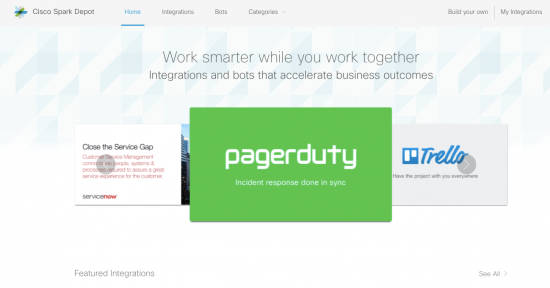
The rate at which innovation is happening is astounding. We are constantly challenging the status quo and finding new ways to make work and life easier for everyone. Among the many innovations revealed at Partner Summit, Rowan Trollope announced Cisco Spark Depot. This latest expansion of the Cisco Spark platform delivers an ever-growing catalog of integrations and bots for users and business of all sizes.Spark_Depot__HomeWork smarter while you work together
Connect your favorite tools to the Cisco Spark rooms you choose to receive notifications, such as when:

  • a file is updated
  • an account is created
  • a task is completed

We’ve simplified the configuration of integrations such as JIRA, Trello, Microsoft Office 365, Wunderlist, and even enterprise CRM tools such as Salesforce and ServiceNow.

What’s the difference between integrations and bots?

  • An integration provides basic notifications for a service, acting on behalf of a Cisco Spark user.
  • A bot can perform tasks for any of the users in the room, presenting itself as another user. In addition to sending messages, a bot can post files and respond to messages – even join calls.

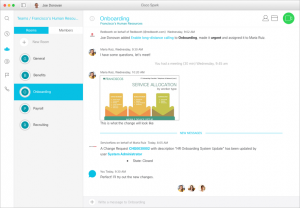
Let’s run through an example. Imagine this: HR managers Maria and Joe use Spark to come together and get work done in rooms for onboarding, recruiting, benefits, and so on. Outside of Spark, they use Redbooth for task management and ServiceNow for incident response.

  • picWhen Joe updates a template in Redbooth with a task, an automated message describing the change appears in the Spark room, thanks to the Redbooth integration.


  • Maria sees the note and jumps on a Spark call with Joe and several other teammates to decide whether they need to make a system update. And they do.
  • Maria effortlessly integrates ServiceNow with the appropriate room. When she adds updates outside Spark, they instantly show up in the Spark room. Her teammates –including those who don’t use ServiceNow — learn about them instantly.

Thanks to the power of Spark integrations, Maria’s and Joe’s teamwork became more collaborative, transparent, and efficient.

Simple for users, simple for developers
Not only can you discover new apps in Cisco Spark Depot every week, it’s a place where you can publish your creations. And all Cisco Spark users can have access to them. If you’re a developer, partner, or ISV – submit your ideas through the Cisco Spark for Developers portal to help make Cisco Spark even better and join our ecosystem.

Given Cisco’s DNA in the enterprise, we also have the ability for organizations to publish integrations and bots that are available only to users on their own domain. You can write integrations and bots specific to your company’s systems — a powerful capability to unleash the power of Cisco Spark in your enterprise.

This is just the beginning of what you’ll see showcased in the Cisco Spark Depot. We can’t wait to see what you create!

Take a look at Cisco Spark Depot and use the comments below to tell me what you think.

Authors

Jason Goecke

Vice President & General Manager

Cognitive Collaboration & Cisco Spark Platform

Avatar

It’s been a few months since Cisco’s Empowered Women’s Network event at Cisco Live. What an amazing half-day of inspiration, networking and reflection. Not only did it challenge my thinking and energize my soul, but it also made me realize that sometimes you just need a reminder of what you already know.

Top10CEWN

As Ruba Borno stated at the beginning of the program, technology will be the greatest equalizer the world has ever known. We all are aware that the world is changing. Gender inequality exists and society needs more women to enter, study and remain in the STEM fields.

A non-STEM focused professional myself, I attended the session with co-workers, customers, partners and my summer intern, all of whom are passionate about how technology and our industries can transform our world. This session reminded me that, in order to be successful, we need diversity. We learned that, in the Internet of Women, we must Connect-Embrace-Lead. Everyone – regardless of gender, age, race, education, sexual preference, socio-economic background, religion or education can play a role. The trick is to recognize that with passion, drive, and a variety of perspectives, we can truly change the world. There is no single job description or ideal background that ensures success. Let’s encourage ambition, risk taking, passion and multiple perspectives.

There was one simple question from the conference that really resonated with me:

Are you living up to your full potential individually and collectively? If the answer is yes, then you should recognize that, “There has truly never been a better time than now to change the world.” #CEWN #NeverBetter

I feel so fortunate to have attended this amazing session and wanted to share my Top 10 Takeaways:

  1. Ask Questions. Be Curious. Laugh. Take Care of Yourself. @Patrice_DEramo
  2. All Choices aren’t permanent. Take the risk. Melissa McCoy
  3. Accept job descriptions as guidelines not rules. Be your own champion @rubaborno
  4. Don’t let one person’s assessment of you limit what you think you could be. @coopermarianne
  5. Culture is the hardest to change, but we can all lead within our own teams. We are all accountable. No excuses. @channelsmart
  6. Stop being your own worst critic. @CEWN
  7. Take time to invest in others even when not in your best interest. @rubaborno
  8. Inclusion is leadership in itself. @channelsmart
  9. It takes persistence and courage. @moniquejmorrow
  10. Title doesn’t define who you are. We are giants of tomorrow and the time is now @shr_plus_ha

Authors

Alison Quispe

Director of Marketing

Americas Service Provider Field Marketing

Avatar

Security is the single biggest concern for our customers. And today, the average organization has security products from dozens of vendors, making security infrastructure complex and difficult to manage.

With the introduction of Cisco ONE Advanced Security, Cisco is reducing this complexity, and simplifying the purchase of infrastructure security.

One-Click Security

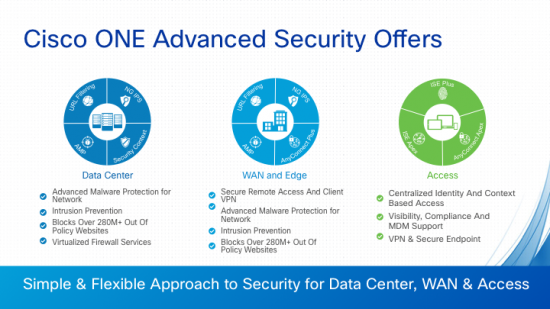
Our customers no longer have to worry about securing their infrastructure as an afterthought. With Cisco ONE Advanced Security, they can buy predefined solutions in the Data Center, WAN, and Access domains – often with a single transaction.

At this week’s Cisco Partner Summit, we are announcing the general availability of three Cisco ONE Advanced Security suites:

  • Threat Defense for Data Center
  • Threat Defense for WAN and Edge
  • Policy & Threat Defense for Access

Cisco_One_Adv_Sec_Media_Slides (10,26.16)

The features included in these suites are aligned to specific use cases offering customers protection for their environments both inside and outside the network perimeter.

Cisco ONE Advanced Security helps customers in many areas. For example, when you buy an Intelligent WAN solution from Cisco, you can now choose to include advanced threat defense capabilities with Firepower services on ASA, a key feature of the Threat Defense for WAN and Edge suite. And as we get closer to the edge, endpoint security becomes equally important, so customers also get Cisco AnyConnect (Plus) as part of this Advanced Security offer in WAN.

Another use case for Cisco ONE Advanced Security is for customers buying wired or wireless access infrastructure from Cisco. They can now purchase the centralized policy engine ISE along with AnyConnect to provide security inside and outside the perimeter, identifying “who, what, when and where” for the people and devices connected to the network.

Over the past few months, as part of our pilot program for these offers, some customers have already been taking advantage of the simplicity and capabilities of these suites. For example, a K-12 school looking to refresh their access infrastructure purchased Cisco ONE Foundation and Advanced Access suites along with Policy and Threat defense for Access. This helped them get ISE and AnyConnect Security features for their school campus through a single transaction.

Subscription Buying

While Cisco ONE has traditionally been made available through perpetual licensing models, Cisco ONE Advanced Security is being offered on a subscription basis. With subscriptions, customers can buy just the capabilities they need, when and how they need them. This enables them to be more agile and helps accelerate the deployment of new capabilities.

In addition to the Advanced Security offering, Cisco ONE Enterprise Cloud Suites are now also available through four new subscription offers, Infrastructure Automation, Big Data Automation, Hybrid Cloud Orchestration and Service Management.

For more details on the Advanced Security offering and to find out more about everything available through Cisco ONE, take a look at Security in Cisco ONE.

We will be sharing more details on both these new Cisco ONE subscription offers at our Partner Summit today in San Francisco.

Authors

Pooja J Kapoor

Product Management Leader

Digitization Office

Avatar

I frequently meet with customers who are trying to “unstore” more of their data, use it in real time, and unlock the latent value that’s contained there. In many ways this is the heart of digital transformation…but it’s also something that’s historically been a challenge to do in an economical and manageable way as data sets grow ever larger. It is for these customers that we’ve developed an exciting new addition to the UCS product portfolio: Cisco UCS S-Series.

Across verticals, our customers are realizing the power of data, which is increasing demands on compute and capacity from infrastructure. For example, in this success story at the University of College Zealand, the university’s IT staff can now back up student files 4x faster than previous platform and the reliability of the S3260 means that students can rely on having access to their files 24/7. Likewise, in sports, digital video is evolving from a capacity challenge to a compute intensive problem.  Real time player tracking, combined with historical correlations and predictions, are changing the fan experience and coaching tactics. On the life-saving front is this bit of good news that hospitals are finally starting to use real-time data processing in concert with predictive analytics tools to enable highly advanced, forward-looking and customized treatment plans for patients. There are examples across every vertical and the pace is only accelerating.

While innovation of this sort is primarily a data management challenge, it’s also a data center technology challenge – because active data requires agile infrastructure built for a world of continuous insight, innovation, and delivery. And here’s what that looks like:

Video: Introducing the Cisco UCS S-Series

A Modular Platform Approach

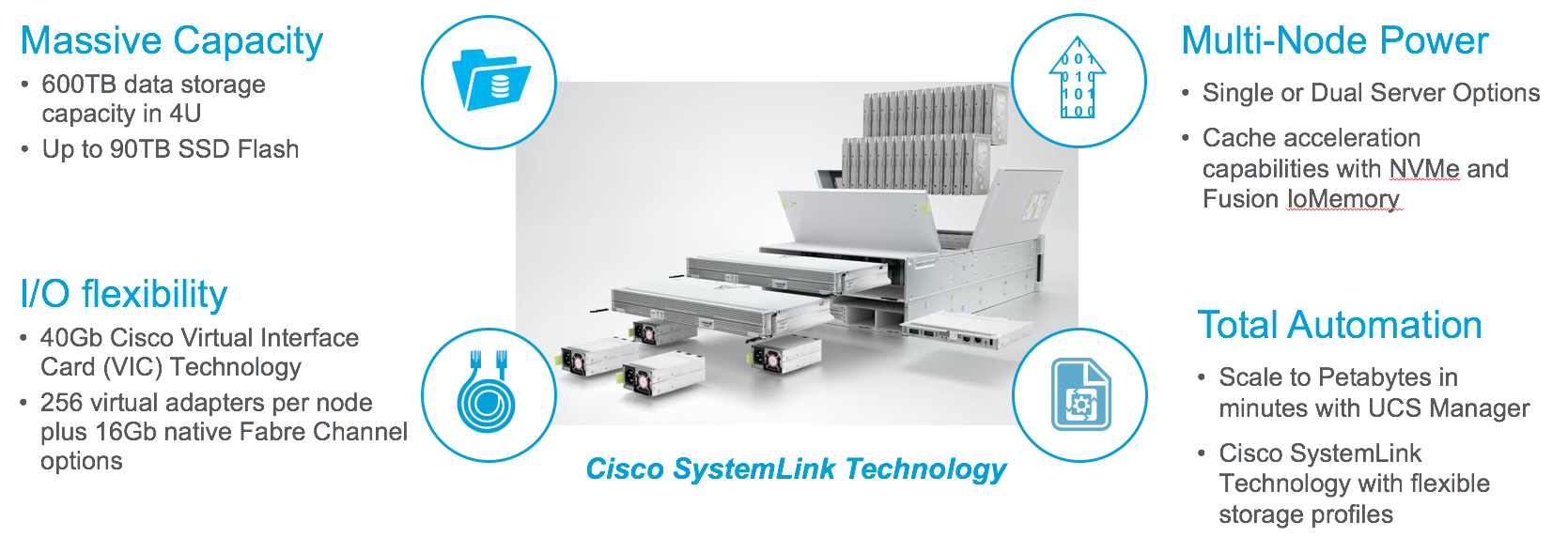
Fundamentally, the need for the UCS S-Series is rooted in the realization that conventional rack server designs can’t meet the requirements of these workloads in terms of operational speed, scale and efficiency. It’s one thing to bend sheet metal around a bunch of disk, it’s another to create the modern data fabric foundation customers need in this space. The UCS S-Series is a completely modular platform approach (check out the video!)  One that’s optimized for active data by coupling dense storage capacity with servers, allowing large amounts of data to reside closer to compute. Much like our B-Series blades are optimized for compute density, S-Series is a similar – modular – approach, optimized for storage density. S-Series modularity, combined with the fabric-centric nature of UCS and advanced management, is unique in the industry and delivers several key advantages:

  1. Rapid scaling of storage capacity, to hundreds of petabytes, through the unrivaled capabilities of UCS for policy based automation and integration with IT and developer toolsets. And scale not just of infrastructure but the ability of IT staff to manage across large and complex environments in a simplified way.
  1. New levels of efficiency, allowing our customers to right size the infrastructure to the workload, eliminating stranded resources and islands of infrastructure and ultimately driving down TCO to less than half the cost of public cloud storage.
  1. Unmatched investment protection and operational flexibility, by decoupling the refresh cycles of compute, IO and storage media, each of which evolve on different industry timelines. Each of these can be upgraded and scaled independently but are connected and composed automatically using Cisco SystemLinkUCS S-Series

Continue reading “Introducing UCS S-Series: Data Unstored”

Authors

Satinder Sethi

No Longer with Cisco

Avatar

Cloud technology is changing the market landscape, and Cisco is committed to delivering our collaboration portfolio from the cloud. This is a pivotal year to take our customers there. Today’s announcements position you to win in this new market.

But why is this the year? Well, because the Cisco Spark platform is ready, our go-to-market is ready, and customers are investing in collaboration now. It’s time for us to start cashing in.

With innovations and offers across the portfolio, we’re making it easier to sell collaboration to customers of all sizes – and more profitable for you. Plus, we are building more and more flexibility into everything so customers can choose the infrastructure that’s right for them, while gaining better and better experiences. Let’s take a closer look.

Endpoints that are faster to deploy, with a path to Cisco Spark.

You’ve had great success with the Business Edition (BE) IP telephony platform, adding more than a million new users every year. But you said it needed to be easier to install. So we added cloud management which means you can install the BE6000 in 60 percent less time.

You also said Software Support Services (SWSS) were too high, so we’ve reduced SWSS costs by up to 78 percent on BE6000 SWSS starter bundles, making it more competitive to get smaller customers into this next-generation collaboration solution and put them on the path to cloud.

Speaking of going down market, we’ve introduced a brand new Business Edition product for small businesses: the BE4000. Cloud-managed, it’s fast to deploy and priced to disrupt. This is the right solution for you to expand into the $800 million worldwide Unified Communications market for small business.

In addition, you can encourage your BE4000 customers to try the free Cisco Spark messaging, giving them a taste of the power of Cisco Spark and opening their eyes to the potential benefits of a broader cloud or hybrid solution for their business.

Learn more about these exciting Business Edition changes.

New opportunities to host and profit.

For customers who want to keep a foot in both worlds, now you can offer to host an incredible meeting experience for them in the cloud, while leaving voice and video local to their network. Today we announced something that is completely revolutionary and completely unique to Cisco – Spark Hybrid Media Services. You can set it up in 10 minutes, and it’s free for existing Spark meeting customers.

A way to differentiate that leads to brand new business.

Many of you are already investing in software development, and many of you have even contributed to our new catalog of 110 integrations and bots called Cisco Spark Depot. It’s the latest addition to our Spark for Developers strategy. When you create Spark experiences for your customers based on the software applications they use every day, your customers are more productive and more loyal to you and Cisco Spark. Microsoft has nothing like it.

A radically simpler way to sell.

We don’t expect your customers to migrate to cloud instantly, and they no longer have to decide on the spot. Now with Cisco Spark Flex Plan, you can sell them a single contract that gives them the choice to move between Cisco on-premises and cloud-based collaboration whenever they want. If you’re a Hosted Collaboration Solution (HCS) partner, we’ve got you covered. Starting early 2017, you can offer your customers premises, cloud, or hosted cloud calling all through this single subscription.

I am confident we are going to capture this new digital market together. In exchange, you’ll reap the rewards of more breadth, differentiation, and sustainability for your practice – and an escalating book of revenue.

Go Full Speed by taking these steps.

  • Get yourself ready: Develop your adoption services practice and benefit from becoming a Lifecycle Advisor partner
  • Get your customers ready: Modernize your customers’ endpoints – Sell the new and improved Business Edition portfolio and DX line
  • Lead your collaboration sales with Spark: Get certified on Cisco Spark, embrace Cisco Spark internally, and take the first step by getting one new customer to adopt Cisco Spark


Authors

Gary Wolfson

Director, Global Partner Software Sales

Avatar

By now, we’ve all heard the estimate that by 2020, 50 billion devices will be connected. Some estimates are higher, some lower, but we can all agree…it’s a lot. What we know and can see is that more data is being generated today than ever before. And the nature of the data is changing. It’s getting warmer and more active. What do I mean by “active data?”

Business intelligence, as we once knew it, meant collecting data and warehousing it away for reporting through the rear view mirror. Now data is moving from stack to flow, being streamed and analyzed for decision making in real time. Video surveillance used to mean collecting and storing terabytes of footage; now it means facial recognition and motion event triggers. Patient records aren’t just being digitized and stored. Diagnostic imaging data is being analyzed in real time for faster and better outcomes. And where we used to store massive amounts of data from sensors and connected devices – scanning and sifting for patterns and problems, we’re now seeing machine learning being applied to accelerate nearly every industry.

It’s no longer about simply accumulating data but constantly analyzing it, transforming it, creating value with it in new ways.

This is active data.

Yet we know that the vast majority of data is collected to only go dormant. It is a data management challenge, but it’s also a data center challenge because analyzing data at this scale and tempo was impossible to do in an affordable way. As technology is evolving – think just of what Hadoop has allowed – it is becoming easier for our customers to analyze massive amounts of data on x86 platforms. But “unstoring” and activating all this data requires a powerful, agile computing platform.

A modern platform to process active data needs to scale as effortlessly as the cloud, integrate IT with developers through the tools they want to use, and provide the fabric that becomes the backplane of these distributed systems. That modern platform is UCS. Now it’s even more powerful with our new S-Series: an exclusive class of storage-dense, modular computing designed to give our our customers what they need to power digital transformation.

This week I’m delighted to be at our World Wide Partner Summit to announce this new addition to the UCS family. I’ll be joined by our ISV and channel partners who come together with us to deliver all the solutions our customers need in a world of active data. Tune in to our Data Center blog, our webcast, and join the conversation with the team to learn more about S-Series and all the joint solutions we’re developing around this exciting new platform.

Authors

Liz Centoni

Executive Vice President

Chief Customer Experience Officer

Avatar

It’s been said before, but this bears repeating. On average, it takes organizations 100 days1 or more to detect a breach after it occurs. On average. This means attackers often have more than three months to examine an organization’s data and then steal what they want. Clearly, this is not effective.

These attacks ultimately target the endpoint – and organizations need to close this window of opportunity for attackers. But how?

Prevention-only technologies remain a mainstay of endpoint security, despite being inadequate at defending against more sophisticated attacks that can evade them.

To pick up the slack, the security industry has showered organizations with shiny new technologies for endpoint security. Should they keep the anti-virus they’ve always had? Add a new agent for visibility? And another for better investigation and response? It sounds complex because it is complex.

We need a simpler, more effective way to prevent threats from getting in, deep visibility into what is happening on endpoints to detect threats, and the ability to quickly get rid of any threats that could have found their way in. We need to work with and share intelligence across a broader security architecture. We need reduced time to detection.

At Cisco, it’s our mission to help customers achieve truly effective security with more integrated threat defenses. We are aggressively innovating across our portfolio, strengthening our architectural approach from the network to the cloud and now out to the endpoint.

In February we announced our new Firepower NGFW for continued network security momentum. And we have sparked an industry transition to cloud security with Umbrella Roaming, Cisco Defense Orchestrator and the acquisition of CloudLock this summer.

Today, I’m excited to share important updates to the third pillar of our portfolio – the endpoint.

Cisco AMP for Endpoints delivers modern, next generation endpoint security in one powerful package. Simply. Effectively. With automation and integration with existing technologies. AMP delivers three key elements that endpoint security solutions must deliver today – prevention, detection, and response. AMP prevents attacks and blocks known and unknown malware at point of entry. However, should something get in, AMP provides continuous monitoring and threat detection to quickly spot malicious behavior, and response capabilities to eliminate threats before damage can be done. This provides a first and last line of defense for endpoints, and it gives customers the level of visibility, context, and control they need to stop advanced attacks.

Effective Security to Prevent Attacks

We start with preventing known and unknown attacks. Why are we successful at this? While we won’t hit on every detail here, we stop attacks at point of entry through a combination of various malware detection methods, including machine learning and fuzzy fingerprinting, our built-in Threat Grid sandbox, and leading Talos threat intelligence. It all comes together as an effective way to prevent attacks.

Deep Visibility for Detection

Monitoring, endpoint visibility, threat hunting. No matter what you call it, you need to know what is happening on endpoints, because as we know, advanced attacks can evade even sophisticated defenses. AMP for Endpoints delivers the deep visibility and continuous monitoring of endpoint activity needed to quickly detect threats, investigate an indication of compromise, and trigger automated response before damage can be done. This means the best time to detection capabilities for the endpoint, and best security value for organizations looking to reduce agent bloat.

Automated Remediation

But we don’t just detect advanced threats in a matter of minutes – once discovered, we automatically stop and remove threats from every computer in the enterprise. 

The powerful integration of prevention along with detection and response calls on innovation the endpoint space has not seen. What about file-less or memory-only malware that injects code into a running process? AMP for Endpoints stops it. How about understanding what laptops and devices are vulnerable to attack? We give you a list of vulnerable computers and software so you know what is most likely to be compromised – and what to fix fast. What about endpoints that could be compromised but don’t have an AMP for Endpoint agent? We use machine learning analytics of web proxy traffic to detect compromised systems without an agent.

An Integrated Architecture

We don’t stop there. Something else that is unique about AMP for Endpoints is that it’s part of a greater integrated security infrastructure. The AMP ecosystem allows organizations to see more threats in more places, not just on the endpoint, so if you see a threat once, you can block it everywhere—automatically, with no human involvement. And it seamlessly integrates with other platforms like the next-generation firewall or secure network access technology becoming vastly more powerful as they are used together. This amounts to a force multiplier effect for IT security teams.

Recent breach detection testing from NSS Labs shows we detected 100 percent of tested threats.  And our time to detection was second to none: we blocked 92% of attacks in less than 3 minutes, the fastest of any vendor tested. This test highlights how AMP for Endpoints works as part of an integrated architecture (network + endpoint) to both prevent and also quickly detect and remediate when attackers evade preventative security tools.

And we are not just integrated with products — Cisco Security Services help you quickly and accurately deploy your AMP for Endpoints solution so you can quickly gain the benefits of AMP technology in your network. Our Deployment Service helps you deploy, configure, test, and tune the implementation for up to 25,000 endpoints or custom deployments.

The Way Forward

What does this amount to? The fastest time-to-detection. We said at the beginning that it takes organizations 100 days or more to detect a breach after it occurs. Cisco prevents nearly all malware from getting in, but more importantly, detects the most advanced threats quickly – usually in around 13 hours or less, and in many cases, minutes – compared with the 100-day average, so attackers don’t have time to operate and organizations stay safer.

AMP for Endpoints will transform endpoint security for your organization. To learn more about Cisco AMP for Endpoints, check out our webcast, watch the video below, visit our webpage, or talk to your Cisco account representative.

1 Cisco 2016 Midyear Cybersecurity Report

Authors

Tom Stitt

Product Marketing Director

Advanced Malware Protection

Avatar

If you’ve read any of my past blogs, you’ll know I focus a lot on the economic impact of Cisco UCS. Today I’m comparing the TCO of hosting data intensive workloads on-prem vs. in the public cloud.

What started out as a 2RU rackmount consolidation discussion (more on that next week) turned into a public cloud vs. on-prem discussion. I was asked the question of how a S3260 managed by a customer in their own data center or colo would compare to Amazon S3 storage. I was completely blown away with what I found.

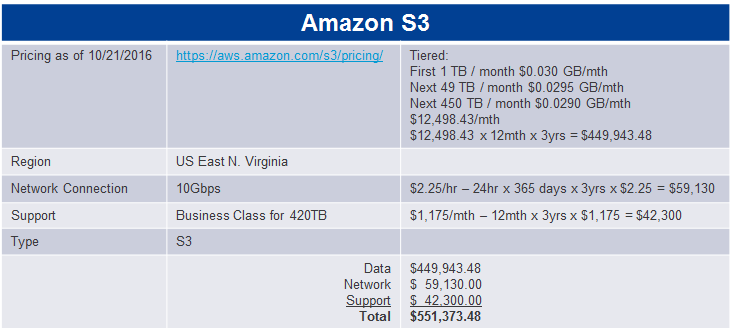
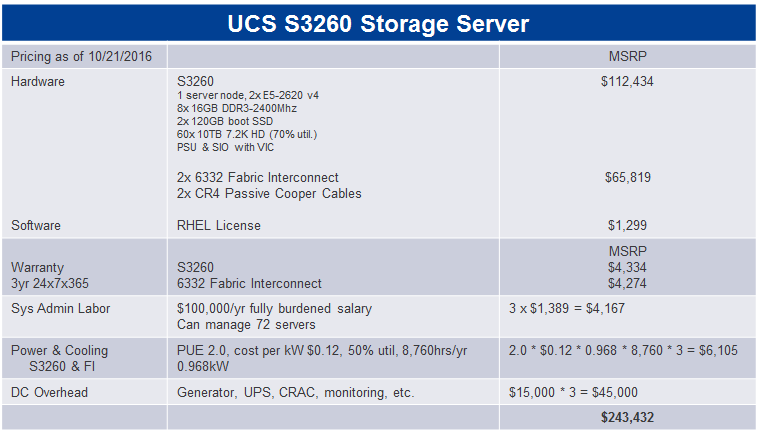
The short story is the on-prem solution is 56% less expensive over three years with a 13 month breakeven point. If you don’t like CapEx, using a Cisco Capital lease, your monthly payments can be less than your payments to Amazon. [I wonder if this is why companies like Dropbox, Moz, and HubSpot are moving away from public cloud?]

Let me break this down for you.

Amazon publishes all of their pricing here. That makes it very easy to price out a configuration. I priced out 420TB of S3 storage in the US East N. Virginia region. I included an always on 10Gbps connection and business class support. Note there are no data transfer charges. The breakdown is below.

Amazon S3 Pricing Table

Next, I configured a S3260 with 60 10TB drives for a total of 600TB of raw storage. Why am I comparing that to 420TB of S3 storage? Overhead – RAID, file system, spare drive, and the fact no one would run at 100% utilization. I used our MSRP for our solution which is effectively an apples-to-apples compare to Amazon’s published web price. Your mileage may vary based on discounts from Cisco Partners or from Amazon.

S3260 Pricing Table

There is enough savings that I could buy a second and third S3260 (1,800TB!) and still have some change left over.

If you need more compute power, you can replace four hard drives in a S3260 chassis with a second server node. What’s 40TB among friends when you are doubling your CPU and memory capacity?

Best part of the S3260 is that it is managed with UCS Manager right alongside B-Series blade servers and C-Series rack servers. One tool, one set of processes and procedures to manage your environment regardless of form factor.

While we are all tempted by instant gratification, it’s pretty clear that storing data in the cloud comes at a premium over the long haul. There can be very good reasons for data to live in the cloud. Just as there are very good reason why data should be on-prem. It will depend upon the cost, application, speed of access, privacy, security concerns, etc. The list is a long one and you will need to decide where the best place for your data is.

Hopefully I’ve piqued your curiosity enough reach out to your Cisco Account Team or Partner to learn more about the S3260 Storage Server.


Authors

Bill Shields

Senior Product Manager

UCS Solutions Product Management