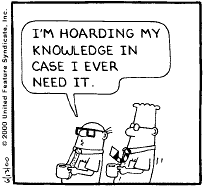
In his most excellent book Collaboration,Morten T. Hansen identifies several barriers to good collaboration. One of these barriers is cultural in nature and is called hoarding.
Hoarding is where an individual or team keeps knowledge to themselves. This means that others have to ask them to ask them to do something for them, or to they’ll tell them how to do it with minimal information. I am constantly surprised that when I share this barrier to collaboration with customers, how many of them look at each other and say “That’s Dick” or “That’s Jane.” It’s then followed immediately with “They call it job security.”
“Data virtualization is a versatile data integration solution that can be deployed to solve a wide range of data integration challenges. Based on nearly ten years of successful implementations, several common usage patterns have emerged to help guide your enterprise’s data virtualization adoption strategy.
2015 was a wild year in technology advancements and decay, and there is no reason to think that 2016 won’t follow suit…
We have seen the biggest tech acquisition in history with Dell snapping up EMC for $67 billion; HP splitting into two companies; Google turning into a subsidiary of Alphabet; and Cisco entering in a new era with Chuck Robbins becoming the new CEO.
Last year we also saw the Tesla model S car drive itself, an ever-growing number of drones in the sky, and SpaceX launch the first reusable rocket into orbital space. We predicted that without apps as part of their IoE strategies, businesses would suffocate from the missed opportunity that mobile offers and Smartphones continued to rule as we spend more and more hours every day with them.
The race to connect the unconnected will continue as well, whether we speak about connecting the next 4 billion people, introducing more wearables, creating body implants or enabling the Internet of Things (IoT), where billions of sensors are changing the way we live our lives. In the coming year, we will continue to march toward IoT with more than 11.5 billion mobile-ready devices and connections – 4 billion more than there were in 2014. Continue reading “2016 and Beyond: Technologies and Trends that Will Change the Future of IT”
With the increased interest in cybersecurity and the recent news that utilities are being targeted around the world I’m making sure our readers have seen the latest white paper to come out of the Cisco ‘Brain-Trust’ on security in utilities and the energy industry.
https://www.youtube.com/watch?v=UA5yJLhL00g
As the white paper announces, “Utilities and energy organizations are part of the critical infrastructure of any nation, which makes them a high-profile target for cyber terrorists and hackers alike. Modernization brings gains in efficiency, but it also increases the attack surface through which threat agents can target utility infrastructure.”
It’s tough being a utility. Constant regulations, standards compliance, security and safety issues. Our security experts analyzed the IT security capabilities of the utilities sector in general, using specific data from the Cisco Capabilities Benchmark Study. They looked at the views of both chief information security officers (CISOs) and security operations (SecOps) managers and, different to other industries, seem closely aligned. What are the differences then, versus other industries? Here are some findings:
73% percent of IT security professionals at utilities say they’ve suffered a public security breach, compared with 55% in other industries.
56% percent of the IT security professionals in utilities say they use cloud-based web security, compared with 36% of the respondents in other industries.
64% percent of CISOs and SecOps managers in the utilities sector say they make use of mobile security tools, compared with 50% of security professionals in other industries.
One important note: The study focused primarily on IT security capabilities, not on the state of operational technology (OT) security. There is a growing trend of convergence between IT and OT, and I and others in Cisco have talked about the ramifications of that trend.
Click the image to download the whitepaper
Despite my earlier claim that the data supports a similarity of views between CISOs and SecOps managers, interestingly the opinions of CISOs and SecOps managers diverge somewhat when the conversation turns to IT security controls. For example, 67% of CISOs say that their organizations have adequate systems for verifying that security incidents have actually occurred, but only 46% of SecOps managers say they have such systems in place. Also, 73% of CISOs say they have well-documented processes for incident response and tracking, while just 54% of SecOps managers say they have such systems. That’s worrying to me.
The white paper has lots of charts and supporting documentation, and discusses the differences between the utility industry and other industries, especially the readiness of using tools and the availability of funds focused on security. One things for sure: utilities are frequently a target of cyber attacks because of their high public profile and the potentially damaging effects of a data breach or service disruption. That explains the figures in my first bullet above (73% versus 55%). This vulnerability further highlights the security challenges that utilities are facing. In many countries, utilities have to report breaches by law, a requirement that may have contributed to the high number of recorded breaches. Perhaps due to their tightly regulated environment, utilities are also slightly more likely than other industries to use internal security incident teams.
At any rate, utilities seem, in many cases, to learn the hard way. What do I mean? Well, publicly breached utility companies lean more heavily on tools such as network security, firewalls, and intrusion prevention systems (IPS), instead of distributed denial-of-service (DDoS) defenses or VPN security tools. For example:
76% of utilities that have dealt with a public breach say they use firewalls and IPS tools, but only 53% of utilities that have not dealt with a public breach use them.
64% of publicly breached utilities use vulnerability scanning tools, compared with 44% of non-publicly-breached utilities.
The figure above illustrates the point. Utilities’ Use of Various Security Threat Defenses (in %)
Since the late 18th century, innovations have fueled modernization in industrial engineering, management and processes that have shaped manufacturing businesses we know today. From manual tasks’ mechanization through moving assembly lines and mass production systems, industrial revolutions resulted in profitability and growth that enabled global economies to prosper. Presently, another revolution is underway – a revolution resulting from access to hyper-distributed computing for manufacturing organizations to excel in their competitive marketplaces. Utilizing advancements in technology and software, manufacturing operations can become increasingly fluid through processes that resource data and analytics to generate just-in-time automation. And in this transformation, traditionally physical assets are metamorphosed into digital assets that become sources of invaluable insights.
Last month, Japan’s Kenichi Ito broke the world record for the 100 meter dash – running on all fours – with a time of 15.71 seconds. Known as “the monkey man,” having perfected the art of moving like a monkey on the ground, Ito sprints on his hands and feet towards the finish line. His performance is reminiscent of Samuel Johnson’s famous adage about dogs that can walk on two hind legs, “It’s not done well but you are surprised to find it done at all.”
But this is exactly what many enterprises are still doing today – building and managing their network on all fours when they should be sprinting on their toes. With network speeds now often exceeding 100 bits per second, traditional approaches to harnessing today’s hyper-distribution of information aren’t sufficient. What’s needed is “Fast IT.”
Over the past six months or so, many of my blogs have dealt with the hot topic of “digital disruption” — both as a threat and an opportunity for companies, regardless of industry.
Several industries already find themselves inside this swirling “Digital Vortex,” which possesses the potential to reshape industries faster than perhaps any force in history. The power of the Digital Vortex is undeniable: it will displace nearly 4 of the top 10 incumbents by industry over the next five years, according to a 2015 study by the Global Center for Digital Business Transformation (DBT Center).
Click to Enlarge
As part of its study, the DBT Center ranked 12 industries based on their potential for digital disruption. The No. 3- and No. 4-ranked industries — retail and financial services, respectively — provide a fascinating contrast in how industries are faring as they confront the Digital Vortex. Continue reading “Financial Services and Retail: ‘A (Digital) Tale of Two Industries’”
Cisco Corporate Social Responsibility strategy prioritizes the issues that are most important to our business and to our stakeholders, identified through a formal CSR materiality assessment. We use the Cisco CSR Report to communicate our approach, objectives, progress, and challenges around five high-level priorities. This morning, we’ll focus on Society:
Cisco has been integral in the growth of the Internet, and we recognize that the growing number of connections can help solve some of the world’s most pressing social issues. Through our social investments, we empower global problem solvers to harness technology to address these challenges. In the video below, Cisco’s Senior Vice President of Corporate Affairs, Tae Yoo, discusses Cisco’s efforts to speed the pace of social change around the world.
Kathy Mulvany, Vice President of Cisco Corporate Affairs, believes technology is a tool that can make the world a better place:
“Whether creating better access to education and healthcare, restoring communications after disaster strikes, or helping nonprofits better serve more people, information and communications technology (ICT) can strengthen communities and improve lives.”
I’ve spent a lot of time on the road over the last few months. Europe. Asia. Canada. Latin America. And everywhere I go I talk to our partners. The one constant: frustration over their ability to have a deep conversation with customers about cloud. Partners have told me their customers want to hear how they can leverage applications and cloud services to impact their business outcomes. However, they also say that their conversations are often relegated to ‘box-level’ discussions about speed and feeds and costs of specific technologies at the bidding phase of the deal.
What if I told you that you can discover every single cloud service your customers are using and help them understand the potential business risk or compliance challenges they are facing. And, armed with such insight, that you can uncover new cloud, security, and data center opportunities.
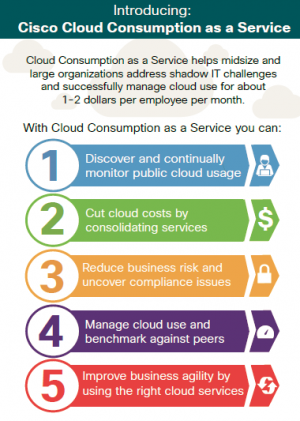
Too good to be true? Partners can do all that and more with our new Cisco Cloud Consumption as a Service. This new product, now generally available, helps customers solve a significant challenge for their business and, at the same time, provides partners with insights and concrete data to help transform cloud conversations with their customers.
Shadow IT: Growing Exponentially
Customers are facing an explosion of cloud use. And it’s becoming a major headache for IT leaders.
On average, large organizations are now using 1,220 individual cloud services, largely without oversight, which leads to increased risk and spiraling costs. And it’s growing by leaps and bounds. The average number of cloud services used has grown 112% over the past year, and 67% over the past six months. Additionally, the hidden cost of public cloud services is four to eight times higher than billed costs.
Cloud Consumption as a Service helps customers discover and monitor which cloud services are being used across the organization. It helps customers mitigate cloud risks, uncover redundant services to reduce costs, and compare providers and benchmark usage. Ultimately, it helps organizations strategically manage their cloud use and gain insight to inform their cloud roadmap.






 2015 was a wild year in technology advancements and decay, and there is no reason to think that 2016 won’t follow suit…