Avatar

For the second year in a row, Cisco employees around the world are supporting our Be the Bridge: Annual Giving Campaign.  While we encourage and match individual philanthropic giving all year long, during this season of thanks and giving we elevate and renew our commitment to think globally and act locally.

It starts with our C-suite and leaders like Chuck Robbins, Rebecca Jacoby, and Rowan Trollope volunteering to sort food at the food bank just a mile from our global headquarters in San Jose, CA.

But that’s just the beginning.

In the last five years alone, employees have donated over $21 million to support critical issues like global hunger and disaster relief efforts.  This year, we’re broadening our focus to include all charities vetted for inclusion in the Cisco Matching Gifts program: 1,900+ options, three times as many as last year’s campaign.

Cisco employees asked for more choice and this is what it looks like: our Annual Giving Campaign puts employees in the driver’s seat to “be the bridge” for the issues and causes that that matter to them. From nonprofits focused on education, environmental sustainability, healthcare, animal rights and more, employees are now free to choose.

The early response has been overwhelmingly positive. Last week, for example, we hosted a 48-Hour Virtual Race, challenging our employees to see how much could be raised in support of local nonprofits in the communities where they live, work, learn and play.  The result: over $440,000 in employee donations came pouring in in just two days.

The recipients included:

Now through December 16, we hope to inspire thousands of employees worldwide to support their cause of choice, and together, raise more than $5 million in donations and matching funds through our Be the Bridge: Annual Giving Campaign.

Join us in spreading the word by using social media to let the world know how you are “being the bridge.” Share your stories by using the #BeTheBridge and #WeAreCisco hashtags and inspire others by posting to the Cisco CSR Facebook page.

If you’re a Cisco employee and want to donate or volunteer, visit our internal Annual Giving Campaign community and learn how you can start making a difference locally or globally today.

Authors

Kirsten Weeks

Senior Manager for Community Relations

Global Marketing and Corporate Communications

Avatar

This blog was guest-written by Tanuja Ganu, Co-Founder and CTO at DataGlen iu-3-183
Inc. 

For more than 80 years, people have envisioned a world where inanimate objects and animate beings operate together in harmony, enabling a safer and smarter planet. Today, with the wide availability of connectivity, low-cost sensors and powerful machine learning algorithms, that vision is fast becoming a reality.

These technologies have the potential alleviate some of the most significant problems facing humanity, from water scarcity and hunger to a lack of affordable healthcare.

Dr. Richard Smalley, a Nobel laureate, recently listed the top 10 problems  – energy, water, food, environment, poverty, terrorism and war, disease, education, democracy and population – currently facing humanity. Cheap energy was near the top of his list, and Smalley argued that energy is the key to solving every other problem.

When I read his article for the first time, I completely agreed with his reasoning. Since I’ve lived in both developed and developing countries, I’ve personally seen how access to energy impacts a country’s quality of life and economic growth. In developing countries, an acute shortage of energy and constant power cuts are a part of normal day-to-day life. And in developed countries, wasted energy comes in the form of malfunctioning appliances or woefully inefficient operations.

Over the last few years, I’ve designed technologies that address such energy issues. After my graduate studies in machine learning at the Indian Institute of Science (IISc), I started working with the Smarter Energy group at IBM Research in India, which applies various computer science and electrical engineering techniques to the world’s clean energy challenges.

While there, I became particularly fascinated with the concept of demand-side management (DSM). As part of DSM, a consumer can shift their energy demand and reduce overall grid load during peak hours, thus reducing the number of critical power cuts. Though traditional DSM techniques are effective in addressing peak demand, they are based on centralized controls that require expensive communication and computing infrastructure. I soon realized that such techniques are not practical for developing countries.

Hence, the major design challenge was to make these solutions simple, inexpensive and easy to implement so they would require no additional infrastructure or changes to existing appliances and grids.

Considering these challenges, I developed a low-cost approach based on autonomous, embedded devices under the theme of a “Smarter Planet in a Plug”. By working with a talented interdisciplinary team at IBM Research, I designed three devices – nPlug, SocketWatch, and iPlug.

nPlugs reduce peak load on the power grids by shifting battery charging and water heating from peak hours to off-peak hours. SocketWatches prevent appliances from wasting energy by monitoring their energy consumption patterns. And iPlugs help adoption of distributed energy sources by making optimal decisions between injecting the electricity into the grid and consuming it locally.

In evaluating prototypes of nPlugs and SocketWatches, we found nPlugs correctly defer loads to off-peak hours without inconveniencing consumers, thereby reducing peak loads by up to 45%. Similarly, SocketWatches are able to pinpoint malfunctions in air conditioners and refrigerators.

I wanted to go beyond research, though, and develop innovations that can succeed in real-life, commercial settings. So, I co-founded DataGlen, a company focused on IoT-based industrial asset management. These assets include solar plants, wind turbines, fleets of cars, and medical equipment; all of which can be operated optimally to increase their return on investment (RoI).

In the case of a solar plant, by using various data analytics techniques, the system can tell us a number of things: how much energy could be generated tomorrow, if any specific equipment is expected to fail, or if a particular set of solar panels needs cleaning. These techniques can help us find the root-cause of specific issues in the plant, making it easier than ever before to optimize operations.

And in the case of fleet management, a car can send an alert in the face of reckless driving or arrange for emergency services after an accident. In the healthcare field, connected devices can provide continuous monitoring and medical support for the ill.

As I work more in this space, I realize how these technologies will impact people, the planet, and society. In fact, many large corporations such as Cisco, GE, and IBM are investing heavily in those technologies. We need more and more people (including young men and women) who are passionate, creative and inspired to change the world by participating in the next technological revolution.

That is why I am participating in the Women Rock-IT Cisco TV series — to inspire young women to consider exciting careers in IT and to support them in their journey to address the global challenges of tomorrow.

Register today to take part in my talk during the session: “

Authors

Austin Belisle

No Longer with Cisco

Avatar

As new discoveries emerge and simplify our lives, human beings stop pushing the boundaries once their needs have been fulfilled. Take the light bulb for instance. Whether in the home or on the street, there is no denying the impact this device has had on life as we know it. But we have only recently begun to innovate beyond the place Davy, Swan, and Edison left us. The same can be said for other subtle, yet revolutionary innovations such as the waste bin, park bench, or even a parking spot. With the help of smart people, and even smarter solutions, Cisco is helping cities and communities leverage traditional assets to provide better services to their residents.

Lighting & Parking

Consider an ordinary evening in which you’re en route to a visit a friend. You turn onto their street and of course, there’s no place to park. You circle around the block a few times until you finally come across a car leaving their occupied spot – luckily for you, the road was empty as you darted over two lanes to get the space.

After you park, you walk two brightly-lit street blocks until arriving at your friend’s house. And of course you spend the first five minutes complaining about how terrible parking is in their neighborhood. Sounds normal, right? Let’s look at real cases, in real cities that suffer this fate. In Paris, residents spend around 3-4 years in their lifetime searching for parking. For the hypothetical situation I just described and for the very real drivers in Paris, this is simply not good enough.

We at Cisco are working toward redefining “normal”. Our Smart+Connected Digital Platform enables public and private organizations alike to use citywide parking data to develop apps that can alert drivers of available parking spaces, allow them to reserve spaces in advance, and ensure the payment is made securely. There is no need to waste time, energy, nor gas combing the streets looking for a parking space.

But what about those brightly lit streets? Along with city leaders around the world, we want to help people feel safer, and to do so in a more cost-effective manner.

Today, street lighting is one of the largest cost centers that a city shoulders, taking a considerable slice of the dwindling budget. With the Smart+Connected Digital Platform and our smart lighting solution, we can help city leaders proactively manage energy usage and light output based on actual day-to-day needs. So thinking back to that same scenario described above, the streetlights would have been illuminated to light the way to your friend’s house and then dimmed to an energy-saving level until another person or vehicle was near. This kind of capability enables cities and communities to save money while simultaneously keeping streets and people safe.

https://youtu.be/-me9UwHF5gY

Waste Management

That’s right, I said waste management, like trash bins. Not the coolest or sexiest topic to discuss, but important nonetheless. As a resident walking the streets of your community, it’s difficult to feel a sense of pride when you see trash and waste strewn about. This is even more so true for tourists with access to Yelp – cities ultimately pay the price via digital feedback.

How then can cities maintain cleanliness and support public waste services without draining time and resources that they don’t really have? With the Smart+Connected Digital Platform, cities and communities can leverage sensor technology to inform drivers when bins reach capacity, where they’re located, and allow city officials to redirect collection services on a need basis rather than at random. This can save time by avoiding unnecessary pickup for empty or barely full bins, and can save gas expenses and employee productivity.

https://youtu.be/fSrG6sGjmzA

Cities are like a living, breathing organism; they require change to survive and thrive. In a time where new challenges emerge everyday, technology innovations can help produce long lasting effects. There truly has never been a better time to build a smarter community. Find out more about how the Smart+Connected Digital Platform is changing city operations like never before, visit cs.co/digitalplatform.


Authors

Harold Bell

No Longer with Cisco

Avatar

The Internet of Things (IoT) has become one of the most talked-about technology trends over the past few years. Yet many customers remain confused. Line-of-business managers don’t really care that much about the technology behind billions of connections. They care about business outcomes. They aren’t interested in hyped-up predictions of future value—they’re interested in quality, performance and how technology can help their bottom line.

After several years of meeting with customers across all industries all over the world, I realized that while thousands of them have already started implementing IoT to improve their operations and transform their businesses, there were still so many who were trying to figure out how to translate all the promise and buzz around IoT into actionable plans in their organizations.

That’s why I wrote Building the Internet of Things, which is being released this week. I wanted to share some practical insights about how organizations large and small can get started on their IoT journeys.

The book is rooted in my own journey in the technology industry over the past 30 years. The energy and momentum that are building today around IoT are reminiscent of the early days of the Internet, when we were just beginning to realize its potential impact on business and society. We felt like we were changing the world.

My first experience with IoT (we didn’t use this term then) was some 15 years ago when Cisco got involved in Industrial Ethernet to bring Ethernet and IP capabilities into industrial  settings. It was a difficult business. There was little contact or communication between IT and the operational technology (OT) folks who actually ran the factories and made purchasing decisions. Equally challenging were the product requirements, from ruggedizing to protocols to certifications. Was this effort worth it?

The answer really didn’t become clear until later, when we started the Connected Industries Group—Cisco’s IoT-related business unit focused on the key industrial and transportation markets. Suddenly, it felt like the beginning of the commercial Internet 20 years earlier. We could see the profound impact of connecting everything to everything. It was no longer just laptops and smartphones being connected—machines were connecting to give us useful data about all sorts of things, from oil rig operations to heart monitors. It was an exhilarating experience to realize that for the second time in my life I was part of something completely new that would revolutionize entire industries. We were on the next phase of the Internet journey.

http://www.slideshare.net/Cisco/building-the-internet-of-things-a-howto-book-on-iot

Since then we’ve seen a remarkable transformation in many industries, and Cisco customers are reaping the benefits of IoT as a foundation of their digital businesses:

  • PepsiCo has leveraged IoT to improve the reliability of its manufacturing systems, reduce both downtime and support costs, and enhance technical support through remote monitoring
  • Harley-Davidson connected its operations and reduced its build-to-order cycle from 18 months to two weeks, accelerated decision-making by 80 percent, and increased profitability by three to four percent
  • Ford Motor Company has implemented IoT technology in 25 of its plants, improving communication, automating its scheduling system, and managing production in real time

These examples just scratch the surface of what IoT is doing today. And we still have so much work ahead of us to fully realize the promise of IoT.

As I’ve moved on to a different role, driving Strategic Innovations I now focus my work with the IoT community on the innovation side of IoT. However, making IoT real continues to be my passion and my mission.

So that’s why I wrote the book. IoT is more than hype, and it’s more than cool technology. It’s real today, and it will change the world. I want to help accelerate that process by providing a practical, how-to guide to help companies get started.

Authors

Maciej Kranz

Vice President and General Manager

Corporate Strategic Innovation Group

Avatar

5 First Steps to Defending against IoT Driven DDoS Attacks

In honor of October’s National Cybersecurity Awareness Month, users of Twitter, Netflix, Reddit and the New York Times were treated to a special treat – and just in time for Halloween. Unfortunately it was more of a trick as users of these and other major websites across the United States were shut out due to a distributed denial-of-service (DDoS) attack. The massive strike, which came in three waves, was immediately investigated by the FBI and Department of Homeland Security which uncovered the root cause of the attack: baby monitors. Yes, baby monitors – and webcams, home routers and many other home-based wireless devices connected to the Internet of Things (IoT).

Since that event, other IoT driven DDoS attacks have occurred. We can expect their frequency and strength to increase. And the public sector will likely be a prime target. So how should we prepare? How should our cybersecurity strategies adapt in response?

Say Hello to Mirai

The Mirai Botnet is a key aggressor in the ongoing DDoS battle. It has been used in some of the largest and most disruptive attacks ever seen, including the attack on cybersecurity journalist Brian Krebs’ web site and the recent October waves. In reality, these attacks were not complex. They were easily carried out by deploying the Mirai Botnet code. It is freely available and requires little skill to use, taking advantage of already known hard-coded passwords in IoT devices like web cameras, printers and DVRs.

Since we use these devices every day in our homes, they tend to stay connected to the internet even when we are not using them. This has created a massive army in-waiting, sleeping quietly and unnoticed but that can be easily commandeered by attackers. Scans of the internet for vulnerable devices like these quickly find hundreds of thousands – and they make ideal DDoS attack points. Why? Because of their huge numbers and varied locations. This makes any attack very hard to defend against. Mirai’s simple setup, combined with its far-reaching networking capabilities has forever joined DDoS with the IoT to create a dramatic paradigm shift in threat assessment. And the public sector must prepare.

How Public Sector Should React

By deconstructing these recent DDoS attacks, we can better understand how to prepare and react to them in the future. First steps to do so would be to:

  1. Limit the number of IoT devices or heavily protect them from within your agency. Be aware that any of your devices that take part in a DDoS attack can strain or destroy your own internet accessibility – even if your organization is not the target.
  2. Create strong policy enforcement to ensure minimum security requirements are met on all IoT devices. This can help prevent them being used to carry out an attack on your infrastructure.
  3. Develop a list of “Approved IoT Devices” to ensure all connected devices have been verified to meet a minimum level of security. Check out https://www.owasp.org/index.php/IoT_Security_Guidance for more information.
  4. Add regularly scheduled scanning and remediation of IoT devices as responsibilities for your penetration testing (PenTest) team’s duties.
  5. Utilize network segmentation to reduce your organization’s available attack surface and limit cross-contamination.

But even with all these precautions and no IoT devices connected to your network, you can still feel the results of the DDOS. In the case of the Mirai Botnet DDoS attack, the army of IoT devices targeted their fire power on a specific provider, DynDNS. Yet the impacts became wide spreading, enveloping those companies using DynDNS’ services and even spreading to dependent public sector organizations, degrading their services as well. In our rush to take advantage of the cloud we may have forgotten that if you can’t access the cloud or it isn’t available you don’t have the service. So I suggest your team take a look at all critical third party dependencies, especially those that are cloud based, and develop contingency plans for any future outages that may occur. I would also suggest having a well thought-out and rehearsed disaster recovery plan for DDoS IoT driven attacks. This will let your organization benefit from a calm and consistent response in times of crisis.

In the end, many of the devices used in the October DDoS IoT attack will never be “fixed” due to additional severe security vulnerabilities that are independent of their passwords. Add to that the low-cost, throw-away nature of most IoT devices and the slim profit margins carried by many of their manufacturers, and we should continue to prepare for the worst. So it is best to think of the October DDoS IoT attack as a blessing in disguise. Thanks to its broad geographic reach and direct impact on the everyday lives of internet users, a much needed understanding of cybersecurity and why it should be a cornerstone of the digital transformation has been elevated in the public’s mind; a consciousness that will far outlive that of Mirai.

Authors

Gavin Reid

CyberCzar/Director

Public Sector

Avatar

I still remember my very first day at Cisco, as if it was just yesterday (though it was july of 2014.) I had just graduated with a Bachelors in Computer Science. I came onboard at Cisco as a Network Consulting Engineer (a dream come true.)

Like every new hire, I was filled with energy, enthusiasm and excitement to kick start my career. There were a thousand things I wanted to do, learn and achieve, and I wanted to do it all immediately. I tried to jump in multiple directions. The more places I jumped, the more overwhelming it started to get. I got lost in my own energy. Too much choice, too many directions, and I didn’t know what to do.

My great manager understood, and encouraged me to attend the Grace Hopper India Annual Conference last year.

Grace Hopper India
At Grace Hopper India last year.

The Grace Hopper conference in India, just like the flagship global event, is where all of these really smart and top-notch women in technology come together to share knowledge, network, learn and even find new careers. It is a power-packed event with keynotes, tech talks and session ranging from early in career and back to work, to entrepreneurship and technology, to leadership and soft skills. It is India’s largest gathering of women technologists. Over the three-day period, I attended many of these sessions, met a lot of my peers, and also networked with and learned from the great women who worked at Cisco.

Grace Hopper India
I enjoyed my Grace Hopper India experience – it gave me direction!

Thanks to this conference, I finally found my direction. My belief that Cisco was the right place for me was even stronger. The guidance and mentorship I got from all those great women made me realize this.

Now, a year later, I can see how my Grace Hopper experience has not only made me understand my role at Cisco, but has also taught me how to succeed here as a woman in tech. There are a zillion things I learned at the Grace Hopper. Since it is a little difficult to jot all of those down, here are few of the things I learned that might help you too:

  1. Have faith and confidence in yourself. I believe this is one of the most important things. There is nothing that you want to achieve that can’t be achieved.
  2. Find a mentor. Having a mentor to guide you is one of the key things that would help you succeed in your career.
  3. Find your passion. There is a lot of great work and innovation happening in every sphere of technology. You just need to find your passion and right fit and dive into it. There are a lot of opportunities waiting for you.
  4. Always be optimistic. Even if you are called foolishly optimistic.
  5. Be well-rounded. Technical knowledge that would take you ahead in your career. But soft skills and people skills play an equally important role.
  6. Give and get back. And as women in tech, we should look out and help our fellow women in tech.

I hope all of the women attending this year’s Grace Hopper Conference would find the empowerment and focus I found that not only helped me find my direction but also to help me transition from a new hire to an employee.

P.S. I can’t wait to meet the new generation of Cisconians who come onboard after this year’s event!

Want to join Cisco? See our open opportunities here.

Authors

Pooja Kabra

Network Consulting Engineer

Advanced Services

Avatar

Tetration_Analytics_Logo_ColorIn a recent cybersecurity study, Gartner reported that data center protection is the foundation of digital business and innovation.  With organizations embracing digital business, they need to address the lack of directly owned IT infrastructure and the prevalence of services outside of IT’s control. These services represent some of their biggest security risks.

Furthermore, Gartner predicts that by 2020 sixty percent of organizations will experience a major service failure due to security incidents.  And service outages damage the brand. Yet according to the latest Cisco cybersecurity survey, 71 percent of large enterprises believe data protection concerns are impeding their innovation.

The key to successfully navigating these data center challenges is pervasive visibility – if you don’t see something, then you can’t possibly know how to protect against it. Cisco Tetration Analytics provides pervasive, unprecedented visibility across every node in your data center and cloud infrastructure.  Coupled with the right dynamic policy enforcement, it allows you to efficiently and effectively manage your organization’s risk posture.

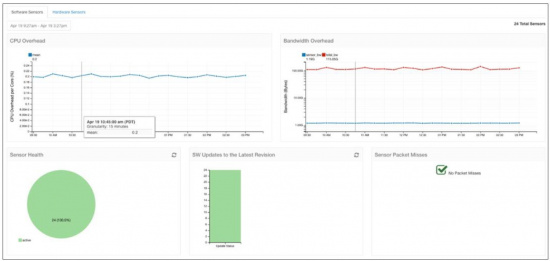
Cisco Tetration Analytics incorporates a mix of network/hardware sensors that monitor every single packet at line rate and server/software sensors with very low overhead.  These sensors work with a big data analytics cluster that operates in real time, presenting actionable insights with easy to understand visuals.  Additionally, it provides application dependencies, automated white-list policy recommendations, policy impact analysis, detection of policy deviation and network flow forensics.

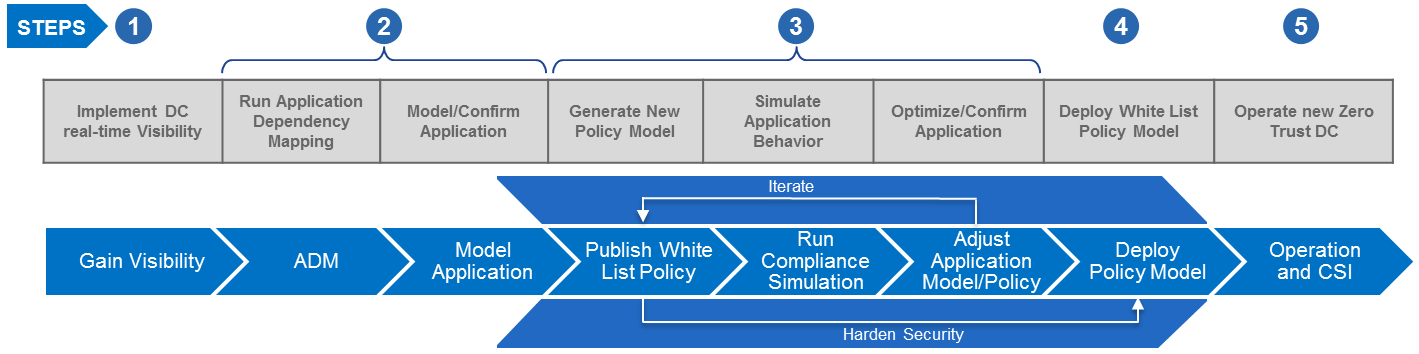
If you want a zero trust data center model and are interested in migrating from black list to white-list security to shrink the surface of attack, but lack information and resources to implement or maintain it, you can follow simple five step Cisco Tetration Analytics implementation guide below.

Tetration 5 Steps Pic

1 – Gain Real-time Visibility: Gaining pervasive real-time visibility is the foundation for zero trust operations in data center. This step entails installing on-prem Tetration Analytics platform, software host and network hardware sensors.  You can immediately start collecting and storing all data flows in your data center.  All searchable when, where and how you want.

Tetration Blog Step 1 Image 

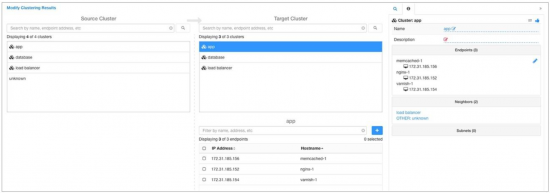
2 – Map Application Dependencies: Tetration Analytics provides application behavior based mapping of processes and data flows using unsupervised machine learning algorithms.  Smart enough to map and group business applications, Tetration autonomously creates application cluster views.

Tetration Blog Step 2 Image 1

If any adjustments are needed, Tetration also allows you to redesign or model new groupings so that you can get to confirmed Application Dependency Map (ADM) template to be used for creation of white list policy.

Tetration Blog Step 2 Image 2

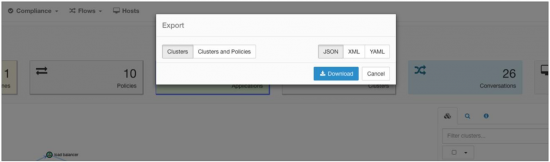
The application mapping then can be exported in various data interchange formats for the next step – whitelist policy enforcement on data center infrastructure.

Tetration Blog Step 2 Image 3

3 – Recommend White List Policy:

Enabling “zero-trust operations” in data center hinges on Tetration’s automated whitelist policy generation that dramatically reduces the surface of attack and simplifies compliance. In a whitelist policy nothing communicates by default, and exceptions are explicitly allowed. This prevents attacks from propagating across applications, tenants and data.

Tetration Blog Step 3 Image 1

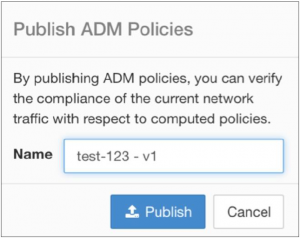
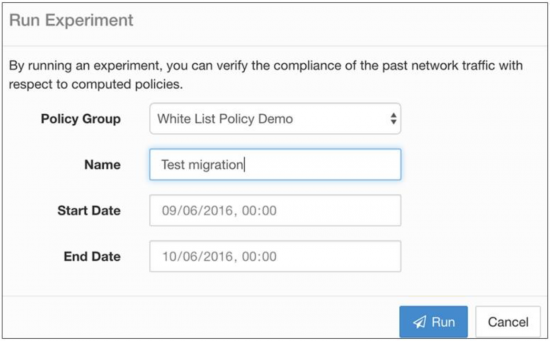
Publishing application dependency policies obtained in the previous step to a policy compliance workspace allows you to run policy experiment.  You can then verify compliance of the past network traffic with respect to recently calculated policies. Simply select the policy group you wish to test and the time period in which you wish to test.

Tetration Blog Step 3 Image 2

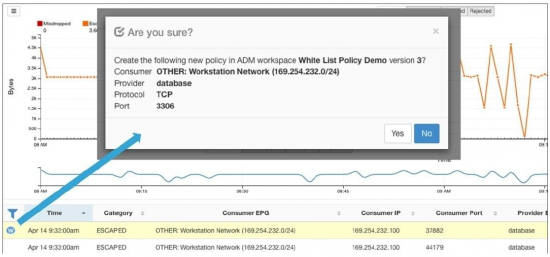
Next, run the simulation of whitelist policy and assess its impact before applying it in the production network.   You can immediately see which flows will be classified as compliant, noncompliant or dropped when this policy is enforced.

Tetration Blog Step 3 Image 3

The end result is the new whitelist policy, deployment of which will result in zero trust data center environment.

4 – Deploy White List Policy: With the compliant and confirmed white list policy model available, it is time to export the policy model to SDN controllers, such as Cisco ACI. SDN controllers then enforce this new white list policy model in provisioning data center infrastructure to create zero-trust operations in production environment.

5 – Operate Zero Trust Data Center: On an ongoing basis, Tetration continues to collect network flows and uses them to generate application connectivity patterns and detecting any deviations from baseline application behavior. Combining unsupervised machine learning, anomalous behavior detection, and intelligent algorithms, Tetration Analytics brings new levels of network and security analytics to the data center.

Change is inevitable, as forces outside the business demonstrate. It’s up to businesses to decide how they’re going to respond to change. IT infrastructure and operations organizations need to quickly and flexibly deliver business services and enterprise apps that best equip a modern workforce. Cisco Tetration Analytics will accelerate your organization’s digital transformation journey by giving you previously unattainable knowledge about data center. Respond quickly to changes in your digital business and to changes happening in your data center and cloud environment, while becoming more secure each day, as additional policy is discovered, simulated, applied, and verified!

This is the only way your business can create competitive advantage and stay relevant in today’s digital world!

Learn More:

Cisco Tetration Analytics Overview

Cisco Tetration At a Glance

Cisco Tetration Video – Cisco IT implementation of zero trust data center operations across 50,000 servers with 70% less staff time by using Tetration Analytics platform

IDC White Paper – See the details in this storyline and the many additional benefits Cisco IT achieved with Tetration Analytics deployment – check it out!


Authors

Adam Ozkan

Hybrid Cloud Infrastructure

Avatar

Cloud computing has become the virtual bedrock for today’s business and consumer applications as well as future offerings on the service horizon. Cloud plays a pivotal role in digital transformation and has literally reshaped global data centers. While this is widely understood, I believe the real challenge for cloud providers, businesses and consumers in 2016 and beyond is not just about cloud service adoption. We’ve already seen tangible improvements in data center efficiency and increased scalability, business users benefitting from more economical “as-a-service” delivery models, and billions of consumers moving their content to cloud storage solutions. Cloud computing has become a preference (not just a standard) in many IT environments. The challenge is not adoption, but realizing the full potential and breadth of what data center virtualization and cloud technologies can enable. As we move into a significantly more connected world, where we want to support many new “things” and applications, we are starting to see a greater need for computing and connectivity capabilities closer to the users and the things. The industry continues to explore the possibilities of the Internet of Things (IoT), Augmented Reality (AR) and Virtual Reality (VR) as they move toward connecting and utilizing disparate IoT devices. Ultimately, this will require more innovation at the network edge with higher performance capabilities from fixed and mobile access

Major strides are being made with PaaS (Platform-as-a-service), IaaS (Infrastructure-as-a-service) and SaaS (Software-as-a-service) on cloud platforms. PaaS is the set of tools and services designed to make coding and deploying those applications quick and efficient. IaaS is the hardware and software that powers it all – servers, storage, networks, and operating systems. Containers and virtual machines are being used to utilize more and more applications into the cloud. SaaS applications are designed for end-users, delivered over the web.

Machine Learning and Big Data are changing how developers build smart applications to customize user experience. Cloud computing is making the job easier for everybody, both web/mobile developers and data scientists interested in building complex data workflows.

To understand cloud readiness further, numerous factors that influence end-user behaviors and Internet access are examined in the Cisco Cloud Readiness paper. There are many intrinsic and extrinsic factors that influence the adoption of cloud computing, and make some countries and regions more cloud-ready than others. As more and more applications are served to the end users, the focus shifts to the end user readiness as to how many of these applications they are able to consume with the broadband capabilities available to them. End users armed with a plethora of devices and things are mostly unaware of where their data travels to, is processed, stored and returned from. End user mobile and fixed broadband download and upload speeds and latency are therefore key to the optimum end user experience.

We don’t generally use cloud applications in a singular fashion, but rather in random and concurrent ways as part of our daily online routines. With the Cisco Cloud Readiness Tool update as a part of the Cisco Global Cloud Index (GCI) study, one can select a number of cloud applications from the list available to see which country networks are able to deploy those applications with an optimum end-user experience. This year, two new applications were added, Augmented Reality (AR) gaming in the “Intermediate” applications category and Virtual Reality (VR) streaming in the “Advanced” applications category. The category definitions are available in the “Concurrency” tab of the tool. More number of countries are able to support advanced cloud ready applications compared to the prior years.

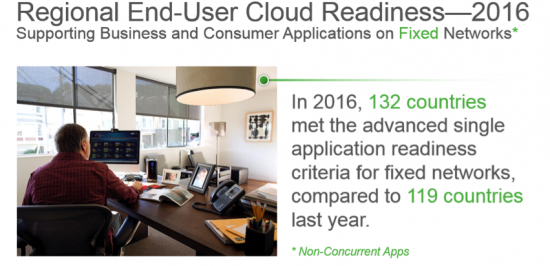
From a fixed networks perspective, there has been tremendous progress made from 2015 and 2016 in end user network performance, and 132 countries have met the single advanced application criteria for the fixed networks compared to 119 countries last year, as seen in Figure 1.

Figure 1:

1

And this progress has been steady over the past years.

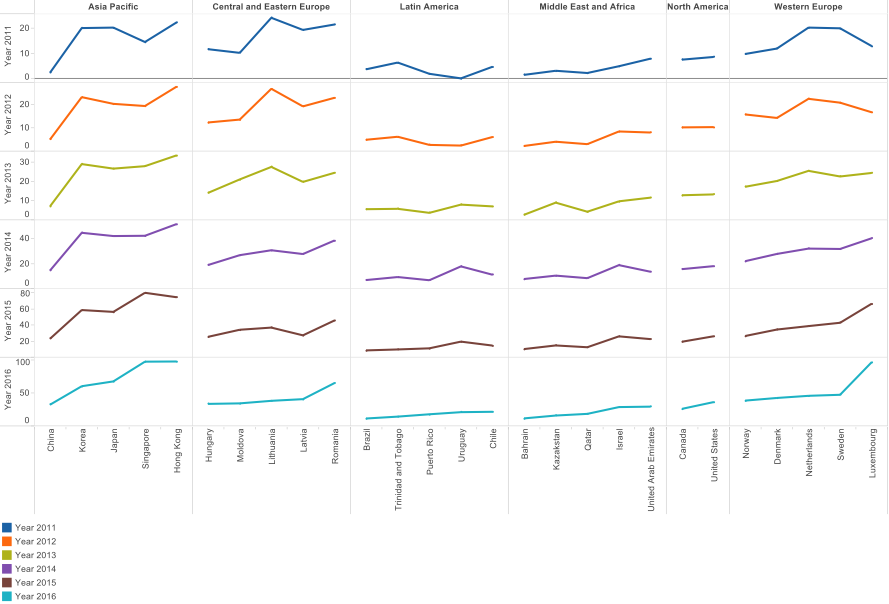
Nearly 300 million speed test records from over 200 countries have been analyzed based on data collected from Ookla’s speedtest.net. There has been a steady increase and growth in average fixed download speeds and average upload speeds as well better average latency performance across the board. Below is a sample set of leading countries from all regions, with increase seen in experienced average fixed download speeds from the years 2011 to 2016:

Figure 2: Average Fixed Download Speeds in Mbps (2011-2016)

2

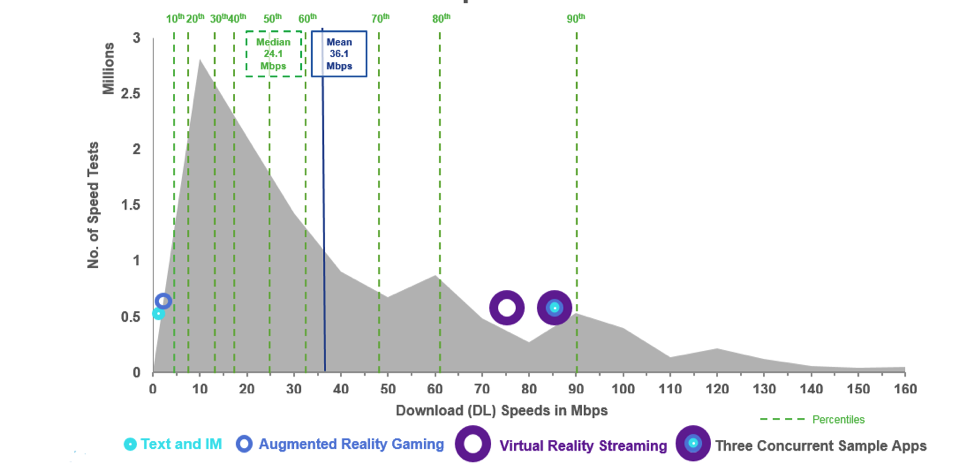
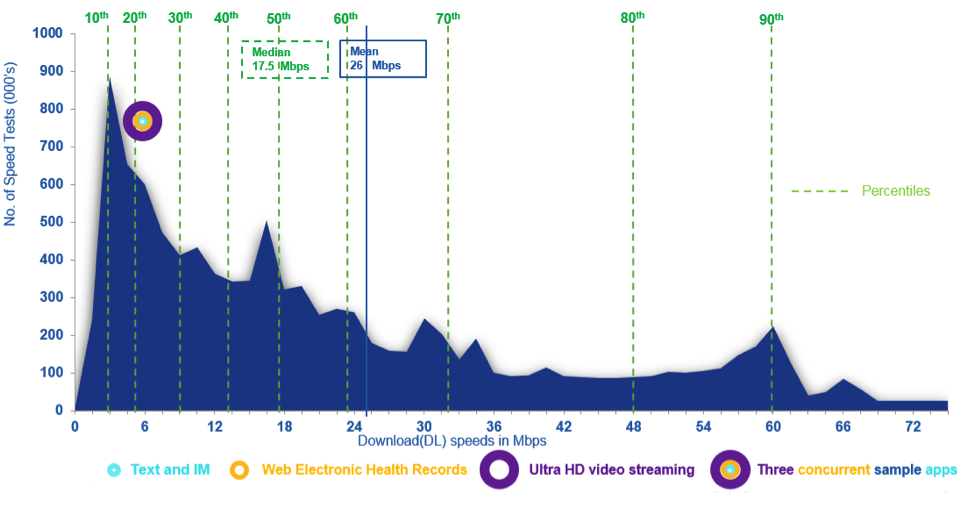
All the major trends that are much talked about this year, AR, VR, IoT, big data, analytics, rely on the end user cloud applications and readiness experience. As the plethora of IoT devices come into use, one of the measures of understanding the quality of the IoT/broadband/cloud connection is not just the average speeds and latency, but also the median speeds which is also a common descriptor of the typical broadband user’s experience in a country. We also observe an increase in median speeds over the past few years, across the board. For example, in looking at the United States’ 2016 distribution of speed tests along with a sample scenario of three applications in concurrent use and comparing it to the 2015 average and median speed test distribution along with a different sample set of three applications, the improvement from 2015 to 2016 is evident.

Figure 3: 2016 Average and Median Fixed Download Speeds – United States; Sample scenario of three applications in use


3

Comparing it to the speed tests distribution in 2015, there has been improvement in experienced median speeds as well as average speeds in Mbps.

Figure 4: 2015 Average and Median Fixed Download Speeds – United States; Sample scenario of three applications in use

4

Similar strides have been made in the mobile networks performance over the past years, the Cisco Cloud Index (GCI) study delves into deeper details and findings.

Are these network improvements enough? Think about your own experiences. Do you still have experience slurred/degraded calls on cloud-based VoIP connections? Have you gotten delays in downloading videos served from the cloud or lags during online cloud gaming sessions? Even in advanced, mature Internet markets, these things still happen. More investments and improvements need to be made for the up and coming connected car vehicle-to-vehicle communication, smart cities, healthcare with robotic surgeries, immersive VR streaming and other applications where tactile Internet capabilities with higher speeds and lower latencies will need to be ubiquitous. Tremendous progress has been made and we continue to stand on the shoulders of the Internet pioneers that have built the networks of today. From this foundation, new approaches and solutions will support fresh waves of innovation that will disrupt every industry and connect people and things like they have never been connected before.

Authors

Usha Andra

Leader, Product Marketing

Data Center and Cloud Networking

Avatar

Earlier this week, more than 200 Cisco partners attended the latest Customer Success Talk webinar, The Golden Thread: Connecting Data in the Value Chain”.  The live event featured Andy Starr, Vice President of Cisco’s Customer Success and Renewal Operations organization, where he shared his perspective on how data and analytics are key to understanding the customer journey and driving more enjoyable customer experiences.

We recently talked to Andy, to find out more about how data and analytics are such a critical component of customer success management.

https://www.youtube.com/watch?v=Yb3esxARrTI&feature=youtu.be

Visit SuccessHub for more information on data management practices that create customers for life.

Authors

Kelly Crothers

Director, Marketing

Global Customer Success