Avatar

Going Digital, Digitization, The Digital Experience are all terms being thrown around these days and I am often asked “what does that really mean?”.  While the industry has done an amazing job of creating new buzz words, it is hard for the everyday technologist to link them to anything practical.  We can put together the best products in each domain; however, if there is not a higher purpose then what are we really doing?

Ruba Borno talks about digitization strategy in three segments, it starts from improving a business process to new insights and at the highest level it is what business is based on.  This incremental improvement might be increased visibility by finding work in process (WIP) through RFID tagging to an end to end design around automation that is the basis for the way a business goes to market.  Uber is usually the darling example used in the latter case, disrupting driver services all over the globe.

I am flying back from London as I write this and discovered that this is not always the case.  You see, London already had a driver system in place long before Uber ever arrived.  By law, everyone driving anyone required a license and provided a car service.  As my Uber driver explained, all that really changed was the app on the phone that made it easier to match clients to her service.  They now know exactly when she is arriving and the rates became standardized for a better customer experience.  She said it did improve her revenue through increase volume by about 8%.  An incremental improvement, for sure, ground breaking, not in that market.  This is different than the disruption it has been in markets like San Francisco, Milan, or Singapore.

This situation comes to mind when a customer says “We have old routers and are thinking about upgrading…”  The first question I ask is “Okay, but what are you trying to do?” often to puzzled looks.  Routers have been around for 30 years and the basic Layer 3 functions haven’t changed much over those 30 years.  Sure, there have been several incremental improvements like Uber in London, not really groundbreaking.  What has changed is the management, orchestration, and automation of the WAN.

The real discussion begins when we focus on where the applications are housed and the experience we are trying deliver to customers and employees.  For example, consider the use of IoT sensors on the roof combined with IP cameras observing the number of people in a queue.  The weather and length of line could drive the types of ads playing on the digital signage, the tempo of the music, and the temperature in the room.  How might this dynamically changing environment per store change how you perceive your wait time?

In manufacturing the use of virtual beacons can identify fork trucks whirling around a busy factory floor.  When you add in some analytics you may find that ten trucks are actually more efficient than 20 due to the traffic flows and part delivery times.  Looking to improve customer experience for mortgage applications and insurance estimates?  Using Spark to provides fully encrypted cloud based collaboration services changes the service level with customers.  Buyers can take pictures while touring a house, upload personal information, and get pre-approved for the loan and insurance policy before they walk out the front door.  To close on the home, location services can direct them to the closest branch and provide a virtual map to a room with a Telepresence system for personalize final signatures and approvals from a centralize location.

Imagine IP Cameras and virtual beacons alerting employees to converge on that area that has a flash crowd and the ability check them out on their iPads.  Finally, imagine if Uber allowed you to put in your flight number and hotel then automatically summoned a car to arrive exactly when your flight landed and have you checked in as you arrive.  Your same phone with NFC with Apple Pay or Google Pay can act as your door key. (Ok that one might be slightly self-serving)

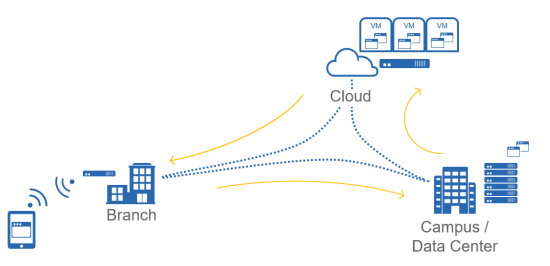
You can quickly see this is much more than talking about a router, a switch, or a server in the data center.  We have to talk about where the apps will live and how they will move between the data center, cloud, and branch to provide a new experience for employees and customers.
three clouds

You need more than a router: will the IoT analytics be processed locally or are you planning on driving all that data to the Cloud?  What density of WiFi will be required to deliver these services and how are you dealing with applications coming from multiple sources?  How are you planning on securely on-boarding all these IoT devices?  What about changes in policy like offering guest WiFi and enabling Spark video in all the warehouses?

We need to think about systems that can spin up compute for an application and have the agility and automation to move the workloads to the Cloud or the branch as needed.  Of course, your security policy has to consider that devices that are no long bound by the buildings as they once were and applications that can live anywhere, simultaneously.

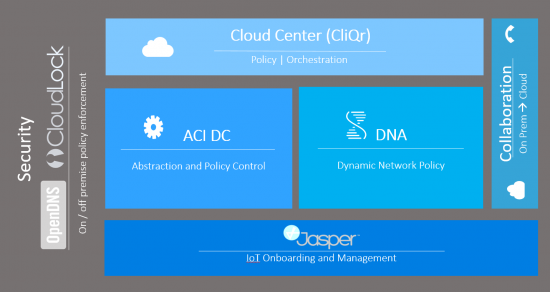
Wouldn’t that discussion look something more like this?
Big Picture

Sure, we can talk about a new router, but how is that fundamentally helping your business improve the experience for your customers and employees to grow revenue and create loyalty?


Authors

Bill Hentschell

Global Director of Intent Based Networking

Global Partner Organization

Avatar

This blog post was guest-written by Nora Ayanian, Assistant Professor 

Diversity is crucial when solving challenging problems, whether you work with people, devices, or robots. For more than a decade, I’ve worked in multi-robot coordination, studying how to make teams of robots work better together. And in that time, we’ve made a lot of progress in putting robots to work.

You might not realize the huge impact robots have had on our lives: they make our cars and airplanes stronger and safer, our mobile devices smaller, and even get our packages to us faster. All of these things happen behind the scenes, in buildings with lots of instrumentation and infrastructure, including high-bandwidth communications, cameras, and other sensors. The reason robots have thrived in manufacturing and warehousing is because they have this infrastructure, and the environments are predictable and highly controlled.

But many of society’s toughest problems are in unstructured environments, environments that are not instrumented, controlled, or even well-known or understood. Robots’ potential to operate in these dangerous conditions makes them excellent candidates for these tasks. Imagine teams of robots searching for survivors and delivering food and supplies to hard-to-reach areas after a natural disaster like a tsunami or earthquake, exploring dangerous areas with remote sensing to find new sources of clean water, or patrolling waterways to prevent the dumping of toxic waste.

While robots have been deployed in such situations before, they’ve always been remote-controlled by expert operators. However, in many scenarios, waiting for experts to arrive wastes valuable time, and can mean all the difference between life or death for those in need. The operators themselves also have limited situational awareness, meaning it can be hard for them to understand what is going on around the robot.

To accomplish these tasks effectively and quickly requires autonomy, or the ability for the robots to operate and make decisions on their own. Without the infrastructure we typically lean on to ensure the robots operate both effectively and safely, though, we need new solutions that will be successful in these tough environments. I believe what we need to get these solutions is diversity, both in the teams that develop these solutions and in the solutions themselves.

Let’s start with diversity in the teams working on these problems. Research has shown that diversity in skills within a workgroup leads to higher-quality solutions. Add to that different life experiences, different perspectives, and the ability to discuss ideas respectfully, and you have a highly functional workgroup. My research group focuses on solving hard problems, so I aim to have a diverse group of people that can bring their different skills and experiences to the table. Without these valuable perspectives, I don’t believe we can tackle these difficult societal problems.

But I realized a couple years ago that I wasn’t approaching my research problems the same way. While I was focusing on diversity within my research group, I wasn’t thinking about using diverse approaches to solve multi-robot problems. This inspired me to rethink how we solve multi-robot problems.

The way we solve multi-robot problems right now is to uniformly apply one control policy to all of the identical robots in the team. For example, imagine we’re trying to monitor air quality with a team of physically identical aerial robots. If we considered all the factors that could affect the problem, the robots, and their capabilities, we might have too many factors to consider and our problem would be intractable.

Currently, we make simplifying assumptions to make the problem solvable, like estimating variable wind speed or potential changes in temperature. Then we construct the best solution for that problem and apply it to all of the robots. But when we deploy the robots, the environment isn’t exactly the same, the temperature is higher and the wind is stronger; our optimal solution across uniform aerial robots is no longer optimal! In fact, it might not work at all!

Wouldn’t it be better if the team of robots each had a slightly different control policy, created with different assumptions? In contrast to the uniform approach, some of the robots will work better than others, which means the robots could learn from one another. Which strategies worked and which didn’t? How can each adjust to perform its own task? By using a diverse approach, we can leverage the strengths of the different control policies under different conditions.

Beyond diversity in control, we can also consider diversity in the physical capabilities of robots. Imagine that same team of aerial robots assisted by robots on the ground. The robots on the ground could provide additional information such as temperature, position, topography, and satellite communications via hardware the aerial robots might not be able to carry. They could also perform computation, telling the aerial robots where to go and mapping the air quality, allowing the aerial robots to use more of their on-board energy for sensing.

Diversity is the key to using robots to solve some of society’s most pressing challenges. Diversity in robot capabilities and control, as well as diversity in the people that develop these hardware and software solutions, will ensure that we make the largest impact possible.

Getting involved in IT is an opportunity to confront these global challenges with your unique perspective. We need more people of all backgrounds involved in technology, especially women! Join me as we jump into the tech revolution on November 29 as part of the Women Rock-IT Cisco TV series.

Register today to take part in my talk during the session: “

Authors

Austin Belisle

No Longer with Cisco

Avatar

By Daniel Etman, Director of Product Management, Cable Access Business, Cisco

“The wonderful thing about “standards” is that there are so many to choose from!

So how do we in the “Cable industry” define a Standard?

In short, we’d take the approach that a Standard is a set of published specifications, protocols, and procedures.

But standards address a much wider fundamental issue key to our industry, not limited just to the technology but to ensure functionality, compatibility and interoperability.

They provide the bed rock for product development and provides for an easier understanding and comparison for competing products.

It is only through the adoption of standards that “true” interconnectivity and interoperability can be assured and enjoyed, and it’s only with the application of these can new markets be defined and ratified.

Let’s set out the case for the “standard” of DAA (Digital Access Architecture). There are many competing contenders for the privilege title of standard namely “Remote PHY”, Remote MAC+PHY, “Remote Mini CMTS”.

All of these protagonist’s merit advantages in their own right, but only one technology can carry forward the expectations demanded of the Cable Industry that meets the requirements and demands outlined above.

That coveted title for the standard of DAA belongs solely to ‘Remote PHY’ specification (CableLabs® MHAv2 now in its 5th issue).

The effort around the standardisation of Remote Phy DAA was an industry wide initiative chaired by CableLabs® with substantial contributions to the specification from Cisco Systems.

The advantage of a common ratified specific are multi-faceted, it will allow vendors to build to a common platform and customers to experience the level of industry cooperation as has been evident in previous DOCSIS specifications.

1

In addition to the technical advantages of Remote Phy over its contemporaries Cisco and CableLabs® have agreed on an “Open Source” program to further accelerate full interoperability for RPD (Remote Phy devices) and drive a collaborative effort between equipment vendors and silicon manufactures alike. Called “OpenRPD”its purpose is to parallel the ‘Time to Market’ demands of the Cable operators by fostering an eco-system to drive RPD development and ultimately the adoption of Remote Phy architectures.

Open source software continues to make solid inroads in the world of network technology. There are various open source industry efforts which are becoming de-facto standards that are being adopted by operators and equipment manufacturers.

It’s my belief that OpenRPD will drive innovation and interoperability beyond what we have experienced previously by allowing the nature of open source to foster technology improvements, rapid prototyping and focus on a common networking cause for the Cable industry.

In comparison a closed proprietary solution cannot leverage the collaborative effect of OpenRPD.

In summary standards fuel the development and implementation of technologies that “Change The Way We Live, Work, Play and Learn”

CableLabs and Cisco Systems announce Open Source software for the future of Virtualisation in Cable.

Save

Save

Save

Authors

Greg Smith

Sr. Manager, Marketing

Cisco Solutions Marketing

Avatar

Every major technology and business transition affects both process and people. Job roles change, some jobs are eliminated, and new jobs are created.

The transition to the Internet of Things (IoT) is no different. While automation and more efficient processes may eliminate some jobs, IoT is creating many new job opportunities—from data scientists, to remote operators, to application developers. The fact is, in the United States and Western Europe there are tens of thousands of manufacturing jobs that are not filled each year because there are not enough qualified candidates. As the IoT-based economy drives trillions of dollars in economic growth, some industries merge and new ones are created, there will be a worldwide scramble for the same IoT-capable workers.

How can you fill these new jobs?

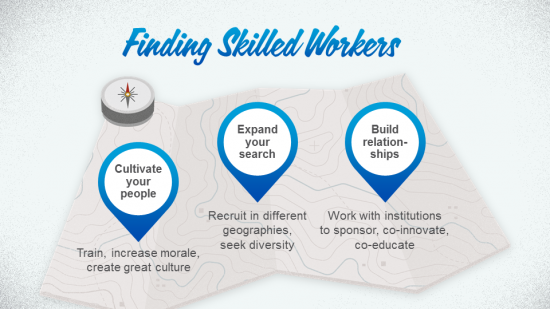
Graphics for talent  (002)Start by cultivating your own people. Invest in your employees to help them grow new IoT skills. This is job one for every company starting on the IoT journey. Creating an IoT-ready workforce is not a one-time training event. It is a mindset change. A new way to run your organization. A new contract between your company and your employees. The model of performing the same job that changes little for 10-20 years is gone. Today, people have to navigate a dynamic landscape where they need to reinvent themselves every three to seven years to keep up with fast-changing IoT skills. This requires a mindset of continuous learning—for both employees and companies. IoT is a journey, and so is learning the skills it requires.

Next, expand your search beyond the usual places. Of course, continue to engage with four-year colleges and universities, but also check out community colleges, and even high schools. Rockwell Automation, for example, runs a summer internship program for high-schoolers. Many IoT jobs can be performed remotely, so don’t be tied in to an arbitrary geographical location, or rigid working hours. Smart devices, accessible technologies, and ubiquitous broadband can also open up a vast untapped talent pool—roughly a billion people in the world with disabilities. An inclusive, accessible approach will bring you a greater range of qualified candidates while broadening participation in the IoT-led economy.

Finally, build relationships. Engage early and comprehensively with schools, veterans groups and industry organizations. Sponsor research, offer internships, and initiate joint projects. Consider co-developing curricula with these institutions. If you need more data scientists, partner with a college to develop such classes, then sponsor them. Be creative. Look at the example of Siemens, which needed more mechatronics experts in its North Carolina facility. So it partnered with a local community college to create a unique four-year apprenticeship program combining on-the-job training with a structured curriculum.

The good news is that the industry is coming together to address the shortage of skilled IoT workers. Recently, Cisco, Rockwell, GE and several other organizations have formed the IoT Talent Consortium—a nonprofit organization dedicated to preparing the first generation of IoT-ready workers.

And while you may be focusing on developing new skills in your existing workforce and finding new workers with IoT skills, don’t forget the valuable expertise of your long-term employees, who provide a legacy of institutional knowledge, history, and context. My father-in-law is a good example. For decades, he worked as the chief technologist at a steel mill. When he retired, the company asked him to continue as a consultant, even as new generations of managers implemented automated IoT processes. Why? Because he had a depth of practical expertise the company couldn’t afford to lose. So they tapped into his experience as the foundation of its automated decision systems.

Developing an IoT-enabled workforce is not an option—it is a must. You could implement IoT solutions and integrate them with your business processes, but if your workforce is not ready (in terms of both skill and culture), your IoT transformation will fail.

If you focus on developing new skills while preserving legacy expertise, you will soon have a workforce ready to take on the dynamic challenges of the IoT economy. Next, it’s time to put them to work solving real problems for your company, your industry, and the world. That’s the next ingredient in my recipe for IoT success—and the topic of my next blog in this series.

Authors

Maciej Kranz

Vice President and General Manager

Corporate Strategic Innovation Group

Avatar

Last week over 5,000 customers, experts and partners gathered at Cisco Live Latin America to learn about the latest Cisco products, solutions and technology trends. Participants were able to attend technical education seminars and clinics, IT management leadership training, hands-on labs, and one-on-one conversations with technical experts.

20161108_164906

The World of Solutions (WoS) was a popular location where each day thousands of motivated Cisco customers visited the more than 80 partners and technology providers in the exhibit hall. The World of Solutions also included the Cisco Product Technology area where visitors could take a deep dive into Cisco’s products, solutions and services.

In the Cisco Digital Industries area, customers could demo technology with an industry specific view. Additionally the Solutions Theater provided the opportunity to hear from subject matter experts and partners during focused presentations that complemented what visitors where seeing and experiencing in the WoS.

Cisco’s Public Sector team was honored to again be part of this year’s event and had a strong presence in the Digital Industries area of the WoS exhibition hall. We addressed a number of current national government and public safety issues including the Public Safety Architecture Foundation, wearables and mobile communications and sensors and Connected Public Safety.

IMG_0180We had the good fortune to be joined in our booth by our partner BlueLine Grid who demonstrated GridCommand, their secure collaboration application platform. This solution was very well received and had many customers stopping by for demonstrations. In addition, BlueLine Grid joined us as we presented on a number of Public Safety topics in the Solutions Theater.

The next event in the Cisco Live series will be held February 20 – 24, 2017 in Berlin. We look forward to seeing you there was we kick off our 2017 Cisco Live series of events. In the meantime, get more information about our public safety solutions on our website.


Authors

AJ Ramsey

Global Industries Marketing Lead

GMCC-Services Marketing

Avatar

Being environmentally conscious is not just a fad – it’s a commitment. As citizens of this planet and stewards of the Earth, we must be aware of the impact of our day-to-day routines and how it may affect our quality of life. Each day our seemingly benign activities, such as getting to and from work are regrettably building a heavy carbon footprint.

Erasing our carbon footprint

I’m sure you’ve heard this term – carbon footprint – on several occasions, but you may not be aware of the technical definition. Formally defined, our carbon footprint is the sum of greenhouse gas emissions produced in support of managing human activities – generally expressed in equivalent tons of carbon dioxide (CO2). Which means there is a direct correlation between how we behave as humans and how the health of the planet is affected. Due to this fact, many cities around the world are striving to achieve carbon neutrality.

What will be our environmental legacy?

The question still remains, how do we adjust our ways, mend what’s been broken and still maintain the lifestyle that we’re all accustomed to? Cities, countries and people around the world are working hard to find an answer to this very question. By balancing our output and the managing the effect of our emissions, carbon neutrality can be achieved when cities ensure their actions work to remove or reduce the amount of carbon dioxide they produce. There are a number of ways that city and community leaders are pursuing in order to make this a reality. The spectrum of approaches can range from something as simple as planting trees, to more complex tactics like investing in renewable energy sources. Regardless of the approach, city leaders are showing true commitment to change with new and innovative ideas.

Success Stories

Our recently announced Smart+Connected Digital Platform is helping cities and communities achieve these kinds of changes. Management and insight of their city’s data is allowing leaders to make informed decisions to better plan for today and for the future.

https://www.youtube.com/watch?v=5qcmTmu6Zk0&list=PLEE1CB50148EBA975

In Copenhagen, city leaders are working toward becoming carbon neutral by 2020. Recent deployments with Cisco, TDC and a wide range of partners has introduced air pollution analytics, smart waste, and soil and water quality sensing as the preliminary environmental sustainability approach of their smart city agenda. And in places like Adelaide in South Australia, smart street lighting is not only helping to save energy and protect resources, but saving the city money as well.

Cities do not become smart over night. Planting trees, installing sensors and changing traffic patterns are important building blocks. But when cities and communities start to turn data into action, the digital transformation vision is brought to life. Once the data starts to flow, city leaders can get an accurate picture of life their communities, which can inform a range of decisions that can impact everything from better transportation, health and wellness, future planning and long-lasting environmental sustainability.


Authors

Brenda Germundson

Global Industry Marketing Leader

Revenue Marketing

Avatar

The most immediate benefit of segment routing is the major operational savings it brings about. By enabling the network to provision its resources more efficiently in an automated way, it gets a better performance from your infrastructure.

But this is far from the only benefit. Segment routing technology, originally developed by Cisco, is now rapidly becoming an industry standard for programmable networks, and is set to underpin many of the most exciting developments in this area over the coming years. And it doesn’t just enable innovations – it allows you to bring them to market at low cost and a fast pace.

Service providers creating programmable networks now have a fantastic opportunity to increase revenues through developing new products. Here are three areas we think it’s definitely worth investigating:

Guaranteed Uptime, Minimal Cost

Some network links are absolutely vital. Think of the connections between data centres that your customers cannot afford to go down. Naturally, businesses want backup to protect their most important assets. But what they may not realise is that different service providers often share the same fibre connections. So getting a second provider to step in in case of failure doesn’t necessarily help.

Segment routing can get around this problem by providing two distinct pathways for thedata to take between data centres – creating what’s called a guaranteed disjoint path. So your customers can rest assured that if the network is disrupted or redundant, traffic will automatically be diverted to the other pathway.

Crucially, what segment routing offers is not just this opportunity, but the automated controls that make it straightforward to implement. So you can develop new capabilities like this quickly, and bring related products to market as soon as you can. We don’t just make innovation possible – we make it easy.


Guaranteed Speed

For some businesses, speed is everything. In high-frequency currency trading, a fast connection can enable organisations to take advantage of price differences between markets that exist for just fractions of a second.

Typically, traffic is routed through high bandwidth centres, but where speed is important, there are other options. Segment routing enables you to offer specific customers a low latency path – in effect, a personal direct, high-speed route. It’s a bit like priority boarding to get on a plane.

Guaranteed Bandwidth

In a world where video is king, sometimes you need to know that your message is going to get through. Maybe you want to live stream a new product launch from a busy location, or broadcast a CEO’s quarterly update to staff around the world. Segment routing prioritises traffic and balances loads on your system, so that occasions like this go ahead without a hitch.

Again, the technology is agile and automated, so it’s simple and efficient to set up solutions like these.

Guaranteed Innovation

These examples are just a taste of what’s possible. Forward-thinking service providers around the world, like Wolfe.net in the US, are constantly finding new applications for segment routing to drive revenue. And doing this will become even more important as the world becomes increasingly connected and mobile. Innovations that succeed will be those that are brought quickly to market and can adapt intelligently to changing circumstances.

Cisco invests $6bn a year in research and development because innovation is at the heart of what we do. Our experience developing programmable network technology, and using it to drive enhanced performance, puts us in a great position to help you find what works.

Explore Cisco Solutions for more information: Application Engineered Routing

Or talk to us to find out more.

KEY TAKEAWAYS

  • Operational savings aren’t the only benefit of segment routing technology. It also enables service providers to create innovative products and bring them to market at a low cost and fast pace.
  • One possibility is to use segment routing to guarantee network uptime by ensuring there are two distinct pathways that data can take between data centres. This means that if the network is disrupted or redundant, traffic will be automatically diverted to the other one.
  • Another is offering specific customers a low latency path – in effect, a personal direct, high-speed route. This can be useful for businesses that rely on ultra-fast connection speeds, like high-frequency currency trading.
  • Crucially, as segment routing is software defined, the implementation of services is automated and simple to manage. So you can develop new capabilities quickly, and bring related products to market as soon as you can.
  • If you want to learn more: visit our Evolved Programmable Network page.


Authors

Bertrand Duvivier

Principal Engineer

Web Portfolio

Avatar

To create world-changing technology, you need world-changing technologists – like the engineers that help make up the #WeAreCisco tribe.

So who better to give career advice to aspiring Cisconians than these inspiring Cisconians? These systems engineers are all Chairman’s Club Winners – the top 1% in their organization (which earns them a trip to Hawaii with the senior leadership team), so you might want to perk up and pay attention.

SE Collage
(L to R) Martin Kundrat, Temi Ajasa, Lidiya Krunic, Sven Arend and Jason Gooley, Systems Engineers at Cisco and Chairman’s Club winners.
  1. It’s all up to you! Prioritize your career, build strong relationships and go above and beyond what’s asked of you. – Martin Kundrat
  1. My career advice? Set goals for yourself, short and long term, and then align with mentors that can help you get there. – Temi Ajasa
  2. What makes a successful Systems Engineer? Have an analytical brain and be a great communicator. – Lidiya Krunic
  3. Make sure you understand a vast portfolio, but then specialize in a niche technology to add value. – Sven Arend
  4. My secret to success is that I’m not only an SE (Systems Engineer) but I’m also an SE (Social Exciter.) – Jason Gooley

We loved this advice so much that we did an Instagram Story on these SEs and other technologists at Cisco. In case you missed it, here’s a replay (You are following WeAreCisco on Instagram, right?)

https://youtu.be/jwwPZQfpUIU

Have a piece of career advice? Add it to the comments below.


Want to join a great team and strive to become a Chairman’s Club member? Take a look at open opportunities.


Authors

Carmen Shirkey Collins

Social Media Manager

Talent Brand and Enablement Team, HR

Avatar

Network managers may be as gripped by the latest online TV series as much as their customers. They may not feel quite so thrilled, though, when they see the demand on their service doubling every 18 months as a result of the binge-watching trend.

It’s no secret that the popularity of video content – not to mention growing numbers of people and devices accessing the internet, and the rise of a tech-addicted younger generation – is driving an explosion of internet use.

In one sense this is great news for service providers, but the sheer pace of the increase in demand is causing headaches. One way of addressing the problem is with more equipment: bigger routers, and more of them. But this means more capital spending, and more complex networks, which are more expensive to operate. It’s a vicious circle, and one that threatens to spiral out of control.

At Cisco, we’re at the forefront of innovations in programmable networks that offer a different way out. Segment routing is a standards-based, intelligent software solution to a hardware capacity problem that simplifies, optimises, and reduces costs all at once.


A New Lease on Life

Segment routing is a new way of transporting data that brings operational efficiencies and lower costs. Essentially, it can program data packets to flow through your network in a more intelligent way, using bandwidth more effectively and getting faster to where they need to be. It’s a simpler system that optimises your network’s traffic and extends its capacity.

Without going too deeply into the technical details, these are the key advantages of segment routing:

  • traffic can be directed in the most optimal way from any point within the system, because you can implement segment routing anywhere on the network – on fixed or mobile elements, within a data centre or at access points
  • your services can be made more resilient through automatic back up paths – if a link fails, traffic can be automatically routed around it within 50 milliseconds.

All this is achieved often not by buying new equipment, but by making your existing infrastructure work better for you. The beauty of segment routing is that it enables the central automated control that can direct data automatically, but retains enough distributed intelligence in the system to allow individual network links to react to local issues.

Instead of constantly playing catch-up, you’ll be getting real results from your investment and instilling your network with a new lease of life. We understand complexity – which means we can make it as simple as possible for you.

Laying the Foundations for Innovation

Segment routing drives immediate results by making your business more efficient. What’s more, you’ll also see benefits in the longer term, because the technology is scalable and lays the foundations for further improvements and innovation.

When the intelligent data transport enabled by segment routing is combined with a central SDN controller, it means that your applications and your network infrastructure can work together more effectively than ever before. This creates even more powerful efficiencies – and it’s from these kind of interactions where some of the key innovations of the future will come.

Forward-looking service providers are already using the technology to enable them to better meet the expectations of today’s customers. This year, Wolfe.net implemented segment routing to help them simplify and speed up their delivery of MPLS to the customer edge. The company is now able to provide big chunks of bandwidth to broadcasters and for special events such as gaming conventions.

“It provides me with the network simplification and service flexibility I need to differentiate Wolfe.net in a competitive market,” says Michael Scott, the company’s general manager.

In terms of the technology it works with, segment routing looks backwards and forwards – it helps you get the best out of MPLS while equally being IPv6 ready. So setting it up not only creates an agile, efficient network – it also allows service providers to grow their business by creating exciting new products and bringing them rapidly onto the market – something we’ll talk more in the video interview.

KEY TAKEAWAYS

  • It’s no secret that the world is seeing an explosion of internet use. In one sense this is great news for service providers, but the sheer pace of the increase in demand is causing headaches.
  • One way of addressing the problem is with more equipment. But this means more capital spending, and more complex networks, which are more expensive to operate. It’s a vicious circle that threatens to spiral out of control.
  • Segment routing offers another way out – it’s a new way of transporting data in a more intelligent way, optimising networks’ traffic and extending their capacity.
  • The beauty of segment routing is that it enables the central automated control that can direct data automatically, but retains enough distributed intelligence in the system to allow individual network links to react to local issues.
  • In terms of the technology it works with, segment routing looks backwards and forwards – it helps you get the best out of MPLS while equally being compatible with IPv6. So it’s future-ready while making the most of the present.
  • If you want to learn more: visit our Evolved Programmable Network page.


Authors

Bertrand Duvivier

Principal Engineer

Web Portfolio