On May 5, First Lady Obama and Dr. Jill Biden hosted over 50 companies at The White House to celebrate the 5th anniversary of their Joining Forces initiative, a nationwide effort that began in 2013 to support veterans and their families through employment, education and wellness opportunities. The participating companies, including Cisco, committed to either hire or train veterans over the next 5 years.
In connection with the $10 million cyber scholarship program Cisco CEO Chuck Robbins announced earlier this year, Cisco has pledged to train at least 1,000 veterans through Joining Forces over the next two years. Details of the cyber scholarship program, a global program targeting women in tech, early careerist and veterans, will be announced in June.
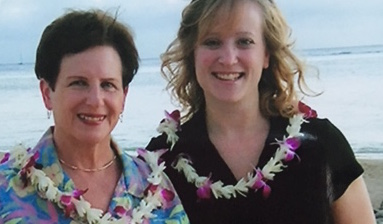
My mom says that being a mom is the hardest job you’ll ever have. But it’s also rewarding when you see your “baby” all grown up and making their way in the world.
Now that I look back (and forward) at my career, I can see the impact my mom had on my professional life. She was a fourth-grade teacher, and was able to impart her wisdom on many a young mind. However, for me, the advice that she never really said out loud, but showed time and time again, is that
Hard work will get you a long way, but it won’t be worth anything if you don’t make time for family.
It’s the advice I give when I mentor today. You won’t look back at your life when you’re 90 and wish you would have worked those extra hours, or had your cell phone on more. It’ll be that you wish you would’ve had more time with the ones you love.
For Mother’s Day, I wondered if my colleagues had any career advice from their moms. Turns out, our “Cisco moms” are super smart.
“The world is not black and white and everyone has their own experiences in life that shape who they are and how they view the world. Embrace your unique experiences to approach life obstacles from a different perspective.
“Here at Cisco, our team faces many ambiguous situations where there’s never a simple black or white type of response. When that happens, we come together as a team to flex our creative brains, our experiences, and different perspectives to come up with out of the box solutions.” – Ray Leung, HR Representative.
“Always be true to yourself and never shy away from a challenge — Life is full of them and without them we would not have any fun in our lives.”
“My grandmother had a huge hand in my upbringing,”says Rehana Rehman, Business Operations Manager. “She was a feisty and fearless woman who worked tirelessly to support and love her 6 kids, 15 grandkids and 13 great-grandkids . She wrote this in my high school graduation card and I have used it as my daily affirmation ever since.”
“I would have to say that my mom’s best work advice to me was to always be a person of integrity no matter what,” says McKinsey Shepherd, Talent Acquisition Coordinator.
“Mom always taught me that the most important quality in a person was their word – and in those words, truth, and commitment not just to themselves, but to those around them, as well as to the success and vitality of the business – because that level of dedication speaks volumes. Not only the quantity, but most importantly the quality of the work you perform should speak for you.”
“Be you.”
“My mom is a homemaker and the best things she did for me and my sister was never to make us feel that we should be the ones learning to cook, clean, do laundry ….. along with our studies and sports,” says Satya Sharma, Software Engineering Development Manager. “She let me be me. She never complained once about ALL THE WORK she does at home and for the home – be it making food for 10+ people without any notice when they just show up or being up the whole night when I was sick and going nonstop without sleep making sure we all have what we need. Not sure how she did it but her patience, dedication, unconditional love for us is something I aspire to have be at home or work!”
“When you have a passion for happiness, and your family’s happiness, it’s not hard to love life. “
“My mom always worked 50-60 hour weeks, and still spent nights and weekends taking care of my sister and I and volunteering for our school or church,” says Justin Riray, Marketing Specialist. “I don’t even know how to not be motivated, because she led such a great example for me, all my life. My mom is THE BEST!”
“To take a deep breath while thinking about how to respond to a tough question, instead of trying to fill the silence.”
“The best career advice I ever got from my mom was received when I was preparing to interview with Cisco,” says Kali Pike, HR Representative. “She shared a funny example of how it’s important to watch out for nervous habits while you’re interviewing.
She learned this the hard way when she was interviewing for her first job out of college. For each interview question she started her answer with ‘Well to be honest…’ Eventually the interviewer cut her off and said ‘I want you to always be honest!’’
She didn’t get the job. It was a lesson that will stick with me. It also taught me that you should always be honest!
“Be flexible.”
“If you have a family, there are days when you will have to drop everything to be by their side, whether it’s a sick pet, an injured kid, or a teenager that needs to talk to you right now,” says Silvia Spiva, Technical Writer. “Don’t think about your job, instead design a career in an industry that values you, and sees you as a whole person. And be there! Those childhood days go by in a flash.”
“There are two things that are true in this life, tomorrow will be another day and you will always keep moving forward so long as you try your best.”
“When I was a senior in college getting ready for the real world, I was completely stressed out if I was going to succeed,” says Marketing Project Specialist Javier Tirado-Montero. “Would I be able to handle living on my own? Will I be able to work well with my team? Can I learn how to cook for myself?
“The week before I was set to walk across that stage, I called my mom to ask her for advice on how to cope with this stress. Ironically, this was a piece of advice my mom always told me since I was a little kid (I should have probably listened to her more), but this time, the timing was perfect. This is something I took with me after I graduated and well into my career. No mistake is ever too great so long as you keep trying your best. Thanks Mom!”
10. “Be authentic, treat everyone with respect, and to help others in every way we could”
When we think of our mom’s career journey the first thing that comes to mind is how she led by example.” say the Daniel sisters. Jina is a Program Manager for Services Operations and Janine is a Program Manager for Business Operations.
“As a leader herself in the government law enforcement sector she showed us what authentic leadership is all about by helping others every chance she had. She instilled in us that with hard work and passion, we could achieve even our wildest dreams. Never putting limits on us, she always made us feel like we could achieve anything we put our mind to. With her own career starting at the young age of 13, she showed us that working hard will enable you to achieve your dreams. She is now a person we wish to be lik e- someone who is respected by multiple government elected officials along with everyone she worked with.”
Does your mom want you to have a great job? Apply at Cisco!
About the Author: Mr. Albach is the Sr. Product Line Manager of IoT Security and joined Cisco in 2010 when he defined and delivered three network security solutions with the most recent – Cisco’s first Industrial Security Appliance.
Did you know you can be contractually obligated to let people you don’t know access your critical infrastructure from outside your network? A simple line (taken from a very real remote operations contract) such as “XXXXX will advise the customer what is required at the time of installation” can leave you vulnerable. Isn’t the time of installation a bit late to figure out security? Let’s talk about this growing phenomena and how it could impact your organization’s security state.
First consider the following:
The first five victims of the Stuxnet infection were partners to the centrifuge effort
The largest data breach in US Government history came through an outsourced partner
Perhaps now would be a good time to think about your own outsourcing, partnering, and dependencies – especially those that reach down to the shop floor. Chances are you won’t get grilled by a Congressional committee (OPM), but a mistaken command or a hijacked remote access station might cause some serious harm to something or somebody.
The challenge at play is the paradox of taking advantage of digitization, improving operational efficiencies, and reducing costs all at once. Throw in the fact that the industrial work force is aging much faster than the rest of the broader work force and you have a particularly wicked problem.
Let’s begin with what is typically the first step in a security maturity model – Discovery.
Find out who outside your company has access to what and under what conditions. In this case the discovery process is not about network topology or connected assets.
First look at your major integrators and system providers. Understand what equipment you are heavily dependent on, who set it up, and what your current practices are with regards to their access. That access question should be about their remote access into your systems and their access when physically present at your site. Once you have an understanding of what is happening, go back and review the contract to see what was agreed to. Make sure you have a grip on what is contractually obligated and the actual practices, and if there’s a difference make sure you get a quick write up. Then look into your smaller providers and repeat.
Now let’s broaden the discussion a bit – look at your production environments outside the major equipment.
Ask yourself:
What kind of access do your parts suppliers and others have?
Are all the buildings your own?
Who maintains them and the grounds?
Who cleans up and hauls away the refuse?
Who maintains the printers, the coffee machines, etc.?
Does the vending machine link back to some other network?
Then look internally:
Are you dependent on your IT department for services?
Have they outsourced some of that work to other agencies or temporary workers?
Think through these answers and where their “touch” extends into your industrial space.
Now consider any new agreements in the making. After all, if you did not like what you found in the earlier agreements then you need to address the new ones. Best to get involved before a contract is signed and you should also consider adding amendments to earlier agreements.
While you trust and rely on some pretty good partners, they are unfortunately legitimate vectors for a breach. Preventing a breach happens to be your responsibility and if they are good partners, they will be more than happy to work towards secure remote access.
In our next blog we will talk about the actions you can take to make remote access more secure.
Subscribe to get the next blog emailed straight to your inbox:
It’s a great day when not just one but two of the innovations in the Cisco Digital Network Architecture (DNA) are chosen as the winners of the Best of Interop Award. The judges consist of 20 of the most influential IT practitioners, analysts and professionals who base their decisions on the technologies that are having “the most significant technical impact on their segment and are helping to move business technology forward.”
When we announced Cisco DNA in early March, I was confident we were not only moving business technology forward but changing the DNA of enterprise networking altogether. Cisco DNA is an open, extensible and software driven architecture that enables new digital applications for digital business. It simplifies network operations with automation and orchestration and enables security of the enterprise with the network as a security control point for both sensing and enforcement.
Cisco DNA was heralded by press and analysts as a game changer when it was announced and winning the Best of Interop award(s) is further validation of our strategy and the ability of Cisco DNA to deliver on real business outcomes for faster innovation, greater productivity and lower costs.
In the area of virtualization, there’s been lots of discussion about Network Functions Virtualization for the service provider, but with Cisco Enterprise NFV enterprises now have a way of taking advantage of NFV to deliver branch service virtualization — really, a software branch.
With the Enterprise NFV, we are providing an end-to-end solution including the NFV infrastructure and orchestration layer to make it simple and easy to automate delivery of network services out at the branch. As the first NFV solution for the enterprise, Cisco is leading our customers in the journey to a more agile and flexible digital branch.
Cisco APIC-EM is the core automation platform behind Cisco DNA and it’s in the hands of thousands of customers with hundreds of deployments. New applications bundled in APIC-EM include base-automation services, plug and play, cloud-delivered provisioning devices and IWAN and Easy QoS new policy-based applications, which means you do not have to be a programmer to take advantage of automation for advanced feature configuration in your enterprise network
And Flexible Radio Assignment is an early example of how Cisco is automating the network by building in intelligence to understand changes and then adapting to meet those changes on-demand. For example if a flash crowd or gathering occurs in a given footprint, such as a common area, the access points will identify the increase in wireless demand and can automatically change to boost capacity in that area. This delivers a better experience and minimizes the impact of device density. Flexible Radio Assignment is available on Cisco Aironet 2800 and 3800 Access Points.
In addition to the Cisco DNA winners, the Cisco FirePower next-generation firewall took the prize in the Security category and Cisco Nexus Fabric Manager won top billing in the Data Center category.
I want to congratulate the engineering and marketing teams who have brought these incredible innovations to life and invite you to take a closer look.
Some of the most iconic characters in movies and television haven’t even been human. For example, most people don’t realize the name of the robot on Lost in Space was actually G.U.N.T.H.E.R, short for “General Utility Non-Theorizing Environmental Robot.”
Far from contrived movie props (apologies to R2D2) robots are becoming more and more widespread in their use and practical in their application. For example:
– Amazon’s Kiva robots are swarming around a warehouse in the UK helping to speed orders.
– I use a tool called Hemingway Editor to avoid the use of passive phrases for my blog posts. (You’re welcome.)
Robots have been historically defined by monotone voices, stilted responses, and pre-programmed, inflexible circuitry. However, some of the most prevalent “robots” actually have flesh and blood. Customer care agents in call centers are constrained by rigid scripting requirements, resulting in a lack of flexibility and naturalness during customer engagement. Often, these traits cause customers to disdain the “robotic service” they are receiving.
The antidote to “robo-service”? Companies are encouraging their customer care teams to have more natural conversations with customers in an attempt to drive higher emotional attachment. It’s pretty easy to spot this trend – and when it can go awry. Having a customer care agent comment about your “local” weather when you are actually calling from a business trip in another state is an example. Such attempted pleasantries can be off-putting when you’re contacting a business about a poor experience – which is often the case when a phone call is the last resort to address a problem
As you strive to create more-emotional attachments with your customers, keep Job #1 in mind: Solve the customer’s problem and (sometimes) skip the pleasantries.
The IEEE Women in Engineering International Leadership Conference is designed to inspire and engage, women in engineering. In a field that’s overwhelmingly male, it can be difficult as a woman to advance and make their voices heard. That’s why this conference was created: to provide professional development for mid-level and senior women, as well as to inspire the next generation of women to join the engineering field. And once again, Cisco is a proud title sponsor of this conference.
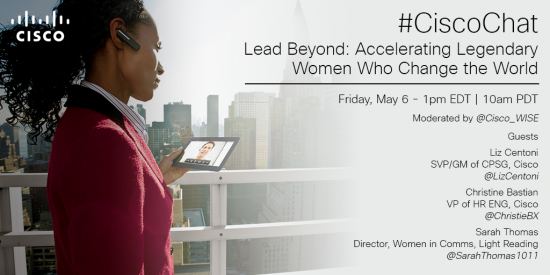
The theme of this year’s conference is “Lead Beyond – Accelerating Innovative Women Who Change the World.” It takes place May 23rd and 24th in San Jose, CA. Take a look at the agenda to see all the exciting activities we are hosting at conference.
With the theme of Lead Beyond, the IEEE Women in Engineering conference is designed to lead and inspire women to change the world. But it won’t happen overnight. The conference is just the beginning of a much larger process. And Cisco is committed to supporting that process every step of the way. At Cisco, innovation starts with culture—a culture of inclusion, regardless of who you are or where you are in your career. The people we are and the people we surround ourselves with define the culture we live in. It is a culture of inclusion that allows us to exploit our potential as individuals, as teams as innovators, as a company and as an industry. At #CiscoIEEE, we challenge you to embrace your power and #BeLegendary.
Join us on Friday May 6th, 2016 10am PST for a candid CiscoChat Cisco’s concerted effort to advance and attract women in technical and leadership roles in the technology industry. We will joined by our SVP/GM of Computing Systems Product Group Liz Centoni, VP of HR Engineering, Christine Bastian and Director of Women in Comms, Light Reading, Sarah Thomas. We want to have a candid conversation on Twitter and chat about the challenges and triumphs we come across in the workplace and how we make an impact by embracing our Power and demonstrating how we can all collectively #BeLegendary! With time, we hope to see more and more technical women in positions of leadership, redefining the tech industry and doing their part to change the world.
Follow the conversation on Twitter using the hashtags #CiscoChat #BeLegendary and find me moderating the chat @Cisco_Wise. Tweet us with your questions- we would love to hear from you!
I am pleased to share that Cisco’s Connected Streaming Analytics (CSA) is among the 15 leading vendors featured in Forrester’s recent survey on Big Data and Streaming Analytics. Forrester ranks Cisco as a strong performer in the market, noting Cisco as a solution with “sweet spots that differentiate the solution” from the rest of the market.
So what exactly is our sweet spot in the streaming analytics space?
Cisco’s approach to streaming analytics starts at the edge of the network, right where data is being created. Our Connected Streaming Analytics software, combined with our powerful ParStream software, helps our customers successfully capture, store and analyze the data enabling them to make real-time decisions. This has huge implications for industries that can use this information to anticipate issues, such as an oil and gas company detecting a safety issue at a well site or a financial firm detecting fraudulent activity.
Cisco is synonymous with networking so you may be surprised to hear we are in the data and analytics space. However, it makes sense when you think about it. For decades we have built our business around networking and devices. Now, with such a wide installation base of networking customers, Cisco can capture, connect and add value to data flows in a way no one else can.
My team’s recent fun event was on a cruise liner on the calm, blue waters of the Pacific Ocean hugging San Francisco. Besides soaking up the panoramic vistas and general bonhomie, I particularly enjoyed my conversation with the skipper. Our worlds were completely apart and yet I found the conversation to be completely relatable. Most specifically, I found so many parallels between his talk of navigating ships and the Agile transformation we are currently navigating at Cisco engineering.
Our engineering development process at Cisco is ever evolving. We are proud to be keeping with the times and overhauling some of our archaic processes, all while keeping the engines humming, producing software that runs several billion devices at thousands of customer premises.
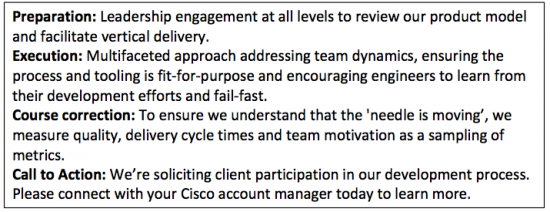
We had several imperatives to launch an agile transformation at Cisco engineering. Primarily, building deeper customer context and therefore smarter products through co-development with customers. We also wanted to improve the overall experience of engineers through the formation of self-governing teams. This allows for faster decision-making and speed. Overhauling our time-to-market and quality were also key factors. And finally, a quick dipstick competitive analysis, especially here in Silicon Valley, showed us that our smaller competitors were adopting agile and reaping benefits. We’re soliciting client participation in our development process through agile/co-dev. Please connect with your Cisco CE today to learn more.
Turning a big ship around, apparently, can take time and effort but exactly how much of it depends on the nature of the carrier. The skipper eloquently spoke of how a cruise ship, designed for luxury travelers, will take longer since it focuses on passenger comfort and doesn’t have the necessary infrastructure onboard to handle a quick volte-face. A battleship by contrast is built for exactly this sort of maneuvering. Essentially, turning an engineering organization on a warpath of waterfall development to an agile model requires nimbleness and skill without disrupting our customer’s lives.
The benefits of our agile transformation have been immense as demonstrated through software stacks like IOS XE and IOS XR built entirely using a customized agile development methodology. Customers get an early window to influence our product development and partner closer with the engineers writing the code. This further results in reduced deploy times and a drop in testing and certification processes. Besides our customers, the benefits for Cisco and the engineering teams are immense. Not just does this move to agile development keep us competitive, we also have better control on the development process and better quality products being built.
I am proud that this next wave of our agile journey will be one of the (if not THE) largest agile transformations, in the world of embedded software development, at this scale. What makes me prouder is that we acted like a battleship even while caring for the comfort of our customers like a cruise liner.
Do tell me about your agile development journeys in the comments section below and let’s swap notes on best practices.
The University of New South Wales (UNSW) in Australia has partnered with Cisco to connect campus and community through technology, fostering an environment of innovation.
UNSW Australia is an internationally renowned, research intensive and globally focused university. It employs over 6,000 staff, has more than 50,000 students and a turnover of $1.8B.
On campus, UNSW implemented Cisco wireless to provide high speed, high density and secure Wi-Fi for more than 55,000 users on 210,000 devices. With an improved digital network, they were able to use Cisco Mobile Experience (CMX) to better track student traffic on campus, gather data, and make more informed planning decisions to optimize the campus infrastructure and resources. Additionally, they enabled alternative learning methods, like flipped learning, due to their improved connectivity on campus.
The partnership with UNSW and Cisco provides exceptional opportunities to lead advancements in enhancing education, both on and off campus, and other technologies through collaborative development.
To showcase the partnership and to better understand the impact that digital transformation has on campus and community, we’ve interviewed Mark Hoffman, the Dean of Engineering at the University of New South Wales in Australia.
https://www.youtube.com/watch?v=ctPwwcBR1_E
Read on to see what he had to say about the digitization of education and UNSW’s Cisco partnership.
How have educational institutions become more dependent on technology to meet the needs of students and educators?
Mark Hoffman (MH): Learning at a university is an experience that truly reflects modern society today. Much of what students learn is not in a classroom, but from online solutions instead.
Students are passionate about learning, and technology makes that learning accessible anywhere, any time. Having the capability to reach students online also gives us the opportunity to educate so many more students than would be possible in a physical environment.
How has technology specifically impacted your campus?
(MH): Technology has had a massive effect on our campus, particularly over the last five to ten years. Now we find that large numbers of students learn by accessing the education material through the online offerings of our courses.
That means that they spend less time in a classroom, but more time actually learning.
How important is digital transformation to your university?
(MH): Digital transformation is key to future education. As a university, we want to have as much impact as possible, and educating future students around the world is a key goal.
To do that, we need to use digital solutions, because it’s not possible to physically put everybody who seeks the quality university education we provide into a lecture theatre in Sydney. We have to blend our learning and online solutions, and have the students on campus interacting with each other at the same time. This is really only possible through a digital transformation.
How has Cisco helped in achieving that vision of digital transformation?
(MH): Cisco has played a big part in the digital transformation at UNSW, which is still ongoing. Their networking solutions are a big part of the connectivity we have on campus to link our students to the learning options.
We also have an Innovation Hub together with Cisco, which is helping us drive technology solutions in Internet of Things uses and applications. UNSW is actually a microcosm of a city, and that means that Cisco is not only helping us with education, but most importantly, helping us develop technologies in education as well as applications for smart cities of the future.
Watch this video to learn more about how universities are leveraging digital technologies to transform higher education around the world, and visit cs.co/digitalcampusanz to see more.



 My mom says that being a mom is the hardest job you’ll ever have. But it’s also rewarding when you see your “baby” all grown up and making their way in the world.












 Turning a big ship around, apparently, can take time and effort but exactly how much of it depends on the nature of the carrier. The skipper eloquently spoke of how a cruise ship, designed for luxury travelers, will take longer since it focuses on passenger comfort and doesn’t have the necessary infrastructure onboard to handle a quick volte-face. A battleship by contrast is built for exactly this sort of maneuvering. Essentially, turning an engineering organization on a warpath of waterfall development to an agile model requires nimbleness and skill without disrupting our customer’s lives.
 I am proud that this next wave of our agile journey will be one of the (if not THE) largest agile transformations, in the world of embedded software development, at this scale. What makes me prouder is that we acted like a battleship even while caring for the comfort of our customers like a cruise liner.