Here at Cisco, we’ve always been proud to support our veterans. Whether it’s hosting a Veterans Career Transitioning Day or providing training and certifications to give veterans a step up in today’s competitive workforce, we have been lucky to be involved with so many wonderful programs over the years that give back to the men and women who have served our country. One of these great programs is the White House’s Joining Forces initiative.
First Lady Michelle Obama and Dr. Jill Biden launched the Joining Forces program in 2011 to raise awareness and rally around service members, veterans, and their families through wellness, education, and employment training and opportunities. Now in its fifth year, the program continues to serve transitioning military personnel across the country.
Back in 2013, Cisco and other major technology companies teamed up with Joining Forces to launch the IT Training and Certification Program for veterans. This program was designed to help vets prepare for and find jobs post-military by equipping them with valuable technology-related skills and certifications.
This Thursday, May 5, my colleague Michael Veysey and I will join other technology executives in the Rose Garden of the White House for an event on Joining Forces’ latest efforts aimed at supporting service members and their families. Michael and I will have the distinct pleasure of announcing the latest pledge made by Cisco to empower all those partaking in the program.
Through our partnership with Joining Forces, we seek to leverage the unique experience and qualifications that military personnel possess, and help them apply those skills to high demand cyber jobs in the U.S. With the training and certifications Joining Forces provides, these veterans and their families are on course to transform today’s workforce.
Rapid advances in digital technology and the demand for high quality customer experiences, has spurred XL Axiata to develop a network solution capable of supporting their business strategy effectively and efficiently. One of the new innovative technologies solution adopted by XL is Network Functions Virtualization (NFV).
As a leading provider of mobile services in Indonesia, XL has never stopped inserting the latest technical innovations into their network and continues applying them as they for transition of the Digital Telecommunications and all of its challenges.
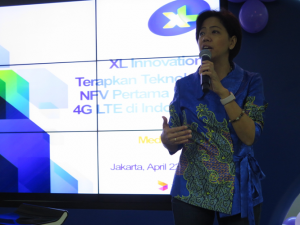
On April 22, XL Axiata hosted an industry press event discussing their strategy with Chief Officer Management Services XL, Yessie D. Yosetya, stating, “There are three things that can never be separated from the business in telecommunications and digital:
Competition with similar companies.
Customer demand for quality services which can meet their needs.
Rapid technological developments.”
Yessie D. Yosetya (second from left) – Chief Service Management Officer at PT XL Axiata, demoing Cisco NFV Solution to attendees.
Migration to 4G and New Services, NFV Leads the Way
4G LTE is a key element of the strategy XL to remain at the forefront in the provision of Mobile Internet Services to meet customer demand for high speed Internet service.
Yessie added, “NFV is one of the solutions for XL to be able to accelerate the implementation of new services in accordance with our business strategy. Using NFV as a ‘weapon’, XL is achieving the growth and development of the business more effectively and efficiently.”
The increasing use of 4G LTE and the growth of smartphones also encouraged the increased use of data services in Indonesia. By the end of the first quarter of 2016, the rate of penetration of smartphones in XL reached 48% of the total penetration. Users of smartphones in XL grew by 19% YoY and totaled 20.5 million users.
XL is one of the mobile industry innovators and must be doing something right. At the end of Q1 2016 their revenue for the first quarter grew by 2% YoY, while Mobile Data Service Revenues jumped 23% YoY on data traffic growth of 94% YoY.
The International Association of Chiefs of Police (IACP) and Cisco Community Policing Awards process is a great way to showcase a Policing agency’s positive efforts at building partnerships within their community. Cisco has partnered with the IACP to encourage policy agency leaders to apply to highlight the great work their agency is doing and to receive worldwide recognition.
Winners will be honored at the 2016 IACP Annual Conference and Exposition in San Diego, California. The winning agency from each category will receive one complimentary conference registration; transportation for one to and from the conference; and one hotel room for five nights while at the conference.
Awards are given by population category and recognize best practices in community policing. Special recognition is given for the use of the community policing philosophy in a homeland security initiative, as well as the best use of technology in a community policing effort.
New to the 2016 IACP and Cisco Community Policing Awards is an additional population category, University and College Police. While there is significant overlap with local, county, state, and federal policing, the unique needs of a university require a unique level of service, one that combines the culture of education with the trends of crime prevention and public order. The category of University and College Police has now been added for university and college police departments to apply.
The online entry process is straightforward, please visit the Community Policing Committee webpage to register and submit an award application. The deadline for submissions for the 2016 IACP and Cisco Systems Community Policing Awards is Sunday, June 12, 2016 at Midnight EST.
Today’s Guest Blog comes to us courtesy of David Alvarado, Regional Director of Service Delivery at Peak10.
Over the last 15 years, I’ve supported companies through over 700 disasters. One of the unforgiving truths of disaster recovery I’ve learned is that the success of your recovery depends upon how well you plan – and test – your disaster strategy.
Consider preparing for a disaster like getting ready for the Big Game. If you don’t know the rules, how can you play? If you haven’t practiced, how can you expect to succeed? Even though the season is only sixteen games, professional football players spend thousands of hours in preparation. They don’t just look at the playbook and assume everything is going to work out. They practice. They strategize. They test and improve. And the truth is that if they don’t do the work, it shows up on the field where they can’t afford to make mistakes.
Here are some of the important details people often miss when working out a disaster recovery strategy: We don’t need a plan. We have a turnkey solution: Many companies purchase a turnkey DRaaS solution and expect it to protect them. A turnkey solution is designed to do a good job for most situations. It does an excellent job simplifying getting your tier one applications up and running again. However, your business is unique, and it needs to be protected in a unique way. For example, your tier one applications might have dependencies with tier three databases. A working application is of little use when you can’t access the data you need. An effective plan needs to identify these interdependencies and recover accordingly.
Our entire business can be operational again in 24 hours: If this is the case, you’re probably spending much more on disaster recovery than you need. For example, your DevTest resources probably don’t need to be back up immediately. Disaster recovery is a process. Critical applications first, then tier two applications within 24 hours, tier three in 72 hours, and so on. Each tier can be handled differently, saving you money on your lower, less essential tiers.
We’ve got tier one covered: While lower tier applications don’t need to be up immediately, they do need to be part of your plan. Again, DevTest resources don’t need to be up immediately. If it’s been a week and they’re still down, however, you can’t make updates and this will begin to impact your operations and your customers.
We’ve had a comprehensive recovery plan in place for years: Some companies take a “one-and-done” approach to disaster recovery. They put a thoughtful plan in place, knowing they are protected, then forget about it. A robust disaster recovery plan is an evolving plan, one that adapts and changes as your infrastructure changes.
My assets in the cloud are safe: Many businesses assume, incorrectly, that their resources in the cloud have automatic disaster recovery protection. If you want your cloud assets protected, you have to implement disaster recovery yourself.
All of my data is protected, and that’s enough: If you lose your building, you’re going to lose a lot more than just your data. In fact, you might have to start back up from nothing. Does your plan include contingencies such as securing new computers for all of your employees?
We can replace whatever we lose: After a disaster, you have to move fast. But negotiating under pressure isn’t ideal. You’ll pay more when your vendors know you’re desperate. That why it makes sense to establish the relationships you need to help you get back up and running. You’ll always be able to negotiate better pricing and availability before a disaster strikes.
We have DR experts on staff to assure a smooth recovery: Sometimes you lose personnel in a disaster. And your disaster recovery plan is worth nothing if there’s no one left who can execute it. Your plan needs to be well-defined, something that a stranger could put in place. Because it might just be a stranger you have to count on.
Our operations will be up and running in no time at our backup site: Many recovery plans are great, up to Day 1. Then they begin to falter because they haven’t considered what long term recovery requires. For example, does your plan also include getting back up and running at your primary site? If you operate your business from your recovery infrastructure for too long, you may be forced to declare a second disaster, and that gets expensive.
We can restore our business exactly as it was: As disruptive as it is, disaster can be an opportunity. When you move from your recovery site, you don’t have to go back to your original infrastructure. If you’ve been thinking of migrating part or all of your operations to the cloud, this could be the right time. Peak10, for example, offers IaaS services so you can shift from your recovery site to the cloud as seamlessly as is possible.
Disaster recovery is about more than just technology. That’s why at Peak10 we work with our customers to help them successfully navigate disaster recovery. With our Cisco Powered Disaster Recovery as a Service (DRaaS), we’ll handle your immediate and 24-hour recovery concerns so you don’t have to. You can also rely on our experts to help you bridge the gap between technology and planning so you can have confidence that your disaster recovery strategy, should you ever need it, will be a success.
Learn more about how Peak10 can help protect your business with our Cisco Powered DRaaS. We also offer professional services to create a disaster recovery plan customized for your organization.
David R. Alvarado has been an industry leader for over 35 years leading worldwide organizations in Business Continuity/Disaster Recovery and Storage for Comdisco, StorageTek, and Computer Associates, and assisted in over 700 customer disaster recoveries including the Chicago Floods, Hurricane Andrew, San Francisco Earthquake, and 9/11. David has been a featured speaker at various conferences including Gartner, CA, StorageTek, Comdisco, BRPA, ITEC, and others, presenting on topics ranging from Business Continuity/Disaster Recovery Strategies and High Availability Solutions, to Compliance Regulations and IT.
There’s a first to everything. Being at Cisco for three and a half years now, I was asked to co-host my first #CiscoChat. Should be in line with first day on the job, first customer presentation, first Tweet, right? Having just came back from the CEB Technology in Financial Services Summit, witnessed some great speakers and soaked a lot of great thoughts and ideas on digital transformation and customer experience for financial services, I was ready to do this!
I was in front of my computer, ready, at 1pm EST. Two minutes into it, I realized I needed extremely faster fingers. Five minutes into it, the 140 character limit was continuously nipping at my patience!
The 2016 International Association of Court Administration (IACA) Regional Conference is being held at The Hague, The Netherlands, on May 18-20, 2016.
Cisco has been working closely with the IACA since 2010 to share how digital best practices can help transform the court system. As an example, Cisco has demonstrated how technologies such as the Cisco Connected Justice solution can increase efficiencies in judicial administration. Through this close collaboration Cisco is proud to serve as the Diamond sponsor for this year’s Regional Conference event at The Hague. Continue reading “Cisco Helps Promote Justice Administration”
Exploit kits have been a recurring threat that we’ve discussed here on this blog as a method of driving users to maliciousness. Users typically encounter exploit kit landing pages through compromised websites and malvertising. However, we’ve found a new email twist to the standard procedures associated with getting users into the exploit kit infection chain.
Usually when we see compromised websites serving exploit kit gates there are malicious iframes dropped on single pages or throughout the entire site. These iframes can either be links to an exploit kit landing page directly or to a gate. Using a gate allows the adversary to change the location of the landing page without having to change the compromised wordpress site. In the spam campaign that we detected and blocked, adversaries were instead linking users to “hidden” web pages (pages located within the site’s directory structure) on these sites instead of linking users to pages containing an iframe.
It’s Spring and that means the IT events season is in full bloom. The calendar at that time of the year is packed and we are looking forward to ONUG (Open Networking User Group) Spring 2016. The event will be at held at Intuit’s headquarter in Mountain View, CA from May 9-11, 2016.
It’s going to be a great event to learn and exchange the latest developments in open networking and open storage. While ONUG was created in 2012, and has steadily grown since then, I want to share its Mission statement as a quick reminder:
The ONUG Mission is to enable greater choice and options for IT business leaders by advocating for open interoperable hardware and software-defined infrastructure solutions that span across the entire IT stack, all in an effort to create business value.
This year’s Spring event agenda is packed again with topics on Software-defined networking, orchestration, network automation, Cloud, Hybrid Cloud, Containers and much more. It features exclusive keynotes and panels with IT executives from the largest enterprises and government agencies, financial and industry analysts, foremost academics, and more. For a full agenda overview, go here.
I want to highlight one topic that is to drive business value and Cisco will be focused on in particular, that of Linux Containers.
A few months ago, SDX Central – a Media partner of ONUG- released its “Inside the Linux Container Ecosystem Report”, and I encourage you to check out the online version. An overview of Cisco’s open source solutions is listed in chapter 7.
With Container solutions (and news) sprouting at a rapid pace while equally getting more and more mature delivering business value, I think Cisco’s Mike Cohen put it best when he recently wrote on ONUG’s Blog site that “few question that Linux containers signal a tectonic shift in how applications are built, deployed, and operated and their composition into microservices will likely become a best practice in application design”.
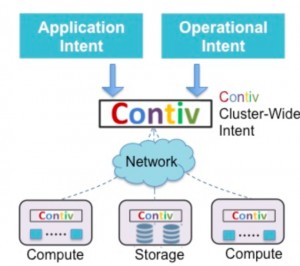
My colleague Harry Petty wrote in his recent blog: Bring Application Intent to Networking Containers about how Cisco’s Project Contiv compliments application intent to enable operational intent to specify infrastructure and policies for network, storage and compute.
Policy-Driven Networking for Containers
We will be talking a lot about Containers at this year’s event and both blogs are a great source to familiarize yourself with Cisco’s Project Contiv before heading to ONUG’s Acadamy next week. In case you still want to register for it – sign up for a 3 hour tutorial on May 9. To learn more about Cisco innovations in networking come join us:
Submitted by Elizabeth Coyne, Managing Editor of Light Reading and responsible for driving the curriculum and direction of Upskill U.
The Internet of Things universe is set to explode over the next few years. As such, service providers and industry players are jockeying for leadership spots in an all-IP ecosystem that promises ubiquitous connectivity for businesses and consumers.
That ecosystem goes beyond IoT devices to include applications, platforms, low-power, wide-area network (LPWA) connectivity services and standards, security, data and analytics and more – and raises more questions than it answers. While IDC forecasts the market to hit $7.1 trillion by 2020 and Gartner says 6.4 billion connected devices will be in use this year, haste may make waste when it comes to rushing into the IoT market due to serious concerns around security and network readiness.
To address the IoT challenges and provide some guidance, Light Reading and Cisco are tackling the topic in the next round of classes on Upskill U, a free online university aimed at upskilling and reskilling the communications industry on a variety of key topics essential to success in the virtualized, software-based future.
Our powerful IoT line-up includes a number of industry experts, including:
IoT 101 (Wednesday, May 4, 1:00 p.m. ET): This introductory course taught by Martin Zander, Vice President, Ericsson Group Function Strategy, covers all the important aspects of IoT, including what it is, why it’s important, how it’s affecting the industry, the challenges and benefits and more, and lays the groundwork for future courses on IoT.
IoT: Tackling the Security Challenge (Friday, May 6, 1:00 p.m. ET): During this course, Jason Porter, Vice President, Security Solutions, AT&T, looks at the various ways to ensure IoT security, including creating partnerships and ecosystems, digital signature and authentication, device management and prevention policies to build security in from the ground up.
IoT: Evolving Networks to Meet the Opportunity (Wednesday, May 11, 1:00 p.m. ET): In this lecture, Timothy Winters, University of New Hampshire InterOperability Laboratory (UNH-IOL), covers how operators’ networks will need to evolve in order to address this diverse IoT opportunity, and addresses key questions as to how accelerating NFV and SDN will enable IoT configuration agility and smart service flexibility for vertical industries, as well as challenges in the transition to virtualization.
IoT: The Impact of Industrial IoT (Friday, May 13, 1:00 p.m. ET): Jim Kilmer, Verizon Enterprise Solutions, will discuss how CIOs become the essential linchpin to ensuring secure connectivity and the management of data to provide the insights necessary for product and service development and delivery. This course will also cover how service providers can work most effectively as partners in this process to be vital players in this landscape.
With the latest debate around proprietary and/or open IoT LPWA that use unlicensed spectrum, you’ll want to register for all four courses to keep up with the quickly changing IoT landscape – and sign up for our next round of classes on cloud at the same time. I look forward to seeing you all on the Upskill U message boards.




 Rapid advances in digital technology and the demand for high quality customer experiences, has spurred XL Axiata to develop a network solution capable of supporting their business strategy effectively and efficiently. One of the new innovative technologies solution adopted by XL is Network Functions Virtualization (NFV).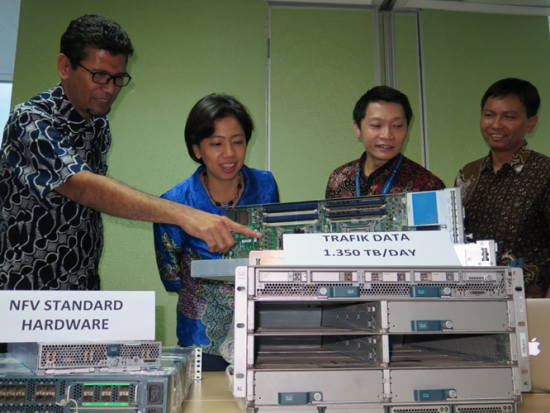








 The 2016 International Association of Court Administration (IACA) Regional Conference is being held at The Hague, The Netherlands, on May 18-20, 2016.