
Avatar

Tsunami Slams Japanese Coastline. Train Derailment Injures 100. Terrorists Attack Airport. We have all read these headlines too often. Sadly, disasters usually strike without notice and timely response by public agencies is critical.

As citizens, we depend upon public services agencies for our safety and protection. Effective communications is essential to cope in real time. Yet these agencies often struggle in emergencies due to the lack of seamless communications interoperability. A frequent problem is that when first-responders from different agencies or locales arrive at the scene of a disaster, their radios are incompatible because they use different frequencies or protocols. As a result, relief can be uncoordinated, help delayed, and even lives lost.

Digital Transformation Creates a New Way Forward

Various solutions have been explored to remedy the problem—mutual aid channels, gateways for bridging radios, and so on. While these can solve part of the problem, none provide a complete answer. And, none can provide an answer when a disaster results in destruction of radio infrastructure or when help is outside the accessible radio range.

Enter “radio over IP.” It overcomes these limitations and more. But its applicability goes well beyond the public domain; it is changing the way businesses think about their own response to disasters. Major disruptions can strike companies in unique ways that may not have the drama of a tsunami or a tornado—but can have serious consequences for the bottom line when their lines of communication fall short, disaster data is incomplete, or the facts are unclear. Fortunately, new solutions are now within reach that turn streaming data—including video—into analytic insights that change the user experience in real-time and let crisis workers take the most appropriate action in response.

Re-Framing the Problem: It’s Not Your Grandpa’s Radio

With connection to an IP network, radio communications can travel digitally. Public safety agencies can communicate and coordinate a response using any radio system in any location. But traditional radio communication is only part of the story. Use of IP networks also enables other types of voice traffic as well as video and data. This dramatically improves situational awareness. Different responders may have different needs—real-time video analysis, streaming data, and expert opinions as examples. Previously these sorts of communications, if they existed at all, had to be relayed through a dispatcher, creating errors and delays.

Interoperability is the new norm. For example, a push-to-talk (PTT) communication originates from a police officer at the accident site of a chemical truck roll-over requesting a check of a hazardous materials’ digital database for toxicity concerns, and then further expresses the need to locate a HAZMAT expert to remotely view a video feed from the accident scene and suggest how to protect those working at the site.

But why do we need push-to-talk communications at all? For many public agencies and private companies, PTT is a proven communications channel that is convenient, cost effective, and is often legally mandated. PTT remains the choice of many industries for fast, accurate, and coordinated communications where close teamwork is essential. Radio isn’t going to vanish. It is just finding a new way of moving over IP networks.

Business Disasters: Saving Lives. Saving Costs. Boosting Productivity.

Enterprises have similar challenges. A good example is the mining industry. Cave-ins often happen without warning in very remote locations. When mining disasters strike, aid is reactive. And when miners are trapped under a mountain of debris, minutes become precious as the mine owners search for a solution to save them.

Once the lives are saved, it may take months for the mine to be back in operation. The impact can be devastating, not only for the lives of the mine employees, but also the economic vitality of the company they depend on for their livelihood.

Cisco is working with mining companies to be better prepared when disaster strikes. We have developed a solution that provides them with a sophisticated, IP-based communications that can range from simple but vital PTT communications to transmission of streaming video feeds traveling from deep underground to remote rescue experts. It’s called Cisco Instant Connect.

Using Instant Connect, a mining operator can dial up all necessary parties on a PTT device, a ruggedized smartphone, or even place a normal phone call. He can immediately communicate with essential internal personnel or external resources through immediate and continuous communications.

Mining companies are connecting their sites via Wi-Fi and Cisco Premium Mobile Broadband (PMB) This evolution allows use of Cisco Jabber, Cisco Instant Connect, or similar collaboration tools, so a remote expert can be reached to examine the situation using a live video link. This saves valuable time and effort where skilled help can assist in mining operations without traveling to the site.

Think of PMB as “bring your own RF coverage.” It allows customers to put in temporary Long Term Evolution (LTE) “bubbles” where devices can connect and communicate. Now a mining company can install LTE coverage and optimize it based on their individual operational needs.

Instant Communications from the Factory Floor to the Front Office

Another example of how adopting a resilient, IP-based communications solution can contribute to dramatic productivity improvements in a manufacturing environment involves avoiding a major disaster, speeding response to a problem and optimizing business productivity. The manufacturer in this example assembles containers of blood plasma critical to emergency medicine. A shortage of blood plasma can have life or death consequences, so maintaining adequate market supply is essential.

One day there was a stoppage in the manufacturer’s plasma packaging line with no skilled personnel nearby to fix the problem. Fortunately the manufacturer had digitized their alerting software to connect directly over the Internet, as well as to the PTT radios. In turn, the alerting software was integrated with Cisco Instant Connect.

When the software detected the line stoppage, it was automatically communicated to management via both smart phones and two-way radios. Management was able to quickly identify the necessary expert to resolve the issue and dispatched him to the plant immediately. Good news/Bad news: He solved the problem but created another.

When repairing the equipment he accidentally tripped a building evacuation warning. Employee phones received immediate notification. Emergency personnel were instantly patched into the communications channels. By observing the plant using video transmitted through cameras located within the building and through instant communications with supervisors on-site, the emergency team determined that the evacuation alert was a false alarm. They communicated their decision to the onsite team via the Internet and to the PTT radios. Blood plasma production was resumed without further delay. The end-result was that essential supplies of blood plasma reached the market as scheduled and the manufacturer maintained the high levels of productivity that its business required to drive profitability.

Does your company have a disaster response plan with a digital communications strategy at its center? If not, this might be a good place to start your company’s digital transformation journey to avoid unnecessary business risk.


Authors

Mala Anand

No Longer with Cisco

Avatar

Most of us use video in personal and enterprise interactions, but how is video doing in contact centers? We are seeing growth in video as a channel within customer care world, both based on recent reports and deployments by Cisco customers. I think that’s good news.

Dimension Data’s 2016 global contact center benchmarking report shows that video as a contact center channel is growing.

video the new voice Ruch blog May 2016This is also the first year that Dimension Data have introduced branches and kiosks as a contact center channel that uses video in many use cases. This growth in video is showing not only on digital channels (web, mobile) but also in physical store and branch interactions as well. As per the report video as a channel grew close to 50% from 2015 to 2016.

Some recent examples of digitization of physical outlets include:

  • NationwideNow: Enables the close of mortgage sales in branch offices by providing access mortgage loan advisors via video
  • SBI Intouch: Delivers exciting new customer interaction experiences in the branch, including virtual advisors

video the new voice Ruch blog May 2016 Image bLikewise, although online video chat has been available for a few years, it’s only in about the last two years that we are seeing mainstream adoption cases. Today organizations are looking to scale their deployments from pilot projects to general availability.

In the past, most organizations considered video as a niche offering for contact centers. Many worried about the operational constraints of video (agent uniforms, office backdrops, special training, etc.) in addition to technical considerations. This is all changing now with the pivot of the contact center from a cost center to a profit center. Breaking silos in organizations–video the new voice Ruch blog May 2016 Image cresulting in partnerships between contact center and other business groups–enables adoption of new capabilities that can drive business outcomes.

Trends enabling video growth in customer-to-business interactions fall into two categories: technological or business transformation. Some of the technological trends that we are witnessing today include:

  • Broader adoption of WebRTC
  • Next-generation video endpoints
  • Availability of 4G
  • Advances in video-adaptive techniques
  • Technology quality improvements

On the business side, the trends are as follows:

  • The need for differentiation
  • Tracking new KPIs such as Net Promoter Score (NPS) and Customer Effort Score
  • The shift in budget control between IT and other Business groups

Video in Contact Centers
Examples of use cases where contact centers are using video – and where we expect video will increase – include:

  • High-value transactions: wealth management, mortgage sales, etc.
  • Expertise-based interactions: education, telehealth, legal proceedings
  • “See what I see:” agents and customers share visual information instead of talking heads
  • Collaborative interactions: co-browse, form-fill, annotation, etc.

Video is the best way to have a great customer interaction that helps to build trust, gain context, and increase opportunity for upsell and cross sell. At the end of the day, not every interaction will use video. But there are use cases across verticals where it can be beneficial, including financial services, healthcare, government services, education, and manufacturing.

To accelerate the growth further, we need to continue to work together to remove any roadblocks, technological or business. The other focus is to drive great user experience and ease of use.

I look forward to feedback/comments and hearing about your experiences on this topic. Learn more about what Cisco has to offer with Cisco Remote Expert Mobile.

Authors

Ruchi Gupta

Senior Product Manager

Cisco Customer Collaboration

Avatar

New cloud-based video experiences like cloud digital video recorder, TV everywhere, and streaming video-on-demand sound great on paper. But will subscribers actually pay for them?

The answer is a resounding yes – to the tune of nearly an $11 increase in monthly revenues per user globally (and almost a $34 increase in North America!), according to Cisco research.

But where do those revenues come from?

friday blog

Boosting subscriber loyalty

Let’s start with what we know: consumers are willing to pay for streaming video subscriptions, and hundreds of millions already do. Many of your subscribers are already paying for a streaming video-on-demand (SVoD) service like Netflix or Hulu on top of their monthly pay TV bill.

Currently those services work largely in isolation from one another. To find what they want to watch, viewers may have to switch between two, three, or more apps and across multiple devices.

Pay TV providers can make these experiences much simpler. Only they can create a truly seamless, universal user interface (UI) that combines all services – live TV, video-on-demand and streaming online video – across multiple subscriber devices. And when delivering these experiences through the cloud, for a start, they could take the lead from over-the-top (OTT) video services by creating more dynamic and engaging UIs. They can make it easy to find content no matter where it resides. They can also use sophisticated profiling to make recommendations based on viewers’ past preferences and behavior.

For pay TV providers, such measures can have an immediate impact on revenue in the form of reduced churn – up to 35 per cent of that projected increase in average monthly revenue per user (ARPU). This makes sense: when you give subscribers more of the content they want, with more personalization and convenience, they’re far more likely to remain loyal. Comcast is a perfect example, seeing a 20 per cent reduction in voluntary churn among customers using its X1 cloud-based platform within two years of launch.

Giving customers more content

Much of the remaining revenue uplift comes from the new increments enabled by cloud-based video services. By introducing universal search and personalized recommendations, as well as bringing services to new devices, pay TV providers empower subscribers to consume more content – and they’re doing just that. The result is increased consumption of video on demand, which in turn means increased advertising revenues as well as electronic sell-through (EST) of on-demand rentals and purchases [see Figure 1].

Figure 1. Cisco MOI Projected Global ARPU Uplift for Cloud Video Services, Year 1

graph for friday blog

Finally, pay TV providers can realize a major monthly revenue uplift ($4.08 globally or $15.67 in North America within five years) through cloud digital video recorder (DVR). Most providers already offer DVR through a set-top box, but delivering it through the cloud offers two key benefits.

Firstly, subscribers will be able to ‘try and buy’ DVR services – something that’s not possible when recording, storage, and playback are tied to an expensive set-top box. With DVR functions handled in the cloud, ‘try and buy’ becomes available to anyone. Operators who roll these services out are expected to see as much as 50 per cent higher DVR penetration as a result.

Secondly, subscribers who are already DVR customers can purchase additional cloud storage to keep more content for longer. This is one of the biggest requests from current DVR users, as any parent obliged to keep hours of recorded cartoons will understand.

Pay TV providers using the cloud are expanding their base of new customers, up-selling existing customers, reducing customer churn, and generating new incremental revenues from storage, EST, and advertising. Add it all up, and that figure of $11 starts to sound downright conservative!

Find out more

Want to forecast what cloud video can do for your business? Use our Monetization and Optimization Index tool to input your specific market parameters and video strategy, and create your own customized model.

For more information about the Cisco video solution, visit: http://www.cisco.com/c/en/us/solutions/service-provider/cloud-dvr/index.html.

Authors

Ben Bekele

Director Prouduct Management

Avatar

Three-and-a-half years ago, an informal brainstorming session among a few of us started a broader discussion on how we should co-innovate with the startup ecosystem, which eventually led to the creation of a new corporate venturing program for startups and scaleups – Cisco Entrepreneurs in Residence (Cisco EIR) – built on Cisco’s foundation of innovation and market opportunity.  Since then, Cisco EIR has transformed the way we discover, co-create and scale disruptive technologies that are impacting our industry and customers worldwide.

Cisco EIR, at its core, solves the three fundamental challenges – the “ABC” – of startup-corporate partnerships: Agility, Business Model and Continuity.  Our hyper-efficient platform to engage startups and scaleups ensures Cisco Business Units (BUs) and our Cisco EIR companies move at the same “startup speed.”  We ensure a mutually beneficial, win-win business model – and we also ensure there is long-term continuity in our partnerships by investing in BU-level relationships rather than relationships based on particular individuals.

We have had a tremendous success since our journey began three Cisco EIR seasons ago.  We have partnered with 27 companies to date, and over 80% of them are actively engaged in strategic initiatives with Cisco today.  We have seen two Cisco acquisitions so far – ParStream, an IoT edge-computing company from Germany, and Pawaa, a file encryption company from India.  Our companies have collectively raised over $50M in funding from VCs and non-Cisco strategic investors since they joined Cisco EIR.  All in all, significant momentum.

On May 10, our Season 3 cohort of startups in Silicon Valley showcased their technologies, market traction and co-creation engagements with Cisco at our latest Demo Day – hosted by our friends at Fenwick & West.  And, to be honest, I don’t know who was more excited, our companies or our Cisco EIR team.

At the Demo Day, Simularity, LISNR, Zoomdata, Tagnos and C3DNA presented to an audience of investors, analysts and Cisco executives.  An expert panel – jointly led by Subu Subramanian (Cisco VP), Mark Leahy (Partner at Fenwick & West), Matt Bigge (Venture Partner at Crosslink Capital) and Christian Renaud (Research Director of IoT at 451 Research) – provided invaluable feedback and commentary throughout the presentations by our companies.  I felt excited and inspired by the richness of the discussion we had and the breadth of participants from our ecosystem.  I am more convinced than ever we have built something special – something which truly benefits the broader innovation ecosystem Cisco is a part of.

Our partnerships with the five companies will continue well beyond the six-month season they have just completed.  I hope to see all of them engaging more strategically with Cisco and creating more value for our shared customers six months from now.

Cisco EIR Demo Day_May 2016Our Newest Incoming Startups/Scaleups in Silicon Valley

Another highlight of the Demo Day was the addition of three new companies joining our program in Silicon Valley.  I believe each of the companies represents a combination of high-caliber talent, strong business execution and a unique value proposition.  I am thrilled to welcome them into Cisco EIR:

Nervana  – Nervana provides a fast, scalable and easy-to-use cloud platform for deep learning built on top of state-of-the-art open source libraries. The company’s brain-inspired deep learning solution has applications in healthcare, agriculture, finance, energy, online services, the automotive industry and more.

Redox – Redox helps health systems manage their connections to cloud-based electronic heath record (EHR) platforms. The company’s API provides a two-way bridge enabling health systems to work with the largest ecosystem of integrated healthcare applications.

Unravel – Unravel provides Big Data Operation Intelligence through a full-stack performance intelligence platform that monitors and optimizes Big Data operations. The company’s platform goes beyond mere usage monitoring with intelligent alerts and automatic resolutions.

Announcing Cisco EIR London

While we continue to build on a track record of success in Silicon Valley, we know we cannot always assume all of the disruptive technologies will come from the region.  Quite the contrary.  Innovation ecosystems outside Silicon Valley are incubating a whole new generation of startups/scaleups with a unique regional and/or technology focus.  One such ecosystem is London and the UK, which has led the region’s startup innovation, investment and exits in recent years with unique strengths in fintech, AI/deep learning and blockchain technologies.  That’s why I am so excited to announce London as our next “regional hub” of Cisco EIR.

I am pleased to welcome three startups/scaleups to our inaugural Cisco EIR London cohort:

Guardtime – Guardtime’s technology takes a blockchain approach to cyber security that ensures the integrity of systems, networks and data at industrial scale.

TaDaweb – TaDaweb is the first “small data” platform designed to clone and amplify human intelligence for Web data. The company’s Web data intelligence platform currently empowers law enforcement, national security and defense customers to detect, locate, track and help combat criminal activity.

Warwick Analytics – Warwick Analytics provides predictive analytics for preventative and predictive maintenance for industrial applications. The company’s platform enhances the ability of businesses to deploy predictive analytics quickly and cost-effectively without the help of data scientists.

From our perspective, there has never been a better time to partner with today’s best and brightest early-stage entrepreneurs for the solutions of tomorrow. All of our new Cisco EIR companies are at the cutting edge of IoE/IoT, AI/deep learning, cloud, security and other areas strategic to Cisco’s future. I cannot wait to see the truly disruptive solutions these six new additions to our program will bring to Cisco and our customers worldwide.

Authors

Tom Yoritaka

Global Managing Director

Cisco Entrepreneurs in Residence

Avatar

Whether you missed something this week or want a sneak peek at what’s to come, we’ve got you covered. This week we’re talking about:

  • Ten amazing women – who are they and what makes them so amazing?
  • Digital transformation (we’re ALWAYS talking about digital transformation)
  • Putting your sales into overdrive with software
  • Making our brand campaign work for you


You’ll only see this here

What do these 10 women have in common?

These ten women have something in common.

They are all part of CRNs Most Powerful Women of the Channel. These accomplished women are:


Give Wendy, Marcy, Michelle, Heather, Connie, Sandra, Julie, Kristyn, Renee, and Donna (Donna, we can’t find you on twitter!),  a shout out and congrats on Twitter.


Digital Transformation: Make More Money with Software

This week Jason Gallo, Director of Sales, asked, “as [digital transformation] accelerates are you able to keep up…and take advantage?” in his blog. Then he revealed the three ways our partners can make money with Cisco Software. (hint: it relates to what Sandra Flinders talked about last week in her blog.)

Oren Singer, Sr Manager, also joined the software and digital transformation conversation in his blog. Find out how we all can stop overthinking products, solution or licenses with Cisco One. All while enjoying some coffee. (Oren, what’s your coffee of choice? Philz?)

In the news:

Fast forward:

  • Grace Lo, Director of Business Development shares ways to accelerate your growth and profitability (sneak peek: it’s all about the role you play)


Making our brand campaign work for you

In his latest blog, Rick Snyder, SVP, Americas Partner Organization, elaborates on how our new brand campaign drives engagement, enablement and evolution. (hint: the future is digital, the time is now; keep the conversation going with Rick).

Fast Forward:

  • Wendy Bahr, SVP, Worldwide Partner Organization, will talk about how our new brand campaign ties into simplicity, alignment, and value exchange (sneak peek: Wendy fills in the blank “For the first time ever our partners can ___”.


What’s next?

The partner weekly rewind and fast forward is designed to give you a snapshot of what you missed and what’s to come. Tell us what you think and what you want to hear about in the comments. And come back next week for more!


Authors

Jill Shaul

No Longer With Cisco

Avatar

This week I had the opportunity to participate in the 11th International Association for Court Administration (IACA) conference.  This conference has been another valuable best practices sharing event with 83 speakers from 53 countries sharing regional and global best practices for justice in the courts and with digital technologies.

There has never been a better time to share best practices for international justice #NeverBetter #IACA2016

countries

Continue reading “11th International Conference for Courts Best Practices”

Authors

Kacey Carpenter

Senior Manager

Global Government and Public Sector Marketing

Avatar

Better TogetherPeople say that opposites attract, but big differences in economic or social background, education, and personality can sometimes lead to misunderstanding, conflict—and a weekly appointment with a marriage counselor! The same can be true when unevenly matched companies—such as a large enterprise and a startup—try to collaborate on an innovation initiative. Differences in size, culture, expectations, and behavior often get in the way of a truly collaborative and productive partnership—and create problems that no therapist could fix!

Despite these challenges, however, co-innovating between startups and large enterprises can be good for both parties, if you approach it right.

Let’s look at some of the advantages from a large vendor perspective. First, by working with a nimble startup, vendors can often fill in a missing piece for their solution—and deliver it to customers—faster than they would be able to do it on their own. Additionally, many large vendors such as Cisco focus on providing broad platforms, or developing common horizontal modulesAM29373-cropped that can be used to deliver vertical solutions. They often rely on channel partners, application developers, integrators and yes, startups, to develop these solutions for specific markets. And finally, startups can differentiate a large vendor’s offerings, providing specialized capabilities that help make the sale to customers that might otherwise go with a niche player.

From the startup perspective, co-innovating with an industry giant can be scary, but if done right, it can boost the startup’s credibility and help propel it into the market. When startups co-innovate with large vendors, they gain access to customers and channel partners where they might not get in the door on their own. As Brian McGlynn, COO and co-founder of IoT startup Davra Networks, said recently, “When you partner with someone like Cisco and are validated in their ecosystem, you have a stronger play.” If the startup is co-innovating directly with a large customer, they develop a targeted product that they can then sell to other customers, using the original customer as an important reference account.

AS85271-croppedCo-innovation between a startup and an enterprise works best when each party fills a gap in the other’s capabilities, and when they share equitably in both the work and the rewards. In recent conversations, leaders of two startups that have worked with Cisco and other enterprises shared some of the factors that have contributed to their win-win co-innovation experiences.


Josef Brunner is CEO of relayr, an IoT startup that won Cisco’s IoT Innovation Grand Challenge two years ago. He pointed out that it’s important to be guided by your overall strategy when evaluating co-innovation opportunities. “Sometimes it’s hard to say no to a big company,” he said. “Founders and CEOs want to take the opportunity to partner with an industry leader, but you have to make sure it’s the right thing to do strategically. Otherwise, it’s easy to lose your identity.” Another guiding principle for relayr has been to always keep the focus on the customer. “Don’t fall in love with the technology. Co-innovation should be about helping the customer be commercially successful. The most important thing is to keep the customer at the very center of what we do, understand their challenges and always think of the business case.”

Davra’s Brian McGlynn pointed out the importance of good governance in a successful co-innovation project. “You can bring in partners by having the right architecture, but you need the right governance to make it work,” he said. It is important to have explicit agreements around who owns what, who decides what, how prices are set, and how revenue is shared. “With the right governance environment, both sides can make money.”

Of course, there are also some things to beware of, for both the startup and the enterprise. Having participated in many co-innovation projects between large companies and startups, here are a few lessons I have learned:

  • Startups should be careful not to be drawn into custom development that doesn’t result in a scalable solution that brings in revenue
  • Startups should ask, is it real—or is it a science project? If you are working with a large customer, make sure you are working with their production team, rather than an advanced research group. If you’re working with a large vendor, avoid projects that are focused on thought leadership or “innovation as a sales tool.”
  • Make allowances for a possible culture clash—the enterprise may not be able to move as quickly as the startup is used to, and the startup may not have all the formal processes in place that the enterprise looks for.
  • Enterprises should think about how to scale the joint solution if the startup doesn’t have a global presence to support it.
  • When enterprises bring a new startup solution to their customers, they take ownership of the success and reliability of the solution, so choose a startup partner with a good chance of stability and longevity.
  • Both partners should have a commitment to the long-term roadmap of the solution and their partnership, not just short-term revenues.
  • Start small and build on incremental successes. As Josef Brunner said, “A lot of companies want to boil the ocean in one day, and that’s very challenging. We take an approach of, ‘crawl before you walk, walk before you run.’ Have achievable milestones, fail fast, quickly correct things that are going in the wrong direction, and move on.”

So, do opposites attract? Yes, they’re often better together. The differences that cause potential conflict can be the very things that make for a strong relationship – complementing each other’s strengths, filling gaps in one another’s capabilities, bringing new perspectives, and sparking creativity. By approaching a co-innovation project with shared goals, good communication, and clearly defined expectations, you’ll have a good shot at mutual success. And you can skip the weekly trip to the marriage counselor!

Authors

Maciej Kranz

Vice President and General Manager

Corporate Strategic Innovation Group

Avatar

Cisco has been actively participating in open source and open standards for a long time and is now also a founding member of the Open IT Framework at the most recently held Open Networking User Group (ONUG) earlier this month. As I wrote in my blog prior to the event our focus was going to be on Containers. And we are certainly pleased to announce the acknowlegement that Cisco’s Distinguished Engineer Vipin Jain (on left in picture above) received as the winner of the “Grand Challenge Hackathon”with his contribution with Project Contiv.

According to ONUG, the goal of the hackathon was to help move the industry forward “toward open, programmable, automated computer networks.” Vipin’s contribution through Project Contiv that is designed to define infrastructure operational policies for container-based applications definitely meets this goal and then some.  For a closer look at his code, you can visit the ONUG GitHub page.

Cisco introduced Contiv publicly less than a year ago but it is one of many open source projects that Cisco is sponsoring. For an overview on all the open source projects that Cisco is actively involved in, please visit http://opensource.cisco.com

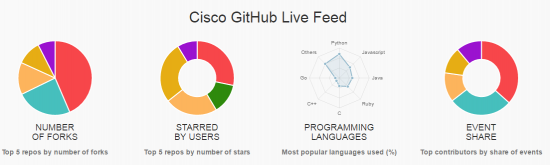
OpenSource GitHub Live Feed

The attention Contiv is drawing is understandable, given that containers and the migration to microservice application architectures remain among the hottest enterprise trends in recent years. Contiv is aiming to solve the difficult task of scaling these technologies in mainstream enteprises by tackling both the operational and architectural aspects. For additional insights and use cases for Contiv  I encourage you to read Vipin’s  and Cisco’s Balaji Sivasubramanian recent interview with SDX central or check out the demo from Tech Field Day Extra at ONUG Spring.

Over the next coming weeks join Cisco experts in upcoming events focused on containers and application microservices.

For example, on June 20 at Dockercon16 in Seattle, Balaji Sivasubramanian, director of product management for Cisco Cloud Native Solutions, will discuss the requirements for building production-grade container apps.

That same week, on June 22 at Velocity in Santa Clara, Mike Dvorkin, founder of the Noiro Project, will be delivering a keynote address on the principles and benefits of controlled consumption model for application microservices, and its implications on devops processes and security.

Cisco will have staffers and subject matter experts on-hand at both events with all relevant topics being up for discussion. This includes all the great contributions Cisco has and will continue to make to the open source communities. We look forward to meeting you there.

For a complete list of the upcoming events that Cisco is taking part in around the world, please visit our global events calendar.

Authors

Klaus Schwegler

No Longer with Cisco

Avatar

Earlier this week, we begun talking about digital inequality as it relates to connectivity, and how communities can begin to address and solve this societal issue. Today, I want to talk at large about the importance of providing technology to all students to aid in the learning process.

As schools start to move towards new models of learning and teaching, we’re seeing an inequitable division forming as a result of some students not having access to personal devices, extended learning resources or the Internet. This lack of accessibility has great consequences not only on the students’ ability to acquire knowledge, but also for the affect on continued education and workforce experience.

Learning is more than just the acquisition of knowledge. It’s about the process of discernment, and the application and the synthesis of the material. For students to be able to personalize and be in control their learning, they need to have equitable access to the resources that technology provides.

(DGLimages)Shutterstock
Photo via DGLimages on Shutterstock

Technology must be inherent, even before a child enters school. In the past, a student’s readiness for kindergarten was based on whether he/she had any knowledge of the alphabet, or knew how to properly hold a book. Today, children are judged based on whether they know how to hold a device, search on a device or use a device for learning.

The importance of technology continues through high school, college and into the workforce. If students don’t have equitable access to technology, it comes to the surface as they move along the education continuum. Technology defines their success in research capabilities, in solving real world problems, and in making career choices. Technology is the enabler and the tool in which we can demonstrate, think and move our society forward.

It’s vital that we address the use of technology in education and work to make it equitable and accessible for all students. School districts and communities must commit to making technology readily available, and seamlessly integrate it into all aspects of learning and teaching.

As a technology company, we have the tools in place to drive necessary change. We are looking to address this issue and working to resolve it in school districts and communities around the world.

E-rate modernization has also been a positive step forward in helping to determine what is feasible to address digital inequality.

As we provide equitable technology and connectivity for all students, we can begin to bridge the digital inequality gap and allow students to drive their own education and learning.

Authors

Mary Schlegelmilch

Business Development Manager

Education