Avatar

Guest blogger: AnnMarie Link, Global Strategic Partner Marketing Manager, Cisco amlink headshot

When you think about the future of IoT, can you visualize the impact it will have on the world around us? Picture a world where everything is connected, with data from everywhere organized, analyzed, and acted upon within a fraction of a second.

But what really does that mean for you and me?

Imagine a scenario where audio sensors detect noise and trigger a notification on a city official’s computer monitor.

The sensors work together with other Internet of Things devices to triangulate the exact location of an incident.  A few mouse clicks later the city official can see that a traffic accident has occurred on a three-dimensional map of the city. A system quickly assesses all available surveillance cameras, analyzing line of sight for each, and pulls up the best visual vantage point automatically.

Armed with a real-time visual understanding of the situation at hand, the city official can make smarter decisions on how to get first responders on the scene quickly, and get ahead of complications such as traffic jams or power outages.

Or, imagine flow sensors on large-scale asset networks such as oil or gas pipelines.  When an issue arises, workers are notified of the exact location of the problem, the moment it happens. Video feeds and additional environmental information will help technicians anticipate any safety risks and put environmental mitigation efforts in motion before arriving at the site.

Those are just a few examples of how data from a wide variety of sources can help people and organizations become more efficient. Enabling analytics that understand the spatial relationships between Internet of Things devices is the Future of Smart — that just happens to be this year’s tagline at the Esri User Conference.

Security camera monitoring events in shopping center at night.


The Cisco and Esri partnership has already enabled ArcGIS Pro in a virtualized environment so that ArcGIS Pro can be deployed for a greater user experience. Virtualization helps to eliminate server sprawl, enable efficient use of server resources, and improve server availability.  It also enables data assets to be centrally maintained for security. IDC has found that more IT organizations are seeking the benefits of desktop virtualization. To learn more about their findings, check out this IDC White Paper, Assessing the Business Value of Cisco’s Desktop and Application Virtualization Solution.

Cisco has and will continue to partner with Esri to explore real-time visualization possibilities for the Internet of Things. With the amount of data being captured and aggregated by the Cisco Digital Platform (CDP), it’s a massive opportunity, and not just for cities. Virtually any field can benefit.

Do you want to hear more?

Join Cisco and Esri at the 2016 Esri User Conference, June 27 through July 1, located in San Diego, to see how we are working to bring real-time visualization and spatial analytics to the Internet of Things.

You’ll find us (and plenty of comfy couches) in the Startup Zone, where you can also grab a quick pic with our Cisco Photo Wall. Snap a selfie, share on social media, and a selfie stick is yours to keep!

Truly, there has Never Been a Time to align with the busy, challenging, changing needs of business, no matter where you are or what you do. Cisco is solving real business problems. Check out another example

https://www.youtube.com/watch?v=8Cv63G38etk

Feel free to connect with me on Twitter and leave any comments below. Let’s continue the conversation!

Authors

Francoise Rees

Marketing Manager

Customer Solution Marketing, Cisco Intersight

Avatar

New challenges lead to the greatest rewards.

That’s why, when I left a comfy job I had for many years, it wasn’t easy, but I jumped at the opportunity. Because working at Cisco has been a goal for me.

The first week at any new job is an adventure (I’m a Territory Business Manager for Northeast Territory Operations.) I knew my first week at Cisco I was going to be hectic, but I loved every minute of it. It was packed full! Lots of people may wonder – what’s your first week at Cisco like, really?

It was full of introductions to great new people, full of checklists and full of information.

On day one, I sat in my first team meeting pinching myself! I had this goal and it was finally my reality!

#IChoseCisco, and there are many reasons why. But the number one reason was the people. Even before becoming a Cisco employee I worked alongside the Cisco community for several years. Everyone is passionate, helpful, inquisitive, motivating and very gracious.

These people have inspired me not only to achieve my goals and dreams but to help those around me achieve theirs. Surrounding yourself with positive and encouraging people is the key ingredient into creating a life that you love.

While I am still “drinking from the fire hose” I am excited to learn more, grow more and help Cisco add value to our customers and partner community!

Want to experience YOUR first week at Cisco? Check here for openings.

Authors

Jen Palloni

Territory Business Manager

Northeast Territory Operations

Avatar

For years the Center for Interactive Learning and Collaboration (CILC) has been the go-to resource for teachers around the world to find ways to virtually connect their students to experts, peers and experiences anywhere, at any time.

The CILC houses a repository of 2,000+ virtual programs, backed by national standards, and posted by 170+ cultural organizations. Through their site, virtual “field trips” are conducted over web-based videoconferencing, experts can virtually present live, interactive lessons, and students can interact with experts to get real-world perspective on their studies.

Today, in the midst the nation’s leading IT education conference, ISTE, we announce a new partnership with the Center for Interactive Learning and Collaboration.

Together with CILC we’ve created the Professional Learning Network (PLN) where educators can connect with an online learning community.

Screen Shot 2016-06-21 at 10.41.50 AM

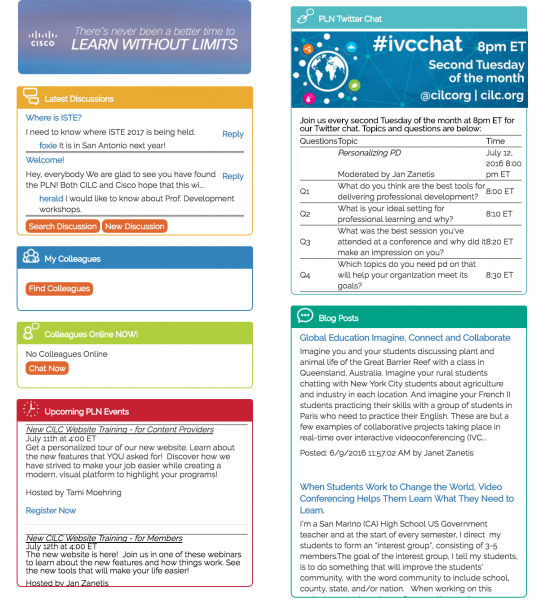
The Professional Learning Network will allow CILC’s 50,000+ members to find colleagues, join discussions and conversations and grow their professional network.

Joining the Professional Learning Network is simple and fast! Head to the PLN dashboard, select “Join Now” and get started on the network.

Screen Shot 2016-06-21 at 10.44.59 AM

Once you’ve joined the Professional Learning Network you can view and participate in the latest discussions, get social with monthly Twitter chats and attend networking events.

So, what are you waiting for? Go to http://www.cilc.org/PDdashboard to join the Professional Learning Network today.

If you’ll be at ISTE, stop by booth #1035 (CILC) or booth #2537 (Cisco) to learn more about the network.

Authors

Mary Schlegelmilch

Business Development Manager

Education

Avatar

ggilboaWritten by Gidi Gilboa, Director of Marketing, SPVSS, Cisco

When it comes to technology innovation, some may think that Israel punches above its weight. And they would be right. Known globally as the Startup Nation, Israel produces more early stage investment opportunities than Silicon Valley.

Enter Cisco.

1

With one thousand employees located in Jerusalem alone, Israel has become one of Cisco’s largest engineering hubs outside of the US. It is leading innovation and technological leadership in all of Cisco’s strategic areas…Internet of Things (IoT), Cloud, Cyber Security, Digitization of Countries and more.

This Sunday, June 26th Cisco’s Jerusalem office will offer visitors a small taste of that innovation when it hosts the “TV – The Future Starts Now” event. At the event, we’ll be showcasing a new range of cloud-based video solutions that are dramatically changing the way we deliver, and experience, TV.

With 11 billion video devices out there and 177 million OTT streaming subscriptions, it’s hardly surprising that, 80% of all IP traffic is for video (Cisco Visual Networking Index)

While this makes it more challenging than ever to compete for viewer eyeballs, it also brings new opportunities for service providers and media companies.

At our “TV – The Future Starts Now” event, Continue reading “TV – The Future Starts Now, In Jerusalem”

Authors

Yaron Agami

Senior Manager

SP Product Marketing, Cable and Satellite Segments

Avatar

Service is the key differentiator for hospitality – service that is driven by your guests’ needs. This is made possible by today’s ability to digitize information across the network, which is changing how the industry does business. But it also means going well beyond providing basic Wi-Fi service. Digitization and the Internet of Things allow you to offer an entirely new range of services to help turn your venue into a destination.

On June 28, please spare an hour to join Cisco’s Hospitality and Mobility leaders as they present a free webcast designed to help you learn how to make digitization a reality for your hotel, resort, cruise line, or conference center. The session is being held at 10:00 a.m. PT/1:00 p.m. ET, and will focus on how to address today’s technology challenges and meet business priorities.

The webcast panelists will present research highlights and the latest technology trends from the recent HITEC conference in New Orleans (I hope you had as much fun at this event as I did). You will also hear real-world use cases that demonstrate how your peers are using Wi-Fi and mobility to deliver superior service and generate added profits, including mobile check-in/check-out services; delivering custom offers and amenities via device; connecting staff and guests; how analytics let you examine usage and traffic patterns to provide better service and new revenue opportunities; and much more. See our Mobility blog for further details.

Register today for this in-depth webinar, and please check out Cisco’s Mobility in Hospitality website as well as our Cisco Hospitality website. I’ll see you there!

Follow me @suzytreece and Cisco Hospitality @CiscoTravel. Also, please join us on LinkedIn.

Authors

Suzy Treece

Practice Advisor

Retail & Hospitality

Avatar

I live in the Hill Country outside Austin where one of our local storytellers, Shake Russell, wroteSaint Willie a song for the Texas sesquicentennial in which he proclaims, “Cotton is King.” He subsequently amends it to say, “Cattle is King,” followed by “Oil is King,” before finally settling on “Willie is King.”

I cannot dispute his nod to Saint Willie, but I feel safe updating Shake’s econ lesson to point out that in 2016, even out here in the boonies, Cloud is King

Case in point: My neighbor, who spends more time on a tractor than a smartphone, is using sensors to track body temperatures of his prized Longhorns via the Cloud as they roam across his 100+ acres. He’s not an early adopter or some tech guru; he has never even heard of IoT. He just likes the sensors “because thSurprised Cowey
attach to the cows’ ears” – a huge improvement over the old way of taking their temperature.

I’m certain the cows prefer it as well.

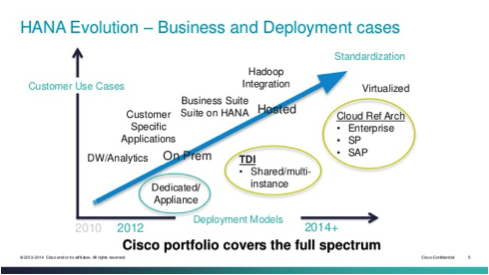
I bring this up because of some interesting data we gathered at SAP Sapphire about just how mainstream Cloud adoption has become. We surveyed over 400 attendees about how they planned to deploy their next SAP HANA project. 68 said on appliances, 85 said via TDI, and a whopping 257 – over 60% – said “in the cloud.”

Cloud Adoption

This is great news for Cisco customers because we have quietly become the benchmark infrastructure provider for simple and secure SAP Cloud hosting. In fact, 7 of the top 10 SAP Global Hosting Providers identified in the SAP Partner Guide have deployed their SAP infrastructure on UCS.   Surprised? Check out the dozen testimonials we have from certified SAP Cloud Hosters. Here are a few excerpts:


  • “As more enterprises move SAP to the cloud, we needed a partner that could help us expand our share of this rapidly growing market.” – Stacy Hayes, VP Strategic Partnerships, Virtustream


  • With Cisco infrastructure, we can deliver high-availability solutions with industry-leading uptime.” – Pat O’Day, CTO, Bluelock


  • Combining our expertise with Cisco infrastructure, we can drive new innovations for our customers.” – Vladimir Mlynar, CTO, Axians ICT Austria GmbH


  • Cisco changed our mindset and offered exactly what we needed in order to get to our goal, which is automation and reduced time to market.” – Martin Stratmann, Managing Director, Oetker Daten und Informationsverarbeitung (OEDIV)


  • Cisco is our trusted partner and a global partner of SAP, helping us keep customer satisfaction high.” – Steve Short, Senior Vice President of Managed Services, intelligence


  • By combining our expertise with Cisco technology, we can deliver innovative services across the globe.” – Umesh Gowda, Director of Business Development, Sourcing Advisory & ICT Relations, T-Systems North America


If these leading hosting companies bet their SAP cloud infrastructure – and consequently their business – on Cisco UCS, maybe you should consider us for your next SAP cloud project?

Meanwhile back in Texas, Willie has ditched the expensive satellite connection on his biodiesel bus and replaced it with a set of wireless data cards from a variety of providers and fused them into a single connection for fast, mobile, inexpensive access to the internet wherever and whenever he’s on the road again.  You can find that story out on the cloud – but don’t search for “Willie Nelson and IoT.”  Google will assume you made a typo.


Authors

Brian Ferrar

Enterprise Marketing Manager

UCS & Data Center

Avatar

We’re going Back to the Future in our Data Center time machine then exploring a new way to be the people that our customers know, like, and trust. Read on to learn how:

  • Tetration Analytics helps customers ____ (we filled in the blank below)
  • Healthy relationships lead to more business. We can help.


Tetration Analytics helps customers… (5 use cases)

Some call it the Data Center Time Machine. Others simply call it amazing.

This week Craig Huitema, Director of Market Management outlines five use cases that illustrate how Tetration Analytics can help our customers see everything happening in their data center, in real-time. He also calls out business and IT benefits as well as all the resources you need to understand the solution.

Tetration Analytics in the news:


>> Fast Forward: coming up we’ll explore more of the opportunities Tetration Analytics offers to you.


Healthy relationships lead to more business

The needs (and demands!) of your customers are changing at a rapid pace. We do business with people we know, like, and trust. So how can you develop and maintain healthy relationships with your customers? And gain more business as a result?

One way is to use Success Hub. It offers you thought leadership resources to help you build successful business models, stay ahead of the changing market, and secure long-term success. Learn how to use SuccessHub to build and maintain your customer success management practice using the four building blocks of people, process, automation, and analytics.


>>Fast Forward: Tell us where you want us to dig deeper in customer success management and customer lifecycle value.


What’s next?

>> Fast Forward: Next week Wendy Bahr, SVP, joins us to talk about customer success and security.

The partner weekly rewind and fast forward is designed to give you a snapshot of what you missed and what’s to come. Tell us what you think and what you want to hear about in the comments. And come back next week for more!

Authors

Jill Shaul

No Longer With Cisco

Avatar

Next week I will be attending the Red Hat Summit 2016 in San Francisco, along with a number of my Cisco colleagues. I am looking forward to discussing with attendees and Cisco partners the latest cloud trends and specifically their interest in OpenStack, associated use cases and their thoughts about Open Source development in general.

The OpenStack community open sources everything, including market research. And as a marketer I always wonder what motivates organizations to adopt new technologies.

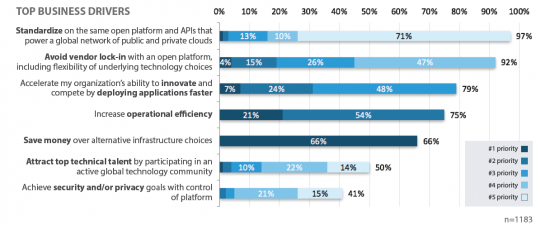
Top Business Drivers OpenStack

Source: OPENSTACK USER SURVEY, April 2016, OpenStack.org

The need to increase standardization, vendor lock-in avoidance, the ability to accelerate time to value and innovate while increasing operational efficiencies rank high in the list of top business drivers based on the latest OpenStack User Survey. These considerations are well aligned with what we hear from our customers as well.

Our role as a vendor is to contribute to the OpenStack community while trying to address some of the challenges organizations face in consuming OpenStack-based cloud services. And that brings us to the solutions we will discuss at this event. Ultimately, it boils down to choice. Our customers must be free to choose the optimal cloud consumption model for each application. In other words, to support a continuum of traditional, cloud enabled and cloud native applications, you need a continuum of cloud consumption models to match your requirements.

That is why at the event – during our breakout sessions and our booth presentations – we will discuss  how you can build OpenStack-based Private clouds with Cisco UCS and Red Hat Enterprise Linux OpenStack Platform, or consume OpenStack as a service with Cisco Metapod. Two very different consumption models depending on your needs and preferences.

Cisco UCSO

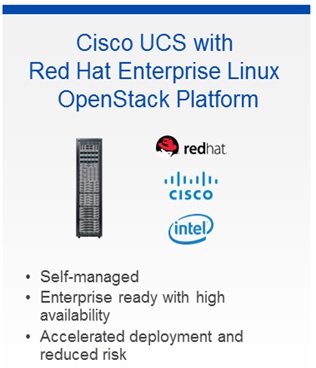
Cisco working in conjunction with Red Hat, and Intel offers a Cisco Validated Design (CVD) that provides proven guidelines and tested configurations to simplify and accelerate the deployment and operation of an OpenStack cloud environment. Deploying this integrated solution gives you a reliable, highly secure, and supported OpenStack cloud environment that is ideal for building your enterprise private cloud and delivering cloud applications and services. You can customize your Openstack environment, deploy RHEL OSP on Cisco UCS and retain total control over your IT environment and location of your data.

Cisco Metapod

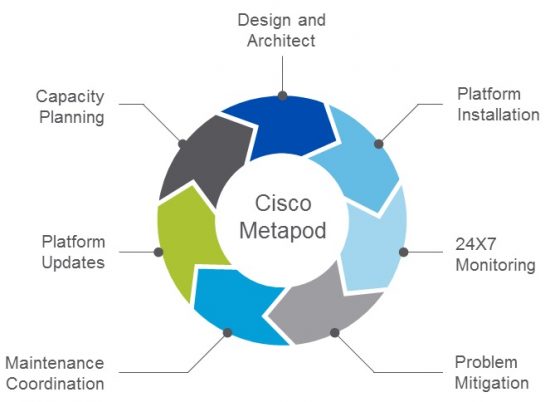
Conversely, if you prefer to have Cisco operate your OpenStack environment and offer it as a service, that is exactly what Cisco Metapod can do. With Cisco Metapod, you still own your IT infrastructure assets, you determine where your data and applications are located (e.g., in your data center). However, Cisco will deliver ‘OpenStack as a Service’. It is important to observe that this is not your traditional managed services delivery model. In fact, this a pretty unique consumption model that allows us to deliver as a service your OpenStack cloud while operating it remotely for you. Obviously, this is appealing when you want to limit the risk associated with your OpenStack deployments or you want to focus on your applications and your cloud services versus figuring out how to manage OpenStack yourself.

And if you are not sure where to get started, take a quick survey with the Cisco BCA Adoption Report, and receive your personalized cloud adoption summary (enabled by IDC) … and … if you happen to be at the Red Hat Summit next week don’t forget to visit our Cisco Booth and bring your questions!


Additional Resources:

Cisco OpenStack Website


Authors

Enrico Fuiano

Senior Solutions Marketing Manager

Cisco Cloud Marketing Team

Avatar

What is the cost for one hour of downtime in today’s digital world? Can a value be placed on applications or data that can’t be recovered after an outage, or needs to be restored from days (or weeks) prior?

Before the advent of cloud computing, organizations were forced to implement disaster recovery by duplicating their infrastructure at remote locations and managing these separate, standby resources. These solutions were costly, requiring additional hardware, datacenter hosting fees, and IT labor – putting the desired level of capabilities out of reach for many organizations.

Today, Cloud based Disaster Recovery as a Service (DRaaS) is a highly effective solution for enabling businesses to protect their data and applications.  DRaaS builds upon traditional backup capabilities to restore IT infrastructure in times of crisis, with little or no capital expenditure – enabling organizations of all sizes to afford the promise of getting back to business as usual with minimal interruption.

Service providers wanting to offer cloud based DRaaS have historically faced a challenging technical landscape, contrary to market expectations.  Challenges include:

  • Managing the protection of hundreds (or thousands) of virtual machine replicas in a multi-tenant environment overwhelmed most tools.
  • Private clouds are typically deployed deep in the enterprise network, behind the corporate firewall – complicating the connectivity needed to replicate systems and access to recovered systems in the event of a disaster or test.
  • Periodic replication of uncompressed data consumes tremendous bandwidth. Often the organization lacked enough bandwidth to complete one replication cycle before another began.

To meet the diverse needs of customers, support the many cloud use cases, and scale efficiently, service providers needed better choices for their disaster recovery platform.  SPs must be able to protect locally hosted workloads, remote datacenter infrastructure, as well as private clouds on customer premises. Providers who can’t protect workloads across today’s “anywhere access” landscape face the loss of market share.

Comprehensive Solutions – Flexible Offerings

We are focused on bringing greater choice to our partners.  The flexibility of our Cisco Powered DRaaS enables them to deliver services and solutions from the vendors that best meet the needs of their customer base.  Cisco partners can extend their market reach by serving a wider target audience with a more diverse portfolio of services that include backup, DRaaS, backup+DRaaS, Infrastructure as a Service (IaaS)+backup+DRaaS, and a powerful portfolio of synergistic Cisco Powered services.  In this way, service providers can offer tiered protection so businesses can protect their entire organization the way they need, at the price they want.

In addition to requiring performance, reliability, and security, the Cisco Powered DRaaS designation requirements validate streamlined operations and an outstanding customer experience. Achieving the designation means the provider has self-service capabilities, secure support for multi-tenancy, and automation to help operations scale.  Advanced features include disaster recovery testing capabilities offering the ability test recoverability without disrupting production, satisfying an organization’s compliance requirements.

Why Offer DRaaS?

The ability to offer Cisco Powered DRaaS with choice, compliance, and control also gives our service provider partners the opportunity to broaden their target market:

  • Deliver services to SMBs profitably through lower touch sales and support.
  • Service businesses with lower DR budgets that are willing to trade off price with tiered protection.
  • Reach deeper into organizations by being able to protect more systems, including Hyper-V based sources, physical servers, and even other clouds.
  • Offer greater flexibility than one-size-fits-all offerings through control of SLAs, storage characteristics, and testing frequency.

Cisco remains focused on not just what our partners need today, but what they and their customers need tomorrow.  As a market leader, Cisco recognizes the need to continuously adapt and is evolving the Cisco Powered Program to match the changing landscape.  By facilitating our partners’ abilities to deliver these innovations, Cisco Powered DRaaS offerings will maintain their relevance by reflecting current market needs.

Register now for the June 29 webinar with Veeam and Cisco and learn more about how you can deliver Cisco Powered DRaaS – the industry’s trusted choice for Disaster Recovery as a Service.

Authors

Ken Seitz

Global Sr. Director, Partner Managed Services

Partner Managed & as-a-Service