Avatar

As the U.S. Air Force’s first female airman to complete the grueling, 18-hour Army Cavalry Spur Ride, Courtney Beard is no stranger to overcoming obstacles. Even with her experience, Courtney faced a much greater challenge when she returned from her deployment — finding a job that aligned with her career goals.

Like Courtney, millions of military veterans across the United States struggle to translate their active-duty experience into achievements that will resonate with employers.

Courtney Beard, a United States Air Force Veteran, was hired by Cisco in 2012 as a Network Consulting Engineer

Continue reading “Cisco is Committed to Helping Military Veterans”

Authors

Patrick Finn

No Longer at Cisco

Avatar

Cisco Intelligent Traffic Director (ITD) is a zero latency multi-terabit layer 4 load-balancer available on 5k/6k/7k/9k. It has support for traffic steering and clustering solution on the Nexus  series of switches.

ITD allows customers to deploy servers and appliances from any vendor with no network or topology changes. With a few simple configuration steps on a Cisco Nexus  switches, customers can create an appliance or server cluster and deploy multiple devices to scale service capacity with ease. The servers or appliances do not have to be directly connected to the Cisco Nexus switch. ITD takes load balancing decision in a single clock cycle of the switching hardware, Hence avoiding latency altogether.

ITD supports IP-stickiness, resiliency, NAT (EFT), VIP, health monitoring, sophisticated failure handling policies, N+M redundancy, IPv4, IPv6, VRF, weighted load-balancing, bi-directional flow-coherency, and IPSLA probes including DNS. There is no service module or external appliance needed.

ITD provides order of magnitude CAPEX and OPEX savings for the customers. ITD is available on Nexus 7000/7700 series in NX-OS 6.2(10) or later. It is available for demo/EFT on Nexus 5k/6k/9k.  ITD is much superior than legacy solutions like PBR, WCCP, ECMP, port-channel, layer-4 load-balancer appliances.

Screen Shot 2015-03-02 at 10.28.21 AM

Note:- ITD is not a replacement for  L7 load balancers


Authors

Avni Baveja

Software Engineer

Data Center Group

Avatar

If you’re an experienced malware reverse engineer, exploit developer, response specialist, intel analyst, or looking to start your career in security, Talos might be the place for you.  We have a number of positions open in Columbia, Maryland; Austin, Texas; San Jose, California; and San Francisco, California.  If you are open to relocation to one of those areas, have the right skills, and share some of our beliefs below then applying for one of our numerous positions might be for you.

For those not familiar with Talos, it is Cisco’s premier Threat Intelligence organization that supports all of Cisco’s security portfolio.  Detecting and preventing threats that target Cisco customers is our job, and given Cisco’s security footprint and breadth of product portfolio we can engage those threats from Cloud to Core.

It does however, take a special type of individual to join Talos, so give the list below a look and see if your beliefs match up with our distinctive culture. Continue reading “Talos is Hiring”

Authors

Talos Group

Talos Security Intelligence & Research Group

Avatar

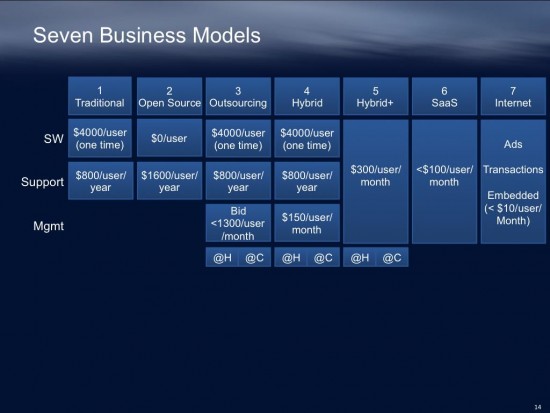
Many years ago I found myself talking to venture capitalists about the differences between SaaS, outsourcing, ASPs, MSPs, online applications; etc. Also I noticed that my Stanford students had little understanding of the economics of software, so I developed the idea of seven business models to cover everything in the software business, and remove the buzzwords and replace them with economic models.

In my previous blog post we discussed the first four models, this post will cover Models Five through Seven.

Seven Software Business Models

We ended the last blog talking about Model Four being able to provide management of the security, availability, performance and change of the software at nearly 10x less cost.

The question we left with was “how”?

How is it possible to decrease the cost of management without just paying people a fraction of what they made previously?

Continue reading “Seven Software Business Models – Part 2”

Authors

Timothy Chou

Lecturer at Stanford University

Avatar

Founded in 1915, Black & Veatch is a leading global engineering, consulting and construction company, specializing in Energy, Water, Telecommunications, Federal, and Management Consulting. Black & Veatch’s annual Strategic Directions Report identifies top of mind issues based on a compilation of data and analysis from an industry-wide survey. The complete report is available from the Black & Veatch website.

“The annual Strategic Directions report series captures Black & Veatch’s global engineering and thought leadership expertise across key elements of the critical human infrastructure market.… This report represents the evolution of Black & Veatch’s inaugural Strategic Directions: Utility Automation & Integration report, with an expanded focus on automation and integration and utilities’ efforts to harness data to make operations and service delivery more efficient.

Black & Veatch 2015

The major sections of the report address:

  • Utility Telecommunications
  • Utility Automation
  • Data Analytics
  • Smart Communities
  • Perspectives

The report notes that utilities and communities, with the proliferation of smart devices, automation and the use of analytics are transforming development and delivery of key infrastructure services to become more responsive, efficient and resilient.

Especially relevant to Cisco’s engagement with the utility industry and communities around the world is Black & Veatch’s observation that as legacy equipment is replaced or upgraded, IP-based technology is creating new opportunities. Connected devices on utility telecommunications infrastructure is now widely recognized as “…an essential element of the Internet of Things (IoT).

Advanced metering Infrastructure (AMI) has often been thought of as synonymous with “Smart Grid”, but the expectations of real-time pricing or even time-of-use (TOU) rates and demand side management are far from the top of the list of top areas enabled by increased data management and analytics. The top three listed in the report are:

Asset Management (67%)

Capital Investment (45%)

Customer Service/Engagement (27%)

More than 63% of electric utilities report plans to replace, upgrade or build communications infrastructure in the next 5 years, with IP leading the way as the network protocol standard including SCADA systems.

“Some utilities are completely embracing a converged mentality and running everything over a shared infrastructure, while others are moving more cautiously by keeping protective relaying and other mission-critical applications separate from the converged network.

The report notes that some utilities are more focused on the cost of maintaining and replacing outdated equipment and are unconvinced that smart grid technologies and automation are critical, but concludes, “Staying on the sidelines carries risk.”

Budget concerns dominate the obstacles to new technology implementation, and convincing stakeholders is key to addressing cost and perception issues.

The report concludes that the adaptive planning enabled by IP communications and advanced analytics allow leaders to effectively address core management functions of Strategic Options Assessment, Asset management and Operational Planning.

“For organizations that provide essential services, this represents the greatest transformation in utility operations in decades. For the smart city, it will facilitate the transformation to becoming a better place to live and a more friendly and desirable place to do business for generations to come.”

Black & Veatch and Cisco partner to create architectures for electricity, natural gas, solar and wind customers that provide secure and optimized network integration for smart grid environments. If you’d like to know more about our work together, contact me by commenting on this blog.

Authors

Rick Geiger

Executive Director

Utilities and Smart Grid

Avatar

When we launched Project Squared in November of 2014, one of the things that was really important to us was to listen to our customers, and to use the things we heard to adjust the experience. We established several “listening posts” – ways for us to get feedback. Analytics and metrics were one way. Another way was a feedback capability right within the application. We encouraged our users to use the feedback feature to report problems, but to also make feature requests or generally tell us what they think.

Within a few weeks of launch, we already started to see some trends in the feedback we were receiving. The number one requested feature that we got – by a long shot – was the ability to leave a 1-1 room. For the engineering team, this was an unexpected request. Why do users want to leave a 1-1 room? After all, if a 1-1 room has no activity, it will downwards in the room list and you won’t see it anymore. So, what is the issue? Continue reading “Project Squared: You Asked, We Listened”

Authors

Jonathan Rosenberg

Cisco Fellow and Vice President

CTO for Cisco's Collaboration Business

Avatar

With Cisco’s cloud-hosted, analytics solution Mobility IQ, retailers and their partners can now gain invaluable insight into their customers’ “showrooming” habits, understanding more about why customers browse in-store – but buy online. This breakthrough solution is making it easier to capitalize on untapped business opportunities and create impressive customer-focused campaigns.

Wouldn’t it be great to show her your in-store item (with a price match!) for that online deal she’s browsing? With Mobility IQ, you can do it right now.

 mobility-iq-retail-1

She’s here already. Now’s the time to let them know you’ll match that online price. Continue reading “Cisco Mobility IQ Ushers in New Era of Retail Engagement and Outreach”

Authors

Keith Day

Marketing Director

Service Provider Mobility Business

Avatar

Cisco’s Connected Mobile Experiences (CMX) solution leverages information from the Wi-Fi network to collect aggregate location data from mobile devices. This can be used to tease out behavioral patterns and trends, which in turn can help businesses make informed decisions on how to improve the visitor experience and boost customer service.

The Mobility Services Engine (MSE) forms the core of the CMX solution. Cisco Live! Milan was an exciting milestone for the MSE development team, as the new version of MSE, 10.0, was officially announced. Among its enhancements are improved scalability and robustness, as well as better monitoring tools. In this blog, we’ll show some real-world examples of what information MSE 10 can provide, as was captured during Cisco Live!.

The New Analytics Dashboard

One of the visible improvements is the redesign of the Analytics dashboard. The dashboard provides reporting capabilities, in which each page can be scheduled at specified intervals to run as a report and be sent to interested parties. Because of this new capability, we now refer to the pages on dashboard as “Reports”.

Each report can have any number of “widgets” – essentially little boxes of information – such as the device count within a certain area, the time spent there, or the number of devices moving between areas. The widgets can be configured to show a set of numbers (ie number of devices detected, new devices vs. repeat visitors, etc.), a graph of specified information broken down by time/place, or data tables.

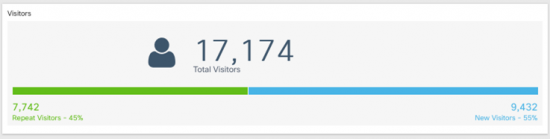
The most basic and fundamental piece of information CMX can provide is visitor count. In Figure 1 you can see the number of detected devices during one just one of the show days. The dashboard gives not only a very clear overview of detected devices, it also shows a comparison of those devices and where and when they’ve been detected throughout the conference.

figure1 milan live

Figure 1 Visitor count for one of the days

Beyond the fundamental data of total visitors, this information can be shown broken down by building, floor, or zone. Figure 2 shows Continue reading “MSE 10 at Cisco Live! Milan 2015”

Authors

Roman van der Krogt

Technical Leader

Avatar

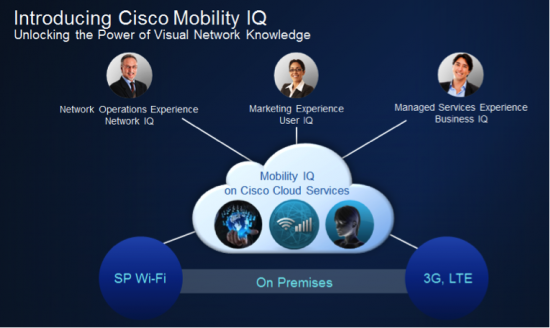
We’re here in Barcelona for the opening of Mobile World Congress 2015, and the energy is palpable. I have to say I’m pretty excited myself as Cisco unveils a new way of doing business with our service provider customers: Cisco Mobility IQ. Mobility IQ changes the conversation from what the network does, to what value it can create. It provides real-time intelligence for network operations, marketing and business development across Wi-Fi, 3G and LTE networks. By giving providers visual network knowledge for driving new business, you can monetize your network in new ways.

mobility-iq

When I say it changes the conversation, this is not marketing hype. Over the past few months I’ve been involved in these conversations with ten pilot customers. In one example we worked with an operator to estimate the ROI on running Mobility IQ on their existing network. We looked at results over a five year period and found Continue reading “Get the Big Picture with Cisco Mobility IQ”

Authors

Suraj Shetty

Vice President

Worldwide Service Provider Marketing