Cisco Silicon One technology continues to offer the most customer choice and can be consumed in a variety of ways including silicon, hardware and full systems. Announcing two new solutions to support AI/ML buildouts across enterprise datacenters and
Change the economics of your network in your favor with a simplified architecture that converges services on a unified, automated infrastructure for maximum scalability and agility to support the AI/ML era as well as 5G and beyond.
Jonathan Davidson interviews Cisco Partner Bas Burger, CEO of BT Business, to chat about BT Business’s recent innovations around sustainability, including their new Global Fabric network-as-a-service (NaaS) platform.
Ethernet is well-placed to support the massive scale that the world’s largest AI network fabrics require, and it has a broad base of suppliers. Cisco will partner with you to build an AI infrastructure that matches your business model.
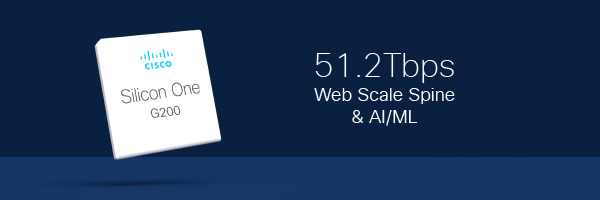
Today we expand the Cisco Silicon One™ portfolio with two new 5nm devices targeting web-scale spine roles and Ethernet-based artificial intelligence/machine learning (AI/ML) deployments. Cisco Silicon One devices now span from 3.2 Tbps to 51.2 Tbps
Customers can deploy Cisco Silicon One to power their AI/ML networks and configure the network to use standard Ethernet, telemetry assisted Ethernet, or fully scheduled fabrics. As workloads evolve, they can continue to evolve their thinking with
Covering the evolution taking place in the Web segment, the trends and inflections we see in those areas, and how we are partnering with our customers on their digital transformation journeys.
While other network providers continue to use commodity chips, Cisco has been developing custom silicon for Nexus switches since 2014. Creating our own ASIC was the only way to fully realize the promise of software-defined networking and enable