High-performance computing – or HPC – fuels groundbreaking research. This isn’t news to scientists, but most researchers studying fields other than quantum mechanics and molecular modeling probably don’t realize that they can use a supercomputer to ramp up their analysis.
This power, historically reserved for the realm of theoretical science, is now available to all – economists and sociologists, engineers and anthropologists, linguists and historians.
Just in case the prospect of using a supercomputer to solve our problems seems like a Cold War-era dream, we want to show you a few ways that high-performance computing is fueling research in a variety of disciplines today. Cue our high-performance computing blog series.
First up, natural sciences.
Unlike Matthew McConaughey (ahem, Interstellar), most of us have never been sucked through a black hole. With the closest one (that we know of) nearly 3,000 light years away, we fortunately won’t get close enough to check them out ourselves.
The good news is that we won’t have to. Using HPC, scientists can simulate what might happen in close proximity to a black hole. They can also simulate possible events that could lead to the creation of a black hole, such as the collapse of a star.
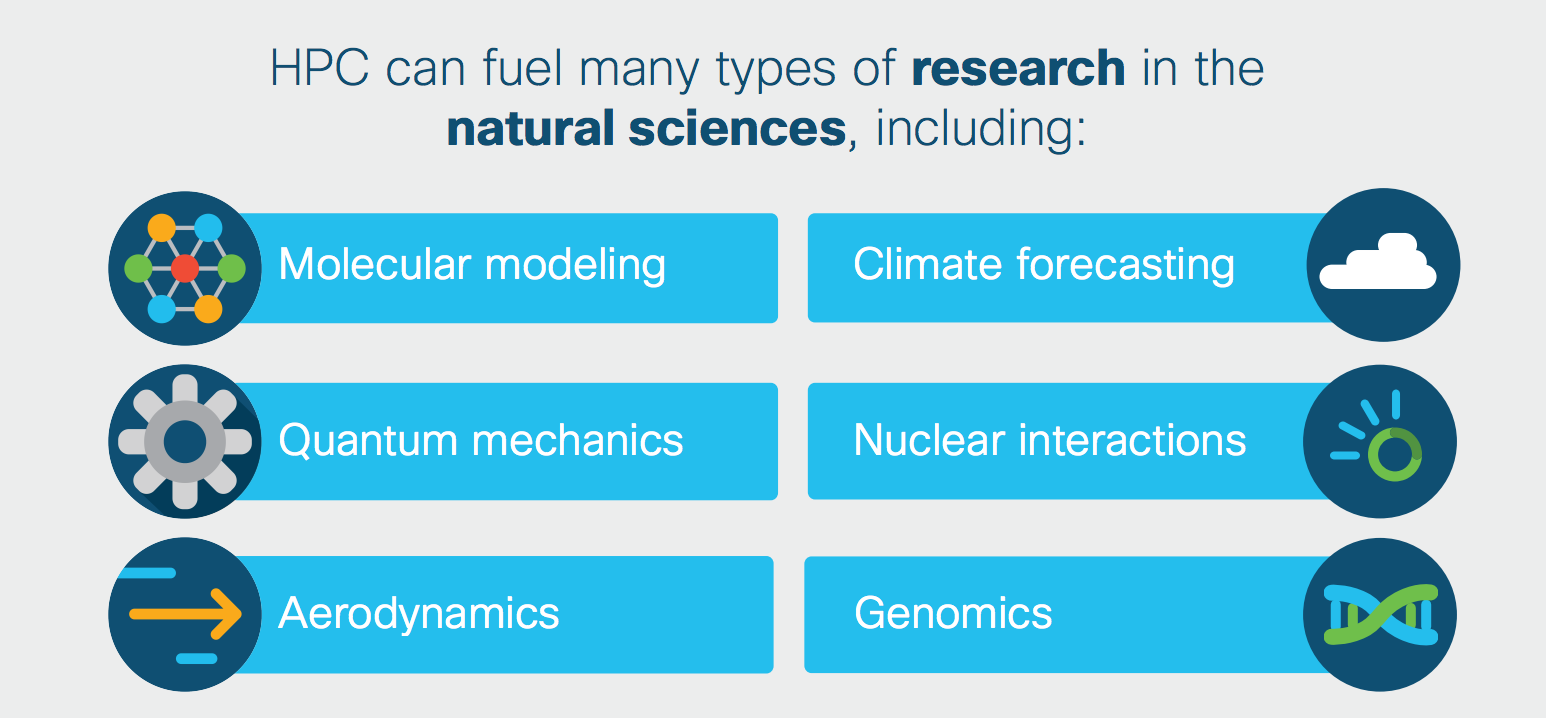
Discoveries about black holes aren’t the only scientific advances made possible by supercomputers. Molecular modeling, climate forecasting, and a variety of other types of research in the natural sciences rely on HPC to crunch the data and power their simulations.
Next up in our high-performance computing use case series? Big data.
Can’t wait for the next post? Learn more about HPC below.
When I was a kid, I won a vinyl record album in a local contest. (For those of you too young to remember, record albums were how early humans listened to recorded music in the dark ages before streaming music. Or CDs. Or cassette tapes. Or 8-tracks.)
I dashed to the neighborhood record store to collect my prize–possibly an Elton John album. I eagerly ran home, where to my dismay, I discovered that my dad’s home-built stereo system had blown a tube. I wasn’t about to listen to anything.
Darn it! (I may have used stronger words at the time).
When is a prize not a prize? When you can’t do anything with it. I know I could have used the album as a Frisbee, but hopefully you get my point.
How often do companies release a product or feature that is essentially unusable? Sometimes it won’t work in your environment. Sometimes it’s too difficult to deploy or manage. Or the user experience is cumbersome. (Does anyone remember those horrid mid-song pauses on 8-track tapes?)
That’s why it’s so important that products and features are usable in actual practice. And that’s why I’m so excited about Release 11.6 of Cisco’s contact center product line. With these offerings, organizations of all sizes can provide connected digital experiences for superior contact centers.
In developing this release, our development team worked closely not just with our partners, but a record number of early field trial customers. Throughout, they followed four key principles:
Make it Flexible: Our teams worked to ensure that your business can deploy the solutions in your environment, to meet your business needs.
Make it Usable: Superior usability means that it’s easier and faster for your contact center agents and supervisors to support customers and do their jobs.
Make it Simple: We focused on making the whole process more straightforward, from designing, ordering, and deploying, to managing your contact center solution.
Make it a Great Experience: Focusing not just on our users, but your customers, we emphasized improving your customers’ journeys to make them seamless across time and channels.
This was our philosophy in development. Now here are some examples of what that looks like in our products:
Shared components:
Finesse desktop enhancements to improve agent productivity
Single sign-on enhancements
Context Service serviceability improvements
Real time view of state and call history for agents and supervisors
Reporting refresh for charts and dashboards (see below)
Enhanced security, including TLS 1.2 support
Contact Center Enterprise solution line:
Enhanced outbound campaign management with no single point of failure
Enterprise chat and email now enabled for integration to third-party tools
Packaged Contact Center Enterprise support for global multi-site deployments and enhanced support for third-party CRM integrations
Remote Expert Mobile enhancements for co-browse and mobile media performance
Contact Center Express solution line:
Enhanced digital channel capabilities, including larger email attachments and group chat
Multichannel agent state and wrap-up reports
New supervisor functionality, including monitoring outbound calls and access to historical reports
Scripting enhancements.
Here’s an example of a new reporting dashboard.
Is your business looking for a contact center solution? If you already have one, do you feel like you’re stuck in a groove and not able to get the most from it? Are you worried about continued support for your present contact center?
If the answer to any of these questions is “yes”, I encourage you to consider what we have to offer. With Release 11.6, there’s never been a better time to go with something that will work for you–and your customers!
Those words may not seem as terrifying as the shouts and gunshots of infamous bank robbers Butch Cassidy and the Sundance Kid sounded to bankers in the early 1900s. But they would quickly create a crippling panic if you saw them flash across your screen seconds after your computer locked up.
If Butch and Sundance were alive today, instead of riding up on horseback, they would sneak into banks invisibly, riding in on malware to deliver their demand digitally to each customer’s account.
Cybercrime is big business. The 2016 Cybercrime Report from Cybersecurity Ventures predicts cyber crime will cost the world in excess of $6 trillion annually by 2021, making it more profitable than the global trade of all major illegal drugs combined. Just like bank robbers in the Old West, today’s cyber criminals are ruthless. Threats and techniques have grown increasingly sophisticated and more sinister.
In the Cisco 2017 Midyear Cybersecurity Report, experts explain that the intent has changed from clearing out the vault to clearing out data.
Cyber thieves can now lock systems and destroy data, perhaps even be planning a wide-reaching, high-impact attack to disrupt the entire internet. Additionally, with the pace and scale of technological change, the attack surface is getting larger. There are more security gaps and vulnerabilities across devices and networks for cyber criminals to exploit.
Cybersecurity Challenges for Financial Services Organizations
There are additional challenges for financial services firms that make it even harder to detect these invisible cyber threats. A complicated mix of security vendors and products makes threats more unclear and difficult to understand instead of providing additional insight.
46% of the financial services organizations surveyed for the Cisco 2017 Midyear Cybersecurity Report said they see thousands of daily alerts but investigate only 55% of them. Of the ones they investigate, 28% are considered legitimate—yet only 43% of that 28 % of legitimate threats are addressed.
With so many security products and vendors that aren’t integrated, information security incident response teams face challenges. Given the high number of alerts, it can be difficult to assign priority and to find duplicates. Without integration, security teams are limited in their ability to correlate and analyze threats.
Integrating legacy applications with emerging technologies can be a daunting task for security teams. Multiple products often operate in silos. Individually, they may be effective, but without integration to share and correlate security information, security teams will be left to manage conflicting alerts and reports.
Just a few years ago, virtual sales could have meant a few different things. For some organizations, it was the outsourcing of specific outbound sales activities. For others, it involved the utilization of tools, such as live chat and demos, to respond to online enquiries. Today, the term “virtual sales” implies a much more holistic approach to customer-creation—one that integrates people, processes, technology and data to guide prospects through their buying journey and entire lifecycle experience.
You’ve likely heard the powerful statistic that 67 percent of the buyer’s journey is now experienced digitally (SiriusDecisions). But when higher-priced purchases are on the line, that same research shows that human-to-human interactions are more frequently a part of the decision-making process. Even when the majority of the buyer’s journey is fueled by digital interactions made prior to personal contact, sales and marketing experts on the back-end can greatly influence those interactions through personalization and virtual, yet human-based assistance.
This shift in buying behaviors and practices has paved the way for a new breed of hybrid sales and marketing professional, one who is culturally different in his/her approach to nurturing leads, offering buying assistance and orchestrating customer-centric interactions.
Three Tips to Build a Well-Oiled Virtual Sales Team
While your organization’s model for virtual sales may still be evolving, below are a few tips based on research from IDC (Evolution of the Virtual Sales Rep: Taking the Buyer Experience to the Next Level) that can help you accelerate your success:
Create relevant, easily accessible content – Virtual sales places greater demand on internal marketing resources to create and maintain content that is less promotional and more helpful to the customer. As such, organizations must delve deeper and speak directly to line-of-business buyers to gain real-world insights into industry- and vertical-specific challenges and opportunities, and then ensure that relevant content reflects those insights. In addition, content marketing assets should be self-service, easy to obtain for buyers and contextually linked to your virtual seller interactions to deliver the best customer experience.
Recruit with a new skill set in mind – The skill set of virtual sales agents will differ from that of traditional sales and marketing hires. Virtual sales reps should be well versed in using CRM, cognitive and marketing automation systems, and they should be equally adept at chat and the art of social selling. Strong virtual sales candidates will have an affinity for technology, particularly when qualifying and nurturing leads. But they should also possess key interpersonal skills that are critical to traditional sales roles, such as those related to likability,effective communications and rapport building.
Invest in your virtual sellers’ experience – Understand that a virtual rep may be the first human interaction (even if behind the scenes) that a prospect has with your company. As such, it is important to appoint people with the right skill set and as much contextually relevant information about the prospect, their company and digital buying journey. Ideally, these professionals are in place because they are keen listeners and solution-oriented in their approach. But proper use of analytics and Artifical Intelligence (ie: Company, industry, Customer’s past purchases, prospect’s tweets, blogs, webpage history…) to augment their effectiveness while transforming their customer’s experience. Happy employees normally translates in higher customer satisfaction. The overarching goal isn’t just to close a sale, but rather to learn more about what the prospect wants, to deliver the expected outcome via an integrated adoption motion. Performed well, this will lead to increased business and higher customer retention rates.
Remember, in our changing digital economy, the buyer is in the driver’s seat, and the goals of instant value delivery and customer success need to remain top of mind. To achieve these goals, you’ll need all hands on deck—both human and digital—and Cisco has an arsenal of tools, platforms and digital assets to help you rise to the challenge. You can read more about the virtual sales movement and how Cisco can help here.
The onslaught of digitization is sparing no industry. Digital competitors continue to disrupt traditional markets. I have the privilege of closely watching this nonstop transformation unfold at my clients in industries across the value chain from retail to high tech.
Let us take an example from one of my clients (large grocery retailer). The $13.7 billion Amazon-Whole Foods deal earlier this year shook grocery retailers nationwide. Groceries retailers like my client must find profitable ways to revive the in-store experience while enhancing online options. With several parts of the customer journey in the grocery business being transformed by digital, my client is looking to rapidly enhance and deliver a differentiated digital experience to its customers. Likewise, another client in the High Tech industry is moving rapidly to reinvent its business model to drive seamless integration and collaboration with customers, suppliers and partners.
In this new era, as businesses are becoming more and more digital, their dependence on IT infrastructure is increasing exponentially. To be an enabler for digital transformation, the infrastructure needs to be simple, agile and reliable.
Reliability is paramount in the digital world where downtime stops sales and leads to customer churn. My conversation with clients regarding “reliability” is now more about “avoiding outages” as compared to “restoring service faster”. The conversation is about simplifying & standardizing the infrastructure, integrating application performance & infrastructure analytics; making the support model proactive & predictive by leveraging Analytics and Artificial Intelligence to detect potential problems and providing fixes for bugs or security vulnerabilities before they impact business. Some clients have really leaped forward on this journey and are ready even for the next level of “preemptive” capabilities which leverage cognitive computing and artificial intelligence for automated remediation of issues before they impact business. For example, one of my High-Tech customers is asking for capabilities to detect and programmatically disable rogue access points.
Within Cisco Services, we bring together people, process & technology to measure, analyze and optimize availability & performance across the whole stack – application, data center and network and make real this promise of a proactive and predictive network. This is no simple feat. For example, our network analytics solution collects data from around 23,000 devices across a grocery retailer’s network, analyzes all this information including around 2 million Syslog messages every day from these devices, correlates it with our intellectual capital & data from 2.7 million devices in networks across the world and provides real actionable insights which help the customer avoid outages in mission critical services.
Want to learn more? Please review the short video below regarding the innovation we are driving within Cisco Services to help enterprises and service providers maximize value from infrastructure analytics.
LabVIEW is a system design and development platform released by National Instruments. The software is widely used to create applications for data acquisition, instrument control and industrial automation. Talos is disclosing the presence of a code execution vulnerability which can be triggered by opening specially crafted VI files, the proprietary file format used by LabVIEW.
Have a question or comment? Tweet at @CiscoCSR and be sure to join us September 21, from 10-11am PT, for a #CiscoChat with PPP thought-leaders Laura Quintana, Vice President, Corporate Affairs at Cisco; Laurence Carter, Senior Director of Public Private Partnerships at the World Bank; Keith Davis, President & CEO of the Camden Dream Center; and Jen Boynton, Editor in Chief at Triple Pundit.
To truly make progress on the world’s largest societal issues, such as community health, economic development, and education and skills development, governments, companies, and nonprofits must work together. But, how does a company or organization develop and sustain successful public-private partnerships to achieve large-scale impact?
First, determine who to work with: Successful PPPs start with stakeholders who are engaged, committed, and able to execute a shared vision. Commitment and support from the highest levels of government and the institutions involved are essential, and all partners should have “skin in the game” to authentically demonstrate their commitment.
It’s important to use quantitative and qualitative research to assess partnership opportunities and risks, and to understand potential challenges that partners may face in fulfilling their pieces of the partnership. This might include market research and financial analysis to determine funding priorities, or a political landscape analysis to determine an approach that is appropriate and feasible given the political climate.
At Cisco, we’ve seen how leveraging innovative PPPs can achieve large-scale impact. Cisco Networking Academy, a world-leading IT skills and career building program, addresses the growing need for IT talent by equipping students with entry-level IT and 21st-century career skills.
The program is based on partnerships with over 9600 schools, community colleges, universities, governments, NGOs, and other organizations, which implement the program across 170 countries. Our global impact includes providing IT education to more than one million students each year–totaling 7.8 million students since 1997–and improving the lives and economic stability of communities worldwide.
As an example, successful PPPs with the highest level of governments and leading academic institutions across the world have helped Cisco scale inclusive social and economic impact. In Costa Rica, nearly 60,000 students have benefited from Networking Academy courses. Our ten-year partnership with the Costa Rica Ministry of Education has provided the country with an opportunity to thrive in the digital revolution.
The information economy demands an unprecedented level of technological literacy for workers, yet in many countries there is a severe shortage of trained networking and IT specialists. To enhance technical training, enable Costa Rica to compete in the digital economy, and improve people’s career options, the Networking Academy core curriculum is now taught in 102 of its 138 technical schools for students in the IT specialization.
Daniela Molina Quesada, pictured above, is a Networking Academy alumna and a civil servant at the Caja Costarricense Seguro Social (CCSS), Costa Rica’s social security fund. After studying computer science at a rural technical school, Daniela enrolled in the Networking Academy program. She earned her technical degree in computer science, successfully completed all four Cisco CCNA modules, and earned a scholarship to study Systems Engineering at the Fundacion Omar Dengo.
Thanks to the Networking Academy program, Daniela was able to get a great job working in the Department of Technology Management at CCSS.
“Cisco was the first door that led to a whole new world professionally. Thanks to Cisco, I was given a job opportunity that has been one of my greatest achievements. Every day, I apply the knowledge I gained from Networking Academy, and this experience undoubtedly led to my ability to get a job that I love,” said Daniela.
Daniela has been at her job for nearly six years and currently supports more than 35,000 network users at CCSS. She believes technology and networking can transform lives and urges “everyone to get involved in the world of networks and to be part of the Cisco Networking Academy community.”
Recognizing the need for digital skills in all career paths (tourism, management, etc.), the Ministry of Education plans to make Networking Academy courses available for all students in technical schools in 2017, regardless of their area of specialization. While Networking Academy is helping Costa Rica develop a workforce trained in essential skills, this partnership also led to a 2017 Letter of Understanding between Cisco and the government of Costa Rica. Working at a country level, this Letter of Understanding highlights Cisco’s role in helping Costa Rica realize its digital agenda by driving digital education, providing access to telecommunications services, and enhancing cybersecurity.
Win-win public-private partnerships play a critical role in achieving global scale and local impact. We have an opportunity to close the digital skills gap, promote equitable education, support economic empowerment, and address critical human needs – all by leveraging the strengths of the public, private, and nonprofit sectors and collaborating to create value for everyone involved. Successful public-private partnerships, however, are not one size fits all. An approach that incorporates best practices, including utilizing the strategy above, helps ensure that all partners, as well as communities, benefit.
Blog #2
To learn more, visit www.netacad.com. Has your organization had success in choosing the right partners in a public-private partnership? Leave us a comment below, tweet at @CiscoCSR and stay tuned for next week’s PPP post on determining when and how long to engage.
A big railroad company is putting sensors on the rails to measure vibration: If it measures over a certain limit, the company sends a repair crew. A retailer implemented digital shelf labeling to be more agile and competitive. If a competitor changes a price for apples or bananas, it takes just minutes to match or beat the price.
Connected vehicles, predictive maintenance, adjustable banana margins: It’s incredible what can happen when the virtual world meets the real world.
But let me talk now about one of my favorite things: Why it really is better to leave the gun and take the cannoli. OK, maybe not that one. This one: How digitization changes how we work and collaborate.
At work, it really comes down to something simple. We’re all just trying to get stuff done! What that “stuff” is for each of us may be very different. But at the end of the day, we’re all trying to outsmart and outperform the competition. So, if we can use digital technologies to help our teams to do their stuff faster, we win!
Digital transformation at the workplace is happening all around us. Sometimes so fast we don’t even notice it. The companies that are quicker to embrace digitization will leave everyone else behind.
Digitization & Meetings
Companies run a lot of meetings. Cisco has its fair share. I’m sure you know what I’m talking about. Meetings are when we make decisions and produce outcomes. There are more meetings than ever before. And more and more they happen in the digital, virtual world.
Just have a look at our cloud meeting product WebEx. That is where we see the numbers. Over the past three years, we have seen growth, significant growth:
2x monthly meeting attendees
2x monthly meetings
3x meeting minutes
All of this amounts to over 1 million meetings per day – on WebEx alone.
And in one quarter – just three months – we’ve seen a record number of meeting minutes. Over 13 billion. That’s 25,000 years. (OK fine, it’s 24,733.6 years. But that didn’t sound as good and I know someone’s going to call me on my “rounding error” if I don’t cop to it now.) Back to the subject: That’s a lot of meetings. And there is more demand for cloud-based meeting tools than ever before.
It’s not that everyone suddenly falls in love with using WebEx. (They do that too, but it is not my point.) Your business is driving the need for meetings. Innovation comes from creative people sharing incredible ideas. Sometimes they agree, sometimes there’s creative tension. In any case, speed is of the essence. Great ideas stagnate while you sit in an airport terminal waiting for an update on your latest flight delay. You want to move faster, meet everywhere. You don’t want to worry about all the locations where the people you need to collaborate with are.
Digitization & Location
In the year 1996, I was working for a German company at their offices in Silicon Valley. There were about 30 of us all co-located in the same space. And we were from all over the world. Some of the development was done in Munich and some in the SF Bay Area. In those days, we had to schedule regular working sessions in one location or the other. Big groups of people moving en-masse and living remotely for a month in order to work together. We easily lost 6 to 12 months on our time to market just waiting for everyone to come together.
Sounds like the Dark Ages right? Just one step above sending carrier pigeons (or ravens) back and forth. Obviously, in today’s world, people working in a modern startup are rarely based in a single location. Their talent is more important than where they live. Teams use digital tools to overcome distance.
And the same already applies to larger companies. Our engineering teams have hundreds of people – and they’re in at least ten locations around the world. In the past we always tried to consolidate, close remote offices, create bigger and better centers, invest in more carrier pigeons. Not anymore.
Instead, we use technology to connect the brightest minds and coolest people around the world. That is how we stay competitive.
Digitization, Agility & Speed
Here’s the big one: The way we work has changed. Everything is agile. We do more with less. We work in small teams of six to ten people but on hundreds of parallel work tracks. We stretch our tools to the limits!
Take email as an example: In the “old” days, it was normal to expect a response to an email within 24 hours. Today, people expect a response in minutes. How many of you have gotten the “Did you get my email?” call when you didn’t respond to someone within an hour? We are basically using email as a chat tool. It was designed for the work in the 90s, not for today’s pace.
So speed is a big deal, everybody wants to move faster! And they need the tools to do it.
Digitization & Integration (with everything!)
There is a huge growing economy of connecting things. I see that things are connecting more and more with each other. I mean, not just things with things, also people with things, and people with people.
Every industry, every business, and every process is different. One size doesn’t fit all, so people see a need to integrate.
One of our VPs has integrated his Tesla with his Amazon Echo. He can tell Alexa to start up his car and back out of the garage on its own. If only I could get my car to tell me when the parking space opens up near the Cuban coffee place when the hipsters have all finally left.
With our collaboration tools, people want to see major integrations to connect with what they want. That’s why companies like IFTTT, Zapier, and Built.io are taking off. They’re connecting everything, whether through APIs or integrations. Without writing even a single line of code, you can connect totally different ecosystems. For example:
Get a text message when a new calendar entry shows up.
Start a meeting when certain people enter a room.
Start a meeting on your phone and automatically switch it to the video system when you walk into a room.
Prompt you to stop eating Doritos (or at least put yourself on mute) when you’re in a meeting.
Remind you to leave the gun and take the cannoli when you open the car door.
And it all happens in the cloud! Recent cloud technologies are really a breakthrough in these integrations. The cloud connects everything! Stuff that has never worked together suddenly does. It’s like Marmite and cheese, coming together on toast for the first time.
Experiences Matter
Now you say “OK, this sounds complicated! New tools, tons of Cisco technology to make all this work.” Fear not.
As Arthur C. Clarke said, “Any sufficiently advanced technology is indistinguishable from magic.”
And that’s our goal for cloud collaboration technology. We strive to create tools and technology that are magical. Tools that hide the technology and the complexity. Tools that get out of your way and allow you to focus on getting stuff done.
If we ignore people, or how they want to work, or what tools they want to use – we fail. People are at the heart of digital transformation and their experience is just as critical.
To get this right, we really had to change how we work at Cisco. We had to start with defining the experience. We had to define the “magical moments” of using a product. And then, only then, we worked back to design and implement the technology stack.
If we ignore people, or how they want to work, or what tools they want to use – we fail. People are at the heart of digital transformation and their experience is just as critical.
Now, this is really hard. But it is the key to getting everything right. The experience, the software, the hardware, the infrastructure, and the networks.
I saw this pyramid about three years ago. I really thought it was a marketing slide.
But frankly, it is not. The network matters when building the foundation for a magical collaboration experience. And it’s critical for digital transformation.
I’ll explain it in the context of one of our larger customers. When we started looking at the challenges they were facing, we used the pyramid for context:
First, we looked at the network. We found and fixed issues with the firewalls and proxy servers. Check, one problem solved.
Next, we looked at the infrastructure and realized that the customer was missing some of the basic infrastructure to support video and VoIP. Check, the second problem solved.
Then, we looked at the hardware. We discovered that many of the conference-room microphones were due to be replaced. Check, the third problem solved.
Finally, we looked at the software. The customer had handed out hundreds of thousands of USB headsets to employees to use with their new soft client. Unfortunately, they didn’t work. Can you imagine? It turns out, it was a simple fix we could deploy to the application. Check, the fourth problem solved.
In totality, all these problems affected the experience of each and every user, not to mention IT. Technology has to serve the user experience. By working through the technology stack, and by having unbeatable knowledge of every layer, we could fix everything and delight the users.
Where to Next?
More and more of your companies have the need to work independently of location, space, and time zones. Agile, digital businesses are moving faster than ever before. There is tremendous pressure to move faster. But now, you can integrate everything and connect through the cloud. And when you do, unbelievable new opportunities open up!
In the end, experiences matter. Whatever any of us create, we need to work back from experiences to the technology that supports them. And you’ll see Cisco deliver the next-generation collaboration tools that do exactly that.
Enabling teams to work from everywhere, any time zone, using any tools.
Supercharging agile teams with new messaging and video technologies.
Building from an open and highly secure platform that integrates with any business and any process.
All of it based on a strong, rock-solid technology stack with Cisco networking.
If my niece were to ask me for career advice, I would tell her that Happiness is within. Don’t look for happiness from outside influences. Learn from the challenges you face, and make full use of the opportunities you’re given.
One of the opportunities I was recently presented was to participate in the Mrs. South Asia India 2017 competition – and I won the title of Mrs. South Asia!
I couldn’t have participated, much less won, without help from my Cisco family. They helped in so many ways, but here are three that meant the most to me during the process.
1. My manager. Cisco puts a priority on work-life balance, and my manager allowed me flexibility during the competition. Being a program manager for thingQbator (which is an internal incubator for innovative ideas for our engineering community) and busy working mom is hard enough, but to add the demands of needing to prepare my presentation, focus on fitness, revive my dancing skills, sharpen my knowledge and my views about current affairs for Q&A — just added a new level to my balancing act. Without my department support it wouldn’t have been possible!
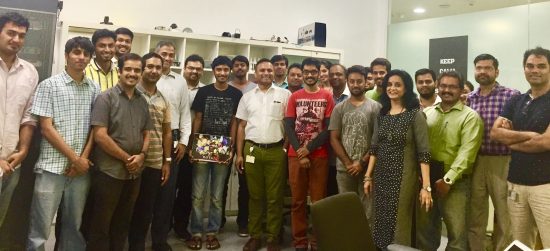
2. My colleagues. Many people were a part of my success just from their encouragement and support – their enthusiasm was priceless! Part of the competition was that I needed to create a video. The global Cisco community (but especially here in India, Singapore and the United States) made my video the most-viewed among all of the participants! They didn’t just encourage me in person, they shared my story, they took the action to watch and participate and even loaned me clothes and shoes for the competition!3. Partnering with other Cisco teams. The Cisco TV team not only supported me as a group of individuals, but as a Cisco team as well. They helped lend their expertise in putting together video reels to help me build my video platform, and on very short notice!
I think that these three things are a really great example of the words on Cisco’s new Careers site. “Be You, With Us. #WeAreCisco.”
Be you: You see, I got to be who I am, follow my passions, and through the competition, create awareness about a cause close to my heart: “Green the Red” – which is a movement that focuses on sustainable and affordable solutions for women’s hygiene – a serious health issue affecting our less privileged sisters.
With us: Everyone at Cisco has unique talents and passions, and we really come together to support each other. Not only on a personal level, but in innovation and team challenges as well.
#WeAreCisco: It’s who we are. It’s at our core. It’s what it’s really like to be a “tribe” of Cisco employees.
I am very fortunate and thankful for being part of the Cisco family and culture.
Want to join a company that encourages you to pursue your passions?We’re hiring!


















 Just have a look at our cloud meeting product



 2. My colleagues. Many people were a part of my success just from their encouragement and support – their enthusiasm was priceless! Part of the competition was that I needed to
  3. Partnering with other Cisco teams. The Cisco TV team not only supported me as a group of individuals, but as a Cisco team as well. They helped lend their expertise in putting together video reels to help me build my video platform, and on very short notice!