Avatar

Artificial intelligence for customer center is a hot subject. One industry analyst recently shared that, starting a few months ago, more than 75% of the firm’s customer inquiries were to discuss just one topic: Using AI to improve contact centers.

What are some key insights regarding contact center and AI?

1. AI is a means to an end, not an end in itself. The top four priorities for contact center have remained consistent for many years:

  • Optimize the human element in the contact center
  • Save customer time and effort through automation and self-service tools
  • Consolidate applications to reduce IT footprint
  • Drive towards personalization of the customer experience

AI can help further address self-service outcomes by helping you deepen offers through more natural and intuitive interfaces. “How may we help you?” will become the most common question companies ask in their self-service offers compared to today’s largely static interfaces.

2. AI will be everywhere, pervasive and integrated. The nature of AI is such that you can infuse it into existing business processes. When executed well, AI should be unnoticeable to your customer, but result in more delightful and efficient experiences. Some customer-facing processes will be completely AI driven, while others will use AI to improve portions of existing processes. It will become increasingly more difficult to discern when AI is part of a business process – in a good way.

3. Innovative AI will come from many vendors. While most people associate contact center AI specifically with chatbots, many forms of AI will impact the entire contact center  value chain. For example, conversational assistants, driven by AI and machine learning will impact everyday life outside of contact center situations. Likewise, vertical AI solutions will drive new value beyond horizontal applications like search, tailored to the specific needs of that industry.

4. Without context, AI just artificial and not intelligent. AI needs data and context to be intelligent. AI-driven contact center processes will only be as good as the quantity and quality data provided to them, whether by human or non-human sources. For example, contact center agents will be a primary source of “training” AI for care by providing input and context to improve AI-driven care outcomes.

5. Cisco AI is connected to context. We recognize that contact center without context will disappoint. Cisco Context Service is a cloud-based source of interaction data used to deliver deep insights into your customers’ journeys. You can use this context to adjust routing, treatments, and provide insight to center agents at key moments of truth in the interaction. Don’t punish your customers for using self-service. Using context lets you provide one continuous experience for customers when the transition for self-service/bots requires a live agent.

6. AI can improve all parts of traditional contact centers. Beyond just self-service, you can integrate AI functions to improve call routing, reporting, and the agent experience. AI will be pervasive through the entire contact center software stack. For example, you can improve accuracy by infusing AI-based intent further in the decision process. You can enhance reporting with insights gained by combining AI and context, fueling deeper insights into customer behavior.

7. AI is far from perfect and will need human assistance at times. While aggressive predictions indicate that AI will displace a large swath of human resources in contact center, AI’s impact in that regard is many years down the road. Therefore, a smooth continuous escalation from AI driven self-service to live assistance is critical to delivering a Connected Digital Experience for customers.

Next Steps: What to do?

  • Stay the course with the goals of your contact center strategy. These likely involve improving service outcomes while addressing your cost-to-serve profile. However, recognize there are new AI-driven tools that can impact both.
  • Drive AI to improve both the customer and agent experience. A majority of existing AI efforts focus around customer-facing processes, such as chatbots. These can improve agent experiences by augmenting complex interactions with AI-driven context.
  • Consider AI first as a way to augment, rather than replace existing processes. To gain momentum, and avoid poor first impressions, consider AI technologies as a complement to your existing stable of contact center processes – rather than complete replacements.

The next several years will show much progress in the realm of AI and contact center. This should result in lower cost and better service for customers globally. In the interim, stay tuned as Cisco continues to drive innovative solutions to improve contact center globally.

Read more about extending your existing contact center experiences with this Connected Artificial Intelligence white paper.

Authors

Zack Taylor

Director

Cisco Global Collaboration

Avatar

When Mohawk, the world’s largest flooring manufacturer, had challenges in their factory network, they needed a partner who understood the enterprise and IT “carpeted” side of the house (pun intended) as well as the “concrete” side of the house in manufacturing.  They chose Cisco, the world leader in enterprise networking and the #1 market share leader in industrial managed switching.

Mohawk invests heavily in environmentally responsible practices, from developing renewably sourced products to keeping their facilities and delivery systems streamlined and efficient.  In its Summerville, GA factory, Mohawk turns millions of recycled plastic bottles into premier carpets.

Read the case study here and check out the video, below:

Mohawk’s challenges were not terribly uncommon for manufacturing in any industry.  As a flooring manufacturer for over 100 years, their factory automation systems expanded over time and were pieced together as the business grew.  These multiple layers created a patchwork of automation systems, networks, and even numerous network protocols, which resulted in excessive network downtime and high support costs.  It also made it challenging to access trapped machine data to improve business operations through any smart manufacturing or Industrial IoT initiative.

Mohawk’s objectives were in line with many manufacturers’ goals.  They wanted to lower operating costs, boost efficiency, get insight into their production processes and simplify/flatten their complex factory networks.

Cisco, together with our partners implemented ruggedized, cost-effective Industrial Ethernet 2000 and 3010 Series Switches on Mohawk’s factory floor.  These switches are part of Cisco’s Connected Factory – Network Solution.  This solution is made up of a series of thoroughly tested, validated, and scalable factory network infrastructure products designed for the factory floor – and powered by Cisco.  Network designs are captured in CVDs (Cisco-Validated Designs), which make it easy for manufacturers to deploy a network that is robust, scalable and secure.

Cisco also covered their plant, wall-to-wall (another pun!), with wireless communications on the factory floor.  The Connected Factory – Wireless solution from Cisco is tested and validated for factory floor environments with demonstrated reliability in industrial control-system environments and for ultra-low-latency motion-control applications.  Cisco Wireless controllers offer robust scalability, which significantly lowers operating expenses by providing the visibility and control needed to manage thousands of wireless points from a single location.

Cisco offers wired-to-wireless access controls and the additional end-to-end security benefits of Cisco Identity Services Engine (ISE) within a Cisco wireless environment.  Ultimately, data access on the factory floor is now seamless for better communications and real-time information sharing.  Together, Connected Factory Network and Wireless provide one converged plant-to-business network, all based on standard Ethernet.

That single network is managed with Cisco Network Prime for cost-effective device operation, administration, and network fault-management.  This single solution helps customers reduce management complexity and deliver carrier-class services. It supports the physical network components as well as the computing infrastructure and virtual elements found in data centers. Prime provides detailed end-to-end views of the physical and virtual network topology and inventory, GUI-based device configuration with prebuilt and downloadable scripts, Up-to-date displays of the network event, state, and configuration changes, and Topology-guided troubleshooting, automated root-cause identification and alarm reduction through de-duplication.

Running standard industrial Ethernet on the factory floor also allowed Mohawk to use standard IP based camera solutions. Standard industrial Ethernet guarantees critical IACS (Industrial Automation and Control System) Traffic is prioritized while still allowing for non-critical traffic like video on the same network.  This design simplifies the network architecture, and lowers support costs.

The result for Mohawk: more in-depth, real-time visibility across the plant through pervasive wireless and access to critical data anywhere.  Mohawk also realized improved cooperation between IT and Operations when they worked together on their new network with Cisco.  This is a significant area where Cisco can help.  Our traditional strength on the IT side of the house means we can be a broker between IT and operations resulting in a more straightforward deployment, faster problem resolution, and a more secure infrastructure.

It also resulted in a whopping 12% improvement in employee productivity, and over $1 million saved at a single plant.  Mohawk’s results are not atypical.  Partner with the network leader, Cisco in both the enterprise and factory, to roll out the red-carpet and create a clear path to optimized production.

Authors

Scot Wlodarczak

No Longer with Cisco

Avatar

Today, Microsoft has released its monthly set of security advisories for vulnerabilities that have been identified and addressed in various products. This month’s advisory release addresses 34 new vulnerabilities with 21 of them rated critical and 13 of them rated important. These vulnerabilities impact Edge, Exchange, Internet Explorer, Office, Scripting Engine, Windows, and more.

In addition to the 33 vulnerabilities addressed, Microsoft has also released an update for Microsoft Office which improves security by disabling the Dynamic Data Exchange (DDE) protocol. This update is detailed in ADV170021 and impacts all supported versions of Office. Organizations who are unable to install this update should consult the advisory for workaround that help mitigate DDE exploitation attempts.

Read More >>

Authors

Talos Group

Talos Security Intelligence & Research Group

Avatar

Clearly, there is a massive transformation going on in the Service Provider sector.  In fact, Cisco predicts that by 2021, the number of connected devices will be three times the global population, IP traffic will reach 3.3 zettabytes on an annualized basis, and broadband speeds will double to 53 megabytes per second.

While this is explosive growth, the average revenue per user is not expected to rise.  This poses unique challenges, as well as opportunities, for services providers (SPs).  To overcome these challenges, SPs need to build new networking infrastructure that meets four key requirements:

1. The infrastructure – physical and virtual – needs to be efficient, both in terms of capital and operating expenses.

2. It needs to allow for new, innovative services that enable SPs to grow revenue.

3. To retain customers (and meet their ever-changing needs), the infrastructure needs to enable SPs to increase the speed and flexibility of offering new services.

4. And perhaps most importantly, it needs to be secure and unbreakable.

Cisco uniquely offers the most flexible and comprehensive portfolio of network solutions that help meet the needs of this new infrastructure.

While Cisco is heavily invested in silicon, optics, and systems innovation to drive efficient capital spending, I’m going to focus this blog, as well as a short video that I just recorded, on our network software offers—the network operating system and the network automation software, and how these two offerings help SPs build new networks with these four key requirements.

https://www.youtube.com/watch?v=VUNF0jrL9EA

Network Operating System

The Cisco IOS XR operating system, with its support of silicon diversity, enables efficient capital spending.  Model-driven APIs and massive visibility enable automated networks driving operational efficiency and speed in delivering new services.

At Cisco, we have taken security to heart—we have put together a 360˚ architecture that secures the network device, secures the network, and secures all users and applications that are coming onto the network.  The IOS XR and automation software fully follows this architecture, making the whole architecture secure.  With its feature-rich capabilities, the IOS XR enables SPs to deploy new, revenue-generating services.

Network Automation Software

When it comes to automation software, we get really excited.  With the Network Services Orchestrator (NSO), a key building block, SPs can deploy new services quickly.  To this building block, we are adding telemetry and analytics, as well as algorithms for traffic optimization, to help SPs optimize the network for efficiency and enable them to use it as a mechanism for new revenue and new services. More than 80 customers around the world  are using Cisco’s NSO.

The bottom line is, our IOS XR software leads the industry, offering more to Service Providers than our competitors:

1. Silicon diversity – runs on Cisco and merchant silicon

2. Cloud-scale operations – model-driven programmability, telemetry, application hosting

3. Networking innovation – Segment Routing, EVPN, MACsec, timing and much more

4. Deploy everywhere – routing (Access, Core, Edge), optical transport on a wide range of physical form factors

5. Proven – built for service provider reliability and scale

6. Secure – 360˚ security architecture

I am very excited about Cisco’s software products.  When it comes to building the new network, the choice is simple.  Cisco is the only innovation partner that can deliver the scope and depth of technology and services that enable transformation and help build this infrastructure.  Ninety percent of all internet traffic travels over Cisco platforms.  Our global scale and reach is trusted by businesses and governments, as well as by our 70,000 partners.  In fact, ACG Research has named Cisco as the top-rated telecom vendor by a huge margin.

I invite you to discover all of the benefits that only Cisco can provide—visit our website for more information or check out the “Cisco Software Innovations for Cloud-Scale Networking” E-Book.

Authors

Sumeet Arora

SVP Engineering

Core Software Group - US

Avatar

As an IT service provider, Germany’s Kommunales Rechenzentrum Minden-Ravensberg/Lippe (krz) knows a thing or two about the technology world. That’s why it’s no surprise why they choose Cisco to outfit their organization with the most cutting-edge devices.

When the company needed to improve network access and offer wireless devices with beefed up security, Cisco was the company krz called first.

“Thankfully, we can always count on our Cisco network,” said Reinhold Harnisch, Managing Director of krz. “It’s simple to manage because we can easily add new customers and sites.”

Working with municipalities, krz has rolled out a wireless-as-a-service program allowing cities and towns to offer a Cisco deployed network. Harnisch said that their clients lease Cisco wireless devices that are outfitted with Cisco security products such as Cisco Identity Services Engine (ISE). These devices are supported by the krz team.

Municipalities that use krz’ services are able to get top-shelf networks without the upfront expense of buying and maintaining their wireless infrastructure. Since a lot of krz’s customers use the infrastructure for emergency security services and first responders, it’s important that the devices that krz uses are the highest of quality. That is the reason why they choose Cisco products.

Harnisch explained, “We can’t build wireless and digital infrastructure with cheap hardware that breaks or is easily hacked. We need standardization around the best products to provide reliable services as economically as possible. That’s why we partner with Cisco.”

To read more about this case study, click here.

Authors

Byron Magrane

Product Manager, Marketing

Avatar

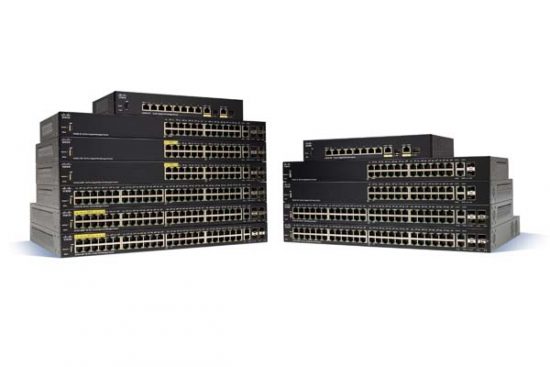
The Cisco Small Business Switching Team is excited to announce the availability of 2.3.5 software release, delivering significant feature updates to the 250 Series Smart Switches. We have added

  • Static routing (IPv4/IPv6)
  • Security with ACL
  • QoS with ACL
  • CLI through Telnet/SSH
  • Dual image
  • Time based PoE and port operation
  • Guest VLAN

If you know about network switches for Small and Midsize Business, you may have heard about “Smart Switches”. These switches are priced very affordably, but provide a web interface and basic configuration options to build your network. Here at Cisco, we have taken smart switches to the next level and provide more capabilities to our Small and Midsize business customers, while maintaining the affordability that people love.

The Cisco 250 Series is the next generation of affordable smart switches that combine powerful network performance and reliability with a complete suite of network features you need for a solid business network. These expandable Fast Ethernet or Gigabit Ethernet switches, with Gigabit or 10-Gigabit uplinks, provide multiple management options, rich security capabilities, fine-grained quality-of-service (QoS) and Layer-3 static routing features far beyond those of an unmanaged or consumer-grade switch, at a lower cost than fully managed switches.

The Cisco 250 series smart switches also support:

  • PoE+ to enable latest wireless access point and cameras
  • PoE input and PoE pass-through for flexible deployment location
  • Smart Network Application for multi device management
  • FindIT Network Manager for on premise and cloud management
  • Network PnP for Zero Touch Deployment
  • Auto Smartport to automatically configure switch ports based on connected devices

With these capabilities, you can set up and configure a complete business network in minutes.

Download the latest software release here.

With this update, we now have 250 series as advanced smart switches and 220 series as basic smart switches. The list price for Cisco 220 series smart switches has been lowered to bring more value. Choose Cisco 250 series to build affordable and easy to use business networking for SMB, and Cisco 220 series for even more budget constraint situations.

The next generation 550X, 350X, 350 and 250 series switches are now replacing the current Cisco 500, 300 and 200 series switches, while the 220 and 110/95 series switches will stay in our portfolio. Learn more about these next generation switches in this video.

Until next time.

Aaron and the Rest of the Cisco Small Business Team

Authors

Aaron Wu

Product Manager – Small Business Switching

Enterprise Infrastructure & Solutions Group (EISG)

Avatar

As of today more than half of the web traffic is encrypted. That’s a big win for businesses and all of us, since it guards against eavesdropping and tampering with content as it moves from device to server and back again.

Of course this rise in encryption comes with one big, obvious downside. Hackers too now use encryption for their attacks, making them harder to spot amidst a stream of encrypted traffic.

Attacks that weaponize two common encryption protocols, Secure Sockets Layer (SSL) and Transport Layer Security (TLS), are on the rise. Some 39 percent of organizations experienced an SSL or TLS attack in 2016, but only a quarter said they were confident they could detect and mitigate them. Beyond this, recent research found that there were twice as many encrypted malware payloads in the first six months of 2017 than the whole of 2016.

In fact, Gartner predicts that in 2017 more than half of network attacks targeting enterprises will use encrypted traffic to bypass controls.

Gartner finds that defense-in-depth effectiveness gaps are being ignored. For example, most organizations lack formal policies to control and manage encrypted traffic. Less than 50 percent of enterprises with dedicated Secure Web Gateways (SWG) decrypt outbound Web traffic. Less than 20 percent of organizations with a firewall, an intrusion prevention system (IPS), or a unified threat management (UTM) appliance decrypt inbound or outbound SSL traffic.

The rapid adoption of cloud apps and services dramatically expands and complicates the IT environment, accelerates SSL/TLS encrypted traffic use, and expands the risk surface for attacker exploitation. Modern applications such as social media, file storage, search engines, and cloud-based software increasingly use SSL/TLS as their communications foundation. Monitoring and scouring these applications and services for malicious content and activity is highly recommended. At minimum, the expanding use of these applications creates more questions about when to strategically encrypt and decrypt

We have attackers preying on the security gaps created by traditional data encryption method, which involves decrypting the data, and this paves way to the attackers to steal your valuable information from the system.

Encrypted Traffic Analytics (ETA) focuses on identifying malware communications in encrypted traffic through passive monitoring, the extraction of relevant metadata elements, and supervised machine learning with cloud based global visibility

Encrypted Traffic Analytics extracts four main data elements: the sequence of packet lengths and times, the byte distribution, TLS-specific features and the initial data packet. Cisco’s unique Application-Specific Integrated Circuit (ASIC) architecture provides the ability to extract these data elements without slowing down the data network.

Encrypted Traffic Analytics also identifies encryption quality for every network conversation, providing the visibility to ensure enterprise compliance with cryptographic protocols. It delivers the knowledge of what traffic is being encrypted and not being encrypted on your network, so you can confidently claim that your digital business is protected.

To learn more, visit cisco.com/go/ETA

Authors

Sabiha Rouksana H.

Security Virtual Sales Specialist

Advanced Threat Solutions

Avatar

[This is part one of a four-part blog series about DevSecOps.]

Today, companies are transforming their business to offer customers connected digital experiences where products and services are increasingly powered by mobile, cloud and data analytics capabilities.  Developers in turn are moving to Development Operations (DevOps) processes to meet the need for greater agility and scale.

In the recent blog, “Who Gives a Cloud?”, Ruba Borno, Cisco’s Vice President, Growth Initiatives and Chief of Staff to CEO discusses the six imperatives every organization should be thinking about when approaching business digitization.  Two of which are Security and Automation.  In this Blog series, we will discuss how DevOps teams can achieve security automation and evolve their practices to integrate security.

Security controls are more and more becoming dynamic where they are context driven based on user, device, location, data and threats to address a changing business landscape and increasing cyber risks. Frequent advisories on critical software vulnerabilities in open source and vendor products is now the norm driving the need for agility in security responsiveness. With the industry transitioning to software defined infrastructure, we have the same opportunity with software defined security to enable security to be nimble and dynamic.

DevSecOps enables security to become a differentiator by bridging DevOps workflows with Information Security (Infosec) Operations to embed security as code, testing and validation during development, and by leveraging automation to run continuous operations.

Cisco Defines and Drives DevSecOps by; 

1) Establishing a DevSecOps Manifesto

2) Running Agile Security Hackathons

3) Enacting Security Guardrails

4) Automating and delivering security as Code via Continuous Security Buddy (CSB)

Establishing a Cloud Security Manifesto

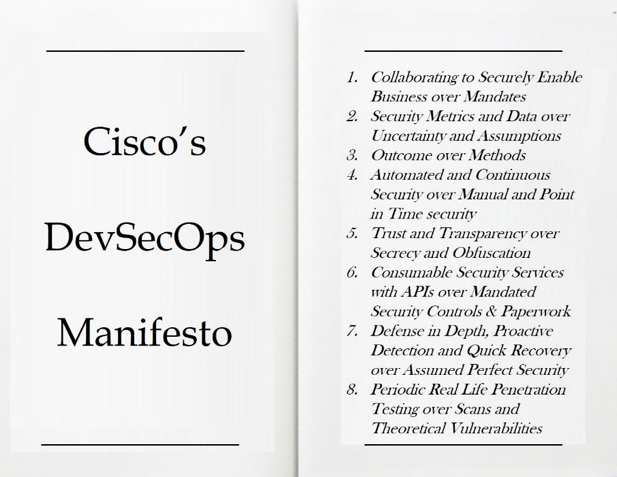
When we engage with our internal business partners, we use clearly defined guiding principles to drive security throughout the process.  This helps establish the mutual trust between the Engineering, Operations and the Security teams. We modified the manifesto provided by devsecops.org to meet our business and security needs.

In summary, the manifesto describes how we approach DevSecOps by:

  • Enabling businesses to address their most critical security requirements over a checklist or security mandates
  • Providing metrics to measure real, not theoretical security risks
  • Defining outcomes and providing the means to achieve them
  • Automating security configurations, testing and validation in the CI/CD pipeline
  • Sharing security information with transparency
  • Ensuring all security capabilities are done via authorized API calls

For security to be continuous it is necessary to balance offensive approaches via secure code, configurations and testing with quick detection and response to operational issues.  While much of this can be automated, we do need humans to conduct real life penetration testing periodically and attend to operational security needs.

In Part 1 of this series, we have established a foundation for DevSecOps practices and in Part 2 of DevSecOps, we will share our practice of running Agile hackathons and building Security Guard-rails. Please stay tuned and in the mean-time we welcome your comments.

Authors

Sujata Ramamoorthy

No Longer with Cisco

Avatar

Welcome to 2018. My predictions consider what’s happening in technology — and how technology is changing society and business.

1. The Internet of Trust Takes Center Stage

By 2020, up to 50 billion devices will connect to the Internet of Things (IoT), generating data and analytics in support of automated and policy-based decisions. These business decisions will become immensely important, shifting the conversation from, “Is the data secure?” to “Is the data correct?”

It’s this nuance—the Internet of Trust—that will enable tremendous gains in IoT in 2018.

Part of the Internet of Trust, blockchain technology will boost IoT in the financial services industry by inherently resisting data corruption. And in global supply chains, organizations will increase traceability, while reducing the import of counterfeit and pirated goods.

The blockchain market size is expected to grow from USD 210.2 million in 2016 to USD 2,312.5 million by 2021.

Defense giant Lockheed Martin has begun to integrate blockchain technology into its supply chain risk management. They’re the first U.S. defense contractor to incorporate blockchain into its developmental processes.

The automotive industry will follow. While we somewhat trust our cars’ GPS systems, we need to 100 percent trust an autonomous vehicles. Will your car “see” those kids walking in the crosswalk ahead of you?

The communication interaction from devices to the vehicle has to be trusted and correct. If that data is manipulated and an accident occurs the potential loss or impact on human life will make or break companies.

The stakes are going to be much higher, and companies are going to begin to differentiate around trust. While security will continue to be important, the Internet of Trust will become the key enabler for adoption and, ultimately, success.

2. The Era of Convergence: Business, Social, and Political

The integration of social, business, and political will force companies to enter into what has historically been considered a “no fly zone.” As competition for technology talent intensifies, silence won’t be an option for businesses.

Keep in mind that by 2020, millennials and Generation Z will dominate the U.S. workforce. Plus, generation Z will make up 40% of all U.S. consumers. The tech industry is heavy with millennials and will also be a draw for Gen Z.

Be warned. They’re one of the most connected, aware groups out there. They’re self-educated, socially conscious, and concerned about the values of the company they work for.

Both groups will reshape the employment landscape due to their convictions and expectations that employers demonstrate similar convictions. One study found that 62 percent of millennials are willing to take a pay cut to work for a responsible company, versus the U.S. average of 56 percent.

Think about how businesses reacted to Donald Trump’s comments about the Charlottesville protests. Leaders from Intel, Merck, and Under Armour each took a stand against the comments. In 2018, and beyond, “taking a stand” will become the norm as companies hire upcoming generations who thrive on a values-driven corporate culture.

To maintain a workforce that will carry them into the future, companies will simply have to listen to their employee base and apply their corporate principles to social and political activities. Silence is no longer an option.

3. Data Has Gravity… Decision Making at the Edge

I travel extensively, and it seems every kid under the age of six has a way of finding me. Doesn’t matter if I’m in coach or first class. They love to show me their “enthusiasm” for flying. The entire trip.

When I realize in the terminal that I don’t have my headphones (yes, it has happened), I become a far different Joseph Bradley than the one looking for a pair of headphones on a weekend.

At the airport, I’m rushing to the nearest kiosk to buy headphones. Any noise-cancelling headphones. Any price. On the weekend, I engage in a conversation at the electronics store, comparing features and the value of available headphones.

Same person. Completely different real-time context. But what happens when real-time context is too late for determining consumer behavior patterns—even enterprise behavior patterns?

That’s where edge computing’s predictive capabilities come in. It’s also why edge computing use cases will pop up everywhere in 2018.

In just two years, 45 percent of all data created by IoT will be stored, processed, analyzed, and acted upon close to or at the edge of the network. And in just three years, 5.6 billion devices will be connected to an edge computing solution.

This doesn’t mean the cloud will go away. It will instead shift from an action-oriented environment to a learning environment. And once the cloud figures out what to do with that learning, it will push the decision making and rules down to the edge, where the edge analyzes real data. Then, the device will make a decision. Pretty nifty, huh?

4. Rise of the Humanities. Don’t Discount Those Philosophy Majors

Have you ever watched young kids, or Generation Z and beyond, do their homework? They’re asking Siri questions such as, “What’s the distance between the Earth and the moon,” or “Where can I find this information?” Artificial intelligence is enhancing their ability to learn and get work done.

This is made possible by a phenomenal growth in computing power over the past 60 years. Meanwhile, U.S. corporations are investing $350 billion annually in education, mostly centered upon STEM.

While these disciplines are important, I predict a rebirth of the Humanities beginning in 2018. It’s no longer just about figuring data. The computing power has the answers. It’s about thinking about how to phrase a problem to understand the question to ask.

For instance, Uber wasn’t about new technology. It was about fundamentally asking a different question about the transportation experience. Taxi cabs had the data to ask this question, but didn’t even consider it needed questioning.

Banks aren’t getting it right, either. They ask, “What account pricing and interest rates are required to increase savings account balances?” Instead, Squirrel (a fintech upstart) asked, “How do I keep savings top of mind, relative to other things in a customers’ life?” Based on this question, they created an entirely new banking model.

Another example? Retailers. They’ve spent a tremendous amount of time focused on reducing line length so customers don’t abandon their carts. Instead of trying to shorten line length, they should be asking how to eliminate lines altogether, à la the Apple store.

In a world where all the answers are known, value is found in knowing what question to ask.

5. Beware of Fools’ Gold. Data Ownership is the Real Gem

Analytics is big business. Worldwide revenues for big data and business analytics will grow from nearly USD 122 billion in 2015 to more than USD 187 billion in 2019, according to International Data Corporation (IDC).

But here’s the kicker. People are realizing that as they begin to perform analytics, the problem isn’t the calculation of the analytics, it’s in not having the data.

In 2018 and beyond, data assets will be the key to success. For instance, if you want to provide a service that predicts when a mobile asset, like a train, is going to fail, you need weather data structured the right way.

Problem is most companies today don’t own or have access to the data they need to solve their most critical and high value problems. Think of service providers offering TV services. At first, it was all about the distribution. Then people began to understand the real value was in ownership of the content. The same will be true with analytics.

Companies will invest in building out and owning data assets. And once they own the data, they’ll know things about their customers that no one else does. Imagine the power these organization will have to deliver exactly what their customers want and need.

There you have it. My five predictions that will reshape how value is created—and determine the winners of the digital age in 2018 and beyond.


Authors

Joseph M. Bradley

Global Vice President

Digital & IoT Advanced Services