Avatar

“You’re doing … what?!  And … where?!  5G?  What’s that? And why in Orkney?!”

Last weekend I took holiday Friday and Monday – including my Cisco “Birthday Day Off”– to travel to Switzerland for some early season skiing with friends.

Neendaz, Switzerland on my Cisco “Birthday Day Off”

Inevitably we talked occasionally about work, and I mentioned I was working on a cross industry/academia/public sector initiative related to 5G.  The aforementioned questions and surprised reactions were indeed pertinent.  The “What is 5G?” question is a good one.  I’ll return to that later, in part 2 of this blog.  The question “Why Orkney?” is key and will surprise many, hence I will address that question in this blog.  First here is a summary of what we are up to.

This past year I’ve been a Cisco board member representative on an initiative called the Scotland Innovation Partnership (SIP) which was set up to tackle some of the challenges of rural broadband, 4G mobile – and now 5G – coverage.  As a team we decided to try to enter the UK Government’s Department of Digital, Culture, Media and Sport (DCMS) “5G Testbed and Trial” competition, which was announced (just!) around the end of October.  After the inevitable moaning about the extremely short timeframes, we rushed – starting with a few members of SIP – to form a consortium  which we decided to call the “5G RuralFirst Partnership”. We expanded the consortium to include some real innovative like-minded and rural-focused organizations. We aimed to deliver a compelling 5G competition entry, which I believe we now have, which was submitted just in time for the December 13th deadline. This blog is my perspective on what has been a very exciting few weeks.

Caveat: This is a Competition and We May Not Win

What I will describe is our proposal entered into the UK DCMS Testbed and Trial competition, and our journey to submission.  My blog should not be interpreted as a commitment that we will bring 5G to Orkney and Somerset.  We will only progress on this ambitious cross industry/academia/public sector collaborative R&D project if we are judged one of the 10 winners of this UK-wide competition.  I expect competition to be tough. Extremely tough.  And if we are not judged as worthy winners, I will still remember these past few weeks as a tremendous learning experience and some of the most exciting weeks of my working life. Oh – I almost forgot – the ski weekend away was pretty exciting too!

The Race to Enter the UK DCMS 5G Competition

In the space of a few weeks, we have formed a wide-ranging consortium – from major high tech companies to public sector organizations to some specialist small and medium enterprises (SMEs) who can deliver very targeted capabilities. We have very ambitious goals to develop and test 5G capabilities.  We have 4 main tracks to our program, one of which involves developing and testing advanced radio spectrum capability in the Orkney Isles, which are located to the north of Scotland in  the UK.  Another track involves examining how IoT and agricultural technology will impact and/or benefit from 5G – and we’ll run some of these tests in rural Somerset in the south western corner of England.

The 5G RuralFirst Partnership I am very happy to say, will be led by Cisco Systems UK & Ireland, and specifically by our Cisco CREATE innovation teamIf (and only if) we are judged one of the competition winners, we plan on (literally!) taking 5G testbeds and trials to diverse and challenging rural locations – from  Scotland’s Orkney Islands to the rolling hills of Somerset in south-west England (and a few other testbeds in-between).  Our goal is to investigate solutions – new technologies as well as potential new business models – to some of the challenges, both technological as well as economic, of rural 5G connectivity.

The Rural Connectivity Market Opportunity:  Solutions and New Business Models

With a world population of 7.6 billion and (only) 3.2 billion connected to the internet, the market opportunity for internet-related services and products is actually greater with people who are unconnected. With approximately 40% of the world’s population living in rural areas, the segment of internet services and products for rural communities – and on transport links to, from and around these communities – is almost certainly one of the biggest internet market opportunities today for innovative and disruptive suppliers. However, it is also one of the most poorly served market opportunities.

With such a huge market opportunity, there is a significant market opportunity for the UK – or it has to be said, another country with challenging rural areas – to become a leader in innovative products and services (such as in 5G spectrum innovation, agricultural automation technologies, and rural industrial IOT) and the necessary enabling business models which make rural internet investments feasible and attractive to public/private partnerships.

(Tweet used with permission – thanks!)

The 5G RuralFirst competition entry will test the viability of using 5G to provide critical connectivity that is sharable, potentially even on a licence-exempt basis.  The challenge in trialling such connectivity is amplified by the geography of Scotland and other parts of the UK, with rugged coastlines, large numbers of Islands, mountainous areas and challenging weather conditions. Here, the cost economics of rural broadband and mobile delivery are not attractive to the free market and therefore become a financial burden on local, regional and national governments who must intervene to make necessary investments.  Hence it could be said that 3G and 4G have at best under-served rural communities – with a notable exception of UK MNO EE’s expansion, driven by public sector investment in connectivity for Emergency Services together with – in my view – a real and genuine ambition to cover 100% of the UK’s geography.  EE as an example, have just this past January (2017), delivered 50 MB/s 4G connectivity to Glencoe Mountain ski centre, a connectivity-challenged, significant tourist attraction which I blogged about in March 2016.

The 5G RuralFirst Partnership – following the charter we developed in the aforementioned Scotland Innovation Partnership – has been formed to kick-start the development of products, services and (arguable most importantly) the new business models which address the challenges and cost economics of rural internet connectivity.  And I’m delighted that we have such a strong partnership, excellent teamwork, vision and identified innovative test cases to make a dent in this huge opportunity.

Let me now introduce a few members of this 5G innovation partnership (next week I’ll publish a full list).

5G RuralFirst Partnership

The 5G RuralFirst consortium contains a diverse mix of academic institutions, major global technology vendors, and small/medium enterprise specialists. Led by Cisco Systems, the consortium includes the following major organisations as “Key Project Partners” who all provide funding if this proposal is one of the winners. In addition to Cisco, we have the BBC, BT, and Microsoft and more as Key Project Partners.

From academia, Key Project Partners include: the Universities of Strathclyde, Edinburgh, Harper-Adams, Heriot-Watt and Surrey, CENSIS and the Agricultural Engineering Precision Innovation Centre (Agri EPI Centre).  This competition is particularly important to our academic partners. If we are judged one of the winners, the grants from the government will enable them to invest in further 5G research,  development and most importantly commercialisation, an area Cisco is looking forward to assist with.

As SMEs (specialist small/medium sized enterprises), key project partners include Broadway Partners (London-based), CloudNet (Orkney), DataVita (Chapelhall), Lime Microsystems (Surrey),  Milkalyser (Exeter), PureLiFi (Edinburgh), Soil Essentials (Brechin, Angus), Zeetta Networks (Bristol), and others. I never thought I’d see Cisco partnering with such a wacky list of partners 🙂 however in the world of IoT, it’s very satisfying to see such small companies in the 5G RuralFirst Partnership.  Indeed I personally hope that our competition entry will provide a platform for these innovative UK companies to showcase their solutions on a global stage.

The DataVita Tier III Data Center in Central Scotland

I was personally delighted when we convinced DataVita to join our team (literally only last week) – a local company I blogged about last year. They are based not too far from the Cisco office in central Scotland and are one of only 3 Tier III data centres in the UK.  With DataVita’s expertise and state of the art, Cisco ACI-enabled data centre, Cisco and the 5G RuralFirst Partnership aim to be the first “production-grade” 5G testbed and trial project in the UK, with deployment in the impressive DataVita data center (again, only if we are one of the winners of the DCMS 5G competition) .

Another particularly interesting partner is Shefa, a subsidiary of Faroese Telecom – which brings tremendous diversity, experience and opportunities for further innovation to the partnership.  I’ve got to say, I was genuinely excited when I heard that Faroese Telecom was joining the team – there is 4G on the Swiss ski slopes (sad person that I am).  I remember flying – sorry struggling – down a black run with “Wow, I can’t believe we have Faroese Telecom on the team” continually running through my mind.  Such diversity is bound to drive innovation! Faroese Telecom will bring strong experience of addressing rural connectivity challenges and will provide the fibre connectivity we need from Orkney to the DataVita data centre.

Finally, we have excellent public sector support – including for example Orkney Islands Council, as well as the Scottish Futures Trust (SFT – a public corporation of the Scottish Government) and the Scotland Innovation Partnership (SIP), who are also key project partners providing funding and/or resources – and indeed SFT and SIP are the genesis of the 5G RuralFirst Partnership.

Why Trial 5G in the Orkney Islands?

Two of the 5G RuralFirst proposed testbed & trial locations: Orkney and Somerset

The Orkney Islands form an archipelago in the Northern Isles of Scotland, situated off the north coast of Great Britain. Orkney is 16 kilometres (10 mi) north of the coast of Caithness in Scotland and comprises approximately 70 islands, of which 20 are inhabited.

Why, then, setup a testbed and run a 5G trial in Orkney? The answer is simple: because it will be a real challenge! Orkney is about as rural as you can get in the UK. It’s not even on the UK mainland, and even only recently was raised in the Scottish Parliament as an example of an area with below average superfast broadband availability, with only 75% of the Islands premises being served by fibre-to-the-cabinet (FTC). Additionally, the weather can be quite wild – which can cause challenges such as out-of-alignment microwave dishes.  It’s also steeped in history and rural beauty and is a lovely tourist destination – although these factors (honestly!) have not influenced out choice of one of our 3 5G testbed and trial locations.

Finally – we really do believe that 5G R&D teams must seriously address rural connectivity challenges right off the bat, so that 5G is not impacted by the same challenges that dog 3G and 4G today.  The SFT-led Scotland Innovation Partnership set that goal very clearly for us, given the challenges of rural broadband and 4G delivery in the UK, and particularly in Scotland.  We are thinking “rural first” – hence the name of our consortium, 5G RuralFirst.

More Next Week ….

It’s been an exciting few weeks.  Coupled with a ski trip and my Cisco “Birthday Day Off”, it will be hard to beat.  I’ll write a part 2 to this blog over the next week or so, to describe more of the 5G RuralFirst competition proposal, and – again only if we are one of the competition winners (caveat caveat!!) – hopefully there will be further episodes of our 5G RuralFirst adventures once the DCMS 5G Testbed and Trial execution phase starts in April 2018.

PS: Another local university, the University of Glasgow, have also formed a consortium and have submitted a 5G competition entry. I’d like to wish them all the best in their bid!

PPS: I do need to apologise to my ski friends, James, Jon and Colin – sorry Patrick (holiday joke :-)) – they say I talked non-stop about 5G last weekend.  I’m convinced that is not true.  However, with 5G (realistically) a few years away from widespread production roll-out, they are sick fed-up of it already 🙂

Authors

Stephen Speirs

No Longer at Cisco

Avatar

I’ve been working on IoT projects since before the Internet of Things became a buzzword. From the beginning, as we were connecting equipment and processes for the first time, we knew we were onto something big.

And big it is. Billions of devices are already connected to networks, and every day millions more are added. Researchers estimate that by year 2025, 20 to 80 billion “things” will be connected, with trillions of dollars in potential value.

Yet, I am not happy with the IoT progress to date.

After more than a dozen years on the IoT journey, the industry is still just beginning to gain momentum. Don’t get me wrong. There are thousands of successful IoT implementations across nearly every industry. For the most part, however, they have focused on incremental improvements mostly by streamlining existing processes to improve productivity or increase profitability.

So why haven’t we seen an explosion of radical transformations, creating new opportunities for people and businesses on a large scale?

In part, IoT’s potential for business transformation has been hindered by several key factors:

Cultural Barriers

In many industries, IoT is often implemented in core business environments and critical infrastructure, making managers wary of radical, large-scale changes. Introducing new technologies and processes can be risky. The upside might bring leapfrog improvements in productivity and profitability—but the potential downside could result in upheaval and chaos throughout the value chain. As a result, organizations often pursue small, low-risk IoT projects or wait until they are ready to install a new assembly line to make it IoT-enabled.

Experienced workers, as indispensable as their know-how is, can also act as a barrier to IoT adoption by advocating traditional approaches that worked for them in the past. And then there remains a long-standing cultural divide between IT and Operational Technology (OT) organizations, which must collaborate at the technology, architecture and even organizational levels to deploy IoT and realize ambitious ROIs. Such collaborations are still fairly infrequent, with joint security architectures as the typical starting point.

Fragmented Markets, Standards, and Ecosystems

IoT is not one market but a collection of markets and submarkets, each with its own set of often competing ecosystems. Many have long-standing traditions of custom solutions, overlapping proprietary or semi-proprietary standards, vertical integration, and limited partner ecosystems—all of which can be barriers to innovation. On top of that, most IoT deployments are in brownfield environments, where new IP-based IoT technologies must integrate with multiple legacy and vendor-specific systems.

A host of standards bodies and consortia are trying to bring order to all of this, but agreeing upon a cohesive set of standards has proven difficult. In manufacturing automation for example, there are a half-dozen ecosystems centered around different standards bodies. Increasingly though, vendors, driven by customers and peers, are beginning to converge key entrenched standards. The industry is also evolving horizontal standards such as Ethernet or IP to meet IoT requirements, including motion and even safety applications.

Immature ecosystems also hamper IoT adoption. Too many vendors are still trying to do it alone, or with just a few entrenched partners. Delivering business-relevant solutions to line-of-business managers requires partnerships of horizontal, vertical and geography-specific specialists, large and small.

Security

Doubts about security can kill an IoT deployment even before it gets off the ground. IoT security has to deal with systems that are more distributed, more heterogeneous and more dynamic than traditional IT environments. For years, “security by obscurity” provided an illusion of impenetrability of OT environments. If you’re not connected to anything, no one can break in. But by its very nature, IoT is connected, so businesses are starting to adopt an architectural approach and best practices (such as  patching, segmentation and role-based policies) that incorporate security into every aspect of a deployment and operation.

Device makers, especially consumer-focused ones, have been the Achilles heel of IoT security. These vendors have often viewed proper security implementations as extra cost, complexity, and time to market burdens with unclear payoff. But recent high-profile IoT security breaches painfully underscored the downside of leaving rudimentary vulnerabilities, such as default names and passwords hard-coded into these devices.

The good news is that after years of under-investment, the security industry is finally focusing on IoT security standards, interoperability and certifications.

The Drive to Transformation

Despite these barriers to massive adoption, we are beginning to see some early examples of new value propositions, new industries and new business models made possible by IoT.

Take new value propositions, such as mass customization and personalization. With IoT and automation, customers can order a car, a suit or just about anything else, and it rolls off the production line made to order at a cost close to the mass-produced goods. For example, Daihatsu Motor Company is using 3D printers to offer customers 10 colors and 15 base patterns to create their own “effect skins” for car exteriors.

IoT has also emerged as a foundational capability that, combined with machine learning, fog computing or blockchain, is creating brand new industries such as autonomous drones. IoT is also a key force behind the convergence of existing industries such as transportation and technology, and retail and manufacturing. And the collaborative, connected nature of IoT is ushering in new business models such as the “co-economy,” based on dynamic ecosystems of partners and customers that bring together their complementary strengths to deliver co-created solutions.

These and many other brilliant glimmers of IoT’s value show what’s possible. As frustrated as I am by the level of IoT impact to date, I am confident the same ingenuity that connected all of these devices will soon allow us to break through the cultural, market and security barriers that have hampered IoT progress. Until that happens, let’s roll up our sleeves and keep working on getting IoT to deliver on its tremendous promise.

This article first appeared in Forbes.


Learn from and contribute to more IoT insights in the new Building the Internet of Things community and newsletter.


Authors

Maciej Kranz

Vice President and General Manager

Corporate Strategic Innovation Group

Avatar

Cisco recently put up an impressive showing at Telecom Asia’s 10th Annual Readers’ Choice & Innovation Awards, to clinch 2 awards despite strong competition. The annual awards ceremony held on November 16 in Singapore, recognizes the advancements and contributions by leading telecom and tech organizations.

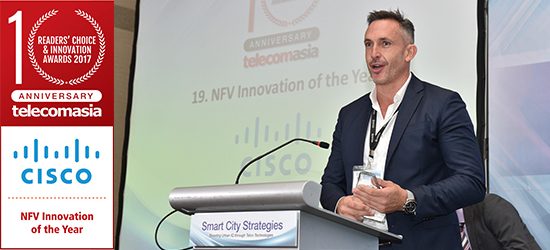
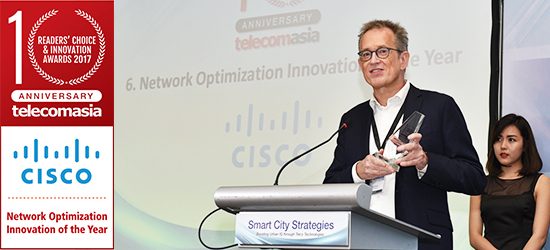
Awarded the NFV Innovation of the Year for our enhanced SDN and NFV Platform for multi-vendor, multi-domain innovation in Telco Networks, and the Network Optimization Innovation of the Year for our Self-Optimizing Network (SON) technology, the wins are an acknowledgement of Cisco’s recent innovation in software solutions which simplify, automate and virtualize service provider networks.

Award recipient of NFV Innovation of the Year: Mr Andrew Eaton – Director, Cisco Systems

The Cisco SDN and NFV Platform, is already simplifying multi-vendor NFV implementation for service providers (SPs). With our first-generation Network Services Orchestrator (NSO) platform release, we’ve enabled several SPs to achieve greater speed, business agility and operational efficiency through network automation. They are now able to accelerate service delivery from months to minutes, bringing services to market ahead of the competition. In turn, their customers are enjoying faster access to customized offerings. And now, with our second-generation platform, we continue to innovate by adding core function packs and modules that further reduces deployment times and costs, for a higher return on investment (ROI) and an even faster time to market required in the upcoming age of 5G and IoT.

Award recipient of Network Optimization Innovation of the Year: Mr Dirk Wolter – Managing Director, Cisco Systems

Similarly, Cisco’s SON technology is enabling massive growth in Asia’s mobile data networks with multi-vendor, multi-technology Radio Access Network (RAN) automation. In India alone, Cisco’s SON is maintaining over 200,000 2G, 3G and 4G cells, with this number set to double in the next two years.

By helping operators improve network performance and availability, our SON technology has become key in the race for faster site expansion, automated optimization and enhanced user experience. Customers can now enjoy higher data speed, improved voice call quality, less dropped calls and more reliable connectivity – all amounting to a superior mobile experience. Due to its rich roadmap, Cisco’s SON has established itself as the preferred SON vendor across Asia Pacific.

The wins are a testament to the strength and diversity of Cisco’s innovation and leadership in Asia Pacific. They mark our goal to meet changing market needs and technology trends, and deliver truly future-proof solutions to our customers. By helping SPs to simplify, automate and virtualize, I believe Cisco is poised to answer the call for greater efficiency and revenue growth, as we head into the 5G era.

Learn more about our 5G solutions here.

Authors

Chris Heckscher

Vice President

Global Service Provider

Avatar

It’s been a big year for Customer Success as we’ve seen a greater share of Cisco partners get started with implementing a practice within their own organizations. The reasons to do so are powerful: according to Gartner, companies that prioritize the customer experience generate 60% higher profit than their competitors. Customer Success initiatives also lead to stronger sales and increased customer retention and loyalty. But creating a culture of Customer Success doesn’t happen overnight, and keeping a program going strong is no easy feat either.

To help Cisco partners navigate the challenges, we established our SuccessTalk webinar series a few years ago, tapping into the expertise of business leaders around the world, including Cisco executives and other industry experts from organizations such as TSIA.

SuccessTalk Rewind: Watch highlights from 2017 webinar sessions

In reflecting on all the valuable advice these leaders shared in 2017, we’ve captured the most memorable quotes and takeaways from our top 10 webinars this past year (rated by 1,000-plus attendees). Here are just a sampling of some of their “words of wisdom”:

“Customer success is a service capability with a sales result.” — Phil Nanus, VP Research & Customer Success, TSIA
From the webinar: Making the Case for Customer Success 

“Today’s customer expects an immediate response, and they expect to receive highly personalized, real-time, useful content at the right stage of their journey. They are much more self-serve.” — John Stone, Senior Manager, Digital Experience & Analytics, Cisco

From the webinar: Getting Your Customers to Take Notice

“Digitization is breeding savvy, self-empowered buyers who increasingly turn first, if not exclusively, to digital channels when they are evaluating products and services.” — Curt Rask, Manager, System Engineering, Cisco

From the webinar: Customer Success – The Inside Sales Toolkit

If you’re really going to go in and talk to that customer, you have to understand where they are going, where their pain points are, and where their road map is so you can help them along that journey.” — Teresa Lewis, Global Enablement Manager, Cisco
From the webinar: Prioritizing Product Usage for Collaboration

Many businesses still view data as a byproduct of their transactions, rather than as a strategic asset.” — Sanjiv Patel, Director, Data Science, Cisco
From the webinar: Data Intelligence in a Virtual World


We’re honored to have had so many experts weigh in on the importance of Customer Success, and to have so many partners engage in dialogue with us during SuccessTalk sessions this past year. If you missed a few of the webinars, check out our SuccessTalk Rewind page for 2017 highlight reels.

Also, as you plan ahead for 2018, we hope you’ll take advantage of SuccessHub. In addition to all of the tools and complimentary resources available, we’ve just added a Top 10 Countdown of our 2017 SuccessTalk sessions as well as a video interview with a panel of experts, featuring their top tips on Customer Success, and how to start strong in 2018 – you can view both here.

Authors

Scott Brown

Senior Vice President

Global Virtual Sales & Customer Success

Avatar

Guest blog by:
Jacob McGill
Network Automation Engineer
Network to Code

Ansible has quickly become a popular platform for network engineers to get started with network automation and eliminate repetitive day to day tasks. There have been Ansible plug-ins (in the form of modules) for Cisco IOS, NX-OS, and IOS-XR for quite some time, but only recently has support been added to Ansible for Cisco Application Centric Infrastructure (ACI).

In the latest Ansible release (version 2.4), thirty-two (32) Cisco ACI modules were added to Ansible core. This means you get this functionality as soon as you install Ansible! These modules allow you to manage ACI fabrics just like you’d manage any other device type with Ansible–through the use of resource-specific and idempotent tasks including one module that allows you to send any arbitrary JSON/XML object to the APIC.

Let’s take a look and see how to get started with these modules.

Basic Intro to Ansible

If you’re new to Ansible, you only need two things to start automating with Ansible: an inventory file (contains what devices you’re automating) and a playbook (contains your automation instructions).

ACI Inventory File

Our sample inventory file looks like this and it’s just pointing to the public always-on APIC Sandbox environment:


As you can see, it’s literally just one line in a text file. Note, in our example, we’re storing credentials in the inventory file as it’s the quickest way to highlight what Ansible can do for ACI. For production, you may want to check out Ansible Vault or Tower.

ACI Playbooks

Ansible uses playbooks written in YAML to define the tasks we want to execute against an ACI fabric (in this case). The playbook also defines which devices those tasks will be executed against.

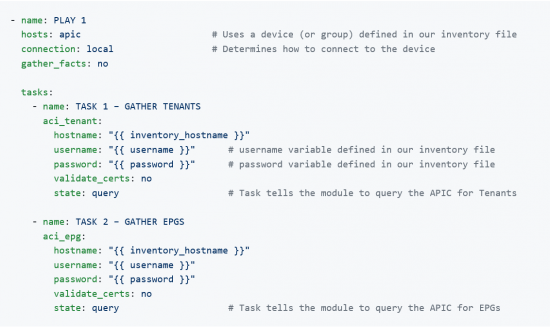
Here is a sample playbook that we use to retrieve tenant and EPG information from an existing ACI fabric. Note that many modules in Ansible support the state parameter with the values of present and absent, the ACI modules support a 3rd value called query that allows us to simply query and retrieve information for the given resource. In this context, a resource is either tenant data or EPG data.

Executing the Playbook

You then invoke this playbook from your Linux terminal by using the ansible-playbook command and passing the inventory file and playbook file:

Note, we’ve add the -v verbose flag as this allows us to see the data being gathered from each task. You can subsequently write this data to a file using the copy or template modules to create nice automated reports.

Using ACI Resource Specific Modules

Now that you have an understanding of how to use and create a basic playbook using ACI modules, let’s take a deeper look. As stated already, the ACI modules support three state values:

  • present – ensures the object exists and is configured per the task’s parameters
  • absent – ensures the object does not exist
  • query – retrieves configurations and state for the object or object type

The query state considers all ACI class parameters and returns the most specific results based on the parameters that are passed to the module.

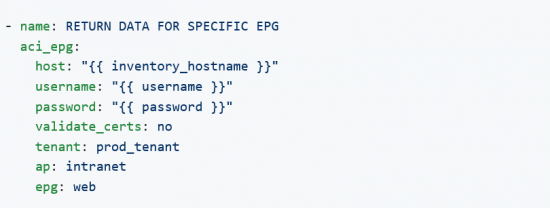
For example, this task will return just the data on the specific EPG called web:

This task will return all EPGs in the specified Application Profile, intranet, since the epg parameter is not provided:
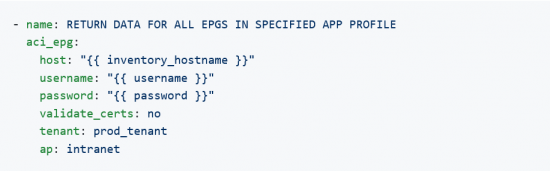
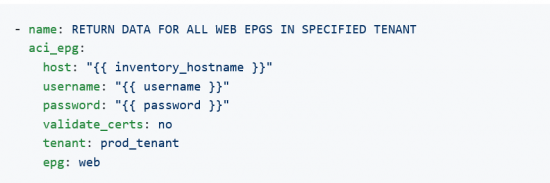
This task will return all “web” EPGs in the specified Tenant regardless of Application Profile since the ap parameter is not provided:
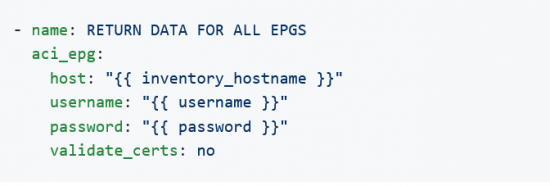
This task will return all EPGs configured on the APIC since it does not pass any ACI class parameters:

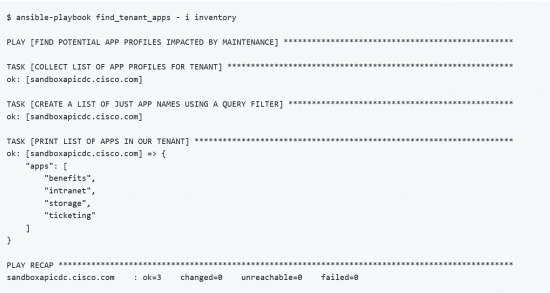
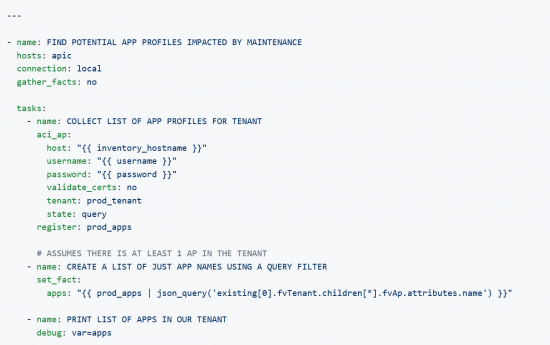
Each of the possible combinations have potential use cases; we will look at gathering all App Profiles for a specified tenant. This data could be useful to gather potential impacted Applications for a maintenance window. We will use the aci_ap module to collect the data, the set_fact module to extract just the useful data, and the debug module to display the App Profiles.

From the terminal, we can invoke this playbook and see the list of apps for the “prod_tenant”:

Note, in this case, we did not need to use the -v flag to see the data collected as we registered and saved the return data, massaged the data to just get the app names, and then printed them using the debug module.

The results from this execution show 4 apps belonging to the tenant, e.g. benefits, intranet, storage, and ticketing.

So far all we did was gather data simply because it’s a great way to start automating and many examples out there only focus on configuration. However, all you would need to do is change the state parameter to present to ensure a given configuration exist making it quite easy to either configure, un-configure, or simply query and fetch data from an APIC.

Finally, let’s take a look at the aci_rest module.

Using ACI REST Module

The aci_rest module allows us to make any request to the APIC. The previous modules were resource-specific, .e.g they’re purpose built for a given object like tenants, EPGs, contracts, filters, etc. The aci_rest is a “catch all” that allows you to make ANY API call, but it does require you to fully understand the API and the ACI object model.

We will focus on making GET requests, but if you start to use this for POST requests, the body can use YAML syntax if that is preferred over JSON or XML.

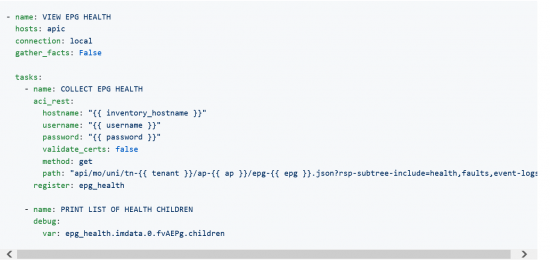
One of the extra abilities we get with the REST module is the ability to query for health, faults, and event-logs using query filters:

This playbook uses variables for the path as indicated by the double curly braces ({{ variable }}). We will pass these variables in as we call the playbook from the terminal as Ansible extra vars using the `–extra-vars command line flag.

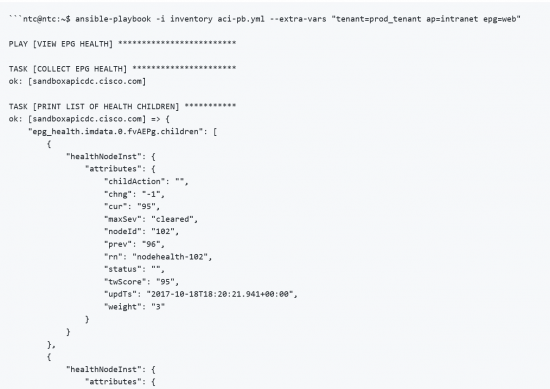
Let’s take a look:

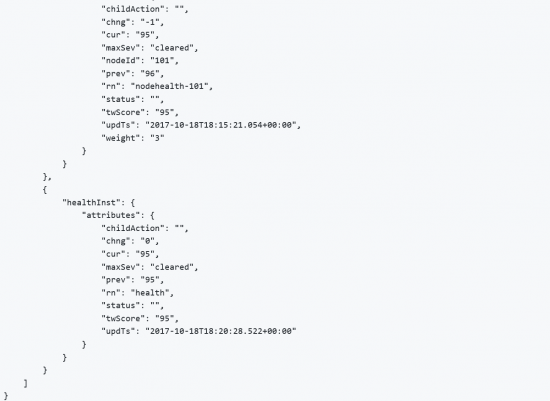
This example only had children for the “health” filter, so that is all that is returned. The EPG has a health score of “95” as do 2 of the nodes that have End Points connected to them; likely their is a minor issue with those two leaf nodes.

As you can see, the aci_rest module provides full access to the APIC REST API, but the downside is that it requires the user to know how to build the URL, including any query strings that help narrow the returned data.

This was meant purely to whet your appetite with getting started with Ansible to automate your ACI infrastructure. There is no need to be in the APIC GUI clicking around when you can leverage a platform like Ansible.

Interested to learn more? Check out the Introduction to using Ansible to automate ACI DevNet Learning Lab.


We’d love to hear what you think. Ask a question or leave a comment below.
And stay connected with Cisco DevNet on social!

Twitter @CiscoDevNet | Facebook | LinkedIn

Visit the new Developer Video Channel

Authors

Hank Preston

Distinguished Architect

Learn with Cisco

Avatar

Guest blog by:
Ajay Chenempara
Senior Network Automation Engineer
Network to Code

If you were to tell your cloud or server admin friends that in this day and age you have to manually configure every switch as you un-box and deploy them, you’ll probably get expressions that range from sympathy to disdain.

Thankfully, you don’t have to put up with that when you’re using Cisco Nexus switches. In fact, there has been a feature that helps with bootstrapping devices on NX-OS for years. It’s just not that widely known. We plan to change that! This particular feature, Power On Auto Provisioning (POAP), is available on all Cisco Nexus switches and empowers data center network engineers to provision brand new switches automatically without ever using a console cable anymore!  And now there’s a new POAP learning lab on DevNet to help you up the learning curve quickly.

Power On Auto Provisioning – Enabling zero touch provisioning for data center switches.

With POAP, the brand new switch boots for the first time (or with an empty startup config), get’s an IP address via DHCP, figures out the appropriate OS/image needed to meet requirements, downloads this image, downloads the desired configuration, reboots and comes up with the desired configuration and image. Sound pretty cool? It should be because the switch comes up ready and configured to production standards – all this without any human logging in to the device!

Let’s explore the technology and a sample workflow that makes this magic happen.

Kicking off things with DHCP

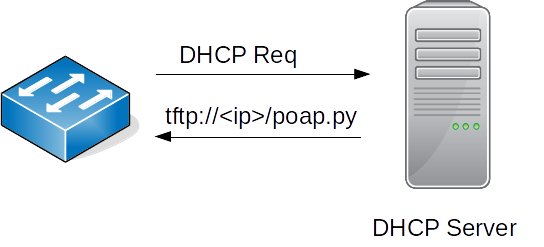
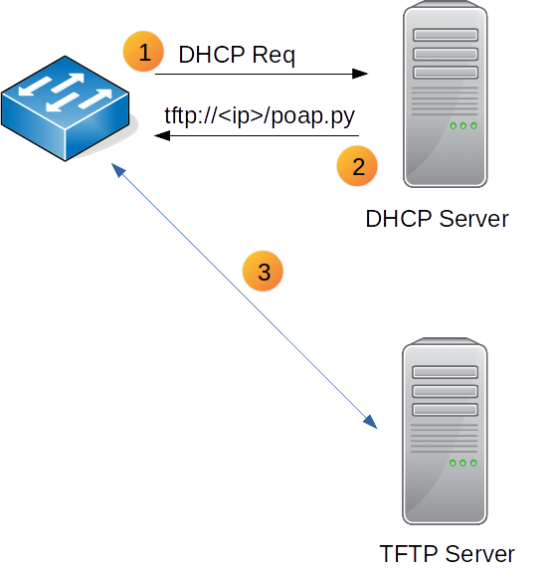
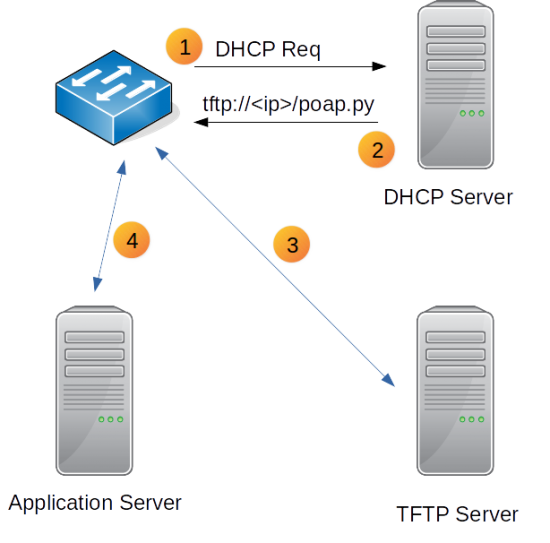
One of the first things a brand new switch on boot does, is make a DHCP request. The DHCP server receives the request and based on the source mac address, assigns the device an IP address. In addition to assigning an IP address to the device, the DHCP server’s response contains the name of a Python(or TCL) script in option 150/66 along with the IP address of a TFTP server to download the script from.

Passing the baton from DHCP

The switch now reaches out to the TFTP server and downloads the Python file from the TFTP server and executes it.

Note that you as the operator have full control of building the script and making sure it has the logic you desire. A sample implementation could be as follows:

  • The script executes some basic device identification commands locally (such as show commands collecting the MAC or Serial Number of the device).
  • It then sends this information in a HTTP request to an internal application server.
  • The application server then uses this identifier receives in the HTTP POST, to generate specific configuration for the requesting device (possibly using the Python Jinja2 library to render the configurations).
  • The application server also provides the the image/OS version information expected to be running on the device.
  • The name of the rendered configuration file, the expected system image and the server/protocol details to download the image and rendered configuration are passed back to the switch.

Download and install

The POAP script that initiated on the switch receives OS, configuration file details and download instructions from the application server in the prior step. It first checks if the image currently running on the device matches the image instructed by the application server. If there is a difference, the switch uses the download instructions provided by the response, to connect to and download the desired image from the file server. Then, the switch downloads the desired configuration and copies it to the startup config of the device.

Reload and we’re done!

At this point the switch has downloaded the desired image and configuration. It then reboots into the new image. The desired configuration loads into running from the startup. With no human intervention (other than switching it on), the switch has automatically been provisioned with the correct image and the desired configuration. So next time you run into your cloud admin friend, hold your head high! Zero touch provisioning…pffft… of course our network can do it.

Try it yourself in the new poap learning lab on DevNet.


We’d love to hear what you think. Ask a question or leave a comment below.
And stay connected with Cisco DevNet on social!

Twitter @CiscoDevNet | Facebook | LinkedIn

Visit the new Developer Video Channel

Authors

Hank Preston

Distinguished Architect

Learn with Cisco

Avatar

After decades of struggle and disappointing results, Artificial Intelligence (AI) is finally coming into its own. Recent advances in computational power, mathematical refinements enabling the creation of much deeper neural networks, and dramatic improvements in techniques used to train machine learning systems have all combined to create applications with real practical value. IBM’s Watson beating the Jeopardy! champions, and Google DeepMind’s AlphaGo beating the highest ranked world champion Go player are two recent high-profile examples.

But what is Artificial Intelligence? In the broadest terms, AI is the attempt to create human level intelligence in machines. This is not something we’ve achieved and some argue we never will (though I wouldn’t bet against human innovation). Nevertheless, AI research has spawned many subfields like computer vision, robotics and natural language processing. Many of these fields make use of Machine Learning.

Machine Learning is easier to define. A machine learning system is one where the output or performance of the system improves as more data is given to it to process. Machine Learning systems are not programmed with specific logic like traditional computer systems. Instead, they identify relationships and patterns in the data, build a model of the problem and use the model to make predictions on new data. Contrast this with data mining which shares some techniques with machine learning but with some significant differences. Data mining uses pre-programmed techniques to identify patterns in the data in a human-directed effort to find meaningful insights. A Machine Learning system does not require either the programming or human direction to produce its output.

The United States Congress recognizes the need to better understand Artificial Intelligence and its impact on society. Senators from five states have drafted a bill to establish a committee on Artificial Intelligence to advise the government on how to implement, regulate and promote the development of Artificial Intelligence.

Artificial Intelligence is currently seeing everyday use in applications as diverse as speech recognition, sentiment analysis and language translation (natural language processing), computer vision and image recognition, autonomous vehicles and recommendation engines. It is a rapidly-growing area, being evaluated for a broad array of use cases across consumer, enterprise, and government markets.

In tandem with this transformative process is the need for industry standards for benchmarking hardware and software systems and how they handle different workloads. These standards are used for comparison between systems, and more importantly, create benchmarks that are used to drive innovation, fueling an iterative process resulting in higher performing systems at lower cost and more efficient energy usage. The unique qualities of AI introduce new challenges, in particular, how to characterize performance and total cost of ownership (TCO). As such, it is critical for organizations like the Transaction Processing Performance Council (TPC) to develop standards that can be used by vendors, customers and researchers.

To this end, the TPC has announced the formation of a new Working Group (TPC-AI), and I am honored to have been elected chairman. The TPC-AI Working Group is tasked with developing industry standard benchmarks for both hardware and software platforms associated with running Artificial Intelligence based workloads. We will be working to define a level playing field for vendors, identify the areas with the greatest potential for improvement through performance optimization, and understand what are the key factors for customers when making their purchase decisions.

I encourage organizations that are interested in participating in the benchmarking development process to join the TPC.

Thank you,
Raghu Nambiar (Chairman, TPC AI)

Authors

Raghunath Nambiar

No Longer with Cisco

Avatar

When discussing next-generation architectures with our Service Provider customers, I am often asked  how they can have silicon diversity for roles in their network, but maintain common operational model, carrier-class features and performance.

The IOS XR offers just that. It runs on Cisco and merchant silicon across a rich variety of form factors. In a previous blog, I discussed the ASR 9000, today I’d like to highlight how IOS XR works some of its magic on merchant silicon.

Before getting into the details, let me share that NCS 5000 and NCS 5500 are actually not the first systems to run IOS XR on merchant processor ASICs. Other routers in our portfolio also use discrete merchant components, so the team has long experience developing software capabilities beyond what is commonly available in standard libraries.

As an example of IOS XR innovation and fine tuning that extracts maximum performance from forwarding silicon for real-world use cases, my team has been working hard on fast convergence since we first shipped the NCS 5500 series, and now we are proud to share the results – a 10-fold improvement in fast convergence. This means our customers have Carrier-Class fast convergence characteristics on the Cisco NCS 5500, thanks to the performance of and optimizations in IOS XR.

Need for Fast Convergence in Merchant Silicon

Many merchant network processors were initially designed for data centers. So, specific ASIC characteristics such as table sizes and forwarding capabilities were focused on switch use cases. For example, Forwarding Information Base (FIB) sizes were often limited to 32-128K entries. At that scale, how fast you program the ASICs forwarding tables isn’t critical.

With NCS 5500, however, we support a broad set of use cases and multiple roles in the Service Provider network, so we had to address some of these silicon design trade-offs. Coming back to the FIB size, we extended in two ways – adding an external TCAM, which enables up to 10M routes on some cards and optimizing label storage on-chip.

Now, with the increase in hardware FIB scale, there was a need for faster programming of the forwarding tables, which is the key platform-specific component of fast convergence.

In response, the team developed a comprehensive set of innovations in our forwarding code, specifically how routes and labels are organized in software and downloaded by IOS XR into the silicon.

Thanks to this work, we were able to deliver a 10-fold improvement in Fast Convergence times in real world deployment.

This has already proved beneficial to our customers. One of our major SP customers made the decision to build their next generation mobile core network with Cisco Segment Routing technology on the NCS 5500 series. Because they wanted their new infrastructure to support upcoming 5G use cases, they needed sub-second convergence with SR and LDP interworking. This was a great opportunity to apply our innovations and demonstrate that we could deliver the type of sub-second convergence the customer was used to, but on merchant silicon.

Thanks to the power of the IOS XR, we have amazing convergence performance on the merchant silicon based NCS 5500 router portfolio. While merchant silicon presents new and different design trade-offs, this is another example of how IOS XR delivers the best system and software innovation enabling us to get the best out of our customers’ choice of silicon.

Authors

Sumeet Arora

SVP Engineering

Core Software Group - US

Avatar

Aside from scuba diving and working with Cisco customers to improve cyber resiliency, cooking is one of my greatest passions.  My favorite dishes are a fusion of the best ingredients, each complementing the other and accentuating the right flavors to achieve culinary heaven.  You see, if you stick with one ingredient, you are stuck with one flavor profile and the dish is left bland and unmemorable. It’s a similar issue with diversity in the cyber profession.

Decades of a male-driven business environment have led to a repetition of the same mindset, narrowing the capabilities of companies to “be more” and limiting their potential. The tech industry, and specifically cybersecurity, has historically been dominated by men. I know this, as I’ve been in the high tech space for over 30 years and have seen many male figures influence business, have the ultimate decision-making power, and accept or override the innovative thinking of individuals across their organizations.

Fortunately, I’ve had the privilege to be surrounded by amazing women throughout my career, influencing, motivating and rooting for me along my professional journey.  In fact, I wouldn’t have entered the cybersecurity space had it not been for my good friend and mentor, Rebecca Jacoby, SVP Operations at Cisco.  She encouraged me to consider the Chief Information Security Officer (CISO) role as an opportunity to rotate in the field and apply my skills and leadership traits to the explosive and unpredictable field of cybersecurity. Needless to say, that nudge shifted the direction of my career, introducing me to many humbling, empowering and motivating experiences.

However Rebecca wasn’t the only female leader that influenced my career.  If I hit the rewind button back to my early 20s, when I was just starting off in high tech, it was a female manager who, while developing my early career, also held me to the same expectations as that of the older and more experienced peers, helping me develop the skills, confidence and poise to succeed. When I decided it was time to shift my career in a new direction, another strong woman took a chance on me, seeing something in me that she later said – “I knew you would not let yourself fail.”  This knowledge, mentorship and guidance shaped the direction of my career and molded my leadership approach.

It is these valuable relationships that encouraged me to reflect internally, to understand and empathize with others, and to tap into my hibernating strengths as well as the best of those around me. Absorbing and learning from diverse perspectives and mindsets not only bolsters my own ongoing professional evolution, it also enables my team as a whole to excel and reach greater goals.

In the presence of these strong female mentors and partners, I learned the value of building partnerships and alliances that prompt teams to overcome any obstacles, ultimately instilling in me the power of an “us” mentality, which today is the pulse of the InfoSec team at Cisco. The more I evolved throughout my career, the more this approach became a personal conviction and a conscientious pursuit for myself as a manager. You see in cybersecurity, partnerships, puzzle-solving mindsets and behavioral analysis are critical factors in dealing with an evolving threat landscape.  It is only when we embrace diverse perspectives that we are able to truly cultivate a more inclusive environment that helps each and every one of us become better individuals and cybersecurity professionals.

Cisco has a great culture in supporting and encouraging change, enabling people to connect with each other in different ways. The Women in Cybersecurity Community is a torch of Cisco’s efforts to drive gender diversity and carve paths for women to take on cybersecurity careers and excel in their journeys, ultimately shaping a stronger cybersecurity team and industry. Women have always been the secret to businesses’ success, but it’s long overdue that we move them into the spotlight to take their rightful role in business.

This isn’t solely a women’s fight, we are all in the same boat and must go beyond talking about what’s right — we must chase it, embrace it, and cement it into our standards. Men have a responsibility to advocate for the advancement of equal opportunity.  Cisco’s Men for Inclusion, an initiative I co-sponsor, embodies this responsibility, with a network of male leaders driving efforts for an inclusive environment that fosters a sense of belonging for everyone and ultimately embraces all of our differences to establish a stronger Cisco. It’s through this understanding and empathy that we can drive positive change and reshape norms.  The advancement of diversity cannot be an accidental occurrence but a conscientious choice that we make and live by.  To all decision-makers, I say it’s time you make a choice – the right, smart and only choice.

Authors

Steve Martino

No Longer with Cisco