Avatar

This post was co-authored by Rajesh Shroff 

66 years in the making!

It sounds like a long time, but first we had to wait for a few milestones to precede us:
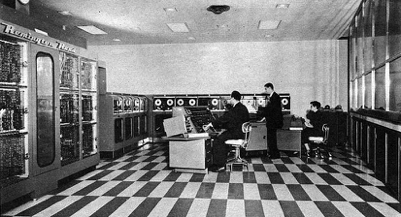
UNIVAC I
  • 1951 – UNIVAC pioneers use of magnetic tape for storage
  • 1993 – Severe Tire Damage is the first band to live stream
  • 2007 – Netflix launches their streaming media business

and finally,

  • 2017Cisco & MapR achieve a SPEC SFS world record for streaming workloads


The Data Age

That’s some pretty impressive company.  Why is this particular benchmark result so significant?

Because data is the lifeblood of business.  According to IDC, we’ve entered the Data Age: The world’s data will double every two years for the next decade.  How companies store, manage, access, and deliver hypercritical data will determine winners and losers.

But such volume of data cannot be easily managed with conventional systems.  As data-driven businesses gain prominence, demand is growing for integrated solutions encompassing high-density storage, powerful compute, and improved scalability:

  • Enterprises are collecting and storing more data for longer periods to support predictive analytics.
  • Data is classified by “temperatures” (hot/warm/cold) for dynamic data tiering.
  • Decision makers want to access and analyze data for real time insights.
  • But traditional storage arrays are expensive and don’t easily support large scale-out landscapes.


A New Approach to Software Defined Storage
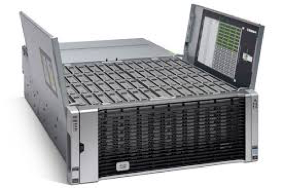
That’s why Cisco developed the UCS S3260 Storage Server, a modular architecture designed to deliver efficient, industry-leading storage for data-intensive workloads.   And that’s why we’re partnering with MapR to provide a complete end-to-end software defined storage solution.

Our S3260 Storage Server offers the industry’s best performance in a compact 4RU form factor.  It supports either Scale Up (expandable to 28 drives/node), or Scale Out (easily adding multiple nodes to your integrated infrastructure), and is a proven Hadoop platform.   MapR-XD provides a highly reliable distributed data fabric with enterprise-grade features such as Global Namespace and Multi-temperature store.


We Blew It Away
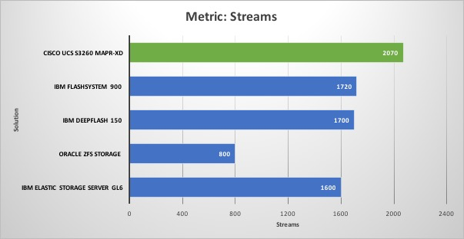
Our SPEC SFS world record demonstrates the performance of the S3260 with MapR-XD.

SPEC’s benchmark suite is the standardized method for evaluating performance using file server throughput and response time.  We ran the Video Data Acquisition (VDA) streaming workload because it simulates applications that store data acquired from temporally volatile sources such as surveillance cameras.

Cisco and MapR have been setting records since we published the industry’s first Big Data benchmark in 2015.    But this was the first SPEC SFS benchmark on a HDFS (Hadoop file system) compatible platform.  Together, Cisco and MapR blew away all previously published SPEC SFS benchmarks:

2070 streams with an overall response time of just 12.94 msecs!

You can read the complete, audited benchmark report here.


Back in the Real World

But companies don’t run benchmarks for a living.   What’s this mean for our customers?

Referring back to our data delivery milestones, the UCS S3260 Storage Server is perfect for modern data-intensive workloads like big data and video steaming.  Analytics and content distribution applications require both simultaneous scalability and high performance.  This need is ubiquitous in industries as different as video surveillance and entertainment.

Remember the frustrating mid-movie buffering we put up with back in 2007?  Yesterday I watched Sunday Night Football’s live stream on my laptop connected to the Cisco network without so much as a hiccup.

Nor did I expect one.  We’ve become accustomed to a right-now world.  We generate and consume more data in real time today than ever before in history.  As our demand for storage capacity and performance in this Data Age continues to increase, we’ll want greater density and higher performance at lower costs.

Cisco and MapR deliver on those expectations.   The innovative, modular design of our UCS S3260 Storage Server allows independent refresh of compute, storage, and network.  And it scales to over ½ PB.   Like the rest of Cisco’s Intent-based Data Center portfolio, the S3260 benefits from profile-based management, 40gE speed, and best-in-class Security to create the most flexible, programmable, cost effective infrastructure you can deploy.

Click here to learn more about how the UCS 3260 Storage Server can benefit your Data Center.

 

Authors

Brian Ferrar

Enterprise Marketing Manager

UCS & Data Center

Avatar

Celebrating a major victory is a ritual that organizations do all over the world. Whether it’s an innovation breakthrough, a landmark customer win or reaching a significant milestone on a critical project, the opportunity to pause and savor the accomplishment underscores its importance and reinforces the values of hard work, creativity and daring to dream big.

I recently had the chance to celebrate what actually makes these accomplishments come to life – the people!   During my organization’s quarterly all-employee meeting yesterday, we unveiled our inaugural Impact Award winners. These are the individuals and teams who through creativity, drive, and collaboration, made a positive impact on our partners, customers and Cisco.

As Cisco’s partner organization has evolved to keep pace with the needs of our partners and customers, we re-tooled our internal recognition program to celebrate achievements around these six areas:

  1. Simplicity – making it easier for our partners and customers to do business with us.
  2. Alignment – increasing alignment between partners and the Cisco field so partners can have more sales impact and move faster.
  3. Value Exchange – evolving our programs and incentives so they are current and commensurate with today’s software and digital landscape.
  4. Growth – helping partners build connections across the ecosystem and capturing new growth opportunities e.g. lifecycle, software, etc.
  5. Influence – creating unmatched advantage in support of either our partners, customers or Cisco.
  6. Innovation – creating breakthrough new ideas and approaches that lead to a significant and positive impact on our partners, customers and Cisco.

The contributions from the 24 people who garnered an Impact Award were amazing. I’d love to share them all, but you’ll have to trust me – they all demonstrate their commitment to helping you, our partners, succeed and to helping Cisco build an even better partner program.

Please join me in congratulating our inaugural Impact Award winners.

Wendy

If you are not a partner with Cisco, learn how to get started today.

Questions or Comments? Feel free to connect with me on Twitter.

Authors

Wendy Bahr

No Longer with Cisco

Avatar

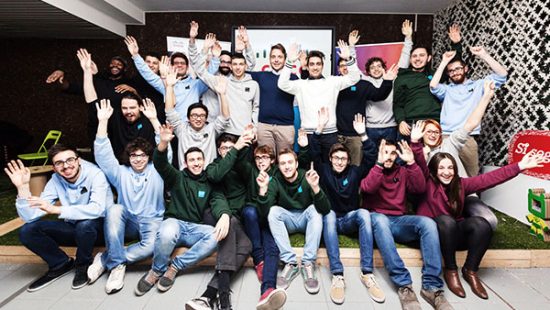
Digitizing a country is not an easy task. However, Shri Narendra Modi, Prime Minister of India, wants to make this real for his country to bridge the digital divide and drive growth in the country. The Smart India Hackathon 2018 is a unique initiative in its second year.  Its goal is to ignite the creativity of student talent and build digital technology innovations for solving real challenges faced by the country.

Cisco DevNet is partnering with the Inter Institutional Inclusive Innovation Center (i4C), and Persistent Systems to sponsor this hackathon. DevNet will offer students learning resources and expert help around Cisco’s industry proven platforms that can be leveraged to solve country obstacles. Cisco Spark, Meraki, and IoT platforms provide functionality like bots, location scanning data, and connected city information that could be applied to a specific need.

[Updated 3/27] We are excited to see 14,887 great proposals that were submitted during SIH2018 to solve 1060 problem statements. The DevNet team is looking forward to meeting you at several in-person Hackathon centers. If your proposal is selected for an in-person Hackathon, Cisco DevNet offers industry proven APIs and Platforms that you can use for your solution. We noticed that a lot of problems involve creating an app to digitize an existing service government provides to its citizens. Experience with these apps could be enhanced using Cisco Spark text-based conversational Chatbot to easily simulate the human response for faster customer service. Watch the latest video from Tessa Mero, Developer Evangelist, Cisco DevNet, Zero to Chatbot workshop using Cisco Spark. If you decide to use a Cisco API for your final solution, submit your proposal here and get Cisco DevNet Expert help.

Cisco DevNet aims to help our community with their need to learn, code, get inspired and connect with other like-minded members. For Smart India Hackathon, here are two amazing Facebook Live sessions that we hope inspire you to learn more about Cisco APIs and platforms. Check out:

All India Council for Technical Education (AICTE) reports that only 33% of the 2million plus students graduating every year get placement. We want to make it easy for students to differentiate themselves by having key industry expertise and help digitize their country with the new skills they’ve gained.

Smart India Hackathon participants can go here to learn about these Platforms and APIs. They can also qualify to win DevNet Expert Help if using a Cisco API for their solution. Get started now!


We’d love to hear what you think. Ask a question or leave a comment below.
And stay connected with Cisco DevNet on social!

Twitter @CiscoDevNet | Facebook | LinkedIn

Visit the new Developer Video Channel

Authors

Shubha Govil

Director, Product Management

Cisco DevNet

Avatar

We live in a digitally connected world where anyone can be a global problem solver, addressing critical issues like unemployment, hunger, poverty, climate change, and income inequality. By combining the power of technology with innovative, entrepreneurial, and passionate people, we can accelerate solutions that create positive and lasting change.

Last year, Cisco set an ambitious new goal: harnessing the power of global problem solvers to positively impact the lives of one billion people by 2025.

We set out to achieve this goal and make this impact in three ways:

  • First, we want to help people build the technology and business skills needed to lead, innovate, and create in the digital economy
  • Second, we invest in breakthrough, early-stage, technology solutions that address social and environmental challenges and have the potential to be scaled, replicated, and sustainable
  • And third, we work with governments, educational institutions, nonprofit organizations, and other partners to support progress and drive inclusive growth

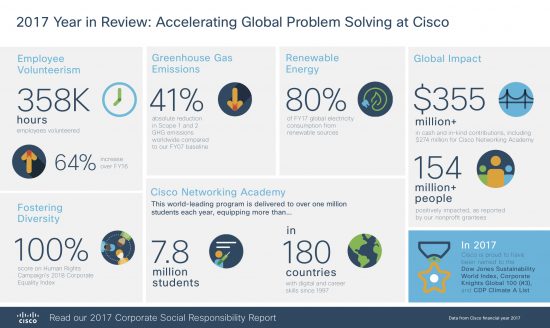
This work has already helped us positively impact 232 million people–including more than 154 million in our last fiscal year alone.

In addition to impacting one billion people by 2025, Cisco also strives to lead on environmental sustainability in our operations and supply chain.

Our 2017 Corporate Social Responsibility (CSR) report is a testament to the progress we have made, and of course, to the work still left to do.

In FY17, 1.3 million students in 180 countries built their digital skills through Cisco Networking Academy—bringing our cumulative total to 7.8 million students since 1997. Our nonprofit partners used our grant investments to positively impact 154 million people across the globe, pushing us towards our goal to reach one billion people by 2025. We also hit a huge environmental goal, reducing our Scope 1 and 2 greenhouse gas emissions by 41% compared with our FY07 baseline, keeping us on track for a 60% reduction by 2022.

We’re proud of these numbers, but they only tell part of the story. They sit alongside the achievements of Global Problem Solvers—Cisco’s employees, partners, and customers, who are tackling some of the big challenges affecting our industry and society as a whole.

Take for example, Cisco Networking Academy, our biggest and longest-running CSR program, which celebrates 20 years of changing worlds this year. Nineteen years ago, teachers Jeff Mason and Rod Thompson brought Networking Academy to students at Newport High School in Bellevue, Washington. While 78 percent of students in the Newport High program earned Cisco certifications last year, what’s particularly unique about this program is the experiential learning that happens far beyond the school.

Each year, the teachers take students to work in underserved communities around the world for two weeks, developing global problem solvers in the process. Past trips have benefited people in Antigua, Slovakia, Turkey, and Uganda. Here, the students apply their networking and problem-solving skills as they design and build 25-30 Internet-connected computer labs in 10 days. The hands-on technology experience is invaluable, but the impact this program has on the students and the communities they touch is far greater.

Another example of Cisco’s global leadership in action is our Connected Conservation program. Rhino poaching poses serious economic and ecological problems in Africa, with three animals lost per day to poachers seeking rhino horns worth more than their weight in gold. A team of Cisco problem solvers, working with our partners at Dimension Data, built a solution that uses our technology to track human movement in game reserves, flagging suspicious activity. Currently being piloted at a South African game reserve, the program has helped reduce poaching by 96 percent since 2015.

At Cisco, we believe that anyone can become a global problem solver, and we’re turning that opportunity into action.


To learn more about the progress we’re making to positively impact people, society, and the planet, visit our CSR website and read our 2017 CSR report. We hope you’ll feel inspired to join us in our work.

Authors

Tae Yoo

No Longer with Cisco

Avatar

We are very proud to announce that Cisco Software-Defined Access (SDA) was the winner of the 2017 Best Next Gen Wi-Fi Network Infrastructure award. The Best Next Gen Wi-Fi Network Infrastructure award was presented to a product that best demonstrate forward thinking in network infrastructure by the Wireless Broadband Alliance (WBA). SDA was nominated for the award with two other competitors.

Held in November, the award was given out to Cisco at the Wireless Global Congress in New York City in front of over 700 guests. In addition to recognizing other award-winning companies in the industry, the gala was thrown in celebration of ecosystem excellence.

It’s no surprise that Cisco SDA won. The product provides a single, highly secure network that allows access to any application in minutes without compromising on security. Cisco SDA adapts to mobile demand, prepares for IoT growth and secures from evolving threats. In other words, it’s an entirely new era of networking.

To learn more, click here.

The Industry Awards are determined by a group of independent industry experts, analysts and journalists. Since the judges are not beholden to any company, the WBA says that this “ensures the independence and quality of the awards.”

The Wireless Global Congress website explains about the WBA: “founded in 2003, the mission of the WBA is to accelerate global leadership for enabling of wireless services that are seamless, secure and interoperable. Building on a heritage of Next Generation Hotspot and carrier Wi-Fi, the WBA will continue to drive and support the adoption of Next Generation Wi-Fi services across the entire public Wi-Fi ecosystem.”

For more information on the 2017 WBA Industry Awards, click here.

Authors

Byron Magrane

Product Manager, Marketing

Avatar

The first song to use a “fade in” to hit #1 status was the Beatles’ “Eight Days a Week” in 1965. Like several early Beatles hits, the witty Ringo Starr suggested the song title before a word was written. Paul McCartney and John Lennon ran with the idea all the way to the top of the charts.

Cisco and BT enjoy a similar beneficial partnership. Recently we surveyed 5,000 consumers across ten countries in Europe, Asia-Pacific, and the Americas about their changing expectations for customer service.

The digital consumer research, “Chat, tap, talk: Eight key trends to transform your digital customer experience” is enlightening from many perspectives. Here are some highlights:

Messaging mania: For customer service, thumbs are becoming as important as voices. Customers want to talk and type. Due to the increasing popularity of messaging services like WhatsApp and Facebook Messenger, the trend is particularly strong in the Asia-Pacific region. Almost 40% of consumers in China use WeChat for customer service.

Chatbots are coming: Get ready to experiment and learn. A chatbot used to be a pleasant surprise on a website and perhaps even considered a novelty. Now almost half (47%) of consumers surveyed say they expect websites to have a chatbot. Begin experimenting now with quick and simple queries before it’s too late.

Voice is still popular. Consumers need live assistance with context when automated options do not completely meet their expectations. An interesting output of the study is the relative lack of difference between generational groups in the desire for voice support (6% is the largest gap). Regionally, there is upwards of a 20% difference between Asia and Europe in the expectation for voice-enabled websites. Your mission: Focus on deepening your ability to engage with context in your voice channel, while optimizing transactions that you can automate.

It’s time to bring social media into your customer care strategy. Perhaps as important as the fact that consumers want to use social media as a customer care channel (up 25% since 2015) is why. Respondents report that they view social media as the best way to get immediate attention from a company 38% of the time.

Video can transform the customer experience. Early in the video customer care cycle, a theory emerged that seeing the customer care agent may actually be a hindrance. The current study refutes this assertion: More than 60% of consumers stated they would prefer to see the person serving them. YouTube has also become the default search engine for new product information, cited by 42% of respondents.

Security matters, but so does effort. Consumers have been historically frustrated by necessary, but cumbersome authentication. More than 60% of those surveyed say current methods take too long and they’d rather authenticate using emerging technologies like voice biometrics.

Customers want proactive support. Want to know what you and a billionaire have in common? You both have the same amount of time. So anything that saves time is important. Reaching out to customers pre-emptively with reminders and updates is a huge win. Consumers increasingly view the personalization of landing pages and portals as a form of proactivity, with 70% citing it as an emerging expectation.

Chat, tap, and then talk. If your customers are between 16 and 34 and/or live in Asia, be ready to use messaging as the first form of communication with them. If your customers are older, wealthier, and in Europe or the United States, be prepared to talk. In either case, more than 60% of consumers cite the desire to escalate to video interactions with the same agent from either chat or voice.

Your action plan? Review these eight trends against your current contact center capabilities. Make sure you have the right capabilities in place based on the age groups and geography and your customers.

With customers wanting more ways to contact your business, it’s imperative you stay ahead of the game – eight days a week!

Download the research paper, “Chat, tap, talk: Eight key trends to transform your digital customer experience,” to learn more.

Authors

Zack Taylor

Director

Cisco Global Collaboration

Avatar

Craig Tranter is a former educator, and now serves as a technology presenter for Cisco. This blog is part of a series on advancements and opportunities in education. All views are his own. 

One thing that all teachers will be fairly familiar with by now is the use of Interactive White Boards (IWBs). However, the level of interaction can vary wildly between schools and between teaching staff. Some teachers are what we might call “power users.” They know all the tricks of the trade, whereas others may simply use these expensive pieces of kit as a display for a PowerPoint. So, it’s safe to say that the student experience can be extremely different, depending on the teacher. So, what’s the point in having these costly devices, when the vast majority end up using only a handful of features?

Let’s take a look at the situation as it stands at the moment. In the UK, the vast majority of schools use SMART board, or Promethean boards. These are excellent and come with a vast array of tools.

This is great for those “power users,” but the problem remains that the vast majority do not use these machines to their full potential. So, is there really any point having all of these complicated features?

Another problem that many teachers will be familiar with is this…

Many of the older generation boards, which are still used in the majority of schools, use a projector-based display, which means that it’s often out of alignment and you need to waste valuable lesson time re-orienting the board. Surely there’s a better way? And of course, there is! We have been using touch-capacity technology for years now and with this technology comes much more accurate, much more responsive touch screens.

So, let’s take a look at the next generation of IWBs. The key to these, in my humble opinion, is simplicity and ease of use. There’s no point investing in new and potentially expensive technology if teachers and students are not going to adopt it into their teaching and learning. In addition, it’s not just about simply having an interactive board that you can use in the classroom for one lesson, we need a system that can allow the interaction to expand beyond the classroom through ongoing projects and continued learning.

Now that video conferencing is becoming a major part of this collaborative process, we also need a simple way to incorporate that into our education environment. Video conferencing allows us to expand teaching beyond the confines of the four walls of the classroom and allow distance learning and to bring in experts from all over the world.

We have seen the rise of personal devices, such as smart phones and tablets, that are much more portable and allow a deeper interaction amongst staff and students. We need to embed this into the classroom environment too.

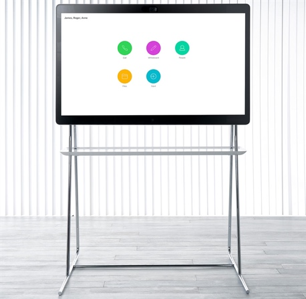
Luckily, the Cisco Spark Board seamlessly integrates features from the Cisco Spark app (whether that’s on your Mac/PC, tablet, or mobile device) with the Cisco Spark Board. Alternatively, it can also be used as a standalone device.

Let’s take a look at why Cisco Spark could revolutionize collaborative work in the classroom and beyond.

Firstly, keep in mind that Cisco Spark is simple and easy to use. That’s how it was designed. So, it’s more likely that people will adopt it with ease. You can use it as a standalone device, where you have the three main options: Call, Whiteboard, Share, or you can pair it with your own devices through the Cisco Spark app (which you can download for free here).

The app is a brilliant collaboration tool that allows you to chat, share documents, whiteboard, and call, all in one. It’s available for iOS, Android, PC and Mac, so it’s always there when you need. It links with all the major Learning Management Systems (e.g. Blackboard, Moodle, etc.) and is also based on open APIs (Application Programming Interface) which means that you have extra added value as you can add bots and integrations to help you get work done. Anyone can develop new bots and integrations specific to their business needs too.

Let’s get back to the boards.

With other white boards, you must log in and have accounts to do anything. You also need to have access to multiple programs to get the most out of the experience. Cisco Spark just has the one app and can be on mobile or desktop and also has the added benefit of bots and integrations. There’s no need to log in to use Cisco Spark Board, as you can use it as a standalone device. You also have the added benefit of interacting from your phone and desktop just by walking into the room. This pairing works through ultrasound. Think of this like Bluetooth, but better. The Cisco Spark Board sends out an ultrasound signal which automatically pairs your device as soon as you walk in the room. No need to log in, or manually pair your device. The sound waves are weaker than Bluetooth, which sounds like a bad thing, but is actually very useful, as it means that they are too weak to go through the walls, doors, windows, etc. So, you know that you, and only you and the other people in the room, have access to any content that you are sharing wirelessly. In addition, the video participants will have access to anything that you want to share.

Other white boards can have limited video calling features. Cisco Spark on the other hand is based on open protocols, so it’s much easier to make calls to and from different video vendors and endpoints. Cisco Spark can view files, annotate files and screen shares, offers persistent chat, whiteboarding capabilities – all from within the same app and whilst on a call. You have the added benefit that everything that you do on the Cisco Spark Board is automatically saved in the app, so no need to waste time sending out notes at the end of the lesson. Everything that you need is already there as it’s part of the ongoing project within the chat space.

Whilst we’re talking about chat spaces, it’s worth mentioning that this is where you can store everything that you need for a particular project, lesson, module etc. Have you ever been running late to a lesson and then realized that you’ve saved that vital PowerPoint to your other USB drive that you happen to have left in the staff room? No problem, with Cisco Spark, you could have already saved that file into the chat space, so it’s there and available for everyone to access. As soon as you walk in the room, you don’t need to worry about USBs, or what adaptor you need to connect your laptop. Simply open up the chat space wirelessly using that automatic ultrasound pairing through the Spark app on your device. Easy-peasy.

Because cybersecurity is becoming an increasingly greater threat in education, Cisco Spark is encrypted end-to-end, meaning that your data is safe during transit and at rest. You can also own the decrypt keys, which means that Cisco cannot decrypt your information even if they wanted to, so you know that your data is secure. Plus, did you know that Cisco is the world leader in cyber security? That’s a comforting thought, isn’t it?

Finally, the Cisco Spark Board offers great value, with an easy to use system that staff and students are going to love! I wish I had access to Cisco Spark whilst I was still teaching as I know that it is such a powerful collaboration tool.

That’s it for now for my, totally unbiased, review of the latest and greatest in IWB technology.  Do you want to see how easy it is to use the Cisco Spark Board? Take a look at this short clip, where I explain the main features of the Cisco Spark Board.

Are there any topics you think we should cover next time?

Let me know in the comments, or tweet me @c_tranter.

Authors

Craig Tranter

Technology Presenter at Cisco

Avatar

Today, Talos is publishing a glimpse into the most prevalent threats we’ve observed between December 01 and December 08. As with previous round-ups, this post isn’t meant to be an in-depth analysis. Instead, this post will summarize the threats we’ve observed by highlighting key behavior characteristics, indicators of compromise, and how our customers are automatically protected from these threats.

As a reminder, the information provided for the following threats in this post is non-exhaustive and current as of date of publication. Detection and coverage for the following threats is subject to updates pending additional threat or vulnerability analysis. For the most current information, please refer to your Firepower Management Center, Snort.org, or ClamAV.net.
Read more »

Authors

Talos Group

Talos Security Intelligence & Research Group

Avatar

In a previous blog, we discussed the role of new product introduction processes (NPI) and the part that collaboration tools are playing in helping drive better ideation while speeding time to production. Similarly, collaboration tools are rapidly changing maintenance, repair, and operations (MRO) procedures on the factory floor.

Downtime is always the antagonist of manufacturing. A machine breaks on an automotive line for example, and it can cost as much as 20,000 dollars per minute. While new programs such as utilizing Industrial IOT for predictive maintenance are helping reduce downtime and overall equipment effectiveness (OEE), many legacy machines only have limited condition insights and still break down. Complex supply chains also mean more coordination and interdependencies in supporting maintenance and repair, indicating that lack of alignment can also impact uptime. The transition of the workforce is even putting a strain on the workforce as many workers with in-depth knowledge are retiring from the workforce and also being asked to support multiple facilities that are spread apart geographically.  Sometimes these experts are not available, and this means that institutional knowledge is not available on-site. New workers are being asked to diagnose and fix issues they are not familiar with, which may increase the risk of safety hazards, and will certainly lead to excessive downtime. Unfortunately, the solution for many manufacturers has been to fly in experts as quickly as they can while losing days of productivity or to pay expensive service fees to outside firms to get their facilities back up and running again.


Leveraging Collaboration Technology for MRO

With the right collaboration tools in place, maintenance teams can quickly locate an expert and collaborate effectively to help solve an issue. These resources can also include outside suppliers or machine builders who have in-depth knowledge of the equipment in hand. Some examples of ways manufacturers are already utilizing this technology include:

  • Using video conferencing and high definition cameras so that remote experts can view and resolve problems at the source of the issue without having to be onsite.
  • Implementing secure mobile messaging apps for a connected workforce so crucial personnel can receive alerts about potential issues in the plants and communicate with them in real time.
  • Installing smart boards in plants to provide better visibility into operations, and leverage whiteboard technology to white board sketches, or even draw on circuit diagrams for example
  • Documenting and archiving common troubleshooting steps for re-use across the company. These records can also promote workplace safety, through incident documentation and process improvements.

Collaboration technology can also serve as a foundation to gain more insight into machinery with Open-application programming interfaces (API’s).  This allows multiple technologies to connect and communicate with one another. With this technology, developers can enhance existing platforms and facilitate the secure exchange of data between machines and devices. This information can then be used to quickly identify any potential issues through alerts and allow maintenance teams to respond rapidly and ensure a quick resolution.

At the foundation, it’s also important to understand that collaboration technology needs a robust infrastructure built on security.  This means secure remote access methods are in place as well proper encryption of communications that may contain sensitive information.

To help manufacturers support better collaboration within their operations, we developed a guide for how manufacturers can utilize collaboration technology. The guide  provides use case examples as well as ways to overcome business challenges and support manufacturing efforts.

I also invite you to learn more about how Cisco is helping manufacturing teams improve collaboration and to check out some of the case studies around manufacturing and collaboration here.


Authors

Eric Ehlers

No Longer at Cisco