#CiscoChampion Radio is a podcast series by technologists for technologists. In this episode we’re talking to Omar Santos and Joseph Muniz, the authors of two Cisco Press certification guides on cybersecurity fundamentals and operations.
Every year, over 44,500 students attend Rheinisch-Westfälische Technische Hochschule (RWTH) Aachen, Germany. With over 150 courses of study, that cover a large swath of educational disciplines, the university is among the leading scientific and research institutions in Europe.
In addition to the large student population, 540 Professors, 5,373 other academic staff and 2,679 non-faculty staff, work at RWTH Aachen University. In turn, this makes the university the biggest employer in Aachen. For years, RWTH Aachen has been a driving force in shaping the successful structural change from a region dominated by the mining industry to a modern high-tech center.
The bottom line: there’s a lot of people who go to school and work here.
The university felt that it was time to begin the process of updating their wireless network and turned to Cisco for help.
As with most universities, RWTH Aachen University offers a university-wide WLAN infrastructure. The wireless networks include eduroam for students, staff, and visitors from institutions using Eduroam (a common SSID that is broadcasted by many schools worldwide so that students can connect anywhere securely), as well as guest SSID MoPS for other visitors to the University. Students can send extra-large files around the world using a service called GigaMove.
The new deployment upgrade included nearly 2,000 access points, featuring the new 802.11ac Wave 2-compliant, Cisco Aironet 3800 Access Points. Thanks to the Cisco products, RWTH Aachen University has created a cutting-edge wireless network that is both fast and secure.
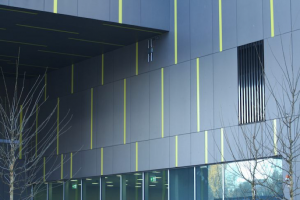
One example of the new deployment can be found at the school’s new facility, the C.A.R.L. auditorium. An energy-efficient state of the art building, the C.A.R.L. Auditorium has 11 lecture halls with 3,500 seats and 16 seminar rooms. Since this new building is outfitted with a lot of glass, it can make Wi-Fi coverage difficult. This is the primary reason why RWTH Aachen University made the choice to go with the Cisco Aironet 3800 Access Points. Additionally the university has adopted the 8540 Series Wireless Controllers in a highly available mode.
In addition to offering the latest in wireless technology, Thomas Boettcher from the IT Center team, deployed a number of Wave 2 802.11ac access points supporting the use of digital media. Not only does the Wi-Fi allow for a better learning experience, but it has a nice benefit for the students too. The state-of-the-art Wi-Fi enables international students to use Wi-Fi calling to talk to their families.
The wireless deployment in this auditorium consists of 90 Wave-2 802.11ac Access Points. Sixty-six of the access points are outfitted with internal antennas, 23 with external antennas and there is one outdoor AP. All access point uplinks are patched to MGig ports at 5Gbps data-rate. A majority of the access point are configured to use both 5GHz radios with active Flexible Radio Assignment (FRA) to maintain best data-rate performance for most of the clients.
FRA allows the access point to automatically change its radio settings to provide additional bandwidth when more people walk into an area. For example, with an Aironet 3800 Access Point deployed in a lecture hall will see an automatic radio switch from 2.4/5 GHz to 5/5GHz when a lecture begins and students fill the room. Once the class is over and the students leave, the access point will switch back to 2.4/5GHz.
RWTH Aachen University has been extremely happy with their new wireless network and will continue to count on Cisco as they update other buildings.
Below are statistics and graphs for the wireless network at RWTH Aachen University.
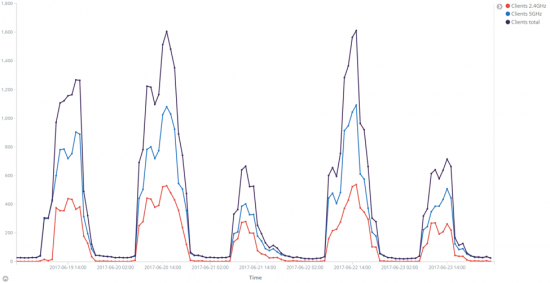
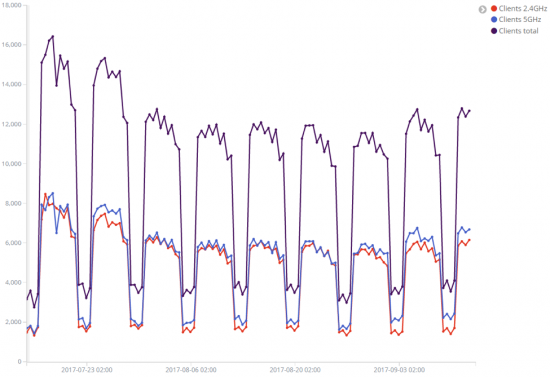
Table 1: association count for a typical week at C.A.R.L. Auditorium.
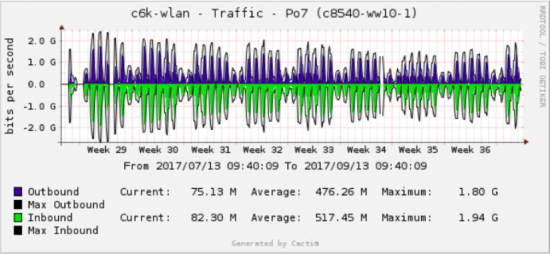
Table 2: RWTH WLAN total traffic statistics for the last 2 months
Table 3: RWTH WLAN total association statistic for the last 2 months
This post was authored by Warren Mercer, Paul Rascagneres and Vanja Svajcer
Introduction
Banking trojans are among some of the biggest threats to everyday users as they directly impact the user in terms of financial loss. Talos recently observed a new campaign specific to South America, namely Brazil. This campaign was focused on various South American banks in an attempt to steal credentials from the user to allow for illicit financial gain for the malicious actors. The campaign Talos analysed focused on Brazilian users and also attempted to remain stealthy by using multiple methods of re-direction in an attempt to infect the victim machine. It also used multiple anti-analysis techniques and the final payload was written in Delphi which is quite unique to the banking trojan landscape.
It’s time to say goodbye to markets based entirely on physical products. Welcome to the new normal, the “as-a-service era.”
This irreversible process is called servitization: a transformation where most physical products’ value is increased by the addition of companion services. These new services help companies attract more customers and create a cyber-physical ecosystem of interacting products and services. When servitization meets ICT, we accelerate pervasive digitization—a phenomenon that is changing the world of business.
Here’s an example: Last year, Cisco’s team in Italy worked with Sofia Locks, a leading maker of access control systems, to integrate Cisco Spark APIs with Sofia’s smart locks and Jago cloud technology platform. The result is a powerful blending of physical product with digital capabilities. It’s a flexible and secure cloud-based access control system that turns your smartphone into a digital key.
Leveraging Cisco’s Spark collaboration capabilities, Sofia has created a “rapid chat user support” service that enables secure, flexible on-demand access control for customers in several different use-case scenarios. Using the Cisco Spark interface, support technicians can send commands such as, “request a new access grant” or “open this specific door for this specific user at this specific time” via secure chat. This customized access increases convenience for users and saves time for support staff.
Use Cases
Smart work places: Today, work processes are more collaborative and transient than ever before, with workers using flexible workspaces on an as-needed basis. With the Sofia-Cisco solution, access to workspaces is as flexible as the work itself. Suppose that a guest in a co-working space wants to book a meeting room. She simply opens the Cisco Spark app, chats with the Meeting Room bot and books the room. The process ends with a virtual key sent to the user so that she can enter directly with her smartphone.
The result: Less time spent at reception, no more badges, very fast selling.
Smart infrastructures: Think about the typical electrical or network infrastructure, with countless equipment cabinets spread across a large facility. Managing keys for all of these cabinets can be a true nightmare. Sofia and Cisco are collaborating to solve this issue. A technician needing to access a cabinet in case of emergency will not have to worry about having the physical key. With Cisco Spark he will ask the control room for the right to access a specific door via chat, and receive the corresponding virtual key in real time.
The result: No more costs for key management or key delivery.
Hospitality: Hotels and bed-and-breakfasts can now offer better service to their customers while reducing their direct management costs. Imagine a traveller whose flight has been delayed and is standing at the door of his B&B without a key at 3:00 AM. The customer uses a mobile app to request access to his room. Customer Care receives the request, uses Cisco Spark to confirm the user’s reservation and room number, and requests access through the Jago cloud platform.
The result: Tired traveller can enter the room immediately, without waiting for a physical key.
Physical keys and badges have a huge impact on operations costs. Thanks to Cisco and Sofia Locks, organizations can drastically reduce the impact of such expenses by virtualizing all keys. Moreover, virtual keys are digital, meaning they can be transferred via secure chats. The process of key generation and assignment can be completely automated by software, increasing the efficiency of your organization.
Together, Sofia Locks and Cisco Spark demonstrate how cloud-based digital technologies can be the key to innovation and productivity.
About the authors: Anna Testa is part of Cisco’s digitization team in Italy, and Alessandro Nacci is CEO of Sofia Locks.
Coffee! It’s not only good to wake you up in the mornings. It’s part of our culture here at Cisco. There are many Cisconians around the globe that love coffee and not only because it has many benefits for your health. It’s a tasty beverage that brings coworkers together.
Join us on our celebration of Coffee Day with a tour around the globe, where I and other Cisconians will share their Coffee love and why we all love where we work.
Lucero Fernandez
Partner Advisor
From: Costa Rica
I have to admit I was not always a coffee lover. My coffee addiction started when I was in college. We had a coffee shop on campus that had 2×1 promotions every afternoon. So I ended up loving coffee, not only for the taste and the fact that it helped me study better, but because it was the perfect beverage for a study break with my friends.
I like to try different types of coffee, but my usual is the latte. One thing I never change is I don’t put sugar in my coffee. It tastes better for me that way. One quick coffee tip I have is to go to amazon and order some Costa Rican coffee. You won’t regret it! After all, we are known for having some of the best coffee in the world.
I love working at Cisco for many different reasons. Having an environment of coffee lovers is just one of them. The culture, the people, my team, the technology and the job are other reasons I love where I work.
RoxanaOlteanu
Business Development Manager
From: Poland
Coffee means happiness to me, means passion, and a drive to do amazing things. I cannot really picture my life without it, and I love how at Cisco you can be yourself, or anyone you want, including a crazy coffee enthusiast, and have the chance to write about it and share this moment with the world.
I like my coffee diverse, for it to surprise me every single time, and the choice of coffee comes in very close relation to the mood, or moment of the day, and day of the week. I would recommend to just explore coffee, allow yourself the opportunity to try and learn! I think we would all be amazed to find out how many different ways of having a coffee are there, and how different cultures have amazing rituals with this drink.
I had a “Coffee at Cisco” moment before joining Cisco, I remember seeing this video about Cisco Krakow, and in one of the scenes there was this guy showing this coffee mug, that says “enjoy” on it…that was definitely love at first sight for me! 🙂
It’s funny how such a small thing can give you so much positivity, so much happiness, so many great meetings, so many new friends made, and so many great encounters – all over a cup of coffee! The Cisco office is very often the perfect facilitator for these events too. I love where I work because Cisco is a place that encourages and embraces diversity and supports YOU in whatever you want to become.
Corinna Darmoro
Marketing Manager
From: Germany
I love coffee because it helps me wake up in the morning and puts me in a good, creative mood. Perfect conditions that help me do a great job! I drink my coffee with lots of milk and a little bit of sugar.
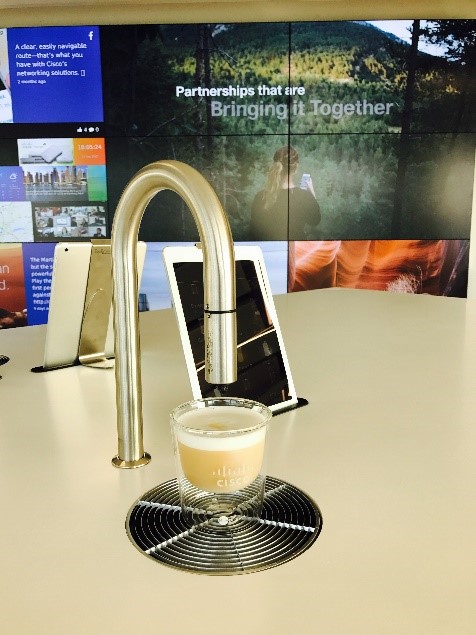
The Cisco headquarters in Munich, Germany moved earlier this year and since that time we have arguably the coolest (and best) coffee machine in our office. We can select our coffee/milk ratio right down to the last gram using the iPads or by an App. From there, we then have a lot of fun watching how our custom coffee freshly grinds, brews, and serves it up in our mug! You see, preparing our coffee is already an exciting process. So if you ever visit Cisco Munich, come and enjoy your own digital coffee experience! 😉
I love where I work because I have flexibility and variety in my daily work, a great work-life-balance, can work with the latest technology, have supportive colleagues, and an impressive office environment that offers work scenarios for every operation. Oh, yes, and of course because of our awesome coffee machine! 😉
Mitja Rakar
Systems Engineer
From: Italy
Perhaps my love of coffee comes from my roots as I lived near Italy, or maybe it is because my grandmother used to prepare coffee for me since I was little – whatever the case, I just love it – and I have taken my love of coffee and it’s powerful connections into my life here at Cisco.
I like to drink my coffee without sugar, with a little bit of milk and not too warm. I also prefer a big portion, so I can drink it from a bigger cup.
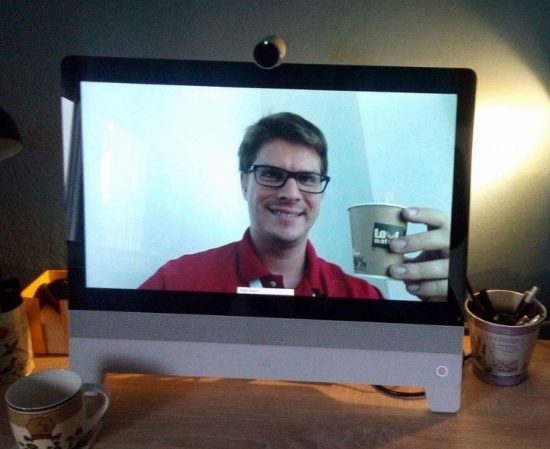
I have regular Virtual Coffee Meetings with fellow Cisconians around the globe, as I think that coffee always tastes better when you’re in good company.
I love Cisco because I drink good coffee at work! But besides that, it is also because I am working constantly with the cutting edge technology and I can develop myself with a good life/work balance ratio.
So, how do you take YOUR cup of coffee? We here at Cisco love that you can be you, with us – no matter your passion. We hope everyone has a perfectly brewed International Coffee Day!
Want to work with a company that encourages you to pursue your passions? We’re hiring!
It’s always exciting preparing for an event like IBC. As we’re taking new products and solutions to the market there has to be a balance between informing those who are starting to look at a new vertical or opportunity, compared to those who have already launched new services. By going out to the wider market we get some valuable insight in into the direction we see industry segments moving in, and at what speed.
For Mobile Video, we’re definitely seeing an acceleration in operators launching and delivering services. Our conversations have moved significantly away from ‘What should I be doing’, and much more into ‘How do I do this’ and ‘How do I make it better’.
Mobile operators are aware of the growth in mobile video – they are seeing it increasingly flow over their networks, heading toward the 80%+ of mobile traffic that our Visual Networking Index predicts. And the content providers are seeing the opportunity that mobile delivery will give them to reach and engage new audiences. For example, they know that millennials are using mobile devices to watch more content for longer, and they need to ensure they can keep, and monetise, these viewers.
But both sides are seeing some challenges.
The mobile operators need to be able to scale their networks right now to cope with the extra demand. We know 5G is coming, but they can’t wait for that to satisfy increasing consumer requirements. At IBC there was much discussion about the latest Apple announcement with the iPhone X, a device that will be able to display some of the highest quality mobile experiences on the market. Users will expect to be able to take advantage of the video features of this new device, and operators will need to meet these increased data requirements on their network.
We also spoke about the scale challenge facing operators. The announcement of the Jio phone from Reliance – bringing mobile video to the mass market in India, at scale – is also seen as significant by many operators. An affordable device delivering video into new markets presents a huge opportunity for growth, and opens up new areas for service delivery, as long as the operator can scale effectively.
For the content providers, they need to make sure their content is increasingly mobile ready. So what does this mean? It’s ensuring that the content is optimised for mobile streaming and making sure the content is easier to identify as it flows across the operators network. It’s about having the flexibility to re-purpose the content into different kinds of bundles and packages more suited for mobile business models such as zero-rating and skinny bundles. And it’s about having the tools to measure how the content is being consumed.
And this takes us to the crux of the changes we’re seeing – co-operation and collaboration. Mobile operators and content providers now see the value in working together. They understand the benefits in bringing their two businesses together to create exponential value for their stake holders, and by doing so creating the best possible service for their consumers. We’re already seeing this today with bundled content and data packages becoming ever more popular. And both sides see the enormous potential in sharing their data to build customer insight.
At Cisco, we’ve been facilitating these relationships. By using our integrated Mobile Video capability we’re seeing operators work closely with their new partners to implement new relationships and business models that will keep their consumers happy, and loyal. And with integration comes automation. Our customers can create new services and deliver new business models faster, and more efficiently than ever, scaling their business without increasing their OPEX costs. As the market is moving from Why, to How, our customers are able to move from How, to Now.
We’re going to be taking our solution on the road, and we’ll be at CES in Las Vegas in January, and Mobile World Congress on Barcelona in February. In the meantime, if you want to know more please visit the Infinite Video Platform page.
Visit the experts in our Cisco booth (#107) at NetApp Insight Las Vegas 2017 from October 2 – 5 at the Mandalay Bay Convention Center and we’ll bring you up to speed on our latest innovations to power your next generation data center!
Cisco is a premier sponsor at NetApp Insight. Cisco and NetApp have been strategic partners for over 7 years delivering FlexPod, the industry’s fastest growing integrated infrastructure and certified reference systems. FlexPod is built on Cisco and NetApp technology trusted by over 8,400 customers worldwide with solutions that are optimized for the most popular infrastructure use cases, applications, and technology transition points in the industry, such as virtualized infrastructure, cloud computing, and enterprise applications. And with continuous innovation over the past 7 years, the FlexPod portfolio has continued to help customers simplify and modernize their IT environments in a constantly shifting technology landscape. Check out this video to learn more about FlexPod.
In our Cisco booth we’ll be featuring the latest FlexPod solutions as well as other Cisco innovations designed to power your next generation data center including:
Fifth generation UCS Servers offering numerous enhancements that provide significant performance improvements and TCO savings
Innovations that simplify management of your multi-cloud environments and give you more visibility, more intelligence and more control over your infrastructure and applications whether on-premise or in the cloud:
Cisco Intersight , a new, transformational systems management platform for Cisco Unified Computing System™ (Cisco UCS®) Systems that simplifies data center operations by delivering systems management as-a-service, offering cloud-powered intelligence for a new era of computing
Cisco Workload Optimization Manager cost-effectively matches application demand with infrastructure supply so that you can keep pace with changes in your business today and in the future
Cisco Tetration Analytics enables you to turn on real-time analytics across your data center and into the cloud with full visibility into application workloads and processes.
Cisco ACI Multi-Site provides a single point of management to efficiently manage multiple data centers – be it in the same building or across the globe
Attend our breakout sessions for a deeper dive on these topics:
Throughout this blog post we will be detailing a newly discovered RTF document family that is being leveraged by the FIN7 group (also known as the Carbanak gang) which is a financially-motivated group targeting the financial, hospitality, and medical industries. This document is used in phishing campaigns to execute a series of scripting languages containing multiple obfuscation mechanisms and advanced techniques to bypass traditional security mechanisms. The document contains messages enticing the user to click on an embedded object that executes scripts which are used to infect the system with an information stealing malware variant. This malware is then used to steal passwords from popular browsers and mail clients which are sent to remote nodes that are accessible to the attackers. These advanced mechanisms and the information stealing malware will be discussed in detail. We will also review a number of static and dynamic detection mechanisms used in the AMP for Endpoints and Threat Grid product lines to detect these document families.
Each year we look forward to getting together with CIOs and industry leaders like yourself at the NASCIO Annual Conference. This year’s theme, “Connect, Create, Collaborate”, is of special interest to us as it is designed to address key issues facing State CIOs in the year ahead; cybersecurity, digital transformation and cloud. As an industry-leader in these technologies for State Government, Cisco is also pleased to sponsor the event for 2017.
Every day our team at Cisco is leveraging an amazing array of innovative new technologies to help states like yours accelerate digital transformation. From solutions that can connect personnel in real-time video across agencies at the local, state and even federal level to automated sensor networks that can help save lives on roadways, we see technology as the greatest opportunity to improve quality of life for all Americans. We’ll be sharing more about these exciting technologies with you at the event so be sure to check it out.
Until then, I encourage you to get the conversation on how State Government can better connect, create and collaborate started by joining us on Facebook and Twitter. We would also love to hear about the #1 topic you want to explore further at NASCIO. Just use @CiscoGovt, @NASCIO and #NASCIO17 to join in.
By the way, we’re already thinking beyond Austin and invite you to join us for the Cisco Post-NASCIO Roundup where we’ll dive deeper on how states can accelerate their digital transformation (Register Now). This live event, scheduled for Tuesday, October 17, will expand the discussion started at NASCIO and feature industry leaders in digital transformation, including:
Doug Robinson, Executive Director, NASCIO
Larry Payne, Senior Vice President, US Public Sector, Cisco
Teri Takai, Senior Advisor, Center for Digital Government
Alan Shark, President, Public Technology Institute.
And as you get ready for NASCIO, be sure to check out some of our most recent customer stories featuring your peers and the amazing things they are accomplishing in areas like emergency management, citizen safety and collaboration.






 Lucero Fernandez
 Roxana Olteanu
 Corinna Darmoro
  Mitja Rakar