Avatar

Digitization is changing every part of today’s enterprise. To take advantage of new business opportunities, organizations are moving quickly to design and deploy new technologies like cloud, mobility, analytics, the IoT and next-generation security.

The challenge is finding the workforce skilled in these new, rapidly-evolving technologies.

I recently wrote an article on these industry shifts that you can read here, if you’re interested in taking a look.

Here, I wanted to talk a little bit about what Cisco is doing to help its customers and partners have a successful journey on the road to digitization.

As digitization drives industry evolution, talent has become a critical barrier for enterprises as they attempt to evolve their business, drive better business outcomes, and create new internal employee and end user experiences.

Learning@Cisco will play a major role in helping Cisco’s customers, channel partners and ecosystem with this industry evolution.

To meet the changing education landscape and stay ahead of growing learner expectations, we too, are embracing digitization.  With new tools, platforms, innovative approaches and technologies, we are transforming our business models, portfolio of offerings, our industry partnerships, go-to-market approaches and policies.

Specifically, we are focused on addressing these key trends that are defining today’s workforce and their skilling needs.

1. A need for continuous learning due to rapid shifts in technology.

2. Evolving job roles that require cross-functional and business-related skills to drive to business outcomes

3. Employers need a credentialing system that validates these new, evolving job-related skills. This system needs to be flexible and adaptive to specific skills, and not to job roles. This is because job roles are continuing to diverge across verticals, regions, and systems. As a result, competency-based education is a possible direction. We are exploring every option that could deliver greater convenience to our learners.

4. With a workforce growing in diversity, learning consumption models are quickly evolving to keep pace with customer needs. We are seeing that multimedia learning approaches that fold in video-based, gaming and flexible learning options, that are available on an as-needed basis, and accessible via any smart device is the direction that we need to go.

5. Internet Protocol (IP) continues to grow as the underlying vehicle that connects all digital businesses. As such, new audiences are being exposed to IP constantly and will need to leverage it to run their business operations. Line of business (LOBs) leaders within enterprises, control engineers in the operations space and developers are examples of populations that will need to have a working understanding of IP in their job roles.

We continue to transform our credentialing system, creating the benchmarks employers need to validate the job-related skills required of the digital enterprise. Our portfolio continues to address new learning consumption models, and encompass the skills required remain of tomorrow’s workforce.

We are committed to delivering learning and skilling offerings that meet the real-world consumption demands of our customers.

For more information about Learning@Cisco and how we’re helping learners adapt to a digitized workplace, click here.

Authors

Tejas R Vashi

Senior Director, Product Strategy & Marketing

Learning@Cisco, Cisco Services

Avatar

The Cisco PSIRT openVuln API is a RESTful API that allows customers to obtain Cisco security vulnerability information in different machine-consumable formats. It supports industrywide security standards such as the Common Vulnerability Reporting Framework (CVRF)Open Vulnerability and Assessment Language (OVAL)Common Vulnerability and Exposure (CVE) identifiers, Common Weakness Enumeration (CWE), and the Common Vulnerability Scoring System (CVSS).

This API allows technical staff and programmers to build tools that help them do their job more effectively. In this case, it enables them to easily keep up with security vulnerability information specific to their network. That frees up more time for them to manage their network and deploy new capabilities in their infrastructure.

Since we launched the Cisco PSIRT openVuln API a year ago, numerous customers, partners, and Cisco employees have used it to build tools, keep up with security vulnerability information specific to their network and assess the impact of such vulnerabilities.

We have just made this API even better! The following enhancements have been introduced:

  • Integration with Cisco IOS Software Checker
  • Ability to query security advisories per product
  • Querying using a date range
  • Additional fields displayed by default in the results


Integration with Cisco IOS Software Checker

The Cisco IOS Software Checker is a tool that allows you to search security advisories that apply to a given Cisco IOS or Cisco IOS XE Software release. You can now use the Cisco PSIRT openVuln API to perform these queries. You can search for Cisco security advisories that apply to specific Cisco IOS and Cisco IOS XE Software releases and have a Security Impact Rating (SIR) of Critical or High. This feature allows you to obtain the first fixed release, as well as the details for each advisory that applies to the specific Cisco IOS and Cisco IOS XE Software release.

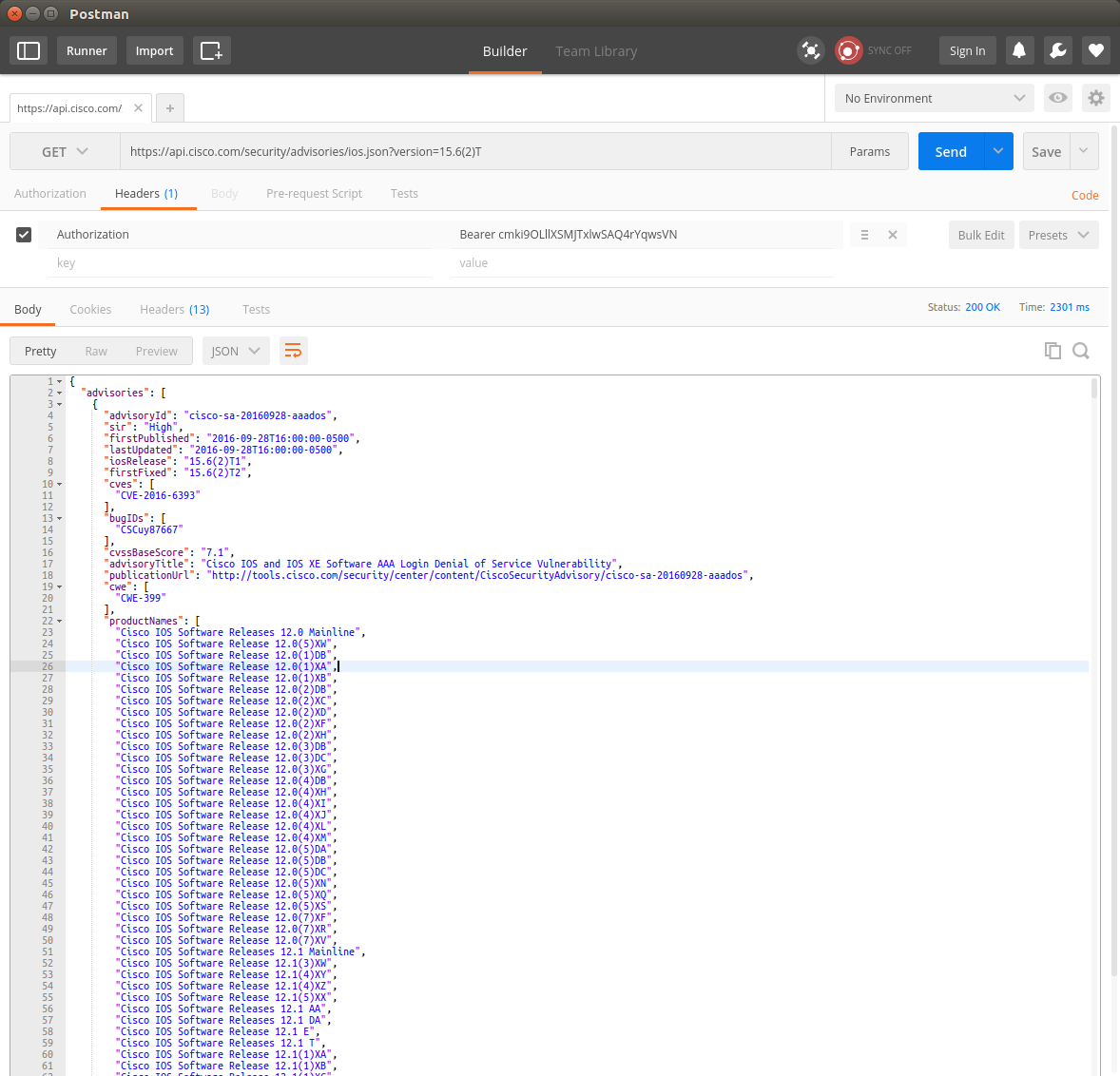
The following figure illustrates an API call to query all advisories that affect Cisco IOS Software version 15.6(2)T using Postman.

openvuln-ios-sw-ck


Querying Security Advisories Using Product Keywords

You can obtain all security advisories that affect a given product by searching using a keyword for such product name. The following is an example using the openVulnQuery python client to search security advisories using the keyword “asa”.

Click on the image to play the animation.


Querying Using a Date Range

You can query advisories (CVRF) and OVAL definitions using a “first published” or a “last updated” date range. The following example shows how to query all security advisories published from 2017-01-01 until 2017-01-24.

Click on the image to play the animation.


The following example shows how to query all security advisories published between 2017-01-01 and 2017-01-24 that had a critical security impact rating.


Click on the image to play the animation.


Additional Fields Displayed by Default

We have added several additional fields in the default results without the need of parsing a given CVRF file. These include:

  • product names
  • Cisco bug IDs
  • advisory title
  • publication and update dates
  • CWE identifiers
  • CVSS scores
  • in addition to the previously existing fields (CVE, advisory IDs, SIR, publication URLs, OVAL and CVRF URLs, etc.).

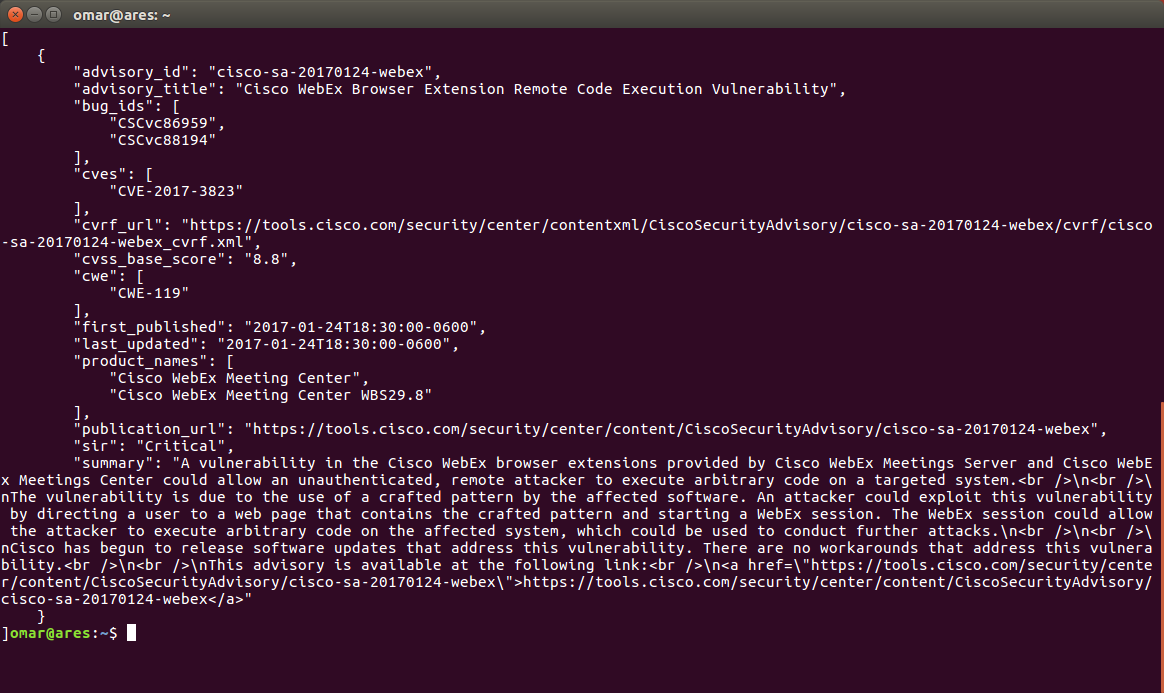
The following figure shows all the fields within the results of an openVuln API call.

openvuln-additional-fields


Technical Details and How to Access the API

You can learn how to access the openVuln API and the technical details about each feature at the Cisco PSIRT DevNet site at: http://cs.co/openvuln-get-started


Cisco PSIRT GitHub

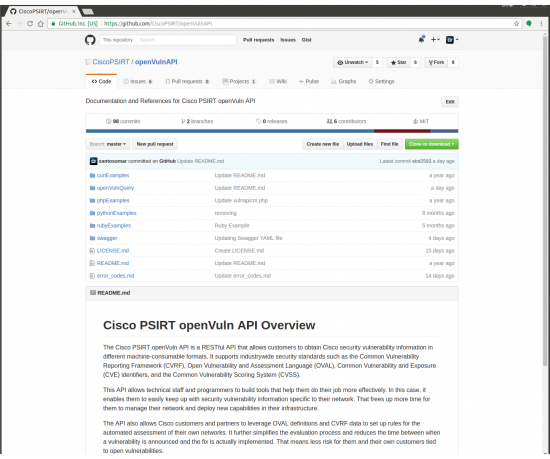
Check out our GitHub Repository to view example client code, additional documentation, and to download the python-based openVulnQuery client.

openVuln-API-github


Swagger

Cisco PSIRT released a beta Swagger YAML file to help you learn, test, and integrate with the Cisco PSIRT openVuln API. Swagger is a very powerful open source framework    vb  for RESTful APIs that was developed by the folks at SmartBear and was contributed to the Open API Initiative (OAI).

The Open API Initiative (OAI) was created by a consortium of forward-looking industry experts who recognize the immense value of standardizing on how REST APIs are described. As an open governance structure under the Linux Foundation, the OAI is focused on creating, evolving and promoting a vendor neutral description format.

The Swagger / Open API Initiative specification provides numerous capabilities that provide interactive documentation, client SDK generation.

You can use the Swagger Editor to obtain sample code to interact with the Cisco openVuln API in numerous programming languages (including Python, Ruby, Java, etc.).
The beta YAML file can be downloaded from Cisco PSIRT’s openVuln GitHub Repository. The technical documentation and specs can be accessed at the following URL: https://github.com/OAI/OpenAPI-Specification

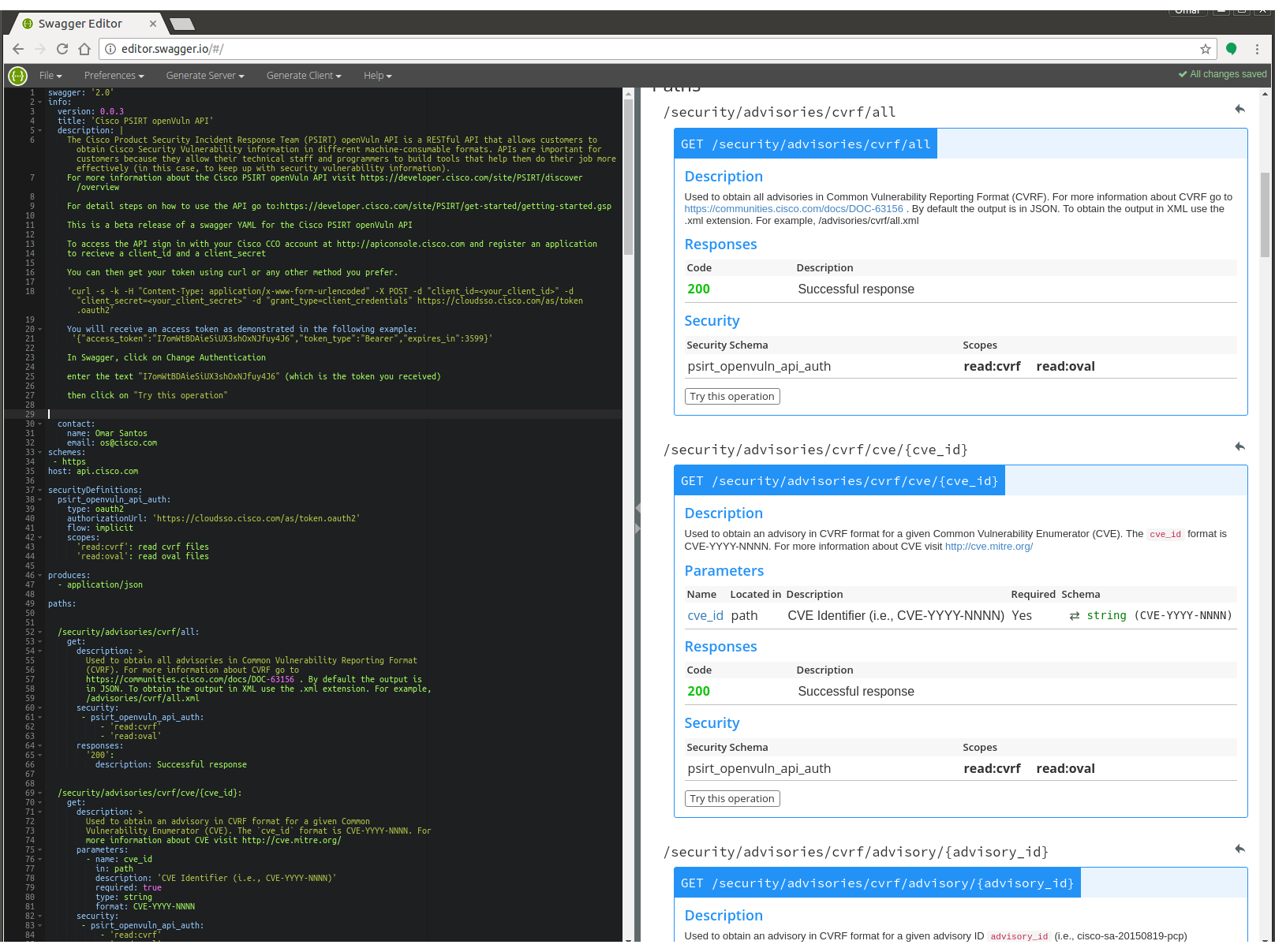
The following is an example of the Swagger editor.

swagger-openvuln-api


Please feel free to engage with us at the DevNet Community or via GitHub.


Authors

Omar Santos

Distinguished Engineer

Cisco Product Security Incident Response Team (PSIRT) Security Research and Operations

Avatar

The Industrial IoT brings new promises to the plant floor: lower operating cost, better visibility, and improved Overall Equipment Effectiveness. These results are all in the pot of gold at the end of the IIoT rainbow, but that pot is sometimes hard to find.

potofgold

Here are the top 7 reasons why I believe IIoT projects fail:

1. Starting too big too fast

If you focus on your entire plant, you will be making success much less likely. Try starting with a smaller project, in a key focus area – perhaps an area that has the most downtime, the most maintenance, the most energy consumption, etc. Keep the project manageable. Make sure you contemplate how to scale – if you are successful, what’s next?

2. Lack of a clear objective

I continue to be surprised by the number of companies diving headfirst into an IIoT journey with no clear goal, objective, or a full understanding of ROI. What is success? Determine what you are trying to achieve and measure it before and after any IIoT implementation. For example, what’s your unplanned downtime today? Where do you want it to be? By when?

3. Lack of internal company alignment

The days where operations can implement networking projects without IT are gone, or at least close to extinction. You can only find the pot of gold together. For example, data analysis might bring new compute requirements where IT can help. IIoT can also bring new security risks – a key area where IT can help, but only by fully understanding operational requirements. You also need executive buy in. Not only can this help you with driving support across your organization, but it may help “grease the skids” for approval by aligning with corporate objectives like Sustainability or Security.

To bring IT and OT together, view our page here.

4. Not understanding and addressing security risks

Connecting to data from the Enterprise or opening up remote access all the way down to the plant floor can potentially open up security risks. With any IIoT project, your attack surface is likely to expand. This is where operations and IT collaborating can bring big value to your organization. Carefully evaluate the potential risks and impact of those risks, then focus on the most serious. Many companies like Cisco can perform assessments to help you evaluate and prioritize those risks. Your entire organization’s IIoT effort may come to a grinding halt if a hacker wreaks havoc in your facility – it’s game over.

Understand potential security challenges by taking our holistic security assessment.

5. Siloed or disparate networks

Make sure you fully understand the different networks in play all the way down to the data you want to capture for analysis.  There’s no disputing that Industrial Ethernet is the de Facto standard today for nearly all control applications. Do you have Controlnet, Devicenet, CAN, or other networks? Do you want to install a “Shmozzle” (technical term, meaning “Varied”!) of different gateways to translate that data to Industrial Ethernet? Or do you want to overlay new equipment to gather data for analysis?

This can create quite a spaghetti of networks and hardware (extra failure points) on your plant floor.  You may decide that extra complexity and risk is not worth it, set a plant floor standard, and explore changing out all controls to a robust standard Industrial Ethernet. With more than 80% of industrial facilities over 20 years old, I’d propose that changing to newer controls with Industrial Ethernet communications is worth the spend. In the long term, it may be more cost effective to replace old machine controls with new ones instead of other options to gather data.

6. Lack of automated analytics

I heard a great quote recently: “Sure you can connect your toaster to the internet, but do you really need to??” Let’s say you are interested in looking at product quality on one of your lines. Although it would be great to correlate the earth’s rotation and hundreds of other potential variables to quality, you don’t want to suffer from data overload. Keep your data set manageable and use basic statistical analysis to look for outlier data. You might consider using edge analytics (fog computing) to reduce the overall data set for later analysis. Work with a partner who has experience with automated analytic software packages designed to look at manufacturing data and glean actionable results from that data.

7. Spiraling cost

Adding gateways, converters, extra wiring, piggy backing extra sensors to get at data, multiple vendors, adding wifi or cellular, adding security, data storage & computational horsepower might all add cost to your IIoT project. In the immortal words of one of my favorite movies, Office Space: “Plan to plan.”

planningmovie

The better you plan out the potential pitfalls to your IIoT project, the more prepared you will be to mitigate surprises later. Companies will either do it right or they will do it over…. which one do you want to be?


Authors

Scot Wlodarczak

No Longer with Cisco

Avatar

Digitization and the transition to cloud are forcing the worlds of IT and business to blend together. In the digital economy, applications are critical. Combining real-time visibility and intelligence at the network, security and application layers is transformational for companies. It can provide them with insight into the state of their business and, most importantly, into the quality of their customers’ experiences. To drive this transformation, we are excited to announce Cisco’s intent to acquire AppDynamics, Inc., a leading privately held application intelligence software platform!

As companies across industries are expanding their digital infrastructure, IT departments are faced with vast amounts of complex, siloed data. AppDynamics helps many of the world’s largest enterprises translate this data into business insights and empowers them to drive value for their customers in today’s digital world.

Together with Cisco’s industry leading digital network architecture, customers will now have unprecedented end to end insight across their technology stack, from infrastructure to application. With this insight, companies will be equipped to improve customer experiences and accelerate revenue opportunities. The acquisition of AppDynamics also supports Cisco’s strategic transition toward software-centric solutions that deliver predictable recurring revenue.

The AppDynamics acquisition is expected to close in Cisco’s third quarter of fiscal year 2017. AppDynamics will continue to be led by CEO David Wadhwani as a new software business unit under Rowan Trollope, Cisco Senior Vice President and General Manager, IoT and Applications business. We look forward to welcoming the AppDynamics team to Cisco.


Authors

Rob Salvagno

Vice President

Corporate Development and Cisco Investments

Avatar

With more than 200,000 visitors a day, and more than 65,000 students spread across multiple sites, The University of Melbourne wanted know how staff, students and visitors were experiencing the campus.

This insight would help answer tough questions, such as which buildings and services should be developed next? How can UoM progress faster on the way towards a more sustainable campus? How should the university engage with visitors and prospective students?

GA000033

With greater insight into users, applications, devices, and vulnerabilities, IT can automate security tasks and speed remediation, and with the addition of real time analytics, the university can offer a better on-campus experience, while planning for future development.

By utilizing Cisco Wireless and Switching with Cisco Security and Management technology, the University of Melbourne is now able to make smarter decisions on campus, helping improve the student experience, retain students, staff and faculty, and save money.

To learn more about the partnership with UoM and the technology solutions implemented on their campus please read the full case study here.


Authors

Reg Johnson

General Manager, Education

Cisco Australia and New Zealand

Avatar

In the US, we are off to a brisk start to the new legislative year. The re-emergence of the Mobile NOW Act is a case in point, with the objective to find more radio spectrum to meet future consumer demand on our smartphones, tablets, and other devices.

Yet, with thousands of megahertz of new spectrum allocations and assignments in various stages of completion, one might wonder – do we still need Mobile NOW? Why does Senator John Thune think that we need even more radio spectrum to sustain our fascination with an ever-increasing array of mobile devices? Or our fascination with more cat & dog videos?

To answer those questions, let’s review where we stand with spectrum. The voluntary incentive auction for 600 MHz spectrum will end well (and soon!), but perhaps with a result not quite as brilliant as many had initially hoped.  Transition of the highly coveted AWS-3 bands (1.7/2.1 GHz) from government use to commercial is continuing, but not complete. Licensing of the shared 3.5 GHz spectrum is not on any kind of fast track, with industry likely to first familiarize itself with generally-authorized access. Millimeter wave spectrum (above 24 GHz) at this point is best viewed as the new frontier of cellular and unlicensed systems, with some licensed spectrum available at 28 GHz, but lots of work left to be done on other bands from a technology or regulatory perspective. Finally, we’re all waiting to see what happens to the 20 megahertz of public safety “FirstNet” spectrum in the upper 700 MHz band, and we’ve been promised an answer soon.

Against this backdrop, Mobile NOW asks the FCC and the National Telecommunications and Information Administration (NTIA) to find at least 255 megahertz of spectrum below 6 GHz of which at least 100 megahertz shall be made available for exclusively licensed commercial use and at least 100 megahertz shall be for unlicensed devices.    The bill would give the agencies until the end of 2020 to produce a plan – which might seem like forever, but in the world of spectrum policy is pretty darned quick.

Will more spectrum be needed?  No doubt about that, particularly post-2020 when 5G implementation and growth in the Internet of Things should be well under way.

It’s also worth noting that Mobile NOW’s 2016 incarnation earned the unanimous vote of the Senate Commerce Committee.  That vote represents an important bipartisan consensus about the key role wireless broadband plays in the US economy –  a consensus that the Congress should keep in mind as it evaluates Mobile NOW in 2017.

As the Committee’s Report last year summed up, “It can take years to identify spectrum that can be made available for commercial use, allocate the spectrum, create service rules, develop auction rules for spectrum to be auctioned, conduct an auction, and relocate incumbent operations, all before beginning to deploy the networks providing service to American consumers.”

So it’s important that the Congress kicks off a process “now” in order to deliver us to a Mobile Tomorrow.


Authors

Avatar


It’s 2017 and we’re still waiting for the flying car (well, one we can afford). However, one futuristic vision is not only here – it’s become a way of life.

I’m talking about video communication.

Sure, applications like Skype and FaceTime have been popular for a while. But recently, video has exploded into the business world like never before. (Just ask any Cisco employee where we’d be without WebEx.)

And nowhere are the benefits of video felt more acutely than in healthcare. According to the American Telemedicine Association (ATA), more than 15 million Americans receive some kind of remote medical care, and that number is only expected to grow.

Routine doctor visits can now be done from any location – house, car, office, and beyond. Patients can get specialist consultations from world-renowned experts, even if they live in the middle of nowhere. One sure sign of success? Many payers are getting on board by covering virtual appointments.

But there are still some hurdles to overcome before this new tech becomes routine. 

Patient and provider attitudes vary

Not everyone is ready to embrace telemedicine just yet. In a recent Medscape survey, 61% of patients said they were comfortable with receiving prescriptions based on email or video visits ­­­­– but only about half that number (30%) of physicians agreed they would feel comfortable prescribing based on a digital consultation. Perceived liability risk may play a large part in that attitude: In the same survey, 60% of providers named malpractice and liability concerns as a barrier.

Physicians do seem to see the promise of the technology, however. A slim majority (54%) of providers in the survey agreed with the statement, “Telemedicine can adequately assess patients for routine medical issues, such as follow-up consultations or chronic disease management.”

Another survey, done by the ATA, polled 429 patients on their use of telemedicine. While only 22% had actually used it, nearly all said they wanted to receive care remotely. The biggest barrier? Their provider didn’t offer it, or they didn’t know how to find a provider who did.

Clearly, the consumer demand is there. Providers are slowly getting on board. Now, it’s not a matter of if, but when telemedicine becomes as ubiquitous as email or texting.

HAL29070

Getting started with telemedicine

Ready to join the telemedicine revolution? One key to your success is getting everyone in your organization excited and on board with your plan. Here are a few tips to overcome barriers and hesitation.

1. To get buy-in, communicate value: not only to the C-Suite but also to providers.

Consider all the stakeholders who could be affected by your plan. Be prepared to share answers to the following questions:

  • What are the organization’s goals with telemedicine? Is it to reduce costs, increase convenience, improve patient outcomes, reduce physician burn-out, and/or grow the business? Share details. (These are all potential benefits of telemedicine – visit the ATA to get more information.)
  • What ROI are you expecting as an organization in one year, five years, 10 years? Help them visualize the long-term benefits.
  • How will you help keep liability risks low for providers? Is your insurance policy up to date? Are there any concerns with licensing? How will you address security? Knowing these answers may help ease provider anxiety.

2. Get a champion (or a committee of champions).

Seek out providers who are enthusiastic about telemedicine and encourage them to share information with colleagues. These folks can also serve as your implementation committee once your telemedicine program is off and running.

3. Run a patient education campaign.

Study after study shows that patients want telemedicine but don’t know where to get it – or don’t know if their insurance policy covers it. Make sure they not only know it exists but also understand how to access it.

4. Have the right technology – or a plan to acquire it.

Can your network handle the increased bandwidth – and is it secure? What about video quality? How will your system operate with other technology already in place? It’s critical that you ensure a smooth transition for your end users.

There’s a lot to think about when implementing telemedicine in your organization, but there are a lot of rewards to gain, too. Have questions about the technology aspect of your plan? Cisco is here to help. Contact us to find out more about our solutions, such as Extended Care, that can help you join the telehealth movement.

And check out this case study that demonstrates the value of using telemedicine for a renowned specialist consultation, even though the patient lives in a rural location, hundreds of miles away.

CTA blog newsletter

Authors

Amy Young

Marketing Manager

Healthcare

Avatar

Today in San Francisco, Rowan Trollope, SVP IoT and Applications, announced two ground-breaking Cisco Spark innovations that will leave their mark on the collaboration industry forever: Cisco Spark Board and new Cisco Spark software capabilities that, together, will revolutionize the meeting experience.

Everyone here is thrilled about the unprecedented levels of productivity we’ll enable for our customers. But what’s equally exciting is the opportunity these much-anticipated announcements mean for you.  All of the investments we’ve made to transform your practices for a future of cloud services and recurring revenue have prepared us for this day. That future is here.

Since we set out on this journey – three years ago – to make revolutionary collaboration affordable and available to everyone, we’ve been working hard to prepare you for the cloud collaboration opportunity. This past November at Partner Summit, everything started to come together as we accelerated “full speed” to cloud with the announcement of Cisco Spark Flex Plan, that bridge to the cloud and recurring revenue.

Now, all of the pieces are in place.

  • WebEx cloud conferencing and our endpoints will converge in Cisco Spark.
  • We’ve introduced Cisco Spark Board, an all-in-one device, powered by the cloud to connect physical and virtual work spaces around the world.
  • Customers can order everything – room devices and software – on a monthly subscription through the Cisco Spark Flex Plan. Hosted Collaboration Solution (HCS) option becomes available in February.
  • Plus, you can develop third-party applications using Spark for Developers to bring differentiated cloud collaboration capabilities into your customers’ critical business workflows.

With Cisco Spark, you can increase your profits not just from selling subscriptions but from monetizing adoption and integration services and adding new small business customers by selling cloud capabilities online.

The on-ramps to cloud and recurring revenue are wide open. 2017 is our year to bring revolutionary meetings to everyone and lead with Spark. One of the ways we’ll leave our mark is sure to be with dollar signs.

Learn more! Visit the launch site for replays of the keynote and partner sessions from today’s live launch event in San Francisco as well as regional partner webinars and other valuable launch resources.

Authors

Gary Wolfson

Director, Global Partner Software Sales

Avatar

Do you like your job? If you do, you’re in the minority. According to a Gallup poll, 2/3 of workers report being “disengaged” at work. That means about 82 million U.S. workers don’t like their jobs. The cost of this: Employee stress, worker turnover, and demonstrably lower profits. Businesses with the most engaged employees report 21% higher profitability than those with disengaged workers.

I’ve spent a lot of time thinking about this problem, as a manager, as a corporate employee myself for 25 years, and for the past four years as the leader of Cisco’s Collaboration Technology Group.

One conclusion I have reached, along with countless researchers, is that we are social beings. Engagement on the job comes not just from having interesting work but from strong connections with co-workers.

Technology has given us incredible ways to make connections at work. So why are so many workers unhappy? Because, while we are not lacking ways to connect, we’re not always making the best kinds of connections. Connections that foster healthy relationships and lead to productivity and fulfillment.

Let’s start with business messaging. Chat is great because it allows us to have more conversations with more people, quickly and in real time. Chat is also less formal than email, and studies show that informal communication styles help to build trust.

Chat can also save time by eliminating some of the need for live conversation. Sometimes, the best meeting is no meeting. How many simply awful meetings have you been to? Most are inefficient, don’t result in real decisions, and keep you from getting actual work done. This may sound like heresy coming from the leader of a top-tier collaboration technology business, but I really don’t get much out of most meetings.

It’s no surprise that business messaging has exploded in the past few years. This is why we first launched Cisco Spark as a messaging service. But we never intended to stop there. Persistent, ambient connection doesn’t do everything we need. It can be both too much and not enough. The quantity and speed of text communication doesn’t always equal quality. Certain conversations just need to be live. Actually, more than that: They need to be face-to-face.

  • First, a face-to-face meeting requires the full attention of participants. Studies by London University and Stanford University show that our IQ goes down when we multitask, and we can’t pay attention or recall information as well. Being focused on a person’s face means we’re more likely to be in the learning zone and giving our all.
  • Second, face-to-face communication allows for incredibly important non-verbal cues – like the nodding head from your boss or the sidelong glance from a coworker during a project proposal.
  • Finally, while it’s true that chat has been proven to build more trust between teams than email, the best way to build trust is not this 😜…. it’s two people looking in into each other’s (real) eyes and sharing a live, vivid, human connection.

We need to connect face to face. It’s hard-coded into our neurology. If we can’t be in the same room, then very high-quality video and audio can be a terrific proxy. (And I stress high-quality because our emotional brains aren’t accustomed to seeing people as 6-frames-a-second flip-books.)

We have to get meetings right. But there’s one major problem: Technology.

An estimated 95% of meeting rooms are a technology wasteland. They‘re a morass of dongles, incompatible hardware, and wires. Actually starting the meeting can take more cognitive load than the meeting itself! And if you want to wirelessly connect to a screen to share your presentation – not to mention with people connecting remotely — you must know arcane magic.

There’s one word for the average conference-room experience today: Pain.

We can do better. Business success depends on it. Your team’s sanity depends on it. Wasting time and money fighting with technology — or worse, having people excluded from meetings because someone couldn’t connect or couldn’t hear or see what was going in the room. That has to stop.

We also need to stop letting the concept of a “meeting” determine how we connect and when. Collaboration happens on a continuum, not in discrete chunks dictated by someone reserving a room or writing an agenda. Meeting is part of an organic, ongoing connection between people. The best meetings never end.

Today, Cisco took a huge leap forward in fixing the meeting problem. We launched Cisco Spark Board and Cisco Spark Meetings new hardware and software that make in-person meetings more productive, allow high-quality face-to-face meetings to extend beyond the conference room, and let teams maintain close connections when they’re not “meeting.” Spark Board and Spark Meetings are affordable, too. Our aim is for teams to have better connections, and for some of those 82 million who don’t like their jobs to like them a lot more.

The opportunity to take meetings seriously is bigger than Cisco’s products and services. We estimate that only 5% of meeting rooms have high-quality video-conferencing products. There’s an enormous upside for all of us in turning meetings from misery to magic. It’s an important opportunity for technology companies, and a bigger one for the businesses and teams they serve.

Watch the replay of our launch announcement and learn more about the Cisco Spark platform.


Authors

Rowan Trollope

Senior Vice President and General Manager

IoT and Collaboration Technology Group