Avatar

Cisco UCS Director delivers new levels of orchestration and automation for Cisco HyperFlex Systems.

Last Saturday was the first day of the Chinese New Year when we entered the year of the Rooster. Among the symbols associated with the year of the Rooster in the Chinese Zodiac are fidelity, punctuality, hard work and diligence. So, as we enter a new lunar year under such omens, now seems like a good time for applying some of that hard work and diligence to your data center’s workloads through better automation and orchestration.

Last week in their blog, Ken Spear and Gil Haberman discussed how UCS Director could help set up IaaS on Cisco HyperFlex Systems our new hyperconverged infrastructure platform.

Today I’d like to explore a different use case and show you how UCS Director can help automate lifecycle operations for Cisco HyperFlex Systems VDI workloads.

Cisco HyperFlex Systems, adaptable, optimal infrastructure for VDI

HyperFlex Systems delivers complete hyperconvergence by combining compute, storage and networking into a simplified, easy to use platform. HyperFlex provides a cluster configuration that scales resources independently to closely match the resource needs of your VDI environment. Because HyperFlex can scale compute and storage resources independently, it brings additional flexibility to your VDI deployments. As a matter of fact, close to 50% of our customers use HyperFlex for VDI.

Watch this short video to see how UCS Director HyperFlex automation workflow provides simplicity from node deployment to datastore provisioning for your VDI deployments.

https://youtu.be/G5z4z8pmHfc

Automating Cisco HyperFlex VDI infrastructure provisioning

Your VDI deployment may need to expand due to external business factors such as demand seasonality or a merger & acquisition for instance. Cisco HyperFlex Systems’ ability to scale out easily and non-disruptively is key in those cases. As the number of virtual desktops increases, you need to provision additional nodes quickly and efficiently. This is where UCS Director can help. UCS Director automates the lifecycle operations of your HyperFlex HX Datastore: provision, expand, mount/unmount and delete HX Datastores. It can also deploy Virtual Machines (VMs) rapidly using HyperFlex efficient native cloning technology.

Automate your converged and hyperconverged infrastructure with the same tool, UCS Director

Many customers have enjoyed Cisco UCS Director infrastructure automation capabilities on Cisco converged infrastructure platforms such as FlexPod, vBlock or FlashStack. As you introduce hyperconvergence in your data center, it is important to know that you can benefit from the same powerful and robust automation and orchestration tool as in the rest of your data center. UCS Director is your common platform for managing both your converged and hyperconverged infrastructure, simplifying the management of all your workloads.

Cisco HyperFlex is engineered on Cisco UCS and provides end-to-end simplicity, speed and scalability across storage and networking configurations.

Want to find out more?


Continue the discussion on Twitter: @FrancoiseBRees

Authors

Francoise Rees

Marketing Manager

Customer Solution Marketing, Cisco Intersight

Avatar

Telecom operators: The key pillars of virtualization

Cisco believes a virtual network should be more than the sum of its parts

As businesses go digital, they will need new kinds of networks to support them – networks that allow them to deliver the flexible, adaptable products their customers now expect.

The enabler of this change is virtualisation. This is technology that decouples the functioning of a network from its physical infrastructure, making it more efficient and agile. As a result, virtualisation also lets you orchestrate and deliver elastic, easily scalable services.

Major service providers like AT&T, Telefonica and Verizon are now investing in virtualisation to help them provide more flexible, modern services.

But what does making the move to a virtual network involve on a practical basis? Let’s take a closer look.

Solid foundations

Cisco approaches the move towards virtualisation from a holistic point of view. We believe that the performance of a virtual network should be more than the sum of its individual parts. It depends on a consistent, optimised network architecture.

The Cisco NFV infrastructure (NFVI), which includes the high-performing network component, the Cisco Virtual Topology System (VTS), is the solid foundation that underpins its virtual networks.

The NFVI offers high availability, reliability, and predictable performance. It provides all the compute, storage, networking infrastructure and software needed to run NFV software services.

On top of this basic architecture, we also offer use cases: solutions specially designed to help service providers with their key challenges, ready to be deployed immediately.

They include the Cisco Ultra Services Platform and Cisco Virtual Managed Services which both help mobile operators launch and deploy new services faster and more efficiently, as well as the Cisco Infinite Video Platform which helps providers deliver services like OTT video.

The third pillar of virtualisation is the orchestration engine – the Cisco Network Services Orchestrator. This helps integrate and automate different components across the network, enabling providers to make the best use of their resources and deploy services as rapidly as possible.

The fourth, and all-pervasive, pillar of virtualisation is security . While it has the potential to create new security threats, in the right hands, a virtual network makes it easier to take a holistic approach to security, bringing greater visibility and control.

Expertise in these key virtual network technologies means that we have been able to help many service providers lay the foundations for success in the new digital landscape.

Creating a cloud VPN for Deutsche Telekom

One service provider that Cisco technology is helping to thrive is  Deutsche Telekom (DT).

DT used Cisco virtualisation technology, including its NFVI, to create a cloud virtual private network (VPN) that gives small and medium businesses a simple way to choose, subscribe to and activate secure and scalable Internet services, through a self-service online portal. (look here)

DT’s customers can use a dashboard to track the status and performance of their services and upgrade their package. They can increase the number of users or the bandwidth with a click of a mouse. Provisioning is automatic, and carried out in real time from DT’s data centre.

And there are many more ways in which virtual networks can be used to provide agile, on-demand services. But while the idea of virtualisation may be relatively easy to grasp, the practical details still need to be carefully planned and executed in order for it to be a success.

Cisco’s expertise and experience mean that many leading businesses trust it to provide the support they need.

And in addition to its experience, Cisco is committed to continuous innovation, meaning that it’s always able to offer informed, up to date advice to service providers who want to make a success of virtualisation. We understand complexity – which means we can help make virtualisation as simple as possible for you.

Find out how a virtualised network can help you provide agile, on-demand services. Read more about the Cisco NFVI Infrastructure.

Key takeaways

– As businesses go digital, they will need new, more flexible networks to help them provide the agile, on-demand services their customers expect.

Virtualisation, which decouples the functioning of a network from its physical infrastructure, is at the heart of this move.

– Cisco’s NFV infrastructure, specific use cases, orchestration engine and holistic approach to security are the key technologies it uses to implement virtualisation.

– Cisco’s expertise and experience in these key areas mean that many leading service providers trust it to provide the support they need as they introduce virtual networking.

Authors

Volker Tegtmeyer

Senior Manager, Product and Solution Marketing

SP Cloud Virtualization

Avatar

Applications are one of the most important things in the data center. But they are misunderstood.

If it weren’t for applications, we wouldn’t build the data center.  It’s the application that makes infrastructure and user data relevant to the business. It’s what drives business value.

The realization of this basic axiom is what has driven us to build Application Centric Infrastructure – ACI.  Our primary goal is to enable the automation of policy, network-based security, and operations for applications in the data center.

The ACI technology easily provides great value in automating operations of classical networking processes.

But to unlock its full potential, you must have a good understanding of what applications are running in your data center, how they are composed, and how they are inter-dependent upon services and one another.

What we’ve discovered is that the majority of our customers don’t actually know the level of detail about their applications necessary to enable a truly Application Centric approach to managing their data center.

Without that understanding, they can’t create a white-list security model, they can’t migrate applications with minimal risk, and they can’t triage problems in an application-focused manner.

Tetration Analytics was created to solve these problems, amongst others, at scale.

Turning the Lights Back On

Tetration leverages the fact that the network is the only thing in the data center that touches all other components.

  • It sees who communicates with who.
  • It sees when that communication occurs.
  • It sees how much information is transferred.
  • And it sees how that information is communicated.

We harvest meta data from all of this communication and developed applications that extract value from it.  These applications provide unprecedented visibility into what is happening in the data center –  and they give insight, in addition to just showing the facts.

Our customers have been running their data centers essentially in the dark with no understanding of how the various parts are moving and interacting.

Tetration takes a “lights out” data center and turns the “lights back on”.

The power of visibility and understanding helps our customers manage their services and SLAs …in real time. It helps them plan, operate, and troubleshoot their infrastructure.

You have to see it and measure it before you can manage it.

Now, we are taking Tetration to the next level – securing those applications.

Sensors as the Enforcer

The dichotomy of agility and security – rapid application deployment and ability to enforce policies and compliance – is a complex challenge for our customers.

Tetration uses software sensors that can be deployed across heterogeneous environments: from public or private clouds, to virtual machines and bare metal servers, and from the network all the way to the endpoint.

You install a sensor in a server, and you don’t have to worry about it anymore.  It’s all managed centrally through the Tetration interface.

Those sensors not only gather the meta data needed to provide visibility, but now can also enforce access policy across heterogeneous environments.

Together, Tetration’s policy recommendation and enforcement engine can deliver fine-grained Application Segmentation – far better than today’s micro-segmentation solutions – and at greater scale.

Using Tetration:

  • You can extract what the current application dependency is in your data center, i.e. the ground truth.
  • You can upload information about ownership of various servers or any other kind of meta data that might be captured in your CMDB or other sources for example, “servers X, Y and Z are in insecure physical locations”.
  • You can create rules around all this information that enforces tighter security between servers in insecure locations, separates data between various business entities, and applies an overall white-list model to the entire system.
  • You can then automatically enforce this dynamically-created policy in the hosts, no matter where they are deployed – on premise, in the cloud, or a combination of the two.
  • You can monitor the system to make sure the policies that are in place are, in fact, enforced.
  • You can see who is trying to work around those policies.
  • And you can see how those policies need to be evolved as applications scale and change.

Never before has this level of integration, ubiquity, and scale been delivered in a single platform.

What you get: a single policy that incorporates multiple requirements, provides enforcement across heterogeneous infrastructures, and is monitored in real-time.

All this through a single, powerful, intuitive, multi-tenant, multi-user interface.

Open APIs Drive Tetration Apps

Tetration APIs allow you to write an application, upload it to the Tetration platform, and have that application mine the data – the same historical and real-time data our applications have access to – and generate reports and alerts.

This allows views and insights to be created by our customers that are unique to their specific industry, applications, environment and ecosystem.

You’ll see our ecosystem thriving in the months ahead, as Tetration easily integrates with third party applications and as our customers build their own applications to fit their business needs.

Shoot for the Moon: Self-Driving Data Center

Putting applications at the heart of our products has pushed our creativity and challenged the best minds.

One day, we envision a self-driving data center – similar to the self-driving car:

When you say to a self-driving car, “I want to drive from San Jose to San Francisco,” you are describing what you want the car to do, what is your intent.  That car must then sense the conditions on the road, the cross-traffic, its speed, etc.  It must adhere to the traffic laws and be defensive to intentional and unintentional threats.

We at Cisco have that vision for the data center, and we want to make sure you make it to your destination – where you intended to go, even if that’s the moon.

It is possible. And we are well on our way.


Authors

Tom Edsall

Senior Vice President and Chief Technology Officer

Data Center Networking

Avatar

[Note: We would especially like to thank the Entrust Datacard team for their contributions to this post and the fruitful collaboration. More info at Entrust Datacard’s Digital DNA blog series and Twitter handle (@entrustdatacard).]

Products and solutions do not operate in silos. In technology, interoperability is a top priority. Thus, making a transition to different communication protocols takes careful consideration and collaboration by multiple parties in order to achieve a seamless operation.

One relatively new protocol is Enrollment over Secure Transport (EST). EST is a standard (RFC7030) designed to improve the provisioning and management of digital certificates. At Cisco, we believe EST will be the chosen protocol for certificate management in industries that need more flexible and secure certificate registration. We have blogged about this before and have written about how EST compares with SCEP and other certificate management protocols, and why the industry has started to shift to EST.

Some of our products already support EST for digital certificates (e.g., Cisco IOS and IOS-XE), but EST endpoints don’t just operate by themselves. EST involves a certificate consumer and a certificate provider, usually called a Certificate Authority (CA). We need to ensure that our EST solutions are compatible with third parties such as CAs, authentication servers, and endpoints.

To achieve that, Cisco collaborated with Entrust Datacard to make sure Cisco’s EST implementations are interoperable with their CA. Today we want to share some lessons we learned from our testing. The Cisco and Entrust Datacard collaboration started in 2015. Entrust Datacard provides the CA functionality (issuance and certificate lifecycle management) while our solutions are direct certificate consumers, clients themselves, or enable other clients to provision certificates from the CA. Our goal for testing was to get the Cisco EST functionality that is embedded in our products to interoperate with the Entrust Datacard EST server.

In the process we fixed a few issues and bugs that prevented our code from completing the supported EST transactions securely. The following are some things we learned along the way:

  • Sometimes language used in standards can be interpreted differently by implementers. Clear, non-ambiguous language in standards specifications is imperative.
  • Underlying library dependencies and design could affect the way new protocols are implemented and can introduce challenges in following the exact standard specification.


Interoperability Success

The EST operations we tested initially were /cacerts, /csrattrs, /simpleenroll and /simplereenroll. After concluding our first phase of testing, we have confirmed that:

  • Cisco IOS and IOS-XE products require feature enhancements to successfully interop with the Entrust Datacard CA. Cisco products that offer Registration Authority (RA) functionality can successfully allow Cisco IOS an IOS-XE products to communicate with the Entrust Datacard CA using EST.
  • libEST fully interoperates with Entrust Datacard CA.
  • Cisco EST libraries (similar to libEST) fully interoperate with Entrust Datacard CA.

We look forward to further collaboration with Entrust Datacard and the rest of the industry to achieve a more secure and flexible PKI for the future.

Authors

Panos Kampanakis

Product Manager

Security & Trust Organization

Avatar

Anyone who has played sports at school or in their community understands how important the entire team is to playing a great game.

With data center technology, it’s very similar: Companies come together to develop solutions that are greater than any single product or technology.  Customers appreciate these efforts because they know firsthand how difficult it can be to integrate technologies on their own.

Everyone benefits.

Today, Cisco announced the next stage in our Tetration Analytics platform.

From the very beginning, we started communicating and collaborating with a diverse ecosystem of industry leaders to solve customer challenges holisitcally.   Together, we are designing robust solutions to help solve some of the toughest customer problems and unlock new use cases.

Some of the use cases we’re tackling together include:

  1. Policy enforcement: Integrating with our partners’ capabilities to enforce policies into more areas of the network – for example, to ADCs and Firewalls. Such enforcement can now be based on network analytics from Tetration and deeper application level insights from our partners.
  1. Security orchestration: Collaborating with partners’ who have security orchestration capabilities to push security rules down the a variety of firewall devices, both on-prem and in the cloud.
  1. Real-time compliance: Security compliance platforms from our partners can now provide automated, continuous compliance assurance by tapping into the comprehensive corpus of flow information hosted on the Tetration Analytics platform.
  1. Service Visibility: With integrations with service management and operations partners, we can correlate network telemetry with higher-level service definitions. This will allow us to develop accurate service topologies/application dependencies, and automatically create service impact events/tickets based on network level insights.
  1. Service Assurance: Deep insights on application and network throughput, latency enables us to deliver analytics driven automated service assurance – to quickly recover from service degradation/outages or, better still, avoid service interruption by automating proactive VM/workload movement, right-sizing, placement, etc.

Our ecosystem will continue to focus on deeper integration to unlock more use cases, with the ultimate goal to make our joint customers as successful as possible. Here’s a sample of what our ecosystem members are excited about:

AlgoSec

“We find natural synergies between AlgoSec and Cisco Tetration Analytics platform and are excited to extend our partnership to help joint customers manage application security at the speed of business,” said Anner Kushnir, VP Technology, at AlgoSec. “AlgoSec’s Security Policy Management Solution with Cisco Tetration Analytics will deliver unprecedented end-to-end visibility and automated enforcement of security policies across a highly distributed and hybrid environment in a compliant and a risk-free manner.”

Citrix Systems

“Cisco and Citrix are collaborating to deliver a new solution based on Cisco Tetration Analytics and Citrix NetScaler Management and Analytics Systems (MAS), designed to provide end-to-end data center visibility, analytics and security,” said Ash Chowdappa, Vice President/General Manager, NetScaler ADC, Citrix Systems. “We look forward to helping our customers continue to succeed through further differentiated innovations, specifically around integration with Tetration, Hybrid Cloud with Cisco CloudCenter, Private Cloud with Cisco ACI and Microsoft AzurePack, and micro-services deployments.”

Dell EMC  

“Dell EMC will engineer Vblock Systems to support the Cisco Tetration Analytics platform to enable our customers to gain additional value from their converged infrastructure,” said Trey Layton, SVP and Chief Technical Officer, Converged Platforms Division of Dell EMC. “Vblock integration with Tetration Analytics will enable our customers to benefit enormously from the automatic white-list policy enforcement and continuous compliance assurance”.

F5

“Cisco and F5 have worked together closely to help customers achieve application deployment agility, with F5 and Cisco Nexus/ACI,” said Calvin Rowland, SVP Business Development & Public Cloud at F5. “I’m excited that we’re now extending our successful collaboration to this emerging analytics-driven security space by taking advantage of the L4-7 analytics in F5 BIG-IP along with the security policy enforcement capabilities of Cisco Tetration Analytics. Together we will deliver comprehensive full-stack network analytics, application delivery and security solutions to micro-segment and secure east-west communications in the Data Center.”

Tufin Technologies

“As the first Network Security Policy Management (NSPM) provider to work with the Cisco Tetration analytics platform, Tufin truly recognizes the opportunity and the market need for this integration,” said Pamela Cyr, SVP Business Development, Tufin Technologies. “With Tetration policy enforcement capabilities, Tufin can automatically enforce application connectivity and security polices in real-time, across a multi-vendor infrastructure. Using Tufin’s Unified security policy model with Tetration, customers can achieve continuous compliance, adherence to security standards and policy consistency across their data centers, enabling zero-trust operations.”

Related Links:

www.cisco.com/go/tetration

www.cisco.com/go/asap

Authors

Ranga Rao

Director of Technical Marketing

Insieme

Avatar

With Cisco Digital Network Architecture (DNA) for education, network management is simpler, faster, and more flexible than ever. Our approach simplifies IT, utilizes analytics for facilities optimization and reduces risks with security everywhere, laying the foundation for digital transformation on your campus.

Check out the video below to learn more about Cisco’s Digital Network Architecture (DNA) for education and visit cisco.com/go/dna for more information!

https://www.youtube.com/watch?v=OAAhZDZXOPM&index=1&list=PLE9603246C9094F72

Authors

Alexia Crossman

Senior Cross-Portfolio Messaging Manager

Cisco Marketing

Avatar

A recent IDC FutureScape on the future of the cloud market forecasts that 65 percent of organizations’ IT assets will be offsite, in co-located, hosting and cloud data centers by 2018. One-third of IT staff will be working at third-party service providers.

This staff prediction points to the reality that we are in the midst of an industrywide shortage of cloud skills. Global Knowledge in 2015 found that one out of five decision-makers was having difficulty finding talent with the skills for cloud initiatives, while cloud computing jobs were one of the highest paying, with a mean salary of $102,000.

CompTIA cited in its 2016 IT industry outlook a prediction by IDC that the cloud would create 7 million jobs between 2013 and 2015. The trade group noted that many of these jobs most likely already existed but were re-engineered with a greater cloud focus.

For those weighing a career in IT, cloud skills are in high demand and worth pursuing. There is a real opportunity for career advancement and success for network and data center professionals with the right training and certifications.

Variations on a theme

There are public, private and hybrid clouds. No one type of cloud is best; it depends entirely on the needs, resources and preferences of each organization, along with the type of data it generates and uses.

The public cloud frees users from having to create its own cloud infrastructure, but it has issues. One of them is security and another is accessibility. For these reasons, many organizations are setting up and maintaining private clouds. Still other organizations prefer a hybrid cloud approach: they use the public cloud when needed, like in peak demand periods, when individual applications can be sent to the public cloud. Hybrids are also helpful during rough weather, scheduled maintenance or rolling brownouts or blackouts.

Cloud skills needed

Whatever cloud an organization uses, it will need IT professionals with certain cloud skills. Some of the fundamental skills are cloud migration and cloud security. Cloud skills training and certification courses should combine learning conceptual knowledge with developing hands-on skills. Among the topics covered should be:

  • Cloud systems management
  • Private and hybrid cloud design
  • Cloud security design
  • Cloud infrastructure launch
  • ACI and APIC automation
  • Private and hybrid IaaS provisioning
  • Application provisioning and lifecycle management

Though a significant number of organizations have already made the move to the cloud, many others are not there yet. They need IT professionals who have a solid grounding in the varying models for clouds. They also need to know how to map the organization’s current IT infrastructure, including its applications and workloads on existing servers, and how to send all of what they have mapped to a cloud equivalent. The larger the organization, the more complicated this becomes.Another major skill IT professionals need is cloud security. Almost every day brings news of yet another data breach. How to keep data secure, how to build and maintain secure platforms, and securing cloud infrastructure are all high-demand skills.Other coveted cloud skills are those related to PaaS, SaaS and IaaS. Organizations need IT professionals with knowhow to develop and work with cloud applications. The same applies to cloud platforms and infrastructures. This means they should be fluent in cloud programming languages like Python, Perl and Ruby along with traditional languages like .NET, Java and PHP. Linux skills are also in high demand.Cloud database expertise is in high demand as well. Every day, at least 2.5 exabytes of data are produced – the equivalent of 90 years’ worth of HD video. Organizations want most to uncover insights and new markets from this tsunami of data, and they need IT professionals with cloud database querying skills. SQL along with open source languages like MySQL, Hadoop or Mongo DB are worth learning.

Throwing down the cloud gauntlet

There’s a huge need for IT professionals with the right cloud skills and certifications. This presents a great career opportunity for those pros to upgrade their skills and show their organizations that they can help drive cloud deployments in a consistent and centralized manner. Are you one of them? To learn more about Cisco’s cloud training and certifications click here 

Authors

Antonella Corno

Senior manager of product strategy, Learning@Cisco

Learning@Cisco

Avatar

Cisco and Microsoft continue their ongoing enhancements to the integrations of their operations and automation tools to help IT organizations achieve greater efficiencies.

Guest Blogger: Nithya Natesan, Technical Marketing Engineer

Cisco UCS™ was designed to help optimize IT operations. We created a broad partner ecosystem from the very beginning to leverage the advantages of our programmable infrastructure and unified APIs. The integrations we have developed with Microsoft and more than 15 other ISVs help organizations customize and extend their existing IT investments in:

  • IT service management (ITSM) and IT operations management (ITOM)
  • Monitoring and analysis
  • Orchestration and automation
  • Configuration, deployment, and compliance
  • DevOps and continuous delivery
  • Virtualization and storage management

Wide Range of Microsoft Integrations

The UCS management integrations with Microsoft include a variety of different tools. Here’s a quick summary:

Cisco UCS Management Pack Suite for Microsoft System Center Operations Manager (SCOM): Provides visibility into the health, performance, and availability of Cisco UCS servers managed by Cisco UCS Manager, UCS Central Software, and Integrated Management Controller (IMC).

Cisco UCS PowerTool Suite: A set of Microsoft Windows PowerShell modules for Cisco UCS Manager, IMC, and UCS Central Software.

UCS Director Integration with Microsoft SCVMM: Enables you to perform basic System Center Virtual Machine Manager (SCVMM) actions on a VM, and it supports a variety of network models.

Integration Pack for Microsoft System Center Orchestrator (SCO) can be used to automate the configuration, monitoring, and deployment of Cisco UCS resources.

Read this, if you’d like to learn more.

Seeing the Benefits

I wanted to demonstrate some of the benefits of these integrations, so I developed a video to help you get started with the UCS Management Pack Suite for SCOM. The demo provides an introduction to the following:

  • Unified installer (UCS Manager, Central and IMC)
  • Configuring the management pack (adding UCS Domains)
  • Health and alerts
  • Hierarchy / tree view
  • Performance metrics

 Ongoing Development with Microsoft

We’ve made several recent updates to the integrations to support the latest releases and provide ongoing improvements.

  • Management Pack: Support for Microsoft System Center Operations Manager 2016 and other enhancements. Click here to download the latest version.
  • PowerTool Suite: Support for the latest releases of UCS Manager, Central and IMC plus new cmdlets to interact with the Cisco UCS hardware and software compatibility list. You can download the latest version here.

For the latest on the Cisco UCS management integrations with Microsoft and other partners go to the UCS Communities site.

Authors

Ken Spear

Sr. Marketing Manager, Automation

UCS Solution Marketing

Avatar

Digital Transformation is changing the landscape of businesses everywhere. To enable new customer experiences, accelerate workforce innovation and introduce innovative business models companies are digitizing their business operations. Buildings- be it a retail store, a factory floor, a healthcare or an educational institution or your very own workplace- are central to this digital transformation.

Building owners are looking at technology convergence to deliver enhanced occupant experiences and improved efficiencies in their buildings. However, as the number of networks and connections within buildings grows, they are becoming increasingly complex. Interconnecting and interoperating isolated building systems such as lighting, HVAC, badging systems, security, CCTV, sensors and audio-video equipment, into a single converged system is fundamental to the digital transformation of buildings. Today’s building systems and equipment need to work together smoothly and efficiently to meet owners’ and occupants’ needs, which requires a holistic approach of integrating new technologies.

Cisco has the leading footprint in network innovation and our vision is to build the next generation building architecture for which we are announcing the Cisco Catalyst Digital Building Series switch– A big step towards a robust foundation for the next-generation digital buildings. This is industry’s first purpose-built switch optimized for low voltage PoE deployments, IoT connectivity and building automation in smart buildings. Digital Building Series switches will greatly simplify the deployment experience with integrated security and lower total cost of ownership.

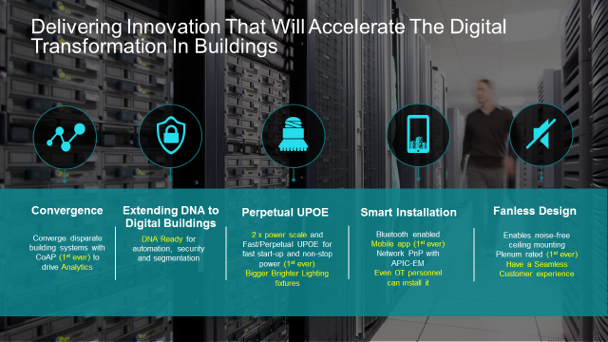
5 innovations we are bringing to market to accelerate digital transformation of buildings are:

Blog Picture1

  • Convergence – This switch enables IP convergence and interoperability of disparate building systems such as lighting, HVAC, badging systems, surveillance over CoAP protocol.
  • Extending Cisco’s Digital Network Architecture to Digital Buildings – Automation, security, and analytics brought to digital buildings for IoT devices enabling faster on-boarding, automated provisioning and monitoring, intelligent threat detection and mitigation. For instance lighting ports can only be used for lighting and not to access other areas in the network.
  • Fast & Perpetual UPOE – Industry’s first 60W per port Cisco UPOE technology delivers twice the power of current PoE+, thereby powering higher luminosity for bigger brighter lighting fixtures. Fast start up and non-stop power through Perpetual UPOE helps power lights back on within 5 seconds during a power outage.
  • Simple Smart Installation – This is the 1st ever Bluetooth enabled switch with a mobile app for unmatched ease-of-use & installation (iOS & Android app). It simplifies the deployment experience to a point where any IT and OT personnel can install it.
  • Fanless Design – Industry’s 1st semi-ruggedized fanless switch which makes it ideal for noise free deployment in ceilings. It enables a stellar noise-free customer experience.

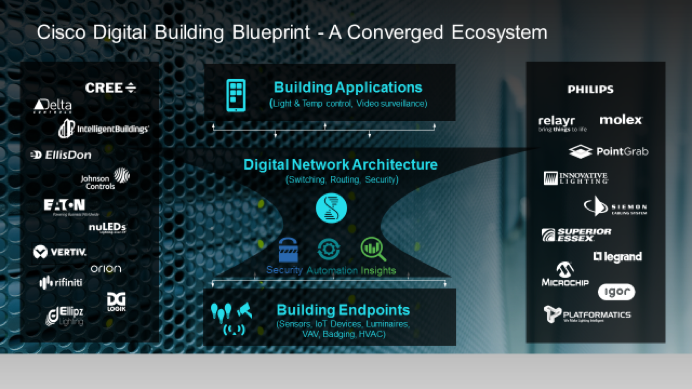
We’re excited about the new opportunities we can bring to our customers in the digital building and enterprise IOT space through our converged ecosystem of partners, products and solutions.

Blog Picture2

Simplify, secure and save through our network innovation for digital buildings –There has never been a better to make your buildings smarter. So, are you ready to embrace the Digital Building revolution?

 Digital Building Website

Cisco Catalyst Digital Building Series Switches


Authors

Pankaj Gupta

Director, Market Management

Enterprise PSM - Portfolio, Software, and Campus Switching