Avatar

Have you ever felt a bit like you’re living the same day over and over again? I used to. Those were the days where my alarm clock would scream promptly at 6AM, my eyes would barely open as I’d smack one of my favorite songs back into sleep mode. Eventually, I’d roll out of bed – now rushed because five minutes became fifteen – and get ready for the day.

I’d grab my coffee and race out the door, only to be slammed into the slow crawl of an hour long commute – which would remind me of how many people really need more coffee in their lives. Finally, I’d cross the finish line, clock in, and collapse down into my chair (second cup of coffee in hand) and do my best to get through the day.

TalentBrandGHC

The next day, it would start all over again. That was my old Monday through Friday, and I think we’ve all had a job or two where each day felt a bit like the movie Groundhog Day, right?

Those days always left me wondering, “What else is out there?” – Especially during the hour long commute home, depleted of energy or coffee.

My story is proof that hard work, networking your face off, and waiting for a few stars to align can truly take you places – and it all took me to Cisco in the summer of 2015. No longer did I have to wonder what else was out there – because I had found it – I was living it! Now I know.CarmenCasieTAGivesBack
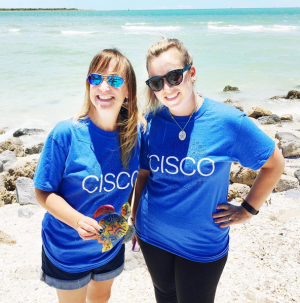
I love coming to work each and every day at Cisco – it’s never the same day twice! Here’s why, for me, I #LoveWhereYouWork.

1. We Give Back. Volunteering has always been very important to me – I love being able to give back, and do so quite frequently throughout the year. It was one of the first things that stood out to me when I was researching Cisco – they’re a company that cares. And in 2016, full time employees each received FIVE DAYS to give back in our local communities to organizations of their choosing. Cisco also matches donations throughout the year, and is proactive in truly making a difference in people’s lives.

For example, I’m planning to take some time in March to help The St. Baldrick’s Foundation for children’s cancer research — an organization I’ve been volunteering with for seven years! I’m their lead photographer for one of the events here in Florida, which is typically a full day spent on my feet, plus weeks of editing in my spare time. Thanks to Cisco – I’m now able to dedicate time on the Monday following our event to edit all those images in one day so that we can share them with event participants and St. Baldrick’s even faster!

Plus, I found out there are other employees throughout Cisco that are also volunteering with St. Baldrick’s – and we’re all participating even more now to help this great cause.

CasiesBday2. We Are a Family, and Family Comes First. I’ve worked on a lot of great teams at a lot of great companies, but this one is something unique. We’re never more than a phone call, text, or WebEx away and when something tough happens in life – we’re immediately in motion to help one another out.

We’re allowed time when our families need us. We understand that doctor’s appointments, vet appointments, and needing to get sick kids from school – those things happen.

We celebrate each other’s wins, and we mourn each other’s losses. We trust one another to get the job done, and we push each other to always be industry leaders in our space. We recognize each other, and never turn down an opportunity to let our co-workers know how much we value them. Cisco also has Connected Recognition, which allows employees the ability to award our fellow co-workers for a job well done.

A few months ago I got to treat myself with a brand new Apple Watch due to the Connected Recognition I earned! It’s something I never would’ve purchased for myself otherwise, but now I have a daily reminder of how amazing my Cisco Family is AND it keeps me active and motivated too! 😊

PS: We also get our Birthdays off! Now THERE’s another reason to celebrate!

3. Work/Life Balance and Flexibility. At Cisco I’m allowed to get my work done, and be flexible about it. I could’ve moved to NYC or LA for other career opportunities, but I wanted to stay close to the city I love and my family.

KimberCoffee

Plus, this meant I could finally get a dog, because I didn’t have to be at the office to get things done! (I’m sitting here with her as I write this.) I love that Kimber is always at my side during the work days, and that she helps to provide necessary breaks away from the computer screen for a quick lap around the block or a toss of the ball between meetings.

At the end of the day, I shut my computer off and head downstairs to immediately spend time with my family. Just kicking a commute to the curb has lessened my stress, given me more time to rest and take care of myself, ample time in the day to exercise without feeling burnt out, and I’m able to really focus on what matters most to me.

I’m happier and healthier because I’m not living to work, at Cisco…I’m working to live.

They say that in the best relationships, its people choosing one another every single day, day after day, no matter what. Good Day/Bad Day – you’d choose them all over again. That’s what love is between people.

But I also think, that’s also what it takes to really love where you work too. Does everything go according to plan or come up roses? Maybe not. But when you sit back and really look at it all, for me…there is nowhere else I’d rather be.

I’d choose Cisco every single day, over and over again, no matter what.


Want to choose Cisco? We’re hiring!

Authors

Casie Shimansky

Content Strategist | Provider of Pixie Dust

Employee Storytelling

Avatar

Every generation since the ancient Greeks has observed that “the only constant is change.” But today, that change is accelerating exponentially and the Internet of Things (IoT) is helping to drive it in every industry—from mining to manufacturing, from agriculture to aviation. Never has it been more important to carefully manage that change and its impact on your organization’s people and culture. Let’s face it: change is the new status quo, and only those that can adapt quickly will survive.

The road to IoT is a journey. And that journey is a catalyst for digital transformation. Just look at the auto industry, which only a few years ago offered mostly blue-collar manufacturing jobs. Today, every new vehicle rolling off the assembly line is a datacenter on wheels that generates up to 2 petabytes of data per year. Auto makers are becoming technology companies and are increasingly chasing the same talent pool as large and small tech companies. The transportation and technology industries are converging fast, driving a dramatic shift in roles, culture and processes.

  
IoT is turning every industry into a technology industry, spurring deep cultural change.
IoT is turning every industry into a technology industry, spurring deep cultural change. The same phenomenon is happening across most other industries globally. With the adoption of IoT, these industries are becoming technology industries, and every company is becoming a technology company. Think robots and automation in manufacturing. Think autonomous hauling vehicles in mining. Think data science and analytics in transportation, oil and gas, construction, energy, retail—and the list goes on.

In the fast-paced technology world, we have adapted to the model of reinventing ourselves every three-to-seven years. We know that we may be able to miss one major technology or business transition and survive, but if we miss two, we will likely perish. Now, people and organizations in other industries must face this very challenge. No longer can you expect to stay in the same role for 10 or 20 years, doing mostly the same things. The rapid pace of change today means you have to be prepared to continually reinvent yourself—as an employee, as a company, and as an industry.

IoT is requiring companies to rethink their approach to workforce roles and hiring. That means cultivating a culture of constant learning and role evolution. Will the chief information officer become the chief IoT officer instead? How will the plant control engineer’s role change in the face of IoT and automation? Will you need a chief supply chain management officer? What new skills will an assembly worker need in order to operate an automated line?

As you embark on the IoT journey in your organization, changing culture may be your toughest challenge. So think of your task as not just implementing IoT solutions, but as a change management process that will likely transform your company.

You can maximize your chances for success by tackling the cultural issues head-on, not waiting for trouble to arise. Before you kick-off your first small IoT project in one plant or store, meet with employees there, find out about their issues and concerns, and address them directly. Identify key influencers and people in key roles and include them as part of your virtual team. Naysayers can become your allies if you take the time to hear what they have to say and actually leverage their expertise. Don’t think your job is done after one meeting or training session on the new tools and technology. Uncertainty fuels negativity, so be clear about the impact of IoT on current roles and the new opportunities it can open. Work closely with employees on adopting the new technology, and continue to expand a coalition of the willing as you build on each success. In short, listen, include, and communicate!

IoT will also impact organizational structures and decision-making—both of which will become more collaborative and less hierarchical. Partnering across organizational lines, and with external partner ecosystems will become more important. IoT is complex and interdependent, and no one can do it alone. That means breaking down silos, bringing together IT with lines of business and operational technology functions.  This level of cooperation will require changes in internal processes and partner relationships—all empowered by IoT.

As an IoT champion, you are very much an agent of change. And yes, change can be painful. But you can lead your company toward digital transformation by creating a culture that is agile, flexible, and collaborative. In my next blog I’ll point out roadblocks, obstacles, and mistakes to avoid along the way.


Authors

Maciej Kranz

Vice President and General Manager

Corporate Strategic Innovation Group

Avatar

In the future, service providers are likely to use more complex network models, with orchestration used to draw together diverse physical and virtual elements

More and more telecom operators and IT service providers are deciding to go digital, as the benefits of being able to offer customers bespoke, flexible services become increasingly clear.

The companies that succeed in the future will be those whose products can be driven by the needs of customers, rather than defined by the limitations of their technology.

And running a virtual network makes it much easier for you to offer your customers what they want. For example, giving them the chance to design their own network services and pay for them as they use them.

The need for change is intensified by the growth of the Internet of Things (IoT). Cisco research has forecast that by 2020 there will be 26.3 billion networked devices and connections globally – that’s 10 billion more than in 2015.

As our cars, homes and cities all become connected, and as the demand for online video continues to surge, being able to bring agile new products quickly to market will be the key to growth.

On the other hand, service providers who don’t go virtual will miss the new opportunities.

Things are moving fast, and it’s important not to be left behind.

Managing the virtual transition

It’s one thing to decide to move to a virtual network. But when you look at what the process involves, you’re faced with a whole range of further questions.

It’s usually not possible for a service provider to transform itself in one stroke. Making the move to a virtual network is more likely to involve a gradual journey.

Many networks will remain hybrid for some time, with virtualisation used to enhance the physical network, rather than completely replace it. And it’s becoming increasingly common to use elements from different vendors.

Managing this change is a delicate operation. One that could bring real rewards, but that you definitely don’t want to get wrong.

We have extensive experience in providing technology and support to complex networks. So we’re able to advise service providers on how to make your virtualisation journey a success.

And we’re proven creators of innovative, high quality technology. The Cisco NFVI infrastructure is well suited to support a gradual evolution to virtual networks.

It has a modular design, meaning it can be easily adapted as your network evolves, drawing together the best of physical and virtual network technology.

Flexibility through open sources and orchestration

We are also committed to creating standards from our innovation (for example, we actively contribute to IETF), giving you greater freedom to tailor your network to your precise needs, and to adapt it as your situation changes.

We also contribute to high-profile open source initiatives, including OpenStack, The Fast Data Project fd.io, OPNFV, Open Daylight and more.

In our increasingly connected world, it no longer makes sense to work in silos. We also want to help create a strong foundation for virtualisation across the industry.

With service providers creating more complex networks, it’s essential for your network to have a central ‘brain’ that can provision capacity in real time and automate processes. This is the role performed by the Cisco Network Services Orchestrator (NSO)

Our expertise in network hardware puts us in an excellent position to manage an effective virtualisation change, helping you build on the strengths of your existing systems.

Our holistic approach can take the pressure off, making sure you retain carrier class reliability, but with added adaptability and agility.

That’s why many leading service providers are now using our technology to support their creation of hybrid and multivendor networks using open architecture.

Every service provider goes about things differently. And we are well-placed to help you make the change in a way that works for you.

Find out more about how Cisco technology can help you make your network faster and more agile. Read more about the Cisco NFV Infrastructure


Key takeaways

Making the transition to a virtual network is likely to involve a gradual journey.

– Many networks will remain hybrid for some time, with virtualisation used to enrich and enhance the physical network, rather than completely replace it.

– An open source driven approach to technology is creating open and multivendor network architectures.

– We are well-placed to support service providers as they create these new complex and evolving networks, through our expertise, orchestration technology, and commitment to open standards.


Save

Authors

Volker Tegtmeyer

Senior Manager, Product and Solution Marketing

SP Cloud Virtualization

Avatar

Malware is one of the most prevalent and most insidious forms of cyber attack.  Identifying and eliminating them are critical in minimizing the impact of a breach.  As a cybersecurity incident responder, I always end up performing some level of malicious file analysis.  In this blog, I’ll share some recommended approaches that have worked for our Incident Response team.

Time is rarely on our side to perform deep analysis of the potentially malicious file. Reverse engineering a file can take weeks or months to complete and takes a level of skill which few individuals maintain. We need to develop indicators of compromise to complete the identification phase of the incident response process with some degree of haste. With an understanding of how to develop those indicators ourselves, we can quickly execute a response plan without needing to wait on full analysis.

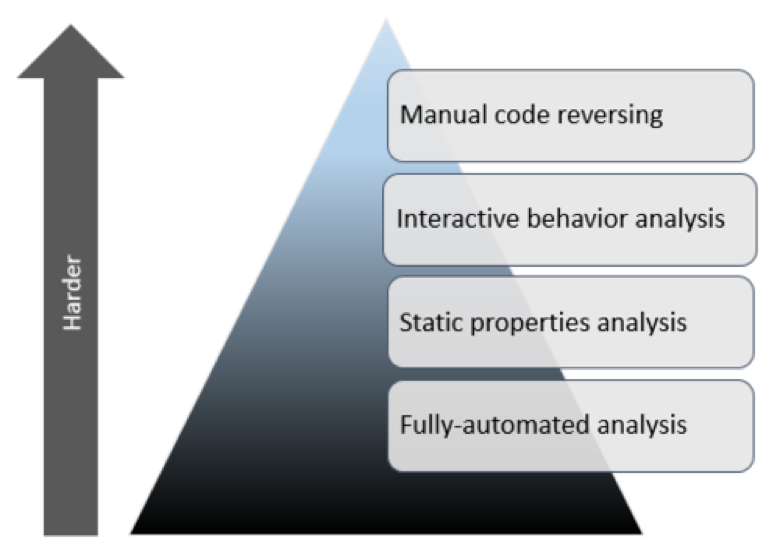
Lenny Zeltser groups malware analysis into four stages. Starting from the easiest to use, fully-automated analysis, we move up into static property analysis, then to interactive behavior analysis, and finally into full manual code reversing. Many of you likely have experience using fully-automated analysis provided by tools such as ThreatGrid. These types of tools provide quick answers, but little in the way of interaction by the analyst. They are easy to use and certainly should be part of the incident responder’s tool kit. Sometimes though we need to do a little more analysis on a suspicious file.

Figure 1. Four Stages of Malware Analysis by Lenny Zeltser

While performing an incident response engagement, we really have to focus on efficiency and effectiveness. The goal of the incident response process is determining root cause and impact to ultimately succeed in recovery. The goal is not one of research trying to fully understand the intricacies of a new vulnerability in the moment. However, further research can and should be performed after the engagement has been completed. During incident response malware analysis, I channel the Pareto principle, which Vilfredo Pareto developed for application in economics. For our incident response purposes, we are stating that by performing 20% of the malware analysis work we can generate 80% of the results necessary for successful incident scoping. We do not need to always perform full manual code reversing to understand what the malicious file is doing and to write good signatures for that sample.

To help us out with this incident response malware analysis, we need a set of tools. The following is a list of the tools I use regularly and will demonstrate in this blog post and the corresponding video.

Tools:

Static Property Analysis:

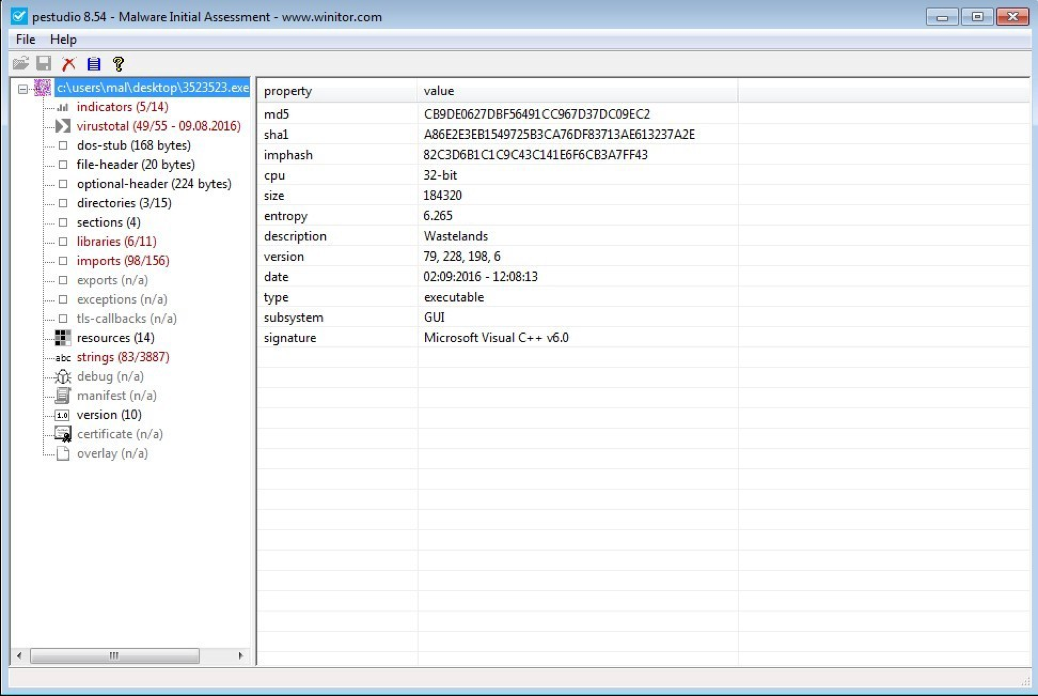
My favorite tool for performing property analysis is pestudio developed by Marc Ochsenmeier. I wrote a personal blog post on this tool a few months ago if you would like a full break down of its capabilities. During static property analysis, we will do some tasks such as searching for the hash on our favorite search engine or malware repository. Beyond simply doing searches for the hash, we will also dump a list of all readable strings in the file, as strings can give us a wealth of information about what the file is likely to do. Files which have little in the way of obfuscation might tell us what domain names it is attempting to call out to and IP address could be stored in plain-text or directory locations where data will be written to.

Identifying the function imports can allow us to predict what we should expect out of the file when we move into interactive behavior analysis. For applications to execute inside a Windows environment, or any operating system for that matter, they must import functions from the application programming interface, or API. These function imports tell us a lot about what the file wants to do. If a program has in its import table a function to write out to the Windows registry, we can assume that it will be making registry modifications. We may even be able to see what registry key is being modified in the strings we dumped earlier. While looking at function imports, pestudio will highlight those functions which are ‘blacklisted’, as in those which are most often used in malicious software.

We can also write signatures based on the static properties of a file. Signatures, whether in the form of anti-virus or intrusion detection and prevention rules, are written on the static properties of a file. Sometimes it is simply the hash, though not often as hashes are not a reliable method for detection due to modern malware samples performing self-modifications to avoid hash detection. More often signatures are written base on byte strings and readable strings.

Figure 2. pestudio 8.54.

Interactive Behavior Analysis:

Most files have some method of obfuscation making static property analysis difficult, as some are heavily obfuscated using custom routines making it impossible to analyze without a deeper form of analysis. During behavior analysis, we let the file execute in a contained environment and collect detailed information about its execution, similar to automated analysis. The difference is that with this method we can interact with the malware while it executes. Additionally, we can provide the malware with an environment that it should thrive in. For example, if the malware exploits a Java vulnerability, then we make sure our laboratory machines have that vulnerable version installed.

While the malware is executing on the vulnerable host, we measure changes to the system. Malware must make modifications to a host to remain persistent; it often must communicate for it to complete its objectives. We can measure these changes and communication to identify other hosts which have been impacted by the malware.

Before we execute the malware, we need to setup of laboratory environment to allow for the execution of malicious files in a controlled manner. Windows 7 Service Pack 0 compiled for 32-bit Intel x86 architecture will likely be able to execute most malicious Windows binaries. We want the system unpatched so that the malware can execute to its fullest extent. If the sample is compiled for a different version of Windows or processor, then change your laboratory to suit the needs for the sample. You will find this information out during property analysis.

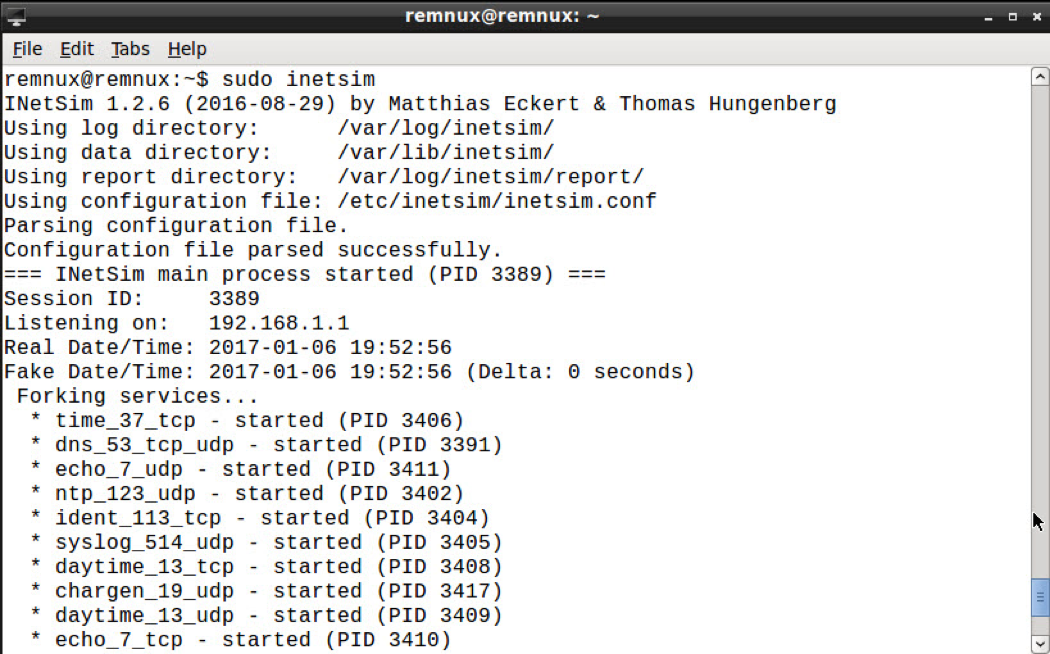
To mimic services that the malicious sample might communicate with, we will use INetSim. This is a Linux application which comes installed on the REMnux distribution developed by the SANS Institute. But you can install the application on any Linux distribution of your choice.

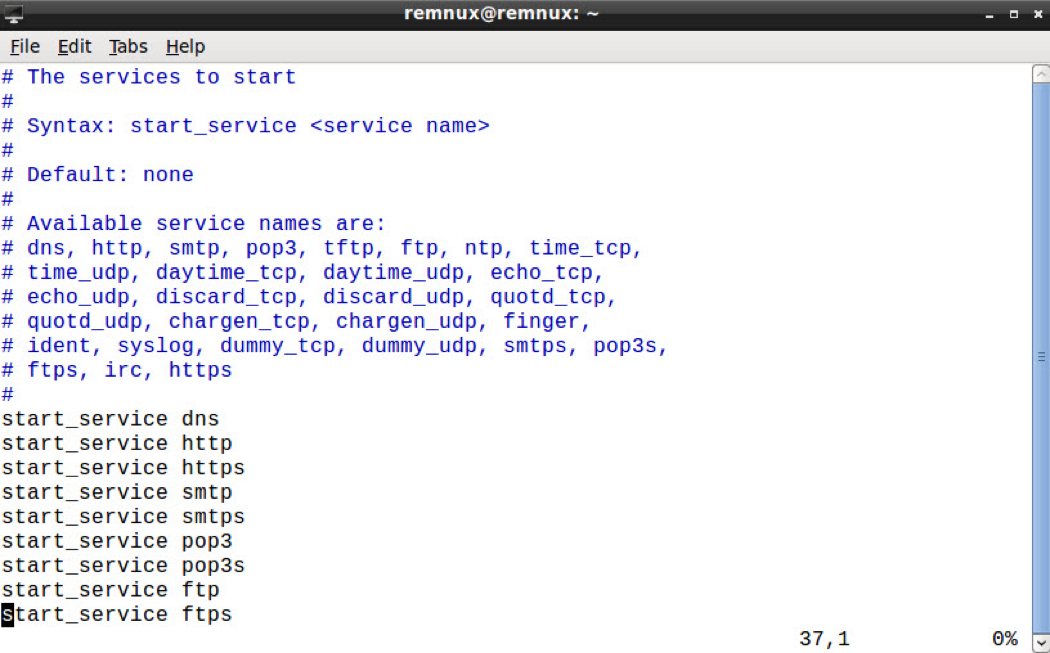
Changes are necessary to the configuration of INetSim to enable all of the services required for analysis. By default, most of the available services are disabled, but you can enable them by uncommenting the appropriate line. I recommend reviewing the configuration and making those changes as necessary.

Figure 3. Screenshot of INetSim executing.


Figure 4. Screenshot of INetSim configuration.

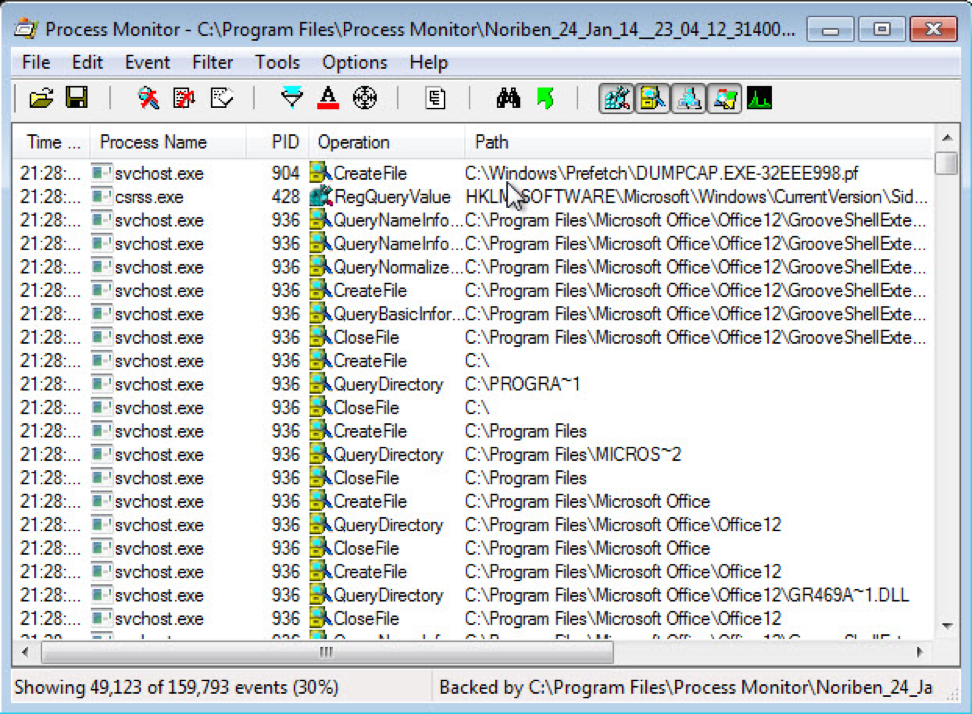
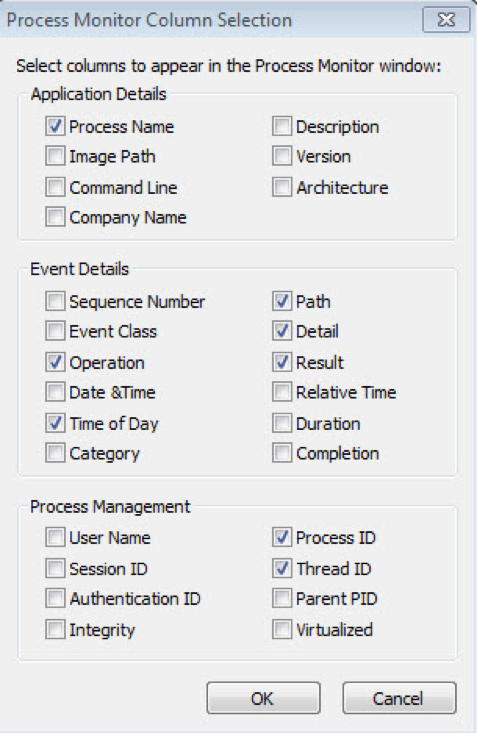
Prior to executing the malicious sample, we need to start our tools to watch for changes. There are two tools which I use for this. SysInternal’s Process Monitor is a tool which monitors the entire system for changes, to include changes to the registry and to the file system via hooks in the Windows API. When a process wants to write the file system, it must make calls to the appropriate Windows API to do so- process monitor identifies these calls and tracks what arguments are made during the call. Details about the processes and their threads are laid out in a table which updates continuously. We can, and ultimately will, output this data into a comma separated value, or CSV, format for ingestion into another product or review in its CSV form. To prepare us for the later use in a tool called ProcDOT, we need to make some minor configuration changes, as seen in Figure 6.

Figure 5. Screenshot of ProcMon


Figure 6. Screenshot of ProcMon Configuration

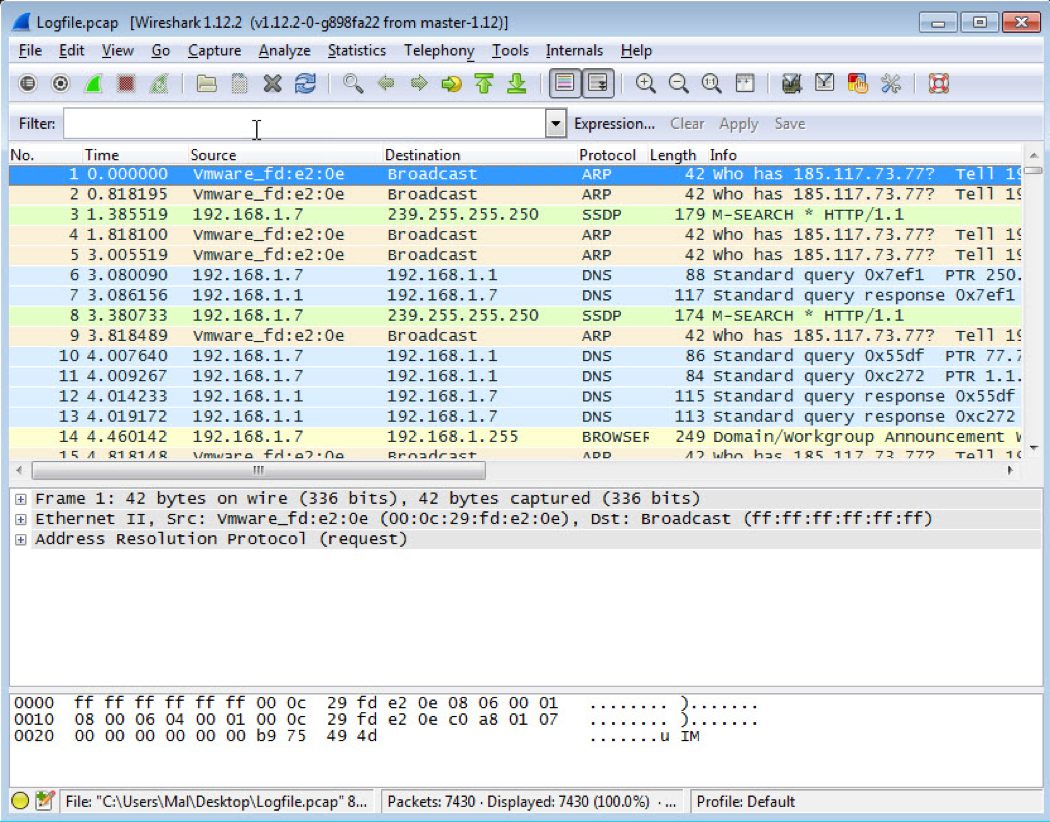
Samples will likely make some form of network communication. To capture this communication, we use the ever-popular Wireshark running on the Windows 7 machine. INetSim needs to be running and communication between the Linux and Windows host must be available for this to work.

We do not want the malware sample to speak to its actual command and control, as doing so would tip our hand to the adversary. Our goal is to find other hosts which made this similar communication. We may also use this information to prepare for second rounds of analysis. Wireshark is our go-to tool to capture this data.

Figure 7. Screenshot of Wireshark

Now that Wireshark and Process Monitor are running we can execute our sample. Running the sample with Administrative privileges will give us the greatest impact to the host. Realistically we will want to run this sample multiple times with a couple different levels of privilege to see what happens. Once we have executed the sample, we may monitor its progress using the Task Manger or Process Explorer. When we believe that the process has completed is primary objective, we can pause the data capture and export our data.

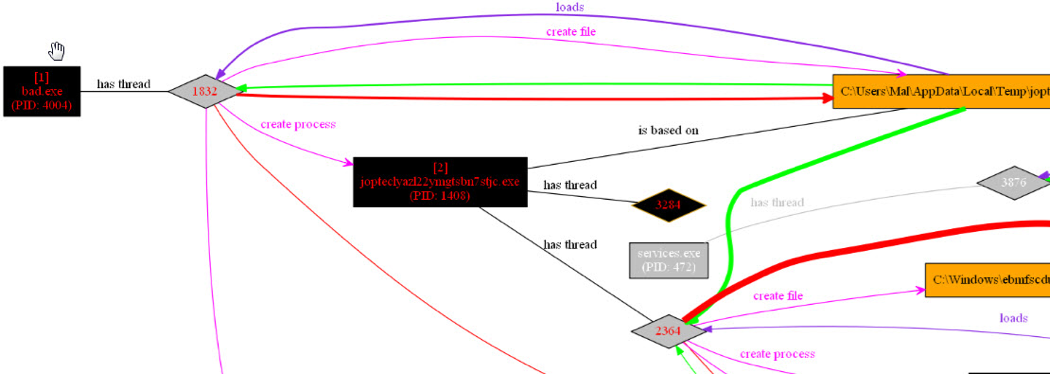
The exported data will now be imported into a graphing tool called ProcDOT. We must make sure that our output is formatted properly from Process Monitor and from Wireshark for use in ProcDOT. ProcDOT produces an interactive graph of the malicious process executing. In the graph, we can see changes made to the registry, files written to the volume, and attempts at resolving domain names for network communication.

Figure 8. Screenshot of ProcDOT Output

Wrapping Up:

The whole purpose of analyzing the file is to determine artifacts, called indicators, which can be used to determine if the file successfully executed in the production environment. We can search for these indicators using the enterprise security information and event management (SIEM) system. Or we can package the indicators into rules such as Yara, OpenIOC, and Snort.

Limitations exist in this process of analysis. Malware can identify it is running inside of a virtual machine. We can avoid this problem by identifying malware capabilities during property analysis of the file then making changes to our procedures or to the sample itself such as removing the offending detection mechanisms. If we cannot get the file to execute at all inside a virtualized environment, we may be able to execute the file on a hardware system instead or perform manual code reversing to NOP out the offending subroutines.

These simple methods for analyzing malicious files can be a force multiplier for the incident responder on the ground during an investigation. Rather than waiting for a full reverse engineering of the sample, we can quickly determine indicators of compromise and properly complete the identification phase of the incident response process. Cisco Security’s Incident Response Service can also help support analysis of malicious files for our customers on retainer, and when those files require deeper analysis, we can leverage our relationship with Talos Intelligence.

For a demonstration on how these tools work together to help us analyze a file, watch my YouTube video.

Authors

Matt Aubert

Senior Incident Response Analyst

Avatar

As a Cisco IT program manager, Vijay Nerella spends his workday in back-to-back meetings. Vijay’s team is responsible for ongoing IT programs that support the work of dozens of groups within Cisco. It’s a responsibility that requires constant communication and coordination. His Outlook calendar is blocked and booked daily.

Yet, in the middle of a typical meeting-intensive day, Vijay has a volunteer commitment: he is tutoring a 7th-grade student in algebra through a nonprofit organization called We Teach Science (WTS).

At 3:00 p.m., his Outlook reminds him to log into the WTS Remote Tutoring and Mentoring (RTM) program. RTM is a web-based interactive whiteboard and communication platform customized specifically for WTS.

The student attends a school in another city in California, at least two hours away from where Vijay works in San Jose. But Vijay simply walks to the small conference room he has reserved for the same hour on the same day each week and connects to the student with a few keystrokes.

RTM is a simple, virtual way for STEM professionals to volunteer their time for local students.

“Mentors for STEM—which encompasses science, technology, engineering, and mathematics programs—are in high demand. But it can be challenging for them to find time to volunteer,” says Alex Belous, education portfolio manager for the Cisco Foundation, which has been supporting WTS since 2011.

“WTS uses collaborative technology that removes the obstacles of time and travel for potential mentors,” he adds. “Their approach matches Cisco’s focus on empowering global problem solvers through technology and expertise to make a positive difference for people, society, and the planet.”

WTS focuses on economically underserved students, especially minority populations and females. Students often begin the program performing far below average. In the 2015-16 school year, students (on average) showed growth in math knowledge of approximately one grade level based on pre- and post-assessment tests. For most of these students, this was their first year of growth in math.

“A flourishing digital economy will need every eager young mind,” says Alex, “and every child should have the education to be successful in this unprecedented era of connectivity. Math, and specifically algebra is a fundamental building block for STEM. The WTS remote mentoring model has proven to be extremely effective in helping struggling students become confident in math. It’s a real testament to the power of mentoring, which WTS has made more accessible scalable through technology.”

Removing the Obstacles of Time and Travel

WTS actually began as a classroom-based mentoring program. “It was clear that it would be difficult to bring in qualified volunteers, battling traffic and packed professional calendars,” says Michael Schwerin, regional development officer for WTS. “Once we deployed RTM, mentors could connect wherever they are—office, home, or on the road—with their students. It makes volunteering easier and eliminates any geographical boundaries for recruiting mentors.”

Students meet with their assigned mentors online for 45-60 minute sessions once per week throughout the school year. Initial grant funding from Cisco helped WTS expand the program to more students, schools, and regions across the U.S. It enabled the program to double the number of students it serves (from 200 to 400) across six school districts in California and Texas. In 2016, the program provided over 4,400 hours of e-mentoring and tutoring sessions from mentors based in 35 states.

Program Coordinators closely monitor relationships to ensure a positive and safe experience for both mentors and students. They review sessions (all of which are recorded and stored) and provide feedback. In fact, Cisco funding enabled WTS to increase its staff of program coordinators to support the mentors, as well as work on-site with school administration and teachers.

Vijay says that the support of the program coordinators makes a big difference in helping him work through any roadblocks with his student. “Last year I got some feedback from the program coordinator that was very helpful—I needed to work on providing more examples from real life to explain the math problems. I also needed to spend more time on breaking the ice with my student, investing the time to make sure he was really engaged.”

The time WTS puts into supporting mentors has paid off in a high retention rate of 65 percent.

Commitment is a Mentor’s Most Important Qualification

Annette Blum is a product marketing manager for Cisco, working with global stakeholders on Cisco’s enterprise solutions. “I loved math in school, but I pursued a career in marketing,” says Annette. “I was pretty confident that I could mentor a student in math, but I wasn’t sure if programs like We Teach Science would be interested in someone who wasn’t an engineer.”

The answer was a resounding “yes!”

“We were incredibly excited that Annette was interested in becoming a mentor,” says Michael. “You don’t have to be an engineer to be an effective mentor. We have at least three levels of support for anyone who is interested in becoming a mentor.”

Annette herself was particularly inspired by the fact that WTS makes a focused effort to find mentors for young girls, who are underrepresented in STEM fields. “I feel very strongly about empowering women, and education is a huge part of that,” says Annette.

We Teach Science’s Tutoring and Mentoring program reduces the failure rate of Algebra students

To her delight, Annette was paired with a young female student whose background is vastly different from her own. “I knew it would be more challenging to find common ground, but that effort has become one of the most rewarding aspects of this program for me.”

Even though results are tracked against academic goals, Annette realized what motivated her student was consistency. “Showing up every week throughout the school year—just for that single hour—has incredible value. I don’t think my student has many female role models. I have an opportunity to remind her that she is clever, she is a problem solver, and that she has a voice that should be heard.”

Annette also appreciates the mentor support that WTS provides through the program coordinators. “A few weeks into that first school year of tutoring, I began to have serious doubts that I was reaching my student. I relayed my concern to the program coordinator. To my surprise, I received a note informing me that my student’s teachers and her grandfather, who is her primary caregiver, had all noticed improvements in her performance and her enthusiasm for learning. It completely changed how I looked at my contributions to this young girl’s life.”

An Unexpected Lesson: What Mentors Bring Back to the Workplace

Working with disadvantaged children is often personally rewarding to mentors. But Annette and Vijay have also learned lessons they didn’t expect going into the program. Their jobs, while very different, require intensive personal interactions with peers. Not surprisingly, productive interactions are often sidetracked by differences in personal style, communication misunderstandings, and other all-too-human issues.

“I didn’t see it immediately, but I realized that the kinds of skills I was learning as a mentor were actually helping me in these workplace relationships,” says Annette. “My student often came to sessions with an attitude or issues that I couldn’t readily understand. I had to keep reminding myself that she’s giving her best effort. I’ve found that same perspective helps me in the workplace.”

Vijay has had a similar experience. “In my job, I have to be as good at building relationships as I am at the technical side of my job. Mentoring has helped me strengthen my ability to relate to people who have a different communications style than I have. It’s even helped me understand my 10-year-old daughter a little better.”

“This perfectly embodies Cisco’s belief that people like Annette and Vijay are social change agents,” says Alex. “They’re inspiring the students they’re mentoring. They’re also bringing a different perspective on relationship building to the workplace. And they’re sharing their experiences with their colleagues, which we hope will encourage other people to get involved as mentors.”

Michael and Alex are now talking about the next step for WTS. “We want to reach out to students at an even younger age. We want to strengthen a student’s math skills and confidence in their abilities before they even start taking algebra,” says Michael. “We also want to innovate around measuring some of the intangibles outcomes of mentoring—things that students learn about themselves and their potential that can’t be measured in a test score.”

“We’re looking forward to working with WTS to take the program into even more innovative areas for STEM mentoring,” says Alex. “WTS is a perfect example of how each of us can help solve a tough challenge just by showing up.”

“I would urge all of my colleagues at Cisco to look into the WTS mentoring program. It’s a comparatively modest time investment that pays big dividends to a child,” says Annette. “And you get summers off!”

Want to use your skills to make a positive impact in someone’s life? Download our Illustrated Guide: 7 Ways to Be a Global Problem Solver in Your Own Community.

Our support of We Teach Science is one example of how Cisco is harnessing the power of the digital revolution to accelerate global problem solving, enabling people and societies to thrive in the digital economy. Our goal is to positively impact 1 billion people by 2025.

Authors

Peter Tavernise

Climate Impact and Regeneration Lead

Director, Cisco Public Benefit Investment

Avatar

For most enterprises today, remaining competitive requires them to modernize their data center infrastructure to deliver operational services at the pace and scale of the cloud and DevOps. The Cisco Nexus 9000 is a key component of Cisco ASAP data center as a foundational element of the modern infrastructure that is optimized to transform enterprises into full-fledged digital businesses.

To help customers grow, consolidate, scale and to adapt to changing business needs, Cisco today is announcing significant advancements and enhancements to the Cisco Nexus 9000 portfolio. These innovations are built leveraging the flexibility of both custom ASIC (Cloudscale) intelligence and merchant silicon options, providing customers with choice in terms of price, performance, and capability options. These industry-leading options make the Nexus 9000 ideal for traditional data center environments or to fully automated, software-defined, hybrid cloud data centers.

The latest Cisco Nexus 9000 innovations include:

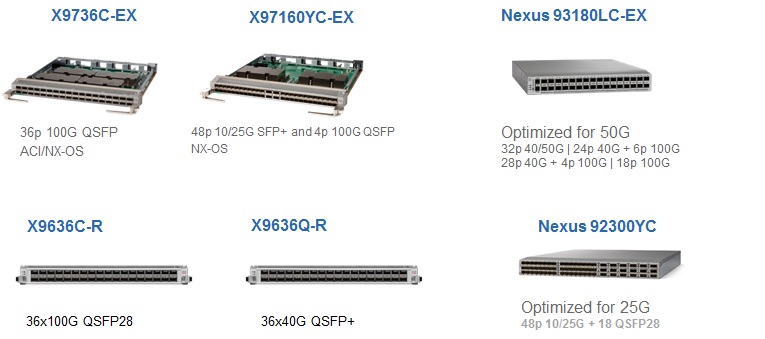
  • Fixed form-factor advancements: Cisco is introducing two new fixed platforms powered by Cloudscale ASIC and optimized for 25G and 50G configurations with 100G uplinks, support for flexible configurations and Tetration Analytics.
    • The Nexus 93180LC-EX is the industry’s first 50-Gbps capable 1RU switch that support 3.6 Tbps of bandwidth and over 2.6 bpps across 24 fixed 40/50-Gbps ports, 6 uplink ports can be configured and 40 or 100 Gbps.
    • The Nexus 92300YC is a high-density model offering 25-Gbps to 100-Gbps performance with flexible topology design that will be available in March 2017. This is a high-performance model capable of reaching 6.0 terabits per second of bandwidth and processing over 4.75 billion packets per second across 48 25-Gbps SFP28 and 18 100-Gbps QSFP28 ports. These performance thresholds make this switch ideal for 25 Gbps server access and 1:1 subscription networks, in a compact form factor.
  • Modular switch advancements: Cisco is also introducing new 100 Gbps modules for Nexus 9500 Series Modular platform powered by Cloudscale ASIC, more distance and are Tetration Sensors-ready.
    • The X9736C-EX offers up to 36 line-rate 100 Gbps ports, ideal for backbone and router interconnect
    • The X97160YC-EX scales to 48 1/10/25 Gbps SFP+ ports and up to four 40/100 Gbps QSFP+ ports. These options make these modules ideal for aggregation layer and enables greater distance for 25 Gbps deployments with RS FEC.
  • The new Nexus 9500-R Series line cards and fabric modules, using merchant silicon ASICs, provide highly scalable route tables and buffering that can be shared or dedicated per-port for better burst absorption. Specifically, Cisco is introducing the X9636C-R – 36 line-rate 100G Ports and the X9636Q-R – 36 line-rate 40G ports (NX-OS mode support only).
  •  

    Continue reading “Evolving the Nexus 9000 to Enhance Today’s Social, Mobile, Cloud and App-Centric World”

    Authors

    Tony Antony

    Marketing

    Solutions

    Avatar

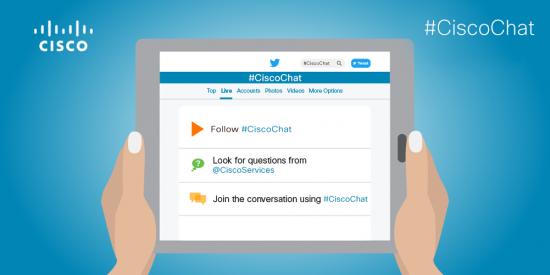
    Join us for a #CiscoChat on February 8th at 11 a.m. PT to discuss the reality of multivendor IT support.

    Imagine you’re the IT director of a global bank. You recently implemented a variety of digital solutions: virtualization, IoT, data analytics. You get the picture. Your company is under pressure to compete and deliver experiences to increasingly demanding tech-savvy customers, and IT is on the hook for making it work seamlessly. Never mind the complexity and the 10-20 vendors you now have to manage.

    One day it all comes crashing down. Panic sets in. Was it a bug in the software from vendor A? Is

    something wrong with your data analytics platform from vendor B? The unthinkable: could it be a cyber-attack? How do you begin to narrow down where or what the problem is? Which vendor do your customers call? If it’s an interoperability issue, how do they troubleshoot across vendors? And while you’re thinking through this, the bank is losing almost 3 million dollars an hour in downtime alone.

    As digital transformation takes hold and IT infrastructure becomes hyper-converged, this is the new “blood, sweat, and tears” reality of IT. But it doesn’t have to be. New support models and technical services have emerged than can help simplify the complexity, while achieving ROI from digital investments.

    Join us on February 8th at 11am Pacific time (2pm Eastern time) for the #CiscoChat, ‘Blood, Sweat and Tears: The Reality of Multivendor IT Support.’ During the chat, we’ll discuss the challenges IT faces in today’s multivendor environment and how Solution Support can help.

    The chat will be moderated by @CiscoServices and co-hosted by @CiscoPartners and @Cisco_Support. Jack Gold @jckgld, Principal analyst and founder at J. Gold Associations, will also join the discussion to provide additional industry insight.

    To participate in the chat:

    • Make sure you’re logged into your Twitter account.
    • Follow @CiscoServices on Twitter.
    • Search for the #CiscoChat hashtag and click on the Latest tab.
    • Add to the conversation by using the #CiscoChat hashtag in your tweets. This way, others can find your contributions to the discussion.
    • When replying to specific participants, add a “.” at the beginning of the tweet so your question or comment will appear in your public twitter feed.
    • If you need multiple tweets to answer a question, preface each tweet with “1A,” “2A,” etc. This will make it easier for others to follow along with the conversation.

    Welcome introductions and questions will begin at 11am PST (2pm EST). Don’t forget to bring your own questions to the discussion, too. See you there!

    Authors

    Denise Denson-Hanson

    Marketing Manager

    Enterprise Solutions Marketing - Services

    Avatar

    Some of our recent blog posts, A Requirements Checklist for the Next Generation Transport Network and The Next-Generation Transport Network: Solution Options discussed the business requirements you should consider before selecting a modernization solution and the technology options currently available to modernize aging transport networks. In the post, we’ll delve into the Cisco solution and how it can be used to provide TDM services as well as modernize a number of different network architectures, including: Legacy TDM networks (with DCS and ADM equipment), SONET ADM ring networks, IP core networks (support for TDM services) and a complete central office modernization project.

    Cisco Transport Network Modernization Solution

    Using high-density circuit emulation (CEM) technology, TDM services can be migrated across an asynchronous IP/Multiprotocol Label Switching (MPLS) network with no errors and a constant delay. CEM provides the ability to terminate TDM traffic over SONET/SDH as an interface, continuing fault propagation between SONET/SDH and the IP/MPLS network using pseudowires running over dynamic label-switched paths (LSPs). LSPs are paths through MPLS networks set up by a signaling protocol. The CEM solution is supported by multiple industry standards and deployed through control planes for both SONET/SDH and IP/MPLS.

    You get SONET/SDH-like features, such as OAM and manageability while IP/MPLS and other technologies help eliminate errors and latency. It’s predictable and deterministic, with sub-50ms resiliency. It’s also invisible to end customers, with no new CPE required. Packet optical technology with high-density CEM is a future-ready transport network architecture because it lets you evolve towards metro Ethernet, Layer 3 VPN, and full IP transport whenever you – or your customer are ready.

    The Cisco solution includes these software and hardware components:

    Cisco Network Convergence System (NCS) 4200 Series
    Addressing the inefficiencies at the network edge, this transport system utilizes high-density CEM technology to convert TDM services into pseudowires, which then facilitate the transport of TDM services over a scalable MPLS core network. With this technology, service providers can keep their existing operational models and service revenue while running all their services over an IP network.

    Cisco NCS 2000 Series
    With its flex-spectrum ROADM, the Cisco NCS 2000 sets the industry benchmark for DWDM solutions. It delivers the touchless programmability, massive scale, and flexibility required to optimize both metro and ultra-long-haul performance.

    Cisco NCS 4000 Series Converged Optical Service Platform
    The Cisco NCS 4000 anchors a converged packet optical infrastructure by providing DWDM, OTN, MPLS-TP, Carrier Ethernet, and IP multiservice capabilities.

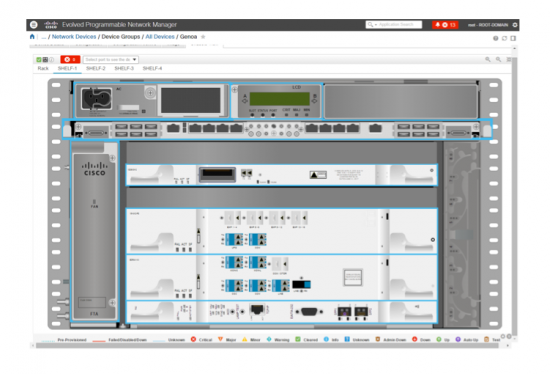
    The Cisco EPN Manager Chassis View
    The Cisco EPN Manager Chassis View

    Cisco Evolved Programmable Network Manager (EPN-M)
    Cisco EPN Manager enables service providers to modernize circuit transport and private line networks by addressing the combination of CEM over packet, OTN, and DWDM/ROADM networks with comprehensive end-to-end network management support.This all-in-one, next-generation product provides device management, network provisioning, and network assurance across converged packet-optical networks.

    How it Works: Migrating Different Architectures

    The Cisco solution can be used to migrate these architectures.

    Legacy DCS and ADM Retirement
    The NCS 4200 replaces the functionality of DCS and ADM components. You get a non-blocking, protocol-independent fabric architecture and boundless scale through the use of high-density CEM over a protected Flex LSP core. The power and space requirements of the DCS are cut by nearly 90 percent based on the small footprint required for the NCS 4200. You benefit from significant space, power, and cooling savings. This architecture integrates into both TDM and MPLS packet core networks.

    SONET ADM Ring Overlay/Migration
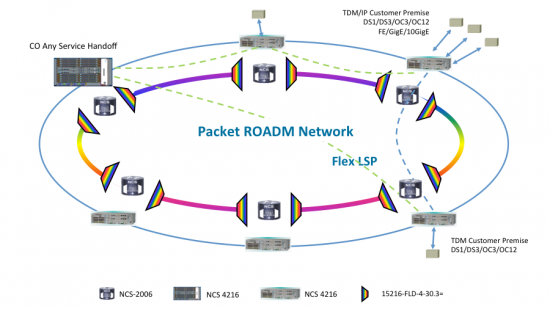
    The NCS 4200 and NCS 2000 replace the aging SONET ring as an overlay with a low-cost packet ROADM architecture. With the NCS 2000, DWDM is used to mitigate the need for a second fiber pair. The low cost of DWDM modules combined with state-of-the-art packet switching provides complete flexibility for service delivery. This new architecture provides any-to-any capability, as well as full hierarchical quality of service (QoS), and throughput control (for example, oversubscription). In addition, there is no time slot bounding through the transport path – you use an already lit fiber path, if required.

    Example of a SONET ADM Ring Overlay Migration
    Example of a SONET ADM Ring Overlay Migration

    CEM + Carrier Ethernet Over Existing IP Core Network
    NCS 4000 and NCS 4200 transport hardware can be added at the edge to provide CEM services across the MPLS core. This lets you transport any service from one location to another. As a purpose-built solution that supports high-density TDM and Carrier Ethernet, it provides any-to-any-connectivity using a packet-switched network not bounded by TDM transport inefficiencies. You utilize existing equipment in the IP/MPLS core to gain unbounded scale utilizing MPLS/Flex LSP versus less efficient packet transport mechanisms.

    Complete Central Office Modernization A to Z
    The NCS 2000 and NCS 4000 are deployed to provide colorless, contentionless, omnidirectional, and Flex Spectrum (CCOFS) ROADM technology, OTN, and MPLS capabilities. After the metro core is established to provide high-capacity OTN and Ethernet switching and a 100G colorless, directionless, and contentionless (CDC) ROADM intelligent photonic layer, the metro access, aggregation, and satellite network segments are added. All links are MPLS enabled, and associated LSPs are used to transport the NCS 4200 pseudowires from A to Z. Cisco EPN Manager provides a multilayer view of the network using a single tool. You can eliminate the aging, limited, and static operations systems modifications for the integration of network elements (OSMINE) for alarming and provisioning, which is unable to recognize or manage advanced hardware functionality. EPN Manager provides all the functionality you need end to end, including managing CDC ROADMs.

    A Roadmap for Transport Network Modernization

    In our E-Book, A Roadmap for Transport Network Modernization, we cover network migrations in more detail. In addition, we look at both the business and technology requirements of transport networks today and into the next decade. The E-Book concludes with an explanation of how our next-generation approach, using Cisco’s high-density circuit-emulation (CEM) technology, provides you with a cost-effective network modernization path, while still supporting ongoing TDM services requirements.

    Are you ready to modernize your network? Find out how with A Roadmap for Transport Network Modernization. Download your copy today. Or for a live demo, visit us at Booth #1501 at the OFC Conference in Los Angeles, March 20-23.

    Save

    Authors

    Alison Izard

    Marketing Manager

    Avatar

    Imagine you’re the IT director of a global bank. You recently implemented a variety of digital solutions: virtualization, IoT, data analytics. You get the picture. Your company is under pressure to compete and deliver experiences to increasingly demanding tech-savvy customers, and IT is on the hook for making it work seamlessly. Never mind the complexity and the 10-20 vendors you now have to manage.

    One day it all comes crashing down. Panic sets in. Was it a bug in the software from vendor A? Is something wrong with your data analytics platform from vendor B? The unthinkable: could it be a cyber-attack? How do you begin to narrow down where or what the problem is? Which vendor do you call? If it’s an interoperability issue, how do they troubleshoot across vendors? And while you’re thinking through this, the bank is losing almost 3 million dollars an hour in downtime alone.

    As digital transformation takes hold and IT infrastructure becomes hyper-converged, this is the new “blood, sweat, and tears” reality of IT. But it doesn’t have to be. New support models and technical services have emerged than can help simplify the complexity, while achieving ROI from digital investments.

    Join us on February 8th at 11am Pacific time (2pm Eastern time) for the #CiscoChat, ‘Blood, Sweat and Tears: The Reality of Multivendor IT Support.’ During the chat, we’ll discuss the challenges IT faces in today’s multivendor environment and how Solution Support can help.


    The chat will be moderated by @CiscoServices with support from @CiscoPartners and @Cisco_Support. Jack Gold @jckgld, Principal analyst and founder at J. Gold Associations, will also be joining the discussion to provide additional industry insight.

    To participate in the chat:

    • Make sure you’re logged into your Twitter account.
    • Follow @CiscoServices on Twitter.
    • Search for the #CiscoChat hashtag and click on the Latest tab.
    • Add to the conversation by using the #CiscoChat hashtag in your tweets. This way, others can find your contributions to the discussion.
    • When replying to specific participants, add a “.” at the beginning of the tweet so your question or comment will appear in your public twitter feed.
    • If you need multiple tweets to answer a question, preface each tweet with “1A,” “2A,” etc. This will make it easier for others to follow along with the conversation.

    Welcome introductions and questions will begin at 11am PST (2pm EST). Don’t forget to bring your own questions to the discussion, too. See you there!

    Authors

    Denise Denson-Hanson

    Marketing Manager

    Enterprise Solutions Marketing - Services