Digital transformation is everywhere. Read any technical site, blog or conference agenda. You get can’t away from it. But all the discussion has lead to one simple fact. Organizations that start their journey to digital position themselves to not only capture the benefits but regularly outpace industry peers.[1]
For many organizations, their digital journey begins with the deployment of a hybrid cloud. But choosing the right solution can be overwhelming. Some solutions only address niche use cases. Others address a broader set of use cases but only after your install every single component.
Cisco recognizes that your business is unique. Your journey to hybrid cloud is as well. Cisco ONE Enterprise Cloud Suite simplifies your journey. It comes with four components that can be installed one at a time — or all together. Each component focuses on a different use case.
Looking for greater IT productivity? The infrastructure automation module automates, manages and monitors the performance of Cisco and 3rd party hardware solutions.
Shadow IT a problem? The cloud management component empowers development teams to deploy applications into on-premise or public cloud platforms with your usage and compliance guidelines built-in.
Need to reduce portal sprawl? The service management component unifies all those self-service catalogs into an intuitive user interface for on-demand consumption of IT and non-IT services.
Deploy and monitor Hadoop clusters, OS and infrastructure from a single user interface via the big data automation component.
Each component comes with 100% subscription licensing so you can better align the solution cost to real business value. You want simple, flexible licensing models. Reduced total cost of ownership. Continuous innovation. Subscription delivers with a lower entry cost and choice of 1-, 3- and 5-year licensing options.
Deliver business outcomes fast with Cisco ONE Enterprise Cloud Suite. Increase IT productivity. Deliver applications faster. Provide a delightful end user experience. Heck, before you know it, you could be at the head of the pack and your competitors are in your rear view mirror.
I’ve visited the United Kingdom any number of times and enjoy the culture, history, and the food. (Well, maybe not the food as much.)
Recently I exposed my lack of verbal maturity in a large public forum there by using a sports metaphor to make a point about customer experience in 2017. As soon as I referred to the game played by more people than any other one in the world as “soccer”, I knew I was in trouble. After my talk, no less than five U.K. residents kindly encouraged me to refer to the game as “football” next time around.
After my talk, no less than five U.K. residents kindly encouraged me to refer to the game as “football” next time around.
But I was encouraged by their reaction to my metaphor of how the modern contact center has become what I refer to as the “digital goalkeeper.”
While watching a football match while abroad, I noticed the difference in outcomes on two separate occasions. Both times, the play began with the attacking team moving past the first and second lines of defense to zero in on the goal keeper. In the first instance, the keeper made the right choice, anticipating where the ball was kicked, and deflected the ball. Cheers erupted. In the second case, the goal keeper failed at his primary task and the ball whizzed into the net. Groans ensued.
In the same way, the contact center of 2017 has the same opportunity. Think of the first line of defenders as mobile, self-service, and emerging bot technologies. Their primary job is to mitigate the need for live assistance, while still providing a good customer experience. These tools are not yet perfected, and you can’t automate every customer situation. When the customer “ball” gets past these lines of defense – the only thing between you and the ball reaching the net is the goal keeper.
Think of your contact center as your “digital backstop” and your agents as your “digital goalkeepers.”
Think of your contact center as your “digital backstop” and your agents as your “digital goalkeepers.” Due to the exceptions that the first lines of defense create, these are the resources that defend your business from a customer attrition event. (Also known as a goal for the other team.)
There’s a reason the goalkeeper often is one of the highest paid performers on a football team. Unlike most moments on the pitch (or field for soccer players) the goalkeeper often represents a specific moment of truth between success and failure – literally a split second. Underinvesting in a goalkeeper can have significant consequences – both on the pitch and in your contact center.
In 2017, one of your goals should be to improve your defense. But make sure you don’t forget where the action really gets interesting – with your “goalkeepers” and the “customer net” they protect.
This blog was guest-written by Juliette Gimenez, Co-founder & Chief Executive Officer of Goxip. She’ll be guest-speaking during the “She Started IT” session of the Women Rock-IT series on Wednesday, February 15, 2017.
According to Moore’s Law, the number of transistors in dense integrated circuits will double every two years, meaning computing power will also double or improve in that time. This exponential increase is making it easier than ever before for anyone to afford faster, smaller, and more sophisticated computers.
Today’s devices are no longer toys for the wealthy or rich, but convenient tools for the general public; everyone can leverage technology to do amazing things. It levels the playing field, where anyone can be a global problem solver no matter their race, gender or age. With digitization comes the freedom for people to focus their efforts on creating innovative solutions for the problems they most care about.
This is, in fact, something we witness every day on the news; an 18-year-old girl designed tiny devices that can charge your mobile phone in 20 seconds and a 19-year-old boy developed an ocean array to remove 7,250,000 tons of plastic from the world’s oceans. Obviously, age is not a barrier for people to create, innovate and solve problems, so why should gender or other biases stop them?
Extraordinary people can tackle many different issues, from health care and pollution to water scarcity and climate change. What are the problems that matter to you, and how can you solve them?
It just so happens that my passion is fashion and beauty, which led me to discover the inefficiency of today’s e-commerce industry. I knew I wanted to create an easier solution for consumers and sellers to buy and sell their products, and I knew it started with technology.
To make things clear, I am co-founder and CEO of a mobile focus technology startup called Goxip. Our tool allows people to snap a photo of any fashion item and find the exact or similar item online, which they can instantly purchase with our image recognition technology. Despite my title, I know very little about coding and networking.
Working in the technology industry does not mean you have to be an expert in programming, and I’m a perfect example; a woman with no coding knowledge who worked in the e-commerce industry for over 10 years. I quickly learned it takes more than the latest technology to make a business successful. Of course, technology is the crucial foundation of most companies, but success also requires the collective efforts of departments like marketing, business development, and manufacturing.
We started Goxip as a tiny, three-person team, and given my lack of expertise in technology programming, I knew I had to find a co-founder and colleague with a background in design and coding. I started by looking through my contact list and pitched my friends a crazy idea; to leave their stable careers and join me in the startup world. Luckily, my plan worked, and soon, we turned my dream of Goxip into a reality.
After long days and nights the next few months, with only a prototype, zero users, and zero real-world testing, we applied for a startup exhibition and competition called RISE, hoping for the best. To our surprise, we won the contest, which helped Goxip gain widespread acclaim. Eventually, that exposure helped us raise US$1.62 million in seed funding, one of the largest totals in Asia Pacific history.
This story may sound simple, but that is far from my own reality. Asking two friends to quit their comfortable careers and join you can place an enormous burden on your shoulders, especially if you are a female founder in Asia. Goxip’s struggles were real, as we faced many challenges together in making our first prototype.
From arguments over user experience to finding a suitable market for our product, I often questioned why I pursued my dream in the first place. I learned quickly, though, that chasing your goal means facing challenges you can’t dodge or avoid like an everyday employee.
That’s why your passion and your beliefs are so important, because, without them, there is no drive to continue. Without them, there is no drive for you to push your limits and keep your dream alive. Passion kills fear and forces you to jump through hurdles you never imagined you’d face. Passion keeps you going, even when giving up is an easy option.
Don’t be afraid. Find a problem you’re passionate about solving. Don’t doubt yourself because you don’t have the technology or networking background of your peers; anyone can be a global problem solver. You can be an expert in your own right, and there are always ways to overcome your obstacles.
The more I work in technology, the more I see women doubting their abilities to make a real difference in the field. What they don’t see is that it takes time, effort and hard work to get to your end-goal; that they can make unique contributions toward the problems they’d like to solve.
A diamond is the most beautiful rock on Earth, but it takes billions of years to become so stunning. And like diamonds, great innovations often take years to form into real-world solutions. I ask you to be patient and work diligently toward your passions; I’m sure it won’t take you a billion years to excel and shine like a diamond in today’s digital economy.
Join us as we profile three young female entrepreneurs who are shaking up the tech world across Asia Pacific. Sign up for Women Rock-IT today! To learn more about Women Rock-IT events visit our website.
Our support of the Cisco Networking Academy is one example of how Cisco is harnessing the power of the digital revolution to accelerate global problem solving, enabling people and societies to thrive in the digital economy. Our goal is to positively impact 1 billion people by 2025.
It’s just two weeks to Cisco Live, Berlin – and time to plan how you get the most out of the event and learn how to thrive in the new digital world. There is a deluge of information on digital transformation – it can be mind-boggling. So, the Technical Services team has developed a series of interactive demos, education sessions and practical know-how on digital topics to help you understand your digitisation options.
Demos are great, but what if you have a specific question about your digital plan? Well, we have over 25 dedicated best-of-breed engineers and subject-matter experts coming to Cisco Live Berlin ready to talk 1:1 about the future of your business – and how we can help you achieve extraordinary outcomes with digital solutions.
There will be a lot to discover, so here’s a list of the 5 Top Technical Services things-to-do:
1) Attend the Enterprise Networks Innovation Talk with Joe Cozzolino
Join Cisco Services Senior Vice President Joe Cozzolino talking about how Cisco DNA enables you to tap into the power of your network to deliver on real business outcomes for faster innovation, reduced cost and complexity, and lower risk. You will also learn about new deployment models that meet both business and IT requirements.
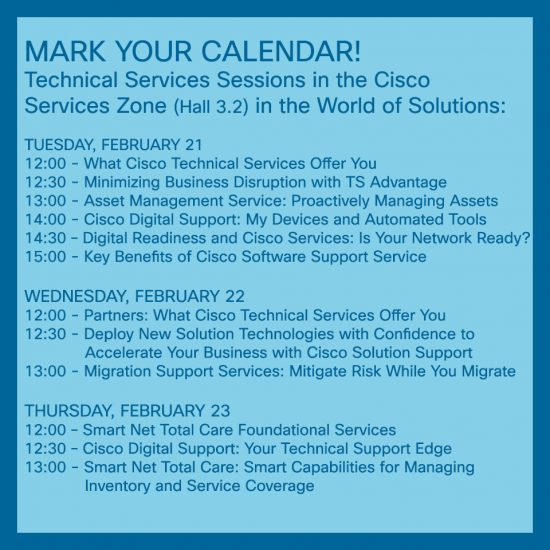
See our services up-close-and-personal in the Cisco Services Zone (Hall 3.2) in the World of Solutions. This is a playground of ideas. Souse this opportunity to talk directly to the architects and IT experts that will deliver interactive Technical Services demos. While you are there, drop by for a Technical Services session in the theatre to get a “deep dive” on selected topics. These bite-size sessions are perfect to explore our services. See the full schedule of Services Theatre sessions.
3) Participate in the passport program for a chance to win a Raspberry Pi
Collect your passport when you arrive at the Cisco Services Zone and start your Technical Services experience and get a chance to win. One of the four stops on the passport journey will be a visit to the Cisco@Learning booth. With demos and information on how to navigate digital transformation, you will not want to miss it.
4) Explore technical education opportunities
Join a technical seminar or a walk-in self-paced lab led by experts from Technical Services and Learning@Cisco. In Hall 2.2, you can also have an informal Technical Solutions Clinic with a Technical Assistance Center (TAC) engineer. Whiteboard new ideas and solutions to your toughest challenges.
5) Chat with us on social media
Join us on Twitter for a #CiscoChat hosted by @CiscoServices on February 22, 11 AM local Berlin time. We will discuss the topic: Is your network behind the digital curve?
Look out for Facebook Live-from-Berlin broadcasts on com/ciscoservices
To keep up with all the exciting updates throughout the week:
We’ve grown DevNet over the last 3 years and, thanks to you, we have had tremendous success together. We feel that it’s now time to work with the broader developer community to drive an important industry transformation in front of us: how modern applications and modern infrastructure can work better together to help society and transform lives. We want to do this in a way that brings together an ecosystem of application developers, infrastructure engineers, designers, technologists, and DevOps and IT professionals from across the industry.
To achieve this goal, I am very excited to announce that we are launching a new developer conference called DevNet Create. It will be held in San Francisco on May 23-24, 2017.https://devnetcreate.io/2017
(Update: NEW DATE! We moved the date to May 23-24 to make sure we don’t take audience away from Google I/O. Okay okay- maybe it’s the other way around 🙂 . We hope that some of the I/O app devs and devops audience will spend the weekend in San Francisco and join us at DevNet Create the following week!)
Applications meet Infrastructure
Traditionally, application development and infrastructure development live separately, and applications ride on the infrastructure through a wall of virtualization. There has been tremendous progress in each domain. The world of modern applications has transformed our lives in every way possible. They’ve changed how we work, how we find information, how we collaborate, how we manufacture, and even how we shop, drive, and raise our kids. Underneath these applications is an infrastructure that provides unprecedented levels of connectivity, computation, and capabilities.
We’re now at the stage where applications and infrastructure come together. Applications are not just connecting people and data, but also the Internet of Things. User experiences are integrating these applications into our daily lives. Infrastructure is not only providing connectivity and computation, but also providing new capabilities such as indoor location, real-time voice and video, and streaming analytics. Emerging technologies such as augmented and virtual reality and drones will have big impact on society. Developer tools and DevOps models are empowering developers to write applications and microservices and deploy them to the world on a cloud and container-based infrastructure.
The world where applications meet infrastructure holds great promise but is still in its infancy. It needs the world’s greatest minds and practitioners to come together to reach its full potential. We hope you will join us at DevNet Create and make this your forum for discussing and solving these problems. We even welcome your input on how to design DevNet Create to make it valuable for you.
You are Invited!
We invite you to submit papers, workshops, learning labs, and birds of a feather discussion topics to DevNet Create. Keep visiting our DevNet Create site, as we will update it regularly with new information on speakers and topics. Also, join our Facebook page and follow us on Twitter and Instagram to stay updated and give us your input. I look forward to working with you in the weeks and months to come!
I’d love to hear from you:
What are your biggest challenges in developing modern applications and in bringing applications and infrastructure together?
On January 28, the international community observed Data Privacy Day, an annual effort to create awareness about the importance of privacy and protecting personal information. Cisco was honored to once again participate in the National Cyber Security Alliance’s (NCSA) Data Privacy Day events.
Each year, the Day’s theme is Respecting Privacy, Safeguarding Data and Enabling Trust – all principles that we at Cisco strongly embrace and make an integral part of our culture and practices. We were heartened to see so many organizations support this important event, as well as the growing press coverage around the event and privacy in general.
Cisco did its part to help raise awareness, starting with a January 23rdblog post exploring why privacy is a basic human right, but also good for business. If you think through the relationship and reputational opportunities, it just makes sense.
I was honored to participate in panel discussions with privacy experts from several corporations during a day-long program at Twitter’s San Francisco headquarters:
I also took part in a lively Twitter chat, Being #Privacy Aware is Good for Business. This discussion, led by NCSA’s Director of Digital Strategy Kara Wright, included privacy leaders from TRUSTe, the Future of Privacy Forum, the U.S. Federal Trade Commission, and several other organizations, providing highly informed perspectives and a lot of food for thought.
Finally, I joined NCSA’s Executive Director, Michael Kaiser, to share our perspectives on leveraging data as a critical asset but respecting the customers and employees that the data represents:
While these events were fun, the underpinning message is that data protection and privacy is serious stuff. In the digital age, the brands that will prevail are those who embrace transparency, responsible data management and demonstrated respect for customer privacy.
If done right, privacy and security can and will combine to create great value for business and for consumers. Data Privacy Day is a great reminder of that. But privacy can’t be a one-day or one-week thing. To be truly effective, data protection and privacy must be deeply integrated into the culture and the ongoing operations of any organization that wants to be, and be seen as, a privacy champion.
We all know the facts about customer loyalty. It’s easier and less expensive to sell to an existing customer rather than acquire a new one. Loyal customers are also more likely to buy more from you and recommend you to other potential prospects. Take a moment to think about your own customer base. Would you consider most of your customers to be loyal? Or, could it be that some of those customers may actually be in an unhealthy, addictive relationship, rather than in a truly loyal relationship?
Addiction is when your customer feels that they are locked in. What we want to get to is a state of adoption, where the competition is locked out.
Delivering on the Promise of Customer Health: Watch this On-Demand Webinar to learn more about driving customer loyalty with a Customer Success practice.
Many customers feel trapped by their vendor because they have invested heavily over a long period of time and the switching costs are too disruptive to consider alternatives. This can be compounded if the customer is using proprietary features. Customers mitigate against this by choosing open source platforms, but in reality, once they have invested time and money into a platform they are reluctant to admit failure. This has prompted the market shift to subscription or cloud models which have protected the customer from investing fully upfront. Customers like the option of making an annual decision whether to renew or not based on the value being delivered.
Some gaming products have created an addiction amongst their users by asking them to pay for regular game updates to unlock the next level or a new feature. Unfortunately some enterprise software buyers may experience the same symptoms of an unhealthy addiction. Compulsive software use occurs when the customer feels that they have no other choice but to buy support and further licenses or subscriptions, regardless of the business outcome. This is an addiction that is bad for your customer’s health. Unless the software is enabling growth or reducing risk or costs, they may feel enslaved to the software platform and unclear of the value it’s adding.
So how do you know if your customer is feeling addicted to your software? What symptoms do you look out for? If your customer has a low Net Promoter score (I.e. they would not recommend your software to another customer) it may be a strong indicator that the customer feels an unhealthy addiction, particularly in customers who are otherwise showing strong sales growth figures and consumption rates.
Detoxing with Adoption
Treatment for addicted customers may be best compared to a new health regime. We do this in our personal lives with wearable fitness devices that come with apps to change behavior, so why not apply this to our customer success methodologies? Many customers may have been using your software platform for years without effective adoption. Initially the software platform may have met the business needs but changing business requirements may mean that it no longer does. Many organizations rely too heavily on one-directional telemetry data on product usage, consumption and deployment rates as an indicator of customer success. It’s the combination of bi-directional telemetry where we proactively help the customer with digital, customized support and content that can drive adoption in real time based on actual usage.
In addition we have created a Value Index to capture subjective measures that consider whether we have really driven successful adoption. Here we are looking for strong signals attributable to the solution that we are delivering tangible bottom or top line results or other business benefits that can help show the customer we are moving from the path of addiction to adoption.
Part of the challenge we face as Customer Success organizations is that software adoption is linked to process redesign, new working practices, new procedures, change in job roles and responsibilities within the business. Business benefits and value are not automatic outcomes of IT projects and must be actively managed throughout the lifecycle of the solution. By always referencing the business objectives, the new capabilities of the software can enable business changes, which will in turn drive further adoption.
There are signals that can show how your products are being embraced within a customer organization. When they substitute your brand name and start using it as the generic term for a product or event then it shows high levels of commitment and acceptance. For example in Cisco we might say let’s have a “Webex” rather than say let’s have a “teleconference”. Or let’s “Jabber” rather than “IM” – just like how Hoover is synonymous with the vacuum cleaner. When users refer to products or services in this way they inadvertently promote further use and show that they have internalized the solution.
Another sign that adoption has gone well is when the customer adds your product to an internal software catalogue as the standard choice to solve certain business problems. Selecting other products requires additional approvals and justification. In short the competition is now locked out. It can also be evidenced by new RFI/RFP’s being issued which specify that any solutions included in a bid must be compatible with your software platform to even be considered.
Another noteworthy barometer of internalization is when customers agree to take part in user groups and communities. The members of these groups tend to be the early adopters of the products and can be instrumental in identifying adoption barriers through their own user experience. Often they are willing to test beta versions of new features and provide valuable feedback.
Good customer health can also be seen when the customer starts to sell the product for you. In my experience of selling software, many prospective customers ask for references before they sign on the dotted line. Champions of your software can articulate better than the vendor the business benefits of the software platform. That’s why achieving customer references are one of the measures I use to determine how my Customer Success Managers are rewarded. If senior executives within the customer organization become advocates of your solution, they are putting their reputation on the line and shows that they value your software platform. Seeing references and positive endorsements sometimes scare off the competition because salespeople will tend to spend their time with dissatisfied customers first.
Bringing it all Together
Customer Success teams and vendors need to act fast to identify customers who are suffering from unhealthy addiction to your software. Action can be taken to nurture addicted customers and help them back to full health via positive adoption. Healthy customers are a vendor’s most valuable assets as they are loyal, successful and happy to reference your part in that success. Never mistake addiction for loyalty.
On-Demand Webinar: Delivering on the Promise of Customer Health
Cisco is committed to helping you deliver consistent customer engagement and the experiences customers want. The goal is simple: drive value realization and grow the relationship over time. Watch this on-demand Customer Success Talk webinar to learn more about how to digitize, automate and scale your own customer engagement practice with a focus on improving customer health.
The incredible momentum of the HyperFlex business continues as we rapidly expand across a broader set of new customers and verticals while scaling-out HX footprints of current customers. For example, one of our early adopters – Ready Pac Foods – has decided to go 100% HyperFlex hyperconvergence in all their data center locations. HyperFlex also continues to help our UCS customers extend their compute and external storage environments with hyperconvergence – utilizing the benefits of the UCS platform and management policies.
It’s now time to Drop Hyperconvergence into Top Gear!
With this 2.0 release we are dropping hyperconvergence into top-gear and putting in the smarts for a consistent and maximized performance in each gear – supercharging your applications across the data center.
HyperFlex 2.0 introduces new Cisco innovations in compute, storage and networking to further expand hyperconvergence within your environment. We are launching new high-performance All Flash HX nodes coupled with high-throughput, 40 Gbps 3rd Generation UCS fabric networking. With higher storage density and more performance options, HyperFlex now provides even better support for data and I/O intensive applications.
Fit HyperFlex To Your Applications
HyperFlex already provides the best selection of configuration options by allowing customers to mix hybrid HX nodes with compute-only nodes, optimizing for specific application needs and reducing your total cost of ownership (TCO).
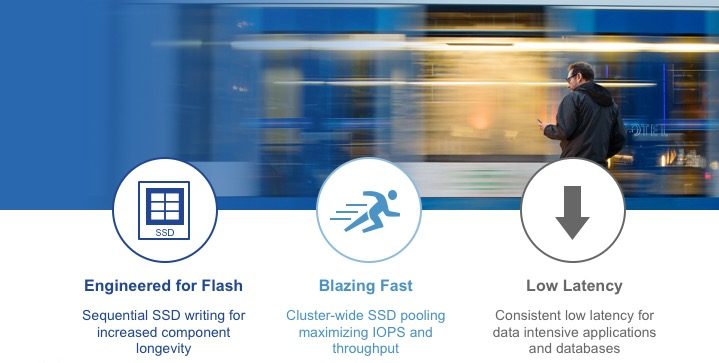
The HX Data Platform has been written specifically for hyperconvergence, designed to ensure your virtualized applications run smoothly across the data center. With the new HyperFlex All Flash nodes, coupled with 3rd Generation 40 Gbps UCS fabric networking, customers can expect blazing fast performance with up to 6X IOPS throughput and 80% reduction in latency, enabling consistent application performance for your HyperFlex clusters
Hyperconverge More Applications
In the past year we have seen adoption in all verticals using HyperFlex in a wide variety of use cases. We are constantly innovating to ensure you can migrate more of your applications and get the full benefits of complete hyperconvergence to achieve truly adaptive infrastructure.
HyperFlex All Flash nodes make it easy to extend your HyperFlex cluster to data and I/O intensive workloads such as SQL databases and latency-sensitive applications, further expanding the simplicity of hyperconvergence throughout your data center
Cisco HyperFlex is engineered on Cisco UCS – the foundation for thousands of private and hybrid cloud environments. For many of our Data Center customers, Cisco HyperFlex is part of a complete data center strategy that includes integration with UCS Director (UCSD) and the Enterprise Cloud Suite (ECS). Make sure to check back soon, when we share more about how ECS and HyperFlex deliver cloud automation and self-service capabilities, enabling on-demand service delivery while lowering operational costs for your organization.
Co-innovating with startups—newcomers and existing partners alike—can become highly contagious. I get no better satisfaction at work than getting to know inspired entrepreneurs who want to get together to change the game with new business models. The rewards of co-innovation just keep astonishing me more and more year after year.
That’s why I’m eagerly looking forward to joining with thousands of innovators in fewer than two weeks at this year’s Cisco Live in Berlin (February 20-24, 2017). Developers, entrepreneurs, startups and big companies will converge at Messe Berlin to learn, connect, share and grow a community of innovators around Cisco’s digital platform.
With more than 600 sessions, this will be a festival of co-innovation experiences and opportunities, ranging from keynotes, breakouts, case studies, 1:1 meet ups, training and educational forums.
And this year, we will be “all in” like never before. We know first-hand the value of co-innovation, and we have a multitude of ways for startups to engage with Cisco. Here are some examples:
The Investments Pavilion, located in the heart of the World of Solutions-Hall 4.2, where you can discover Cisco’s amazing worldwide investment portfolio, including 16 portfolio companies representing 8 countries and various technology domains including Security, Data Center, Big Data/Analytics, IOT, and Mobility.
The DevNet Zone, (World of Solutions-Hall 2.2), our software developer resource and community where you can get hands-on with Cisco SDKs and APIs. You can learn and have some fun here helping developers and network engineers learn, code, inspire, and connect so you can innovate on top of Cisco technologies and platforms. Register for DevNet Zone sessions inSchedule Builder
Cisco Innovation Center booths, (in the DevNet Zone), where we can exchange the latest and greatest ideas in person. We will feature our network of co-innovation hubs via an interactive map, and we can introduce you to recent startup partners with whom we have engaged in different ways. Dedrone, the recent winner of the Innovation Grand Challenge, will also be on hand to discuss what it’s like to work with Cisco. Dedrone came up with an aerial security solution that identifies rogue drones. Swing by, talk to them and learn more.
Speaking of Innovation Centers and startups, you’ll also have the opportunity to see representatives from MishiPay, Teska Labs, Hoxton Analytics, Sentryo, Alnet and NestinCloud. They all have unique stories to tell about working with Cisco as a startup and we can’t wait to share them with you.
Don’t forget to check out the speaker schedules too—not just the conference keynotes but also in the adjacent DevNet Zone classrooms. I’d like to highlight two events involving Maciej Kranz, vice president of our strategic innovation group and recent author of the New York Times best-seller, “Building the Internet of Things.” On Tuesday, Feb. 21, Maciej will join a panel discussion on, “Cisco’s IoT Integrations and Solutions,” and on Wednesday, Feb. 22, he will present, “Getting Started on the IoT Journey.”
Since we are in Berlin, I encourage anyone to visit the nearby openBerlin Innovation Center and experience first-hand one of Cisco’s flagship Innovation Centers. By touring the facility, you can gain a deeper understanding of how these “working labs” bring together our ecosystem of partners to co-innovate disruptive, digital solutions.
At openBerlin, you can attend one of our VIP Customer Briefing Sessions by registering with us here. At these sessions, you can learn more about our co-innovation strategies, how to get involved and engage with Cisco technical experts on Cisco’s technology solutions goals. After you register, we’ll take care of the rest, including transfer from Cisco Live to openBerlin, along with snacks and drinks on the way!
If Cisco Live! Berlin was a concert, organizers would tout it as a festival of the world’s most creative new talent. In a way though, it really is like a festival. It will be music to my ears–to listen, learn, and discover new relationships with innovators to start composing game-changers for our growing audience of customers.
On a personal note, I am most passionate about disruptive innovation that leads to new business models in companies of all sizes and types. Don’t hesitate to contact me if you have questions, get stuck, or need an innovation therapist:







 guest-speaking during the “She Started IT” session of the










 amazing worldwide investment portfolio, including 16 portfolio companies representing 8 countries and various technology domains including Security, Data Center, Big Data/Analytics, IOT, and Mobility.
 you can learn more about our co-innovation strategies, how to get involved and engage with Cisco technical experts on Cisco’s technology solutions goals. After you register, we’ll take care of the rest, including transfer from Cisco Live to openBerlin, along with snacks and drinks on the way!