Jordan and Pippen. DeMar and Kyle. Magic and Kareem. The Great One and The Moose. Edwin and Jose (…too soon?)
Sports history is filled with dynamic duos. Players who so perfectly complemented each other in skills and personality that they elevated their entire team to greatness. A business is no different. For every Jobs, there is a Wozniak. For every Ben, a Jerry.
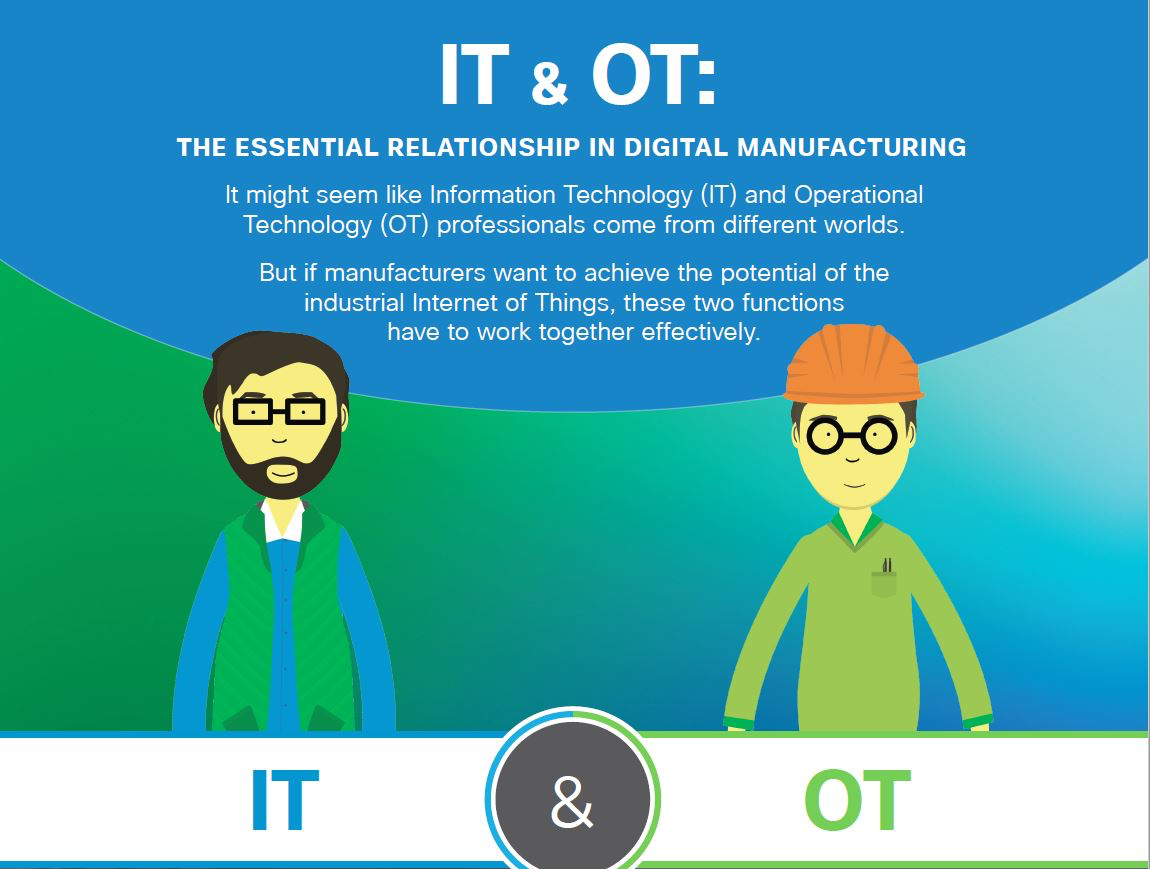
To this pantheon of duo-ed greatness we now add Chad from IT (Information Technology) and Stan from OT (Operational Technology). This is their story.
Traditionally, Chad and Stan maintained separate networks within an industrial environment. Chad owned the organization’s technology network and all associated connected devices – computers, phones, video endpoints, and so on. Stan owned the hardware and software that monitored and controlled physical devices such as valves or pumps.
Chad worked in the office. Stan worked in industrial environments. Chad focused on network security. Stan focused on plant productivity.
But that was before the Industrial Internet of Things. Now IT and OT networks are converging, creating new opportunities and driving digital transformation across the manufacturing industry. However, with convergence comes confusion and some organizations don’t yet see the value in bringing together IT and OT leadership.
We’d like to announce a “Save the Date” and “Call for Speakers” for the FIRST Amsterdam Technical Colloquium (TC) 2017. The main event, hosted by Cisco Systems in Amsterdam, Netherlands will be a plenary style conference held on the 25th and 26th of April 2017. We are also offering an optional, free, training on Monday April 24th.
Event registration is open now. This will be free event with no registration charges (although registration is required). This event will be open to all (not just FIRST members) and fills up quickly. Note, the Monday training has limited seating, so please register early to avoid being turned away. Please register here.
A list of recommended hotels and travel information is available here:
FIRST is looking for speakers that would like to present at this Technical Colloquium. This is a GREAT opportunity to give something back to FIRST and the industry, while practicing your speaking skills and sharing your hard work. We are most interested in new presentations and presenters, however important updates on prior work are also welcome. We strongly encourage any individual who has not spoken at a conference before to submit a proposal. The ideal behind the TC is to encourage security teams and researchers to share their technical work in a friendly environment. While we give special to consideration to local talent, submissions are welcome from anyone, anywhere.
Any novel ideas, techniques, case studies, or research related to incident and threat response are welcome. Some suggested topics are as follows:
Threat actor techniques
Creative incident response techniques
Indicators of compromise and how detect/mitigate
Data analytics for security
Criminal underground
Denial-of-service attacks and countermeasures
Hardware security/embedded systems security
Network and OS security
Digital forensics
Human-computer interaction, security, and privacy
Intrusion and anomaly detection and prevention
Malicious code analysis, anti-virus evasion, etc.
Security architecture
Open Source tools
Attack and response to an organization
For your submission, please provide the following information:
Title
Brief Summary (Abstract)
Presenter’s Name(s), Affiliation, and short biography
Estimated Time (45 mins + 10 for questions is typical)
FIRST does not allow presentations with the aim of gaining the audience’s interest in any commercial application, solution, or product. In other words, NO MARKETING PRESENTATION. Please only submit a talk if you are actually able to attend the TC in Amsterdam.
Our goal is to have the program on the event website by the end of February 2017, to that end please have all submissions completed by February 17th. Feel free to reply with any questions.
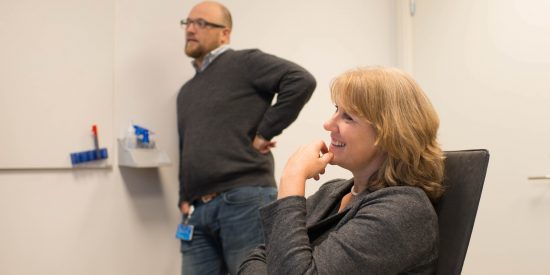
Women have come a long way in technology, but sometimes, it feels like there’s still a long way to go. We got a little closer to the end goal here in Norway recently, when my friend and colleague Kari Asheim became the second female CCIE in the country. (The Cisco Certified Internetwork Expert is a technical certification offered by Cisco that certifies the skills required of network engineers.)
What made Kari get into technology? Coming from a technical family, her older brother was her first mentor.
“I’ve always loved to solve complex problems,” Kari explains. “I loved networking technology and getting creative with routers. Connecting small things to bigger things.”
So Kari started to work on her CCIE to expand her skills. And it wasn’t easy. The work was hard, and took a lot of time. She used her personal network to share ideas and do lab work.
Kari had been working with Cisco people and Cisco products before joining, and everyone told her about the nurturing environment at Cisco and how it was always noted as a Great Place to Work. She also expected that there would be a lot of opportunity to work on quality products with other engineers to create exciting solutions.
“Different from anything I’d been able to do before.”
She even interviewed using Cisco’s Webex, which further showcased to her the potential of Cisco’s collaboration products. The majority of her interviews were at home, which let her balance the process with taking care of her family and the work she was already doing.
“During one of my interviews, my son interrupted (as they often do.) I thought it would be a negative on my interview, but my interviewer completely understood, calmed me down, was kind and laughed about the situation to put me at ease.”
Her first impression of working at Cisco continues during her first year. Her manager is approachable, transparent and consults Kari and the team on decisions.
“There’s a lot of opportunity to learn new things, and for me, as a Consulting Engineer, this is essential.”
Kari is currently working on a network improvement plan with a financial services customer.
“I’ve become a trusted advisor to their business, consulting them on a top security scalable solution,” she says. “It’s a product with high visibility that affects millions of users. If you think about every ATM transaction or online purchase made, Cisco technology is at the core of this service. So it needs to be up and running, else people will know about it! “
Now that Kari’s tech career is well underway and growing even more in her role at Cisco, she has some tips to share with other women in Norway, and around the world, who might want to follow her footsteps.
Be confident in yourself.
Take some risks and push yourself out of your comfort zone.
It’s OK to not know everything. You can develop and learn. Know the fundamentals and learn as you go.
Grow your network. Keep in contact with people who share your values at university, throughout work. This will be invaluable to your career.
If you’d like to join Kari at Cisco, we have open opportunities. Check them out here.
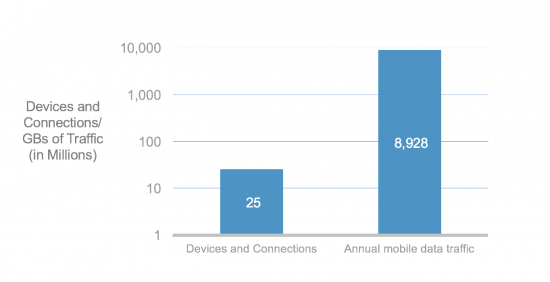
The 2017 Cisco Mobile Visual Networking Index (VNI) forecasts that there will be about 25 million 5G capable devices and connections by 2021, which will generate 8.9 exabytes (EB) of annual mobile data traffic. Let’s compare that in context of the overall Mobile VNI Forecast. By 2021, there will be nearly 12 billion mobile devices and connections generating 587 EB of annual mobile traffic globally. As a percentage share then, 5G will account for less than half a percent of total mobile devices and connections and one and a half percent of total mobile traffic.
Figure 1. 5G Connections and Traffic by network
Source:Cisco VNI Global Mobile Data Traffic Forecast, 2016–2021
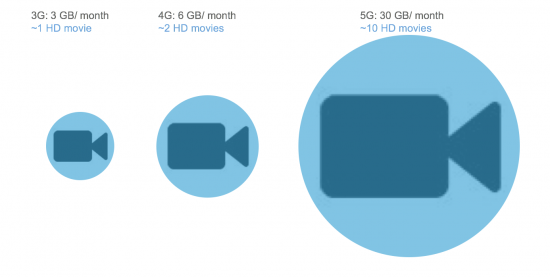
Those absolute and relative 5G projections might not seem impressive at first glance. However, if we look at the expected average monthly traffic per 5G connection in relation to the average 3G and 4G connections, the variance is significant (if not awe-inspiring).
Figure 2. Average monthly traffic per 3G, 4G and 5G connection
Note: One HD movie is estimated to be approximately 3GB Source:Cisco VNI Global Mobile Data Traffic Forecast, 2016–2021
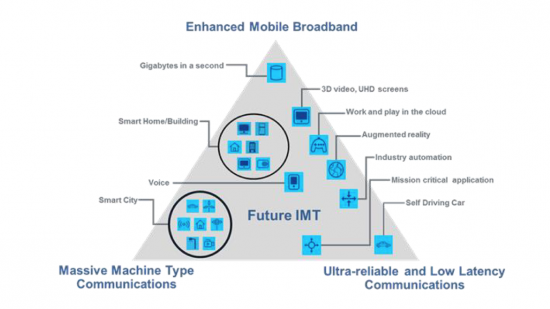
There is a lot of discussion and anticipation around the launch of 5G networks – it is expected to resolve many if not all of cellular connectivity problems. 5G is expected to address a variety of current mobility issues. The ITU Radiocommunication Sector (ITU-R) envisages 5G as an enhanced mobile broadband solution that will deliver ultra-reliable and low latency communications while dynamically supporting massive volumes machine type communications.
Figure 3. ITU-R 5G Usage Scenarios
Source: Rec. ITU-R M.2083-0
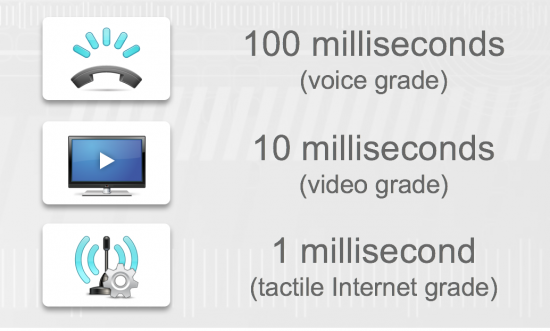
With a potential bandwidth capacity of 1 Gbps and ultra-low latency of 1 millisecond (ms) combined with software defined networking (SDN) and network functions virtualization (NFV), 5G promises to be a game-changing technology. It is expected to:
Complement (and in some cases even supplement) broadband connectivity for optimum end user experiences
Enhance and increase the usage of cloud applications and storage
Promote tactile Internet – necessary for virtual reality and emerging applications such as autonomous cars and remote tele-surgery
Support high and ultra-high definition video and rich media telecommunications
Accommodate a wide range of machine-to-machine M2M communications
There are several issues that remain to be addressed before significant commercial 5G deployments commence (starting in 2020). Can you imagine the impact of 5G on today’s data cap structures? Currently, top 1 percent of mobile users consume 30 GB of monthly data. When 5G is introduced, 30GB will be the average. My fellow Cisco VNI senior analyst Usha Andra will cover the issue of 5G and data caps more fully in a future blog. And that is only one of the issues. Mobile carriers also need to figure out how to fairly and profitably monetize 5G services. In addition, there is the big question of spectrum availability and allocation. Currently there are several field trials and pre-commercial deployments underway globally (US, South Korea, Japan, Russia and China) in sub 6MHz and mm-wave bands to test out 5G performance. Perhaps 5G will require spectrum in both sub 6MHz as well as mm-wave bands to address the wide area, low power usage requirements of machine type communications on the one end that have low bandwidth requirements and high latency tolerance and tactile Internet, reliable broadband applications on the other end that needs much higher bandwidth and low to ultra-low latency.
Figure 4. 5G Latency in Perspective
Source: Cisco VNI Global Mobile Data Traffic Forecast, 2016–2021
The other challenges besides monetization and spectrum allocation surrounding 5G commercial deployments are device availability, air-interface ratification and test data development. There are concentrated efforts underway to resolve these challenges so that 5G can deliver on the promise of optimized network utilization, open access and tactile Internet, and provide an important option not only for broadband connectivity but also for core networks.
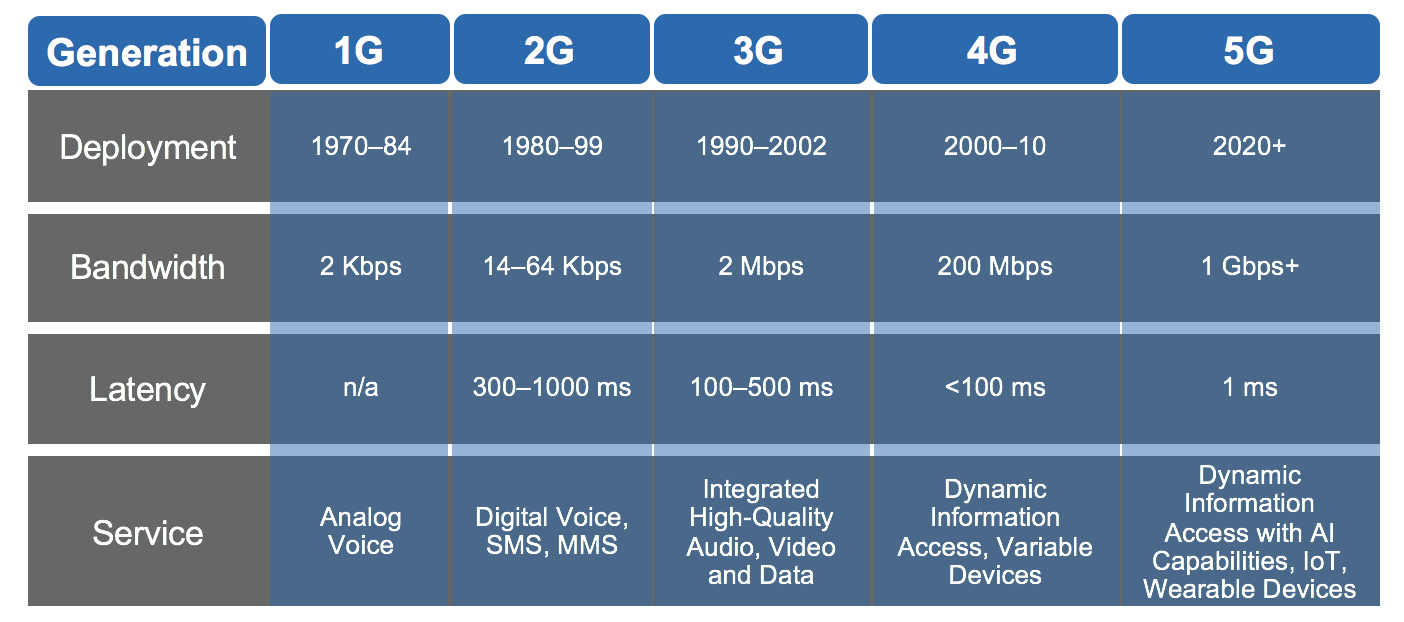
Figure 5. Generations of Mobile Technology – A Snapshot
Source: Cisco VNI Global Mobile Data Traffic Forecast, 2016–2021
To see all of our Mobile VNI Forecast resources and online tools, please visit our public web site.
We recently released the annual update of the Cisco Mobile Visual Networking Index, 2016-2021. Mobile continues to be a highly dynamic space, with robust growth, and there are always a few surprises lurking in the numbers. I’d like to highlight a few of the numbers that struck me as particularly impressive this year.
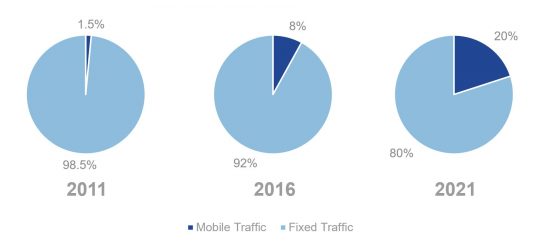
1. Mobile will approach 20% of total fixed and mobile IP traffic by 2021
Five years ago, mobile connections generated less than 2 percent of the world’s total IP traffic. In 2016, mobile was 8 percent, and by 2021 mobile will account for an eye-opening 20 percent of total IP traffic. Global mobile data traffic will increase sevenfold between 2016 and 2021, with a compound annual growth rate (CAGR) of 47 percent. The volume of mobile data traffic will reach 49 exabytes per month by 2021, and will have an annual run rate of over half a zettabyte. We expect mobile to continue to grow twice as fast as fixed, and mobile’s traffic share will continue to increase.
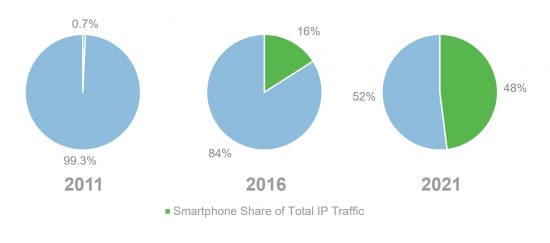
2. Smartphones will be responsible for 48% of all fixed and mobile traffic by 2021
Not all traffic on smartphones and other mobile-connected devices crosses the network. Much of it is offloaded onto home or public fixed (usually Wi-Fi) networks. We estimate that in 2016, more traffic was offloaded onto fixed networks than remained on mobile networks. 60 percent was offloaded in 2016 and by 2021 we expect 63 percent to be offloaded in this way.
If we consider the high volume of offload together with the fact that over 80 percent of traffic is generated by smartphones, we find that over 48% of total IP traffic will be due to smartphones by 2021.
This is an astounding trend, particularly considering how prominently PC traffic has always figured in IP traffic. In 2011, PCs generated 94 percent of total IP traffic. In 2021, PCs will be less than 30 percent of total IP traffic, and smartphones will be the device category with the highest share at 48 percent.
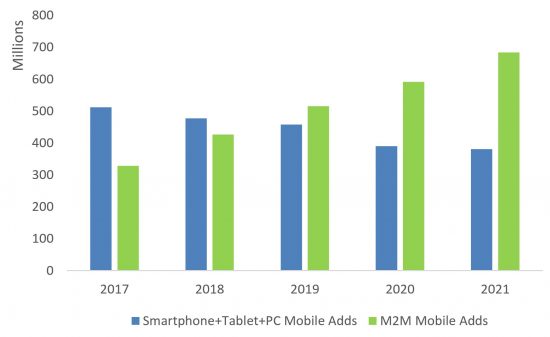
3. Starting in 2019, more “things” will be added to mobile networks each year than devices
This year, 328 million “things” will be added to mobile networks, while a substantially higher number (512 million) of smartphones, tablets, and PCs will be added. The balance will shift starting in 2019, when Internet of Things (IoT) connections will account for more mobile additions than smartphones, tablets, and PCs. And by 2021, 638 million IoT modules will be added, while smartphone, tablet and PC additions will reach 381 million.
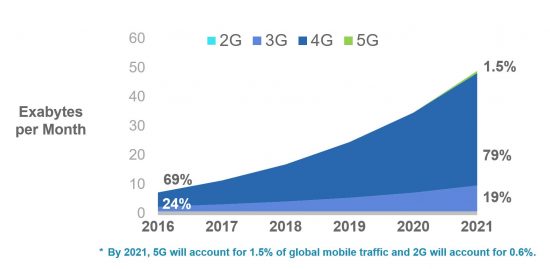
4. 5G will generate 1.5% of traffic by 2021
By 2021, 5G will still have a very modest share of mobile connections – 0.2 percent, or 25 million. However, each 5G connection will generate nearly 30 gigabytes per month per connection in 2021, an amount that is 4.7 times higher than the average 4G connection. In aggregate, 5G will represent 1.5 percent of total traffic by 2021 despite the low connection share.
For more details see Shruti Jain’s blog on our estimates and her assessment of the role 5G in future mobile networks, also published today.
5. Traffic “wants to be mobile”– but cellular capacity constraints ensure ongoing need for Wi-Fi.
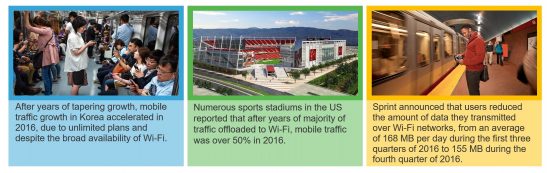
It appears that when mobile pricing conditions are right, traffic will migrate back onto cellular networks from Wi-Fi, even when Wi-Fi might be available. In Korea, unlimited plans led to an acceleration of mobile traffic and a deceleration of mobile offload onto Wi-Fi. The surprise here is that this “reverse migration” occurred despite the fact that Wi-Fi is highly available in Korea both in the home and in public locations. Likewise, there were examples of reverse migration in the US with Sprint reporting a decrease in offload rates, and with a number of sports stadiums experiencing more mobile than Wi-Fi traffic for the first time in several years. At sports stadiums, the drivers of mobile were the increase in mobile quality and speeds associated with 4G. For Sprint, the driver of decreased Wi-Fi was the availability of unlimited data plans.
A corollary of reverse migration may be that when pricing allows, heavy users want to be mobile, too. While generally the top 1 percent of users have been heavily curbed by data caps (the top 1 percent of mobile data subscribers generated 6 percent of mobile data traffic, down from 52 percent in 2010), there is anecdotal evidence that with unlimited plans the balance of traffic shifts back to the heavy users.
Despite the traffic’s desire to go mobile, however, we expect reverse migration to continue to happen in isolated pockets and instances rather than becoming a global phenomenon. The limited availability and high expense of spectrum is a constraint that will not allow the majority of mobile operators to offer unlimited plans.
6. And much more!
Though these trends are straightforward extensions of trends seen in previous years, mobile networks continue to hit milestones in terms of video, speed, and average usage.
• More than three-fourths of the world’s mobile data traffic will be video by 2021. Mobile video will increase 9-fold between 2016 and 2021, accounting for 78 percent of total mobile data traffic by the end of the forecast period.
• Mobile network connection speeds will increase threefold by 2021. The average mobile network connection speed (6.8 Mbps in 2016) will reach 20.4 Mbps by 2021.
• The average smartphone will generate 6.8 GB of traffic per month by 2021, a fourfold increase over the 2016 average of 1.6 GB per month. By 2021, aggregate smartphone traffic will be seven times greater than it is today, with a CAGR of 48 percent.
To see all of our Mobile VNI Forecast resources and online tools, please visit our public web site.
Everyone these days seems to want to operate like the massive scale data center operators or at least capitalize on the economies of scale they created in their wake. It’s a familiar trickle-down economics idea that sounds great on paper but doesn’t always operationalize well for the rest of the world. In the case of data storage, we will walk through comparisons between an open source design vs. one that is commercially available for everyone and not just massive scale data center operators.
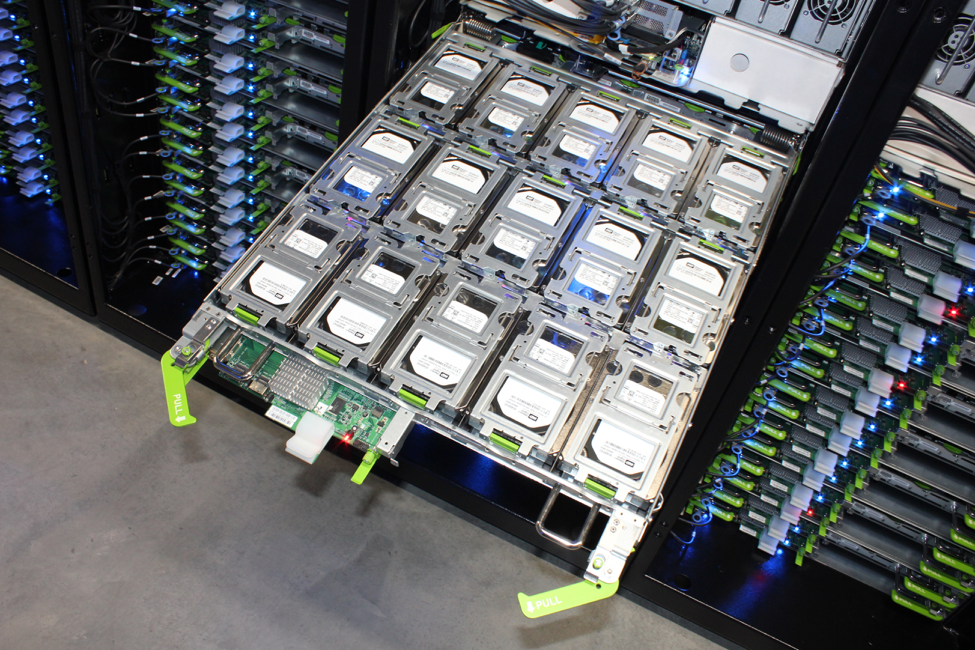
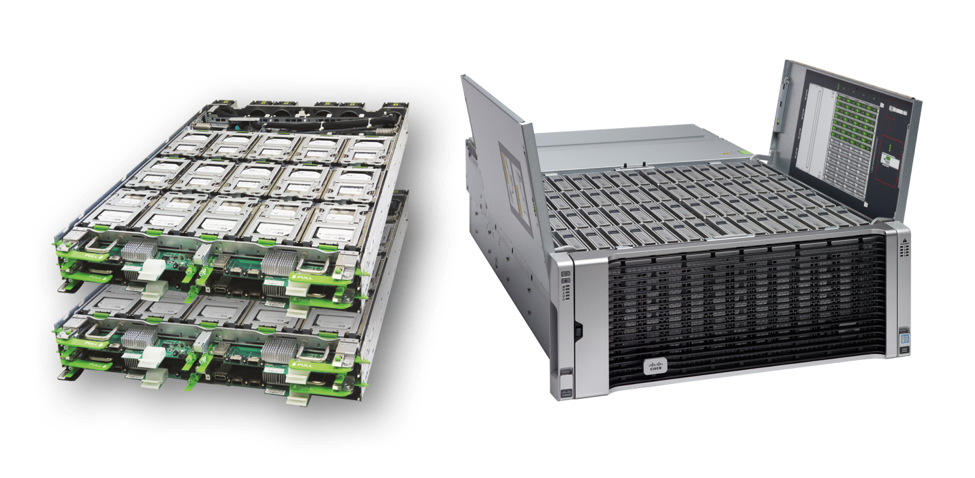
In 2013 Facebook contributed to their Open Compute Project a hardware design called Open Vault for high volume data storage. This is a 2RU dual-tray modular disk enclosure supporting up to 15 3.5” HDDs per tray and designed initially as JBOD storage. Products like this are great for serviceability where hardware design can have immediate value to ongoing operations.
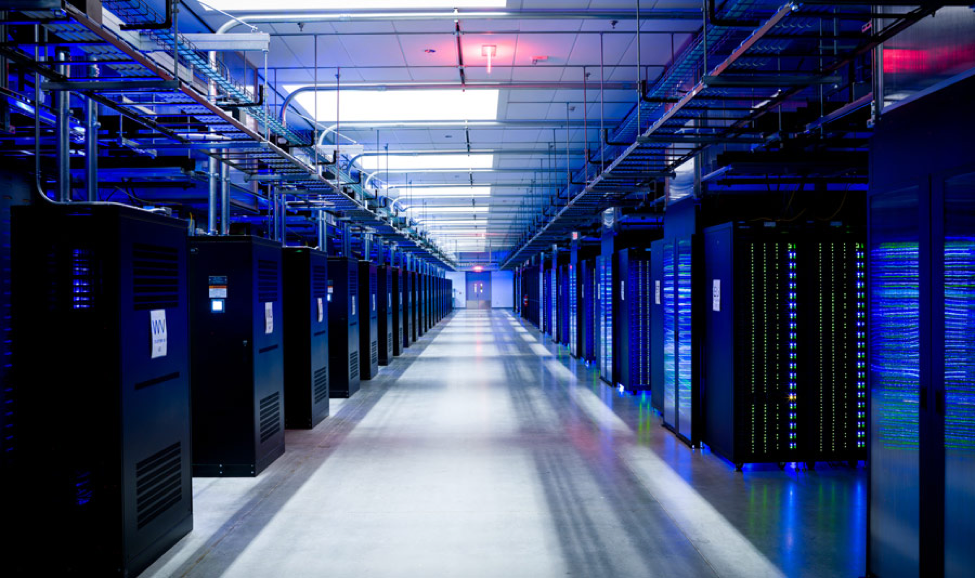
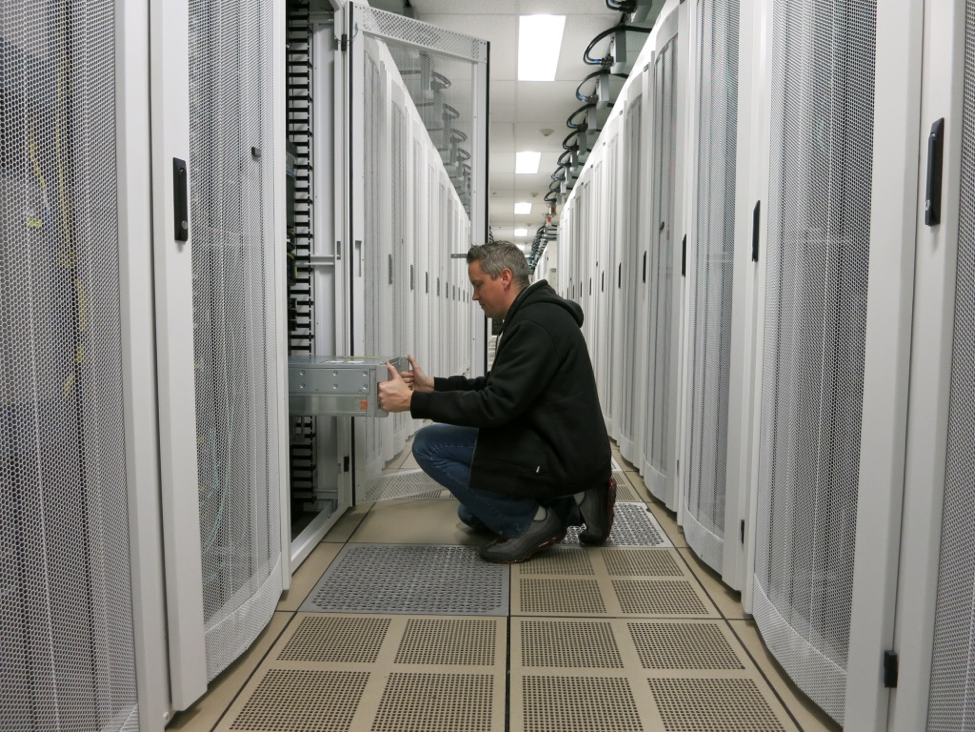
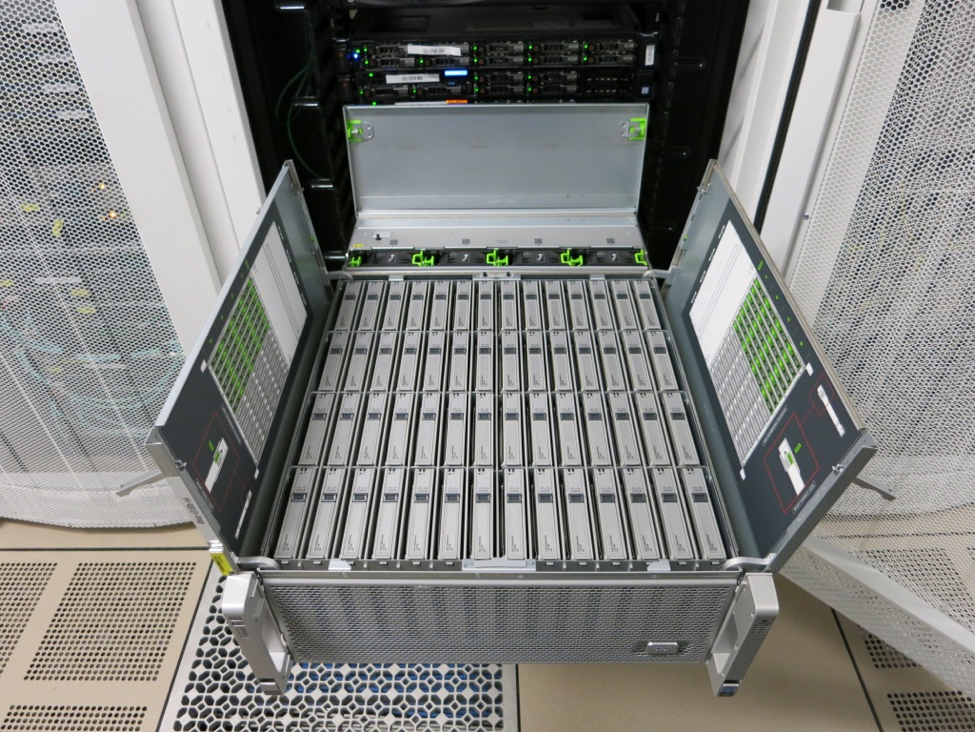
It got me thinking to take a little field trip to our own Data Center in San Jose to see our products in action. Our Cisco IT department was gracious enough to let me in for a tour and help scout out a pair of S3260 storage servers used to test data protection software for our corporate backups.
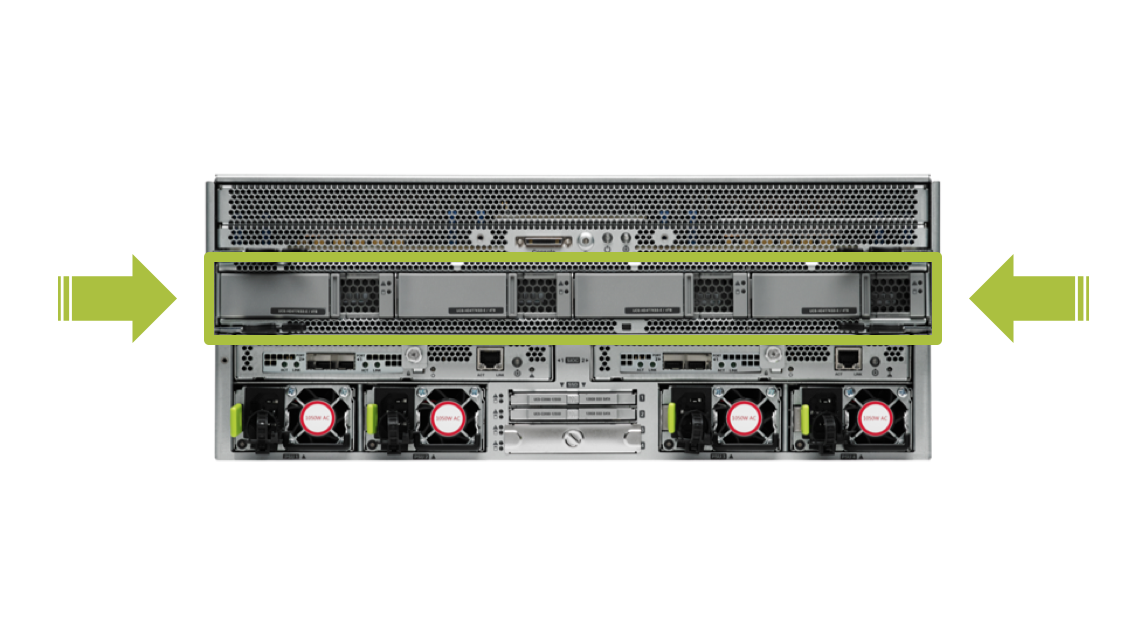
This is exactly what I was hoping for to show you the S3260 storage server in comparison to the Open Vault product by Facebook. As you can see both products were designed with many of the same serviceability concepts in mind for hosting large volumes of data.
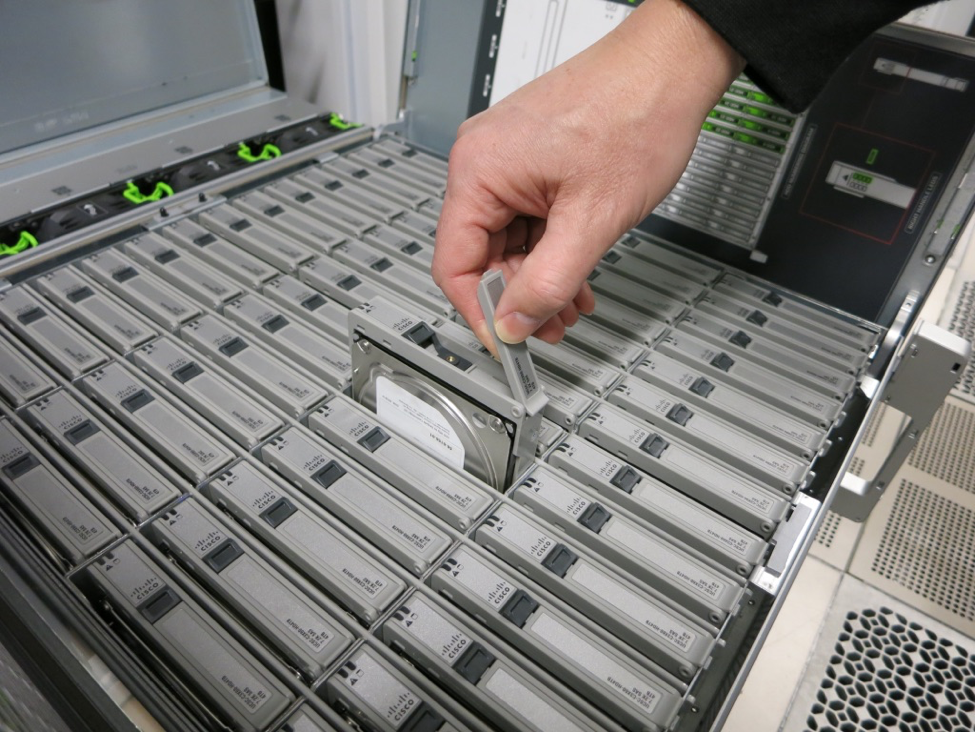
The entire chassis is designed to be serviced without the need for tools. I would even go so far to say that you can easily get into this box without reading an installation guide as it’s latches and neon green spring loaded buttons are very intuitively designed. To gain initial access to the box you simply flip two latches on the front left and right handles to unlock and pull out the enclosure from it’s rack.
Doors on the top open with easy to use latches exposing 56 vertically oriented data drive slots which can host SSD or SAS drives. Drive carrier adapters are removed by pressing a single release button and can accommodate either a 2.5” small form factor drive or a 3.5” large form factor drive.
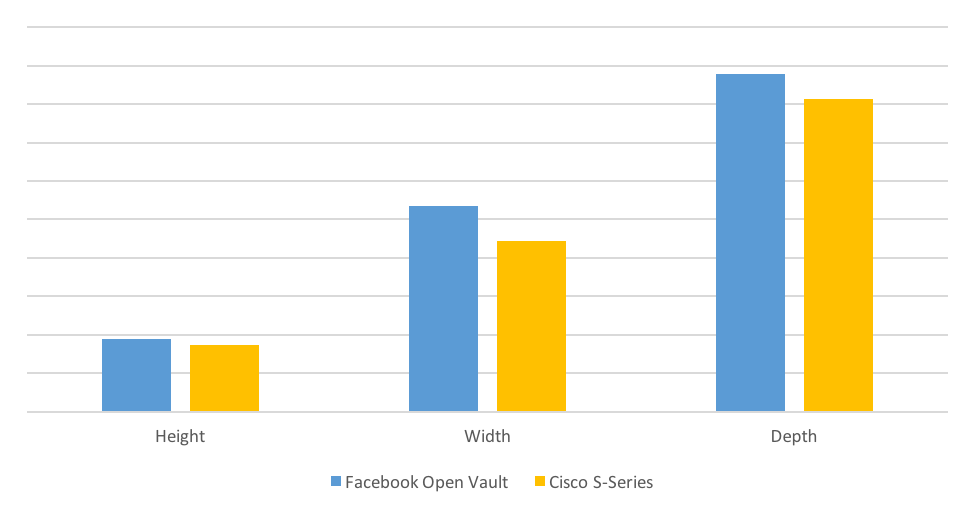
Outside of serviceability and raw storage attributes, you might want to also compare the efficiency of the hardware design itself. In the chart below you can see we were able to design a product within a 4RU footprint that supports the same number of data drives as two Open Vault products, but squeezed into a much smaller form factor. This was achieved with a simple design decision to vertically orient the drives vs. laying them flat in simple carrier trays.
You might look at the chart and say “that’s not a big difference”. But it is a big difference if one or two inches prevents you from inserting your new chassis into a rack due to width or close and secure a door due to depth. Although this isn’t a problem for Facebook or Open Compute adopters. Open Vault was designed to go inside their custom designed Open Rack system that is wider and deeper than standard racks to accommodate their own custom designed servers, storage and networking gear.
For traditional IT equipment manufacturers, we need to design products that work for everybody. Meaning we design within the constraints of the four-post EIA rack specification described in section 1 of the ANSI/EIA-310-D-1992 industry standard. These type of racks have been around for decades and are still prominently used in majority of our customer’s data centers hence the need to design products optimized for them.
I did mention earlier the S3260 supports 56 vertically oriented data drives. One of the cool things about this box is it’s ability to convert into different personality modes depending on your specific need. Single or dual-server nodes, JBOD or RAID, more processing power or storage capacity, cache acceleration or unified storage connectivity, it’s really about versatility. To put it simply, this isn’t your father’s JBOD or legacy storage server.
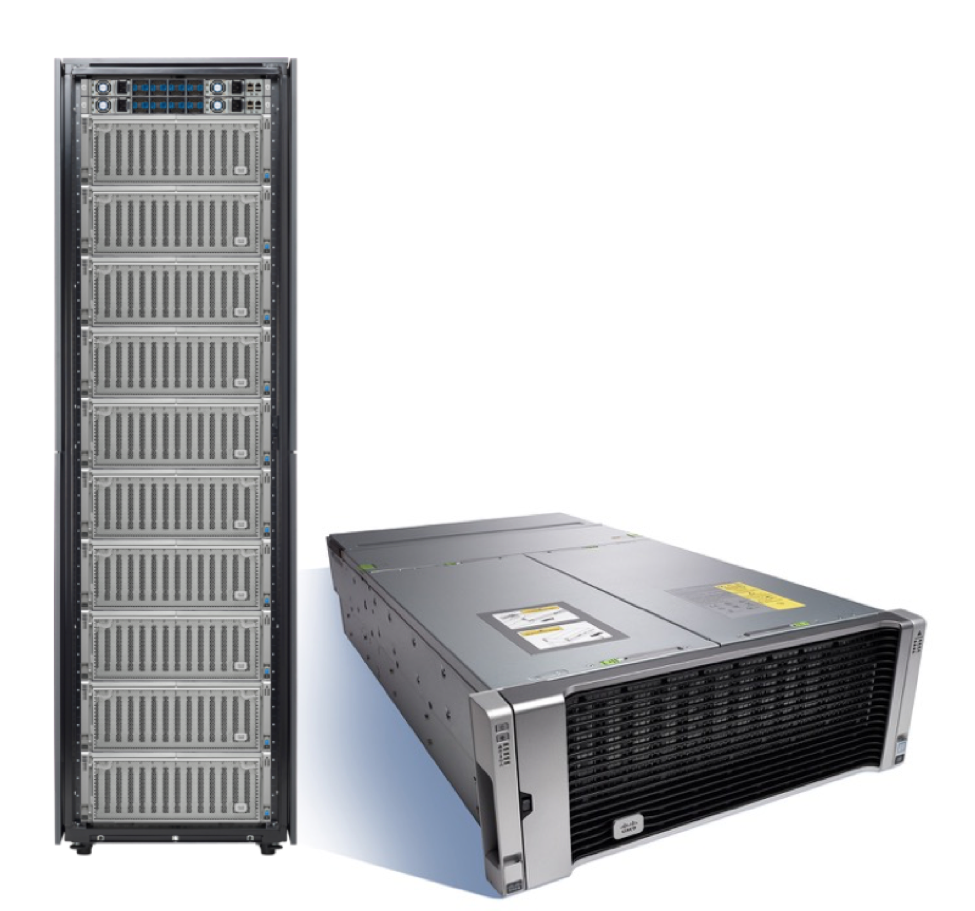
To achieve parity with Open Vault on capacity, we can convert to a single node system by adding a drive expander giving an additional four data drive slots totaling 60 data drives or 600 Terabytes of raw storage with our new 10TB drives. The S3260 is pretty beefy as a single box but you can also connect up to ten S3260s to redundant 40 Gigabyte Fabric Interconnects for up to 6 Petabytes of raw storage per rack.
In this configuration, it would take two Open Vault’s to support the same amount of drives. But as highlighted in the chart above, the S3260 requires much less space and is well within the constraints of an industry standard 19 inch rack like our R-Series Data Center Racks. And better yet, each server node is a two-socket architecture with processor options ranging from 8 to 18 cores each, giving customers greater flexibility to not only store data but to also run data intensive workloads.
While both approaches are cool they each have very specific intent. In our intent, we look to provide innovative products and solutions catering to the broadest range of customers. We also look to help solve problems not just for homogenous application environments but the more challenging goal of solving problems for multi-generational heterogeneous application environments.
If you are interested in taking a virtual field trip and seeing a S3260 in action, check out our 3D model or reach out to a Cisco Partner for more information.
If you liked this blog please stay tuned for more on data center storage solutions at Cisco and be sure to follow me on Twitter.
Next week, some 30,000 security professionals will descend upon the Moscone Center in San Francisco for the 2017 RSA Conference. Cisco’s AMP Threat Grid, the first unified Malware Analysis and Threat Intelligence solution, partnered with RSA to create the RSA Conference Security Operations Center (SOC), where engineers will monitor all traffic on the Moscone Center’s wireless network. Threat Grid is the integrated Dynamic Analysis technology partner for Netwitness Packets (formerly Security Analytics).
You can register now for your free tour of the SOC, where we’ll show real time traffic; plus advanced malware analysis, sandboxing and threat intelligence from Threat Grid. You will also receive a security briefing and have time for Q&A with RSA and Cisco engineers.
Advanced registration is highly recommended. Below are the available tour times. Please fill out the RSA SOC Tour Request Form to request your spot.
Tuesday morning, 14 Feb at 11:00am
Tuesday afternoon, 14 Feb at 3:00pm
Wednesday afternoon, 15 Feb at 1:00pm
Wednesday afternoon, 15 Feb at 3:00pm
Thursday morning, 16 Feb at 11:00am
Thursday afternoon, 16 Feb at 2:00pm
Once onsite, please meet at the Cisco booth (N3517) which is located in the North Hall. Proceed to the RSA SOC Tour sign, where a Threat Grid expert will escort the group to the SOC (max. 20 persons per tour).
RSA customers are able to register for a no cost Threat Grid account within RSA’s Netwitness Packets, to support up to five malware sample submissions per day. You also have direct access to the Threat Grid platform for search, correlation, and advanced malware analysis capabilities. Additionally, with a full Threat Grid account, you may utilize our well documented API to pull our highly actionable, curated threat feeds derived exclusively from our analysis. Finally, the API allows you to integrate the threat feeds with your specific IT security infrastructure with a Threat Grid subscription.
The content derived from the Threat Grid platform is continuously updated and enriched by the daily submission and analysis of hundreds of thousands of malware samples, which provides you with faster, more accurate detection and response.
Also, I will be facilitating a hands-on Learning Lab: Tracking Ransomware – Using Behavior to Find New Threats. This hands-on interactive lab (bring your own laptop) will explore the latest ransomware trends and how to defend your enterprise against this threat. Attendees will understand what is ransomware, the attack vectors and the commonalities between variants. They will learn the skills to find and track new ransomware with dynamic analysis of behavior, and what is the sophistication of the perpetrators.
We previously discussed how data models have become a key component of network programmability and the role they play in cloud-scale networking. Data models provide a clear representation of the capabilities of a networking device with a definition that is structured, well defined and computer friendly. But, how can a programmer use models to control a networking device?
The process can be a little bit involved. A client application and a network device need to agree on a protocol, encoding, transport and data structures. Traditionally, programmers require a set of libraries for the specific combination of protocol, encoding and transport that they intent to use. Furthermore, the application needs to be able to generate and handle configuration and operational data, plus actions, in compliance with the model implemented by the network device. As it should be obvious, there are several pieces to figure out before an automation application can take advantage of data models.
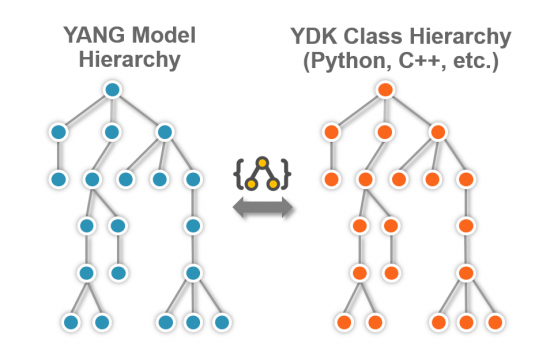
We have created the YANG Development Kit (YDK) to address the challenges of network programmability using data models. YDK can generate APIs in a variety of programming languages using YANG models. These APIs can then be used to simplify the implementation of applications for network automation. But how do these APIs really make your file easier?
Model driven. You have no need to learn new data abstractions or hierarchies. YDK mirrors the structure of your data models. If you become familiar with the structure of a particular model, you will feel right at home using the API for that model. No need to handle YANG files directly.
Built-in data validation. YDK takes care of data validation, so you do not have to. Data models not only define a data hierarchy, but also specify the constrains associated with the data (e.g. type, valid values, ranges, etc). YDK services automatically perform thorough data validation (i.e. types, values, semmantics, deviations, etc). That validation takes place locally before your data is exchanged with the network device.
Protocol, transport and encoding support. You are not required to code the specifics of a management protocol (e.g. NETCONF RPCs) or manipulate encoded data directly (e.g. XML or JSON). A set of predefined services take care of the management protocol, the transport for your management session and the encoding and decoding of your data. Your automation code can focus on the details of the data exchanged with the device and the automation logic.
We open sourced YDK last year to help the industry reap the benefits of data models and facilitate the implementation of network automation. We welcome contributions and suggestions. You can expect an increasing number of models, services and providers, plus support for more programming languages in future releases. We have published APIs for Cisco IOS XR, OpenConfig and IETF data models. You can find the Python APIs in the YDK-Py repository and C++ APIs in the YDK-Cpp repository. In addition, we have made available hundreds of examples in the ydk-py-samples and ydk-cpp-samples repositories.
You can find additional details and documentation in the YDK site and join the discussion on the YDK community. For additional information on programmability, you can visit our model-driven programmability site.
Retailers are embracing and adapting to digital innovations to keep pace with rapidly-evolving customer demands. Online and mobile purchases continue to increase exponentially. According to Deloitte, 58% of consumers have used their mobile device to browse an online shopping website or app. In fact, double-digit growth of e-commerce is expected globally until 2020, as retailers continue to expand and enhance the digital customer experience and the boundaries between physical and digital shopping experiences become increasingly blurred.
It’s no surprise therefore that retailers represent a very attractive, and lucrative, target for cyberattacks, topping the league of most-attacked industries. U.S. companies and government agencies suffered a record 1,093 data breaches last year, a 40 percent increase from 2015, according to the Identity Theft Resource Center. [Bloomberg] Phishing attacks in 2016 exposed information such as social security numbers, user account information, and passwords. A lack in security can cause you to loose customers’ trust and loyalty and cause irreparable damage to your brand. Retailers need to plan to secure the entire value chain to mitigate risk and protect themselves, their partners and customers. This means every store, channel for customer interaction, distribution center, and all touch points across the supply chain.
The Cisco 2017 Annual Cybersecurity Report, highlights some of the newest cyber threats introduced by digitization, and the well-organized adversaries focused on exploiting them.
Our research identified retailers’ key areas of cybersecurity vulnerability and concern:
Nearly 1 in 3 retail organizations have experienced loss of revenue due to an attack.
Retail organizations perceive targeted attacks as their highest risks (followed by insider exfiltration).
54% of retail organizations have managed public scrutiny due to a security breach (other industries – 49%)
Only 52% of retail organizations perceive their security infrastructure is very up-to-date and constantly upgraded with the best tech (other industries – 59%).
1 in 3 retail organizations reported a severe data breach caused systems to be down for more than 9 hours.
Only 61% of retail organizations strongly agree that they are able to maintain full PCI compliance
These statistics highlight how cybersecurity must be a key factor during your journey to digitally transforming your retail business, and ingrained at every stage. Just as you would ensure that your brick-and-mortar store has locks and security systems of the highest quality, your digital storefront must have the same levels of security, if not higher. If consumers do not trust your digital storefront with their data, or if that trust is broken because of lackluster website performance, or worse, a data breach, the cost to rebuild that trust is incredibly high. Looking at the whole picture, not only does a secure system help mitigate attacks, it also increases brand value with your customers and secures your associates and brand.
Cisco security solutions for retail help retail organizations see more of what’s happening, protect your data, and respond faster to network security attacks when they (inevitably) do happen. And when done right, Cybersecurity excellence not only protects your brand and customers, it can create business value and a competitive advantage.
Join our Cisco UKI Retail Security Trends Briefing in London on February 28, 2017 to get key insights from our Annual Cybersecurity Report and what they mean for retailers and hear first-hand from two leading retailers – Travis Perkins and Morrisons – on the steps they’re taking to protect their business, customers and brand reputation.