A perfect recipe for a delicious dish calls for the right mix of ingredients, and a career at Cisco is no different. From the smile of receptionist from front desk to a red-eye flight back from customer site is all that defines your job and makes you love it.
I’m a Customer Success Manager here in the Software, Systems and Operations organization. Allow me to share my Cisco recipe for why I love where I work.
1 Cup of Finding Where You Fit: Here at Cisco, it’s all about finding your our “rhythm” and resonating it with the activities happening around you. Having a strong technology base in your skills really helped me here. Plus, adding my Business degree at just the right time made my next transition at Cisco much more organic.
1/3 Cup of Work/Life Balance: There were multiple instances when a Customer visit, a presentation or a demo for a customer directly coincided with my getting my MBA and working on Ph.D. research reports. Having my wife going to Dental school in parallel and a 3-year-made things even more challenging. The fact I was able to do all of it and still win the “Cisco Services Sales BRAVO” award for three-quarters in a row shows nothing is impossible once you put your mind to it, and have a company that supports you both at work and away from it.
A dash of innovation: You’ve got to love a company where disruptive ideas are heard, innovative thinking is allowed to groom, cross-team collaboration is encouraged and lead opportunities are provided with the right credentials. With the amount of change in technology it’s almost a pre-requisite to innovate within your role. You need to be adaptable. We are living in an era where the job description for your next role has not even been written yet. Keep the hunger alive and never be complacent – there is so much more which can be dreamed up to change the world with Cisco!
A Tablespoon of personal development: It’s amazing to be part of a company you who not only values your work but willing to provide limitless opportunities to grow professionally. I got to go back and get my MBA and put it to use for the business. Win win!
A pinch of JUST DO IT! By end of the day one’s biggest regret would not be to go back and change something which was done but the regret of NOT DOING something when you had the opportunity.
Mix all these ingredients into a bowl and bake. You’ll have the most delicious career at a great company to show for it. Like me!
If your job is anything like mine, you find yourself using a wide range of SaaS-based applications. Today alone, I found myself using Salesforce.com, WebEx, Workday, Spark, Office 365, Box, JIRA, Trello, SmartSheets, and Google Docs. And I’m not even counting some of the things I use for fun: Spotify, Netflix, and Instagram. Every company is dealing with the implications of all of these applications being moved to the cloud. And this is on top of the massive shift towards mobility and BYOD that IT has already been working to address.
And that means most companies are between a rock and a hard place. On one hand, you want to move to the cloud, but you recognize the visibility gaps and new attack surfaces it creates. If your employees don’t use the VPN, then they’re left with very little protection. Let’s face it, one of the reasons your security team is overwhelmed with malware and ransomware is due to what happens when your employees are off the corporate network
But what about your Secure Web Gateway (SWG)? Originally designed for bandwidth and access controls, they’ve been repurposed to help with threat protection. And while they may appear to accomplish this — they often do so in an ineffective and inelegant way. They’re complex to deploy, requiring agents or PAC files to be installed in order to get protection. You’d be hard pressed to find a admin who loves their SWG. They constantly create problems around latency and capacity. Even the cloud versions of SWG carry over the complexity and maintenance burdens of traditional proxies. The SWG is not enough to properly secure your users in this mobile, cloud-era.
To address these challenges and provide effective protection for users everywhere, we set out to reimagine how security is delivered. For us, it wasn’t about taking the old technology and just sticking it into the cloud. We knew the approach of yesterday wouldn’t solve the challenges of today. We wanted to create a new layer of defense — protecting users whether they’re on and off the corporate network. We want it to be easy to deploy, be highly effective, minimize latency, support world-wide installations and support the open architectures that have made SaaS so effective.
Think of this new category as a Secure Internet Gateway (SIG). A SIG is a secure onramp to the internet. Wherever users go, even when they are off the VPN, this cloud-delivered internet gateway provides safe and secure access. As internet requests are made, a SIG acts as the first line of defense and inspection. For more details about the key capabilities of a SIG, check out our whitepaper.
Today, we’re announcing the industry’s first SIG in the cloud, Cisco Umbrella. Umbrella was built upon the OpenDNS platform, a platform that has been delivered from the cloud since its inception. Then we integrated technology from across the Cisco security portfolio, including capabilities from the Cloud Web Security proxy, and the Advanced Malware Protection (AMP) file inspection. These technologies haven’t just been stitched together, but re-engineered to be delivered within Umbrella, so that they’re easy to use and able to deliver even more effective security.
For more details on new features in Cisco Umbrella, check out our product blog or product webpage — umbrella.cisco.com. And stay tuned for more — there are additional security capabilities that we’ll be bringing to our cloud platform in the coming quarters.
Enterprises need a scalable, flexible hybrid cloud solution that 1) responds with agility and ease, 2) is simple-to-manage, and 3) scales on demand, while retaining on-premise benefits.
Where you are on your cloud journey may vary, but what’s clear is that it’s a hybrid IT journey.
Cisco is accelerating hybrid cloud adoption by gearing up to offer Microsoft Azure Stack on Cisco UCS in Q3 2017. By combining Microsoft’s robust Azure cloud platform with Cisco’s UCS server platform designed specifically for cloud workloads, customers gain a powerful, cloud-ready solution that gives them full control over how they manage data, governance, security and performance.
Some of the key benefits of Microsoft Azure Stack on Cisco UCS include:
Provides accelerated growth and innovation for enterprise customers and service providers looking to grow their businesses quickly with an efficient and flexible cloud consumption model. Service providers can deliver Cisco-Azure infrastructure as-a-service (Iaas) and platform-as-a-service (Paas).
Builds on the industry leading Fabric-based UCS architecture featuring High-Performance Networking with the versatile Cisco Virtual Interface Card that is optimized for Azure Stack.
Simplifies management and control by providing a single pane of glass for managing Compute, Azure Stack Optimized Adapter and Networking through policy based templates thus reducing the Total Cost of Ownership for joint customers.
Increases confidence and trust with an IT environment supported by Cisco and Microsoft – proven innovators and market leaders in hybrid cloud infrastructures.
Enables management of cloud actions with Cisco ONE Enterprise Cloud Suite Cloud Management package to automate deployment and management of applications across 20 hybrid cloud environments including Microsoft Azure Stack.
Connects everything through Cisco enterprise networks which preserves policy to ensure performance and security.
The Cisco Integrated System for Microsoft Azure Stack reinforces Cisco’s complete approach to cloud, offering businesses the freedom to choose the best environment and consumption model for their traditional and cloud native applications. Microsoft and Cisco are proven innovators and trusted technology partners and our joint customers have confidence that their IT environment is supported and remains secure.
To learn more about Cisco Integrated System for Microsoft Azure Stack, please visit our website at Cisco/go/azure stack. Stop by the UCS home page while visiting cisco.com.
Come visit Cisco Live in Berlin from February 20-24 at the Messe Convention Center. I will be talking about this exciting new solution with Microsoft in my Innovation Talk on Tuesday February 21 with Vijay Tewari, Group Manager, Microsoft Azure Stack. Vijay will also join Siva Sivakumar, Senior Director for UCS solutions, for a breakout session the following day.
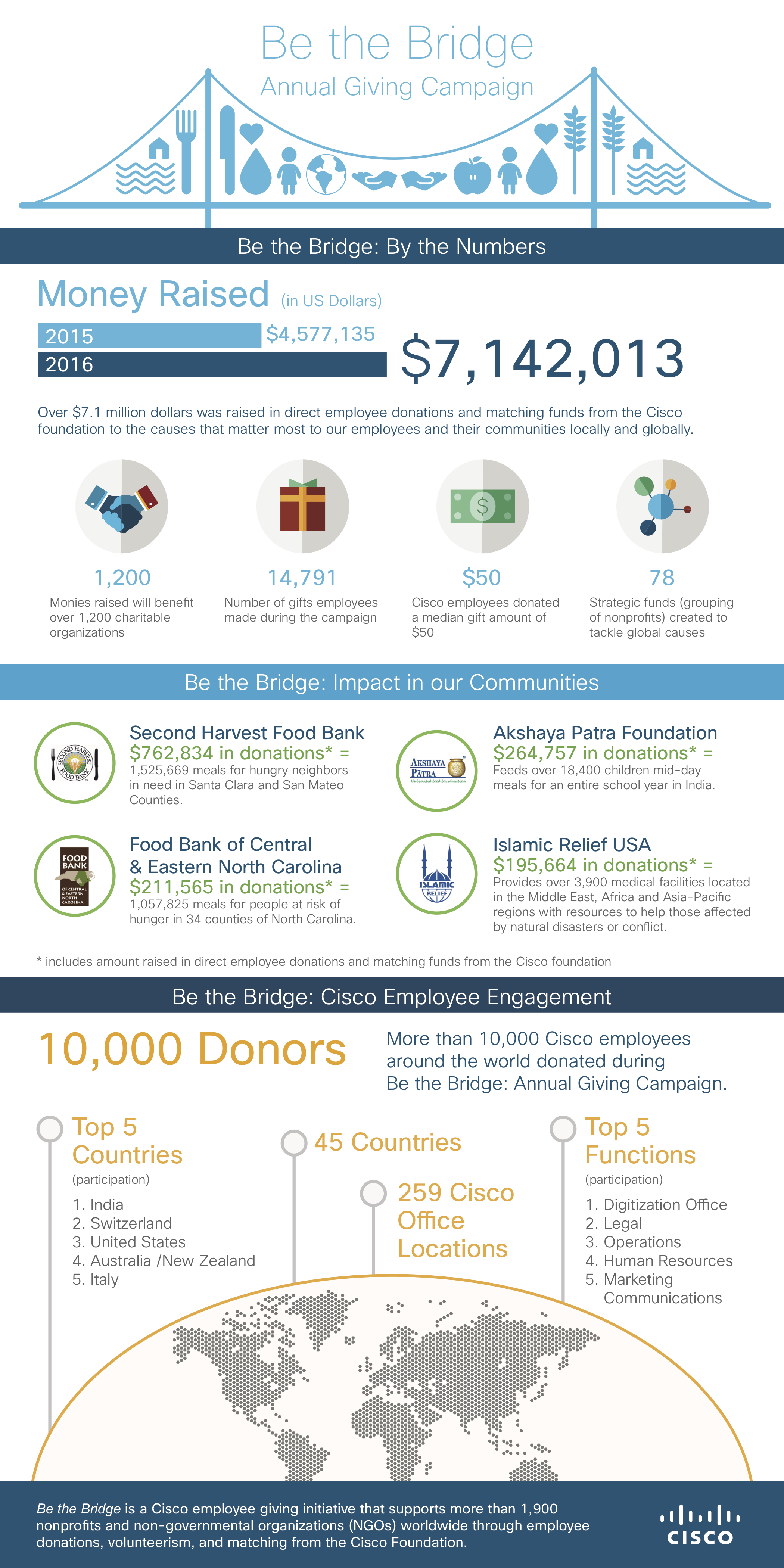
For the second year in a row, our Be the Bridge Campaign was a gravity-defying experience for Cisco employees worldwide. Together, they acted as global problem solvers and supported the Annual Giving Campaign by raising millions in donations, volunteerism, and matching from the Cisco Foundation.
At the core of our People Deal is the idea of benefiting everyone — we are dedicated to changing the world for the better by connecting resources, technology and our employees to their local communities. This signature campaign built upon Cisco’s decades-long commitment to supporting those in need and empowered our global workforce to support social issues in their own backyards.
During last year’s campaign, employees supported organizations focused on critical human needs, which include shelter, water scarcity, nutrition, hunger and emergency response. This year, we shifted the campaign to truly make an impact for everyone. While critical human needs remains a key focus area, we realized our employees are passionate about many social issues and causes, from education and hunger to disaster relief, medical research, and animal rights. Knowing this, we expanded the scope of the campaign to include over 1,900 organizations worldwide, regardless of focus area.
The result: Over 10,000 employees in 45 countries participated, generating $7.1 million dollars in direct employee donations and matching funds from the Cisco Foundation for 1,200 community partners. This is a 56 percent increase over 2015’s collective $4.5 million dollars in direct employee donations and matching funds.
The monies raised will make a meaningful impact in our communities and elevate our commitment to thinking globally and acting locally.
In San Jose, our donations will help Second Harvest Food Bank provide over 1,500,000 meals for hundreds of thousands of people in the San Mateo and Santa Clara communities.
In India, our donations will help Akshaya Patra feed mid-day meals to over 18,400 children for an entire school year.
In Canada, employees supported the Toronto Daily Bread Food Bank, raising funds and generating an additional $10/hour for time volunteered.
Across the United States and around the globe, our donations to St. Jude Children’s Research Hospital will help change the way the world understands, treats and defeats childhood cancer and other life-threatening diseases.
Globally, our donations to Islamic Relief USA will help provide 3,900 medical facilities located in the Middle East, Africa and Asia-Pacific regions with resources to help those affected by natural disasters or conflict.
These are just a few examples of how our donations will impact our communities worldwide.
Thank you to all the employees who were able to participate in this year’s campaign. It was touching for me to hear some of the personal stories of giving during last month’s all-employee meeting. I was genuinely moved by their generosity. Once again, you’ve been a great example of “Being the Bridge” to our communities around the world.
Cisco offers a robust set of resources year-round to support the causes, issues, and nonprofits that reflect our employees’ passions and interests. Cisco provides five calendar days per year of paid volunteer-time-off through our Time2Give employee benefit, a matching gifts program through the Cisco Foundation and global programs – Girls Power Tech and Earth Aware – that align with our employees’ passions. In FY16, Cisco employees volunteered over 187,000 hours and donated nearly $11.3 million to organizations around the world.
Follow Cisco CSR on Twitter to see how we continue to accelerate global problem solving around the world.
Our support of Be the Bridge is one example of how Cisco is harnessing the power of the digital revolution to accelerate global problem solving, enabling people and societies to thrive in the digital economy. Our goal is to positively impact 1 billion people by 2025.
The growth of the IoT and new customer expectations are making networking more complex. Carried out effectively, virtualisation can help service providers overcome this challenge, enabling them to get closer to their customers
The recent launch of Google Home, the smart speaker and virtual assistant that rivals Amazon’s Echo device, underlines the rapid growth of the Internet of Things (IoT).
Soon, connected devices like these are expected to move from being novelties to the norm, with the IoT set for explosive growth in the coming years.
Everything from cars to trains, cities and entire manufacturing chains is being connected to the IoT. Cisco research projects that by 2020, there will be 26.3 billion networked devices and connections worldwide– that’s an increase of 60 percent from 2015.
The growing number of connected devices and objects will require flexible networks that can be adjusted and scaled easily to suit changing situations.
And this comes on top of growing customer expectations for agile, bespoke services.
To meet these new demands, many service providers are choosing to move to virtual networks. With these networks, they can develop the right products and launch them quickly.
If they can do virtualisation well, there are real rewards on offer. But if they don’t manage to make the change, they risk becoming spectators.
So how do service providers make sure their virtual network will enable them to thrive in the digital future?
Cisco Network Services Orchestrator – simplicity through automation
A virtual network comprises different kinds of technology. One of the most important elements is the orchestration engine.
Cisco’s Network Services Orchestrator (NSO) is a crucial component of our virtualisation technology.
It enables providers to design and deliver high-quality services faster and more easily, without creating custom code or causing disruptions.
It also simplifies your operations by automating processes across the network, reducing manual configuration steps by up to 90 percent.
This solution is ideal for service providers making the move to a virtual network, because it’s compatible with both virtual and physical elements.
And because it’s built using open standards, it’s flexible enough to adapt to the changing needs of your business.
Cisco – a natural partner for virtualisation and orchestration
Our expertise in using the latest technology to build virtual network architecture means we can help ensure your services are agile and adaptable, as well as delivered rapidly. This allows you to meet even the most stringent service-level agreements.
The Spanish service provider Telefonica recently chose the Cisco NSOto help it create a more automated and agile network and bring new products to market faster.
Pedro López, Telefonica Business Solutions B2B customer operations director, said: “With Cisco NSO we get the agility to design, refine and repackage network devices and services at the speed of software through standards-based modelling and end-to-end zero-touch automation, responding dynamically to our customer demands and dramatically cutting service delivery cost and time.”
Expanding your offer with use cases
Setting up an effective basic architecture for your virtual network is just the start.
Our use cases allow service providers to take things one step further, offering you a reliable route to immediately deploying new services in key areas.
Earlier this year Ooredoo, a leading communications company with operations in the Middle East, North Africa and Southeast Asia, announced that it would be using Cisco’s Virtual Managed Services use case to offer its customers automated cloud-based services.
This will enable customers to outsource the management of their network and IT services to a trusted technology partner.
And our other use cases enable service providers to offer other kinds of services, too.
There’s a different mix of technology to suit each service provider’s needs. So why not follow Telefonica and Ooredoo in trusting our expertise to help you realise the potential of virtualisation?
Why Cisco
We have deep experience of building networks and are committed to innovation. We also understand the complexity of both physical and virtual networks. Which means we can keep things as simple as possible for you.
The new digital world represents a huge opportunity. But to take advantage of it, service providers will need to go about virtualisation in the right way.
We can help you make sure that – when delivering the services that your customers are now demanding – you flourish rather than flounder.
Find out how Cisco technology can power the bespoke, agile network services of the future. Read more about the Cisco Network Services Orchestrator (NSO)
Key takeaways
– To meet growing expectations for agile, bespoke services, many service providers are moving towards using virtual networks.
– There are lots of different ways of building a virtual network, and it’s important to go about it in the right way.
– Cisco’s NSO is a crucial component of its virtualisation technology. By automating processes across the network, it can reduce manual configuration steps by up to 90 percent.
– On top of the basic network architecture, use cases give service providers a rapid way to expand their offer into areas like agile mobile networks and OTT video.
– This makes it much simpler to operate the network. It allows service providers to deliver the flexible services their customers have come to expect, and meet stringent service level agreements.
The most dangerous threats to your organization are the ones you can’t see or stop.
Cybercrime is on the rise—and the healthcare industry is particularly vulnerable because of the value of the data. Devices and data are growing by the second, creating incredible complexity and a dynamic threat landscape. No wonder 76% of IT professionals say visibility is their greatest challenge.
To help bring this issue—and its solutions—to life, HIMSS (Healthcare Information and Management Systems Society) created the Cybersecurity Hub. Located in Cleveland, Ohio, the newly unveiled 30,000 square-foot exhibit takes visitors inside the journey of electronic health data to illustrate points of vulnerability. As risks are uncovered, tools to help prevent or mitigate the problem are revealed. It’s truly a one-of-a-kind, immersive learning experience.
At Cisco, we think it’s a brilliant initiative—so much so that we’ve become the first collaborator-level sponsor of the HIMSS Cybersecurity Hub. It’s a natural partnership: Just like HIMSS, we’re passionate about healthcare cybersecurity. We understand what’s at stake for our healthcare customers, and we agree that solutions to cybercrime start with visualizing the threat.
We know that to protect the important—often life-and-death—work of healthcare, organizations must not only gain enterprise-wide visibility but also develop proactive defense strategies. Security must be everywhere, spanning the enterprise network, data center, cloud, mobile, and endpoints. And it can’t be just an afterthought; security must be integrated into every process and every technology.
“We know the bad guys are targeting any device on the inside of healthcare organizations to access protected health information, or PHI, for extortion via ransomware or to sell on the black market,” says Andrew Peters, senior manager, Security Marketing, Cisco. “Our integrated solutions allows healthcare security to identify, segment and protect medical and other IoT devices and data from both internet and internally-born threats.”
When we design security solutions, we’re guided by three basic principles: It must be open (for seamless interoperability), automated (to work fast and minimize manual processes), and simple (for easy implementation). Those are the benefits baked into products like Cisco Umbrella for ransomware protection and Cisco Medical NAC for medical-device and PHI security. As a leader in the security space, we’re constantly analyzing the environment and creating solutions to help our customers stay one step ahead of attackers.
The healthcare industry is at an inflection point of digital disruption, and the possibilities are endless. But to truly reap the rewards of this exciting transformation, we must start with a foundation of security built right into the network. Only then can the healthcare industry move with greater speed, efficiency, and agility, as well as achieve goals like reduced costs, new service delivery models, and a successful shift to new reimbursement models. And let’s not forget the patients and their families—they, too, can benefit from a better experience and improved outcomes.
If you’re looking to understand and address the security issues facing healthcare, the HIMSS Cybersecurity Hub is a great place to start. We’re proud to support this initiative and look forward to continuing our long-standing support of HIMSS. If you’re in the Cleveland area, do yourself a favor and check it out. In the meantime, we’ll be at the HIMSS17 conference – see you there!
This post was authored by Edmund Brumaghin with contributions from Angel Villegas
Summary
Talos is constantly monitoring the threat landscape in an effort to identify changes in the way attackers are attempting to target organizations around the world. We identified a unique malware campaign that was distributed via malicious Word documents. The campaign appeared to be targeting victims in Portugal. The malware being distributed was interesting for a variety of reasons. As the author of this malware refers to it as “Athena” in their source code working directory and the fact that the C2 domain used by the malware begins with “athena”, we have identified this malware as “AthenaGo”. We were unable to locate a detailed analysis of this particular malware.
AthenaGo appears to be a Remote Access Trojan (RAT) that also features the capability to download and run additional binaries on infected systems when instructed to do so by an attacker. The malware was written using the Go programming language. Windows-based malware written in Go is not commonly seen in the wild. Additionally the command and control (C2) communications used by the malware made use of Tor2Web proxies, which is part of a trend of increased reliance on these proxying services by various malware authors. As this was an interesting/unique infection chain, Talos decided to examine the malware itself as well as the campaigns that were distributing it.
Of course not. Nobody wants their project to fail. But, as with any transition, especially one as far-reaching as the Internet of Things (IoT), we’ve seen some disappointments—and even a few truly spectacular failures.
For example, “smart parking” solutions are a much-touted component of smart and connected cities. However, the first generation of vehicle parking solutions relied on immature technology—sensors inserted into the street surface—that proved to be expensive to install and easily damaged by cars, weather, and even vandals. However, once this initial approach was replaced by video sensing (which was more reliable and cheaper to deploy) automated parking solutions started to gain traction.
Smart parking is one IoT solution that has improved with maturing technology.
Sometimes IoT initiatives fail simply because of poor communication. A coalition of partners spent two years working with an oil & gas company on a connected refinery solution based on outdoor Wi-Fi. The project was extremely challenging, but the team succeeded. To their surprise, the solution was actually never implemented because the business units—the actual customers—had never bought into the project and chose not to take it live. Oops.
Having spent the last several weeks talking about my recipe for IoT success, it seems only fitting to discuss some common mistakes and how to avoid them. So here is a summation of issues and challenges I have seen while working with people across the globe on their IoT implementations:
Starting with technology instead of business opportunity. The primary goal of IoT is to solve business problems, not to excite tech geeks with a cool project. So focus on the business problem and the technology will follow.
Approaching a solution in isolation without integrating it with business processes. If you don’t examine existing workflows and integrate your IoT solution with them, you’ll see diminished ROI, or even a complete lack of business benefit.
Leading with connected devices instead of data and apps. Applications and data analytics drive the need for device connectivity, not vice versa.
Neglecting a strategic and long-term focus on change management. Implementing IoT will change the way your business operates, so you can bet there will be resistance. Prepare for an enduring effort to combat it.
Confusing tactics with strategic vision. Think big, but start small. Start with a low-risk tactical project with clear benefits, then—as your expertise and support grow—choose more ambitious projects within your overall strategic direction.
Designing IoT solutions without a proper security foundation. Integrate security into your implementation from the start, and make it everybody’s job.
Trying to do it alone. IoT is a team sport. Assemble an ecosystem of partners from inside and outside your company, and make sure they can work together well.
Implementing single-vendor custom solutions. Insist that suppliers open up their architectures, embrace open standards, and adopt a co-development model. But don’t make it a custom solution—insist on an open platform that can be adopted by the industry.
Taking a grass-roots-only approach. You must have executive support at the highest levels. After all, you’re re-engineering the company. You need C-suite sponsorship.
Underestimating the challenge of legacy systems. Pursue an aggressive but thoughtful plan to replace existing proprietary systems with open standards wherever possible.
Failing to communicate. Communicate more than you think is necessary. Broadcast both successes and lessons learned from failure.
Underestimating the power of existing relationships. Many industries have well-established ecosystems and relationships. Some of these players are eager to be change agents, and some will resist. Seek out openness.
Betting on immature technologies. New technologies bring big promises, and can be a big gamble. Implement them in phases, and learn and share with your peers.
Compromising on interoperability. This mistake will doom your project to a very short life and cost you a bundle.
Not managing risk vectors properly. Be thoughtful about how many new variables you’re planning to introduce in an IoT project and stage them carefully.
Falling for hype instead of building a business case. Build a solid business justification for your IoT project. Continue experimenting, learning and benchmarking your results until you find a compelling ROI for your first small IoT project.
I can assure you that you’ll make plenty of mistakes in your IoT journey. But if you spot them early, you’ll be able to recover from and correct them. Let’s look at another example from the oil & gas industry. A company decided to install advanced process control (APC) systems in its refineries, but it did it one location at a time. All well and good. However, when they proceeded to integrate all refineries into a single synchronized system, they discovered that the individual APC implementations were incompatible with each other. A fatal mistake? No. But it took a lot of time, money and effort to go back and implement a standardized architecture.
Yes, IoT projects do fail. But by avoiding these common mistakes you’ll help ensure that yours won’t be among the casualties.
Next week we’ll look at the role of service providers in the IoT ecosystem.
I have been very fortunate in life and in my career that I have been able to see much of the world. I find tremendous joy in immersing myself in different cultures and seeing first-hand how other people live, communicate and work. While every destination and every culture has their own twist on these fundamentals, there is one recent phenomenon that is a constant: digitization. You’ve heard Cisco use this term on more than one occasion, but now we would like to share our expertise with you as it relates to marketing. Within our existing partner Marketing Velocity platform, we’ve created a track exclusively for our distributors. To help equip you and our partners to conquer the digital marketing world.
This week, live on Cisco SalesConnect, we invite you to enlist in Project Market Yourself Awesome, our elite training program that will teach you to how to optimize your digital presence, get stronger leads and generate more revenue.
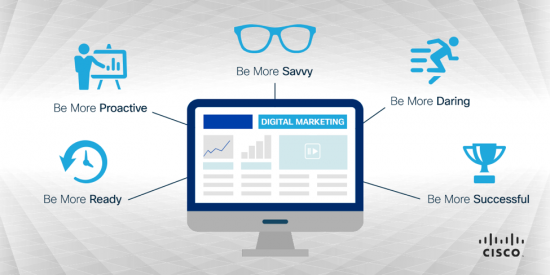
Be More Ready
The first module of MYA advises on planning digital strategy and effective digital marketing campaigns. We discuss how to create a seamless customer journey throughout the entire campaign cycle.
Be More Proactive
Expand your knowledge on revenue marketing and discover the most effective ways to turn leads into sales. Find out what Cisco services and resources are available at your advantage.
Be More Savvy
Learn how to boost your brand and your online presence. We dive into the importance of partnership, co-branding and give away our top ten tips for simplifying your language to ensure your content is engaging.
Be More Daring
Master how to build relationships and boost sales with social media. MYA has two routes to this module. Opt in for social selling and learn how to efficiently use your network. Or, gain knowledge on how to integrate digital marketing with your events and generate more
opportunities.
Be More Successful
Tracking and measuring your digital activity is essential to your success. In the final training, we go over why reporting is so important and what measurement tools you can utilize for all your digital marketing activity.
Don’t worry if you don’t have a spare hour or two to complete a training, we’ve designed these training videos for the modern marketer: short, engaging, and available via laptop or the SalesConnect app. Each module also has accompanying takeaways for your future reference.
Your mission, should you choose to accept it, is to complete Project Market Yourself Awesome, enhance your digital marketing skills, and report back to your Cisco Partner Marketing Manager with your feedback.












 When we design security solutions, we’re guided by three basic principles: It must be open (for seamless interoperability), automated (to work fast and minimize manual processes), and simple (for easy implementation). Those are the benefits baked into products like