IoT adoption is growing. Cities are becoming smarter by optimizing parking revenues, waste management and collection routing, street lighting operations, and more. Airlines use real-time aircraft, airport, and weather sensor data to improve operations. As organizations embrace IoT to transform their businesses, often the first step is to deploy sensors on machines and devices to convert physical measurements into digital signals that an IoT network can use. Sensors that measure pressure, motion, vibration, temperature, humidity, etc. can make assets more productive. And IoT integration platforms can use this data to support new product innovations, preventive and predictive maintenance, optimized marketing, and more.
Securely Connect New Things
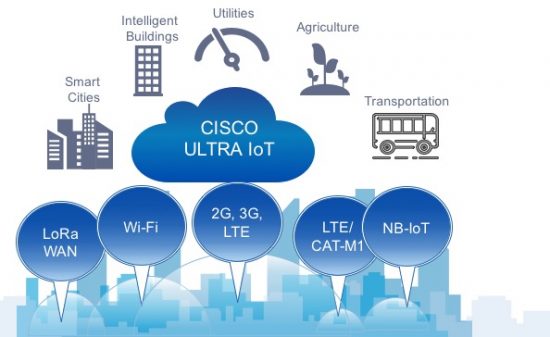
For Service Providers, the immediate opportunity is to provide secure connections for IoT devices, sensors, and solutions across a range of access network types that vary in terms of cost, complexity, security, data transferred, and reliability. Cisco’s leading industry-tested access networking solutions for unlicensed (Wi-Fi, LoRa) and licensed (2G, 3G, LTE, NB-IoT, CAT-M1) radio enable SPs to offer appropriate class of services as demanded by IoT applications.
Customized IoT with a Cloud-Scale Mobile Core
The next natural role for Service Providers is to transport IoT data and signaling from securely connected devices back to a multi-access core with unified policy, charging and service capabilities. Cisco’s Ultra Service Platform is a fully virtualized, 5G-ready mobile core that runs on a virtual hardware instance for better performance, scalability, and cost. At MWC 2017, Cisco introduces “Ultra IoT”, which evolves the Cisco Ultra Service Platform to support the 3GPP Cellular IoT (CIoT) architecture. Ultra IoT is an access agnostic, virtualized mobile core optimized for IOT, including core network support for all 3GPP connectivity, including NB-IoT and CAT-M1.
Cisco Ultra IoT Supports a Range of Industry Solutions
Furthermore, Cisco Ultra IoT’s built-in network slicing capabilities allow Service Providers to deploy instant virtual mobile networks for IoT applications requiring customized services. A virtualized mobile network “slice” for Connected Vending machines can be provisioned differently for latency and bandwidth from another slice for a Connected Car service.
New Ways to Monetize IoT
The IoT end game for most organizations is to create new services for new revenue streams. For example, automakers eventually will sell not just vehicles, but transportation solutions, including support for new ownership models requiring seamless IoT connectivity – e.g., ride sharing, on demand, and shared ownership. Ultra IoT includes standardized open and secure APIs that provide SPs new ways of monetization by exposing network intelligence and capabilities to IoT applications.
Cisco has worked with SPs across the globe to deploy many horizontal and vertical IoT solutions, including Smart+Connected Communities, Connected Transportation, and Connected Asset Management (e.g., Financial, Telco, Utilities, Buildings, etc.). These solutions are based on reference architectures, validated network designs, and include Cisco and 3rd-party network products and services.
Find out more
To learn more about the Cisco Ultra IoT solution and the new opportunities it creates for Service Providers, please click here.
I went to school in the Dark Ages. Alright, that may be a little melodramatic. It was San Francisco public schools in the 80’s and 90’s: we barely had enough musty, old textbooks to distribute to each student, school computers were used solely for Oregon Trail, and my teachers used noisy overhead projectors with dry-erase transparency sheets as learning tools. If you’re over 35, you may remember all of this fondly.
But it’s 2017 now. Today, campuses and classrooms are undergoing a digital transformation. A classroom of students can connect with guest lecturers virtually, from across the world. Learning tools have gone digital, where students use tablets and laptops in place of those musty old textbooks I had. In fact, 75% of teachers believe that digital learning content will totally replace printed textbooks within the next 10 years. Students can even join in on class lessons from their hospital beds. A stunning 2 out or 3 children today begin using digital learning tools by the time they turn 5 years old. (Deloitte Digital Education Survey 2016)
Today’s digital campuses and learning technologies require a robust network to support bandwidth heavy courseware and collaboration applications (video, voice, etc), learning management systems, and the multitude of devices (laptops, tablets, smartphones). With this complexity in mind, the network should be simple to deploy and manage, while student and research data need to be secure. And in today’s rigorous academic settings, competition among schools for student retention and attainment keep these institutions striving to increase student engagement with personalized and relevant experiences.
Cisco Digital Network Architecture (DNA) ensures that your network can handle the requirements of devices, applications, and services on your digital campus. With Cisco DNA’s automation and assurance, insights on the network and your users, and security network-wide, education institutions can focus on fostering innovation, learning, and engagement among their students and faculty. To learn more, check out this interactive infographic on how Cisco DNA can enable digital transformation on your campus. Is your campus network going digital? Let me know how, in the comments below!
Cisco has long supported updating the Electronic Communications Privacy Act (ECPA) to better protect customer data and communications stored with third-party providers against unwarranted searches and seizures. We, therefore, applaud the unanimous voice vote in the U.S. House of Representatives to pass the Email Privacy Act (H.R. 387) introduced by Representatives Kevin Yoder (R-KS) and Jared Polis (D-CO).
This bipartisan legislation would require the government to obtain a probable cause warrant before demanding access to customer data in the cloud. We firmly believe that data stored in the cloud must receive equivalent legal protections against search and seizure to those accorded physical papers and electronic data stored on premises.
We firmly believe that data stored in the cloud must receive equivalent legal protections against search and seizure to those accorded physical papers and electronic data stored on premises.
In a groundbreaking decision dating back to 2010, a United States Court of Appeals held that the current statute is unconstitutional to the extent it allows the government to seize the contents of emails from a service provider without a warrant. Cisco and most other major cloud providers adhere to this position. We require warrants from law enforcement before acceding to demands for the contents of our customers’ communications. However, the text of the law requires updating to enshrine these greater protections into the U.S. code. The Email Privacy Act would accomplish this goal.
ECPA was forward thinking at the time of its original passage in 1986. It now requires an update because its development has been outpaced by technology. More than 30 years ago—long before the advent of the public Internet—it perhaps made sense to assume data left in third-party storage for more than 6 months might deserve some lower level of protection against government intrusions. Now, in a world where we treat ubiquitous cloud-based storage as a natural extension of our homes and offices, this distinction does not make sense.
U.S. Supreme Court Chief Justice Roberts wrote in the Riley v. California decision concerning police searches of cell phones incident to an arrest: “[c]ell phone users often may not know whether particular information is stored on the device or in the cloud, and it generally makes little difference. Moreover, the same type of data may be stored locally on the device for one user and in the cloud for another.”
It is, therefore, clear the Fourth Amendment’s requirement that “[t]he right of the people to be secure, in their persons, houses, papers, and effects, against unreasonable searches and seizures” must include not only physical papers but also their digital equivalents. It must protect not only communications stored on our persons and in our homes, but also the natural extensions of those places enabled by the connectivity that drives our economy and powers our modern world. The government should obtain a warrant when seeking access to communications regardless of whether they are stored in mobile devices we carry or in the cloud that powers them.
Cisco, therefore, welcomes the House passage of the Email Privacy Act. We are committed to working with the co-sponsors, like-minded private sector peers, and advocates from civil society to speed this legislation’s passage into law.
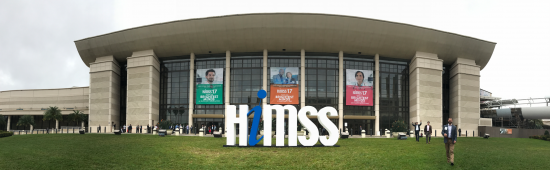
HIMSS17 is over, but the drive toward innovation and digital transformation will continue! According to Modern Healthcare, 42,287 providers, C-suite executives, IT managers, clinicians, government employees, and vendors from around the world attended the conference, which was held last week in Orlando, Florida. Cybersecurity, cloud, EHR ease-of-use, patient engagement, and interoperability were the key issues that attendees are interested in solving for their healthcare organizations.
If you were at HIMSS17 and had the chance to visit the Cisco booth, thank you! We know how busy the show was, and we truly appreciate you taking time to learn about Cisco healthcare solutions that can help you personalize patient engagement, deliver remote care and collaboration, and simplify clinician workflows, all while maintaining security and patient privacy.
Here are some highlights of our presence at HIMSS17.
On Tuesday, February 21, healthcare executives and specialists gathered for the 10th Annual Cisco Connected Health Summit, co-sponsored by Optum, to hear customers share stories about empowering new innovations in care delivery:
Cracking the Code on Secure Clinical Communications: How HCA Tackled one of Healthcare’s Most Common Challenges, Annabaker Garber, CNIO, HCA
Expanding Access to Care for Kids and Families through TeleHealth, William Kennedy, MD, Chief of Pediatric Urology, Lucile Packard Children’s Hospital at Stanford
Enabling Care Transitions Through Mobility and Extreme Customer Service, Patrick Hale, Chief Information Officer and Executive Vice President, VITAS Healthcare
Improving Patient Care and Population Health with Analytics, Jennifer Kuroda, MSO Quality Improvement Manager, SwedishAmerican Health System
In the Cisco booth, we showcased these innovative healthcare solutions that can be deployed now to connect patients, clinicians, processes, data and things in a meaningful way:
Medical NAC: Identify and protect medical devices and patient data from network threat.
iOS Mobile Solutions: Show seamless integration between Apple iOS and Cisco collaboration.
Cisco Meraki: Cloud managed WiFi and video surveillance.
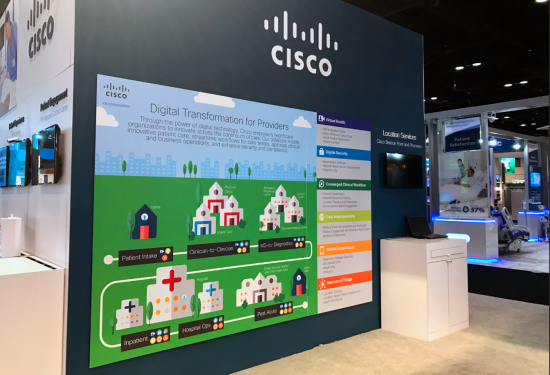
At HIMSS17, we displayed our new roadmap to support digital transformation for healthcare providers. Through the power of digital technology, Cisco empowers healthcare organizations to innovate across the continuum of care.
We look forward to working with you on your digital transformation, and we encourage you to engage with us on your favorite social media channel. Check out highlights below from @CiscoHealth and #HIMSS17 on Twitter.
Transportation is the life blood of any city. An efficient, safe and secure network is critical to support an increasing mobile population. Digital business transformation is a journey towards adopting and deploying digital technologies and business models that measurably improve performance. A digitally transformed organisation is hyper-aware, IoT ready, predictive, and agile—with dynamic processes enabling it to adapt and thrive in an environment of near-constant change. Gartner defines a “Digital business as the creation of new business designs by blurring the digital and physical worlds”.
Cisco is helping Government and Transportation Operators world-wide to adopt a simple, secure and intelligent Digital Network Architecture (DNA) that will enable, transform and disrupt the industry. Whether it’s providing an enhanced passenger experience; improving safety, delivering better service levels, or improving security and environmental control to maintain regulatory compliance, digital transformation will continue to drive new opportunities in cities around the world.
People tend to call me because I’m a blend of helpful and optimistic – you might say a caffeine free way to start your day. So when the phone rang, and I was asked to be part of a well-being initiative Cisco was introducing in our EMEAR region – my Mary Poppins nature kicked in with a quick, “Yes!” Little did I know that this yes would be life changing – for me and my family – and would test my natural optimism to its very limits.
The initiative being introduced was in collaboration with internationally renowned well-being expert, Jessie Pavelka. What I had said yes to was sharing my experiences as I lived the “Pavelka Way” and – most importantly – completing a major challenge six months later. That challenge would be to climb the tallest mountain in the United Kingdom, Ben Nevis, which stands 4,013 feet tall. Eek!
My starting point was that of “struggling to walk up a flight of stairs” – what possessed me to sign up to such a massive challenge? Honestly – the fear of how tired and unfit I had become was far greater than the fear of that mountain. Just the month before I started this challenge my family had been in a car accident – thankfully no one was injured but the impact this event had on us was significant. It was suddenly very clear how tired, unfit, and lacking in resilience I had become. As energized as I was by my career – I had almost no energy left by the weekend and simply wasn’t able to be as present for my husband David and thirteen-year-old daughter Iona as I should have been.
Something needed to change. The phone call felt like a life line.
How do you go from a standing start to the top of a mountain? One step and one day at a time. Using Cisco technology to meet virtually, Jessie spent time getting to know what made me tick, what my schedule looked like, and helped me find the time and space to fit in well-being and movement – he realized quickly that being outdoors was key for me! And this was my path to my 15,000 daily step target, which became a joy to do!
At the same time I was putting more color on my plate, cutting out processed food, and getting more sleep. That’s pretty much what I did for three months as I focused on getting stronger and more fit one step at a time – and the health benefits were almost immediate!
Then came the more challenging part of the process – having built up a level of fitness and making movement a part of every day, it was time to tackle my mind power. This is where Mary Poppins felt well and truly out of her depth! My challenge was to complete a high rope obstacle course, and I don’t mind admitting I’ve never known fear like it – ever.
Taking the first step off the platform was the toughest moment – I really thought I wasn’t going to be able to do it! Turns out that the fear of failure was greater, so off I zipped! Over the course of the morning I screamed, I cried, I got angry, I fell off obstacles and somewhere along the process a switch flicked in my head – and I think this is where Wonder Woman made her first brief appearance. I finished the obstacle course. Bruised, tired, and more proud of myself than I’ve ever been. I could not believe what I had done!
Now it was time to get serious about this mountain climb – for the next three months I grew my inner Wonder Women gradually day by day. A big part of Wonder Woman’s power, of course, is her attitude and her mind power! That’s the muscle I built up the most when I stopped talking myself out of things. When you stop second guessing yourself a whole new world of possibility suddenly opens up. When it came to the day of the climb I felt 100% ready. Nervous, scared and excited. But definitely ready.
All of the elements from the Pavelka Way – food, movement, mind power, and family –helped to power me up the mountain on the 4th of September! I ate the right fuel to get energy all day. I paced myself and dug deep physically on the tougher parts of the climb. I stopped to actually notice and take in the incredible scenery on the way up, and even managed a few peaceful moments of reflection. Most importantly, I built an incredible support team around me in the lead up to and during that day. What made the experience even more meaningful was the ability to raise over $3,000 for Scottish Autism thanks to the generosity of sponsors and our Cisco Matching program.
What I thought would be an ordeal to “get through” turned out to be the greatest adventure of my life – I discovered strength in myself I did not know existed and realized that what you can achieve becomes so much greater when you are part of a team all pulling in the same direction.
My career at Cisco is all about creating the best teams and enabling people to truly play to their strengths, every single day they arrive to get to work. I’ve learned more about the power of teams and how to discover your strengths in my mountain climb than I could ever have imagined, and it’s exciting to now take what I’ve learned back into my work.
This was an incredible opportunity to have and Cisco even provides the perfect environment to #payitforward as I share my experience and insight with others who maybe want to find a little bit more energy in their days.
My main takeaway from this experience? What you are truly capable of lies on the other side of fear – we discover strengths we don’t know we have when we push past what we’ve always done. But you don’t have to do it all on day one – start with one step at a time.
It’s also never been clearer to me that humans are not wired to succeed on their own – we just aren’t. Building a team around you for support is vital for your learning, your success and it’s just much more fun!
When you think anything is possible – I mean truly believe it – it turns an optimist into an adventurer. It’s where Mary Poppins becomes Wonder Woman.
Interested in joining a company that empowers you to find your strengths? We’re hiring!Apply now!
The Cloud is changing how service providers and enterprises deliver services to users and provides new opportunities to drive their business forward. With cloud infrastructure, apps, and services they can proactively respond to market and business needs with greater agility, while reducing costs and complexity.
Yet, for all its benefits, the Cloud is also extending the perimeter and expanding the attack surface. Hackers are increasingly targeting service providers and enterprises with sophisticated attacks that exploit weaknesses in new mobile services, expanded network connections, device proliferation, and unsafe user habits.
Cisco and Ericsson are leveraging their relationship to deliver new NFV and cloud-based security services to enable service providers and enterprises to see more, detect and protect better, and respond faster to cyber-attacks. Service providers can now embrace NFV to increase revenue with new, differentiated value-added managed services that allow their enterprise customers to adopt cloud-based strategies securely. Enterprises can drive forward with NFV with confidence, extending security across the enterprise – including branch offices and remote locations – for consistent protection that’s simpler, automated, and more cost-effective.
This new integration helps to speed delivery of NFV and Managed Security services with pre-tested and out-of-box interoperability of Cisco Security VNFs with Ericsson Security Manager for simplified configuration and integrated logging, reporting, and single-pane-of-glass management.
Cisco and Ericsson will promote the joint interoperability for NFV and Managed Security at Mobile World Congress 2017.
Please stop by the Cisco Booth located at #3E30 in Hall 3 at the Fira Gran Via Convention Center to learn more and see a demonstration of Cisco Security VNFs together with Ericsson Security Manager in action.
Millennials are often judged as being ‘lazy, impatient and self-entitled.’ We want it all and we want it now (myself included!) But is that really a bad thing? Look at all the innovations that our impatience and need for convenience has sparked. The moment we wake up, we check our mails, read the day’s news and pay our bills all from the convenience of our smart phones. We ask Alexa to book us an Uber, grab our morning cuppa on the way to work, and pay for it all with our phone or even our watch. If there ever was a time when impatience was rewarded, it is now!
Now why should you, an enterprise, care about us ‘pesky’ millennials? It’s because, like your friendly neighborhood Starbucks, we are everywhere! In 2017, millennials already represent a third of the US workforce, and the Brookings Institute forecasts they will make up 75 percent of the workforce by 2025. And, along with your employees, your customers will also increasingly be millennials, bringing with us $200 Billion in annual purchasing power. This means that you will want to find new ways to enhance your product or service and market to an increasingly educated, hyper-aware generation, spoilt for choice with multiple options and the impatience to jump from one to the other if they are not satisfied. You will need to innovate to stay competitive in an increasingly disruptive world which challenges existing business models. This is why dear corporate leader (whether you are a CEO, CIO or LOB executive), the future success of your organization rests squarely on our CrossFit-toned shoulders.
Digital Transformation and the Cloud
Now that we have established our plans to conquer the world, you may be wondering how best to prepare your organization for this next revolution. Two simple words: Digital Transformation. And cloud is the secret sauce that powers digital transformation. It’s impact on customer experiences, new business processes and models, and new workforce innovations is undeniable. So, it’s only logical that you can power your organization’s digital transformation by embracing the cloud, in turn making your company ‘millennial-friendly’. If you are wondering how cloud is connected to all of this, you will have to understand us millennials better, so here are a few pointers.
We want quick, easy access to information and tasks
We are the generation of decreasing attention spans. We want everything instantly and we want it to magically work perfectly, the very first time. We value personalization and expect to be delighted, be it an office collaboration tool or ordering groceries on a mobile app. If we can’t figure out how to use an app in less than 30 seconds, I’m sorry, it’s not me… it’s you!
In such a dynamic, increasingly agile product development environment, companies can no longer take ages to go to market with the latest products and features. Enter the knight in shining armor: DevOps- made possible with agile cloud-based application development and management.
Work-Life balance is important to us
Nine to five office jobs? No thank you! We need flexibility in how we work, play, learn and live. We want to be able to take that important meeting while waiting for our doctor’s appointment or on the way to a Yoga class. It’s no wonder we prefer cloud-based services that give us the flexibility to access our information on the go and collaborate with people anytime, anywhere and across multiple devices.
We are comfortable with Technology and the Cloud
Millennials embrace change! We are comfortable adopting new technologies we are not familiar with, provided we see value in them. We don’t fear the unknown, why should we? We have grown up with the internet providing us answers to all our questions, teaching us new skills and providing us an avenue to share our knowledge with the world. New tools at the workplace or finding better ways to get everyday tasks done? No worries! Why fear, when Google is here?!
Privacy and data security are a major concern for us.
Don’t be fooled by the vast amounts of data we share on the internet through our many social profiles (Facebook, Twitter, LinkedIn, and the likes), data privacy is of the utmost importance to us. It’s easier than ever to lose customers and brand reputation when one security slip-up is magnified over social media. Obviously, that puts pressure on you to make sure you provide end-to-end security while still ensuring it’s not tedious for us to access our own data.
We are a self-service generation.
If our company’s IT department doesn’t have the right tools to help us solve our problems, we are happy to go out and find public cloud/ SaaS solutions that can. Call us ‘Rogue IT’, ‘Shadow IT’ or anything else you want, we don’t wait around for slow processes and people to fulfill our needs. Remember the days before BYOD where companies tried to restrict what employees could and could not bring into the office? We all know how that turned out!
The Cloud Gap
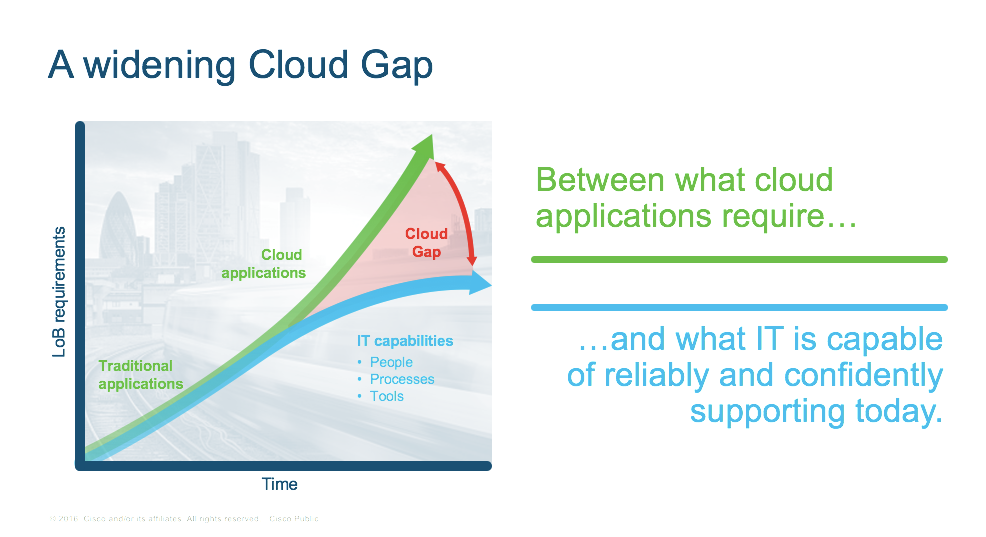
For all these reasons and many more, IT departments need to evolve from being gatekeepers struggling to ‘catch up’ with growing business demands to trusted IT enablers of solutions across hybrid IT environments (cloud and non-cloud infrastructure, applications and management) from many different providers and consumption models. This way they can elevate themselves to strategic advisers who expedite the journey to the cloud instead of being viewed as a bottleneck to growth and innovation. However, this is easier said than done due to an ever-expanding ’Cloud Gap’ between what cloud applications and LOB stakeholders require and what IT is able to reliably and confidently support today, when it comes to their people, processes, and tools. How can you find that balance between meeting the demands of a young generation looking for innovative solutions while simultaneously ensuring the highest standards of operational excellence, security, governance and compliance?
What can you do to bridge your cloud gap?
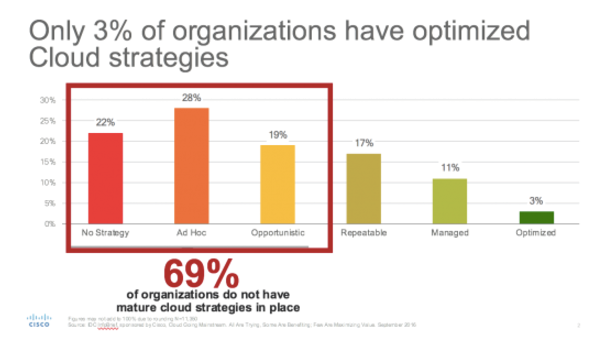
If you are overwhelmed at the mammoth task of creating an optimized cloud strategy for your organization, and are already contemplating an early retirement, fret not, you are not alone. According to IDC’s recent CloudView Survey conducted with over 11,000 IT professionals, ONLY 3% of organizations have optimized cloud strategies. And even more surprisingly, 69% of organizations do not have mature cloud strategies in place. Yet, almost 78% of organizations use some form of cloud, be it public, private, hybrid or multi-Cloud. This proves that a vast majority of organizations are still experimenting with hybrid IT environments to identify their own unique cloud strategy, while realizing that no one cloud fits all.
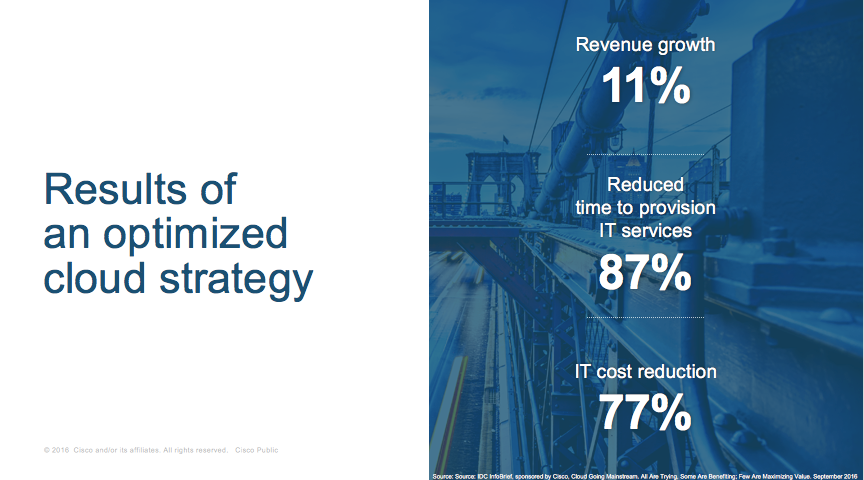
The #MicDrop moment here is to realize that you need to embrace the cloud rather than shy away from it. The sooner you do this, the more you will be surprised at the business benefits it can bring (see IDC results below) while making your brand and organization more appealing to us millennials, both as employees and consumers. Imagine your brand being amplified over our vast social footprint…we can become your biggest advocates without you spending any marketing dollars!
So, what are you waiting for? Start your journey to the hybrid cloud with a little help from your friends at Cisco! You can assess where you stand in the cloud maturity model by taking the Business Cloud Advisor Online Assessment today.
P.S. If you thought your millennial problems were huge, wait till the next generation comes into the workforce. Gen Z or simply, iGen, these guys were practically born with a smart phone in hand! I would call them the cloud-native generation. More reason for you to #GetWithTheProgram and be #CloudNative.




 Get the Podcast