Avatar

I’m really excited for next week’s Enterprise Connect in Orlando. Why? Because this show is so focused on what matters most to us: Collaboration.

We’re looking forward to having you experience our latest products in our demo area. Because it is all about the experience with us.

I find that more than ever, I’m focused on experiences – creating great experiences. We want our products to go beyond being business tools to becoming a natural part of how you interact and collaborate. To help you work faster, smarter, more productively.

Experiences matter. Think about how digital technology has transformed different experiences.

For millennials, this may sound like ancient history, but not so long ago, the only way to see a movie was to go to a movie theater. If you wanted to see Star Wars when it was released (the first time), you stood in line for hours to get a ticket to sit in uncomfortable seats with a few hundred other people. Now, you can hold movies in your hand and watch them on a mobile device. Digital transformation has taken us from uncomfortable theater seats to the couch at home – or the coffee shop for that matter.

It’s amazing how much the experience has changed – and how quickly. It’s still about watching a movie. But now you decide when and where and how. The experience has evolved from passive to interactive, from someone else’s schedule to yours.

And it’s all powered by amazing technology: cloud platforms and deeper integrations between hardware, software, and networks.

One Tool, One Experience: Cisco Spark
We’re at the same turning point with enterprise collaboration experiences. We move between multiple modalities: casual messaging, real-time, messaging, ad hoc meetings, formal meetings, and so on all of which make up your workstream. Bouncing between them doesn’t foster productivity or innovation.

The solution isn’t better screens, faster meetings, or better voice quality. The best experience is one that seamlessly connects your workstream. Bottom-line: seamless, integrated solutions drive better outcomes.

Meetings, messaging, and calling are in our DNA here at Cisco. No one has a better perspective of the entire workstream continuum than we do. And that’s why we built Cisco Spark. One tool that brings together meetings, messaging, and calling, with world-class hardware into one fluid flow, with no compromises.

With Cisco Spark, you can stay within your workstream – it’s easy to collaborate and easy to work when your tools work the way you do. You get an amazing experience leveraging the best technology available.

Data Privacy
Behind the experience is encryption… robust and end-to-end. As a user, you don’t see it, but it’s there. It’s transparent. It doesn’t interfere with your experience.

But Cisco Spark was built for enterprises – and they demand data privacy at the same level that they had with on-premises deployments. And that fits their established procedures for compliance and security. This is why we’ve had data privacy in mind since we started designing Cisco Spark. And it has been a part of the underlying fabric, the platform, and the product since the beginning. Which makes the enterprise very happy.

What’s Next?
We have great technologies at our disposal right now, better than ever before. And we are at a perfect moment with new tech: Greater acceptance of cloud, artificial intelligence becoming mainstream, speech recognition appearing in all sorts of devices. All this technology has the ability to make collaboration experiences even better.

Cisco Collaboration is all about incredible continuous innovation: extending the platform, integrating more workloads, and creating more magical experiences that you love.

What’s next? Get the latest from Jens Meggers in his keynote at Enterprise Connect. Join us or register to watch live online on Tuesday, March 28 at 10:00 a.m., ET.


Authors

Jens Meggers

No Longer with Cisco

Avatar

Digital transformation is creating new business models, new customer experiences and improving workforce experience. It is changing the way we work, live and play. It involves connecting millions of endpoints and disparate types of data sources.  In the digital era, businesses are becoming more dynamic and distributed with trends like cloud, mobile and social. All this leads to complexity and that’s why there is a need for simplicity in infrastructure.

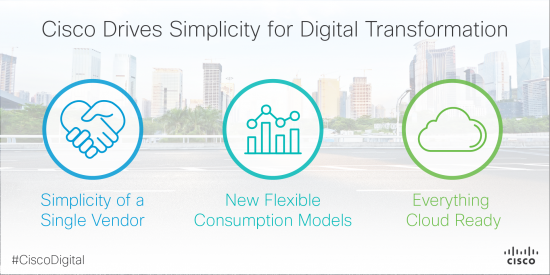
Simplicity is the corner stone of Digital Transformation. If businesses cannot simplify they cannot respond to the market faster and cannot innovate. Cisco is all about driving simplicity by providing the following:

  • Simplicity of a Single Vendor
  • Everything Cloud Ready
  • New Flexible Consumption Models

Cisco brings together industry’s broadest portfolio across network, data center, Cloud, security, IoT, analytics and collaboration. It connects the dots among them and automates more parts of infrastructure then anyone else so that you can build and deploy the services faster.

Cloud is all about driving simplicity and agility. Cisco is heavily invested in cloud and offers cloud managed products like Meraki, DNA etc. We also accelerate your journey to public, private and hybrid clouds.

Cisco also provides flexible consumption models that improves OPEX predictability and reduces initial CAPEX. Cisco ONE and Spark Flex Plan are two great examples of this.

Simplicity is the first principle of Digital Transformation and with Simplicity, Cisco makes IT move at the speed of Digital Business. For more information, please visit our Why Cisco for Digital Transformation White Paper.


Authors

Pankaj Gupta

Director, Market Management

Enterprise PSM - Portfolio, Software, and Campus Switching

Avatar

In the recent blog, How Do We Know If We Are Ready for Data Virtualization? we examined the value-add that data virtualization provides, as well as useful tools that organizations can use to assess their data virtualization readiness.

In this blog and on-demand webinar, I move from the general to the specific by examining how a particular organization knew its time had come to use data virtualization.

Cisco Services – The World’s Largest Data Virtualization Deployment

Towards this objective, I felt you might enjoy learning how Cisco’s business and IT leadership itself answered this question. As such, I interviewed Bill Schongar, a Senior Business Architect from Cisco’s multi-billion-dollar Services business. Bill guides the adoption and use of Cisco’s data virtualization offering, Cisco Information Server, within the Services business in support of arguably the largest data virtualization deployment in the world.

On Bill’s watch (and in close partnership with Cisco IT), Cisco Information Server was widely adopted across Cisco’s Services business with the objective of enabling Cisco customers to more successfully use and gain value from Cisco’s products and services. The resulting changes and integrations benefit more than 25,000 Cisco employees, as well as millions of Cisco’s customers and partners through tools on cisco.com, Cisco’s Technical Support Mobile app, service and support APIs, and more.

As you can imagine, the data sources that flow to and from these tools are extensive – petabytes of product, services, reference and even customer data across many distinct source systems. Beyond integration, securing data at this scale and diversity is critical, especially where customer data is involved. To address this complex, global data security challenge, Cisco also leverages Cisco Information Server to meet customer data protection mandates.

How Cisco Knew It Was Time to Use Data Virtualization

Bill had a number of great insights to share, netting these out in five highly significant reasons as follows:

  1. Delayed time to solution for new information requirements
  2. Proliferating data silos and ineffective sharing across groups
  3. Data security issues
  4. Complex technology migrations
  5. Rising IT staffing and infrastructure costs

As these challenges grew, Bill realized his existing data integration tools were holding him back.

Delayed Time to Solution for New Information Requirements

Delivering the data sets required to meet new information needs faster than other, less agile data integration technologies is a key differentiator for data virtualization.

In Cisco’s dynamic, global Services line of business, new information requirements arise daily, from aggregating and analyzing locally-enriched data sets to enterprise-scale data.

Leveraging Cisco Information Server enables Bill and team to meet these needs with the agility that business requires; POCs in a day, not a month, with reusable, secure approaches to quickly access, cleanse, enrich and deliver that data.

Proliferating Data Silos and Ineffective Sharing across Groups

Data silos can proliferate as organizations take advantage of data housed in traditional, IOT, big data, and cloud technologies. While each new data silo may have a justified value-add to its users, the data within each is too valuable to hide away.

Cisco IT and Services teams use Cisco Information Server to “democratize data” – making it available securely for proper use rather than focusing on what team “owns” it or where it lives. Centralized catalogs, security entitlements, and reusable “build once, deploy for many” enrichments empower users to easily view what data is available and request access, shifting valuable time and expertise from focusing on access to analysis.

Data Security Issues

No matter where the data exists, whether central or in a silo, security is top-of-mind. Users need the data necessary to do their jobs – no more and no less – and their use of the data needs to be tracked.

This was an especially relevant challenge for the Cisco Services team because the user community is diverse, with many different roles and specific access needs. Just as with data requirements, the roles and permissions of users, as well as security capabilities of integrated systems, evolve frequently.

Role-based access control in Cisco Information Server, along with column and row-level filtering where required, makes this more manageable. High-level access policies and integration with SSO and LDAP allow construction of robust, flexible security policies across all users and system-to-system accounts. For security testing, or even in case of potential issues, these policies accelerate diagnosis and corrective action regardless of source system or consumption pattern.

Complex Technology Migrations

One of the ways that Cisco Services keeps pace with customer needs is to continuously evolve the technology infrastructure that supports its people and business processes. But migrating from older technologies to newer ones is often fraught with technical challenges. And “being down for a while as we transition” is not a valid option.

As these migrations occur, whether it’s data moving from traditional RDBMS to NOSQL stores or Teradata to HANA, Cisco Information Server provides a uniform access layer to ensure data contracts can be maintained with maximum uptime and minimum surprises. This allows teams in Cisco Services to experiment with any new data technology stack or consumption pattern with minimal effort and risk, while ensuring the secure cross-pollination of valuable data between organizations.

Rising IT Staffing and Infrastructure Costs

IT is typically the largest capital and often one of the largest operations expenses in organizations today. So being smart about these spends is paramount. Because of its faster time to solution, fewer components, and low infrastructure demands, data virtualization is a proven choice for driving IT savings.

Before data virtualization, many teams in Cisco Services had their own data systems maintained by their own dedicated IT and DevOps teams. As systems grew, interdependencies meant planned maintenance windows became more and more complex, and downstream systems were not well-insulated from upstream changes.

With Cisco Information Server, Cisco IT was able to create a global scale, multi-tenant distributed data access system which maximizes capabilities, decreases latency through caches and strategic co-location with sources, and provides reusable data services across all organizations. The result? Less IT spend, more uptime, more data security, and more capabilities.

Want to learn more?

If the challenges that Bill outlined sound familiar, then you too might be ready for data virtualization.

View our on-demand webinar to watch as Bill discusses how Cisco uses Data Virtualization, and how you can realize benefits like reduced data integration costs, time savings, and improved data security.

Watch now.

Authors

Bob Eve

No Longer with Cisco

Avatar

Business growth, digital transformation, and business innovation are propelling enterprises to adopt next-generation, high-value, data-centric applications such as real-time analytics, operational intelligence, and machine learning. To support the data requirements of these high-volume, high-ingestion-rate, next-generation applications, enterprises are rapidly adopting massively scalable and non-relational databases such as Apache Cassandra, MongoDB etc.

To deploy web scale systems leveraging NoSQL databases like Cassandra, an easily-scalable infrastructure and a reliable backup strategy is paramount. Cisco ACI enables zero-touch addition and removal of Cassandra nodes with an intent- and policy-based language, while DatosIO RecoverX provides reliable on-premises and cloud-based backup and recovery. In this blog, I will take you on a quick tour of how the three technologies together provide a reliable, scalable, and recoverable data center solution for modern applications.

Cisco ACI, Cassandra DB and Datos RecoverX: Better Together

With the combined power of Cisco ACI, Datos RecoverX, and Apache Cassandra, applications can expect superior performance, deep application insight, and a modern backup strategy. Cisco ACI’s application-profiles model the pieces of an application into endpoint groups (EPGs), or tiers. The profiles use contracts to specify which pieces can talk to each other, and they use filters to specify what they can talk about (ports, protocols, etc.). After an application profile is modeled, new endpoints can be added without making any changes to the existing policy. After Cisco ACI fabric understands the intended policy, more nodes can be added without the need for any user intervention.

Key value-props of Cisco ACI: Zero-Touch Addition and Removal of Cassandra Nodes

The addition and removal of Apache Cassandra nodes to a cluster demonstrate the power of Cisco ACI application profiles. In an existing environment, you frequently may need to add more Cassandra nodes to a cluster to accommodate growth in the database, increase resiliency, or add computing power. In a non-ACI envt, each node added required manual configuration of the network infrastructure. This process could take a long time, because the needs of application teams cannot readily be translated into traditional network objects such as VLANs, subnets, IP addresses, quality-of-service (QoS) policies, access control lists (ACLs), etc

With Cisco ACI, adding a new node is zero-touch operation. Cisco ACI already has the application profile and components needed to identify the traffic from the new node when it reaches the Cisco ACI fabric, and it can enforce the policy at line rate in hardware immediately. You do not need to notify Cisco ACI of the new nodes.

When Datos RecoverX with Apache Cassandra is run in a Cisco ACI environment, the cluster can elastically expand and contract without the need to manage the details of the network infrastructure underneath. Modern, application-centric policy already is in control and knows how to adapt.

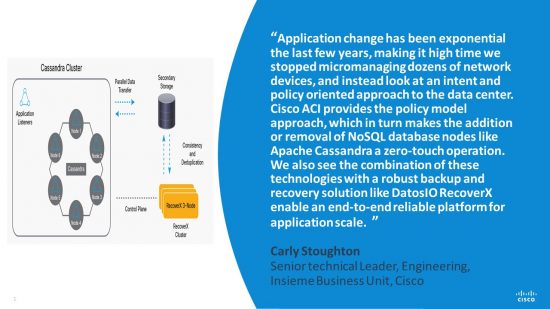
Insieme’s ACI Czar, Carly Stoughton has extensive experience in developing ACI based solutions for hyperscale applications. Carly summarizes the value-props of ACI eloquently as below in her testimonial:


Cisco ACI and Datos RecoverX with Apache Cassandra Validation/Test Environment

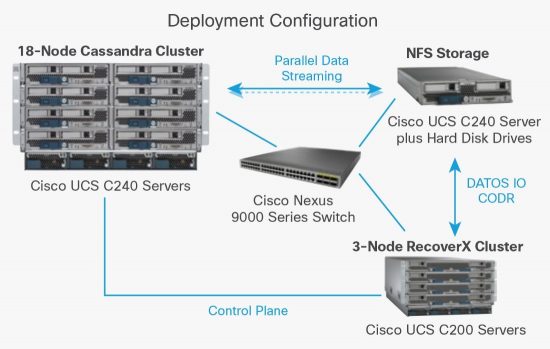
We validated the ACI-Cassandra-Datos RecoverX architecture in a production quality Lab environment.

Test Results:

Using CODR architecture that removes media-server bottlenecks, RecoverX was able to complete the initial backup of the entire cluster within 1.6 hours. This result is equivalent to about 60 TB per day of backup performance. And because of the solution’s industry-first semantic deduplication capability, only 1.4 TB of storage capacity was used on the NFS server.

Conclusion:

As more next-generation applications use highly distributed nonrelational databases such as Apache Cassandra and MongoDB, catering to the needs of the application becomes increasingly important from the perspective of the infrastructure. Insieme Business Unit will continue to lead the research and  exploration of integrated solutions featuring other web-scale solutions coupled with Cisco ACI.

Related Links

www.cisco.com/go/aci

https://www.cisco.com/c/en/us/solutions/collateral/data-center-virtualization/application-centric-infrastructure/white-paper-c11-738617.html

http://datos.io/datos-io-codr-architecture/

Authors

Ravi Balakrishnan

Senior Product Marketing Manager

Datacenter Solutions

Avatar

Over the next five years, global IP networks will support up to 10 billion new devices and connections—near tripling IP traffic growth by 2020, according to Cisco’s Visual Networking Index forecast. The proliferation of connected devices, video, and over-the-top (OTT) traffic are pushing SONET/SDH transport networks to the breaking point.

Transport networks are straining to handle the onslaught of IP multimedia traffic, and the forecasts show volumes and bandwidth demands climbing higher and higher. Repairing aging equipment in legacy transport networks is extremely expensive and difficult, as platforms such as DCSs are reaching end of life. Manual-intensive operations significantly slow a service provider’s ability to deploy, modify, and charge for services. The high costs for operations and energy are eating away at service provider revenues. With these challenges, service providers today are in need of a better transport solution that can address high traffic growth in the coming years.

The solution is transport modernization

There are a number of options for modernizing transport networks. A few examples include native TDM switching over the optical transport network (OTN), a complete overlay network with routers and DWDM, and finally migrating to packet optical using circuit emulation (CEM). Each option has value, but the value depends on the customer goal.

Leading service providers realize the need to transform their network architecture to achieve the operational efficiency, scale, and reliability needed to succeed in the digital age. In 2015 Verizon announced the next step in its transport modernization by deploying a next-generation 100G metro network in the U.S. Last year at the Optical Fiber Communications Conference (OFC), Cisco announced Verizon’s plans to deploy the Cisco NCS Series on portions of its 100G metro network, in conjunction with Cisco’s new innovations for transport modernization. We are committed to preparing this network and are pleased to assist Verizon in improving scalability, functionality and efficiency.

Before heading to Los Angeles for this year’s OFC, I caught up with Lee Hicks, vice president of network planning at Verizon, to get his perspective on Verizon’s network modernization plans. He said, “We continue to deploy 100G systems, including Cisco’s NCS Series, in high traffic areas of our metro network to optimize for higher capacity and scalability and to help meet traffic demands.”

Cisco’s innovations in optical transport networking offer a viable, cost-effective migration path for service providers to address these challenges and meet their business needs. We will continue to work with Verizon toward this transformation and delivery of new technology and services.

If attending OFC, come by our booth (#1501) or attend our sessions to hear the latest on optical networking technology. I also welcome you to read our eBook: A Roadmap for Transport Modernization.


Authors

Bill Gartner

Senior Vice President/GM

Optical Systems & Optics

Avatar

Recently, we partnered with the BBC and Western Australia’s Curtin University to discuss taking education to the world and becoming a leading 24/7 tertiary institution.

Our multi-faceted partnership with Curtin University, which reaches across teaching, learning, research and innovation, is underpinned by the digital campus.

Five years ago, the university had no collaborative classrooms. Now it has 76 – all video-enabled with cameras that are able to transmit in and out. It has also just opened its first 180-seat classroom that is completely video conference-enabled.

Chief Operating Officer Ian Callahan is one of the people who has presided over the university’s transition to being a cutting-edge university that is now truly positioned as a global institution.

“We are continually experimenting with new ways to do things, failing in some, succeeding in others, moving on to the next piece,” Callahan says.

From Cisco’s perspective, the power of digitization offers three main areas of growth which fit into Curtin’s overall perspective: the power to change student experience, the power to transform the business model/marketplace and differentiate the university in an increasingly competitive global landscape, and the power to enable greater staff productivity and engagement.

Four years ago, Curtin Deputy Vice-Chancellor Professor Jill Downie started in the position with the idea of transforming learning. She visited several universities overseas and came back with a vision of Curtin being totally globally connected. Soon after, the idea of Curtin Converged was born.

Curtin Converged is the institution’s model for teaching and learning, a mix of traditional lectures, flipped classes, technology-enriched environments and distributed learning techniques – such as Massive Online Open Courses (MOOCs), high-end video and 3D technologies that actively engage students whether they attend classes on campus or from elsewhere.

To learn more about Curtin Converged and the transformation this university has gone through, read the full article on the BBC.

Authors

Reg Johnson

General Manager, Education

Cisco Australia and New Zealand

Avatar

There is a certain value associated with getting in early, riding the wave, and then jumping ship to go to work for the next hot company. Serial startup employees assume folks that work for “large” companies like Cisco fantasize about joining an early-stage, venture-backed technology company and wonder what it would be like to trade in their badge and cubicle for a standing desk and 4PM cocktails on Fridays.

Sometimes, the “perception’ and the “reality” don’t always align.

I worked for cloud security startup CloudLock, acquired by Cisco in August of 2016. Now that I’m officially a “Cisconian”, I’m happy to report that the acquisition has surprised me in more ways than one.

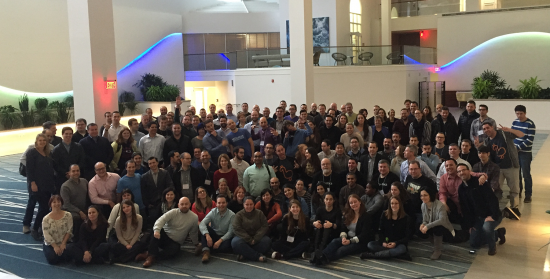
Cloudlock team

60

I joined CloudLock in July of 2014 (we were around 60 employees at the time – I know, I know). CloudLock offered everything I could ever want from an employer. The benefits in the pro column were undeniable and plentiful:

  • Fast-paced, VC-backed startup
  • “A” players, both on the executive team and throughout the company
  • Extremely hot market (cloud cybersecurity)
  • Limitless personal growth potential
  • The opportunity to work with brilliant colleagues
  • A very cool office space
  • All the fun startup perks (snacks, lunches, ping pong, beer fridge)

I worked with an incredible team. I knew everyone’s name. I knew their pet’s name. I knew what kind of ice cream they liked, where they grew up, what kind of car they drove, and what motivated them.

We worked together. We spent endless hours together. Early mornings, late nights. Team dinners. Project kickoffs, project completions, project wrap ups. Highs and lows.

I experienced the growth startups promise first hand, taking advantage of opportunities made available by the nature of the startup model and making great strides in my personal development.

The company grew. And grew some more. A year after I joined, the team had doubled in size. The cloud security (or CASB) market continued to expand – rapidly. Large, established technology companies began to express interest in building out their cloud security offering or shopping for the right company to acquire.


70,001?

On the morning of Cisco’s announcement to acquire CloudLock, I was ecstatic. I’m sure my neighbors can confirm this; I ran around, chanting, in some kind of crazed, borderline involuntary celebratory dance.

For the CloudLock team, acquisition was not simply a goal, it was an affirmation of our strategy, our work. Ourselves.

But, more important than what it was, was what it wasn’t. Acquisition wasn’t a finish line. Rather, it was yet another inflection point on an ever-steepening hockey stick (up-and-to-the-right trajectory).

However, in this brave new world, I had many questions for myself. What kind of workplace will this become? Will our streamlined nature be crushed by giant corporate bureaucracy and the dreaded “P” word (process)? Will we be able to hold onto the magic that led us to this point?

Cloudlock team

191

The reality is this: CloudLock is Cisco’s 191st acquisition. Cisco has performed so many acquisitions, they have a reputation in the market for refining the process to the point it is incredibly smooth.

Cisco recognizes the acquired company had excelled for a reason, and does not want to disrupt the success that led to acquisition in the first place. As such, Cisco affords newly acquired companies a high degree of autonomy, and my experience at CloudLock serves as a perfect example.

In short, CloudLock now boasts many of the advantages of a startup (fast-paced environment, cutting-edge technology, brilliant minds, and, yes, ping pong), coupled with the benefits of Cisco and the 70,000+ employees that proudly call Cisco home. Well, work

And all those things I mentioned about the benefits of working at Cloudlock? Now, I know that Cisco has a lot of great options too! For example, they encourage employees to take time off to give back (a great new perk), the snacks are still there, I’ve added new brilliant colleagues (70,000 more of them), I’m still in a hot market, but now with all of the resources of the powerful machine that is Cisco. We just now have more ingredients to accelerate our vision.


1

Every day, I discover something new about the Cisco universe that fascinates me. One of the most compelling discoveries? The unique contribution I felt like I brought to the table at CloudLock hasn’t gone unappreciated at Cisco. Rather, I feel as though at Cisco, I am appreciated for being myself – quirky personality and all – the same way I was at a startup.

And the same is true for my peers – their personality continues to shine in the workplace, but now the workplace is that much larger an environment for them to excel. We are not cogs in the wheel. I am not employee number 70,001. We are appreciated as individuals. But as a group – this is where we start to make a difference and an impact.

If it sounds like a happy ending to you, it’s not. This is just the beginning.

As I type this, I’m surrounded by the energizing hum of sales calls. Bob Marley is playing in the background (I’m talking deep cuts, live tracks). Half the marketing team is pouring over a spreadsheet a couple desks down from me. A few of the Product Managers are in with the Cloudlock’s CEO (I still sit four steps from his office) and they are drawing on the whiteboard with such excitement, there’s more black than white space left.

Personally, I couldn’t be more excited about the road ahead for our team. The only thing missing? It might be you.


Interested in working at Cisco? See open opportunities here.

Interested in joining the Cloudlock team specifically? For now, you can find those here. https://www.cloudlock.com/company/careers/


Authors

Michael Gleason

Product Marketing Manager

Security Business Group (Cloud Security)

Avatar

I didn’t quite appreciate it, however over the years, I’ve become a data center geek!  My job doesn’t involved working daily in a data center, but when I do get to visit one, I find the facilities and energy design principles and practices employed absolutely fascinating!

I jumped, then, when I had the chance to visit a brand new data center just over the road from my Cisco office in central Scotland.  DataVita, a new entrant to the local data center services market, are operating this brand new data center.  Three key aspects of the DataVita new build really struck me: Innovation, in energy efficiency in particular, Quality, and Design for Agility.  You can gain a sense of these by watching the virtual tour video:

Let’s now discuss how DataVita has achieved these key attributes in more depth.

Innovation

What is most impressive, in my view, is how DataVita have innovated and designed for energy efficiency. Their Power Usage Effectiveness (PUE) metric of 1.18 is very impressive.  To provide some perspective on this, the Cisco Allen data center reported at its opening in 2011 a PUE of 1.35, while Google show continual improvement in trailing twelve-month energy-weighted average PUE from 1.21 in 2008 to 1.12 over the past year.  Energy efficiency helped by use of free air cooling.  You can’t do this in many places in the world, but our often cool, mild and wet Scottish climate makes us an ideal data center location 🙂  It’s this intense innovative focus by DataVita on energy efficiency that is enabling them to offer ultra-competitive pricing for their data center services.

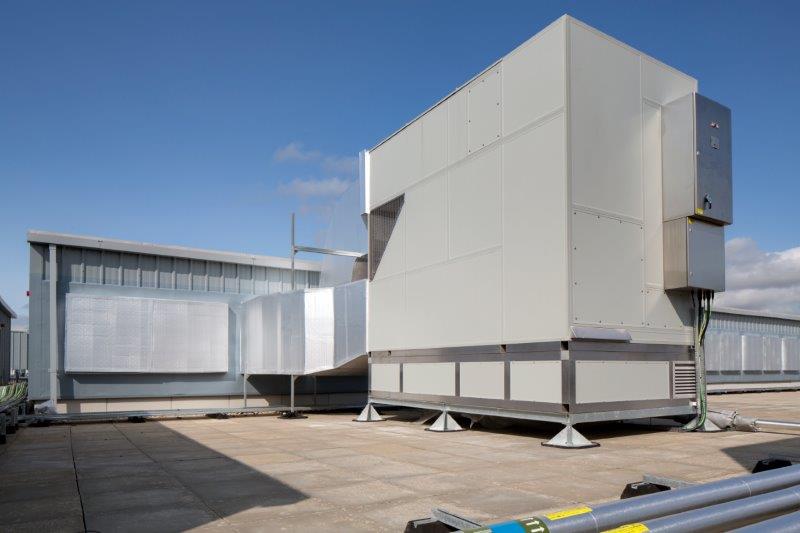
Roof-based Cooling Equipment

It is notable that they take 100% renewable energy from mains power. In the UK at least, this is tricky to guarantee, especially if you mandate that the energy supply companies provide formal certifications guaranteeing that your data center always receives only renewable energy. And the roof-based cooling equipment, supported by a specially reinforced roof which can withstand 12 Newton tonnes of equipment per square foot (!), makes particularly impressive use of space!


ACI Enabled from Day 1

Software-defined networking was an early architectural decision in the data center infrastructure design, and Cisco ACI chosen as the DataVita core SDN platform. Cisco ACI, then, is the enabler for customers to consume cloud services – public, third party and private cloud – making the DataVita data center most-definitely cloud enabled. Their Cisco ACI platform has been designed and implemented by Cisco partner Hutchison Networks – and it’s already live delivering value to DataVita customers.

Quality

For DataVita, their definition of quality, among other attributes, includes offering a 100% uptime SLA and actually being able to meet this.  It includes security built-in, physical and logical. In our discussions as we toured the plan, we discussed many aspects of resiliency and how it contributed to the overall DataVita quality ethos.

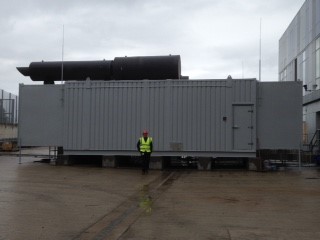
Backup Generators – with my colleague Johnny Paterson for scale

One key example is where DataVita have put in place a Tier IV resiliency design, including. N+N UPS systems (some DCs will just go for N+1 failover) – despite the fact that overall their’s is officially a Tier III facility.  However it was when we were able to see, at first hand, the size of the backup generators (see below), which protect against the unlikely even of mains power failure, that the DataVita commitment to resiliency really came though. Wow they are big, as the photo shows!

Physical security was also very impressive, unfortunately essential in today’s volatile world, as was their vehicle ‘air lock’ and their 10 (!) layers of security combined with two factor authentication to gain access to a data center cabinet.  And I thought getting into the Cisco office was tough 🙂

Agility

Reading this, you may be wondering “why not just use Amazon Web Services?” As well as innovation and quality, agility is a key benefit Data Vita have designed for.  They are very clearly targeting the local Scotland and UK data center market, where data privacy and EU regulations may require local data storage which other data center providers can’t offer.  DataVita are also thinking ahead. Their low latency services will put them in an impressive position to capture the opportunities arising from both Scotland’s 5G infrastructure rollout and planned support for autonomous cars.

Agility has been designed in to both technology and processes. As well as being Cisco ACI-enabled, DataVita even provide on-site customer build rooms to help customers who choose to host their own data center equipment in the DataVita facility, adding to their overall value proposition around delivering customer agility.

Wrapping Up

All in all it was a fascinating tour of this future-proofed data center.  Please do take some time to view their virtual tour.  Finally, you can find out more about DataVita on their web site and in their topical blog.


Authors

Stephen Speirs

No Longer at Cisco

Avatar

In my previous blog in this series, I shared the key components needed for an Innovation Funding Board (IFB) to function effectively, including the importance of establishing what success will look like at the outset. Now, I’ll break down the innovation process itself—and the key stages needed to take a great idea from initial inception through to full implementation.

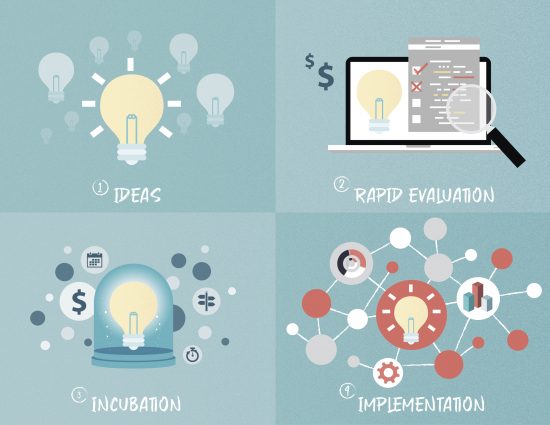
There are many ways that the innovation process can be approached, depending on the ultimate goals of those involved. The method described in this blog uses a build/test/learn approach to encourage a lean startup mentality amongst project teams. There are four main phases involved: Ideas; Rapid Evaluation; Incubation; and, finally, if a project is successful, Implementation.

 As a project moves between phases, its accompanying business plan will undergo continuous refinement until it’s completed, de-risked, and ready for implementation at the end of the process. Let’s look at each phase in a little more detail:

 The starting point for any new project is the Ideas phase, where the innovation venture teams consider longer-term ideas and shape them into meaningful concepts for the IFB’s consideration. Input at this stage can come from many sources, including strategic organizational priorities, customer insights, co-creation opportunities, and more.

Any project proposals deemed good enough by the IFB to warrant further exploration move to phase two: Rapid Evaluation. At this stage, initial funding is granted, buying the venture team a limited period of time (usually two to four weeks) to stress test the core concepts and establish whether it’s a good idea or a great idea. Peer reviews will often take place in the rapid evaluation phase, as well as low-fidelity testing of killer issues. Ideas deemed to be merely good should be killed at this stage to make way for truly great ideas.

Projects that make it to the Incubation phase have been thoroughly stress tested and proved to have significant commercial viability. At this stage, the first funding tranche is made available to the venture team and an experimental plan is agreed on with the IFB. It’s then down to the venture team executing against the agreed on plan and deciding how and when to return to the IFB for progress reporting and further funding. At any point during this phase, the team and IFB can decide to pivot based on new learnings, persevere with the current project direction, or kill and celebrate learnings made.

Finally, if the IFB approves the project for full Implementation, it will transition out of the IFB process to standard governance processes used within the wider organization.

A Note on the Importance of Ongoing Evaluation

Throughout the entire IFB process, the importance of ongoing evaluation cannot be overstated. Not only does it allow for accurate measurement of the quality of the idea, but it also helps to ensure the innovation process is being followed properly at all times.

There are many ways evaluation can be done, from scoring of opportunities against pre-defined metrics to tracking key variables such as the number of hypotheses developed, or customer engagements taking place. Whichever methods are chosen, evaluation should be both thorough and regular.

In my last blog of this series, I’ll share the important final considerations to think about before implementing an IFB and summarize key learnings that can help every organization get its innovation back on track.


Authors

Matt Asman

Innovation Manager

Services Innovation Excellence Center (SIEC)