Avatar

Unless you were living under a rock or holed up in a bunker, you most likely saw the video of the professor doing a live interview with the BBC from his home office when his kids stole the spotlight.

My husband was the first person to show it to me and I immediately related on so many levels. As a former television news producer, I know the pitfalls of live TV, and as someone who now works from home a couple of days a week, I’ve had my kids make unexpected appearances during TelePresence meetings.  All that being said, I can’t imagine not using all of the collaboration tools that are now at my disposal.

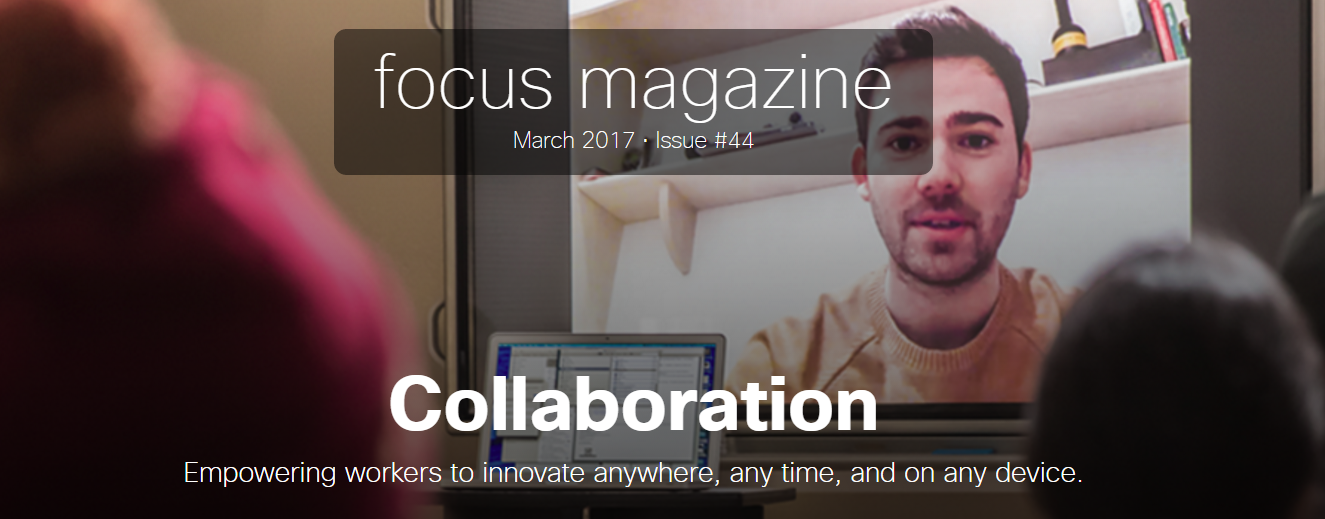
This month’s Focus Magazine is all about collaboration, and one of the stories comes from another family that can relate with juggling work and family. You’ll meet Cecilie Sindum and her husband, parents of TWO sets of twins, who use Spark Board to help them run their design business and manage their life at home.

We’re just at the tip of the iceberg when it comes to cutting edge collaboration tools. Cisco Senior Vice President of IoT and Applications, Rowan Trollope, and his team are constantly pushing the envelope when it comes to creating new and exciting technology in the collaboration space. He’s a guy who lives and breathes innovation and in our Q&A with Rowan, you’ll learn why he thinks a career in tech was his destiny.

Cisco continues to look for new collaboration ideas and is putting big money behind it’s mission, with a $1 million-dollar investment to an enterprise accelerator.

While Rowan and his team continue to innovate and Cisco continues to invest in startups, Monica Zent, an attorney and entrepreneur offers some great insight on how to create a culture of teamwork and not just buying into the latest fad. She’s spent a career collaborating with other attorneys and is a pro at using the tools that are already available, tailoring them to fit her needs.

The now famous BBC dad may have given all working parents a chance to laugh out loud at the challenges of work life balance, but he also showed the importance of collaboration tools. I’m excited about the great work Cisco is doing to make that balance a little easier.

Happy reading and collaborating!
 

Authors

Liza Meak

Social Media Communications Manager

Global Corporate Communications

Avatar

For those of you who know me, you know that I’ve dedicated much of my career to the development of Internet standards. The Session Initiation Protocol – RFC 3261 (SIP) was part of joint research I did with Professor Henning Schrulzrinne at Columbia University beginning in 1995. And after 20 years, SIP has grown to become the foundation of modern telecommunications. SIP has helped create new markets for new products, it has created jobs for people to build and support systems based on it, and it has helped connect people all over the world. I’m very proud of this work, both personally and professionally.

Standards like SIP are hugely important to Cisco, Cisco’s collaboration products, and to our newest platform, Cisco Spark. The vast majority of deployments of voice and video within enterprises today are full of products from multiple vendors. In order for them to work together, SIP and its related standards are essential. The cornerstone of Cisco’s collaboration portfolio – Cisco Unified Communications Manager – has supported SIP for over a decade. And it’s widely used for connecting to other vendors’ products, as well as interconnecting multiple clusters of our own product.

While we are in many ways in what is called the “post-standards era,” there are many areas where application-layer standards like SIP remain essential even as IP communications moves to cloud. Indeed, SIP interop exists all across our cloud products. WebEx supports SIP-based dial-in and dial-back for video meetings, and this capability is seeing huge growth each day. Cisco Spark supports SIP-based calling, giving every user – free and paid – a SIP URI with which they can make and receive calls from other users outside of Cisco Spark.

SIP and related standards are built in the Internet Engineering Task Force (IETF), which has oversight of the technical operations of the Internet. The IETF has been the birthplace of countless technologies – like SIP – that have made the Internet what it is today. IP, TCP, HTTP, SMTP, DNS, DHCP – protocols that every network-savvy engineer knows – were all created by the IETF. The IETF has been around since 1986, long before most people had even heard of the Internet.

The IETF’s continuing importance to Cisco and Collaboration is why – in part – I’m really excited that our own Alissa Cooper has been named as the ninth chair of the IETF. Alissa has a long history of contributions to the IETF, serving most recently as the area director for the set of working groups that produce real-time communications protocols like SIP. Alissa, who was recently appointed to Cisco’s top technical rank of Cisco Fellow, takes the IETF reins in an exciting time. Areas like IoT, SDN, and NFV are requiring significant attention and making big impacts on the industry.

With the IETF in her hands, we can all rest assured that the Internet will continue to grow and expand for the benefit of all.

Read this Q&A with Alissa Cooper about her new role in the IETF.

Authors

Jonathan Rosenberg

Cisco Fellow and Vice President

CTO for Cisco's Collaboration Business

Avatar

Hello all,

Here is a quick note to announce the 3rd and final week’s winner: John Wieser, from Auburn, Washington!

Congrats John! Mr. Wieser was shipped a Cisco Shirt, Backpack and Journal along with a Cisco RV Series Router.

Stay Tuned for more information on the next contest.

Of course – more blogs to come!

Marc

Authors

Marc Nagao

Product Manager

Small Business RV Series Routers

Avatar

The post was authored by Sean Baird, Edmund Brumaghin and Earl Carter, with contributions from Jaeson Schultz.

Executive Summary

The Necurs botnet is the largest spam botnet in the world. Over the past year it has been used primarily for the distribution of Locky ransomware and Dridex. Earlier this year, we wrote about how the Necurs botnet went offline and seemingly disappeared, taking most of the high volume Locky malspam with it. Talos recently identified a significant increase in the amount of spam emails originating from the Necurs botnet, indicating that it may have come back to life, but rather than distributing malware in the form of malicious attachments, it appears to have shifted back to penny stock pump-and-dump messages. This is not the first time that Necurs has been used to send high volume pump-and-dump emails. In analyzing previous telemetry data associated with these campaigns, we identified a similar campaign on December 20, 2016 shortly before the Necurs botnet went offline for an extended period. This strategic divergence from the distribution of malware may be indicative of a change in the way that attackers are attempting to economically leverage this botnet.

Read More >>

Authors

Talos Group

Talos Security Intelligence & Research Group

Avatar

We’ve reached a tipping point in education. Students have unique needs and require new models for learning that keep them engaged and allow them to learn at their own pace. Curriculum is becoming more personalized and can happen before, during and after school—anytime, anywhere. Adaptive assessments and curriculum make it possible to know where each student is on their path. We have an unprecedented opportunity to address their unique needs and connect them to the world beyond their traditional school or community.

An eSchool News special report highlights Mooresville Graded School District in North Carolina and McAllen Independent School District in Texas. Mooresville uses an all-digital curriculum to create more personalized, student-centric, data-driven approaches to teaching and learning. Former superintendent Mark Edwards states, “It’s rare that you see whole-group instruction anymore. What you see is small-group collaborative work, where students are developing expertise working in teams.”

McAllen has provided students with iPads, which has led to a rise in student engagement and a shift toward inquiry-driven, project-based learning. “Students are finding information without the teachers holding their hand,” said Ann Vega, Director of Instructional Technology. As a result of these efforts, elementary reading scores are on the rise and McAllen’s three comprehensive high schools are ranked among the best in the nation by Newsweek.”

Get Started with a “Journey Map”

Beginning a digital transformation can be daunting. Before you start, you need to have a clear vision for what you hope to accomplish with technology and how it will transform teaching and learning. Technology investment must carry clear value over time. Future-proof technology can be supported by new sources of funding, lower costs, and can be leveraged in both the classroom and operations.

Cisco can help you begin your journey using a “Journey Map” approach. Our Cisco Education Team will partner with you to chart your school district’s journey toward your desired future state. If you are interested in learning more about the Cisco Journey Map engagement process, contact us at psjourneymaps@external.cisco.com.

Funding Your Digital Journey

There are many funding resources to help schools finance a digital upgrade. They include E-rate funding to close the Wi-Fi gap and provide access to high-speed broadband, Cisco Capital financing for Education, and Cisco’s Public Funding Office to help you navigate the funding and grant process for digital learning initiatives.

There’s never been a better time to reimagine education.


Avatar

Posting this blog on behalf of Babi Seal, Senior Manager, Product Management, INSBU, who has been driving  BGP EVPN based solutions in the datacenter.

Digital disruptors have challenged established business models by creating new ways of engaging with customers in real-time to better serve the changing customer needs. To maximize revenue and maintain customer interest, businesses must transform.

Cisco has been innovating all aspects of IT, enabling customers to move faster, handle ever-increasing traffic loads, and deliver the applications and services needed to grow and be competitive. Cisco’s Nexus 9000 family of switches provides key innovations and sets the stage for the new era of digital transformation. Some of these innovations include:

  • Cloudscale ASICs
  • ACI for policy and automation
  • Tetration for visibility and security
  • Control plane enhancements with BGP/EVPN
  • Common orchestration plane and fabric OAM for management and serviceability

EVPN with Cisco Nexus 9000 continues to mature

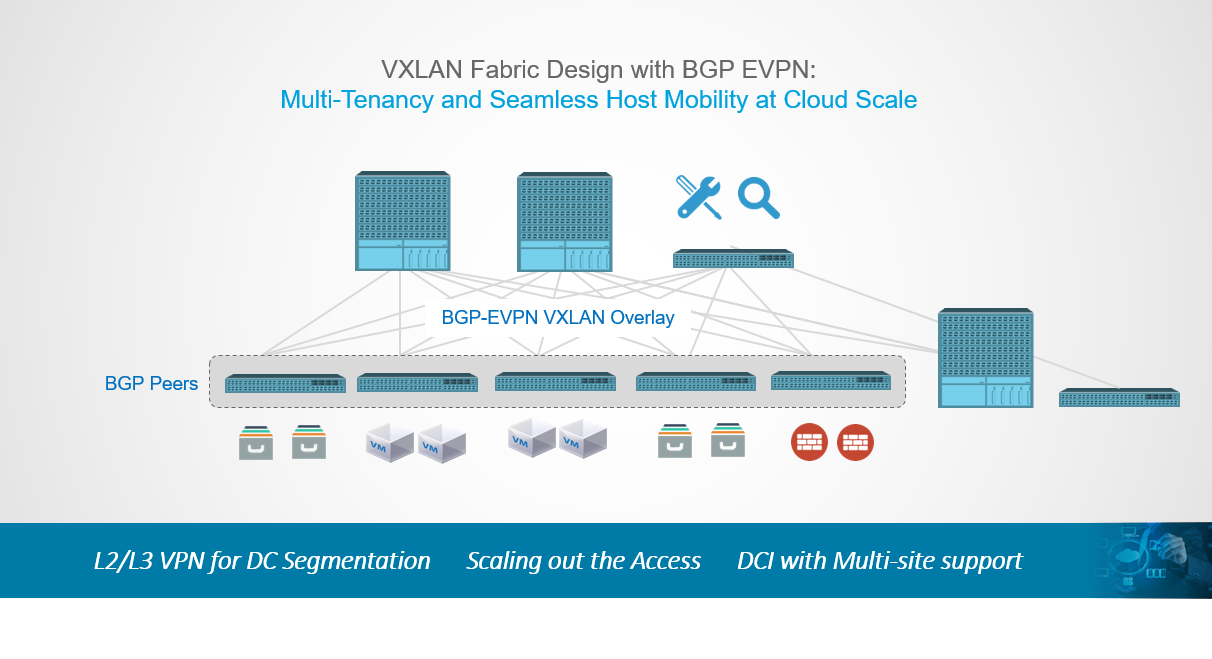
This month Cisco is noting the two-year anniversary of our launch of the BGP EVPN Control Plane for VXLAN on the Nexus 9000 family of switches. The BGP EVPN control plane is designed to address multi-tenancy, scalability and workload mobility requirements for modern data centers. The Nexus 9000 was the first switch in the market to support VXLAN routing, thereby enabling customers to push out their L2/L3 boundaries to the access layer in the datacenter. By employing the EVPN control plane to distribute reachability information and realizing a distributed IP Anycast Gateway, optimal layer 2 and layer 3 forwarding is achieved by disaggregating the necessary forwarding state.

Customer Adoption success 

Since our launch, more than 100 Cisco customers in the enterprise and service provider space have deployed the VXLAN EVPN solution; some in very large fabrics comprising hundreds of switches. This market traction is important as VXLAN is the de-facto standard for overlays in the industry. Cisco has focused on developing BGP EVPN as the control plane for VXLAN by co-authoring and driving multiple IETF drafts toward standardization. As we speak, several of these drafts are in last call and are about to become IETF RFCs. Driving customer adoption paired with innovation and driving the standards bodies, the VXLAN EVPN ecosystem has expanded from just three to more than 10 in a span of just two years.

Continue reading “Cisco BGP EVPN in the datacenter”

Authors

Tony Antony

Marketing

Solutions

Avatar

The Data Center Interconnect (DCI) segment can be a difficult one to analyze across equipment vendors. Over-the-Top (OTT) providers are not always eager to advertise the architectures of their newest data centers, describe their DCI strategy or their vendor choice(s). Telcos similarly are either building new data center interconnects or adopting new data center technologies. Calendar year 2016 provided some notable changes to the DCI sector and probably had one of the largest technology shifts. Here’s what you need to look for heading into OFC’17.

Solution Scale

Speed matters. That has been the case in DCI for some time now. For DCI, high density optics across a range of optical reach variants is critical to optimize the DWDM network design. Pluggable optics and stackable systems are the DCI system architectures of choice for scale and flexibility and they are correspondingly two of the core tenets of the Cisco NCS 1000 product family. The NCS 1000 delivers on data center form factor and environmental performance. Data center operators are no longer leveraging Telco form factor products in their networking environments with the plethora of these new pizza box form factors that are now available.

https://youtu.be/rKpgAK-2_do

Operational Efficiency

Have you seen the ACG report on Multi-layer SDN? I’m not pointing this out because Cisco is leading the field, but rather because data centers thrive on these types of demand shifts. Shifts in traffic demand can really wreak havoc on a the IP and optical network if you don’t have the multi-layer tools to cope. Service assurance and continued network re-optimizations are just as important as the provisioning or multi-vendor orchestration requirements of data center operations.

Network Integration

The physical networking portion of DCI is built on peering routers and optical transport. Until now these networking elements have run on disparate operating systems. Legacy network management systems and orchestration solutions have delivered the translations necessary to operate in a multi-vendor and multi-OS environment. What if the routers and the optical transport devices just ran the same OS? What if they used the same YANG data models to communicate their service constructs? Now consider the physical, virtual and hybrid networking opportunities in a data center. The importance of network integration and streamlining network telemetry continue to grow. Cisco’s NCS 1000 series and NCS 5000 series run on IOS XR, the same operating system Cisco high-end routers use.

Most optical networking vendors don’t have a real routing portfolio, only some Layer 2 devices or aggregation cards. Some optical networking vendors don’t even have a DCI platform, choosing instead to focus on long haul. Once you add in some of the highly publicized layoffs and the merger activity in the optical market you see that we are at a crossroads.

Who will you trust your future data center interconnect to? Choose wisely and do your homework at OFC this year.

At Cisco we’re working to simplify, automate, and virtualize the network. Come check us out at OFC Booth #1501, ask to see the DCI demo and see our vision in action.

Look for more announcements here!

Authors

Greg Nehib

Senior Marketing Manager

SP Infrastructure

Avatar

As we head to MPLS + SDN + NFV World Congress this week, I’m reminded of conversations I have with Service Providers all the time.  They tell me how they need complete solutions to meet their business needs, not just a slice of a technology stack.  They tell me they want software that supports an end-to-end architecture that is tightly integrated with their OSS/BSS systems, and runs on a full range of hardware. And, they want it to be simple to implement and easy to use.

That’s exactly what we created with Cisco IOS XR.  More than 150 service providers – including some of the biggest web players around the world – have deployed our next generation containerized/virtualized IOS XR, which is the richest networking stack available on the market, with industry-leading innovations in IP transport (Segment Routing), IPv6, Services (EVPN), Visibility (Streaming Telemetry), Security (MacSec), Programmability (Yang), 5G (clocking/synch) and a whole lot more.

Our IOS XR has three main areas of innovation:

  • Unparalleled silicon diversity, running on world class Cisco ASICs as well as merchant silicon
  • Cloud-scale automation, with performance, model-based interfaces for software-centric operations
  • Next-generation network architectures, with common design patterns that Service Providers can apply to leverage unified network fabric  from  data centers, central offices, and across multiple domains in metro and core networks

An example of this innovation is IOS XR’s support of Linux containers, which we delivered back in 2015 with IOS XR 6.0.  We architected our IOS XR software stack to run in containers and provide support for customer and third party applications in containers too, which is possible because the software distribution supporting IOS XR is based on Open Embedded Linux. At the same time, we aligned our deployment and automation capabilities with industry standards (Netconf/gRPC) as well as server workflows (iPXE, ZTP, Ansible, Chef, Puppet and more). In fact, we demonstrated IOS XR running as part of a Mesos Cluster at MesosCon 2015.

We also made sure IOS XR is available on Cisco and merchant silicon across a wide variety of hardware platforms, ranging from 1 RU to multi-chassis systems.  It runs in a virtual form factor on general x86 compute platforms with the full feature set and a high-performance data plane. With support for physical and virtual, IOS XR gives Service Providers  real choice in their designs, while offering a common operational experience end-to-end.  We are also laser focused on making our software easy to use and implement.  We are designing with ruthless ease in mind.  You can read more about full IOS XR capabilities on https://xrdocs.github.io or follow @xrdocs on twitter.

I’m so proud of our team for their continual innovations in software that launched the industry to new heights back in 2015 and still far outpaces anything on the market today.

If you are attending MPLS+SDN+NFV World Congress make sure to register for the event online for  Cisco’s workshop to learn more about IOS XR and meet our experts.


Authors

Yvette Kanouff

Senior Vice President/General Manager

Service Provider Business

Avatar

The term web-scale has been with us just a few years. Mainly referring to managing a data center infrastructure with capabilities to scale in size, speed and agility, it has usually been associated with large cloud service firms such as Amazon, Facebook, Google, Netflix.   It has not been associated with communications service providers.   However, these very same service providers need such capability to address the challenges of digital transformation happening now across all industries and countries.

Enter Jio-Scale

India’s population is greater than 1.3 billion and increasing at a rate about one person every two seconds.  It’s purchasing power parity (PPP) ranks at 106th in the world according to the World Bank.  Such challenges create innovation opportunities for a forward-looking service provider.

Reliance Jio (Jio) embarked on a journey to enable the vision of Digital India. This vision included propelling India into a global leadership role. Jio transformed the Indian digital services space by creating an eco-system of network, devices, applications and content, service experience and affordable tariffs for everyone to live the Jio Digital Life.

Essential Partnering

Jio partnered with Cisco to build a first-of-its kind, 5G-ready network. It is the largest all-IP, multi-Terabit capacity network in India.  Jio enables massification of infrastructure services such as broadband connectivity, mobile video, and high quality communications, thereby digitizing industry verticals, such as education, healthcare, security, financial, and government services.

The Jio all-IP digital platform is a result of co-innovation in product and services between the two companies. It is built on Cisco’s Open Network Architecture and Cloud Scale Networking technologies.  These feature IP/MPLS and span Data Center, Wi-Fi, Security and Contact Center solutions.

Jio-Scale by the Numbers

Jio has on-boarded 100 Million 4G subscribers in a record span of 170 days! This is about 7 subscribers per second! This has set a new bar for the industry worldwide that underscores the company’s scale, efficiency, and speed.

Within the same timeframe, Jio’s network traffic has surpassed US mobile Internet traffic volume. It is ten times the Internet capacity of the world’s largest providers.  Jio has driven India’s monthly user data consumption to increase 40 times since service launch.  It is now the highest data consumption per subscriber in the world.

Jio is delivering broadband services at the lowest cost per GB globally.

Free Voice Calls

Built on this all-IP network, Jio has revolutionized the Indian mobile communications landscape. Jio offers voice calls to Jio customers absolutely free, across all of India, to any network, any time, for life.

Find out More

Hear it straight from Jio’s President, Mathew Oommen, in this video interview – Working with Reliance Jio to Digitize India.

I also interviewed Jio’s Tareq Amin, Senior Vice President, technology Development and Automation in this video – Building the World’s Largest All-IP Network.

You can also learn more in this case study and press release.

How will you achieve Jio-Scale?


Authors

Sanjeev Mervana

Vice President of Product Management

Emerging Technologies & Incubation