Avatar

Globally, mobile data usage and traffic are on the rise. As a result, mobile network operators (MNOs) are adjusting their offers and billing structures to accommodate user behaviors. More than a quarter of plans tracked in the third quarter of 2016 had allowances of 10 Gigabytes and above according to Ovum Informa Telecoms and Media. At the same time, Ovum tracked a smaller share of unlimited plans – a share that was small to begin with and was only 2% in 3Q16. And this figure may increase in 2017 with the reintroduction of unlimited plans in the US.

For several years, it seemed like the US mobile operators were steering clear from unlimited plans. It caught many industry experts by surprise when Verizon wireless brought back unlimited plans in February 2017, with the Verizon Unlimited offering. The offer includes HD video streaming, with 10GB of LTE data and unlimited 3G data after that for mobile hotspot usage. Industry watchers also doubted that Verizon’s move to join T-Mobile and Sprint in offering unlimited data would have a significant impact on the market. Very few anticipated that AT&T would extend its unlimited plan offer beyond its DirecTV customers – the only customers AT&T was offering unlimited data to at the time. However, within three days of Verizon’s unlimited offer announcement, AT&T’s new offer seemed to have a domino effect. A new price war ensued with T-Mobile and Sprint announcing similar unlimited data plans.

The fight over which cellphone carrier has the best unlimited data offering isn’t over. AT&T announced on March 12th that it is debuting two new unlimited plans this week — one, a no-frills option that tries to undercut its rivals on price; and the other, a more expensive plan with all the bells and whistles. The no frills $60 GoPhone plan offers 3 Mbps maximum wireless data speeds, doesn’t include Mobile Hotspot support. Reaching the 22 GB monthly data cap reduces download speeds to 128 Kbps for the rest of the monthly pay cycle. Stream Saver, AT&T’s mode for downscaling videos to 480p quality to use less bandwidth, is enabled by default. Meanwhile, T-Mobile increased its soft cap to 28 GB per month.

All of the plans offered have reduced speeds and deprioritization of traffic after reaching their soft cap (depending on plan details). All four carriers have soft caps that range from 22 GB to 28 GB per month. Bottom-line, there are limits – but not as costly to the customer as tiered plans once the caps are met.

Shared data plans and tiered plan offerings remain competitive in terms of price offerings but the impact of the reintroduction of unlimited plans on mobile traffic usage is yet to be seen.

Total global mobile data traffic is expected to grow to 49 exabytes per month by 2021, a seven- fold increase from 2016, according to the Cisco Visual Networking Index (VNI). Mobile data traffic will grow at a CAGR of 47 percent from 2016 to 2021.

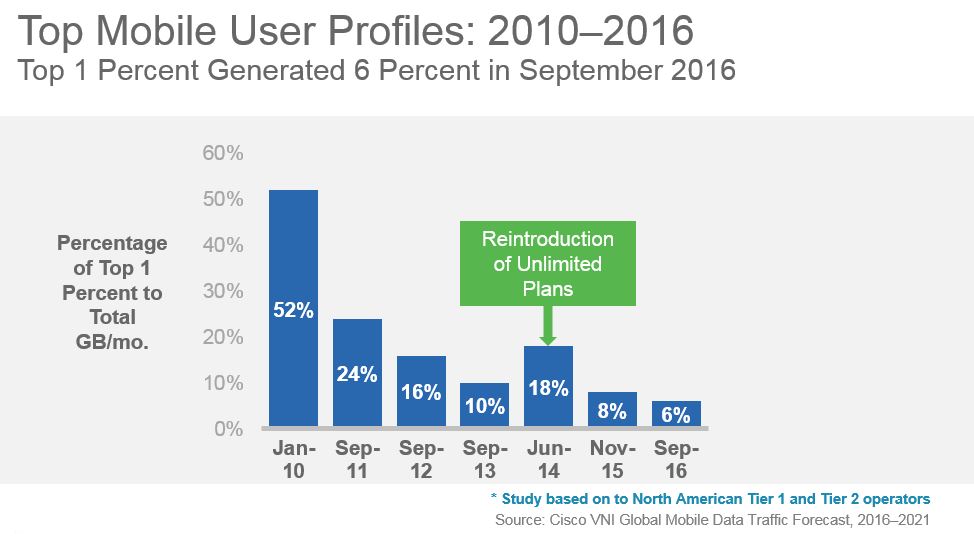
Operators have however historically managed to throttle heavy data users. As a part of the tiered pricing study within the Cisco VNI Forecast, the usage per month of the average top 1 percent of mobile data users has been steadily decreasing compared to that of overall usage. At the beginning of the 6-year study, 52 percent of the traffic was generated by the top 1 percent. With the reintroductions and promotions of unlimited plans by tier 2 operators in the study, the top 1 percent generated 18 percent of the overall traffic per month by June 2014. By September 2016, just 6 percent of the traffic was generated by the top 1 percent of users, showing that operators managed to mitigate the increase in traffic generated by the top 1 percent users.
This phenomenon has not spread beyond the US except in a few pockets around the world, but it is a hot topic of discussion. For example, this year in Malaysia, Webe offered a no-contract postpaid plan with unlimited data, voice, and text, aggressively priced at $18, as a competitive measure.

Similarly, in Taiwan, T Star differentiated on price and through unlimited data in order to gain market share. The three strong incumbents in Taiwan and a new challenger launched promotional unlimited LTE data plans in response.

In India, Reliance Jio announced (March 2017) an unlimited data plan with no daily data cap restrictions along with several other lower priced unlimited plans with daily data usage restrictions. In response, its competitors Airtel and Vodafone have offered other value-added services such as unlimited voice, doubling of data, etc.

After years of tapering growth, mobile data traffic growth in South Korea accelerated in 2016, largely due to unlimited plans (and inspite of broadly available Wi-Fi access).

It should be noted that mobile operators are continuing to offer tiered plans. These offers can be particularly differentiated at lower usage tiers (and lower price points) compared to the unlimited plans. This alternative remains attractive to some customers.  Realistically, carriers can’t offer only unlimited data plans – that approach could oversubscribe mobile networks and overtax spectrum limitations. There is also the major consideration that increasing infrastructure costs require commensurate revenue uplifts for long-term sustainability and profitability. Wi-Fi continues to be a viable and in many cases necessary offload alternative for dual mode devices.

The high level of competition among established MNOs is expected to continue on many fronts. There is now also a wider pool of new competitors. Alternative communication technologies, such as instant messaging services that use data rather than traditional voice and text, are increasingly used by mobile consumers. So, what will be next for operators after the unlimited plans race and alternative communication technologies? With 5G on the horizon, I think we can expect more mobile makeovers in the future. The good news is that there should be something for everyone. From IoT applications to Tactile Internet experiences, creativity will be at the forefront. And hopefully, many of us will be able to afford tomorrow’s innovations.

 

Authors

Usha Andra

Leader, Product Marketing

Data Center and Cloud Networking

Avatar

Today, we released the first Cisco IOS & IOS XE Software Security Advisory Bundled Publication of 2017. (As a reminder, Cisco discloses vulnerabilities in Cisco IOS and IOS XE Software on a predictable schedule—the fourth Wednesday of March and September in each calendar year).  Today’s edition of the Cisco IOS & IOS XE Software Security Advisory Bundled Publication includes five advisories that disclose vulnerabilities in the following technologies:

  • DHCP client
  • Layer 2 Tunneling Protocol (L2TP)
  • Zero Touch Provisioning
  • Web framework
  • Web user interface

This bundled publication is the first that uses Version 3 of the Common Vulnerability Scoring System (CVSSv3), which is the latest version of this industry standard. CVSSv3 allows vendors to better analyze the impact of security vulnerabilities and more clearly define the urgency of response for customers. For more information, see the announcement from my colleague, Omar Santos. Other than this change, today’s publication should feel fairly familiar.

Make sure you take a look at the Cisco Event Response—our go-to document that correlates the full array of Cisco Security resources for this bundle, including links to the advisories, CVSS scores, Security Impact Ratings, and OVAL and CVRF content. And don’t forget about the Cisco IOS Software Checker, the quickest way to determine your exposure to vulnerabilities disclosed in this advisory bundle and to identify the earliest release (“First Fixed Release”) that corrects all the vulnerabilities described in a particular security advisory. Cisco updates the Software Checker data daily to include the most current information. And, as you may recall from the last bundled publication, the Software Checker now supports queries for Cisco IOS XE Software releases. You asked for this functionality and we listened.

As the project manager who oversees the management and delivery of these bundled disclosures, I have unique insight into the level of effort and collaboration involved—a dedicated team of incident managers, a variety of partner organizations, special tooling, months of preparation, and thousands of communications. All of these come together to deliver a bundled disclosure on the fourth Wednesday of March and September each calendar year.

Cisco PSIRT is committed to improving our disclosure processes to meet your needs. We hope the publication timeline, enhanced tooling, and additional “bundling” help your organization plan and ensure resources are available to analyze, test, and remediate these vulnerabilities in your environments. Please let us know in the comments below. We take your feedback seriously!

The next Cisco IOS & IOS XE Software Security Advisory Bundled Publication is scheduled for September 27, 2017. Mark your calendars now. And don’t forget—for all things security, visit the Cisco Security portal, the primary outlet and home for Cisco security intelligence content.

Authors

Erin Float

Project Manager

Security Research and Operations Group

Avatar

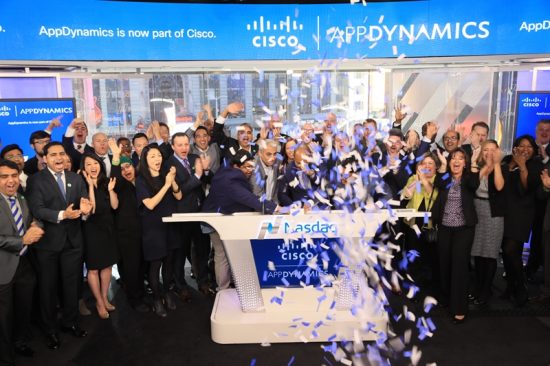
Today, I had the sincere honor to stand with leaders of AppDynamics to ring the Nasdaq opening bell. I can now say that AppDynamics and Cisco are one team. In ringing the bell, we celebrated the amazing company that the founders and leaders of AppDynamics created as well as a new era of innovation that Cisco and AppDynamics will create together. The talented team at AppDynamics, along with their industry-leading software technology, provides an amazing extension to Cisco’s strategy and transformation.

AppDynamics is helping solve numerous challenges for companies by providing real-time visibility into the performance of applications as well as business analytics that are increasingly critical in the digitizing enterprise. No other player in the industry is delivering these insights more effectively than AppDynamics.

The acquisition of AppDynamics is part of Cisco’s broader strategy to drive growth for the company, our customers and our partners. Through acquisitions, strategic partnerships, investments, co-development and internal R&D, Cisco is better able to anticipate, capture and lead market transitions. AppDynamics is special for a number of reasons. It is the largest acquisition we’ve announced since Cisco’s new leadership team was announced 22 months ago. At the time of the IPO, AppDynamics was on track to be the fastest growing publicly traded company in the enterprise software space. AppDynamics represents a great step forward in both our digital transformation and that of our customers and partners. Combining AppDyanmics’ unparalleled analytics with Cisco’s incredible global reach will enable us to accelerate AppDynamics’ success and broaden Cisco’s software offerings, a key area of investment and growth for us.

AppDynamics accelerates Cisco’s push to bring further software and network relevance in Hybrid Cloud, as well as drive our transformation to greater percentage revenue from recurring revenue and subscription models. With AppDynamics, Cisco will provide unprecedented visibility into the performance of customers’ applications as they move them from private cloud to public cloud and multicloud environments. This, together with Cisco’s analytics at the network and datacenter layers, provides market leading differentiation for Cisco. I am excited about the value that this acquisition will deliver to Cisco’s customers, partners and investors. We are proud to welcome AppDynamics to the Cisco team.

Authors

Hilton Romanski

No Longer with Cisco

Avatar

[Blog authored by Aaron Weis and Samuel Wigley]

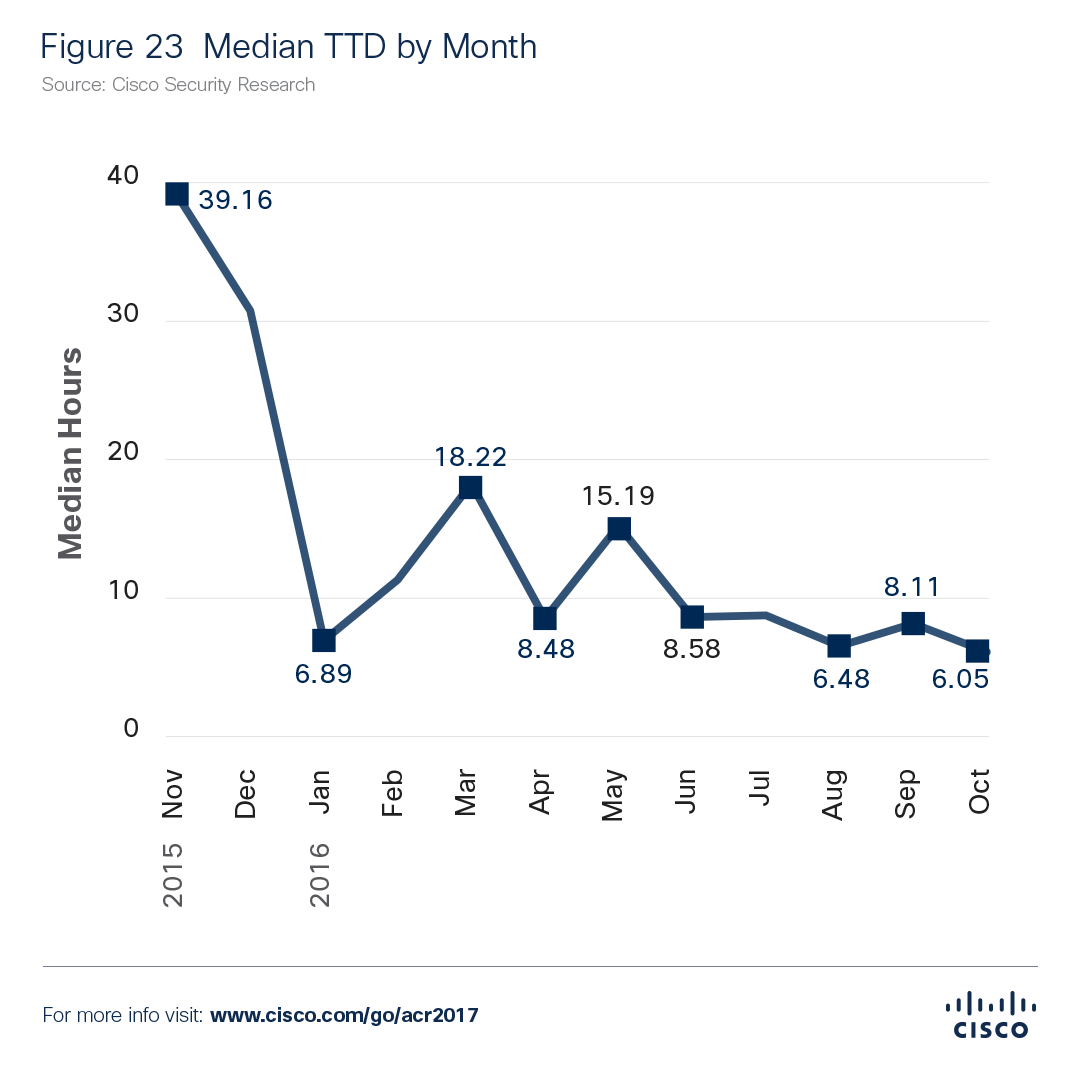
Cisco has been measuring our security products’ median “time to detection” (TTD) — the window of time between a compromise and detection of a threat — since 2015. This exercise is a way for us to benchmark our progress, and continually refine our approach, to detecting threats.

Tracking TTD over time also helps to highlight the constant struggle between defenders and adversaries (see chart below). When adversaries launch new threats, the median TTD increases. Declines in TTD indicate points when security researchers have gained the upper hand.

Cybercriminals use various obfuscation techniques to keep their malware strong and profitable. That means many of the “new” threats that researchers encounter are actually fresh versions of old and known threats. To better understand how adversaries help malware to evade detection and continue to compromise users and systems, we sought to measure “time to evolve” (TTE). This research is highlighted in the Cisco 2017 Annual Cybersecurity Report. From November 2015 through October 2016, we closely examined a select group of well-known malware families to see how adversaries employ two specific tactics: evolving payload delivery types and quickly generating new files (to defeat hash-only detection methods). Our threat researchers looked for changes in file extensions delivering the malware and analyzed the file content (or MIME) type as defined by a user’s system.

By analyzing web attack data from various Cisco sources — web proxy data, cloud and endpoint advanced malware products, and composite antimalware engines — we can measure the time it takes adversaries to change the way specific malware is delivered. We can also measure the length of time between each change in tactics.

For each malware family included in our study, we examined patterns in both web and email delivery methods. We also tracked the ages of unique hashes associated with each family to determine how quickly adversaries are creating new files. Through our research, we learned that:

  • Each malware family has a unique pattern of evolution
  • The examined ransomware families appear to have a similar rotation of new binaries
  • Some malware families employ only a handful of file delivery methods; others use 10 or more
  • Adversaries tend to use effective binaries over long periods
  • Frequent file changes indicate that malware authors are under pressure to switch tactics

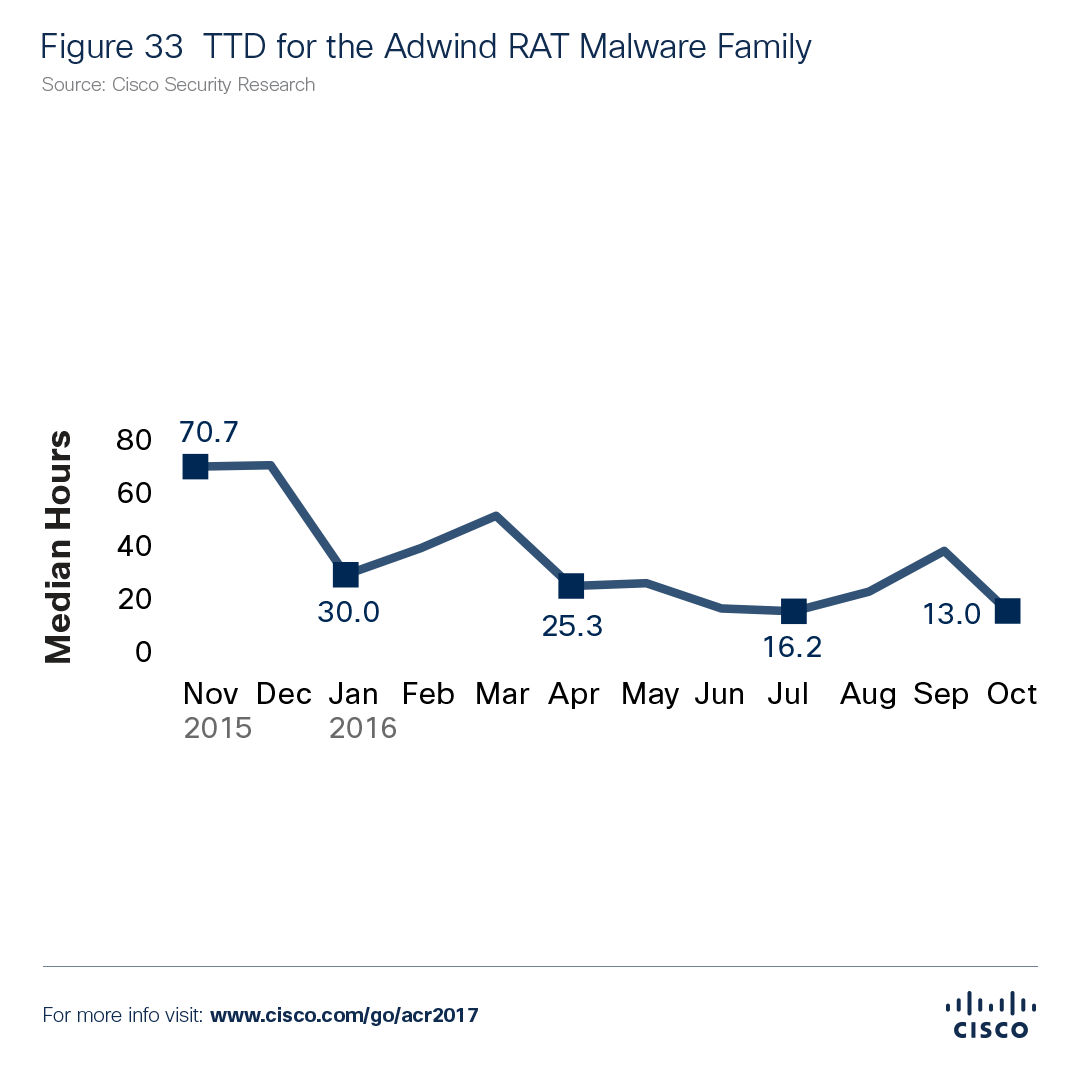
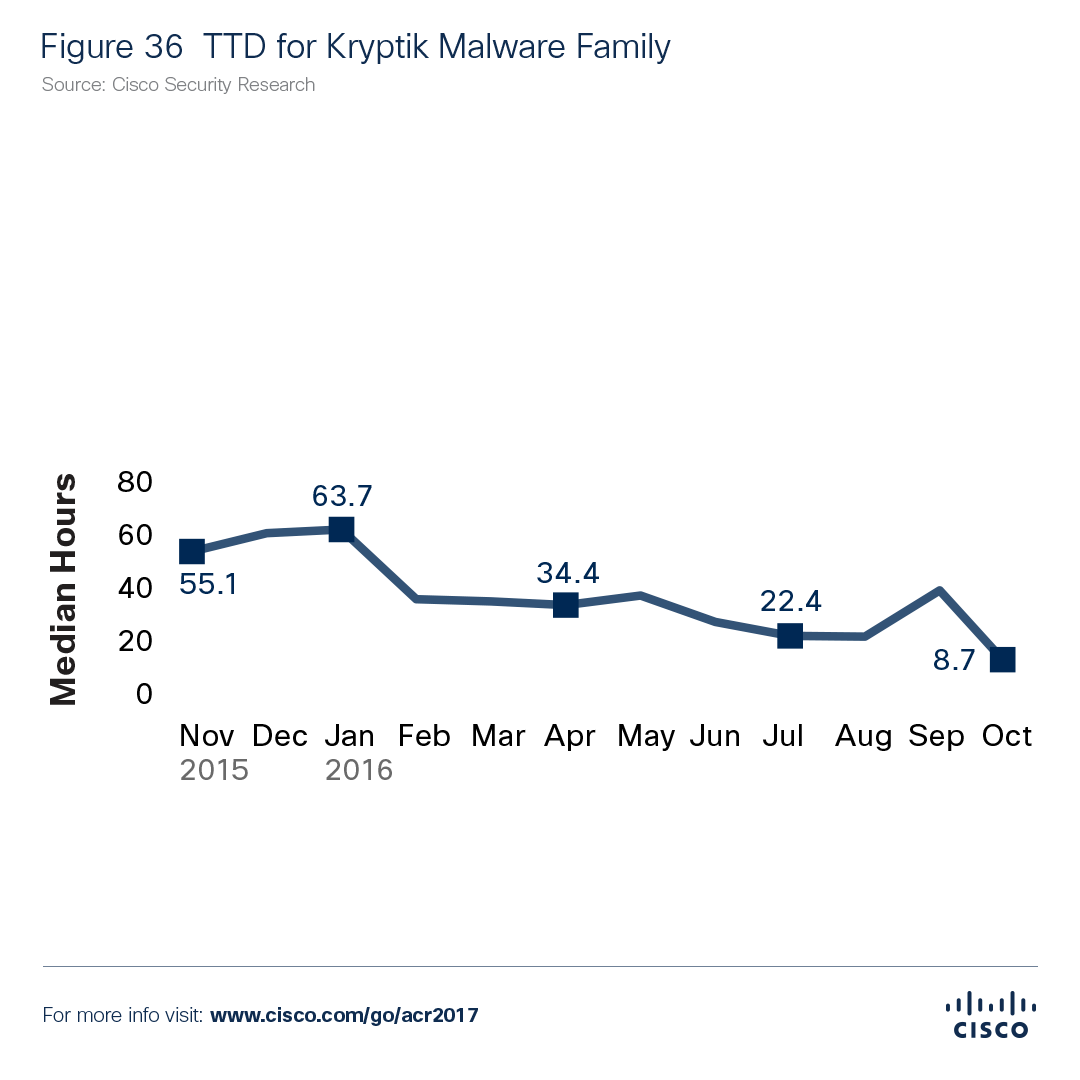
Two of the malware families included in our research were Adwind RAT and Kryptik. Our researchers found that these two families had a consistently higher median TTD than the other families we analyzed. In addition, they have a greater mix of file ages compared to other families in the study. This suggests that adversaries reuse effective binaries that they know are difficult to detect.

However, as the charts below illustrate, by October 2016 Cisco products were detecting both malware types within 14 hours: Adwind RAT (13 hours) and Kryptik (about 9 hours). (Note that Cisco’s overall median TTD for the period from November 2015 to October 2016 was 14 hours.)

Our research also showed that Dridex, a once-popular banking Trojan, was fading. In late 2016, we observed that detection volume for Dridex had declined, as did development of new binaries to deliver this malware. Near the beginning of this year, Dridex was seen re-emerging with a new variant in the wild leveraging a new code injection method dubbed AtomBombing. This reinforces that malware authors monitor their effectiveness to evade detection to maximize profits and will devote resources towards evolving their malware.

This research offers a glimpse into two ways that attackers’ shift their methods to evade detection, but the landscape is complex and ever-changing with many opportunities for attackers to shift methods. In order to stay ahead, or at least keep pace with attackers, organizations need integrated security architecture that is open and automated to allow their defenses to communicate to provide real-time insight into today’s threats and ensure quick detection and remediation.

Download the Cisco 2017 Annual Cybersecurity Report to learn more about our research into TTE and other security topics.

Authors

Aaron Weis

Market Intelligence Manager

Cisco Security Business Group

Avatar

I am not a big Starbucks fan but let us face it, it’s nice to go there, sit down and have a coffee while you work. The sound, the ambiance or let us say the customer experience it’s good. When you are in a hurry and especially if you are in a business area, the lines get very long and on a Monday morning, you really need some caffeine to boost your Data Center brain. Not being an early adopter made me either spent more time in those long lines or missing my morning coffee until I downloaded the Starbucks app.

Quite easy… you download the app, trust that all security considerations were taken and put some money in it and then you can order your coffee the way you like it. When you get to the store you do not even say hello to anyone; you just get in the store, go straight to the end, grab it and leave. You get points and after some time you get some perks in the form of food or a coffee.

The more I used it, the more I thought…hey! This for sure must be some form of Digital Transformation. We at Cisco believe in the power of technology enabling digital processes and experiences that deliver a great value for companies but how does this become a reality? Starbucks is a great example. While having a great experience in the store and leveraging the app on a regular basis; made me do some research about it and here are the findings:

Starbucks digital transformation is really happening. It is not marketing speech but a true vision on how companies need to change to drive innovation in their own industries. Companies need to understand why, what and how to transform to be successful. Starbucks digital efforts are paying. Just to mention a few:

  • Mobile payment now accounts for 21% of all transactions
  • Their loyalty program has more than 20 million members around the world. This is a gold mine for marketers to engage with their customers, listen and understand them and most importantly, speak to them according to their behavior
  • In store investments and new openings are being more balanced since they see digital as a growth avenue

Now, how does cloud has to do with this apart that cloud powers Digital Transformation? I found some interesting information about a Starbucks purchase back in 2008 of some internet-connected “Clover” coffee machine maker that will let them customize your coffee for you. The purchase came with CloverNet:

…“a service that gives you web access to your Clovers. Find out what’s brewing on each of your Clovers right now, and visualize business trends through real-time charting. CloverNet also makes it easy to update brew parameters for all of your coffees, and to keep your Clovers in peak operation through system monitoring”…

Apparently, the company had plans to start linking other in-store equipment such as refrigerators into a cloud based network that could report in real time. That sounds like a ton of connected devices, data and a good amount of work for the IT department. Sounds like this cloud will deliver great insights to drive more business for Starbucks and drive more revenue with their digital strategy.

I wonder if Starbucks is part of the 3% of companies that have an optimized cloud strategy? I guess they do. They replaced their 18 years veteran CIO Curt Garner and hired Gerri Martin-Flickinger; former Adobe’s senior vice president and chief information officer who will drive the company’s global technology agenda around: …”cloud, big data analytics, mobile and security expertise”…

This is how digital transformation, cloud and coffee gets together.

Cloud needs a strategic approach, it’s not just public or private or hybrid cloud. It’s hybrid IT making sure that what comes from the public cloud provider flows nicely into the overall IT infrastructure and, ultimately, into the business strategy of a company.

If you don’t see yourself among the 3% of companies that have an optimized cloud strategy and would like to learn more; do the following:

  1. Go to your favorite coffee shop
  2. Sit down, relax and click here to discover your current cloud adoption and associated business benefits

Authors

Sergio Licea

Marketing Manager

Cloud Solutions, Americas

Avatar

Cisco’s continued innovative approach is guided by Systems Engineers taking action on their experiences at the forefront of business change. This is a group of people who are passionate about technology and leading market transitions.

Charles Duffy – Cisco Distinguished Systems Engineer

Two years ago, Distinguished Systems Engineer, Charles Duffy, and Principle Systems Engineer, Cesar Obediente, came to me and proclaimed we were in the midst of a transition in the market where we would need to understand how to converse with application developers to continue being relevant to our customers.

This transition would put the network at the core of the DevOps conversation and drive a new requirement for network engineers to solution seamlessly with application developers.  This was such a new concept to me and I was somewhat skeptical that the change would happen quickly, if at all.  But it was Charles’ statement, a veteran of many transitions at Cisco, that made me look very hard at the idea.  He said that Cisco could fire him for any number of things, but not continuing to be relevant wouldn’t be one of them.

Cesar Obediente – Cisco Principle Systems Engineer

Charles and Cesar created a grass-roots training effort to bring their Systems Engineering peers along with them on the journey.  That initial spark of innovation and insight propelled our organization to learn network programmability and shape the network engineers’ new relationship with the application developer and infrastructure team.

We began our journey to train thousands of  Systems Engineers in applications concepts, APIs, and basic programming about 18 months ago.  As with any major transition, our teams went through the major steps to acceptance.  We had a few leaders who immediately embraced the concepts, but many were in denial that we were in the midst of a major transition. I heard repeatedly, “But Mike, my customers aren’t asking about APIs.  They don’t talk about these things.”  There were, of course,  many customers who were very far past us in the transition and had already embraced programmability and automation.  But there were also customers who hadn’t or didn’t realize that we were on the journey.  We began challenging our Systems Engineers to go have conversations with the applications developers, make a few mistakes, and learn how to have these conversations.

Jose Bogarín Solano‏ @josebogarin – Mar 2 DevNet Express

After 18 months, more than 90% of our SEs have taken training, practiced their skills, and have started having new conversations with our customers about the point where applications meet infrastructure. Once we embraced these concepts, we learned that we could help the infrastructure team talk with the applications developers.  They began leveraging the network and network analytics to automate the security of their applications, develop fog-computing applications hosted in the network and optimize applications for speed and agility.  I rarely hear an SE who is concerned that we’re attempting to turn them into developers.  Instead I hear the success stories about the new ways our customers are leveraging the network to overcome business challenges or deploy new applications that previously weren’t possible.  The innovation when you bring these groups together is extraordinary.

@SusieWee helping teach coding @DevNet

If you are interested in starting this journey with your team or company, you can start by checking out the following resources

The time is now to Embrace Innovation Where Applications Meet Infrastructure.


Authors

Michael Koons

Vice President, Global Systems Engineering and Technology

World Wide Sales

Avatar

#DevNetCreate Conference

Welcome DevNet Create

Being social and digital first, it’s really #DevNetCreate to me – who doesn’t talk in hashtags? What an exciting time where a big shift continues toward application development and how apps are changing the world. Application developers are no longer confined to building to specific infrastructures. Where applications meet infrastructure is where it’s at!

Through cloud, IoT and new developer platforms and tools, developers are creating enterprise apps for the future. These apps aren’t just for business—they affect everything—people, places, and things. They are built on a programmable infrastructure connected through APIs and DevOps practices, making the relationship between infrastructure and apps symbiotic.

Want More?

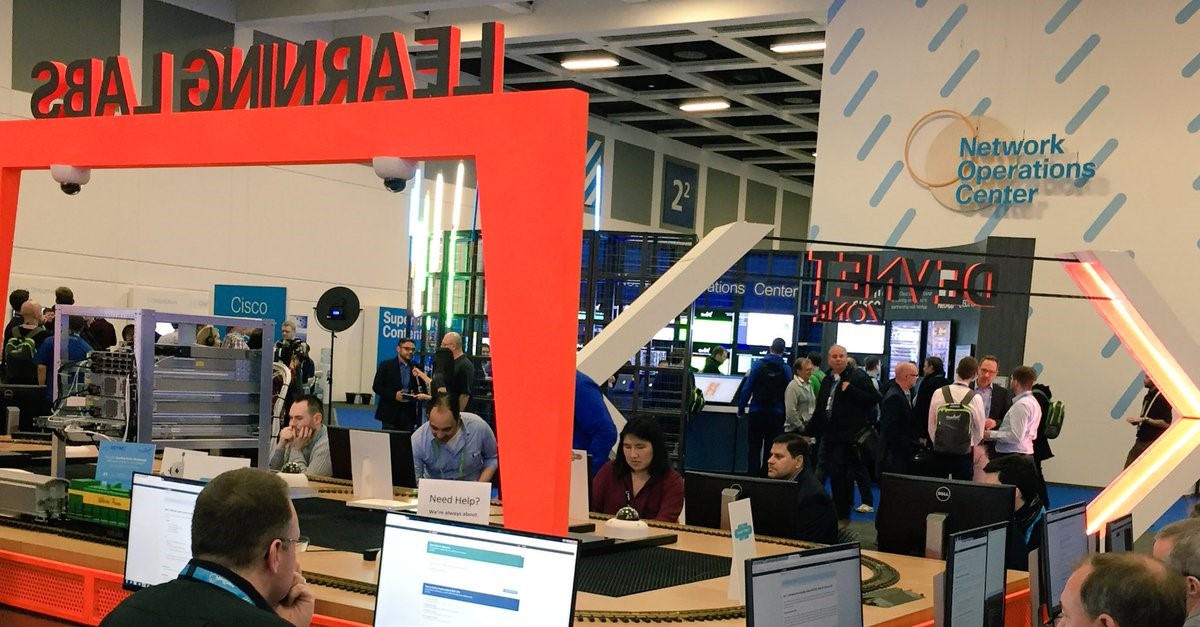
Please meet DevNet Create, held in San Francisco, CA, May 23-24, an industry-led two-day conference built to dive deep into the blurred lines between infrastructure and applications. Through two session tracks (IoT & User Experience and Cloud & DevOps), networking, keynotes, workshops, mini-hacks and learning labs, the conference offers top notch content combined with hands-on learning, to break down the barriers between infrastructure and applications.

Get insight about DevNet and #DevNetCreate, where we started, where we are going and why in the latest CUBEConversation with Jeff Frick (theCUBE) and Susie Wee (VP & CTO of DevNet, Cisco Systems).

Want to Present?

  • Call for Papers is open until April 7th! We are looking for session abstract submissions. See our suggested topics and session types, and start putting your ideas together to be a part of DevNet Create. Excited? We are!

Want to Attend?

  • We want you to attend too! Early bird prices are offered until April 13th – ticket sales are limited so don’t miss out on this industry-wide event.

Keep updated, go here for more:

We are also looking for your ideas about the best digital and social experiences from conferences you’ve attended. Anything stand out that we need to know?

Authors

Janel Kratky

Project Manager

Cisco Marketing

Avatar

Interoperability standards have posed an elusive challenge for the NFV industry. Cisco recently participated in ETSI’s first Network Functions Virtualization (NFV) Interoperability Plugtest, held in Madrid, Spain, between January 23 and February 3, 2017 with great success, further validating Cisco NSO’s broad set of multi-vendor orchestration capabilities

Designed to perform interoperability testing among different telco vendors and open source providers, the ETSI Plugtest event brought together a diverse group of industry representatives, including those from several open source organizations for two weeks on intense and collaborative effort. During the two-week on-site intense testing phase, interoperability tests focused on validating ETSI NFV Release 2 end-to-end capabilities including management of descriptors and software images, as well as life cycle management of network services and virtual network functions. The validation focused on ETSI NFV Release 2 end-to-end capabilities including management of descriptors and software images, life cycle management of network services and virtual network functions.

The results from the ETSI Plugtest event are now in with ETSI issuing reporting near perfect success across the NFV test schemes evaluated by the assembled multi-vendor industry group. During the Plugtest, 160 different combinations of virtual network functions, management and orchestration, virtualized infrastructure manager and NFV infrastructure were confirmed for interoperability, with more than 1,500 individual test results reported across the different participant organizations. Specific interoperability testing included 15 virtual network functions, 11 NFV platforms and 9 MANO solutions. The overall results and lessons learned from the Plugtest will be driven back to the ETSI NFV Industry Specification Group.

Cisco’s NSO based NFVO platform stood out during the event, demonstrating 100% success for interoperability tests of network service on-boarding, instantiation and termination across all the different test scenarios evaluated.

Fredrik Jansson, Senior Architect from Cisco’s NFV and NSO team led our on-site testing efforts in Barcelona. “The ETSI Plugtest was a great opportunity to confirm Cisco NSO’s broad NFV interoperability and multi-vendor support. It was a very good and intensive two weeks of regression testing with lots of opportunity to evaluate our MANO with many different VNFs of varying complexity above of us but also, four different VIMs below us. All the vendors we worked with were very open and we all did our best to get everything to work.”

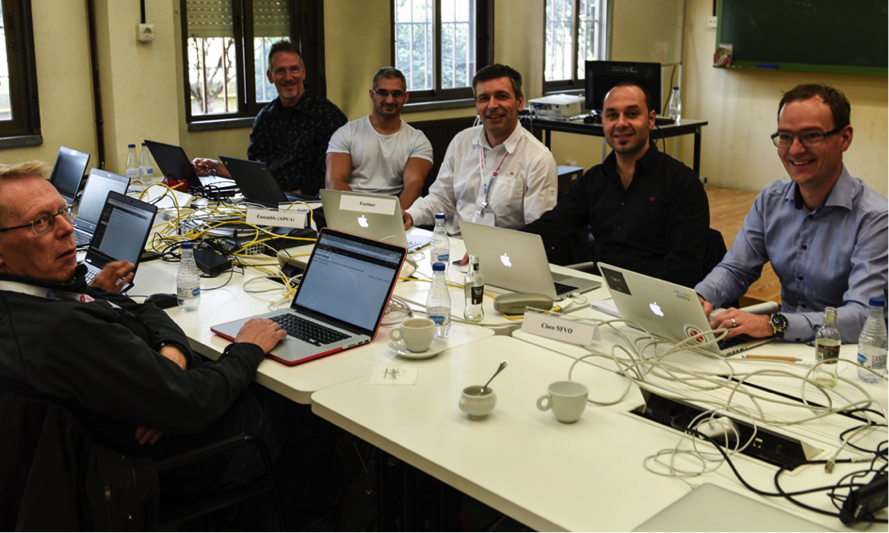
ETSI Plugtest with Cisco, Fortinet, and ADVA

Around 30 vendors, open source projects and universities came together for the onsite staging in Madrid, Spain at the end of January 2017, after completing a remote integration phase initiated in November 2016.

In addition to Cisco System, other vendor participants at this year’s NFV Interoperability Plugtest event included: A10 Networks, ADVA Optical Networking, Anritsu A/S, Canonical USA Inc., Cisco Systems, Ericsson, F5 Networks, Fortinet, Fraunhofer FOKUS, Hewlett-Packard Enterprise, Huawei, Intel Corporation, Italtel, Ixia, Keynetic Technologies, Lenovo, Mahindra Comviva, Netrounds, Openet, Palo Alto Networks, Radware, Red Hat, RIFT.io, Sandvine, Sonus Networks, Spirent, University of the Basque Country (UPV/EHU), VMware and Wind River

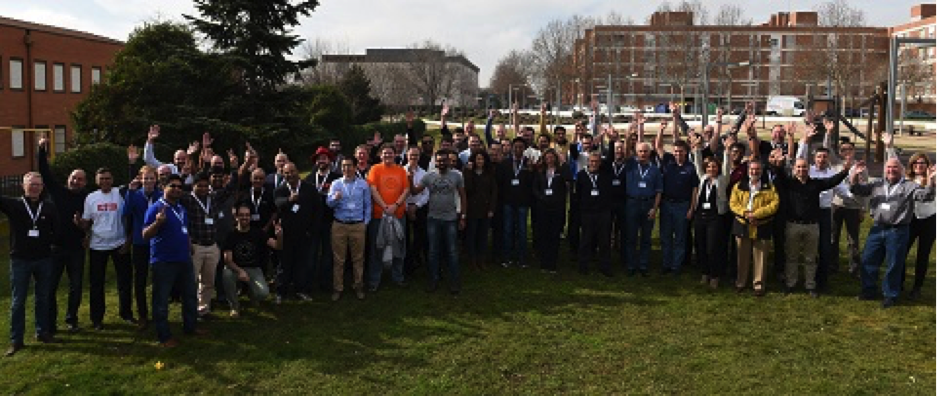
ETSI NFV Plugtest Participant Group Photo

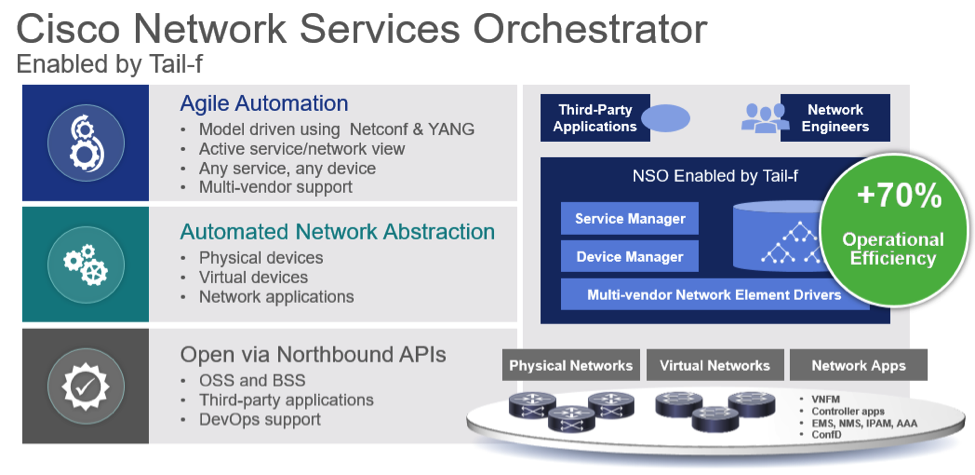
Cisco’s Network Services Orchestrator and NFVO Solution, validated during the Plugtest, is proven to work across all domains in your network. It helps Service Provider’s fulfil every aspect of a service. Leading Service Providers currently leverage NSO for their existing network, as well as, their network functions virtualization (NFV) projects. This all-in-one software package addresses:

  • NFV management and orchestration
  • Software-defined networking
  • Your traditional, complex physical network

What else makes Cisco NSO standout?

  • NSO is unique in that it works in multi-vendor environments and technology stacks delivering consistent, seamless performance across a broad scope of environments. Our NSO solution works with today’s legacy network challenges, such as layer two or three VPN provisioning as well as next generation networking based on NFV and SDN.
  • NSO is entirely model driven. NSO lets you create and change services using standardized models without the need for time-consuming custom coding or service disruption, as well as, solving the challenge of massive scalability. You’ll gain the agility you need to bring services to market ahead of the competition.
  • NSO offers full life cycle management supporting creation, updating, and deletion of network services.
  • Automate more than 50 to 70 percent of customers’ operations workflow.
  • NSO also provides transactional integrity which ensures fail-safe operations based on real-time view of the network. If something happens such as a device failing to update, NSO makes sure the network manager has a reliable rollback path and meet even the most stringent service-level agreements.
  • NSO is a fully proven solution with 10 years of experience, running right at scale now in a diverse set over 100 global customers’ networks worldwide spanning major Tier 1 services providers to large enterprises, cloud smaller providers, and larger enterprises in the financial services segment.

So, if you are looking to achieve true service agility and interoperability through network automation, go with the market leader and choose Cisco NSO.  Extract simplicity and take cost out of managing your network!

Find Out More

To find out what Cisco Network Services Orchestrator can do for your business, visit our NSO page.

And for more details on, the first ETSI NFV Plug test, the full report download is available here.

If you’re joining us in MPLS SDN NFV World 2017 in Paris on March 21 -24, visit the Cisco booth which will feature a demo of Cisco® Network Services Orchestrator (NSO) enabled by Tail-f.

To learn more about Cisco NFV Orchestration (NFVO) click here.

Authors

John Malzahn

Senior Marketing Manager

Service Provider Cloud Solutions

Avatar

This post was written by guest blogger Erin Connor, Portfolio Manager for Critical Human Needs, Cisco Corporate Affairs and Cisco Foundation

Today, an unprecedented 63.9 million people worldwide are forcibly displaced, and 21.3 million of those are refugees. From Syria to Afghanistan to Somalia, millions of men, women, and children are being forced to flee their homes because of conflict and persecution.

Often, they travel hundreds, even thousands of miles to settle in countries ill-equipped to handle the influx of those in need. The journey from Turkey to Greece, for example, is a treacherous one; refugees crossing the Mediterranean often travel in poorly-constructed rafts with little protection from the elements.

And when they arrive at their destinations, whether in Pakistan, Lebanon, or other countries, they’re often met with new challenges. In 2013, Lebanon’s population was 4.5 million, but the immigration of 1.1 million refugees increased the country’s population by a quarter. Turkey currently hosts 2.5 million refugees—the most of any country—but lacks many of the resources to cope with the added population.

The result? At least 40% of refugees in Lebanon live in inadequate accommodation, including makeshift shelters and informal settlements. Others face eviction or live in overcrowded apartments, unable to adapt to their new country’s standards of living. Many are unable to work due to local labor laws, while those in countries such as Greece are detained in camps where they wait hours in line for meals and can barely meet their most basic needs.

Fortunately, global problem solvers are coming together to make an impact in every corner of the globe. Cisco joins a growing list of companies and organizations applying digitization, collaboration, and innovation to solve what’s become one of the world’s most pressing issues.

At Cisco, we understand we must leverage core capability to achieve social impact. Since October 2015, we’ve taken a multi-pronged approach to our response, leveraging our people, products, and financial resources to provide over $4 million in support to the refugee crisis.


Our Tactical Operations engineers and Disaster Response team volunteers have carried out 10 two-week deployments in partnership with NetHope, and together, they’ve installed Meraki-based Wi-Fi networks across 75 sites—64 of which are currently active—in Greece and Slovenia and provided remote technical support and equipment for installations in Serbia.

The networks have connected over 600,000 unique devices, allowing refugees to reach more than two million friends and family members through high-speed Internet connections. Using our cloud security software, we block an average of 2,000 cyber threats per day, guaranteeing secure connections for all users. Cisco has granted all of the Meraki equipment needed for these installations to NetHope and provided a supplemental cash grant of $100,000 to support their crisis informatics work, which streamlines their installation efforts.

Cisco has also provided $350,000 to Mercy Corps to support the development and scaling of a mobile-enabled Refugee Information Hub. Currently available in three countries and in three different languages, the hub provides refugees with critical information such as legal options and instructions on seeking asylum, safety information, and available social services. Today, more than 30 NGOs use the tool, which is expected to grow this year to include seven new countries.


On a company level, we understand leadership support and employee engagement drives global action and innovation. A Cisco team of volunteers in Hamburg, Germany worked in close collaboration with a number of ecosystem partners to develop and implement the Refugee First Response Center (RFRC). This innovation transformed shipping containers into doctors’ offices, equipped with Cisco technology that enables access to the Internet and real-time translation services with 750 medically trained interpreters collectively speaking 50 languages.

The original unit, launched in Hamburg in October 2015, caught the attention of a local private donor, who funded $1 million for the production of 10 additional units that have been produced and deployed to Red Cross camps throughout Hamburg. The 10 units average about 30 consultations a day and have provided over 18,000 medical video-supported consultations to date. Two RFRCs have been shipped to Lebanon and Greece for replication.

The Cisco team in Lebanon is working with the Ministry of Health and local NGO Beyond Association to implement RFRC and will include virtual psychosocial services. The RFRC in Greece plans to offer telemedicine services for specialties not available at the hotspots, facilitate remote examinations, interpretation services and video communication for separated families.

Seeing the success of the shipping containers led other organizations to expand on that idea. Deutsche Bahn, the largest shipping and logistics company in Europe partnered with Charité Hospital in Berlin to transform a former passenger bus into a mobile medical clinic – known as the DB medibus

Charité and Deutsche Bahn contacted Cisco, who volunteered to network the bus. Cisco outfitted it with secure wi-fi high-speed connectivity and video collaboration units to allow for translation services in 50 languages. Their first use case for the pilot phase is mass vaccinations to be delivered at refugee settlements in Berlin, and they have already provided 10,000 treatments since launching last fall.


We also recognize the critical importance of education and employment opportunities for refugees. Our Networking Academy in Germany has also committed to providing IT training to 35,000 refugees in Germany over the next three years, and are piloting projects with the International Labour Organization and local universities to train refugees in Turkey through Cisco’s Networking Academy.

Through our annual matching gift campaign in 2015, Cisco donated a total of $743,000 to more than 40 organizations aiding in the refugee crisis. As this crisis endures, Cisco Foundation continues to match employee donations to these organizations dollar for dollar. We know this is an issue close to the hearts of many employees, and viewing them as valuable partners in global problem solving has helped Cisco focus on how best to apply its technology expertise in the field.

Follow Cisco CSR on Twitter for updates on today’s Humanitarian ICT Forum

Cisco’s Deputy Director of the Cisco Foundation, Charu Adesnik, will speak with Daudi Were, CEO of Ushahidi, about the power of strategic partnerships and scaling humanitarian ICT solutions.

Authors

Austin Belisle

No Longer with Cisco