We rely on our specialized partners to play to their strengths. Singlewire, an ISV headquartered in Wisconsin, is one of them. They’ve developed a mass notification system that sends audio, text, and images to mobile and on-premises devices. This makes it easier for companies to share info fast – whether it’s a chemical spill at a factory or a snow day for a school district. It’s working really well for their customer Aspirus Healthcare.
Singlewire says…
We work with Aspirus Healthcare, which serves 60,000 people in central Wisconsin and northern Michigan. Their facilities include eight hospitals and more than 40 clinics. When they needed to renovate their operating rooms, they realized they didn’t have a plan for incorporating intercoms for overhead paging. Their legacy paging system also needed to be replaced. On top of that, they needed a simple system to communicate with medical staff, while not sharing sensitive pages with patient families.
We helped Aspirus use InformaCast to boost the power of their paging capabilities over their Cisco IP phones. We were able to set up simple, uniform paging buttons on Cisco phones that made it easy for doctors and nurses to signal critical Code Blue pages.
With assistance from InformaCast, they were also able to set up paging zones and tones that kept these pages discreet. This reduced stress for patient families, as Code Blue pages were directed away from waiting areas to only reach hospital staff that could respond.
With the escalation of cybercrime, the role of Chief Information Security Officer (CISO) is fast evolving beyond its traditional operational functions of monitoring, repelling and responding to cyber threats. Continuous changes in our connected business landscape make customer data, intellectual property and brand properties new targets for information theft, which can directly impact business performance and shareholder value. In response, CISOs are progressing to a stronger leadership role, with an imperative to move beyond the confines of reaction and enforcement.
As I looked to this list of influential security officers across a broad spectrum of industries, I realized we are all tasked with an evolving and challenging assignment to secure the integrity of our businesses and customers – integrate fully within the organization, strategically approach information risk management and lead the transition toward a culture of shared cybersecurity ownership across the enterprise.
The losses stemming from modern cybercrime are not limited to high profile attacks. While 2016 brought sensational headlines of a half billion records stolen from a leading online search portal (and a subsequent massive devaluation), catastrophic hacks to a major political party and serious attacks on other corporate giants, small-to-midsized businesses were just as vulnerable.
Many organizations can quantify the revenue losses they experience due to public breaches. 29 percent of security professionals responding to our 2017 Annual Cybersecurity Survey said their organizations experienced a loss of revenue as a result of cyberattacks. Of that group, 38 percent said that revenue loss was 20 percent or higher. There is also an impact on customer attrition. 22 percent of responding organizations said they lost customers as a result of attacks. Of those, 39 percent said they lost 20 percent of their customers or more. These are very high stakes.
Such dramatic consequences are possible because of the significant maturation of cybercrime. The situation has quickly advanced from unrefined “old school” hackers to “new school” professional cybercriminals linked to multi-billion dollar businesses with targeted ROI and sophisticated supply chains. It’s a new form of organized crime, against which securing a business is not keeping pace. The lack of security not only increases risk of harm to existing operations; it can also hinder innovation and the progress of mission-critical initiatives.
Therein rests the CISO’s challenge and opportunity. Much like how the Chief Information Officer’s (CIO) role went through a decade of change, from running infrastructure operations to becoming a business enabler and senior leadership peer, the role of the CISO is following a similar journey. The Guardian and Technologist is giving way to the Business Strategist, the Business Enabler and the Trusted Advisor, who articulates risk, reviews metrics and reports regularly to the board. The importance of this shift is evidenced by increasing changes in CISO reporting structure, with 35 percent reporting directly to the CEO or President[1]. Also, the rate at which Boards are formally updated on cybersecurity risks has increased by ~20% in 2017 over 2015[2].
This greater business engagement requires CISOs to realign priorities and perhaps build some new skills. It’s a compelling moment of opportunity and responsibility for a profession that is emerging from the backroom of IT to a much needed seat at the boardroom table.
It’s DockerCon time again! We are excited to be the Gold Sponsor of the conference this year and looking forward to engaging with the community to accelerate the momentum in container adoption.
If you are planning to attend this premier container community and industry conference, meet the Cisco team to learn how many organizations just like yours are deploying cloud-native applications and successfully modernizing traditional applications using Docker and Cisco products. We have an exciting agenda planned for you at DockerCon:
April 17th, 3-5 PM and Wednesday, April 19th, 3-5 PM Room 19B
Docker Networking with Contiv. Hands-on workshop
This is a must-attend workshop if you are interested in container networking.
Co-hosted by Docker and Cisco, this instructor-led hands-on workshop will take you from 0-100 in everything Docker networking with Contiv. Registration is free, but you must hurry as space is very limited. Register now for the workshop.
Monday, April 17th, 6-7:30 PM
Welcome reception
Cisco is sponsoring the welcome reception. Grab a drink on us and network with the community in an informal setting. We have an exciting gift for you to take away. Don’t miss the welcome reception.
Tuesday, April 18th, 2:00 PM
Networking for your Docker Applications from Dev/Test to Production
Attend this Cisco session to learn how you can address various container networking requirements for your applications and adopt containers beyond dev/test and in production with confidence.
Tuesday-Wednesday, April 17-18th 8:00 AM-5:30 PM Expo Halls, Booth G13
Visit Cisco booth G13 in the expo halls to experience in-person demos:
Contiv
We will have multiple demos to showcase how Contiv enables production-grade container networking for your specific applications needs. Various networking backends – overlay networking, Layer 2, Layer 3 or Cisco ACI mode – we have all of them covered to demonstrate which mode suits best for your applications.
See Contiv’s policy based automation in action. Automation is the key for speed, security and scale requirements of your containerized apps.
Validated Compute and Storage – Cisco UCS and FlexPod for Docker
Cisco and Docker are teaming up to jointly develop, and support unified and certified solutions for the entire application journey, whether you are containerizing traditional apps, refactoring apps to microservices, or creating new applications. Learn how validated solutions for Docker Enterprise Edition on Cisco UCS and Flexpod can provide your organization greater confidence and unique advantages as you adopt containers.
Welcome AppDynamics
We’re very excited that some of the newest members of our family from AppDynamics will also be joining us in the Cisco booth. Stop by to see how AppDynamics supports the monitoring of Docker systems today and get a sneak peak of what we see as the future of monitoring containers in the context of your applications..
Follow @projectcontiv, and @ciscocloud for live updates from the conference.
Looking forward to seeing you at DockerCon!
Learn More:
Getting started with Contiv has never been easier using step-by-step tutorials. Get started now. http://contiv.io
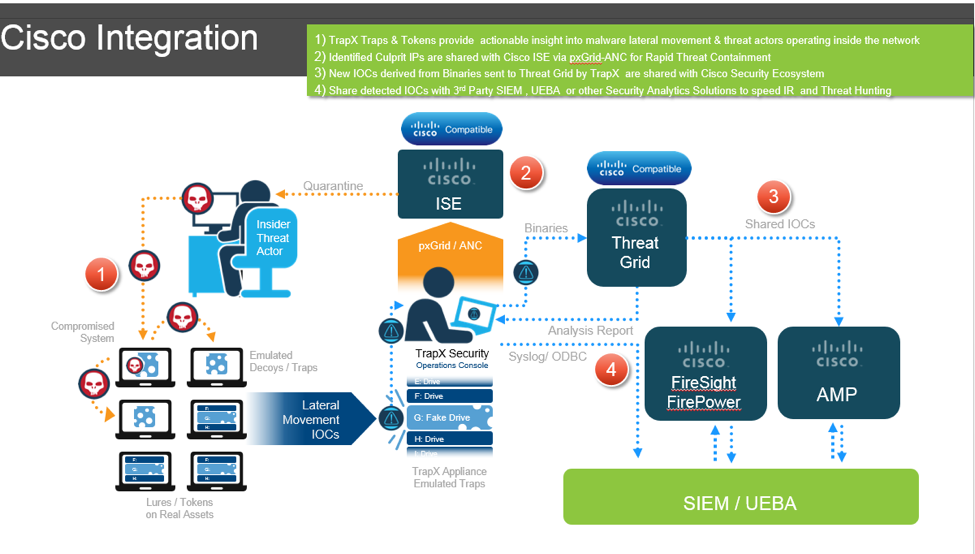
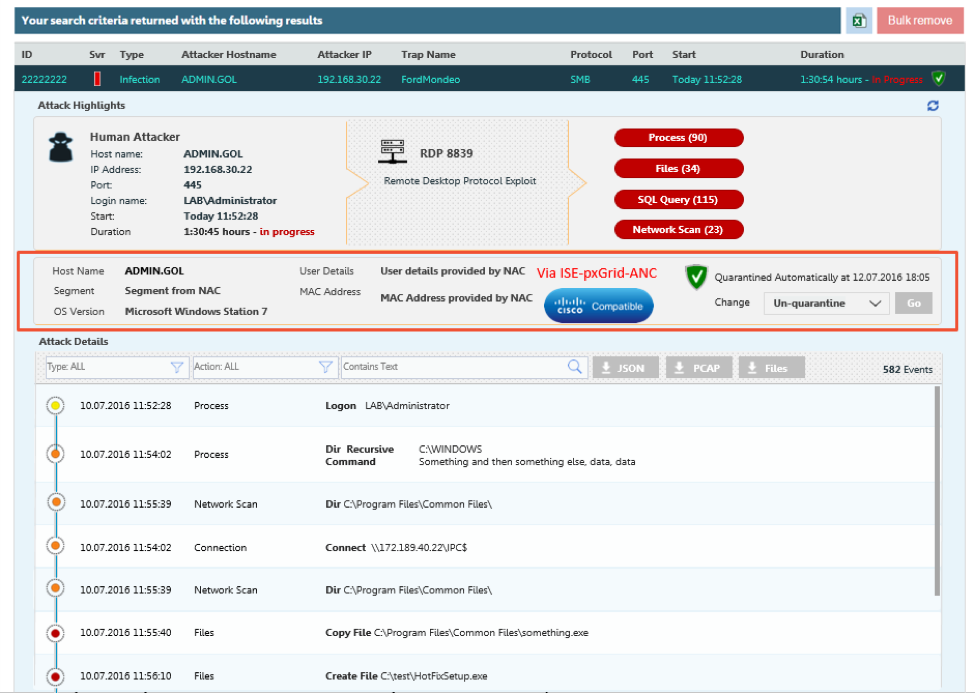
A core responsibility in my role at Cisco Security is guiding ecosystem partners through the Solution Partner Program, executing daily on the Open and Automated pillars of the Cisco Effective Cybersecurity strategy. Over the past few months, I have been working with TrapX Security, a global leader in deception-based advanced cyber-security defense to achieve the Cisco Compatible Certification. TrapX utilized the open architecture of Cisco security products for the successful integration of its DeceptionGrid technology with Cisco’s Identity Services Engine (ISE)Platform Exchange Grid (pxGrid) and Threat Grid.The integration provides immediate threat actor identification and rapid threat containment, as well as threat intelligence to be shared across Cisco’s security portfolio. The Cisco Compatible Certification now enables TrapX to be recognized as a Cisco Preferred Solution Partner.
The DeceptionGrid integration into Cisco ISE pxGrid and Threat Grid greatly expands the TrapX ecosystem for detection and response; by enabling Cisco Security to offer deception technology to our joint customers and providing actionable threat intelligence throughout our security portfolio of products. Cisco’s customers benefit with TrapX’s early detection capabilities for advanced threats, zero-day attacks and other sophisticated malware; as well as rapid containment capabilities that isolate the threats and effectively shut them down in real time. The threat intelligence obtained from DeceptionGrid integrations can then be shared with Cisco Security Technical Alliance partners; and across multiple Cisco platforms and devices in our security ecosystem, augmenting our overall customer value.
TrapX’s integration with ISE pxGrid and Threat Grid also enables our customers to use existing Cisco infrastructure to remediate threats once they’re identified and isolated; empowering users to get the most out of previous investments by relying on what’s already in their IT environment. This in turn leads to higher ROI, while also accelerating the process of threat remediation. Effective Security that is Simple, Open and Automated.
A little about me: I’m a Scorpio, a New Yorker, and am opening a new plant-based Mexican restaurant in China Town with my husband this month. Oh, and in August I will have celebrated my 11th anniversary with Cisco.
In the past decade, I have had the privilege of working with some of the most incredible service providers and content producers on the planet, witnessed countless acquisitions— and have helped to manage three major tech transitions alongside my customers since I started. I helped build Cisco’s Media & Entertainment business, and now lead a team of impassioned account executives and engineers through the IP transitions that are reverberating across this space.
Why do I tell you this? Simply because I believe there are few at Cisco better positioned to understand where we have been and where we are going. I have quite literally grown up in it—spending one third of my life here! My media customers have ranged from some small production houses and distributors, to global conglomerates. I understand the space, the transition, the technology. I also understand the politics. And it’s because of this Layer 8 phenomenon, that I am writing today’s post.
I want to incinerate any doubt that Cisco doesn’t understand, or isn’t invested in this space. People get uncomfortable whenever there is a new disrupter in a legacy industry and companies try to maintain their foothold by throwing FUD whenever the transition does not benefit them. Thus it’s totally normal that individuals hold tight to partnership decisions of the past that have made their careers. Nostalgia is a compelling emotion, but it’s not an effective strategy for navigating towards a future ripe for disruption. Simply take inventory of the past decade, and the evidence is apparent of what happens when people hold on too tight. Netflix, Amazon, Snap—these companies have completely changed film production and distribution, the literary world, and the process in which individuals consume news content. We all know the companies that have been demolished in their wake. #EvolveorDie
Which brings me back to Layer 8—the resistance does not serve the industry. Companies scared that they will be losing their grip are eager to spread statements, like “we don’t believe in Cisco’s direction in this space” or “other technology vendors are already paving the way.”
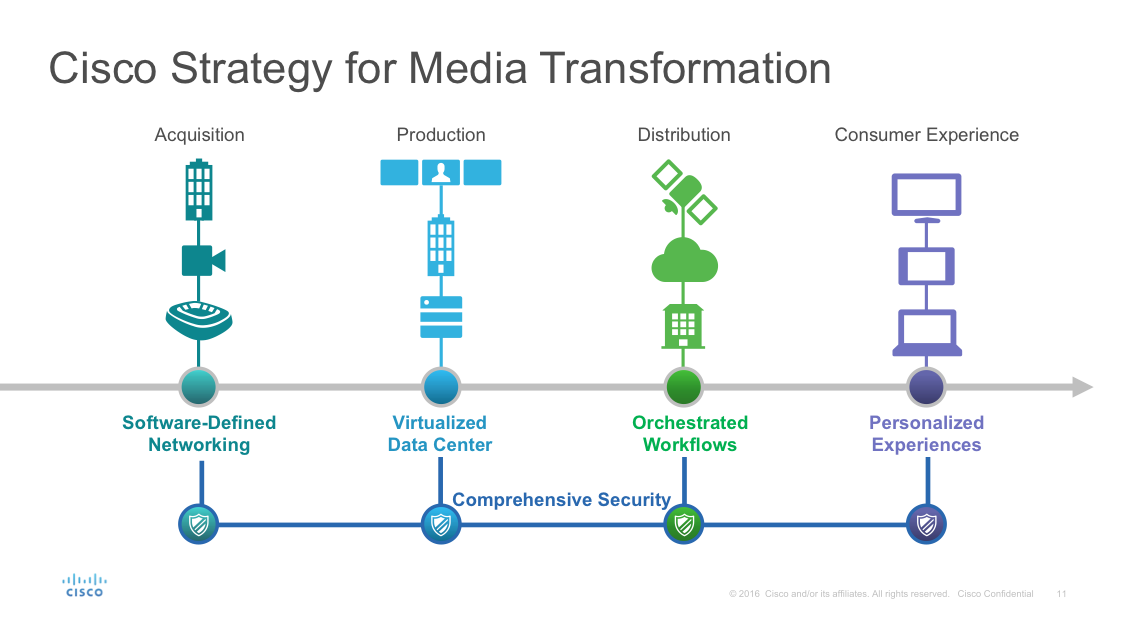
The first statement is crazy—especially if you have witnessed Cisco’s vision and strategy for Media production and distribution. To hear our vision distorted in the marketplace is quite literally #AlternativeFacts. The truth is that Cisco is executing a clear, open, and productized strategy for this space. We call it the Media Blueprint.
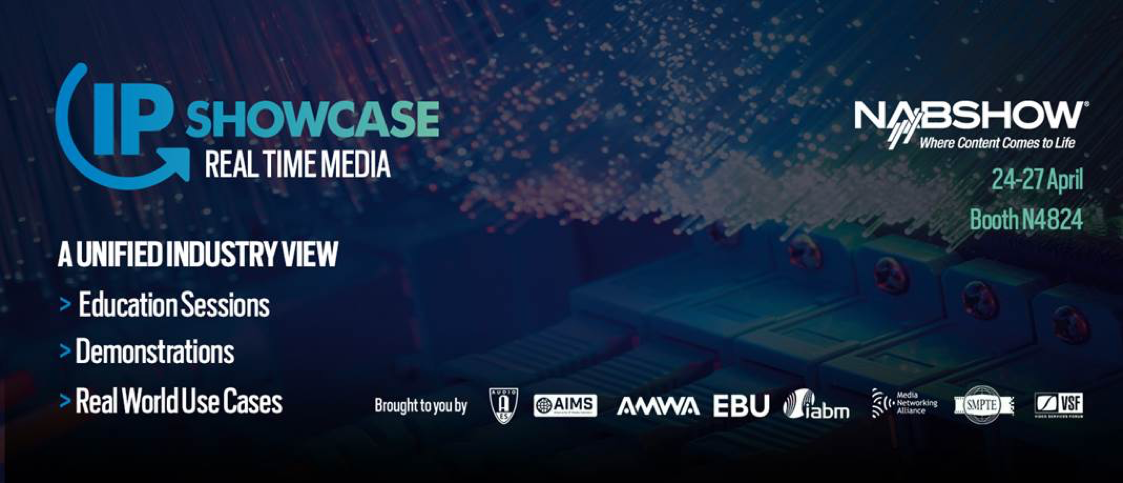
The foundation of Media Blueprint is an end-to-end ecosystem approach which is a strong challenge to point-providers who do not have that vision. And it is based on open, standards-based IP technology for production and delivery to propel our industry towards digitization ahead of legacy organizations who have not yet breached this frontier. Our solutions and innovations will be demonstrated in all their glory at NAB. So if you have any doubts about our vision, make sure to head to the South Hall to check it out. We will be showering innovation all over NAB: you will find us playing a central role in the IP Showcase demonstrations and Cisco technology will be on display in several partner booths as well (more on those in a couple of paragraphs).
Now the second statement has me all riled up. Other vendors ahead of us in this transition? Really?! Come. On.
We are Cisco. We created the world’s first routers, we propelled IP across every industry, and over the course of the past 16 years have acquired FOURTEEN video companies. We entered the Studio Production space recently, but we have been doing Distribution for over 5 decades thanks our acquisition of Scientific Atlanta. And if there is one thing you need to know about Cisco, it is that we won’t enter a market if we cannot be a leader in it. Media is no different. With a market cap of $171B, 2016 Revenues of $49B, and close to $5B invested in R&D annually, we have the financial wherewithal to be in this game for the long run.
So, let’s hit the facts. In 2016, we cemented our relationships with media ecosystem partners including Grass Valley, EVS, Imagine Communications, Riedel, and Lawo. We have worked tirelessly with standards based organizations to ratify protocols that we believe leapfrog the first-to-market switch manufacturers. Our solutions are not only being adopted in production and post, but they are being leveraged to change the conversation.
We are invested. We have never been more serious about Media. And we fully plan to crush this transition.
For years, PowerPoint has dominated the solution selling scene, but the age of static slide presentations seems to be coming to close. Today, prospects and customers demand more. They want to see solutions in action. While PowerPoint provides a solid basis for introducing and discussing things like product benefits and features, when it comes to presenting software solutions, it often fails to deliver the messages of impact, immediacy, and relevance that help salespeople close deals. And just as one era ends, another rises to take its place: enter the era of the real-time product demo!
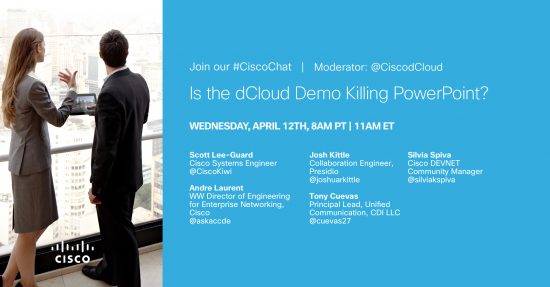
Join Cisco dCloud on April 12 at 8am PT (11am ET) for a live #CiscoChat on solution selling, the shift from PowerPoint to real-time demos, and a look at dCloud — Cisco’s catalog of fully-scripted, customizable demo environments designed for showcasing Cisco Solutions. In attendance during the #CiscoChat will be experts Scott Lee-Guard (@CiscoKiwi), Systems Engineer, Cisco, Andre Laurent (@askaccde), WW Director of Engineering for Enterprise Networking, Cisco, Josh Kittle (@joshuarkittle), Senior Collaboration Engineer, Presidio, Tony Cuevas (@cuevas27), Practice Lead Collaboration / Network, CDI LLC, and Silvia Spiva (@silviakspiva), Cisco DEVNET Community Manager.
To participate in the chat:
Make sure you’re logged into your Twitter account.
Search for the #CiscoChat hashtag and click on the Latest
The chat will be moderated by the Cisco dCloud channel (@ciscodcloud) on Twitter. Be sure to follow the account to participate. They will begin welcoming guests at 8am PT (11am ET) and posting questions for discussion.
For @ replies to specific participants in the discussion, please use a “.” at the beginning of the Tweet. This way, your question or comment will appear in your public Twitter feed.
If you need multiple Tweets to answer a question, please preface each tweet with “1A, 2A,” etc., to make it easier for others to follow along with the conversation.
Be sure to use the #CiscoChat hashtag at the end of each Tweet so others can find your contributions to the discussion.
Don’t forget to bring your own questions to the discussion as well! We look forward to seeing you there.
Each May students from all over Maine converge on the University of Maine as it hosts a summer student conference as part of the Maine Learning Technology Initiative (MLTI) 1:1 program. Last year, for the 13th year, over one thousand middle school and high school students, armed with their mobile devices and laptops, descended on Orono, ME to learn about technology through a host of fun activities.
In 2016 the MLTI theme was blending storytelling with electronic gaming. Donn Fendler, a Rye, NY native, was the conference speaker and he told the students about when he was 12-years-old, being lost on Maine’s Mt. Katahdin for nine days. As he recounted his tale, the connected students created the imagery via Minecraft on the auditorium’s 70-foot screen. This topic of storytelling and gaming was woven throughout the day’s topics including 3D graphics in game development and movie production.
With that many kids doing that many network-intensive activities on their wireless devices, there needed to be strong and stable Wi-Fi infrastructure for which the University leverages Cisco products.
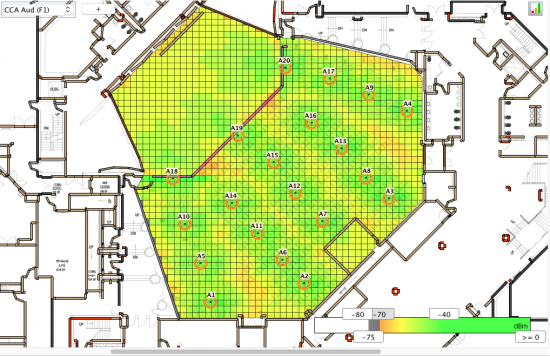
University of Maine System Network Architect Garry Peirce along with other Networkmaine staff deployed 26 of the Cisco Aironet 3802 Series Access Points throughout the Collins Center for the Arts Concert Hall. (See image below)
“We were able to cover the entire area very well creating small cells, by placing APs under the seats” he explained.
Although there is plenty of conference planning, Peirce and his team had to set up the network infrastructure quickly—in just one day prior to the conference. That meant that there was little time to test and only one shot for the network to run properly. This isn’t the first time that the team used Cisco products, so the team wasn’t worried.
“We were confident that the Cisco products could handle this without a lot of testing,” Peirce said. “The hot-off-the-presses APs were a wrinkle, but they worked well. The 2016 MLTI conference was by far the most seamless wireless service in the conference’s history enabled through the use of Cisco switching, 3802 AC2 capable APs, with Connected Mobile Experience (CMX) handling authentication and Umbrella service for some generic content control.”
Peirce said that these features were leveraged to maintain smooth network access in the hall and across campus throughout the day.
“At the beginning of the conference, the students provide some information to login to the network and then at the end of the day we use that information to raffle prizes – including scholarships ” he said. “This is also done highlight to students that they are logging into a network aware of their device’s presence, so they should practice being good network citizens.”
Peirce said that one of the good things about this conference, and the Cisco partnership, is that it allows the University to test equipment and see how it runs under both controlled and chaotic circumstances.
This May, the conference will once again be ready for the students—powered by Cisco.
Digitization is changing the world. All kinds of businesses, organizations and countries are going digital to innovate more quickly, compete more effectively and serve customers better. But digitization is also placing unprecedented demands on the network. Traditional hardware-centric, manually configured networking models will be unable to scale to keep up with the pace of business in the digital era.
This transformation is affecting not only the technological infrastructure but the IT professionals who will create and shepherd digitization.
For IT professionals, the ability to deploy and support a new era of software-centric, fully automated digital network requires new skills. Network engineers need to adapt to rapidly evolving technologies in software-defined networking (SDN), mobility, enhanced security, flexible access and virtualization, while taking full advantage of cloud services.
Changing the DNA of the network
Anticipating this shift, Cisco is changing the DNA of the network. Cisco DNA – our Digital Network Architecture (DNA) – is evolving the network to an automated, software-driven model that responds at the pace of the digital business.
This move toward digital networks is worldwide, and it’s building momentum. A recent study by IDC revealed that 45 percent of organizations expect to achieve digital-ready network capabilities over the next two years. That represents three times the current adoption rates. Additionally, companies that have invested in modern network capabilities are experiencing two to three times the rate of growth in revenue, customer retention and profit.
There’s a massive opportunity for networking professionals to take on a leadership role driving this evolution within their own organizations. Job functions are evolving from performing device-level, platform-specific configuration to delivering secure, automated services with business-centric analytics capabilities. And to help skill these new job functions, Cisco has introduced certification and training options in network programmability.
Equipping IT for the journey ahead
The digital-ready network includes digital technologies and applications that weren’t on the radar even five or ten years ago. Today’s digital network engineer or application developer needs to have skills in analytics and automation to connect data, people, processes and things securely.
As businesses transform to embrace the digital world, these automation and programming skills become critical. They enable maximum flexibility while reducing operational costs.
As part of the Digital Network Architecture, Cisco is providing new training to take IT talent to an entirely new level and help networking professionals become stronger strategic business partners in their respective organizations.
I invite you to get the details on the network programmability certifications and training options Cisco has introduced to deliver these critical skills. Visit Antonella Corno’s blog on the Cisco Learning Network to learn more.
For more information,
– Click here to see how Cisco Digital Network Architecture (DNA) is changing the game.
– Click here to visit the Cisco Network Automation, Analytics, and Virtualization microsite.
Service providers are transforming their business using NFV based services and SDN enabled networks. But the pace of transformation has been slow. To find out why, Cisco recently conducted a study to understand the progress and challenges that SPs are facing as they go through SDN and NFV transformation. Even though most operators interviewed were at an early stage of the journey, we identified some of the key success factors:
Senior Management must buy in because success depends on transforming the business not just evolving the technology
Creating a more innovative and agile culture is needed to truly embrace NFV/SDN
Boosting software skills is critical to managing and running the virtualized network
Moving to a DevOps service delivery model requires tight linkage between product management, network planning, operations and IT
Educating customers on the value proposition of new services enabled by SDN/NFV drives their adoption and success
Building the business case makes selling the value of the services easier
Over the next few weeks, we will share with you a lot more details from this study. We will cover the following areas in detail:
The transformation pathways that these operators took
The top 10 challenges they faced
How operators overcame the challenges
Educating customers on the value proposition is critical to success. To highlight the value of SDN/NFV, we’ll share the key findings from another study of 350 large, medium and small businesses globally. That study shows that by 2019 the spend in cloud will grow from 5% to 16% of total ICT spend. That will lead to more than $116 B overall opportunity in Virtualized ICT services and over $7.6 B opportunity in SD-WAN services for you. SDN & NFV drive these opportunities because they bring your business customers the flexibility and agility they value, as shown in the responses from every region in the study. To learn more about these opportunities, check out the ITaaS webinar on ICT revenue opportunities. Stay tuned for more.