The world travels more now than it ever has, with Americans alone logging more than 405 million long-distance business trips every year.
Maybe you regularly contribute to that number? I know I do!
I love working for Cisco, and in particular, I love that we embrace technology, which often removes the need for business travel. I have had amazing conference calls over WebEx or TelePresence, and it’s not rare to hear how connected we Cisconians all feel – no matter the fact that many of us have teammates located across the globe. The world is increasingly growing smaller as technology advances, and Cisco is every bit a part of this process.
Sometimes, however, an old-fashioned in-person meeting is needed. Typically, I would view this as a burden: being apart from family, worrying about what’s happening on the home front. Yet, Cisco takes what could be a ‘pain point’ of most jobs, and turns it into an opportunity to show that they value their employees.
Before a recent business trip, my manager asked if my spouse would want to travel along with me – and this was not the first time I was offered this opportunity! Cisco has routinely encouraged my wife, Amber, to join me on my business journeys.
What a concept—growing and exploring together! Amber and I have experienced diversity of culture, climate, and cuisine in San Diego, Salt Lake City, and London—each trip with an adventure to unlock; each city with an endearing quirk to be discovered together.
Up front, it should be said that not everyone’s spouse and/or kids have a schedule that allow for travel with their occupations, school, and other activities taking priority. For this particular work trip to London, three or four of my teammates significant others work remotely or were able to take the time off to be able to join us on their own time and dime. 😉 Inevitably, they were woven into our week in London and were able to show up at the office or by joining us at dinner in the evenings. With that said—I have found Cisco embracing my family to be one of the most unique and compelling reasons to work for Cisco.
Others around me at Cisco have done the same in traveling with their partners, and I love that this enables our team – and our families – to connect and meet each other face to face. It grows our bonds even further as we get to know everyone, and in no time at all, it has taken our relationships as colleagues to something much more: family.
These experiences have given me a different, more three dimensional look, at my co-workers – and my company. In many work places, the relationship you have with your co-workers extends just to the end of the work week. It lives and breathes in Monday through Friday, nine to five – and rarely extends beyond those perimeters. It speaks volumes to me that Cisco encourages me, and all Cisconians, to bring our families into the workplace. And while I already feel respected, cared for, and invested in by Cisco – the simple invitation to include my wife in work activities just grows these feelings even further.
Cisconians work hard together, grow together, and trust me when I say: we have fun together! Whether it’s meeting a deadline, dinner at the end of the day, or an after-work surfing outing (as my team once ventured out on) – we’re there for each other no matter the distance.
Our Cisco People Deal – the “agreement” between Cisco and employees on what the company expects of them and what they can expect of Cisco – says that, “We respect and care for each other. We work, grow, learn and have fun together.”
I cannot think of a way that could be more relevant or uniquely expressed than encouraging me to include my family throughout my journey at Cisco.
Family is at the core of who I am, and by embracing my family, I get the sense that Cisco embraces me as a person—all of me.
Does this story have you thinking it’s time to join Cisco? We’re hiring!
In my previous blogs in this series, I shared the key aspects of the Innovation Funding Board (IFB) concept—from guiding principles and stakeholder roles to the innovation process itself. In closing, we’ll look at some final process and cultural considerations to address before implementing an IFB.
Process Considerations
Every organization will face unique circumstances and challenges, however, the process considerations highlighted here are applicable in many cases.
First and foremost, try to remove guesswork wherever possible. Imperfect information is a given for any process of this nature, but working with facts wherever possible will ultimately lead to a faster, more desirable outcome.
Secondly, instill entrepreneurial rigor around managing a diverse set of small bets and de-risking ideas as they progress. In doing so, innovation teams learn the discipline of validating customer needs and problem definition instead of jumping straight to solutions.
Thirdly, allow for a varied project portfolio. This can be achieved by designing an IFB process for robust, disciplined governance across a variety of project types. The focus is on innovation funding, but longer term, higher risk projects might be diverse and difficult to compare directly.
Cultural Considerations
Implementing an IFB presents a golden opportunity to instill a stronger entrepreneurial mindset across any organization. But change doesn’t happen overnight. The following considerations will help to smooth the path to effective, long-term cultural change.
Begin by encouraging big picture, business-focused thinking. Get teams to build “fundable business opportunities” instead of just pitching innovative products/solutions. In many cases, initial concepts are wrong. However, if they’re part of a wider business opportunity targeting a large, attractive market then it’s off to a great start.
Next, make sure those involved know that it’s okay to fail. Fear of failure can be one of the biggest barriers to success. Demonstrate that smart risk-taking is encouraged, and that killing projects can be celebrated, not lamented, because it shows learning and frees up resources for better opportunities. In conjunction, challenge long-held assumptions to break new ground as this is often where the best breakthroughs come from. Make sure teams are open to new thinking and never allow group or personal assumptions to stand in the way.
Finally, instill a sense of accountability within innovation teams. Encourage them to self-assess opportunities before putting them to the board. Remember that an IFB is not a “pitch panel”. It’s a forum for funding, guiding, and empowering teams.
Too frequently security professionals only consider software vulnerabilities when considering the risks of connecting devices to their networks and systems. When it comes to considering potential risks of connected devices and the Internet of Things, not only must security professionals consider potential vulnerabilities in the software and firmware of these systems, but also physical vulnerabilities in hardware.
Tampering with hardware is method by which attacker can physically modify systems in order to introduce new malicious functionality, such as the ability to exfiltrate data without resorting to exploiting software based vulnerabilities.
Cyber threats have changed radically with the evolution of technology. Yet as threats continue to mount, many enterprises are still relying on yesterday’s cyber protection methods, technology infrastructure, and cultural ethos as the foundations for their modernization efforts. While IT digitization is integral to business growth and trajectory, enterprises must also update their cyber resilience approach to protect the full breadth of their operations.
I recently sat down with TechRepublic’s Dan Patterson to discuss what we at Cisco see as essential components of a cyber resilience strategy. Below is a summary of our conversation, be sure to check out the recordings for further discussion on each topic.
Future-Proofing Enterprise Cyber security
Future-proofing enterprise cyber security starts with a holistic approach to shifting the organizational culture. Everyone must look at cyber as their responsibility, not something to be left to the IT department. At Cisco, we sponsor frequent, formal cyber education for our employees. The next step is institutionalizing a continual process around resilience. Frequently assess what in your organization is changing. What is most important to your business, and what are you doing to protect it? When you do detect cyber intrusions, are you prepared to quickly recover normal operations? Can you recover? Regularly reviewing these factors will help protect your company for the long term. Click here for the full discussion.
Becoming Resilient to Cyber Threats
With the diversity of cyber threats, enterprises need to look at which specific types of threats are most critical to their business. We recommend a four-step systemic approach to developing cyber resilience:
Identify critical aspects of business, such as the information and processes that are most important.
Establish preventive mechanisms to protect those— systems, technologies, staff education.
Use that solid protective posture to operationalize how you detect cyber vulnerabilities, but don’t set and forget. Look for active adversarial activity on an ongoing basis.
When you have detected an attack, have a remediation plan to restore normal operations quickly.
What are the Biggest Enterprise Cyber Security Red Flags?
One of the biggest red flags is isolation of cyber responsibility to one person or one group, such as the Information Security team. You simply can’t permit other stakeholders to abdicate responsibility. Cybersecurity ownership must span the entire organization—people, processes and technology. There is also a tendency for the security industry to think one piece of technology is going to solve all the ills—it’s not. When I see organizations functioning at a high level in this regard, it’s because they have created a culture of responsibility. Click here to learn more.
Why Your Company Should Invest in Cyber Security Infrastructure
Many companies realize that digital transformation is critical to their growth. But we see them relying on legacy capabilities to build out a digitized environment. For example, a modernizing manufacturing environment might be built on top of 20-year-old infrastructure not designed for today’s cyber threats and impacting resilience.
Because IT systems play a fundamental role in the growth and trajectory of a business, a forward-looking enterprise must have a resilience strategy that includes investing in updating IT infrastructure. It’s not just about risk mitigation, it’s about giving your business the agility to go where it needs to, quickly. For example, how quickly can you adopt a cloud technology because you’re comfortable with its cyber security? How fast can you gain the efficiency that’s going to drive? I guarantee digitizing companies are going to depend on cyber security to underpin where their business is going. Don’t think about it as a cost center; it’s a fundamental enabler of growth. Click here for the video.
As the cable industry prepares to transition towards distributed access architectures utilizing the CableLabs Remote PHY standard, it’s starting to see the many benefits that RPHY can bring.
One of those key benefits is around simplifying the network, which is the focus of this blog.
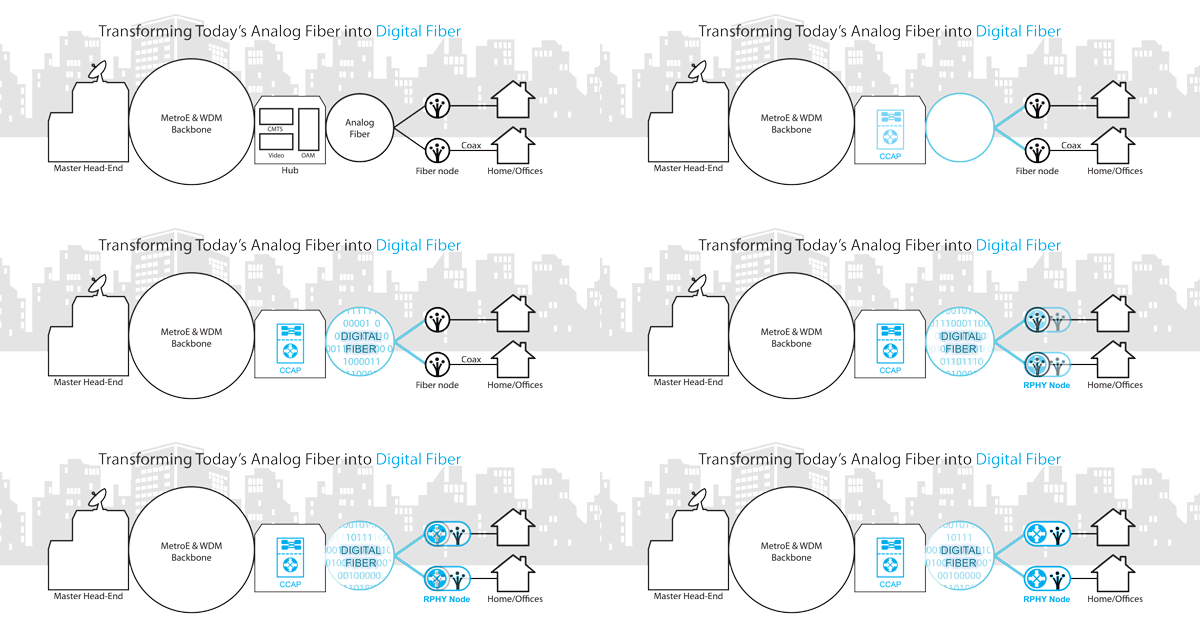
Today there is a legacy analog optical network that all cable operators/MSO’s have in place to service their optical nodes feeding the coaxial networks.
In the future, the connection between the CMTS core and the Remote PHY Device (RPD), the Converged Interconnect Network (CIN) according to CableLabs definition, becomes standardized, cost-efficient, simple and fast “plain old” Ethernet.
It is this CIN that provides a huge potential, an Ethernet network that has access to millions of subscribers and businesses, with a very high coverage in most of the worldwide population and business centers. This optical network historically has only been used for Cable TV and DOCSIS services.
Do you see the potential opportunity here?
What if this network can be unlocked allowing cable companies to offer access to both residential and business subscribers, with multiple services on top of it? DOCSIS, Ethernet, PON, WIFI or 5G – the physical transport becomes irrelevant, it is the service on top that matters. Yet, with that many different services on a network, the complexities of managing QoS and QoE increases dramatically.
Enter Segment Routing. Cisco is working towards providing full-fledged Segment Routing (SR) capabilities in this CIN, enabling network slicing and simplified traffic engineering. Standards-based SR removes the complexity out of multi-service networks – delivering on our commitment to the industry to simplify operations yet increasing the capability to differentiate services to ensure QoE and QoS. These services could include:
Business services:
DOCSIS
PON
ETTB
Wireless
Residential services:
DOCSIS
ETTH
PON
Wireless
WIFI Hotspots and Access points, including IoT access
Open Access
4G and 5G backhaul
PON based services with OLT’s embedded in the RPHY enabled Optical Node or remote device
What are the other drivers for SR in cable networks? Next to the CIN use case, we are also implementing SR in order to drive traffic separation in the core, such as for multicast streams. Transitioning from MPLS-VPN and MPLS-TE towards Segment Routing.
“Great companies do many things, but one theme I heard over and over is:
‘Great companies honor their past.'”
– Ron Ricci
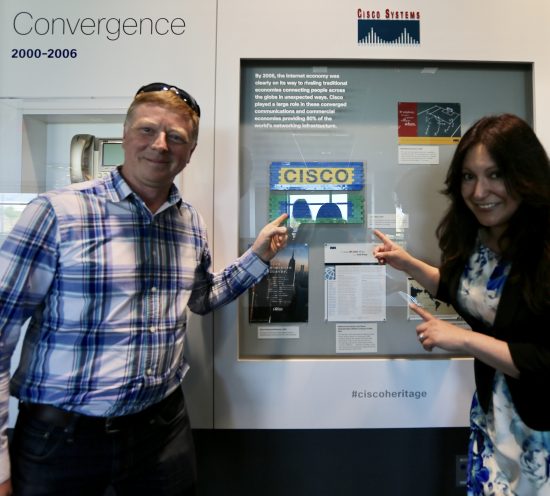
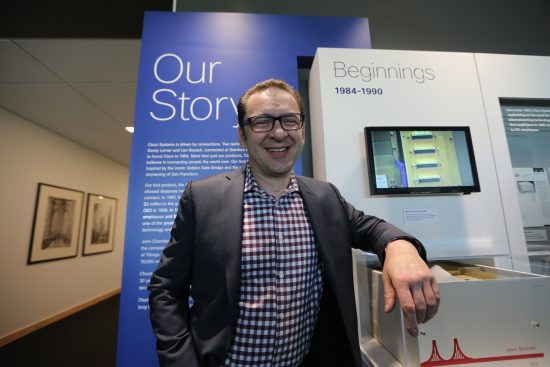
This was the welcome message and theme of the day during the dedication ceremony of the new Cisco Heritage exhibit, #CiscoHeritage. Where is this new Cisco History museum located? You can visit it at our Corporate Headquarters in San Jose, at the award-winning Cisco Customer Experience Center #CiscoCXC.
The Building Blocks of the Internet
After Ron’s opening remarks, past and present Cisco employees were treated to inspirational talks by past CEOs John Chambers and John Morgridge.
Cisco is a leading partner to countries around the world working on building a digital agenda. As we get more immersed in the Information Age, we are making great efforts to chronicle our history, especially through oral stories. The time to record the story of how we got here is now, as we celebrate the many people who built Cisco.
Maciej Kranz, leading innovation at Cisco.
Our Customers and Partners who visit the Cisco Customer Experience Center are most valued members of this family. When you visit us, we invite you to take the time to enjoy this tribute to our shared success. Share your memories on social media, and include the hashtags #CiscoHeritage #CiscoCXC
John Morgridge continues to inspire us
“If you listen hard, customers will answer any question you ask, including:
‘What does it take to sustain a great company?'”
– Ron Ricci
dCloudSteve rides the DEVNET Express
How can you help build Cisco’s future? Claim your #DEVNET account! Register: developer.cisco.com
This month, we made another big step in completing our full vision of next generation SMB switches. The Cisco Small Business Team is pleased to announce 19 new models in the successful 550X and 350X series switching product line. These new models provide Gigabit or Fast Ethernet with 10-Gigabit uplinks and advanced features to deliver unmatched value for Small and Midsize businesses.
Together with the full 10-Gigabit 550XG and 350XG models already available on the market, we now have a comprehensive portfolio to help customers upgrade to 10 Gigabit and ride the wave of digital economy at an affordable price.
For those of you who don’t know, Cisco 100-500 series portfolio is a complete network solution with routing, switching and wireless products tailored to Small and Midsize Businesses. They’re easy to use even for non tech-savvy users, while providing exceptional reliability and security. Best of all, these products are offered with value pricing and limited lifetime warranty, so building a solid network foundation for your business has never been easier.
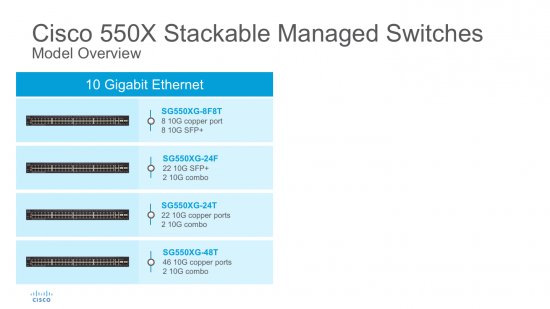
Cisco 550X Series Stackable Managed Switches are next-generation to the existing 500 series switches. These switches support true stacking, built-in fan redundancy, a redundant power supply connector, and layer-3 dynamic routing, to deliver the reliability and performance that demanding environments require. Models are available from Gigabit and Fast Ethernet with 10GE uplinks to full 10GE with both copper and fiber options. With easy configuration, management, limited lifetime warranty (with next-business-day advance replacement), the Cisco 550X Series provides a solid foundation for business applications for today, and for the future.
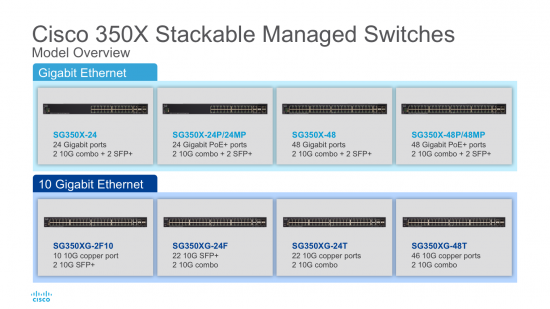
The all-new Cisco 350X Series stackable managed switches provide a versatile and high-performance, 1/10GbE switch architecture that offers deployment flexibility. With a choice of models that supports high performance and low latency, you can deploy switches that are best suited to your needs. With support for Layer 3 features, high-bandwidth stacking, and strong security, they deliver high performance and lower total cost of ownership (TCO), while providing business resilience and high-availability. They’re covered by a limited lifetime warranty with next-business-day advance replacement.
As part of the next generation SMB Switches portfolio, both 550X and 350X series are designed with the following key features and benefits.
Simplified web GUI, dashboard, wizards, and search for easy management
Standard RJ45 console and USB port for easy configuration and image management
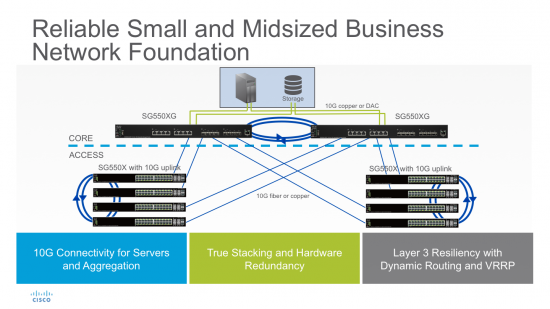
Now you can easily and cost-effectively build a reliable network foundation with 10G core to better support your business growth. Here is an example with 550X series switches.
Feeling excited? These switches are now available to order from your favorite partners and distributors. For more details, check out the product pages below or test drive these new products with our online emulator.
Imagine a world where students aren’t assessed simply on the regurgitation of facts, but more on true understanding of material. This is possible through the strategy of group-based learning. With a powerful network and the ability to connect with remote experts and peers, you can open up new possibilities for students to collaborate, research and learn with others. Read on for Alan November’s take on how, with the help of collaboration and open-mindedness, you can transform assessment in your classroom.
What if we could empower our teachers to turn assessment into a process of learning instead of a focus on measurement? Further, what if this mindset change led to an increase in student achievement on tests? That’s exactly what is happening at Trailside Middle School in Loudoun County, Virginia, at high schools in Gaston County Schools, North Carolina and a few other pioneering classrooms around the country where I have had the opportunity to work with innovative educators. Depending on how you view the purpose and management of tests this innovative process may seem counterintuitive at first—but it has led to dramatic gains in their students’ understanding.
The technique involves testing students twice: once individually and once in groups. It’s something I first saw practiced by Harvard physics professor Eric Mazur, who has redesigned the culture of his classroom to have students own their learning.
By making the learning a socially interactive experience, where students are discussing and debating the problems with each other, Dr. Mazur has found that his Harvard students are much more engaged in the class—and they also learn more from each other than they learned from him alone. In fact, he has seen achievement gains that are three times greater than what he experienced when he used to lecture.
“It is an amazing experience to watch the engagement, the excitement, the energy, and the constant debate students have with one another,” he says. “There is this passion that really disseminates across the whole room.”
Professor Mazur observes, “We mostly assess students on low-level skills, like remembering, and our only way of testing them on that is to cut them off from any other source of information or each other. But that’s not how they will operate later in their careers,” Dr. Mazur says. “We all have access to the internet, books, and other people. That’s why I think it’s very important that we transition to a more authentic form of assessment, where students do have access to this information and to each other.”
In Professor Mazur’s process, students first take an assessment alone; then, they are placed together in small groups to discuss those same questions and decide what the right answers are and why.
“They essentially get three tries to get a decreasing number of points as a team for those questions,” he says. “In a sense, it makes the assessment a learning opportunity and also a feedback opportunity, which is what it should be.”
The big question is; will a process that shows improvement with highly motivated Harvard students work with high school students who are under motivated or middle school and elementary students who are struggling? The answer is a resounding YES.
Michelle Junkin is a sixth grade math teacher who has been a teacher for 17 years. By applying this group testing approach, she saw the best outcomes she has experienced in her career—and she was so excited that she contacted me to share her success. “The benefits my students received from just this activity are more meaningful than you may realize,” she shared.
I was so impressed with her willingness to experiment with an innovative approach that I recorded an interview with Michelle and her colleagues to learn more about how they managed the details of this new assessment model. In Michelle’s case, she first tried this peer assessment model with her accelerated students. She approached it a little differently than professor Mazur: She had her students take the test together in small groups first, then had them take the same test individually later. When they took it individually, they were much better prepared—and their understanding was reflected in their performance on the exam.
“They were giving me feedback about how much they liked it,” she said. “They were able to hear things from their classmates that they didn’t think about themselves, or to see (the problems) done in a different way. I thought that was so powerful.”
The process went so well that she has tried it with her math 6 students, too. Again, the level of understanding that students exhibited was well beyond what she had experienced on similar tests. “They did much better than I normally would have expected,” she noted.
Felix Colaciello is a seventh grade math teacher at the same school, and he also tried this new approach with his own adaption. He spent two days on a unit test in algebra. On the first day, students completed eight word problems by themselves, and during the second half of class, they got into groups and discussed those eight questions. On the second day, Felix gave them a different set of problems with the same level of difficulty, and students completed those problems individually.
And like Michelle, Felix also saw impressive results. “We told (students): Make sure the things you heard from your group mates will help you prepare for the second test,” he said. “Giving them that experience and having a chance to go home and study, and come into class the next day ready for the test, the kids did really, really well on that second part.”
When I asked them whether they thought it was cheating to let students discuss the answers with their classmates, their responses were insightful.
“The whole point of the assessment is to see whether they’ve learned the material or not,” Michelle said. “I don’t think it matters (how) it’s presented to them, as long as they learn it. I mean, I could give them a study guide that looks exactly the same as the test, and it doesn’t matter if they do it individually or together. The only thing I changed is that they did it together, and they talked about the answers (with each other).”
As Felix observed, if you’re asking questions where students have to show their thinking, instead of regurgitating a memorized response, the question of cheating becomes irrelevant.
“You still have to show your work,” he said. “You have to show how you got the answer. So, you’re thinking at least. If you know the answers, that’s great—but if you don’t know how to do the problem, that’s not really what we’re looking for. We’re looking for your thinking.”
There is this idea called the “curse of knowledge,” where teachers know so much about their subject that they sometimes fail to appreciate the misconceptions a first-time learner might experience. Having students help each other learn addresses this problem. And in the process, everyone understands the material more deeply, because those who are explaining it to their classmates have to conceptualize the idea at a very deep level in order to do so. When I visited Gastonia County, North Carolina I asked high school students why they find it so helpful to work with their peers. The answer was, “My friends speak the way I understand. Sometimes they can explain things in a way my teachers do not.”
Michelle said her students tend to “listen more intently to their peers that they would have for me,” and she said it would have taken her longer to explain a concept in a way they would understand. She thought she would have to play a more active role in guiding their conversations, but that wasn’t the case. “I was pleasantly surprised that I really didn’t have to do that at all. They were very self-directed and self-motivated,” she said.
Students who never really talked in class were much more willing to share within their group than with the class as a whole, Felix said—especially if they noticed that a classmate didn’t fully understand a concept. “They were trying to explain it in different ways,” he said, “sort of like what you do as a teacher. But they were doing it for their friends, because they wanted to make sure their friends understood.”
What about parents, I asked: Did you get any pushback from parents who were concerned about this new approach to testing?
“I was proactive,” Felix said. “I send parents a weekly email, and I told them, ‘Here’s what we’re going to do this week, we’re trying something new.’ And I told them the reason behind it. I told them the benefits: getting to hear kids talk, getting to learn their thinking. If I heard anything where I needed to step in (and correct a false assumption), I would. I didn’t have any parents say anything back negatively. A lot of them said, ‘This is a cool idea; let us know how it goes.”
“I actually just got an email from a parent last night, saying how their daughter is not very math inclined—and she came home and was talking at the dinner table about how great it was,” Michelle said. “She felt so much better prepared for the test. She got ideas that she wouldn’t have thought about on her own. That feedback I got just yesterday was very positive.”
A key reason that Michelle and Felix were willing to try this strategy in their classrooms is because the school’s principal, Bridget Beichler, has established a culture of innovation that encourages risk-taking. In fact, Bridget said this new process for managing assessment has been adopted by much of the school’s staff as word quickly spread about the success that teachers have experienced.
“Yesterday, we were doing division-level learning walks, and I walked into a sixth grade teacher’s science class and he was introducing this group test to his students for the first time,” Bridget said. “My staff is very willing to take risks. It’s like a ping pong ball: They play off each other. It’s amazing to watch.”
She concluded: “Assessment is really about moving forward in your learning, and not about the grade.” And that’s what this strategy does: It advances students’ understanding in very powerful ways.
True story. This happened to someone on my team. Her father-in-law lives alone.
Several years ago, he had a stroke. He lay on the floor for hours until a neighbor noticed his open front door and found him.
Luckily, he made a full recovery.
It was clear how fast a treatable health condition could become a critical problem. If he’d had regular monitoring or a relationship with a doctor he could quickly talk to, then maybe they would have noticed his blood pressure was rising and treated it.
More than 29% of people over the age of 65 live alone.* They’re more likely to be women and tend to be unfamiliar with technology. Many struggle with isolation and some go for days without actually talking to a live person.
This is the challenge that our partner World Wide Technology (WWT) and their client, Mercy Virtual, are
working to solve.
Patients with chronic conditions have it rough. It’s difficult to monitor your health, and keep dozens of appointments. So, the staff at Mercy wanted to bring health care to them. And create a completely virtual telehealth experience.
All the connections had to be invisible. Elderly patients had to be able to set up and access services without getting frustrated.
Mercy wanted it to be something patients would not just accept, but come to value. The chance to connect with caregivers who would get to know them. To ask questions, get real answers, and quick referrals. Not a promise that someone would get back to them days later.
We have to try to build that rapport with the patient over time to earn their trust. I get to know them on a really personal level, what’s important to them, what their goals are.
-Veronica Jones, Registered Nurse, Mercy Virtual
To be a service patients trusted, Mercy needed a partner they could trust – WWT. And WWT needed technology they could rely on – Cisco. Because every connection our technology creates is about building relationships. This is how WWT works every day too.
I feel like when I come to work I have 50 grandparents that I’m taking care of. Some patients get the hang of it so quickly. The day after we install them they’re sending all their vitals, they’re sending me messages.
-Shelby Zytko, Navigator, Mercy Virtual
For Mercy Virtual, this means people like my teammate’s father-in-law can connect to medical staff from home anytime. And get care to stay healthy and out of the hospital. Before a small problem becomes life-threatening. To stay in their homes and feel empowered and independent.
I am so proud of our partners like WWT who are making a real difference in the lives of the people Mercy Virtual cares for. It’s a great story. And there are more stories just like this one that our partner ecosystem makes possible.
What stories do you tell your customers?
Discover the story of how Mercy Virtual is connecting patients with care.