Digital transformation has created a sense of urgency to adopt “as a service” business models, such as hybrid cloud. Hybrid cloud delivers speed and agility. Users are empowered to deploy workloads across multiple cloud platforms. Your business stays compliant and safe. Business and development teams can use their platform of choice.
Cisco ONE Enterprise Cloud Suite comes with the tools your organization needs to deploy a multi-cloud platform. It is designed for modular implementation. Allows your organization to go on its multi-cloud journey at a comfortable pace.
But sometimes you encounter problems. Where do you go to solve technical problems? Or discover workarounds to get over hurdles? Could you use a site that provides technical content or forums to ask questions? The Cisco ONE Enterprise Cloud Suite Community was designed with you in mind to leverage guidance and best practices from your cloud peers and Cisco experts.
Need to incorporate Prime Service Catalog into your current environment? Learn how. Want to combine ACI SSL with Cisco CloudCenter application profiles? No problem. Discover new validated infrastructure workflows that can accelerate the development of custom workflows. It’s all here waiting to help.
Business transformation can be a challenge. Hero’s like yourself could use guidance from time to time. Make your first stop the Enterprise Cloud Suite community. Obtain technical guidance. Share your inner hero with others.
When you need help, it is just a click away. Check it out today.
When it comes to thoughtfully placing technology into the classroom and the curriculum, it’s about more than just providing the tools.
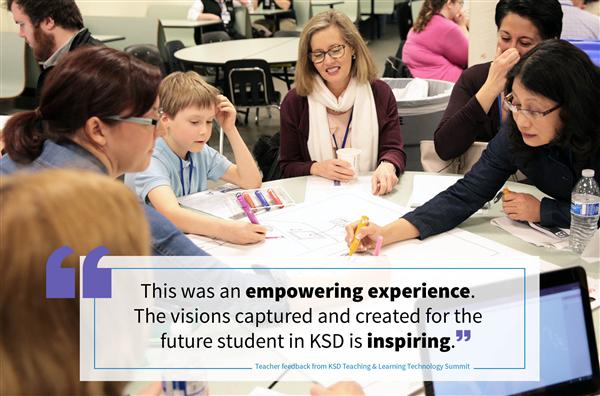
Kent School District in Kent, Washington knows firsthand about the shift from giving students and educators technology access, to providing them with the right technology access and skills to empower learning. They recently underwent a multi-step visioning process to drive this shift. To do so, they hosted a Tech Summit for students, educators, administrators and community members.
“How are we using technology?” said Kent Superintendent Calvin Watts at the summit. “How are we ensuring that this infrastructure that we have – this wonderful tool that we have – is not simply used as a toy? Is it actually used as a tool to help enhance and advance teaching and learning? That becomes the question, how and to what degree are we connecting teaching and learning with our technology.”
So, how do you connect teaching and learning with technology?
Integrating technology into your school doesn’t start with giving each student a laptop and expecting it to instantly change the way they learn. It starts with crafting a vision for the future of your school district, then determining how technology can help achieve that vision.
Here are four steps to shifting the way technology is and will be used in your school district.
1. Involve those who will be using the technology. More often than not, decisions about new tools are made by those who will never use the technology in its intended state. To ensure positive adoption of technology in the classroom, you must involve those who will actually be using it – the students and the educators.
For Kent School District, hosting a Tech Summit was the ideal way to bring together all stakeholders to discuss the future use of technology in their district.
Superintendent Calvin Watts said of the summit, “The goal in the next five years is to enhance our core business. Our core business is teaching and learning with an emphasis on learning, and that means we need to ask ourselves – our neighbors, community members, work family, home family – how are we doing? Are we doing what we said we would do in terms of using our technology to support teaching and learning?”
The one-day summit brought together 135 people to discuss.
2. Look towards the future. If there were no limitations, what would learning look like on your campus? What would it look like at home? What tools do the students want to use? What tools do the educators need to drive meaningful knowledge gains?
When you ask the right questions to the right people, you get amazing results.
During the Kent Tech Summit, small groups created sketches and scripts of what the day in the life of the future student in the Kent School District would look like.
Once the students, educators and community members had an open forum to discuss their thoughts, the ideas for how to improve the district got flowing.
One student suggested a global learning program, where students could connect with native speakers to better comprehend foreign languages. Another suggested personalized learning tools, both in the classroom and at home, to enhance learning for all individuals, regardless of pace.
“Our students are sharing with us exactly what they need and how they need to learn,” said Superintendent Watts.
It is with this knowledge of the students’ desired future state that a school district can begin to plan for the future.
3. Determine what technology can support. Once your school has determined what the future state should look like, it’s time to find the tools you’ll need to achieve that state.
What technology tools are highest priority? Will your network be able to support the heightened use of technology on campus, and the added need for access to educational resources? How can you plan to roll out technology over time to yield the same results, yet fit into your districts’ budget?
4. Listen to feedback – good or bad. Achieving meaningful digital transformation by successfully implementing technology into your school is an ever-evolving process. Once technology is placed into the classrooms, you can’t just sit back and hope that it will be impactful, you must constantly adapt, and enhance.
Listen to what the students, educators and parents are saying about the technology. Use their feedback to improve and adjust. The more involved they are in the process, the more successful your technology implementation will be in the long run.
Interested in creating more impactful and thoughtful uses of technology at your school? Check out how other schools, like Mesa Public Schools and Rochester City Schools are using the visioning process to plan the future state of their districts.
Cisco’s education experts can help you turn your future state into a reality by helping navigate the technology journey. To learn more, please email ctemesi@cisco.com.
There is no doubt that we are living in the Hyper Scale Data age when it comes to all things data storage related, which is impacting both consumers and companies. According to Cisco research, by the year 2020, the amount of data stored inside data centers is expected to grow by a factor of five, from 400 exabytes to almost two zettabytes. That’s enough storage capacity to hold more than 60,000 times the entire Netflix video catalog.
What’s also changing for today’s storage administrators is the pace of changing storage networking innovations available to them. Customers require scale and performance to support today’s latest technologies, such as multi-core processors, advanced memory, emerging technologies like NVMe over Fabric, and Flash storage arrays. In order to remain competitive, customers need smarter and faster connectivity to access data faster, 24X7, with zero downtime
Attend this webinar to learn more: April 19th, 10am PDT.
Cisco continues to innovate across both emerging and traditional storage networking realms as illustrated by today’s announcements (Press Release):
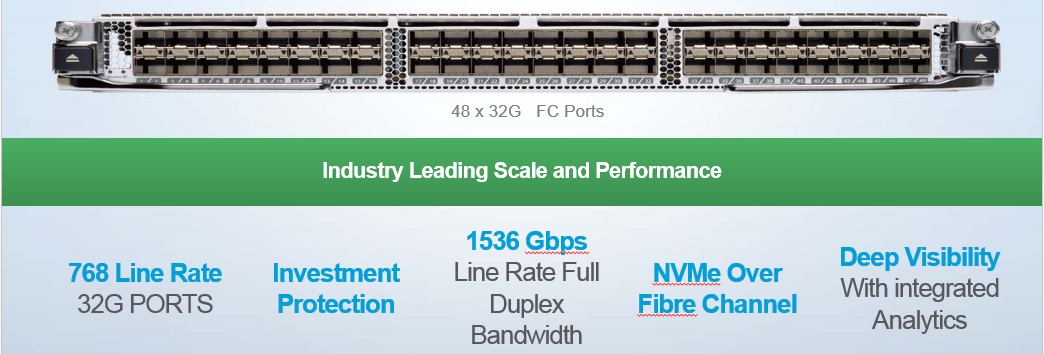
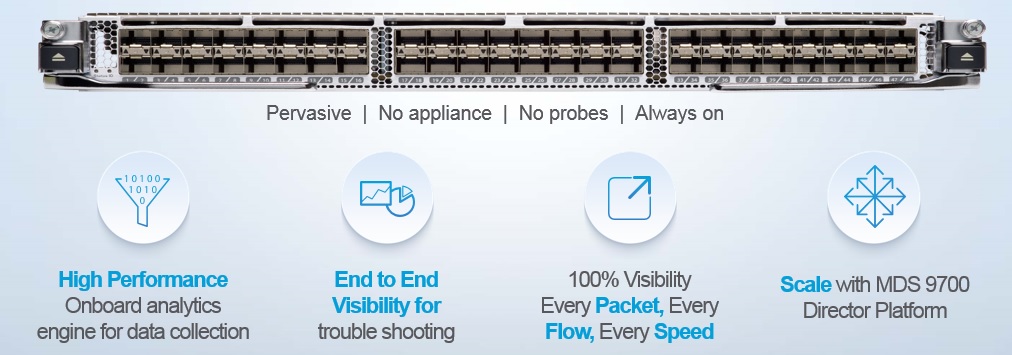
New high-performance 32 G Fibre Channel Module on MDS 9700 Directors: This new FC module makes the Cisco MDS the highest-density 32G director in the industry today, achieving line-rate performance across all 768 ports per switch. This new module also offers investment protection, as it is compatible with existing MDS 9700 directors and is field-upgradeable.
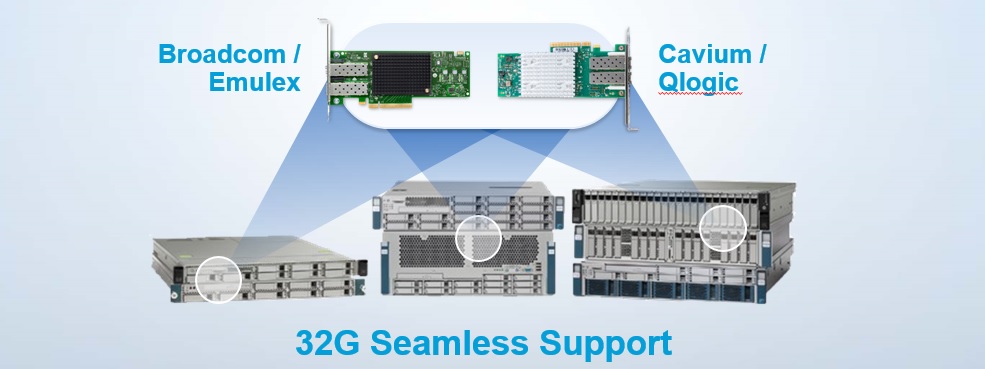
New 32G Host Bus Adapter for UCS C-series: Cisco is collaborating with Broadcom/Emulex and Cavium/Qlogic to offer 32G Fibre Channel Host Bus Adapter connectivity with seamless support on Cisco UCS C-Series. These HBAs are designed to address the demanding performance, reliability and management requirements of modern networked storage systems that utilize high performance and low latency solid state storage drives for caching and persistent storage, as well as hard disk drive arrays.
Integrated analytics Think deep visibility for your SAN operations: This includes the ability to monitor all flows on all ports at line rate to empower storage admins with the ability to make informed and proactive operational decisions. Cisco achieves this through a built-in analytics engine on the new 32G FC Module that is hardware-based and purpose-built for maximum performance. It is capable of IO-level metrics that are computed in every switch through dedicated Network Processor Units. Customers can now analyze in real time all Fibre Channel exchanges and report on various metrics, thereby providing comprehensive, timely, and continuous monitoring of any potential performance issues or deviation in the network.
NVMe over Fibre Channel: The Cisco MDS 9000 now offers support for NVM Express (NVMe) over Fibre Channel, enabling end-users to scale their flash storage appliances to achieve faster application response times and better scalability. Cisco MDS customers can upgrade their existing SANs through a non-disruptive OS upgrade to support NVMe over FC using a combination of the MDS SAN Directors and UCS C-series servers. The customers will benefit from having multi-protocol flexibility in their MDS installations that can now support NVMe and SCSI simultaneously over both Fibre Channel and FCoE. Customers also benefit from investment protection as NVMe support extends to all current and future generations of MDS switches including MDS 9700, 9396S, 9148S and 9250i.
A special thanks to all our partners for their support and participation to make the launch successful. Cisco’s MDS product line is supported and sold by authorized original storage manufacturers (OSM). We are very pleased that all of our partners are looking forward for the arrival of the new 32G Module along with the other innovations. Cisco is also working closely with Flash Storage partners, Technology Partners and Channel Partner to bring customers better efficiency and flexibility and built a network that last for the next decade.
These MDS advancements fulfill the promise Cisco made to customers with the introduction of the MDS 9700 in 2013, ensuring that customers can upgrade their SANs without incurring the time, costs, and risks of forklift upgrades. This is possible because Cisco built the MDS 9700 from the ground up with next-generation technologies in mind, a critical advantage as customers go further into the hyper scale data age.
I am so pleased to share the news that for the sixth year in a row, our Cisco Channel Partner Program has been awarded a 5-Star ranking by CRN and will be listed in CRN’s 2017 Partner Program Guide. In addition, this year our Cloud and Managed Services Program also earned this prestigious 5-Star ranking in addition to being listed in the Partner Program Guide for the fourth year, and our Solution Partner Program, Lifecycle Advisor, and Integrator Partner Roles will also be included in CRN’s 2017 Partner Program List.
The 2017 CRN Partner Program Guide is the definitive listing of technology vendors that service solution providers or provide products through the IT Channel. On behalf of my entire Program Portfolio team, I am appreciative and excited about these awards and what they represent: a true alignment with partner’s business needs and Cisco’s program design. Our partners work hard to achieve success in their business and the Cisco team continuously strives to listen to partner feedback and create programs that fit our partners.
Ready for the Next IT Wave
We’re on the verge of the biggest IT opportunity in two decades – the Digital Transformation. Our industry-leading Channel Partner Program will help make sure partners have everything they need to take full advantage of it. Our Partner Programs are best-in-class, offering value-add to partners and increasing their opportunity to build and maintain a profitable business. The award-winning Channel Partner Program provides many ways to differentiate our partners’ business from their competition. The program offers a myriad of solutions, training, tools, rewards, and support to enable our partners to drive toward profitable growth and customer satisfaction.
Our Cloud and Managed Services Program is designed for an elite group of partners who have earned differentiation in the marketplace by delivering innovated and validated Cisco Powered cloud and/or managed services to solve their customers’ business needs. Tiered partner levels make it easy to enter the program and increase their level of expertise and benefits based on business needs and customer demands. The Cisco Powered Service designation is built upon a foundation of superior service, security, and 24-hour support. These partners can take advantage of financial rewards, branding, and go-to-market support from Cisco.
Continuing the turn toward digitization and differentiation, our Solution Partner Program helps partners integrate their solutions with Cisco’s world-class architectures and technologies, and navigate the increasingly complex world of selling and delivering integrated solutions to customers. Likewise, our Lifecycle Advisor and Integrator partner roles offer partners unique opportunities to not only land solutions, but also drive adoption, solve business problems and measure results.
Partner Program Excellence
CRN’s 5-Star Partner Program rating recognizes an elite subset of Partner Program Guide applicants who offer solution providers the best partnering elements in their channel programs. The 5-Star rating is bestowed on programs whose overall rating is among the elite.
We created our Partner Programs and Partner roles to make sure partners have everything they need. So they can bring their customers new technology with a name IT buyers have trusted for decades, and have a deeper conversation with them about where they want to go.
The next time you fly, look at the instrument panel the pilots are using to fly the plane.
Gone are the quivering dials and cloudy gauges. Flight decks are now dominated by sleek, digital displays and advanced on-board systems that allow pilots to focus on flying the plane rather than managing the instrumentation.
The digital revolution has changed nearly every aspect of how we work, play, and live. From listening to music, to corresponding with colleagues to flying airplanes – the last twenty years have dramatically changed daily life. However, if you ask a network engineer to configure a Cisco Catalyst switch, chances are the engineer will type commands into a text window, the same way they would have in 1999. Back then, Cisco set the industry standard for command line interfaces (CLI) – and many competitors imitated our solution.
Today, Cisco is again leading the industry in adopting open and programmable interfaces for our switches and routers. Traditional CLI may have built the Internet as we know it, but it certainly isn’t a perfect – or modern – solution. CLI’s is basic computer programming and its inherent flaws include:
Inefficiency – Engineers must manually type long and cryptic commands to program switches and routers to perform basic functions. Simple configuration tasks across multiple devices require hours-long maintenance windows that could be spent on higher value network tasks.
Human-focus – CLI is designed for humans to interact with machines. It isn’t the optimal solution for machine-to-machine communication and programmatic control.
Error-prone – Manually typing commands into network devices is an ongoing source of errors. Mere typos can bring networks crashing down, stopping work progress and often requiring hours of troubleshooting to fix.
Cisco Catalyst switches now support technologies that simplify automation and provisioning and make the network engineer more efficient. Some of the features Catalyst now supports include:
Day 0 provisioning. With Cisco Network Plug-n-Play (PnP), switches can be brought up out of the box with little hands-on configuration. Simply set up the PnP server (APIC-EM or Prime Infrastructure) and the switches automatically pull down the correct software version and configuration. For consistency across Cisco platforms we now support ZTP and industry-standard PXE boot.
YANG models. Cisco has enabled YANG data models for a large number of our most popular features. YANG models allow switches to be configured and managed programmatically, using industry standards like NETCONF. In addition to our own models, Cisco is committed to supporting models defined by open standards as well.
Python support. IOS-XE 16.5 will feature on-box Python support for many Catalyst models. Scripts are able to take advantage of a direct connection to the device they are managing and can also integrate Python with Cisco Embedded Event Manager (EEM).
Programmable interfaces will make network operations teams more efficient, bringing them out of 1999 and into modern, programmatic control of the network. What do you think? I am interested in your insights. Over the next few blog posts, I will discuss each of the programmability features in detail. I am interested in your feedback.
This post was authored by Martin Lee and Warren Mercer, based on research conducted by Patrick DeSantis.
Industrial Control Systems provide stability to civilization. They clean our water, deliver our power, and enable the physical infrastructure that we have learnt to rely on. Industrial Control Systems are also highly prevalent in manufacturing. They’re the robots who build your cars and assemble T.V’s, they’re the forklifts that ship your e-commerce purchases. As factories, utilities, and other industrial companies shift to a modern industrial infrastructure, it’s vital that those processes and devices remain safe from attackers.
One key component in any ICS architecture is the access point which provides the connection between ICS devices and a industrial wireless network. Inspired by From LOW to PWNED we decided to take a look at one ICS wireless access point and see just how many vulnerabilities we could find in two weeks.
Written by Tim Brophy, Product Manager Cable Access Business Unit
In recent blogs, we focused on fiber deep architectures and changes in topology. The implication one might draw is that this “network of the future” is the one and only thing operators should pursue moving forward and that it is a simple strategy that fits all market segments. But as we highlighted in the discussion on the value of the fiber deep network, not all plants will require such investment today. For low-density areas or those with adequate capacity, existing architectures will suffice for many years to come. Even so, those legacy plants will benefit from advances in linear transport technologies. Plant extensions, maintenance-level rebuilds, and equipment replacement will continue. This is the topic of today’s blog.
To justify continued expenditures on legacy plants, two criteria may serve as guidelines. The first is to ensure that performance is enhanced to extend the physical infrastructure and to flexibly keep pace with anticipated capacity increases. The second is to ensure that these changes lay the groundwork for the inevitable changes down the road so as to protect the investment made today.
Historically, linear optics has supported increases in operational bandwidth and information capacity since its inception. Recent moves enabled DOCSIS 3.1 deployments, and linear optics kept pace, increasing RF frequencies to 1.218MHz. As competitive offerings drove billboard data rates to ever-higher levels, exploiting all available bandwidth and improved data density demanded higher order QAM modulation and the introduction of OFDM for ensuring maximum utilization. When combined with the architectural changes towards fiber-deep, even more stringent demands were placed on legacy plants to either keep up or allow the subscriber base to erode in a search for “better.”
Enter now into the mix a linear optical source which realizes the many goals of the ideal transmitter. Based on improvements at the fundamental physical level of the laser, the transmitter boasts the following highly desirable features:
High immunity to fiber nonlinearities, enabling links in excess of 100km
Support for a full complement of DWDM ITU wavelengths
MER performance exceeding headend levels
Efficient fiber utilization using common optical passives, EDFAs, and receivers
Competitive price points for both short and long links
With this innovation, the industry has a transmitter which pushes the link limitation back into the RF domain. The optical link is no longer the performance-limiting segment of legacy plant.
What does this mean for operators? Consider that with the advent of this universal transmitter, operators gain the ability to simultaneously increase performance, distance, and loading in both RF bandwidth and high-order QAM or OFDM. In addition, they can:
Carry high CNR analogue signals if desired.
Use the same transmitter for all links
Simplifies sparing
Increases commonality of link designs
Maintain current capital allocation levels
Address competitive offerings to reduce churn
Position and adapt architectures in preparation for the move to remote PHY
Fiber-deep long links supported
No regrettable spend extending plant—it’s prepared for future use
In summary, CapEx budgets can be planned more judiciously, allocating scarce resources and personnel to areas of greater need. With intelligent architectural planning, the transition to tomorrow’s digital plant is considerably eased. Thus, the universal transmitter conserves past investments and postpones new expenditures thereby extracting the value of existing plant.
Cisco is pleased to have begun deployments of this technology over a year ago, and continues to be the sole source for this best-in-class linear optical transport. As an important part of a total investment portfolio for operators, Cisco continues to help service providers meet their customers’ demands for complete, cost-effective strategies to capture and retain market share today, and prepare the groundwork for continued success.
In our next blog, we will turn our attention to current and future opportunities that R-PHY brings, and examine the potential impacts of digital predistortion (DPD) and full-duplex DOCSIS (FDX). There are many exciting twists and turns ahead, and we look forward to active engagements with our customers to continue to provide guidance and products that benefit them and our industry.
Today, Talos is publishing a glimpse into the most prevalent threats we’ve observed between March 31 and April 7. As with previous round-ups, this post isn’t meant to be an in-depth analysis. Instead, this post will summarize the threats we’ve observed by highlighting key behavior characteristics, indicators of compromise, and how our customers are automatically protected from these threats.
As a reminder, the information provided for the following threats in this post is non-exhaustive and current as of date of publication. Detection and coverage for the following threats is subject to updates pending additional threat or vulnerability analysis. For the most current information, please refer to your FireSIGHT Management Center, Snort.org, or ClamAV.net.
I recently participated in a panel discussion Solving the IoT Talent Puzzle at the 2017 Internet of Manufacturing Business Conference on behalf of Cisco and the Internet of Things (IoT) Talent Consortium. Alongside other industry leaders Rockwell Automation, MIT, and the State of Illinois we discussed industry trends in the IoT and the evolution of skill sets needed.
Here are the top three takeaways from the panel discussion:
Manufacturing is leading the way in the IoT: The manufacturing industry in the U.S. is embracing digital technologies. According to market intelligence firm IDC, 43% of manufacturing companies are already going through digital transformation, and 41% have identified digital transformation opportunities for their businesses as of 2016. The future of the IoT looks bright in connected manufacturing. IDC has forecasted that 75% of manufacturing companies will update their operations with IoT and analytics by 2019. By 2020, 60% of plant workers will work alongside automated assistance technologies.
There’s a major talent gap in the industry: As the industry continues to evolve, lack of talent and skills continues to be the biggest barrier to harnessing the power of the IoT. According to LinkedIn, there are around 67,000 control engineers within the marketplace. Industry estimates suggest that around 60% of the workforce is represented on LinkedIn. This means that there are around 112,000 control engineers worldwide. Cisco predicts that 220,000 new engineers will be needed globally every year for the next 10 years to keep up with the technological surge of IoT. This presents a huge gap. Not only is a new breadth of skills necessary for those entering the industry, but also for those within the industry. Individuals must upskill as IoT technologies evolve.
The IoT Talent Consortium is working to fill this gap: The IoT Talent Consortium is an industry-wide initiative focused on building and growing IoT talent. As a founding member of the IoT Talent Consortium, Cisco realizes the need for a new breadth of skills – in security, infrastructure, cognitive, leadership, big data, mobility, and software. As part of an industry-wide effort, Cisco develops individuals with the interdisciplinary skills needed to harness the power of the IoT.
These key points resonated to an audience of leaders in the manufacturing industry. Manufacturing company executives are recognizing the need to reskill their employees and the importance of credible learning providers to help develop talent from within. They also worry about objectively sourcing candidates with the right skills and are anxious to understand which training and certifications matter most.









 We’re on the verge of the biggest IT opportunity in two decades – the Digital Transformation. Our industry-leading Channel Partner Program will help make sure partners have everything they need to take full advantage of it. Our Partner Programs are best-in-class, offering value-add to partners and increasing their opportunity to build and maintain a profitable business. The award-winning Channel Partner Program provides many ways to differentiate our partners’ business from their competition. The program offers a myriad of solutions, training, tools, rewards, and support to enable our partners to drive toward profitable growth and customer satisfaction.