The new release of Cisco UCS Central Software makes it easier for you to manage a wide range of environments at scale, even if the servers are in different corners of the globe. It incorporates significant enhancements to automate and simplify routine tasks, enhance consistency, and reduce risk.
Thousands of companies around the globe were affected this week by a major ransomware attack called WannaCry. Ransomware is a type of cyberattack that encrypts data until the user pays a specified fee, and is one of the industry’s top evolving cyberthreats.
As these and other threats continue to proliferate, the Cisco SAFE Threat Defense methodology guides you in thinking about how to secure your retail network before an attack occurs.
Securing Your Store: What’s the Best Approach?
In the digital age, weak security can profoundly damage brand loyalty and critically affect your customers’ trust. These increasingly include creative new assault methods such as the WannaCry attack, which affected banking, healthcare, retail, and many other industries. The great majority of shoppers (86 percent) have said that they will reconsider shopping with a company if it fails to keep their data safe, according to an article from last year’s Retail Dive (April 20, 2016).
Risk management has therefore become a critical part of customer experience. To avoid these challenges, you need to:
Protect cardholder, company, and partner data
Protect your brand and reputation
Mitigate theft and fraud
Secure physical and digital assets
Simplify regulatory and process compliance
Many retailers believe that security is an enormously complex problem that’s challenging and expensive to solve. But this doesn’t have to be the case.
We’ve developed the SAFE methodology to help simplify your store security. SAFE helps you define and address each threat to the retail branch with corresponding security capabilities, architectures, and designs – guiding you to a complete security solution.
The Cisco SAFE Approach and the Next-Gen DNA Network
SAFE defines a foundation that can help you digitize your stores and corporate offices encompassing security, cloud, and the Internet of Things (IoT). It shows you how to make best use of Cisco’s DNA for Retail networking architecture, which makes it simpler to manage each store branch and corporate networks while protecting customer and business data, reducing TCO, and providing deeper business insights. It gives retailers:
More effective security – Makes the network into an extended data source for threat visibility (network as a sensor) and to accelerate threat mitigation (network as an enforcer)
Better cloud applications experience – Creates a network that automatically adapts to new traffic patterns and optimizes the secure delivery of cloud applications
Operational cost savings – Enables centrally managed, policy-based automation of IT across the entire network
Business agility – Provides greater business efficiency. Tasks that used to take weeks and require wide IT staff, now take minutes and fewer people
IoT scale – The network connects and secures any IoT device through device profiles, on a massive scale
Business innovation – Data and analytics on users, devices, applications and locations enable creation and protection of new customer applications and experiences
It’s not just about cardholder data
SAFE-enabled threat defense helps you to identify problems, isolate affected network segments, and patch networks that are under attack as quickly as possible. WannaCry, for example, demonstrated how critical it is for retailers to protect every aspect of the corporate network. As part of the SAFE program, you can also get up-to-the minute information on possible threats through the Cisco Talos intelligence capability. For Talos’ take on WannaCry, read their recent blog post.
Optimizing the Workforce Experience
While the focus today is on customer experience, the heart of that experience lies in providing a well-informed, engaged associate. Even online, 83% of consumers want some form of support during the buying cycle (PR Newswire). In today’s unified commerce environments, retail tech allows the workforce to provide accurate product information, advise on purchases, and offer quick customer help and resolution. This can make all the difference in closing the sale, and just as importantly, assuring repeat business. Associates can also take advantage of collaboration and training capabilities to help optimize associate productivity.
Designing the Secure Store Branch
Using the DNA architecture, SAFE helps you design a strong security solution for each store branch. This includes support for your employees using devices (smartphones, laptops, tablets) that require secure access to the Internet, collaboration services like email and voice, and branch-critical applications. It also encompasses third parties, such as service providers and partners, to provide secure remote access to apps and devices. But, most important of all, it offers security connectivity for shoppers who need guest Internet access within the store and across channels on their phones or tablets.
By mapping the security capability to the security threat, you can design a secure infrastructure for the edge, branch, data center, campus, cloud, and the WAN. This plan also encompasses operational domains such as management, security intelligence, compliance, segmentation, threat defense, and secure services. SAFE solutions have been deployed, tested, and validated to provide guidance, best practices, and configuration steps.
What comes to mind when you hear the term “digital transformation”? Do you get excited about the possibilities? Impatient for the budget to pursue your vision?
Or do you have a more muted response? Something between annoyance at the thought that you need to do research on the topic, and anxiety that it’s moving forward so quickly and you may already be lagging behind?
My guess is that the majority of us fall into that second category. Without a complete understanding of the technology behind these concepts (or an extraordinarily active imagination), it’s hard to envision the possibilities. So we back-burner them until they have been brought up so many times in so many different contexts that we can’t avoid them any longer.
That’s where Joe Weinman comes in. Joe is a former telecom and IT executive turned digital strategist and author,* and he is going to get you excited about digital transformation. Not so much by drowning you in the technical end of it, as by providing examples of who is using it and why it’s worth doing it yourself.
Specifically, in this episode Joe touches on how an active embrace of digital transformation:
Has helped Nike deliver greater value to customers while creating stickier relationships
Allowed GE to sell and maintain their aircraft engines in a way that increased safety and efficiency
Could very well prevent healthcare providers from accidentally killing you
He also gets into some of the larger issues related to digital transformation, such as:
The pros and cons of Net Neutrality
How successful most companies have been so far at building out AI
Whether it’s worth sacrificing privacy in exchange for some of the fabulous convenience that comes with the Internet of Things
*Joe is the author of: “Digital Disciplines: Attaining Market Leadership via the Cloud, Big Data, Social, Mobile, and the Internet of Things” and “Cloudonomics: The Business Value of Cloud Computing” (Wiley, 2012).
Service providers want to offer flexible video services in a simple way. Here are four reasons why they no longer have any excuses not to
I magine that one of your customers was watching a film on TV at home, but then wanted to restart watching it the next day on their tablet on the train, while connected to another company’s WiFi network. And that the day after that, they wanted a recommendation for what to watch next.
This is the kind of experience that people now expect from online video – and they are wanting more and more of it. Cisco research predicts that video will account for over 80% of internet traffic by 2020. And that it will be viewed on 11 billion connected video devices – from TVs and consoles to tablets, phones and even cars.
The key challenge for service providers is to meet the growing demand for reliable, flexible online video services, without exponentially increasing their operating costs.
Legacy systems, which provide video through a range of separate platforms and distribution networks, will struggle to meet these demands. And this is where Cisco’s next generation video technology comes in. Our Infinite Video Platform, for example, is a single cloud platform for integrated, flexible video, with four key benefits for service providers:
An unrivaled viewing experience
Above all, people want their TV service to do the simple things well. But keeping things simple in the modern world is becoming increasingly complicated.
The full system visibility and real-time analytics of the Infinite Video Platform enable you to smoothly manage the complex operations required for flexible video services. You can control and optimise how you distribute video over your managed network, deliver video over external networks (pure over-the-top (OTT)), and quickly identify and resolve potential problems.
And the data provided by the platform, together with its powerful metadata processing engine, enable you to offer personalised and responsive content discovery. The ability to act as an effective aggregator and guide is becoming increasingly critical for service providers as the sea of content, from both traditional and online sources, grows.
A world class SaaS delivery model
Customers all want different things, and what they want is always changing.
The Cisco Infinite Video Platform enables you to create services that can cater for these demands, because it uses a software as a service (SaaS) model. This removes the technical hassle from service creation, leaving you to focus on customer needs.
Its scalable cloud-based operations make it easy to launch new services, deliver them to market, and deploy new features – reducing timescales from months to minutes. And you can offer these using flexible pricing models, including subscription, advertising, skinny bundles, a la carte, and try before you buy.
One platform for all devices
People own an increasing number of devices, and they want to watch video on all of them.
The Infinite Video Platform enables you to publish content on any device and network, offering customers seamless viewing inside and outside the home. It supports the traditional way of delivering the content over a managed network to a set top box. But alongside this, you can also publish video to people’s own devices like phones and tablets (iOS and Android), PCs, Macs, OTT boxes, smart TVs and games consoles.
So service providers can extend their reach beyond broadcast or managed network environments. And content providers can reach consumers directly, via the devices they already have.
So although audiences are becoming increasingly fragmented, you can continue to engage with them – whatever their interests are, and wherever they’re located.
Uncompromising security
The division between traditional and OTT TV is crumbling. To protect their content, infrastructure and revenue in this new world, service providers will need new security technology.
Preventing piracy is among the chief concerns of service providers. If people can access your content for free, then you don’t have a business model. Yet a UK government study last year found that one in five consumers still access some online content illegally
Cisco’s uncompromising, threat-centric security technology gives you the confidence to scale your business, knowing that your content is secure.
It also helps you provide the best possible content by meeting studio requirements for supplying ultra high definition video. And being based in the cloud helps to protect your infrastructure from attacks, too.
No more excuses
If they try to create agile video services on legacy infrastructures, service providers are likely to run into problems. But thanks to these four key pillars of our next generation video technology, there are no longer any excuses. We can help you transform your entertainment offer – whether you’re an existing online TV provider, or a new entrant to the market.
Do you want to find out how you can create the agile online video services of the future? Read more about the Cisco Infinite Video Platform
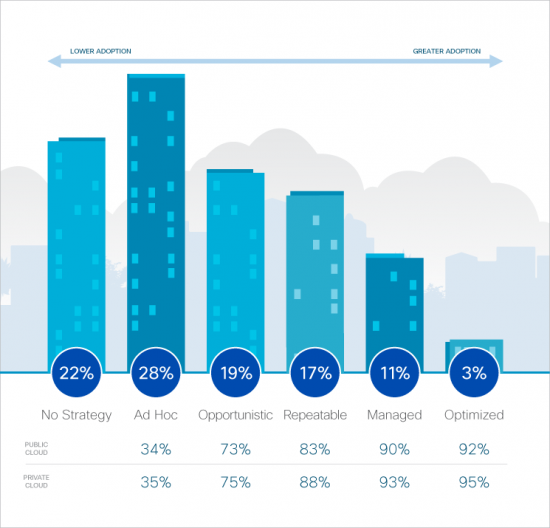
Over the last year, we’ve seen a significant shift in enterprise cloud strategies. What used to be about cost cutting, has become more about how to transform and digitize business. It’s all about innovation. CIOs we talk to are ready to make cloud investments to help solve business problems and bring better business outcomes. While cost is still important, the value they see from cloud goes beyond cost and focuses on how cloud can speed innovation while maximizing security at the best possible cost. If you are viewing cloud through the single lens of cost reduction, you may be missing a bigger opportunity.
IDC categorizes the maturity spectrum of cloud adopting organizations from ad-hoc (beginning awareness and immediacy to adopt) to optimized (mature and delivering IT-enabled products and services). IDC cited, that as companies execute their cloud strategy and move along the cloud adoption curve from ad-hoc to optimized, they see greater benefits and are able to more strategically allocate their IT budgets to innovation.
Source: IDC InfoBrief, sponsored by Cisco, Cloud Going Mainstream. All Are Trying, Some Are Benefiting; Few Are Maximizing Value. Sept. 2016.
Investments in cloud have evolved beyond just one thing like migrating workloads. New, day-1, born in the cloud applications are opening up opportunities for businesses to interact with customers in completely different ways and improve business models. Cloud providers are on board and are rapidly pushing out applications and enhancements that help businesses do more. For example, AWS releases new features daily and released over 1000 new services and features in 2016. Enterprises are also shifting their thinking and using multiple IaaS providers and cloud services with different tools, APIs, and SLAs. They are choosing where to run each workload to get the best productivity benefits and experience based on the outcomes they want to achieve.
It’s no longer about doing the same thing you were doing before, but cheaper. The future is about how you transform, reinvent your business as a digital business, and build a strategy focused on the broader business outcomes that cloud delivers.
As long as there have been banks, there have been bank robbers. In the past, bank robbers may have held up bank tellers at gunpoint. Today, threats are less visible—but just as frightening. This weekend’s massive ransomware attack demonstrated just how pervasive, far-reaching, and devastating a cyberattack can be.
What is ransomware?
Even if you hadn’t heard the word “ransomware” before, after this weekend, you’re probably talking about it quite a bit (or at least reading about it). On Friday, a global ransomware attack hit thousands of computer systems—and is being called “the biggest cyberattack the world has ever seen.” Organizations such as the UK’s National Health Service (NHS) and global companies like FedEx were affected by the ransomware strain, known as WannaCry.
Ransomware is a type of malware that encrypts data, making it impossible for the owners of that data to access it unless they pay a fee. In this case, the WannaCry virus spread through a vulnerability in Microsoft Windows software. Although the “hole” in the software that allowed the virus into the system could have been patched by a free upgrade from Microsoft in April, many computers that were infected were out-of-date devices that were likely not deemed worth the cost of an upgrade. Some were machines involved in functions that were too difficult to take offline to patch without disrupting crucial operations. This ransomware virus was unique because it spread independently through networks to unpatched devices, without the need for a person to download a file or visit a website.
For a more in-depth review of the basics of ransomware and how to comprehensively protect your organization, download our free eBook or explore our ransomware resource page.
Cybercrime and financial services: Not a new relationship
Though this week’s WannaCry attack was one of the most visible and widespread cyberattacks, it wasn’t the first, and it won’t be the last. The 2016 Cybercrime Report from Cybersecurity Ventures predicts cybercrime will cost the world in excess of $6 trillion annually by 2021, making it more profitable than the global trade of all major illegal drugs combined. Cyber criminals can be ruthless and cunning, striking quickly inside a tiny window of time or space with temporarily limited security.
Most major financial services firms have major technical controls, staff, and processes in place, but many smaller banks and credit unions haven’t fully invested in secure networks and IT automation to help prepare for attacks. And there are many more attacks on the horizon. According to the Cisco 2017 Annual Cybersecurity Report, for example, ransomware is growing at a yearly rate of 350%.
One of the most compelling recent examples of a cunning modern-day bank robbery occurred in February 2016 when hackers breached Swift technology to heist $81 million from the Bank of Bangladesh. The Federal Reserve Bank of New York matched a set of codes assigned to the Bank of Bangladesh inside a series of 35 transfer requests and transferred $81 million of the Bangladesh bank’s money to the Philippines.
Is cybercrime already stealing your greatest asset?
Besides the obvious and looming consequences of a cyberattack, fear of security breaches can prevent executives from spending time on larger strategic innovations. Seventy-seven percent of bank executives consider cybersecurity to be their “most concerning issue.” A major roadblock to digital innovation in large banks is the fear of a data breach as well as the resulting regulatory fines. In a recent Cisco study, 71% of banking executives said concerns over security are hindering their ability to innovate, and 39% say they have stopped a mission-critical initiative because of security problems.
Register to attend a special “WannaCry” ransomware webinar that three of our top cybersecurity intelligence team leaders will host on Thursday, May 18 at 1:00 p.m. EST / 10:00 a.m. PST. The webinar will feature an in-depth discussion and review of the history and recent surge of these attacks and help you identify what your organization can do to protect itself from future attacks. All attendees will have an opportunity to ask our security experts questions during a live Q&A.
To gain competitive advantage, you need to get things done faster and we can help. Moving fast is critical in the disruptive economy. It is no longer just Uber in transportation and Amazon in retail that are disrupting industries. Traditional industries like agriculture and financial services are changing rapidly. One of every two CEOs believes their organization will be significantly transformed within three years!
New research shows that speed is the next business differentiator. How fast a company innovates impacts its bottom line, according to a research team from MIT and Stanford. Top innovators outgrew median innovators by 1% to 3% per year, every year. Given that 10% is a fast rate of growth for most companies, an extra few percent amounts to a significant edge. In short, speed counts.
Collaboration technology has the power to speed people, or slow them down. This is especially true when it comes to teamwork and delivering on big ideas. People have technologies for simple tasks, like email, phone calls, and conferencing. But when a project involves a group and takes place over days or months, those siloed tools cannot keep pace. In a recent Forbes column about Cisco Spark, Patrick Moorhead writes “Businesses are finally realizing they need new ways to work, collaborate and meet.”
Working at speed requires:
Instant information: Mobile devices are our window to the world in our personal lives. Our office tools need be just as effective at helping us find immediate answers.
Magical experience: No technology delays. No technology learning curves. No visible technology causing friction and slowing us down.
Teamwork: Every member must be able to access the same tools and information at any time, and to create together.
Earlier this year, we introduced Cisco Spark Board and the Cisco Spark Room Kit, physical extensions of online Cisco Spark spaces. These devices give you the same app-based file sharing, whiteboarding, chat, and conferencing inside and outside the meeting room. Teams can innovate at speed. Cisco customers like Facebook and Tableau Software, a visual analytics company where “innovation is the lifeblood,” agree.
“The ability of the Cisco Spark and Cisco Spark Room Kit ecosystem to extend the collaboration lifecycle beyond the meeting room will allow our teams to be productive before and after the meeting.” – David Levinson, Tableau
“We do a lot to encourage collaboration among our teams,” David Levinson, Tableau’s unified communications manager, told us. “The ability of the Cisco Spark and Cisco Spark Room Kit ecosystem to extend the collaboration lifecycle beyond the meeting room will allow our teams to be productive before and after the meeting.”
We’ve also introduced machine learning as another element of Cisco Spark’s magical experience. “We are already impressed with the great features of the Cisco Spark Room Kit, such as the ability to detect people in the room and digital speaker tracking – both are effortless,” according to David.
Dave Michels, founder of Buffalo Communications, also sees the value of machine learning to improve access to information. In a recent Network World article, Michels writes “Cisco has previewed a planned feature that displays each participant’s name on screen. This will facilitate collaboration and improve analytics. For example, it may be possible to search recordings for a meeting with ‘Stan and three others.’”
Magical experience also comes from good design. Facebook is known for its strong culture of collaboration and focus on user experience. The Facebook team said, “We really like the design aesthetic of the Room Kit and think it will perform well in our environment. It’s a great fit for multiple room types, which is a definite requirement for Facebook. We are looking at these tools for wide deployment.” The expert panel at Red Dot also recognizes the value of good design, awarding the complete portfolio of Cisco Spark Board and Room Kits with Red Dot design awards this year.
Innovation and speed make the difference for our customers, and it drives everything we do at Cisco.
I’ll be giving the keynote at UC Expo 17 in London on May 18. Join me to hear more about using collaboration to your advantage in the disruption economy.
What comes to mind when you think of Durham, North Carolina? If you’re like most people, it’s probably one of three things: minor league baseball, Duke basketball, or tobacco.
The 1988 film Bull Durham cemented the town’s notoriety and the Durham Bulls as one of the most famous minor league franchises in sports. Coach Mike Krzyzewski took over the Duke basketball program in 1980 and turned the team into one of the elite programs in college sports. Tobacco, on the other hand—which was one of the city’s founding industries—is long gone (with the last tobacco operation leaving the city in 1999). Since then, the old industry factories have become chic urban lofts, breweries, and restaurants.
AWNC is the leading manufacturer of power transmissions.
However, the industrial sector is alive and well in Durham–and in many cases, is thriving right along with the region’s technology hubs. One example is the company AW North Carolina (AWNC), which is just nine miles from downtown Durham and boasts a 1.3-million-square-foot factory and more than 2,000 employees. It produces more than 600,000 transmissions a year for Toyota in the United States. It’s a highly complex operation with 700-800 parts incorporated into the final product and around 3,000 final products shipped out the door daily.
As the company grew, however, it realized that its outdated network was becoming a bottleneck to its complex operations. Data, process improvements, and reliable communications were critical in ensuring that the company could eliminate downtime and improve productivity on the factory floor.
“Over the past year, AWNC has made a huge technology leap. We got rid of our outdated communications and networking equipment and replaced everything with Cisco,” said John Peterson, General Manager of Information Technology at AWNC.”
AWNC has deployed a 450-line Cisco Business Edition 6000 Unified Communications system in its offices. It has installed an optimized Cisco Connected Factory network infrastructure with access points and controllers for seamless and secure Wi-Fi coverage to more than a million square feet of factory floor. A new FlexPod system provides integrated computing, networking, and storage to support new applications.
The result has been zero-network downtime since the installation and has allowed the company to build on a foundation for cloud computing, as well as implement new enterprise resource planning (ERP) and manufacturing execution systems (MES).
“It’s already paying off with faster speeds, lower power consumption, and the ability to process data like never before. The best part is that with all of these improvements, we actually lowered our overall IT operating costs. We’ll save over $1 million in technology costs this year, and we have a reliable, secure platform to build on,” said Peterson.
AWNC’s remarkable transformation has gained notice in the industry and is featured in the following publications:
When news broke last week of cyber attacks threatening systems in nearly 150 countries, the first thing I did was rush to make sure my home PC was protected. (It was.) It’s likely that individuals and organizations—including K-12 schools, colleges and universities—the world over had the same reaction, especially as word of the ransomware’s demands for thousand-dollar payoffs spread like the virus itself. In fact, “Prioritize cyber-hygiene,” that is, ensuring regular software patching and rigorous password management, is one of the three guiding security principles outlined in the Cisco whitepaper Tackling the Ransomware Threat: Guidance and Recommendations for Schools and Universities.
“Build user awareness,” another guiding principle, notes that the weakest link in any organization’s security structure is its users, not because they’re malicious, but because they’re human and cyber threats are often transmitted in attractive packages. (At home, my “weak link” and I share a PC, which is one reason I moved so quickly to check its status.) Though it isn’t entirely clear yet, it is possible that the WannaCry ransomware attack making headlines today was propagated through phishing emails or malicious website content.
So far, only colleges and universities in Asia have reported falling victim to the latest ransomware attack, but K-12 schools, colleges and universities—which balance the desire to offer ubiquitous access with the need to ensure security and protect privacy—are common targets of cyberattacks such as phishing or other attempts to access sensitive data. Institutions across the U.S. and around the world have paid the price: from tens of thousands (if not millions) of dollars in “ransom,” to mandatory investments in costly identity protection services for students whose data has been stolen, to lost federal funds. According to Cisco’s 2017 Annual Cybersecurity Report more than one-third of all organizations that experienced a breach in 2016 reported substantial customer, opportunity and revenue loss of more than 20 percent.
It is no longer a matter of “if” your organization will suffer a security breach; it’s a matter of “when.” And for many, “when” has already happened—the breach just hasn’t been discovered yet. This is why the final guiding security principle for tackling the ransomware threat is “Assume that breaches have taken place.” In this way, you can look at the entire threat spectrum—before, during and after an attack—to protect, detect, or remediate any malicious activity that comes your way.
Ransomware and other cyber threats can be frightening and understanding all the variables can be a daunting task. Attending this upcoming webinar is one way you can find out more. You’ll also find some other great resources here.