Avatar

Legacy networks are at risk. Faced with increased security risks, an explosive growth in IoT, mobility & access issues, and new cloud-based consumption models, these old networks must evolve; evolve to the new era of intuitive networking.

The new era is introducing a multitude of new devices that range from mobile devices and video endpoints that need high capacity and scale, to low power sensors with varying latency and bandwidth needs. In the new era, driven by advancements in IoT, various IT and Operational Technology (OT)  services are converging. In the new era mobility is taken for granted, and network boundaries don’t exist. In the new era, the threat landscape has expanded with an ever-growing attack surface. In the new era, users expect robust connectivity and a consistent, secure experience for accessing applications in the public and private cloud. And in the new era users, devices and services seamlessly interconnect to enable the consumption of services across the network.

Digitization is a boardroom conversation for all leading organizations. Whether it is a retailer trying to transform in-store experiences, or a hospital that needs security and privacy for its patients, or an office creating an engaging workspace for its employees, a digital ready network is foundational. More than ever before, organizations need the network to aid and abet innovation, and not stall and hinder progress. The network needs to powered by intent and informed by context, continuously learning and adapting.  It needs to evolve into an agile platform that drives innovation across various business processes from enabling access, and ensuring policy and control, to allowing visibility and assurance, the network should simply work. To that end, the following network functions become critical:

Automate Everything, from Edge to the Cloud

Increased IT agility and speed foresees the need for automation. Automation is needed to Design, Build and Run the network. From image and configuration management and user and device onboarding, to enabling operations that optimize application performance and end user experience, automation is fundamental for faster delivery of services. APIs, as the new global currency for networking are a necessity in the new era. The use of APIs will drive advanced automation on programmable, intent based infrastructure, such that intelligent network functions don’t remain daunting and cryptic, but become intuitive, the new normal.

Secure Everything, Based on Intent

Security breaches are a huge financial risk. In the new era, the threat landscape has increased, and perimeter security is simply not sufficient. With about 50% of the network traffic now encrypted cyber-attacks are also encrypted.  To protect, and to effectively detect and respond to threats, security must be integrated into the network. Trusted hardware, that is first hitless itself, and which enables secure access and sophisticated threat detection – even for encrypted traffic – is critical. Beyond that, a network powered by intent, expressed as a policy, will automatically segment users, things, applications, and data to secure assets and restrict threat proliferation.

Drive Outcomes Through Context

Enterprises spend significant resources in the ongoing management of their network, with up to 3 times the dollars spent on managing the network than on the infrastructure itself.  Whether it is network health monitoring, change management, load balancing, detecting failures, or diagnosing and debugging issues, it takes time, which draws organizations away from their core focus of running their business. The ability to easily collect, manage and analyze data will create winning organizations. In the new era, the network will become a fully automated system that provides contextual insights into users, devices and applications; and that can self correct and enable intelligent decision-making and outcomes.

Cloud First, Edge Ready Applications

The proliferation of cloud applications continues to transform traditional architectures and traffic patterns, ushering a need for organizations to re-architect their network. And now, with the emergence of applications at the edge for IoT control, firewalling, intrusion prevention, network monitoring, telemetry, and analytics, the network needs to be ready for applications hosted anywhere. The network will evolve, to not only enable consistent secure access from edge to the cloud, but also enable hosted applications at the edge.

In the new era of intent driven networking, we must evolve. The opportunity is immense and organizations must seize this opportunity to reap the full rewards of digitization. For an organization to transform, the following are fundamental –

  • A new culture that drives and rewards innovation. A traditional culture with restrictive change management and stringent approvals has paralyzed organizations. In the new era, we must adopt new tools and processes.
  • Investment in people with new skills and capabilities in the cloud, DevOps, software, APIs and analytics.
  • Cost and functional innovation. Full automation will enable organizations to tackle higher priority business problems.
  • A closer partnership between network and security teams to design and implement the most secure, most agile and comprehensive architecture to protect their business.

The new era of intent based networking is here. How do you believe organizations will transform? What help do organizations need to embrace this new era? I would be interested in your thoughts.

For more information on the Catalyst 9000, SD-Access or the Network Intuitive, click here.

#NetworkIntuitive

Authors

Sachin Gupta

Senior Vice President, Product Management

Cisco Intent-Based Networking Group

Avatar

What a great year to be at Cisco Live! There was so much going on—from visionary keynotes to the World of Solutions exhibits, to the many sessions that let attendees go deep into the areas that interested them. What I heard and saw challenged my thinking in some areas, and confirmed what I’ve been learning in my work with Cisco’s Hyper-Innovation Learning Labs (CHILL). It’s an exciting time for innovation. And Cisco Live was an especially good time to CHILL when it was 106o outside!

Here’s my photo diary of the week, with my countdown of top five moments:

5. Innovation is born through thoughtful, exploratory questions.

There are many ways to innovate, but they all start by asking questions. I was glad to see this hands-on example of physical-world crowdsourcing to truly understand what makes a good patient experience. When we design a CHILL Living Lab, we always start with questions: What area is ripe for disruption? Where does Cisco have a unique opportunity to drive an industry shift? What other companies have the innovation and strategy alignment to stand shoulder-to-shoulder with us to create that change? And what needs are not being met by current solutions?

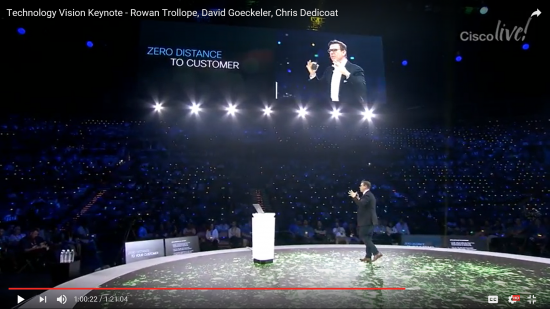
4. Companies don’t care about technology, but what technology can do to create “zero distance to customer.”

In his Day 2 keynote, Rowan Trollope declared that in today’s new data economy, winners are the people with the most data, who can derive the best insights from that data, and connect it to effective action. This capability creates a level of intimacy with customers that meets their needs at a deep and satisfying level. One example is the wearable mobile personal emergency response system (mPERS) developed by Cisco Jasper’s partnership with Jupl and Samsung. This is a great system for elderly or disabled people to keep in touch with caregivers, friends, and family—and to summon help if needed.

3. It was fun to have my 15 minutes of fame on Cisco TV.

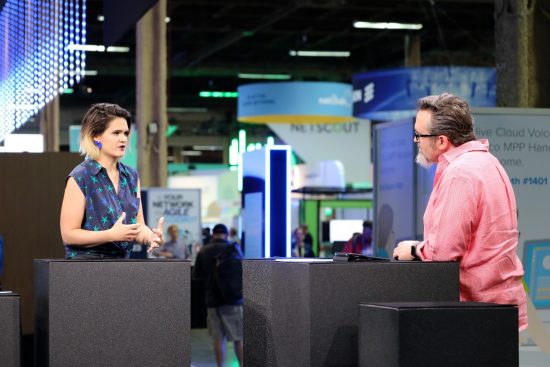
I had a great time on Cisco TV Tuesday morning talking with host Robb Boyd about what makes CHILL so special. He asked me why we bring end users into the very beginning of the innovation process. The fact is we have to be willing to kill our darlings if we want to get to the best solution. An idea can live or die on the word of an end user. In our healthcare CHILL lab last September, one group was having an intense discussion about whether to include a particular feature in the solution prototype—they felt it would make patients more likely to go to the hospital ER, which the hospital might like, but the insurance company would not. So they posed the question to a cancer patient right there and then, who said, “No, you don’t understand. I would sooner die than go back to the ER.” Argument over.

2. Innovation is in our DNA—the Network. Intuitive.

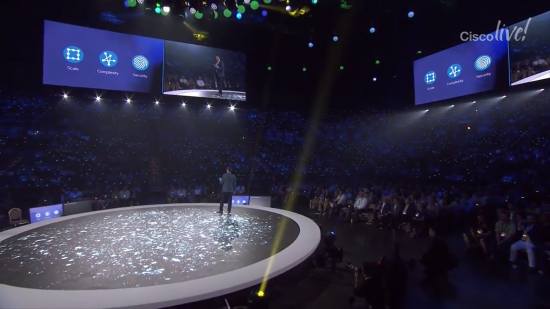
At first I thought it might be tough to compete with all the buzz about the biggest Cisco launch in a decade. There was certainly a lot of excitement as Chuck Robbins introduced Cisco’s new intuitive digital network architecture—the DNA Center, the blazingly fast new Catalyst 9000, and incredible new capabilities like being able to detect and stop malware hidden in encrypted traffic. But it turns out that this reimagined network doesn’t compete with the message of CHILL it reinforces it. In fact, it’s just what we need to accelerate the innovations that come out of a CHILL lab—innovation not limited by capacity or complexity, a network designed to speed solution implementation at scale.

And, my #1 snapshot from Cisco Live U.S. (drumroll, please!):

1. “CHILL! I’m In.”

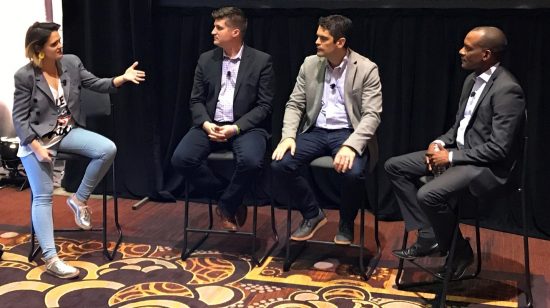
What a pleasure it was to introduce the panel of CHILL alumni during my session Wednesday afternoon, “Let’s CHILL: Industry-Wide Innovation on Hyper-Drive.” Richard Ebach, CIO of DB Schenker, talked about rapid prototyping and the progress his company has made since the most recent CHILL lab, developing blockchain technology to secure the supply chain. Brad Haczynski Managing Director at Intel discussed new opportunities in the deep partnership between Cisco and Intel—and showed his superhero power as an impressionist! Who knew he could double as John Chambers?  And I was especially excited to introduced Mike Jordan, acting CEO of MyWays, who talked about his experience as a serial entrepreneur—moving from a startup in the connected car space to improving the healthcare experience of cancer patients. I loved his insights on what it takes to build a startup from scratch.
We live in a world of exponential change, touching every area of our lives. The next CHILL lab in November will explore how technology will change the Future of Work. To prepare for the Living Lab, we are selecting customers to go on an invitation-only Learning Journey in the San Francisco Bay area on July 26 to see how the workplace is already changing in some of the most innovative companies. Would you like to be invited? Simply tweet #chillimin to @kateokeeffe or comment below and we’ll get back to you. Are you in?


Authors

Kate O'Keeffe

Senior Director

Customer and Partner Innovation

Avatar

What if your network could help you personalize care, streamline clinical workflows, optimize business operations, and facilitate security across your organization?

Cisco DNA for healthcare means faster, flexible deployment and simpler management of an intelligent network to help your IT teams get up and running in days instead of months. “By building a more intuitive network, we are creating an intelligent platform with unmatched security for today and for the future,” said Cisco CEO Chuck Robbins on announcing The Network. Intuitive.

Cisco DNA for Healthcare enables you to:

  • Personalize engagement for patients and care givers, from mobile wayfinding to seamless scheduling to data insights that can lead to better care
enter
  • Improve business and clinical communications across the care continuum, creating a more mobile workforce with secure wireless access to telehealth applications, patient data, and resource tracking
enter
  • Streamline operations through simplified networks, automatic provisioning, and consistent network-wide management, enabling lower costs and faster deployment
enter
  • Facilitate security for patients and research through network-as-a-sensor threat detection, containment, and response
enter
  • Enhance protection for medical devices, including context-aware access control to guard against ransomware

Cisco DNA for healthcare is revolutionizing how you design, build, and manage your hospital, clinic, and research networks. Check out the infographic below to learn more about what the intuitive network can mean for you.

Stay tuned for two more installments in our Cisco DNA for Healthcare blog series, which focuses on network security for healthcare and what you can do to make your hospital digital ready.

Learn more about DNA for Healthcare at cisco.com/go/dnahealthcare.

Authors

Sarah Struble

No Longer at Cisco

Avatar

On Tuesday we announced Cisco Kinetic, a first-of-its kind IoT operations platform designed to unlock the power of data from the billions of connected devices being added to the network.

In recent years, companies across the globe have embraced the idea of a hyper-connected, digital world. Now I’m starting to see a level of maturity within those companies, an understanding that they need to move beyond the test-and-learn phase to truly master IoT as a way to drive massive business growth.

At Cisco, we’re committed to making it faster and easier for these businesses to get their IoT initiatives from proof of concept to implementation to scalable bottom-line results. Cisco Kinetic will help companies accelerate their progress by leveraging the network, automating management of their IoT devices, and extracting value from the terabytes of IoT data at their disposal.

Cisco Kinetic does this by solving three substantive IoT challenges for companies, within a single platform:

  1. Easily connect their devices on the world’s enterprise networks
  2. Benefit from a highly distributed computing environment to deliver fast decisions
  3. Ensure data is securely extracted and routed to where it can deliver the most value

Connection Management

The sheer scale of IoT demands a new, automated way to onboard, authenticate, monitor, and manage IoT devices. There are billions of devices yet to be connected, and as we’ve learned after 10+ years in IoT, ensuring that every connection works as flawlessly on day 3000 as it did on day one is absolutely critical.  After all, if you can’t get the data from the device to an end point, nothing else matters.

Cisco Kinetic is designed to solve that problem by deeply understanding how to turn connected things into trusted IoT devices, and making the enterprise network a welcoming, secure place for those devices to connect.

Imagine you’re installing a connected vending machine – or a copier, lightbulbs, a security system, etc. – in an office building. As the manufacturer of that IoT device, you simply want to plug it in and walk away and know that it will work as intended. With Cisco Kinetic – coupled with Cisco DNA Center – we’re streamlining and automating the complex processes of getting the local network to recognize it, authenticate it, apply the right kind of policies, and ensure the data gets to its intended destination without co-mingling it with other devices on the network. And when you want to add other devices, we apply the same principles, giving everyone the tools needed to ensure working connections throughout the service lifecycles of these products.

Fog Computing

One critical effect of connecting billions of devices is that computing will be highly distributed – from the public cloud down to the furthest reaches of edge devices, and everything in between. The simple truth is that, when devices are generating terabytes of data, it’s not practical to send everything offsite.

Cisco Kinetic addresses this by significantly increasing the efficiency of how and where data is processed, automatically determining what needs to stay local, be shared on site, or delivered to the cloud. With fog computing, we make it possible to process data at the edge and execute fast decisions close to the action, when and where that information is needed most.

Take the example of Chevron, who realized it was inefficient to send massive amounts of data thousands of miles from oil well sensors to the engineers responsible for optimizing their production. With Cisco Kinetic, they now can process much of that data onsite, then parse and send only the essential data to the subject matter experts in Houston, Texas. As a result, they have been able to reduce time-to-decisions from 2 weeks down to a matter of seconds. This approach also reduces bandwidth needs and latency, helping companies like this to manage costs while extracting maximum value from their IoT hardware and network.

Data Delivery

One of the biggest challenges in IoT is how companies can extract maximum value from the terabytes of IoT data at their disposal. Cisco Kinetic helps companies achieve this by making it easy to extract, normalize and securely deliver data, across all the participants of an ecosystem, based on rules defined by the data owner(s).  We play a vital role in enforcing the rules that have been negotiated between parties.

One example of this is some of the work we’re doing with Industrial Machine manufacturers like FANUC or Makino, who benefit greatly from extracting data from their products running on a factory floor.  However, many of those factory owners are concerned about enabling a connection to a 3rd party and what data is being collected and shared with whom.  Cisco Kinectic is there is ensure both parties – the Thing Maker and the Thing Owner – get access to the data they are authorized to access, while protecting the connection from threats and vulnerabilities.

The Foundation for IoT Success

By consolidating Connection Management, Fog Computing, and Data Delivery within a single platform, Cisco Kinetic will help enterprises accelerate the path from proof of concept to implementation, give our partners a powerful foundation on which to build additional services, and enable companies worldwide to maximize the value of their IoT data.

For questions or more information, e-mail to CiscoKinetic@cisco.com.

Authors

Macario Namie

Head of IoT Strategy

IoT Business Group

Avatar

As part of our work to positively impact one billion people by 2025, Cisco seeks to inspire and empower a generation of global problem solvers to thrive in the digital economy.

Through the first-ever Cisco Global Problem Solver (GPS) Challenge, we are able to recognize the vision and accomplishments of social entrepreneurs who are students and recent grads.

Ten winners were awarded a total of US$300,000 in funding to promote and accelerate breakthrough technologies. Their ideas leverage the Internet of Things (IoT) to help benefit our economy, society, and the planet, as well as promote inclusion.

The 1st annual GPS Challenge was an intense competition that began with more than 1100 registrants from 450+ schools around the globe. I’m inspired by their work and excited to announce our inaugural winners:

Grand Prize (US$100,000): Project Vive from Pennsylvania State University

This team aims to provide significantly better and more affordable tools for people with communication disabilities. Their wearable sensors enable communication via finger, elbow, knee, foot, and movements to give a voice to the voiceless.

First Runner Up (US$75,000): DOT LEARN from Massachusetts Institute of Technology

This team is architecting a video-based online learning platform that works reliably on inexpensive smartphones and even 2G connections to extend educational access to a greater cross-section of the population, including a pilot in Ghana and Nigeria aiming to reach 100,000 end users across Sub-Saharan Africa.

Second Runners Up (US$25,000 each)

  • PathVis from Purdue University is developing a smartphone-based disease detection platform that quantitatively measures the level of pathogens in patient samples and the environment with real-time location data.
  • Solistice Energy Solutions Inc. from Stanford University is designing SHYFT, a hardware/software platform enabling the next generation of distributed energy management.
  • Smart Bandage from University of Waterloo (Canada) is creating patented inkjet-printed IoT sensors that provide real-time data to monitor early warning signs of chronic wounds.

Third Runners Up: (US$10,000 each) 

  • BYU Village Pump from Brigham Young University is improving water pump design and integrating sensors to monitor operations and trigger alerts when maintenance is needed.
  • Forest Devices Inc. from Carnegie Mellon is designing a first stroke screening device that can be used by all medical personnel in any environment.
  • myBalanceSens from Temple University is developing smart glasses to enable users to improve their balance and reduce the risk of falling.
  • Baby Bloom from Columbia University is designing an IoT-based lactation tool that automatically tracks pumped milk production and uses machine learning to personalize lactation plans.

People’s Choice Award (US$10,000): ODA Systems from Instituto Technológico de Costa Rica 

This team captured the hearts and imagination of the general public with their service that efficiently measures lubricant oil quality in machines to decrease pollution and reduce economic waste while concurrently boosting productivity.

Additional Finalists

Lastly, I’d like to recognize these five finalists for their outstanding work. Simply making it to the finalist pool signifies that a team has been singled out during a rigorous review and evaluation process for its merit, novelty, and potential to benefit society:

  • Pass.ng from Ladoke Akintola University of Technology in Nigeria is helping students learn and prepare ahead of time for required exams.
  • OneMedical Global Inc. from John Hopkins/Emory is customizing existing medical record management technology to meet the particular needs of the African market.
  • InSight Imaging Mobile Retinal Imaging from Washington University in St. Louis is designing low-cost, portable, and noninvasive retinal imaging using a smartphone attachment to enable accessible ophthalmological screening.
  • VITA from University of Campinas in Brazil is using image processing and information communications technology to enable fast and reliable pap tests.
  • Centree Technologies from Georgia Tech is building smart city solutions that use microphones to detect emergencies and automatically report them.

Congratulations to all of our winners and finalists. I’m already looking forward to our next competition and seeing the amazing ideas and work taking place around the world.

To learn more about our efforts to accelerate global problem solving, please sign up to receive our email updates.

Authors

Tae Yoo

No Longer with Cisco

Avatar

As an early adopter of Instagram, signing on for the first time in January 2011, I know how important photography is. Heck, I was a photographer in a past life! And it should be no surprise that on the WeAreCisco Instagram account, we’ve seen over and over how many great photographers Cisco has as employees. They’re some of our most avid #WeAreCisco advocates!

For National Camera Day, we wanted to introduce you to just a few of the #WeAreCisco Shutterbugs along with some of their favorite shots, below.


Ileana Cates — Raleigh, North Carolina USA

My favorite Cisco photo taken was of my team members for the WeAreCisco Snapchat snapcode photo. I love it because it was a great example of Cisco in so many ways. My co-workers were flexible and excited enough to jump in after I asked out of blue who’d be up for a quick photo opp. Six of them volunteered to help me and they all had great fun with it, responding well to my direction. I also felt that the group who volunteered represented our diversity which is one of my favorite things about Cisco. This photo wound up being used, in a way, to represent the “face” of Cisco for our WeAreCisco Snapchat account — even being featured on the Nasdaq Tower in Times Square, NYC! To have our own employees featured this way confirms the genuine voice behind WeAreCisco.


Pete Kavanagh — Galway, Ireland

After a long day at Cisco Galway for our Women in Tech “Girls Power Tech” event, it was great to capture the youthful energy of these young ladies. Community outreach is a big part of Cisco, and having our own established Women in Tech here at Cisco share their experiences and career advice with the next generation – and seeing the excitement around STEM! – really made me feel like we have a bright future.


Jarrod Weise – Phoenix, Arizona USA

I didn’t realize what I had captured until I went back and looked at the raw file of this image. Great moments like this one sit inside the data. No different than what we do as marketers everyday or our customers and partners at Cisco. This photo inspired me to keep looking at the real world and capturing these moments as I encountered them.

When you spend your day doing digital, physical becomes pretty important. It’s also a reminder of what we do here at Cisco and how that sits just beneath the surface – our technology makes the real world possible!


Yana Lipen — Krakow, Poland

Sometimes we work hard and sometimes we have a little break from work! ❤ In Cisco Krakow we have very cool play-rooms for downtime that help us to unwind or even brainstorm a bit with colleagues. I definitely love capturing moments like these around the office that showcase our fun, laid back side as well. Hard work deserves hard play! 😊


Leah Streeper — Raleigh, North Carolina USA

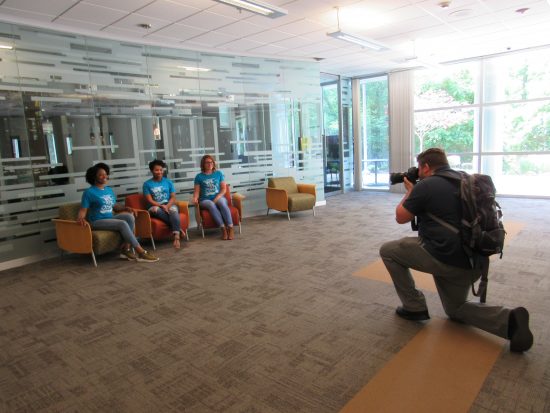
I love this picture from the Cisco RTP photoshoot. I loved getting to meet people from all over the company, and seeing how everyone would light up while getting their pictures taken – knowing they might soon be on Cisco’s new careers site! It’s incredible how connected Cisco makes you feel.

Be sure to follow the @WeAreCisco Instagram page as the Shutterbugs work pops up there quite a bit! Are you passionate about photography or Instagram as well? Reach out to Casie on the Talent Brand Team to Join the Shutterbugs!


Want to join a company that encourages your passions? We’re hiring!


Authors

Casie Shimansky

Content Strategist | Provider of Pixie Dust

Employee Storytelling

Avatar

Strategize, Digitize, Analyze

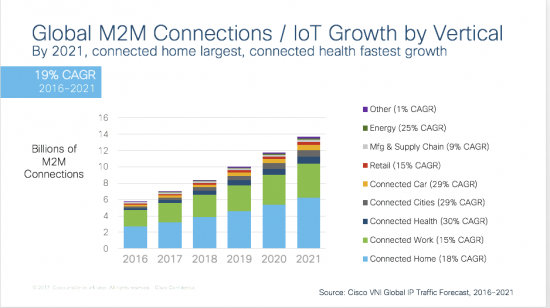
The latest Cisco VNI Complete Forecast update forecasts that for the first time in its 12-year history, there will be more M2M connections than end-user devices such as smartphones, laptops, TV sets, etc. By 2021, there will be 13.7 billion machine-to-machine (M2M) connections globally, accounting for 51% of the total IP connected devices and connections. This represents an average of 1.75 M2M connections per capita globally – demonstrating how pervasive M2M connections are going to become to our networked lives making Internet of Things (IoT) a reality.

Globally, the largest segment of M2M applications is going to be in the connected home (46% of the total M2M connections by 2021). This segment includes applications such as home automation and security, network equipment (printers, routers, etc.), white goods (connected refrigerators, HVAC control, etc.) as well as human and personal asset tracking. The fastest global growth, however, is going to come from the connected health segment, which includes health monitors, medicine dispensers, telemedicine, applications for assisted living, first responder activity and more. Connected health M2M connections will grow at a 30% compound annual growth rate (CAGR) from 2016 to 2021.

While connected cities are the second fastest growing M2M vertical globally (29% CAGR), it is fastest growing segment in regions such as North America (35% CAGR), Middle East and Africa (56% CAGR) and Latin America (50% CAGR). Connected cities includes M2M applications such as environment and public safety (CCTV, street lighting, waste removal, et al.), public space advertising, public transport and road traffic management.

There are multiple examples of connected city advancements around the globe – Amsterdam, Barcelona, Dubai, San Francisco, and Singapore just to name a few. In these cities, municipalities and local governments are investing in technology initiatives to improve residents’ quality of life and safety while using resources more efficiently via the innovative deployment of M2M solutions. This is not a simple or easy undertaking. To be successful, connected city deployments require an entire ecosystem to plan, execute, and maintain a sustainable digital strategy. Approaches vary from city to city, but a common element are strong partnerships among solution or app providers, cloud/ data center providers, network operators, IT vendors, municipalities and local public administrators (as a baseline minimum). This collaboration must also be backed up with information, awareness, and training to help residents adapt to the digital transformation and understand its intended benefits.

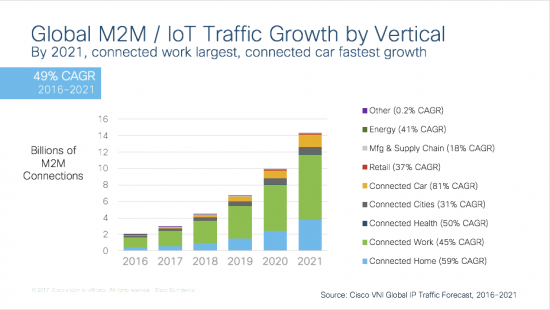
While M2M will account for 51% of the total devices and connections by 2021, they will account for 5% of the total IP traffic. My colleague, Arielle Sumits, has helped estimate M2M traffic by vertical. Connected work, with applications such as office building automation and security, office equipment and commercial appliances, will be generating the largest amount of M2M traffic over the next five years. The fastest growing segment is going to be connected cars, which is also going to be the segment with the highest ratio of video capable connections.

The world’s growing affinity and acceptance of digitization makes networks even more relevant and puts network intelligence and security at the very crux of any successful IoT implementation (large or small).

VNI Forecast Resources
Cisco VNI Complete Forecast homepage
Three Internet Trends that Warrant Global Service Provider Attention (and Action) blog
The Internet is Closer to Home Than You Think blog
• Watch Cisco VNI Complete Forecast Webcast (AMER/EMEAR or APJC)
• Check out the VNI Complete Forecast Update Infographic
• Read the VNI Complete Forecast white paper
• Read the Zettabyte Era Trends and Analysis white paper
• Launch the VNI Complete Forecast Highlights Tool
• Read the Cisco VNI Frequently Asked Questions document

Authors

Shruti Jain

Leader, Project & Program Management

X-Architecture Marketing, Enterprise Networking & Cloud

Avatar

You didn’t think WannaCry was the end of the ransomware story, did you?

This week, a new ransomware exploit began sweeping Europe and apparently made its way into the United States in a matter of hours. Although many press accounts identified the malware as Petya, Cisco’s Talos threat analysis team has documented it to be distinct from Petya and dubbed it Nyetya.

Nyetya encrypts the victim computer’s master boot record. Once it enters a system, it has several means to spread through the network. Microsoft issued patches several months ago, but unpatched systems are vulnerable.

Our U.S. Federal customers who want to be sure they are safe from the exploit can click here for the latest information from Cisco, including a rundown of our Ransomware Defense solution.

Ransomware is a type of malware that encrypts the victim’s files and promises to decrypt them once a ransom is paid. Sometimes the attackers keep the promise to set things right, sometimes they do not.

Get the scoop on the state of federal cybersecurity.

What you see if Nyetya beats your defenses.

In this case, paying the ransom (something nobody recommends doing) is already impossible: The company that hosted the address where victims were to send their payments shut down the account once it became aware of the scheme, reports The Verge.

Ukraine appears to have been hardest hit, with the attack locking data in banks, public transportation, the airport and power systems, among other targets.

The new ransomware does not yet have an obvious mechanism of transmission, according to Talos. At least some of the infections appear to be connected to software updates for MeDoc, a Ukrainian tax accounting package.

Get more of the technical details from Talos here.


Authors

Michael Hardy

US Federal SME

Cisco Americas Public Sector

Avatar

For my inaugural blog post, I want to show you how vulnerable your Internet of Things exposure can make you.

But first, about me: I’m one of four Distinguished Systems Engineers in Cisco’s US Public Sector organization and work with customers across the federal, state, local and education markets. The majority of my time is spent designing/building/analyzing architectures and the interactions across multiple technology disciplines (routing/switching, wireless, security, IoT etc.) within that architecture. I’m also lucky enough in my role at Cisco to participate in industry working groups like the Wi-Fi Alliance, where I currently serve as chair for the Security Marketing and Technical Task groups.

So how does your personal IoT exposure affect you and why should you care? Great question – it all has to do with simple analysis and correlation of information being broadcast out in the ether for everyone to consume. In this new age of constant connectivity, pervasive Wi-Fi, IoT and personally wearable devices, there is a wealth of personally identifiable information continuously being transmitted through all of a device’s interfaces:  Bluetooth, wireless, Ethernet etc.). Chances are, you are giving away a lot more information than you know.

A crowd
Pro Tip: In public spaces, keep your WiFi and Bluetooth turned off when you’re not using them.

Federal employees are not immune to this kind of vulnerability, although there is a better chance that agency-issued devices will be set up to minimize the users’ exposure. But everyone can benefit from understanding the information I’m providing here.

First, let’s look at the reason why devices transmit this information: Ease of setup/onboarding and a focus on usability. In simpler terms, the developers were trying to solve two problems: How to connect two devices easily and how to make services discoverable once the device is on the network.

In order to connect two devices with Bluetooth (say your activity monitor and your smartphone), one or both of those devices must be discoverable. When I make a Bluetooth device discoverable, by default it transmits unencrypted:

  • A friendly device name like “Bob’s-phone;”
  • Services the device has enabled;
  • Device unique identifier;
  • Additional technical information about the device, such as its manufacturer, software version and battery level.

In order to establish the secure connection, all of this information has to be made available to all devices that are within range. Freeware tools and apps are available for all types of devices that will allow you to scan Bluetooth transmissions and get a view of what types of devices are near you (roughly 100 meters away at most). The stronger the Bluetooth signal, the closer the device.

Most of us name our devices something simple and easy to spot, such as our full name or email address. As a result, your device now advertises itself and others can see that “Bob’s watch” or “Bob’s laptop” is nearby. Human nature strikes again, because we typically leave our devices discoverable all the time for convenience.

What about Wi-Fi? Once you establish a connection to a Wi-Fi network, all the devices on the network are able to share multicast and broadcast traffic among each other. To address ease of use and discovery of services and devices on the network, multiple service advertisement protocols like Multicast DNS (mDNS/Bonjour), Universal Plug and Play (UPnP), and Microsoft’s Link Local Multicast Name Resolution start once you’ve joined the network.

These protocols advertise all types of capabilities into the network (printers, file sharing, remote login, applications, device synching, etc.). These protocols were originally developed for home/consumer to allow connecting to network devices by name instead of IP Address. They send out similar information to Bluetooth across both Wi-Fi and Ethernet, if you still own a device with an Ethernet port.

Typically, these service discovery protocols are limited to an Ethernet Segment or a Wireless SSID. However, with the advent of wireless controllers, I can have a SSID that spans an entire location, campus and enterprise. With that, I can see other connected devices and what services the devices are offering. This is not very useful on its own, but let’s move on.

The interesting part is when you take these two pieces of information, which are innocuous on their own, and correlate the information being offered. Take the following scenario:

You’re connected to an open Wi-Fi hotspot in a public venue and you also have Bluetooth enabled on your device. You scan the network for services and see a device named “bsmith’s-tablet” offering a bunch of services into the network. Some of the services are for applications that synch files between devices, and which are allowing full access to some information stored on that device. By the file names, you suspect bsmith might be a federal employee with some highly sensitive information on a BYOD tablet.

As you are a good-natured IT professional and don’t want this person’s information exploited, you decide to try and locate this individual to show them the error of their ways. There is no better way than to perform a Bluetooth scan and see if the person is near your location. When you do this, you see a fitness tracker advertising “bsmith’s-watch,” with a strong Bluetooth signal suggesting the person must be close. You glance around the room and you see a young man with a federal agency’s IT tag and with the letters BS monogramed on a briefcase. He’s about 15 feet away and is using a tablet.

While each of these pieces of information (Wi-Fi connection, Bluetooth device and personal monogram) alone don’t provide a lot of insight, the correlation of multiple pieces of information does. It doesn’t take a skilled hacker to obtain this information.

The moral of the story is simple: Know what information you are broadcasting into the world.

Some tips to stay safer:

  • Turn off Bluetooth when you are not using it (or at least turn off discovery);
  • Turn off your Wi-Fi when you’re not using it;
  • Don’t name all your devices with the same naming convention (and don’t use your name);
  • Don’t leave services enabled on your device that synch files or allow remote access when not connected to a secure network.


Authors

Stephen Orr

Distinguished Systems Engineer

US Public Sector