By now, everyone’s likely heard about the top picks at this year’s NBA Draft. As expected, freshman Markelle Fultz out of the University of Washington was selected No. 1 overall by the Philadelphia 76ers. With so much hoopla surrounding the top picks on Draft Night, it’s hard not to get caught up in the excitement and emotion of the players, their families, and the fans.
But what happens after the names are announced? Once the picks walk across the stage, don their new hats, and shake hands with NBA Commissioner Adam Silver – what’s next?
As a proud Official Technology Partner of the NBA, Cisco was right in the thick of things on Draft Night, capturing both the excitement and the chaos on the media floor at the Barclays Center.
As in years past, Cisco technology powered the NBA’s Global Media Circuit – using Jabber Guest and video conferencing to connect 16 journalists from 11 different countries to eight first round Draft picks.
But there was an exciting new element in the mix this year as well, as Cisco technology connected the No. 1 and No. 2 picks to the Jimmy Kimmel Live show for interviews immediately following their selections. The Jimmy Kimmel Live team set up backstage at the Barclays Center and used Cisco video conferencing to connect the players to Jimmy on-set back in L.A. on the (Cisco!) Wall of America. Check out the clips below:
For nearly a decade, the NBA has seen enormous growth in the consumption of digital media with the help of Cisco’s technology, which allows the league to bring data and video from the court to fans around the world in real time. Cisco and the NBA are committed to enabling new fan experiences and elevating the way people experience the game they love – at home, on-the-go and in the arena.
Yesterday we announced our fifth generation of UCS servers. Today I want to take a deeper look at the M5 blade servers. Tomorrow, I’ll tackle the M5 rack servers.
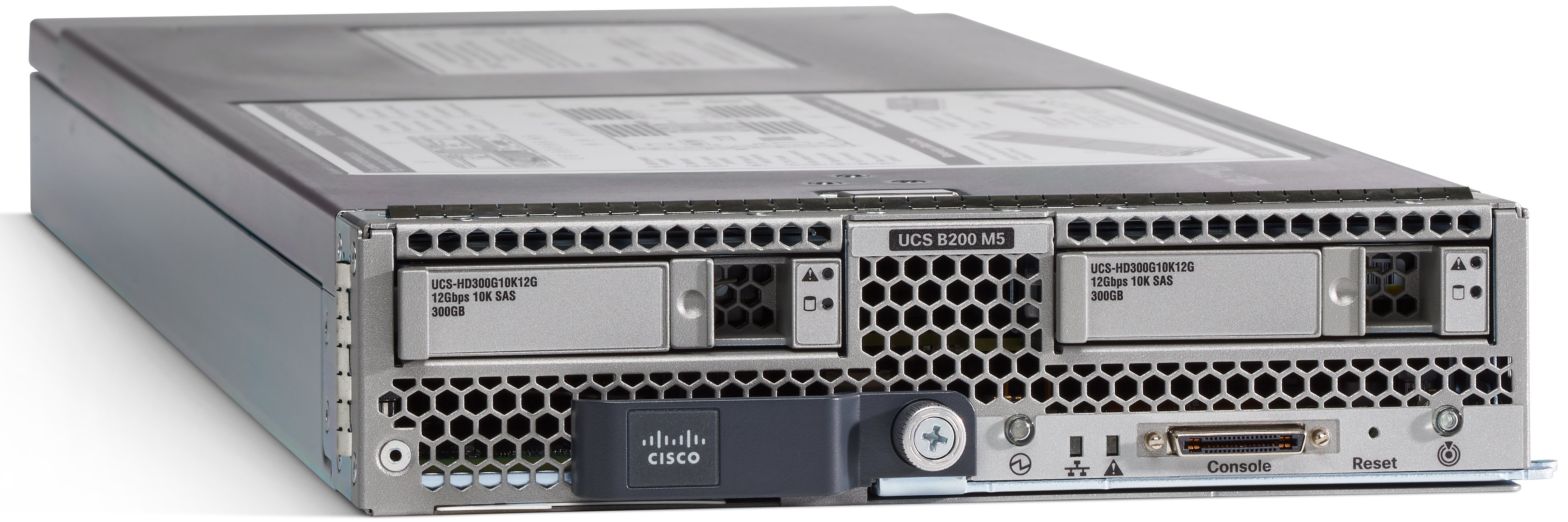
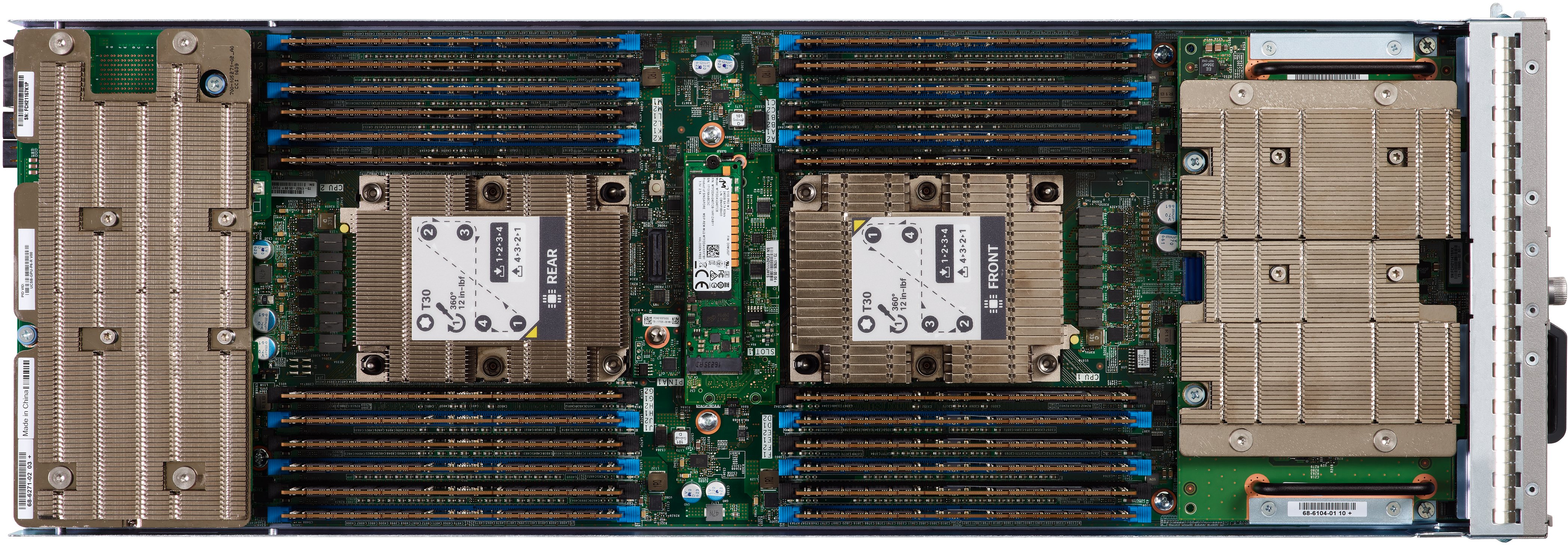
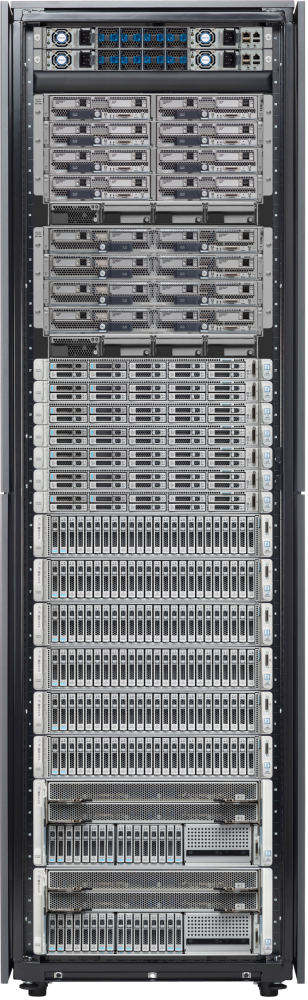
The B200 M5 Blade Server has more of everything you love. More cores, more memory, more GPUs. Based on the Intel® Xeon® Scalable processors, the B200 M5 server supports up to 56 cores (28 cores per socket), and up to 3TB of 2666MHz memory.
The two front drives and RAID controller are modular like on the B200 M4. This means if you are stateless and booting from SAN, you aren’t burdened with that extra cost. Like on any blade server, that very valuable real estate should be used for something so we added support for a second GPU. Cisco is the only server vendor offering two GPUs on a half-width blade!
Also, new to our blade and rack servers is support for dual M.2 SATA storage devices, up to 960GB. This gives you more flexibility and speed than using SD cards for your OS boot images. We will be updating the M.2 form factor to support NVMe later this year.
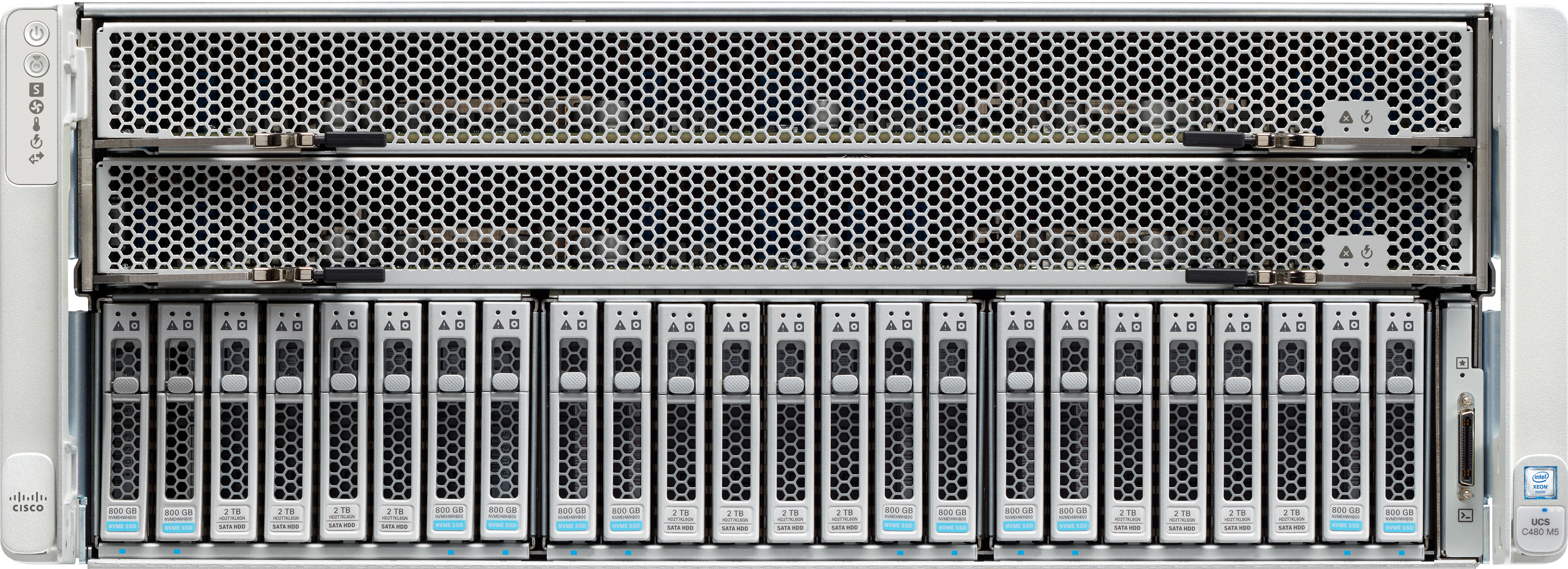
Speaking of NVMe, all of our blades support 7.7TB SFF NVMe drives and NVMe mezzanine adapters of 560GB or 3.2TB.
If two sockets and 3TB of memory isn’t enough for your application, we have you covered with the new B480 M5 Blade Server. The B480 M5 is a four socket server supporting up to 6TB of memory. With the common socket that all new Intel Xeon Scalable CPUs support (Bronze, Silver, Gold, and Platinum), we are able to simplify our blade product portfolio. The B480 M5 replaces the B260 M4, B420 M4, and B460 M4 servers. And unlike those servers, the B480 M5 supports four GPUs! Similar to the B200 M5, if you don’t need local storage, you can have two GPUs up front in addition to the two in back.
As you can see, our new blades offer very flexible configurations. You can go storage heavy with up to 160Gbps of network throughput, storage light with GPUs, or other combinations as you see fit.
Best of all, there is no forklift upgrade required to take advantage of all the new goodness! The new M5 blade servers will work in the original UCS 5108 Chassis we launched in 2009. They are also Starship ready. Starship is cloud-based management and advanced operation analytics. This generation of UCS systems has all the hooks in place for integration with Starship when that platform launches later this year.
For more information on all of our Cisco UCS M5 servers, go to www.cisco.com/go/ucs.
Today, Microsoft has release their monthly set of security updates designed to address vulnerabilities. This month’s release addresses 54 vulnerabilities with 19 of them rated critical, 32 rated important, and 3 rated moderate. Impacted products include Edge, .NET Framework, Internet Explorer, Office, and Windows.
Today we are announcing our latest generation of UCS servers based on the Intel® Xeon® Scalable processor family and 6 industry standard world record benchmarks. Since Cisco first entered the server business, we’ve been setting records and our new M5 servers are no exception.
Using industry-standard benchmarks is a great way to compare performance. With our 6 world records, Cisco continues to show how customers can accelerate their performance and get faster time to value with UCS.
Cisco UCS World record benchmark results announced this week include:
SPECjbb®2015 MultiJVM – #1 2-socket server result for Max-jOPS. The C240 M5 delivered 179,534 max-jOPS – a 52% increase when compared to Cisco’s previous result.2 Detailed official benchmark disclosure report.
SPECjbb®2015 MultiJVM – #1 2-socket server result for critical-jOPS. The C240 M5 delivered 118,551 critical-jOPS – a 65% increase when compared to Cisco’s previous result.3 Detailed official benchmark disclosure report.
SPECjbb®2015 CompositeJVM – #1 2-socket server result for Max-jOPS. The C240 M5 delivered 155,296 max-jOPS – a 45% increase when compared to previous generation #1 result.4 Detailed official benchmark disclosure report.
SPEComp®G_base2012 – #1 2-socket server for SPECompG_base2012. The C240 M5 delivered 23.1 ompG base – an 86% increase when compared to Cisco’s previous #1 result.5 Detailed official benchmark disclosure report.
It is interesting to note that although all vendors have access to same Intel Xeon Scalable CPUs, only Cisco UCS unleashes their power to deliver high performance to applications through the power of unification. The unique, fabric-centric architecture of Cisco UCS integrates the CPUs into a system with a better balance of resources that brings processor power to life. Cisco’s results demonstrate the degree to which Cisco servers deliver the power of the new Intel Xeon Scalable processors. Cisco UCS maximizes Intel innovations and with improved performance of up to 86%. You can count on both innovation and versatile performance from Cisco UCS: It’s not a server. It’s a system.
The SAP SD 2-tier benchmark with Cisco UCS C240 M5 Rack server improvement of 50% in comparison to a Cisco UCS B200 M4 Blade Server equipped with the previous-generation Intel Xeon processors. These results are available at http://www.sap.com/benchmark
The Java application performance improvement of 52% compared the SPECjbb2015-MultiJVM max-jOPS score of the Cisco UCS C240 M5 Rack Server with the previous-generation Cisco UCS C220 M4 Rack Server, a result that was available on March 1, 2016.
The Java application performance improvement of 65% compared the SPECjbb2015-MultiJVM critical-jOPS score of the Cisco UCS C240 M5 Rack Server with the previous-generation Cisco UCS C220 M4 Rack Server, a result that was available on March 10, 2016.
The Java application performance improvement of 46% compared the new benchmark SPECjbb2015- Composite max-jOPS score of the Cisco UCS C240 M5 Rack Server with the previous #1 platform result that was available on Nov 6, 2016.
The rack server parallel-processing performance improvement of 86% compared the SPECompG_base2012 score of the Cisco UCS C240 M5 Rack Server with the previous-generation Cisco UCS B200 M4 Blade Server, a result that was available on Mar 16, 2016.
The floating-point throughput performance improvement of 17% compared the SPECfp_base_base2006 score of the Cisco UCS C480 M5 Rack Server with the previous-generation Cisco UCS C460 M4 Rack Server, a result that was available on May 17, 2016.
SPECfb, SPECjbb, and SPEComp are registered trademarks of Standard Performance Evaluation Corporation. The benchmark results used to establish world-record status are based on those available at http://www.spec.org as of July 11, 2017.
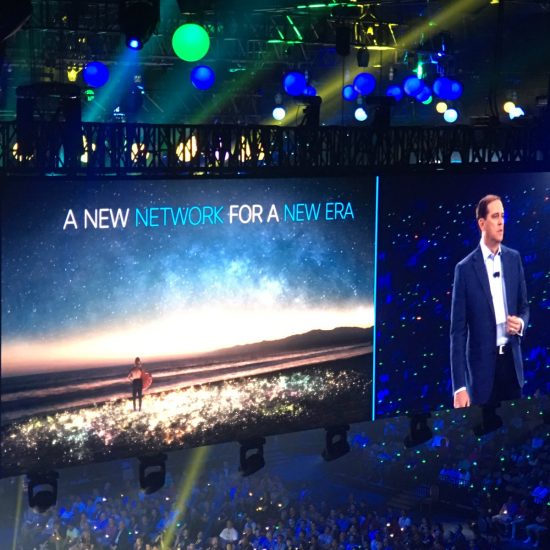
What an incredible Cisco Live event! During the week of June 25, 2017 over 28,000 people from all over the country traveled to Las Vegas, NV to take part in a superhero-themed Cisco Live. From CEO, Chuck Robbins, opening the show with surprise guest, CEO of Apple, Tim Cook, to Bryan Cranston closing the show as the final keynote speaker, it truly was a week full of energy, innovation, and fun. The continued launch of The Network. Intuitive. emphasized the introduction to a new era of networking, that constantly learns, adapts, protects, and is a real game-changer for businesses.
In addition to Chuck Robbins and Tim Cook highlighting the Cisco-Apple partnership, there were other remarkable keynotes as well. Chris Dedicoat’s Technology Vision Keynote called out the sports & entertainment Cisco Vision technology, and how companies are investing in technology and using network capability to enhance the customer experience.
https://youtu.be/Uyrs1QB8H3M
Attendees were also able to walk around the World of Solutions expo and explore the latest solutions from Cisco and take part in demos, attend sessions from industry expert speakers, and engage with our Partners to learn about the newest features and technology.
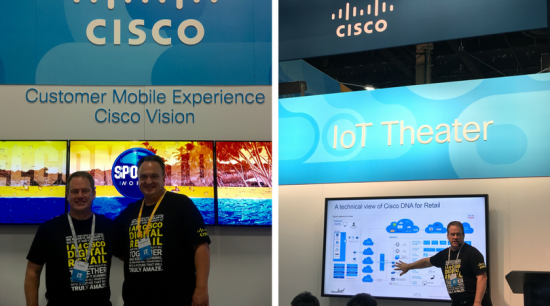
At the IoT and Industry District Booth, we had demos on Cisco DNA for Retail and how it simplifies the ability for retailers to innovate into the future. For attendees looking to find what’s driving retail transformation, Ron Kjelden led a Speaker Session on how retailers can secure the mobile experience.
Digital retail is constantly evolving, and Jeremy Witikko and Derek Dykens both spoke about their takes on digital retail, and the investments they believe all retailers should be making today.
To learn more, watch these live periscope videos featuring both Jeremy and Derek:
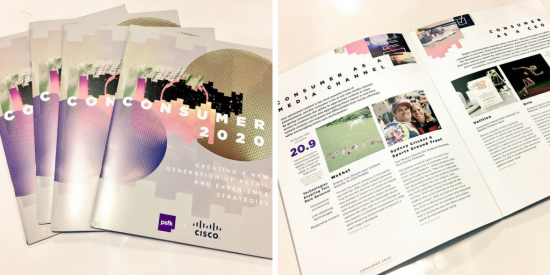
Additionally, at a time of constant change in consumer industries, attendees were also given the Consumer 2020 report. This research paper led by myself and Scott Lachut, SVP at PSFK, provides a fresh perspective on consumer 2020 and more importantly, why you need Cisco DNA to enable the customer, guest, and fan experience now and in the future. Download the report here.
Cisco Vision was also an important topic at Cisco Live this year! For the first time ever, Cisco Vision was used throughout Cisco Live in the Social Media Hub, on screens throughout all of Las Vegas MGM properties and the Mandalay Bay Convention Center, and at the state-of-the-art T-Mobile Arena. Cisco Vision was highlighted as an IP-TV digital signage solution that has expanded from the sports & entertainment industry vertical to retail, hospitality, casinos, airports, and transportation hubs. It provides the ability for businesses to communicate to the masses, and provides a platform for engagement, awareness, education, and even sponsorship and advertising. It also creates a true revenue center that provides digital transformation and communication.
To learn more, watch this live periscope video featuring Ed Olsen, Cisco’s Global ROI and Content Strategist, speaking about Cisco Vision:
https://twitter.com/CiscoSESG/status/880213437380386816
Finally, Wednesday evening in Las Vegas was a night to remember, as Bruno Mars took the stage at T-Mobile Arena for the Customer Appreciation Event. The fully-packed arena held thousands of attendees as they sang and danced while wearing their light up superhero fedora hats that made the arena sparkle.
So after an incredible, busy, and exciting week, Cisco Live 2017 was definitely a success! A big thanks to all of the superheroes that work, partner and merchant Cisco, because it wouldn’t have been possible without you. With the conclusion of an event unlike any other, it’s clear that now is the time to partner with Cisco to engage in a new era of networking.
The federal government is in a time of rapid transition. We have a new administration, new priorities, new opportunities, and new threats. Technology is advancing at an unprecedented pace and agencies are challenged to find innovative ways to leverage technology to support their missions, improve their efficiency, and provide top quality citizen services. But the government can’t just adopt every new and potentially valuable application and device that becomes available. Agencies must balance risk and reward to securely implement new capabilities.
On March 27, the president created the Office of American Innovation. According to the Presidential Memorandum, “This office will bring together the best ideas from Government, the private sector, and other thought leaders to ensure that America is ready to solve today’s most intractable problems, and is positioned to meet tomorrow’s challenges and opportunities.”
On June 27, Matt Lira, the special assistant to the president for innovation policy and initiatives, under the White House’s Office of American Innovation, began to lay out the priorities of the Office of American Innovation, which include driving efficiency and improving contracting, hiring and procurement.
Technological advance never stops.
“We want to bring people together so we can work on these problems, and hopefully imbue a culture that will endure,” Lira said. “I’ve said this before, but I think it’s still pertinent. If we had the ability to wave a magic wand and instantly deliver a modernized federal government — which of course we don’t, but if we did, within six months we would still have to modernize again, because technology is continually changing.”
The pace of technological advancement must be managed through a culture of innovation across the entire federal government, Lira said. Technology is moving fast and the government must evolve organization, policies, and operations to take advantage of new capabilities while mitigating risk.
Cisco’s role in federal government transformation
At Cisco Federal, my top priority is to support the government in this time of change by helping to modernize and secure their networks, enable digital transformation, and to diversify their consumption choices. All of these objectives are interrelated and complimentary, but require careful planning for successful implementation.
Modernizing and updating government networks is a necessary first step in creating a flexible and scalable digital foundation. According to senior White House adviser Jared Kushner, the head of the Office of American Innovation, the administration supports the Modernizing Government Technology Act. The House of Representatives version of this bipartisan bill was approved in May and the Senate version is in process. The overarching objectives of this bill are to replace legacy IT systems, address cybersecurity risks, and to accelerate the use of the latest applications and devices.
Pay attention to cybersecurity
Careful attention to cybersecurity needs is simply a part of modern business and government. In order to take advantage of new technologies and applications, it is necessary to take an architectural approach to security that spans the full technology spectrum from applications and devices at the edge to data centers and cloud capabilities. Each and every hardware component, software application, device and circuit must be secured to avoid creating a vulnerability that can be exploited. So, essentially, cybersecurity is an essential element of government technology modernization and is intertwined with network modernization.
Before government agencies can take full advantage of digital capabilities, they must develop secure and modern network foundations. Secure networks enable digital transformation and allows agencies to move workloads to secure cloud environments such as FedRAMP offerings and secure private clouds for sensitive and classified data processing and storage. The secure network also enables agencies to begin to integrate IoT devices and edge computing capabilities to support their missions and increase productivity.
The Network. Intuitive.
Combining modern, application-centric, and cloud-ready secure networks with analytics, artificial intelligence and automation creates a platform we call “The Network. Intuitive.” It is constantly learning, constantly adapting and constantly protecting. With an intuitive, secure network, federal agencies can spend less time and budget on maintenance and more on innovation. This is perfectly aligned to the goals of the Modernizing Government Technology Act, and the objectives of the Office of American Innovation.
Like the government, Cisco is in a time of change and innovation. A few years ago, we started on our journey to transform the company. We expanded our focus from hardware products to include software, services, and cloud offerings. We work with our federal customers to adapt and certify our products for use by government agencies. We carefully test and validate that our products and services meet government regulations and requirements including JITC, FIPS, Common Criteria, and other standards. We have developed FedRAMP certified cloud offerings that allow agencies to leverage hybrid cloud capabilities safely and securely.
At every step in our own journey to innovate, transform and create value we consider the needs of our federal customers. Cisco is committed to helping the federal government modernize, innovate and excel. Together we can create a new government technology platform that empowers agencies, maximizes efficiencies, and continues to adapt to a changing world.
Customers around the world – now 60,000 strong – rely on UCS as their platform for IT innovation and have made it the industry’s system of choice for enterprise applications including big data analytics and business applications. Today, I’m very pleased to introduce another milestone in the UCS journey, a very powerful new generation of servers: UCS M5.
Customer-Inspired
From the beginning, the success of UCS has arisen from design inputs and priorities that come directly from our customers. As we bring forward our 5th generation rack and blade servers, things are no different: customers asked us to focus on increased density for accelerators such as NVMe and GPUs, and we have responded. You will find significant engineering differentiations that enable broad support for NVMe across our server portfolio with a 5X or better capacity increase on rack platforms and an all-NVMe high density rack platform. We’ve also delivered industry-leading GPU density, particularly in blades, where we will offer the only half-width blade in the industry with dual GPU support. These are the type of advancements our customers need to increase computing density and efficiency – not just for VDI, but also for real time analytics, deep learning and machine learning.
Faster Applications, Fewer Complications
The new Intel® Xeon® Scalable processors bring increased core counts and faster memory. In Cisco lab testing comparing M4 to M5 generation machines, we’re seeing performance improvements up to 89%. For scale-up workloads like in-memory database, we’re doubling the memory capacity on all of our 2-socket servers. The big picture is that faster CPUs, more memory, and the GPU/NVMe accelerators increase the workload applicability for 2-socket servers, which will save customers money and provide quicker time to value as they refresh their environment.
It’s Not a Server. It’s a System.
All that said, the truly sustainable advantage we deliver isn’t found at the product level, it’s in the operating model our customers enjoy from our architectural approach:
Simplicity you can build on.
UCS is a software-driven architecture that delivers pervasive simplicity and operational agility. From the software embedded in the custom ASICs of our Virtual Interface Cards to the UCS Management software embedded in the system, to the orchestration software in Cisco Enterprise Cloud Suite, it’s software that creates the magic of UCS: fully abstracted and truly software-defined infrastructure from top to bottom. The future of IT is being built on infrastructure-as-code for powerful integrations and continuous delivery of distributed applications.
Performance with versatility.
UCS has a proven track record of performance leadership, one that we’re extending with this new line of servers. But our systems approach means that customers can configure UCS to meet the unique needs of all their various applications without spawning islands of infrastructure, management, policy and security. Be it scale-up, scale-out, physical, virtual, container, converged, or hyperconverged, UCS offers the versatility to support the performance and scalability of all of these with common management and resource pools.
Future proofed by design.
UCS is a unified yet modular architecture and still completely unique in this regard. The power of these 5th generation servers, like all of those before, comes to our customers as a simple plug-and-play into the UCS environment. No forklifts for connectivity, management, or disruptions to the operational model. The real beauty of UCS is that our customers are assured that as yet-unknown technologies become available in the future, Cisco will integrate these and deliver them as part of a system. This has been proven time and again with examples such as HyperFlex and S-Series.
Starship Ready
Recently we’ve begun communicating about the exciting path we’re on toward cloud-based management and advanced operation analytics. This generation of UCS systems has all the hooks in place for integration with Starship when that platform launches later this year. Again, we are always focused squarely on future-proofing IT investment through superior architecture. Watch this space as that story unfolds.
Making Something Great Even Better.
I’d like to congratulate the teams at Cisco and our technology partners on this latest round of UCS innovation. It’s incredible to look back on the 8 years of success we’ve had with our customers and the ability for this system to get stronger with every new generation. Please look for additional blog posts this week with deep detail on the advantages of these new M5 servers. You will also see new Cisco Validated Designs in partnership with our ISV and storage partner ecosystem.
As a Microsoft Azure Stack integrated system supported infrastructure supplier and partner, Cisco is excited to be part of the Microsoft Azure Stack milestone announcement at the Inspire conference and the opportunity this exciting solution presents to channel partners. Let me outline some key channel partner initiatives aligned to the Cisco Integrated System for Microsoft Azure Stack.
Open new opportunities for your Azure practice with a Hybrid Cloud solution
Enterprise customers, as they grow and modernize their data centers, are often looking to service providers for a unified hybrid cloud experience that spans on-premises, hosted, and public cloud services. Service-based cloud providers can further differentiate themselves in the market by addressing the demand for hybrid services amidst growing concerns around data sovereignty, data stewardship, and compliance.
Generate new revenue streams through Azure Services
Unlike some Azure infrastructure suppliers, Cisco is not a Microsoft Cloud Solution Provider and does not have any current plans to resell Azure services with our Azure Stack solution. This opens up new revenue streams for your growing Azure practice to include Azure services from the Microsoft Azure public cloud platform. These services range from development tools to new mobile interfaces for existing or new applications.
Leverage Cisco’s leading cloud network and infrastructure products
It is all about the right infrastructure – from network to server solutions for hybrid cloud deployments, and Cisco continues to lead in cloud ready enterprise network solutions. Cisco UCS is deployed in over 60,000 global customer installations because we offer an innovative solution that unifies compute, network, storage access, management and virtualization into one integrated platform. UCS solutions eliminate complexity and increase business agility; the same capabilities designed into our Azure Stack solution.
Join us at Microsoft Inspire Booth number 711 and meet with our channel and technical experts to learn more about Cisco’s solution for Microsoft Azure Stack.
Today, Talos is disclosing a vulnerability that has been identified in Iceni Infix PDF Editor that could lead to arbitrary code execution on affected hosts. This vulnerability manifests in a way that could be exploited if a user opens a specifically crafted PDF file that triggers this flaw. Talos has coordinated with Iceni to ensure relevant details regarding the vulnerability have been shared. Iceni has developed a software update that addresses this vulnerability. In addition, Talos has developed Snort Rules that can detect attempts to exploit this flaw.