Avatar

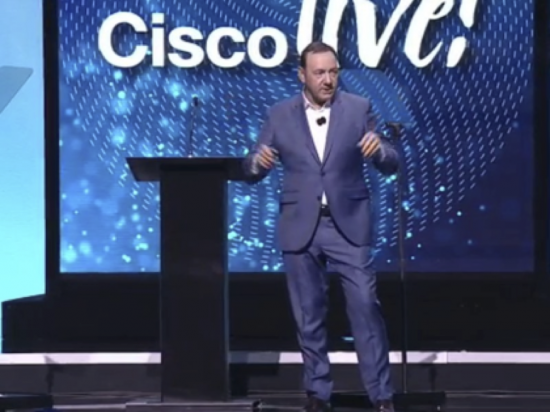
Kevin Spacey delivered an amazing keynote closing out Cisco Live 2016: “Today, the last words of my speech belong to Frank Underwood.”

spacey


Cisco Live this year was all about how digital is dramatically redefining business models. Digital is creating disruption for incumbents and opportunity for the disruptors. In today’s world, digital is about survival.

Digital simply means we can do things that were never possible before, and this is enabled by technology. When we develop a specific business process, does it account for new capabilities available today such as social, mobile or geo location? Survival means disrupting yourself before someone else does, about being fast, agile and responsive to change.

Continue reading “Financial Services Gone Digital at Cisco Live 2016”

Authors

Alexander Revzin

Managing Architect, Financial Services

U.S. Enterprise Business Transformation

Avatar

Cisco Live has come and gone and now is a time to reflect on the incredibly crazy few days and see what was discussed. Business outcomes were top of mind for our customers and analysts, and we had no shortage of them.

We kicked off the week talking to our analysts at CSCAPE and the big theme was customer stories. We had Voith, a machine builder with a focus on the Pulp and Paper industry, talk about implementing a collaboration suite. They now know what’s going on and can troubleshoot without having to fly somebody to fix problems due to remote capabilities from Cisco and our partner LibreStream. This brings a huge value to their customers who are in remote areas and allows them to save time and expense.

Another customer we had was Fanuc who talked about how they’re implementing their zero downtime offering based on predictive maintenance algorithms. They have 6500 machines currently pushing data to the cloud to allow savings of anywhere from three minutes to hours of downtime. Which when you look at $20,000 per minute of downtime, that starts adding up to a huge return on investment very quickly.

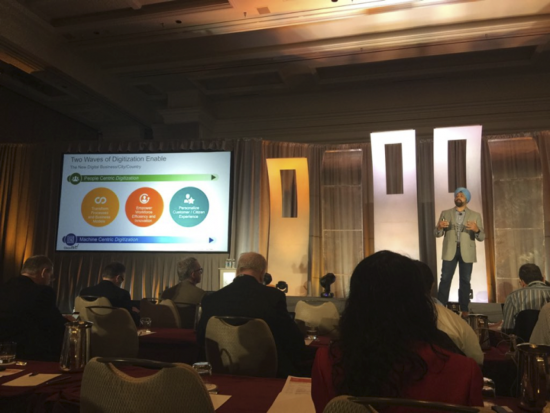
Next our CTO Zorawar Biri Singh shared how digitization requires companies to transform processes, empower their workforce, and personalize their customer experience.

mfg_1

He also shared:

“If you aren’t building deep learning/machine learning capabilities into your products, you aren’t relevant”

Our VP of Growth Initiatives Ruba Borno then spoke at her session, Business Case for Digitization. Here are some of the takeaways:

  • Unlocking the digital economy requires security in the network along with analytics.
  • Data is becoming perishable – act on it or trash it. Cisco’s Jasper brings together LTE, WiFi, LoRa, Bluetooth, Zigbee and more.
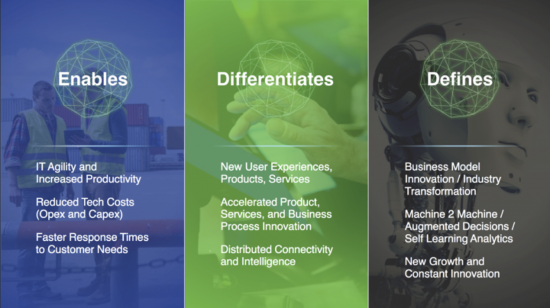
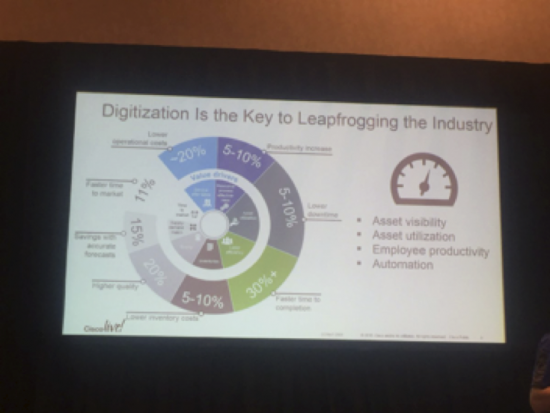
  • There are 3 stages of digitization and digitization requires digital culture:

mfg_2

Notable Quote: “Be the agility you want to see”

The full presentation is available here.

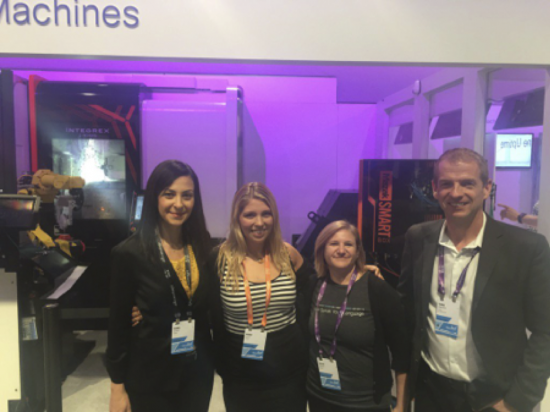
Ruba and Rowan Trollope also stopped by our booth and we were able to capture this video with her.

mfg_3

mfg_4

On Tuesday my teammate Scot Wlodarczak presented on our work with Daimler Trucks by sharing this video and giving us insight into their transformation at the breakout session Cisco Digital Manufacturing Solutions in Practice at Daimler Trucks.

Here are a few of the takeaways:

  • Daimler trucks installed pervasive wireless connectivity which lets employees and machines stay connected across the entire factory.
  • DTNA defined and established an automation architecture practice to bridge the traditional gap between IT and OT (Operational Technology, i.e. controls and automation) job functions.
  • Daimler Trucks now has real-time visibility across production operations. Data is now transmitted securely to managers and helps them make better, faster decisions and keep plants running more efficiently.

At the first guest keynote, Jason Silva blew the crowd away which was an absolute must-see (recording here – thank me later). The quotes below should speak for themselves:

  • “Technology is the human mind turned inside out. We use technology to overcome our boundaries.”
  • “Our brains evolved in a world that was linear and local. Our intuition is linear. We don’t live in a linear and local world anymore. We live in a world that is globally interconnected and that is exponential in its nature. Technology evolves in exponential rates.”

mfg_5

  • “If you take 30 linear steps, by step 30 you get to 30. If you take the same 30 steps but you do it exponentially, by step 30 you’re at a billion. That is the reason that the smartphone in our pocket today is a million times cheaper and a million times smaller yet a thousand times more powerful than what used to be a $60M supercomputer that was half a building in size 40 years ago and you needed special permission to get access to it. Now it fits in your pocket. Tools to change the world are in everybody’s hands.”

At the end of Wednesday I hosted a session called: The Case for Machine Intelligence. Here are some of the highlights:

  • There hasn’t been an Uber or Airbnb in the Manufacturing industry yet.
  • A 2% increase in OEE is a 1% increase in profit – That’s a CFO discussion.
  • Machines were not built for the internet and complexity stands in the way of digitization.
  • I shared 8 digital manufacturing use cases and the payoffs:

mfg_7

Finally the conference ended with a closing keynote by Kevin Spacey:

  • “Create something that you find compelling and others will too. Don’t try to create for the masses. Tell your own story. Tell what you know. That’s what gets me to share content.”

mfg_8

  • “Place a bet on those who are not afraid to challenge the powers that be.”
  • “For those of us climbing to the top of the food chain there can be no mercy. There is but one rule – hunt or be hunted.”

As you can see, it was an incredible week full of excitement, content, and some fun. To feel like you were there, check out our twitter feed of the show here. In fact if you were there, it is impossible to see every presentation due to timing so check out the session archive to see what you missed. See you next year!

To receive future Manufacturing blogs straight to your inbox:

subscribe

Authors

Douglas Bellin

Global Lead, Industries

Manufacturing and Energy

Avatar

We’ve reached the midway point in 2016 and now’s the perfect time to reevaluate – or even re-think – your current growth strategy. Traditionally in our industry, business growth has been built around gaining market share: adding new logos, making more deals and fueling the sales pipeline.

“Being successful in this new economy increasingly requires that companies actively manage their customers during their engagement relationship, instead of just focusing on making the technology sale.” – Forrester Research

But we all know it’s more costly to land new customers than it is to retain existing clients. Experts say it’s as much as 15% more costly. And as the subscription economy continues to transform the world around us, “customer share” is emerging as the growth strategy that makes the most business sense today.

What is customer share? It’s a growth plan geared toward earning more revenue from fewer customers — as opposed to looking for growth from more new clients. Instead of focusing your sales team on new logos, the emphasis is on expand selling and growing customer lifetime value (CLV).

Initial Sale = 5-30% of revenue

Post Sale = 70-95% of revenue

– Source: Totango, Customer Success Putting the Pieces Together

As trust is built with existing customers, new and more valuable opportunities often arise with them during post-sale engagement. In fact, Totango says up to 90% of a company’s revenue can be generated in the post-sale phase. That’s because the ability to upsell, cross-sell and expand a client relationship becomes much easier when a trusted partnership is already in place.

Expanding relationships with customers isn’t always automatic, however. We have to work at it and stay focused on how our technology can help the customer achieve their preferred business outcomes. With that in mind, here are five tips for increasing wallet share with existing clients:

  1. Focus on product adoption: The key to selling more with existing clients begins with driving value realization and encouraging successful product usage. Effective and complete product adoption enables you to build trust, and it opens the door to new opportunities.
  1. Build value realization across all stakeholders: Opportunity is driven by the value the customer feels they are receiving. Not just the value of the product, but also the value you provide as a trusted advisor. Value realization should extend across all stakeholders in the client organization. Think CFO, CMO, Call Center and more. The more stakeholders see value, the more growth you’ll see with clients.
  1. Conduct more effective, more frequent business reviews: Although the traditional Quarterly Business Review has its place, customer relationships grow faster when they are less about formalities – and more about trust. In a value exchange model, decisions are made using information that is current and timely, which means having more frequent and more meaningful, outcome-based conversations with your customers is essential.
  1. Use data to uncover additional opportunities: We all use a variety of tools that capture data. This data can provide actionable insight to help you grow wallet share, too. Through access to your customer’s Smart Net Total Care portal, for example, you can interpret their data and conversationalize it to anticipate their needs and offer solutions that support their desired business outcomes.
  1. Use automation: To successfully address the opportunity at the bottom tier of the pyramid, it’s important to use data-driven, automated selling solutions. Automation helps you connect more effectively with clients—from the moment a product or service is purchased; to the point that it is adopted; and across the upsell, cross-sell, renew and refresh phases. An intelligent and automated approach to digital engagement puts you in position to deliver more value, be more proactive, discover untapped opportunities, and find new ways to scale your sales practice for increased profitability.

As you rethink your growth plan, it comes down to this: when picking a strategy, do you want to invest in acquiring more customers, or in making sure that your existing customers keep buying more from you?

To find out more about growing customer share, visit SuccessHub.


Authors

Steve Cox

Vice President, Employee Experience

Avatar

Vulnerabilities discovered by Aleksandar Nikolic. Blog post authored by Jaeson Schultz and Aleksandar Nikolic.

One of the most fundamental tasks performed by many software programs involves the reading, writing, and general processing of files. In today’s highly networked environments, files and the programs that process them can be found just about everywhere: FTP transfers, HTTP form uploads, email attachments, et cetera.

Because computer users interact with files of so many different varieties on such a regular basis, Oracle Corporation has designed tools to assist programmers with writing software that will support these everyday tasks: Outside In Technology (OIT). From the OIT website: “Outside In Technology is a suite of software development kits (SDKs) that provides developers with a comprehensive solution to extract, normalize, scrub, convert and view the contents of 600 unstructured file formats.”

In April, Talos blogged about one of the OIT-related arbitrary code execution bugs patched by Oracle. The impact of that vulnerability, plus these additional eighteen OIT bugs disclosed in this post, is severe because so many third-party products use Oracle’s OIT to parse and transform files. A review of an OIT-related CERT advisory from January 2016 reveals a large list of third-party products, especially security and messaging-related products, that are affected. The list of products that, according to CERT, rely on Oracle’s Outside In SDK includes:

Read more

Authors

Talos Group

Talos Security Intelligence & Research Group

Avatar

The Digital Economy is rapidly changing our world – seemingly as quickly as you can read this sentence there will be 50 billion devices connected to the Internet (Forecast by 2020: Cisco Internet Business Solutions Group). The Internet of Things (IoT), mobility, cloud, business intelligence and social media continue to generate unprecedented amounts of global IT traffic and immeasurable amounts of data. The ensuing insights fast-forward innovation at a breathtakingly swift pace – to the point where disruptive companies can redefine entire industries overnight.

Indeed, the internet has set in motion a wave of capitalism that will transform all sectors of business including: entertainment, media, banking, retail, healthcare and, of course, technology. To operate in the global digital playing field – where new rivals are unencumbered by rigid policies and thinking – astute firms are dispensing with hierarchical decision-making in favor of an environment that is more market-like and organic. In today’s world, leaders realize that there is no limit to what their organizations can achieve – but there is also unprecedented potential for displacement.

However, with companies racing to prove relevancy in the Digital Economy, attack surfaces are expanding faster than ever. At the same time, adversaries are becoming more sophisticated, creating threats that are increasingly pervasive and harder to detect. But this is where cybersecurity needs to meet – not defeat – business. A strong cybersecurity strategy can fuel innovation and growth because it fosters – not inhibits – the development of digital offerings and business models.

In fact, Cisco’s recent Cybersecurity as a Growth Advantage survey indicates that one-third of finance and line-of-business (LOB) executives view cybersecurity primarily as a growth enabler. Instead of thinking of network protection measures as purely “defensive” efforts, 44 percent of surveyed executives say cybersecurity delivers a competitive advantage. Two-thirds feel that cybersecurity is a “significant” driver of the success of their digital products, services and business models, given that nearly two-of-five reveal that they’ve had to halt mission-critical initiatives due to data defense issues.

For cybersecurity teams to truly emerge as business enablers, they must work with CIOs and LOB leaders to develop a partnership built upon trust.

In the past, trust was implicit and expected. CIOs, executives and workers went about their day assuming that the network and data was protected, even if they could not verify it. But the pervasive nature of current threats has changed all of this, setting in motion a transition from “assumed trust” to “verifiable trust.”

At Cisco, we are committed to an ongoing, proactive state of verifiable trust. Verifiable trust requires that you identify how your company’s products/services are designed, distributed and supported. You ensure everything is developed using a secure development lifecycle. You validate that your entire ecosystem – including your Value Chain of suppliers and authorized distributors – has security designed into every aspect of your business processes, technology and policies. Assumption, after all, no longer suffices.

We are continuing to find new ways to establish verifiable trust. For example, we introduced an auto data classification technique to distinguish sensitive data with speed and scale. As a result, we’ve learned that less than four percent of this data is actually considered “sensitive,” mandating rigorous levels of protection. This enabled us to implement a dynamic user policy and user differentiated role-based restrictions, providing speed and flexibility for the business while safeguarding the sensitive data.

You must deploy an integrated threat defense architecture that is capable of blocking a high percentage of the “bad stuff”; but we know they can’t prevent 100 percent – human error creates cracks in our defenses and advanced threats sometimes will get through. To detect and contain these threats we’ve deployed an active response program to extend our visibility of threats, catching them before they can do harm.

Gaining visibility into these unpreventable threats involves an investment near to or equal to that of the traditional defenses. Extensive instrumentation of the network and its resources enables collection of some 21 billion events per day while advance analytic techniques allow for the rapid detection of threats before they inflict damage.

It’s not all about technology either, as clear policies, education and awareness must take hold organization-wide to launch an effective, end-to-end, pervasive security posture to counter today’s advanced attacks.

By taking a holistic approach to security – combining technology, policies, and education and awareness – organizations can not only survive the next challenges of the Digital Economy, but thrive within them.

Authors

Steve Martino

No Longer with Cisco

Avatar

We welcome and strongly support Microsoft’s successful challenge of a federal criminal search warrant for messages stored on an email server located in Ireland. The decision from the US Second Circuit Court of Appeals supports the protection of data stored in the cloud, and it provides overseas customers of US companies greater confidence that their private communications will not be seized directly from cloud service providers simply because they have a significant presence in the United States.

Microsoft prevailed on the argument that US authorities should have sought the assistance of the government of Ireland via a Mutual Legal Assistance Treaty (MLAT) rather than to demand the data from the company. The Court agreed that a search warrant could not be used to require a third-party provider of email to search a foreign site and bring the contents of its customer’s communications back to the United States. Cisco has supported Microsoft’s view of the case throughout the litigation—as did the government of Ireland.

The ruling reinforces an important principle—data and communications stored in the cloud should receive equivalent protections against unreasonable government search and seizure just like documents stored on premises or in paper files.  For this same reason, Cisco has supported changes to the US Electronic Communications Privacy Act (ECPA) that would ensure search warrants are used whenever the US government seeks access to data in the cloud from service providers. Such warrants would then be clearly bounded by the territorial authority of the United States.

Last week’s groundbreaking decision and the approval of the Privacy Shield Agreement between the US and the EU will allow our overseas customers to take advantage of the cost savings, security gains, and innovation boosts that come from access to cloud-based computing while enjoying the safeguards afforded by their own countries’ data protection laws. These developments combine to grow confidence in the privacy and security of communications, something that is critical to the economic contribution of the global internet.

We also recognize the challenges faced by law enforcement confronting transnational crime in a global marketplace. Therefore, we strongly favor developing a modernized framework for national governments to route legal assistance requests in an efficient, coordinated way. For this reason, we applaud the recent introduction of the International Communications Privacy Act in the US House and Senate and look forward to working with the sponsors as these bills advance.

Authors

Eric Wenger

Senior Director, Technology Policy

Global Government Affairs

Avatar

Learn more from Monica Paolini from Senza Fili and RCR Wireless

Last week, my children used Facetime to chat with me while I was traveling to hear the latest Cisco developments at CiscoLive in Las Vegas. While they love seeing the things around me via the video, it’s the stories they most want to hear. They love to hear about the silly person who sat next to me in the airplane or what I saw in the lobby of the hotel when I was checking in. In return, I really want to hear about the latest in their board game they are playing with each other or their adventures at camp.

As much as we try to replace our communications with text, emails, social media, and other forms of communications, the sound, lilt, and expression in someone’s voice is hard to duplicate using a keyboard or even a picture.

While the application of voice hasn’t changed, how we talk has. No longer are we strapped to a wall telephone with rotary or even push button numbers. Now the voice calls come through our tablets, our mobile phones, and yes, even sometimes the phone that has an outlet in the wall. We have also become accustomed to the fact that we can now get connected anywhere to make those phone calls. In the last couple of years, a lot has been written about how the adoption of Voice over LTE (VoLTE) has driven costs down for our Service Provider customers and provided better voice for the consumers. In fact, VoWi-Fi has also been adopted to address those voice calling demands, in part driven by the fast adoption of non-cellular devices like tablets and laptops. In many ways, VoLTE and VoWi-Fi actually complement each other.

The 2016 Cisco Visual Networking Index observed how voice is following the same trend as data in the adoption of Wi-Fi. “Wi-Fi access has had widespread acceptance by MNOs globally, and it has evolved as a complementary network for traffic offload purposes—offloading from expensive cellular networks on to lower-cost-per-bit Wi-Fi networks. If we draw a parallel from data to voice, we can foresee a similar evolution where VoWi-Fi is evolving as a supplement to cellular voice, extending the coverage of cellular networks through Wi-Fi for voice within the buildings and other areas that have a wider and more optimum access to Wi-Fi hotspots.”

When we spoke with Monica Paolini from Senza Fili in RCR Webcast “Voice comes to the fore again.  VoLTE and Wi-Fi Calling redefine voice,” she also suggested that VoWi-Fi and VoLTE appear to be complementing each other instead of competing with each other.  The benefit is not limited to our SP audience. Cisco’s Mark Grayson, Distinguished Engineer from Office of the Mobility Cisco CTO, mentions in his exclusive RCR interview how the trends in VoWi-Fi will benefit enteprises and service providers alike.

If you haven’t had a chance to watch the RCR webcast and interview, please check it out before it is archived.

webcast


Authors

Maywun Wong

Manager, Market Management

Avatar

Hello! My name is Kevin Wood, and I am a retail business architect here at Cisco for both Retail and Hospitality. I have done a lot of work providing security to retailers – one of the most vulnerable industries in the world today.

We all know that staying ahead of security threats is a dynamic and rapidly growing challenge. Since your retail business has to handle cardholder data, run Wi-Fi networks, and manages email and other private transactions, maintaining security and staying compliant is a critical factor in your success.

For most companies, detecting the average breach can take more than 200 days with point security solutions, and 60 percent of data is stolen in the first few days. What is this costing you?

  • Statistically, there is a 26% chance you will have a material data breach involving 10,000+ lost or stolen records
  • The average total cost per data breach is estimated at $4 million
  • We are seeing a 29% increase in the total cost of data breaches since 2013
  • The largest financial impact is lost business due to lost customer trust, which can run up to millions and last for years

At the same time, hackers are reselling your information for a profit. Here are some of the going rates for your data on the black market:

  • Data Exploits: From $1,000 to $300,000
  • Credit Card Numbers and Data: $0.25 to $60 per record
  • Malware Development: About $2,500
  • Facebook and Social Media Accounts: About $1.00 per account with 15 friends
  • $34M/year income from ransomware per campaign

As the number of exploits increases, they may occur in the store, in the hotel, across the network, on the mobile device, or through mistakes made by well-meaning but uninformed employees. Today, hackers cost our global economy about $1 trillion per year.

What can you do to protect your organization? Deploy network security that underlies every single thing your company does – from customer welcomes to operations management – to protect you no matter what the threat. This integrated approach also has the benefit of making your system less complex and fragmented, and thus easier and cheaper to run.

Cisco gives the network the ability to protect itself and its data at any point before, during, or after an attack. Let’s look at some examples of how a threat defense strategy can detect and mitigate events.

Data Loss Prevention Before the Attack

In this scenario, a valid employee device is the source of a data leak. A valid corporate asset is compromised unknowingly by a hacker or malware. The device starts to send large amounts of data outside of the network. By leveraging the threat defense strategy utilizing tools such as LanCope, we already know the typical behavior for that device and that user. When a traffic pattern change is detected, an alert is sent to network administrators while the intelligent network automatically takes the device offline.

Unauthorized Device Access During the Attack

A hacker decides to steal cardholder data or corporate data from a store chain network. He accesses an employee’s permissions by “eavesdropping” on their device to gain their username and password. Once credentials are obtained, he uses a client or mobile device to log in to the network. However, the network has prior knowledge of approved users and devices. When the hacker tries to join the network, access is immediately blocked since the device itself is not authorized to join the network. Even though he had the credentials, the hacker’s incorrect device alerted the system to his illicit attack, before any access was granted.  Who said that switch security isn’t important?

Malware and Vulnerability Detection After the Attack

A new piece of ransomware has been placed on an approved device. Without quick action, this malware will spread and lock the store out of its data. However, the store has real-time, up-to-date research on vulnerabilities and alerts thanks to Cisco’s Threat Grid and Talos organization. Talos provides multiple daily security information feeds into Cisco Firepower, allowing them to identify new threats and quarantine them on the fly. The system’s quick action can save thousands, if not millions, of dollars and lost man hours.

The philosophy of continuous security has been hugely successful for retailers working with Cisco, allowing them to reduce breach detection from 200+ days to just 17.5 hours. This gives you every chance to detect, identify, and manage potential problems across the business – minimizing issues or making them completely transparent to shoppers and guests. To learn more about our Before, During, and After security methodology, go here.

Follow us on @CiscoRetail or Facebook, and join our Cisco Retail LinkedIn Group.

Authors

Kevin Wood

Industrial IoT Architecture Lead

Industrial IoT Americas Sales

Avatar

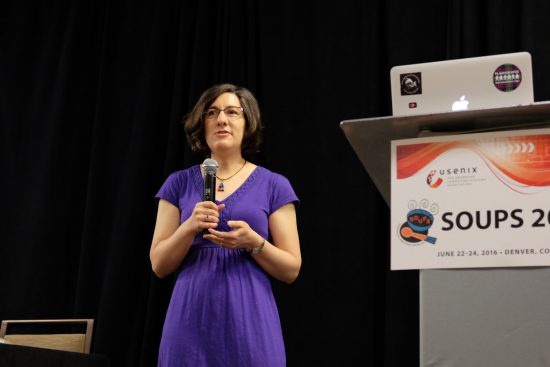
Every year the Symposium on Usable Privacy and Security brings together an interdisciplinary group of researchers and practitioners in human computer interaction, security, and privacy, to present and discuss the latest research in the areas of usable security and privacy. Cisco’s sponsorship of SOUPS supports student research and mentorship in this area (see below), as well as leadership by providing the General Chair (me). Here is some of what SOUPS provided this year in privacy and security innovation.

FTC Chief Technologist Lorrie Faith Cranor covered her initiatives in privacy and security policy to date within the FTC. Most recently, she discovered that your mobile phone account can be hijacked by an identity thief with just a fake ID with your name on it, and knowledge of your phone number. How did she discover this? She was the target of exactly that attack. “I called the fraud dept. The first thing they did was blame me, saying you haven’t updated your anti-virus software.” Which turns out to be entirely incorrect.

SOUPS 2016
FTC Chief Technologist Lorrie Faith Cranor

Want to know what information would be left on Twitter about you if you were to remove your twitter account? Try out twitter-app.mpi-sws.org/footprint/. It shows information leakage from others about you on Twitter. “Forgetting in Social Media: Understanding and Controlling Longitudinal Exposure of Socially Shared Data” is the first study that kind of of information leakage of residual activities of deleted tweets and accounts.

Snooping on Mobile Phones: Prevalence and Trends” (Distinguished Paper winner) quantified the prevalence of looking through someone else’s phone without their permission. With an estimated 31% of the online participant pool doing so within a 1-year period, weighted to the U.S. population, 1 in 5 people snooped on someone else’s phone in the previous year. Snooping attacks are especially prevalent among young people, and the more people use their devices for personal purposes, the more likely they are to snoop on others.

Brigham Young University surveyed 1,976 individuals on “User Attitudes Toward the Inspection of Encrypted Traffic“, and found that most of them recognized legitimate uses of this practice. Legitimate uses included protecting organizations, protecting individuals, and law enforcement and surveillance. There was also strong support for notification and consent; adding it generally doubled the number of individuals supportive of the practice.

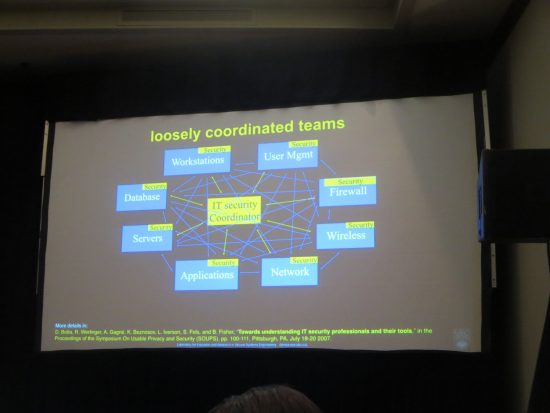
A full day Workshop on Information Security Workers explored research in making security professionals of all kinds more effective, efficient, and productive. A study on penetration testing’s impact on software developers shows it increases developer awareness of security, but in itself does not create long lasting change in developer practice. A survey of cybersecurity competition participants shows their experience built up their reverse engineering and analytic skills, and positively influenced their career decisions to move into cybersecurity. The plenary overview of a multi-year empirically-driven investigation into understanding and improving IT security include an overview of the complexity of the communication patterns for IT security management, across multiple loosely coordinated teams. The sense of the workshop is that these complex communication needs have not changed much in the last nine years.

Clljm27WEAAl7JY.jpg-large
Communication patterns for IT security management

Follow My Recommendations: A Personalized Privacy Assistant for Mobile App Permissions” (IAPP Privacy Award winner) built on prior work showing that it is theoretically possible to predict many of the privacy settings a user would want by asking the user a small number of questions. In a field study, they assigned users to privacy profiles based on existing permissions and up to five contextual questions. 78% of the recommendations then made were adopted by users.

Understanding Password Choices: How Frequently Entered Passwords Are Re-used across Websites” measured online behavior of 134 participants over 6 weeks. They found people reuse passwords that are more complex, and mostly reuse passwords that they have to enter frequently. In the student population, their university password was the most commonly reused by far. The findings suggest that users manage the challenge of having many passwords by choosing a complex password on a website where they have to enter it frequently in order to memorize that password, and then re-use that strong password across other websites.

Other papers and posters covered privacy, security and safety concerns of visually impaired people as input to design considerations for future wearables, the privacy perceptions of drones, what kinds of sounds signal cyber threats well to the visually impaired, and efforts on an interactive privacy patterns catalog.

Supporting education and research to increase the pool of talent working in cybersecurity, Cisco sponsored the inaugural John Karat Usable Privacy and Security Student Research Award. The award honors Karat’s contributions to the usable privacy and security community, and his dedication to mentoring students. The winner was Blase Ur of Carnegie Mellon University, whose breadth and depth of mentoring is sure to inspire the next generation of security professionals. We look forward to benefiting from the future work of all the student nominees as they begin their young careers in privacy and security!

Authors

Mary Ellen Zurko

Principal Engineer, NGFW/NGIPS

Security Business Group