In the first blog of this trilogy, I wrote that pay TV providers do not seem to perceive OTT video as a threat to their business.
Well one thing’s for sure; there is plenty that we can learn from OTT video providers.
They certainly brought new standards to the video industry. And satisfaction surveys are clearly showing that their subscribers are happy. Service providers would do well to learn from these standards and implement them today.
So what is the secret sauce of the OTT video provider’s success?
Three words: Aggregation, Segmentation and Simplification (no acronym needed this time).
Aggregation is about making it effortless for the subscriber to discover and enjoy relevant content. In fact, the content should find the subscriber and not vice-versa. And it should be available in formats optimized for all screens so that users can enjoy the best possible viewing experience on any device.
Segmentation is about mining the big data to better understand your subscribers so you can sell services and personalize the viewing experience for different user segments.
Simplification is about making it easy to opt in or out of a service, so that users can pay for what they like and access any type of content, at any time, on any network.
There’s no doubt that OTT video has made its mark. But is it here to stay?
For me, the answer is a resounding YES. In fact it will only grow… big time.
As I mentioned in my last blog, video does indeed take up a huge part of IP traffic today. But compared to the overall video industry, video-over-IP represents only a fraction of the total video minutes delivered across the world. So there is plenty of room to grow.
It’s already clear to every video professional that IP brings huge advantages for video delivery in that it extends reach and enables better personalization.
And so, in the long term, it seems that OTT will definitely play a dominant role in the pay video industry.
That said, the IP network is still not ready to support full video-over-IP. Take linear video for example. There has still not been a linear video event broadcast over IP to an audience of more than 1.5 million people (not exactly enough for the Super Bowl …). That’s true when we discuss OTT on the unmanaged network (aka. the Internet), but it’s also true for IP managed networks used by service providers.
It was the same story in the early days of Voice-over-IP (VoIP). But look at how ubiquitous that has become.
Similarly, Video-over-IP will ultimately become superior to video-over-broadcast. It presents a huge opportunity for service providers that can cope with this change, offering immediate competitive advantages while preparing their operation for the new video era.
Which leads to the inevitable question…
What can service providers do today in order to prepare for, and lead in, an OTT world (or should we say IP world)?
In the first blog of this series on leading for innovation, I shared the importance of encouraging an innovative culture and the pivotal role that the leader must play in the process.
In the next two installments, we’ll look at some of the specific behaviours that leaders must employ to create an innovation-focused mindset amongst employees and ensure buy-in from every level of the organisation.
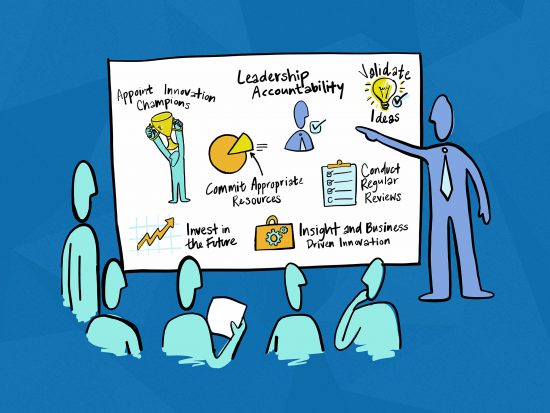
First and foremost, demonstrating effective support for innovation is key as people will follow your lead. This can take many forms, but some of the most effective include clear and regular communications about the organisation’s innovation goals, why it’s needed, the provision of innovation training to all levels of employees, and acting as a mentor to specific innovation teams.
Leaders “walking the walk” make a huge impact and quickly permeates the organisation as everyone can see how seriously the leadership team is about innovation. Conversely, adopting a “do what I say, not what I do” attitude only serves to create a mismatch in message that confuses and stifles enthusiasm amongst employees.
Committing appropriate resources is another important step to enabling long-term culture shift. This may be ring-fencing budgets, or allocating time in employees’ workloads specifically for innovation projects. After all, it’s unrealistic and unfair to expect your people to produce innovation if they’re maxed-out with “run-the-business” work. Appointing innovation champions can also be useful. Doing so means all innovation activity is channeled through a specific group, providing a companywide overview and ensuring multiple teams aren’t working on similar ideas.
Linked to this, ensure there’re accountability in the leadership team for innovation performance, keeping it front and centre to clearly demonstrates how much it matters. Often innovation isn’t reported on at the top table, leading to a perception that it’s not as important as ongoing operational activity. However, a short-term mindset will only damage the business in the long run.
Effective innovation means looking beyond the here and now, investing in the future to ensure the business will actually have a future. Associated risks are minimised by spreading available resources across a diverse range of innovation ideas and concepts, while conducting regular reviews with the teams involved keeps ongoing projects on track.
Finally, ensure that all innovation strategy and activity comes from insight and is business driven. Speaking to customers to understand their problems and their “jobs to be done” is key for a leader, and will lead to copy-cat behavior. This will prevent well meaning, but blinkered teams from persisting with their solutions to issues that don’t actually exist or don’t actually meet the customer need.
As per Ash Maurya, ‘life is too short to build something nobody wants.” Make sure innovation teams aren’t working in isolation, have access to all the necessary data and insights they need, and validate their ideas with customers to minimise this issue and keep them on the right track.
In the next blog, we’ll look at four more essential behaviours of a leader to encourage and foster an innovative culture, regardless of an organisation’s size or industry standing.
Remember that disruption can come from anywhere and there’s no such thing as ‘too big to fail’ anymore. Encouraging innovative thinking is the best defense against a slow death by complacency. Don’t let it happen to your business.
In recent years, utilities have risen in the ranks of common targets for cybercriminals. On Wednesday, December 7th, @Cisco_IoT and @CiscoUtilities hosted Utilities Security Imperative: More Real Than Ever, a #CiscoChat focused on cybersecurity for utilities companies. During this lively #CiscoChat, we were joined by Patrick Miller, Edna Conway, Marc Blackmer, Eric Ehlers, Jon Stanford, and John Reno. We dove into a discussion on the most pressing cyber threats facing the utilities industry today, how security teams can combat attacks, and what companies can do to better protect precious data and fortify themselves against a breach.
For those of you who missed this fantastic discussion, not to worry! Highlights from the chat are collected below:
Question: How can utilities address industrial cybersecurity challenges?
A2: Employee training is critical to ensure that now unintentional intrusions occur due to unauthorized connections or devices. #CiscoChat
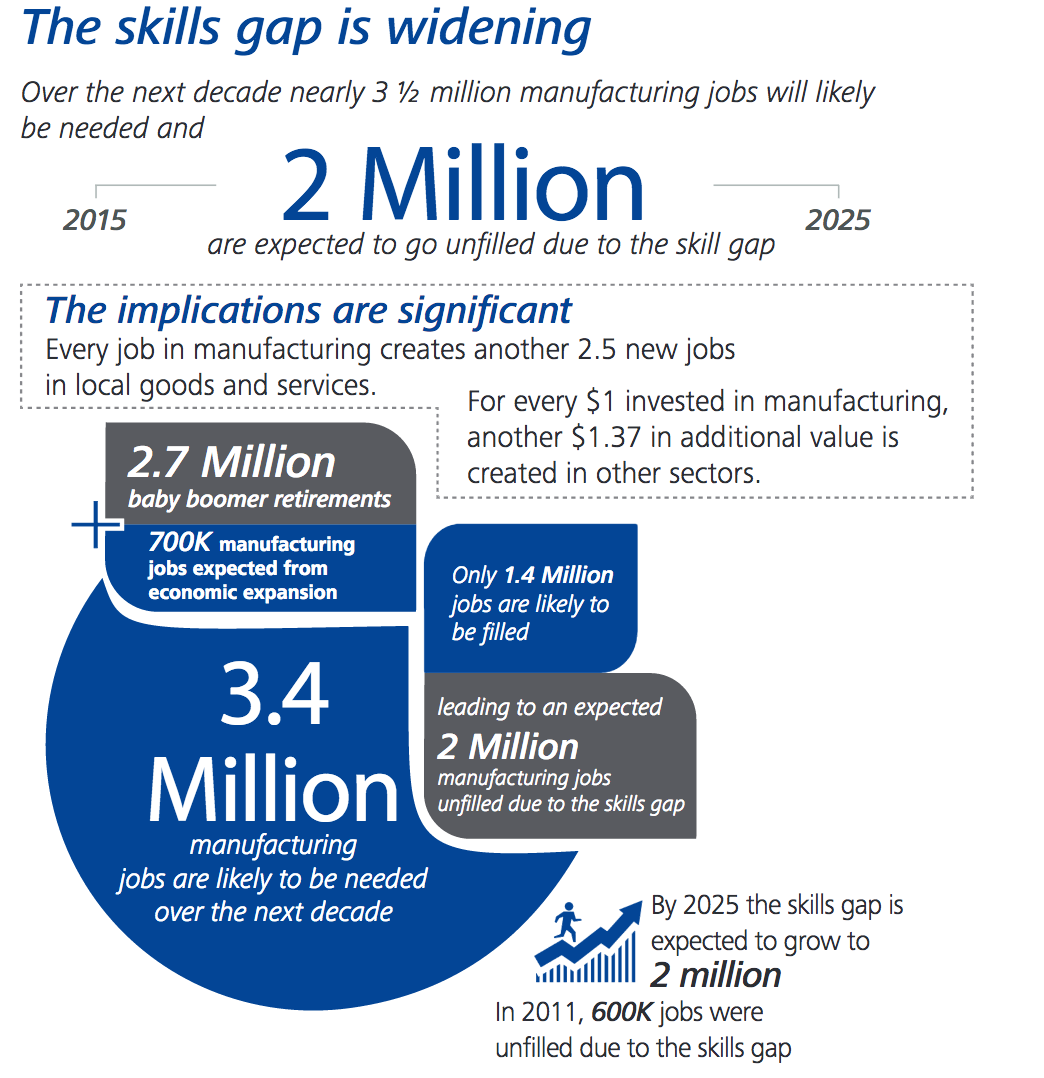
In the United States, an available and consistent labor pool has been a differentiator to help manufacturing companies drive their business forward. Now we see the changing dynamics of an aging workforce that is starting to form a “perfect storm” that we need to ensure never hits our shorelines!
Our aging workforce is nearing retirement age, and we are faced with the challenge of ensuring our world class manufacturing base does not blink as we transition through these waters. We have performed valiantly to bring manufacturing back to the US shores, and we need to continue disrupting our vision and traditional thinking to keep it here!
What the skills gap looks like
One-third of workers are over age 50 and the average age of a highly skilled manufacturing worker is 56
Skilled trades also have far fewer 65-and-older workers than the labor force as a whole, meaning that many skilled workers aren’t holding off on retirement and the skilled worker shortage will continue for the foreseeable future.
The U.S. could face a shortfall of about 875,000 machinists, welders, industrial machinery operators and other highly skilled manufacturing professionals by 20202
In a report by Deloitte, they call out 82% of US executives believe the upcoming skills gap will impact their implementation of new technologies and increase productivity in their manufacturing operations.
The path forward
You know it’s funny that we talk a lot about “IOT” and “Digitization” and “Disruption” and until now, there have been leaders and there have been followers in terms of embracing these paradigm shifts to the business. Early adopters of this technology revolution will be ahead of the curve as their workers retire and move to the next, and well deserved, phases of their lives.
I see the solution mainly as a two phased approach:
The first lies in technology adoption and enabling the workers to do more tasks with greater efficiency. We talk about technology a lot, but we don’t really spend much time talking about training, education, and the necessary output we need out of our younger generation today.
The second is a perception change of manufacturing jobs – highlighting the honor of these crucial jobs that make the luxury of the modern world possible.
Manufacturing is a tough (and very honorable) career choice since the industrial revolution. It took skills, commitment, and a work ethic second to none to get the job done, and it is woven into the American DNA. Today the manufacturing companies that are future-proofing themselves are executing a digital strategy that will accelerate them well into the future. And empowering their workers with the latest technology – the tools of today extend beyond the toolbox.
For example, have you looked at Amazon lately? Their core business model revolves around their distribution centers and logistics models, and they are world class! Amazon enables their workers to be more productive than ever before.
If we agree that we don’t have the same manufacturing environments as days gone by, then we shouldn’t have the same expectations of our upcoming youth as they are deciding what their career choices are. We often overlook the high tech trades and the amazing satisfaction that comes out of those long days building solutions that help make the world a better place.
Mike Rowe did a great job calling out the misconceptions of skilled trade jobs in this TED talk:
We gave our kids a choice, and a bachelors degree at a university was one of those choices. We also need to emphasize that trade schools are full of fantastic opportunities, ones that go beyond sitting behind a desk.
We have amazing and very high-tech trade school programs in our educational system that are affordable! If we peel the layers back, it will absolutely make a difference in the future of our country from a manufacturing perspective. We will always need the MBA to market, the PHD to design, and the sales teams to sell and help run the business. Yet we struggle without people making the products on the floor the right way.
We do not stand alone in this challenge as other countries face the same issues of an aging workforce with a slowing demographic. We do however stand tall in our ability to embrace change, stay agile, and make a difference for generations to come. I am passionate about the future we are building and want us to rethink our legacy perceptions of square pegs and rounds holes.
I feel like we have a responsibility to lead this effort with the amazing workforce we have and the technology that can arm them to future-proof our industry. This is not a moment in time, but a journey we can take together. The first step is always the hardest, but if we do it together then we move forward more efficiently and make sure neither one of us slips!
To learn more about the future of manufacturing check out our website:
It’s that time of year again – the annual board meeting.
As the Head of Manufacturing, you’re ready to go with your presentation and review for the year. Slides look good – production was up and safety improved to just one minor incident. A new factory is coming online this year, and current progress on its build-out is on track. The team is ready for production of a new product line that will be a game-changer for the company.
All in all, a pretty good year.
As you present, the board asks some tough questions, but you’re able to answer them all and present the roadmap and targets for next year. Then you get a final question from a board member.
“How secure do you think the plant is?”
She’s been hearing a lot about how security is becoming more of an issue. She’s been reading a lot about hacked plants, stolen intellectual property, ransomware incidents, and even just plain human error that’s slowed production at other sites. Are there potential issues with your facilities as well?
It’s the one question you don’t have a solid answer for, because it’s so complex.
There are cameras across the plants, but a lot of employees and contractors come in and out, and you can’t keep tabs on all of them. There’s a mix of older machinery and newer, state-of-the-art equipment, some connected and some not. Just keeping on top of some of the new compliance policies has required dedicated resources and more employee training. Your answer is straightforward – it’s a work in progress and we need to work on a plan.
The board appreciates the candor, but everyone’s now more concerned. They want a plan in place to understand how potentially vulnerable the plant is, plus quarterly reports on progress.
You agree – this is a top priority, but in the back of your head you just aren’t sure where to start exactly. There are so many factors with security that you didn’t have to worry about before, and this task looks daunting….
Assessing Your Security Risk
The scenario above is a fictional example, but the reality is that these types of conversations are now happening all the time, and for good reason. A recent cybersecurity report from MAPI explains why security is becoming such a big concern for manufacturers:
36% cited IP protection as their top concern
39% had experienced a breach
28% had losses of 1-10 million+
Almost a third hadn’t performed a cybersecurity assessment of their shop floors and industrial control systems
The report notes that while there’s no silver bullet to cybersecurity for manufacturers, it’s important to prepare, assess, clarify, and drive awareness within your organization to build a security framework.
To help build that foundation, we’ve developed a risk assessment checklist that outlines how you can begin. If you’re not seeing enough checks in the boxes, we’ll be happy to help you review your current infrastructure, make recommendations, and help you align and prioritize your business and security needs.
https://www.youtube.com/watch?v=UKrL_Ke9lmc
When it comes to securing your factory, doing nothing is no longer an option.
To learn more about assessing risk and setting a security strategy, visit our interactive security experience for manufacturing:
Partners of all types across the globe have one very important thing in common. Yes, they all want to become more profitable; but, they also want to help facilitate this by aligning their sales and marketing teams more closely.
While some still see marketing as a “support” role, it really is critical to a healthy, successful sales business. Some of our distribution partners have embraced “smarketing” to develop plans and strategies together to help drive business goals. We had the opportunity to experience one of our distributors working smarter together to ensure success in the coming year (and beyond) with the team at Ingram Micro.
Our team had the opportunity to join the Ingram team at an offsite planning meeting for the Cisco BU Market Development Executive Team and the Channel Account Specialists. But here is what made this so unique: marketing representatives from both sides were asked to provide input and hear the strategies discussed for each region as those plans were being developed.
In addition, marketing was represented on each team that was tasked to develop go-to-market strategies for the upcoming year. By working together to look at how to move the needle in their specific territories, the sales and marketing teams developed comprehensive plans and developed value pitches for the Ingram/Cisco partnership.
When was the last time you heard about that happening?
When we were first looking for examples of “smarketing” from the Ingram team, I was looking for just one story. But several came through the door! The Ingram team teaches us all a valuable lesson – if partners could change their mindset to come together with sales teams (and vice versa), we can develop powerful and salient discussions that can lead to bigger discussions.
Here are a few of my favorite “smarketing” opportunities:
Marketing can ensure sales teams are aware of upcoming marketing events and activities to integrate into year-long planning
Sales can ensure marketing hears directly what is deemed important for their regions and how marketing can play a role in their partners being successful this year.
Cisco has also made marketing easier than ever with new product design, simpler brand language, and improved marketing support through Marketing Velocity and Partner Marketing Central.
When it comes to leadership in the SDN marketplace, clearly there is one winner. And that is, Cisco ACI. The proof is in customer momentum numbers. Cisco ACI has 2700+ ACI customers and a rapidly growing ecosystem of 65 technology partners. ACI ecosystem partners come from a broad spectrum of L4/L7, Security Management and Orchestration, Analytics, Operations Monitoring and Compliance, Service delivery, and other categories addressing a broad set of use-cases and buying center requirements.
In this blog, I intend to give an overview of our major L4-7 ecosystem partner solutions, the new innovations, a quick discussion on what to look forward to in 2017, and how customers can benefit deploying the solution.
Before I continue on, I would like to thank my colleagues, Ahmed Dessouki and Asha Hegde, (Insieme Business Unit), our colleagues at the Cisco Security Business Unit, and our ecosystem partners for providing their contributions in this blog.
Cisco ACI with Cisco Security
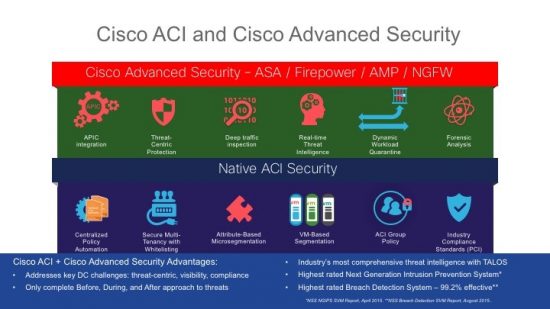
Cisco continued to enhance and extend security integration with ACI throughout 2016. The ASA device package, available since the introduction of ACI, received updates to improve policy automation capabilities while development began for Cisco’s advanced threat protection solutions: Firepower NGIPS and Firepower Threat Defense NGFW. Highlights include:
TrustSec support in the ASA device package to simplify policy management by enforcing policy based on Security Group Tags (SGT)
Rapid Threat Containment for ACI to instruct APIC to quarantine offending devices when a threat is detected
Offering customers ASA deployment flexibility by adding support for Service Management Mode integration with the ASA Fabric Insertion device package. This allows organizations to benefit from automated firewall services insertion without disrupting the way ASA(v) policy is managed
Integrating advanced threat protection with the FirePOWER (NGIPS) and Firepower Threat Defense (NGFW) device packages. The device packages will support the Service Manager Mode so security service insertion is automated by APIC and security policy management is maintained by the Firepower Management Center. These are currently in Beta with a release target of Q1 CY17.
In 2017, we’ll add support for additional use cases with Rapid Threat Containment for ACI and will improve policy automation and simplicity by allowing FirePOWER/Firepower Threat Defense policy to be defined using ACI constructs like EPGs.
Cisco ACI with A10 Networks
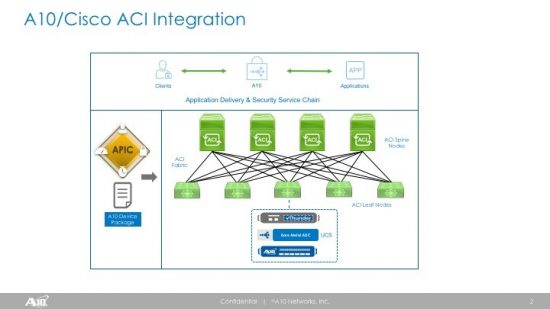
The integration of A10 Networks Thunder Application Delivery Controllers with Cisco ACI provides organizations with rich application services in a shared, multi-tenant environment. This integration can be leveraged to dynamically provision advanced L4-L7 application services, and to ensure that SLAs and security requirements are consistently met. The Thunder ADC platform can help customers to deliver secure, responsive, and always-on experiences to their users from their data center applications and networks. A10 Thunder and Cisco ACI integration enables customer choice with Thunder hardware, virtual, and bare metal form factor integration.
The integrated solution has been generally available (GA) since 2014, and since GA, A10 has focused on enhancing the solution with additional features. This year, A10 enhanced the service policy mode with complete ADC on-device capabilities, including support for, device clustering and data path redundancy, WAF, Layer-3 virtualization and multi-tenancy, and various deployment modes. In 2017, A10 will implement the service manager mode through the A10 aGalaxy centralized management system. This will both further simplify and provide advanced ADC deployment capabilities. A10 will also integrate its security offerings into the ACI environment.
Cisco ACI with Avi Networks
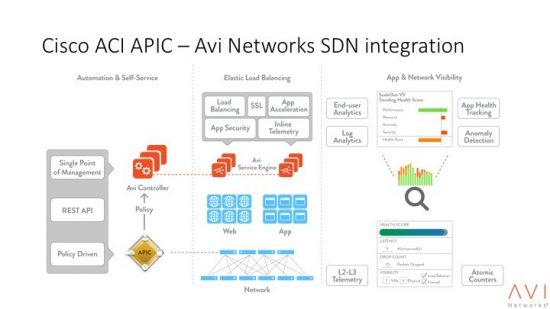
The Avi Vantage Platform, a software-defined application services product with separate central control & distributed service delivery, is integrated with the L4-7 Service insertion framework of ACI. In 2016, several multinational organizations deployed the joint ACI-Avi solution in production. In addition, the solution was enhanced with support for ACI Service Manager Mode, application services across different VRFs, and single arm deployment of load balancers with traffic accessible by ACI L3 routed mode.
2017 will see continuing advancements and differentiation in performance and resilience with features such as BGP route health injection for elastic scale-out and policy based routing for advanced traffic flow. These will enable further automation of customer environments with software-defined networking across the entire stack.
Cisco ACI with Check Point
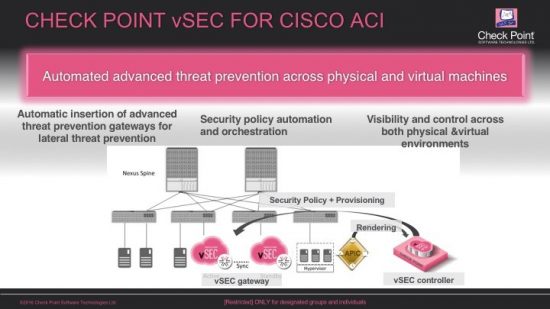
Check Point vSEC for CISCO ACI offers industry leading advanced security protections against malware and zero-day attacks as well as advanced cloud network integration for modern day data-center infrastructures. Certified by Cisco for ACI, vSEC automates provisioning and simplifies deployment of Check Point’s advanced threat prevention security in next generation data centers built on Cisco ACI technology. Together, Cisco and Check Point provide a powerful solution that gives customers proactive protection from cyber threats as well as, complete traffic control as well as full threat visibility, logging and reporting of both physical and virtual data center environments. The joint solution forms the foundation of a dynamic application delivery architecture, where comprehensive security protections seamlessly follow workloads to accelerate application deployment while lowering the costs and complexities of securing private clouds.
vSEC for Cisco ACI, released in July 2016, delivers comprehensive threat prevention, automated security provisioning (insertion) supporting both go-thru (L2) and go-to (L3) service insertion models, automated and dynamic security policies with auto-discovery of Cisco ACI cloud objects (endpoint groups), import and usage of EPG objects in security policy for ease of provisioning and enabling fine-grained micro-segmented security policy, complete threat visibility, policies and logs that leverage cloud objects, control, centralized and unified management. The joint integrated solution uses the Service Manager integration Mode for both physical, multi-tenant and virtual security gateways – Network Policy Mode is also supported. In 2017, Check Point will add deeper integration with ACI environments, support for tagging/auto-quarantining of infected hosts as well as enhanced PBR support (policy based redirect) alleviating a lot of unnecessary topology and configuration changes to EPGs, dynamic peer routing capabilities, multi-site/multi-pod support, and Check Point apps in Cisco AppCenter.
Cisco ACI with Citrix
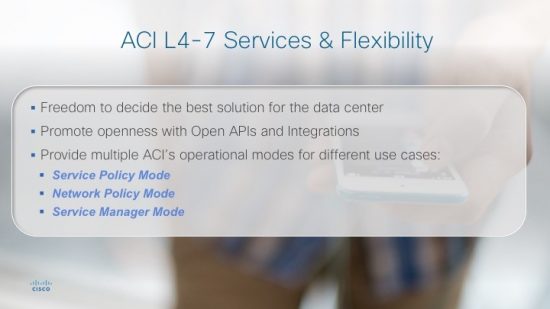
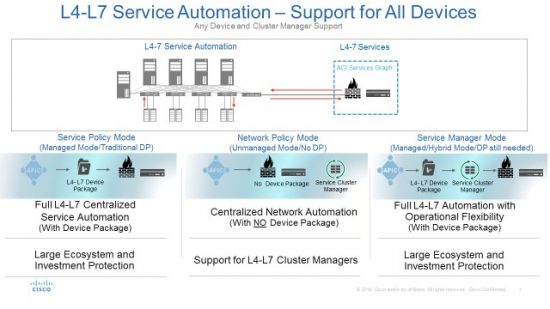
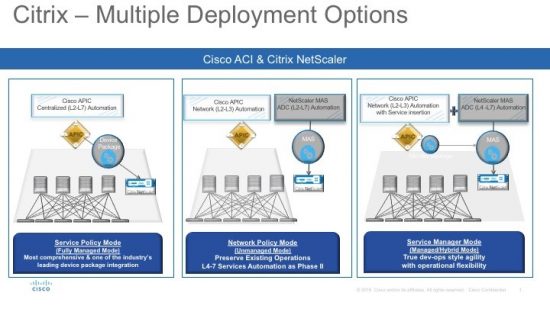
We are very excited to deliver on yet another innovative and differentiated solution to our growing base of customers, integration between Citrix NetScaler Management and Analytics System (MAS) with Cisco ACI. This solution is also referred to as Service Manager Mode/Hybrid Mode. Simply put this mode enables customers to perform network automation through the Application Policy Infrastructure Controller (APIC), while delegating the rich and detailed L4-L7 configuration to NetScaler MAS, which acts as a Device Manager in the APIC. In addition to the Service Policy Mode/Managed Mode, Network Policy Mode/Unmanaged Mode and the new offering of Service Manager Mode/Hybrid Mode, customers now have the choice of pacing their journey towards application centric automation.
The Cisco ACI-MAS framework enables consumption of physical, virtual, multi-tenant and containerized NetScaler’s through APIC as part of the application workflow. We look forward to delivering continued customer success with further differentiated solutions in the near future, specifically around hybrid cloud with Cisco Cloud Center, Private Cloud with Microsoft AzurePack, micro-services deployments, and integration with Cisco Tetration Analytics platform.
Cisco ACI with F5
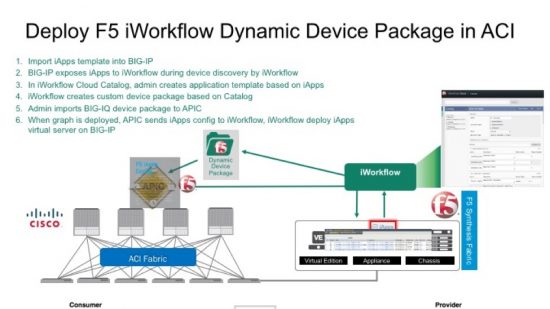
F5 released F5 iWorkflow earlier in June 2016, which presents F5 network services provisioning to Cisco APIC in a very flexible and dynamic fashion. F5’s iWorkflow enables cloud and DC admins to dynamically define the F5 device package based on F5 iApps technology. Different flavors of device package can be generated dynamically based on required L4-L7 policies, thereby providing cloud & application teams the option of integrating F5 BIG-IP in Service Manager Mode. F5 iWorkflow acts as the F5 Service Device Controller. Through self-service catalogues, iWorkflow tenants deploy highly-configurable and administrator-defined application services templates, a.k.a F5 iApps. Deploying services as a template approach provides the tenant an abstraction from device-centric operational complexity.
The benefits of such abstraction, and simplification, are twofold: (1) greatly reducing the learning-curve for deployment staff unfamiliar with complex application delivery services, and (2) simplifying the integration of application-delivery policy into 3rd party management and orchestration systems. As F5 and Cisco march on together, we’d be looking at continuously improving and evolving the service catalog experience and extending to other integration points as well, such as Cisco Cloud Center (a.k.a CliQr) and more.
Cisco ACI with Fortinet
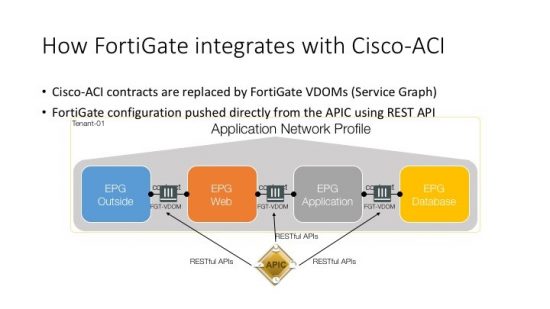
FortiGate Connector for Cisco ACI provides the automation and programmable application services to build software-defined infrastructure where policy enforcement across all workloads is consistent and segmented intelligently. Cisco ACI, together with Fortinet’s FortiGate Next Generation firewall, allows enterprises and cloud service providers to respond rapidly to business demands by enabling automatic provisioning and insertion of dynamic L4-L7 security and network services.
The solution debuted in 2015. In 2016, we further embraced more FortiGate models to ACI ecosystem from midrange to high end firewall appliances. There are also additional supported features (IPv6 Policy Configuration, Firewall Port Forwarding (Destination NAT or DNAT), APIC Dynamic EPG Notification, Monitor FortiGate Devices (Health) Status, and FortiGate Device Packet Statistics on physical port. Service Policy Mode has been introduced in 2016 and we can look forward to supporting FortiManager centralized management, dynamical routing protocol BGP, Proxy Policy and SSL/SSH Inspection in 2017.
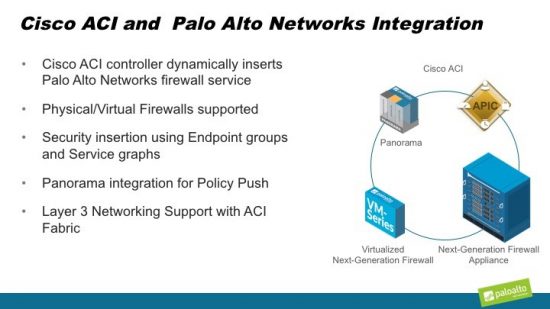
Cisco ACI with Palo Alto Networks
Palo Alto Networks® Next-Generation Firewall (NGFW) integration with Cisco® ACI™ enables advanced security to keep pace with the dynamic workloads within application-centric infrastructure. Palo Alto Networks device package for Cisco® ACI™ enables the APIC to configure both physical and virtualized form factor Palo Alto Networks next-generation firewalls via PAN-OS® Restful APIs. With new enhancements to the device package introduced recently, customers can now leverage high availability, multiple virtual systems, and aggregate interfaces on the physical firewalls and layer 2 support.
With the rich firewall feature set available through the integration, customers can do seamless service insertion of Palo Alto Networks next-generation firewall as a service, gain granular visibility and control of application traffic and leverage advanced threat prevention features, including, application-level segmentation, security policy enforcement that complements application centric nature of ACI, prevent known and unknown threats from both an inbound and lateral movement perspective , centrally manage with Panorama™ and automate security to keep pace with new or changing workloads.
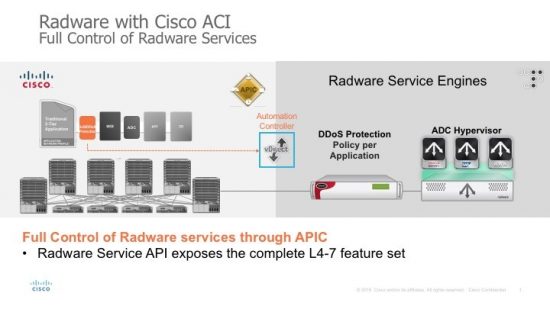
Cisco ACI with Radware
As businesses move towards SDN infrastructures, they are finding the need to manage the benefits of these cloud architectures – agility and elasticity. Agility is the ability to change applications quickly and easily. Elasticity enables on-demand resourcing to scale resources based on client demand. It is essential that the network can deliver these services and application delivery controllers (ADC) are a key technology to enable these services.
Radware’s ADC, the Alteon NG platform, offers full integration with Cisco’s ACI architecture and APIC through Cisco’s Service Manager, the Alteon NG ADC can be used to deliver the agility and elasticity that ACI customers are looking for. Radware’s ADC technology enables the load balancing and scaling of services in addition to the protection of application layer services through web application firewall (WAF) and DDoS protection solutions. The ADC is a core technology required to enable the benefits of ACI architecture and Radware is committed to integrating their solutions into Cisco’s offerings.
Conclusion:
The momentum is going strong with ACI ecosystem, and several new technology partners are in the process of coming on board. There are lots of exciting ACI innovations on the menu to benefit customers. The Cisco App Center is one of them which extends the openness, and programmability of Cisco ACI and enables our technology partners to run custom built Apps to serve customer needs.
We look forward to delivering continued customer success with further differentiated solutions in the near future, specifically around hybrid cloud with Cisco Cloud Center, micro-services deployments, integration with Tetration Analytics platform, and the ability to demo most, if not all, of the solutions mentioned in this blog on Cisco dCloud.
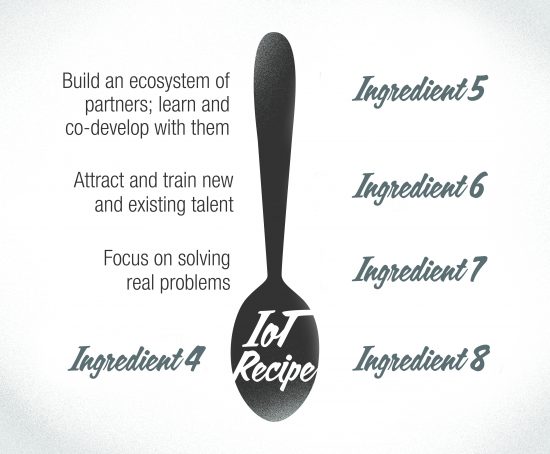
The search for the “next big thing” in technology has almost taken on mythic proportions. Just as Captain Ahab became obsessed with his pursuit of the elusive white whale in Moby Dick, it’s easy to get caught up in pursuing big solutions and big technology. But that is not necessarily the path to success.
I’m a believer in the Internet of Things (IoT) as the driver of transformational change across industries. In fact, I just wrote a book about it. But that doesn’t mean every IoT deployment is going to be transformational—or even moderately successful. Successful IoT deployments do have at least one thing in common, however—they focus on solving the customer’s real business problems.
This third ingredient in my Recipe for IoT Success may seem obvious to you. Of course you focus on real problems! But you may be surprised at how often these efforts wander off track because someone is chasing a shiny new technology instead of starting with the customer—and the customer’s problems—at the center.
I have seen a lot of technology companies (especially startups) taking the technology-out approach—building yet another IoT platform or a real-time fog engine. But the successful ones take their horizontal technology and focus it on one customer segment and one customer business problem. They know that IoT is not one market, it is a collection of huge markets and even one use case in a specific segment can represent a multi-billion dollar total addressable market (TAM) opportunity. Let’s face it, there will be very few horizontal IoT platforms but zillions of vertical solutions based on horizontal capabilities.
Consider the transportation market—a segment rich with IoT possibilities. These opportunities are driven by the convergence of traditional technology and transportation industries, which is redefining business structures and value propositions across both industries. Today, IoT solutions such as predictive maintenance are helping transportation companies minimize equipment downtime and reduce maintenance costs. Implementing a predictive maintenance solution for a city bus system would be an example of the solution focused on real customer needs in a specific segment, yielding immediate benefits. In fact, predictive maintenance is one of the four fast-paths to IoT payback that I have identified to help you get started on the road to IoT success. Once you conquered this market segment and this use case, you can then easily move to address the same use case in an adjacent market, such as delivery vehicles or dump trucks in open pit mines. And then maybe, just maybe, you will have a shot at the IoT platform status.
There is another aspect of focusing on real customer problems that you need to consider: How do you distinguish a “science project” from a real, production-ready deployment? Here is a hard lesson learned by a team of contractors that failed to connect all the dots to make sure a project was “real”: They spent two years working on an initiative for an oil and gas company to install a Wi-Fi network in an existing refinery. The team overcame numerous obstacles, including obtaining permission to access the hazardous site, making Wi-Fi work reliably surrounded by metal structures, and integrating this new network with existing technologies. But the one thing they failed to ensure was whether or not the business units—the actual customers—had approved the project. They had not, and in the end, they chose not to take it live—a tremendous waste of time and money.
While there may have been many internal communication problems to blame for this situation, here are the key takeaways: 1) make sure that you are dealing with business decision makers with budget or the ability create budget; and 2) break down silos of all kinds—including the all-too-common disconnects among IT, operational technology, and the lines of business.
By starting with a real solution for a real customer problem, and by ensuring that your project is ready for production, with buy-in from all stakeholders, you can be well on your way to IoT success.
Next time, I’ll discuss the fourth ingredient in my IoT Recipe: prepare for a journey, not a one-time event. And in case you missed my earlier blogs on the Recipe for IoT Success, click these links to look back at the first and second ingredients.
Today, Cisco is proudly announcing that our cBR-8 Evolved CCAP has achieved both NAGRA CA (Conditional Access) and Cisco’s Videoguard CA certification in compliance with the standard DVB Simulcrypt used in Europe and other parts of the world for delivery of digital cable video to STBs.
Why is this important? Well, it allows cable operators worldwide to use the cBR-8 for video and data services if they have Cisco or NAGRA CA systems in place for the video delivery platform. By converging services onto a single platform they achieve significant cost savings from a total cost of ownership perspective. This is what CCAP is all about – convergence of services.
Just as a reminder for those who might not be familiar with the cBR-8.
The cBR-8 is the first integrated CCAP product designed for full spectrum DOCSIS 3.1. and beyond. Our full-spectrum platform can converge all services, including DOCSIS data services and MPEG/DVB video services, into a single chassis. At the same time the cBR-8 is designed for both conventional integrated capabilities as well as Cablelabs standardized Remote PHY. This all in the same chassis, imagine the total cost of ownership benefits by reducing required rack space, power and cooling in the Cable Operators HUB site!
The scalability the cBR-8 offers means that video and DOCSIS data services can be turned on by a simple, straight forward license activation, all 158 QAM channels in a service group, with a total of 64 service groups in a cBR-8 with the 8×16 line-card. Remote PHY will soon at least double that capability, no need for CAPEX burning chassis forklift upgrades, the same line-card can support Remote PHY or I-CMTS.
Now, what exactly was certified at NAGRA?
Cisco received a “Certificate of Compliance of Simulcrypt ECMG, EIS and PSI-SI Interfaces” from the NAGRA Kudelski group on the 23rd of November, 2016.
At the same time we have passed all testing with our own Cisco Videoguard CA solution.
The cBR-8 was already deployed at cable operators in a converged fashion for both DOCSIS data and video services, now it can be used for NAGRA CA and Videoguard CA deployments as well.















 Consider the transportation market—a segment rich with IoT possibilities. These opportunities are driven by the convergence of traditional technology and transportation industries, which is redefining business structures and value propositions across both industries. Today, IoT solutions such as predictive maintenance are helping transportation companies minimize equipment downtime and reduce maintenance costs. Implementing a predictive maintenance solution for a city bus system would be an example of the solution focused on real customer needs in a specific segment, yielding immediate benefits. In fact, predictive maintenance is one of the
  real customer problem, and by ensuring that your project is ready for production, with buy-in from all stakeholders, you can be well on your way to IoT success.
 Just as a reminder for those who might not be familiar with the cBR-8.