Avatar

In my previous post, I shared the challenges of innovating within a large enterprise, and how we approached this learning from startups whenever possible. I shared the first of five steps we’ve learned so far: Getting the right people on the bus. On this post I would like focus on Step 2: Getting the mindset right.

With a great team aboard the bus, we realized that it was critical to get the thinking right. We felt inspired by what startups do right when they succeed, whether it was out of virtue or necessity. We used that as our guiding light. In many cases, this forced us to ask ourselves hard questions. Specially, how to change how we would naturally behave in a corporation and instead think, “What would we do if we were in a startup?”
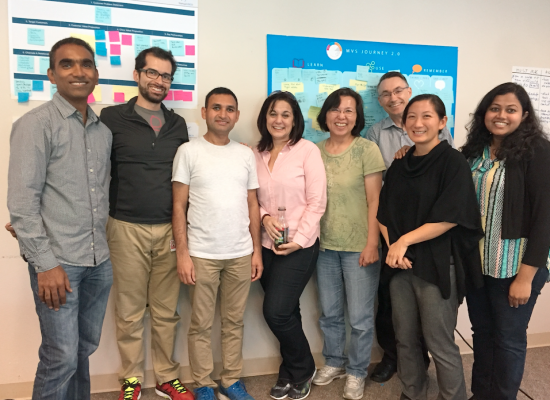
This was one of our teams at the last Startup//Cisco Workshop in San Jose.

We identified several mindset components:

Breaking the resource curse—and going back into bootstrapping mode: When created, most startups have very limited resources—and they have to get extremely creative to get by. On the other hand, many corporations and their teams get used to a distorted view of the world, where everything is extremely expensive and takes a long time. We needed to resort to thriftiness, introducing artificial time and resource constraints. This forced us to speed up our decisions, to get creative to use less resources, and to focus on what really matters.

Bias to action: In a corporate setting, it’s possible to admire a problem for a long time. There are actually dozens of very defensible reasons why to defer action (i.e. “we need to get xyz’s buy-in,” “we need to sync up with this other group,” etc.). Yet, the fact that something is defensible doesn’t mean you should use it as an excuse to slow down. Because this often leads to over analysis and not getting anything real done—other than PowerPoint decks and emails. Startups can’t afford this wasted time, as in many cases time is indeed running out before the next round of funding, before a competitor beats us to the next release, etc. So, bias to action became a critical component of our team’s mindset.

If it won’t explode, it’s probably ready to sell: Many startups find themselves in the need to begin selling a suboptimal, sometimes barely functioning, version of their product to get some traction and revenue—and to accelerate their own learning process to allow them iterate into a good product. We had to follow this to get started. (I’ll cover this in detail in my next post.)

Kill silos before they kill you: Amongst many other dynamic tensions they need to balance, corporations need to find the harmony between optimizing for a function and for the whole. Optimizing for a function creates groups, which in many cases, end up being at odds—or having little motivation to collaborate with each other. Gillian Tett describes many examples in The Silo Effect. Startups can’t afford to have this happen to them at the rampant level it reaches in dysfunctional larger organizations, because it would kill them instantly. Hence, as mentioned in my previous post, we deliberately began our effort with a cross-functional team, which proved useful to bust many silo barriers.

Follow rules—and work around them if they slow you down: Large organizations are based not only on great talent, but also in processes and policies that allow the machinery to operate. However, as organizations get bigger there are more and more rules. At some point, you might reach a point in which practically anything you want to do contravenes some internal rule or policy—or what people think rules are. (We have found many examples in which employees’ fear is manifested in a more acceptable form: alluding to a rule or policy that exists somewhere, preventing us to do that thing we fear.)

Startups, on the other hand, haven’t even had the time to build complex policies and manuals (and most likely they don’t need them and don’t even want them). In our own journey, we decided we would bend all of the rules necessary to achieve the beneficial objectives for Cisco. If we hadn’t done this we’d still be asking for permission left and right, with no real progress to show. We’ve asked for forgiveness a few times, but overall we’ve found support because we’re trying to do the right thing.

These mindset components allowed us to move faster than the average speed of an internal initiative. Designing our effort to drive change behaving like a startup, instead of a corporate initiative, gave us a competitive advantage.

In my next post I’ll describe the Third Step: Once you have the right people and mindset, it’s time to build the engine and get moving.


Authors

Oseas Ramirez Assad

Senior Manager, Business Development and Innovation Enablement

Strategic Innovation Group

Avatar

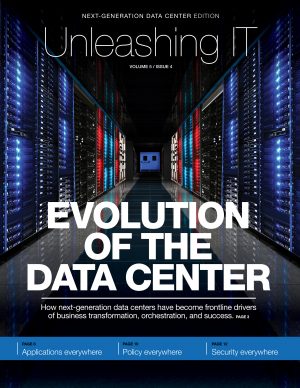
We are pleased to share this newest edition of Unleashing  IT  which talks about how next generation UIT V5 Iss4 coverdata centers are drivers of business transformation, orchestration, and success.  It contains 6 thought leader  articles and 2 customer stories providing unique perspectives on business challenges and solutions employing state of the art Cisco technology.

Why Data Centers Are More Important Than Ever introduces the importance of a consistent policy model for analytics, simplification, automation, and protection in the ASAP data center.

A DVR For Your Data Center explains what happens when you capture  every packet and every flow in your entire data center and add analytics with machine learning to deliver application dependency mapping and establish zero-trust operations by combining Tetration and ACI.

Finding The Right Home For Your Applications discusses how to model and application’s characteristics and policy requirements to deploy and manage them in the data center and cloud environments best suited to optimize price and performance for the business.

Software-Defined Networking Just Got Better talks about how ACI extends policy-driven automation up the cloud stack and uses a common policy model to accommodate any L4-L7 service for firewall, intrusion detection, and load balancing services.

Protecting Users Beyond the Firewall shares how customers are using Cisco Umbrella and CloudLock to protect users and data in cloud applications that are directly accessed from mobile devices outside the data center network.

Easier, Better Security With Micro-Segmentation introduces how Cisco automates configuration and enforcement using group-based management to secure applications, devices, and users in and out of the data center.

Hyperconverged Infrastructure, Hyper Efficient Operations details how a company enables rapid growth and deliver excellent user experiences using a next-gen data platform.

Building A “Field Of Dreams”  talks about how a service provider assembles a powerful cloud platform to transition from a network integrator to becoming a DevOps facilitator.

I hope you enjoy reading it and share the publication with your colleagues.  Just share the link:

http://www.unleashingit.com/ASAP


To Learn More:

Authors

Harry Petty

Director

Data Center and Cloud Marketing

Avatar

Cisco has won another important ruling from the ITC in our effort to stop Arista from using our intellectual property. In the Initial Determination for the second ITC investigation (known as ‘945), the judge confirmed that Arista has infringed another two Cisco patents covering critical core networking technology. That brings the total number of Cisco patents that Arista infringed to five.

The Judge’s ruling found:

  • violation of U.S. Patent 6,377,577 (“Access Control List Processing In Hardware”)
  • violation of U.S. Patent 7,224,668 (“Control Plane Security and Traffic Flow Management”)

These patented technologies are required to improve the operation of networking products, and to protect the control plane of a router or switch. These are core switch functionalities, and are included in Arista’s entire line of switches. Once again, Arista’s customers will need to bear the risk associated with any import ban and cease and desist orders.

As you might remember, on June 23, 2016, the ITC found that Arista infringes three patents in the ‘944 case. These cover Cisco’s private VLAN network security technology and Cisco’s proprietary core SysDB technology. As a result of the first ruling, an import ban and cease and desist order were put in place, and because Arista continued to sell despite these orders, the ITC began an enforcement investigation in September.

We understand that Customs and Border Protection (CBP) has recently sent Arista a letter indicating that CBP considers Arista’s redesigned products outside the scope of the ITC’s Exclusion Order. The ITC is not bound by that decision and will issue its own decision in the Enforcement Action.  Unlike the CBP process, both Cisco and the ITC Staff can and are participating in the Enforcement Action.  And CBP acknowledges it will be bound by the ITC’s enforcement determination and will carry out any actions mandated by that decision.

Similar to the first ITC investigation, this ‘945 ruling is subject to full Commission Review which is expected to be complete by April 9, 2017. Presidential review takes an additional 60 days, and if a new import ban is implemented, we would expect it to begin on June 9, 2017.

Arista has stockpiled products and components since the first ITC ruling, and has indicated it will soon be using local manufacturing facilities. But it is worth noting the Commission has the authority to enjoin local manufacturing of infringing products made with unlawfully imported components. Local manufacturing using unlawfully imported components is not a legal workaround, it’s still willful infringement and deliberately violates the Commission’s exclusion and cease and desist orders.

Additionally, we are in the Northern California District Court this week presenting our case to a jury about Arista’s copyright infringement of Cisco’s User Interface, including our multi-word commands for our Command Line Interface, output screens, help descriptions, as well as our user manuals. Our case further includes infringement of a separate, valid Cisco patent, which relates to Cisco’s innovative command line interface technology. The case is expected to conclude by Monday, December 12, 2016, with a jury verdict shortly thereafter.

In my two decades at Cisco, we have initiated an action such as this against a competitor on only one other occasion. There is no question that Arista copied from Cisco. There is ample evidence and multiple admissions from Arista confirming they have done so. Our goal has always been to protect technological innovation, and stop Arista from using our patented technology. We have made substantial investments in our technology and product development to build great products. We have a legal right and an ethical obligation to our employees, customers and shareholders to protect that innovation.

We welcome fair competition, but “slavishly copying” (Arista’s words) is neither fair nor innovative. It causes harm to innovation across the industry. And the implications only intensify for their investors, customers, partners and suppliers.

We thank Judge McNamara and the ITC staff for their diligence and review of the evidence.

Authors

Mark Chandler

Retired | Executive Vice President

Chief Legal and Compliance Officer

Avatar

How’s your holiday shopping going? Finding everything on your list?

Sorry—shouldn’t have asked.

I know the answer. Any other time of year, you can skip out the door on a whim, head to the mall, and see what treasures you happen to run across. No pressure. No obligations. No fear. You pick up an item for yourself in one place, spot the perfect gift for your 9-year-old in another. It’s all harmonious and easy and good.

But holiday shopping is different. Suddenly lists are involved. And pressure. Because failure to deliver on the specific items in these lists will not be met with gracious understanding. In fact, it may very well be met with tears. You don’t want tears.

So you trudge out clutching your list and embark upon what will surely be an epic search for Hatchimals (gratitude is in order if you have no idea what those are), the new Nintendo set, the Nerf Remote Control Drone Blaster, or whatever it is that has been scrawled onto that very well thought-out list of desperately yearned-for items.

Sounds a lot to me like shopping for private cloud.

Your company leadership knows what they want (to save money and gain a competitive advantage), your developers know what they want (quick and easy access to compute resources), and you know what you want (for whatever you choose to succeed gloriously so you will continue to enjoy all the benefits of full-time employment).

So you’ve got your list. And if you’ve read the analyst reports, you know it’s going to be very difficult to make all the contributing authors to that list happy. Private cloud is challenging. And done incorrectly it can be a time-consuming, costly endeavor.

But that doesn’t mean it can’t be done. Make no mistake, private cloud is being done very well by some companies. And being leveraged very effectively by the customers of those companies.

So where do you shop? Which private cloud solution will check all the boxes on the list and have your constituents dancing merrily around the data center after it’s been deployed?

I suggest you look into Cisco Metacloud.

It’s a fully-managed, on-premises, OpenStack-based private cloud. We build it, we deploy it, and we remotely operate it 24×7 on your behalf. All you do is consume it. Just like public cloud.

It makes your company’s leadership happy because it delivers significant savings over the public cloud resources your team has probably been using; it makes developers happy because it does in fact provide fast, easy access to the resources they need to innovate; and it will make you happy because it is backed by a 99.99% uptime SLA (which is to say you can run production workloads on it without putting your job in jeopardy).

What kind of workloads are people running on Metacloud?

Some of our customers are running websites on it, some use it for test and dev, several use it for their big data analytics engines, and others are running their entire product stack, from the customer interface to the back-end databases on it. They work our product hard. They push it. And they continue to surprise us with the creative ways they are using it to revolutionize their businesses.

I could go on and on about what Metacloud can do and how your company will benefit from it, but that will make this blog post longer than anyone wants it to be.

So if you’re itching to cross “private cloud” off your list and you’re at all curious about Metacloud, I encourage you to pop over to our website and spend a few minutes learning more about it. You can keep it high-level and stick to videos and case studies, or you can dig deep into product functionality with our webinars and technical tutorials. Or, if you’d like to cut straight to the chase and have someone answer your very specific questions directly, just email me at aamagasu@cisco.com. I’ll be happy to put you in touch with one of our systems engineers or salespeople so they can talk through your challenges and help you figure out if Metacloud is right for you.

Happy Holidays, and good luck with the shopping.


Authors

Ali Amagasu

Marketing Communications Manager

Avatar

We’ve all been there.

You walk into a conference room, and you have a simple task – project your laptop screen onto the screen at the end of the conference room. Yet, until now, this simple task has been really hard.

The first step is the hunt for the cable. Sometimes it’s right there on the table. Sometimes it’s buried in one of these hidden nooks in fancy conference rooms and you have to flip open all of them to find the cable. Often it’s on the floor, underneath the conference room table or hidden behind the TV or screen. Sometimes, you find more than one of these cables in the room. Then you have to play guessing games about which one connects to the projector and which one connects to the video conferencing unit.

If you do manage to find the stupid cable, your next dilemma is dealing with the fact that it probably doesn’t reach to your seat at the conference table. So, you have to move seats and eject someone just to sit next to the cable. Some rooms have the opposite problem – the cable is so long that you feel like a cowboy, unrolling a lasso to make it reach across the table, knocking over coffee cups and displacing papers.

But the problems don’t end there! The next trick is the dongle game. The cable is VGA but your laptop only has HDMI; or the cable is HDMI and you only have display port. Maybe if you’re lucky, the cable has a keyring with dongles attached. So, you flip through them until you find the right one. Now, just as you reach the moment of truth – you plug in and – nothing! What now? You need to find the source selector for the projector or screen to manage to tell it to actually show the output of your laptop.

It’s time for this cable to meet its end.

I’m pleased to announce that today, we’ve shipped an update to Cisco Spark that will once and for all end the evil tyranny of the conference-room projection cable.

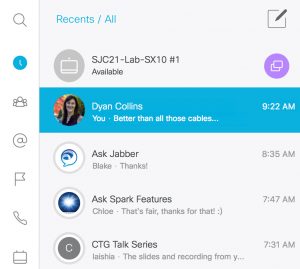
How does it work? Easy. With Cisco Spark on your laptop (now supported on our Mac and Windows clients), just walk into any Cisco Spark enabled conference room. Your laptop will automatically pair with the video system, and the Spark app will show an icon with the name of the video unit and a button to share your screen. Press the button. That’s it! Your laptop will go into presentation mode and the contents will show up on the screen.

spark conf-room share


This one-click-magic is enabled by no less than four innovations we’ve built into the solution.

  • It works with your laptop on any network – even cellular. There are other solutions in-market for wireless sharing, but they typically require the laptop to be on the same LAN as the video system. In an era of BYO devices, guest wifi, and network segmentation, this is less and less the case. With Cisco Spark, your laptop doesn’t need to be on the same LAN as the Cisco Spark room system. It only needs to be able to reach the Internet.
  • It works in any Cisco Spark conference room – not just those in your own company. Think about it: If you visit someone else’s office, you can plug in your HDMI cable into their projectors. With Cisco Spark, the same is true. Walk into any conference room with a Cisco Spark room system, and the wireless-sharing feature works.
  • The projector app and meeting app are the same. Many modern projectors in conference rooms offer downloadable apps you can use to project your screen without plugging in. However, if you want to share your screen into an online meeting, you also need a meeting app. With Cisco Spark, they’re one and the same. The Cisco Spark Room OS endpoint serves as both a wireless projector and video-conferencing system, and the associated Cisco Spark app also accomplishes both goals. You use the same app to project your laptop onto the screen as you would to join an online meeting.
  • Go there to show there. A common concern with wireless projection technologies is whether someone can project content onto the screen without being in the conference room. An HDMI cable does have the benefit that only someone in the room can project content onto the screen. Competitors that offer wireless presentation apps for their projectors often use cumbersome codes to ensure your presence in the room. Again, Cisco Spark makes it easy. Cisco Spark’s wireless presentation-sharing feature uses our unique ultrasonic proximity technology. With it, users can project their screens only if they are physically within the conference room – no codes required.

Oh, did I mention that this feature is available for both free users and paid users? Of course, someone needs to have purchased the room system, but once it’s there, any Cisco Spark user can share wirelessly.

I’m really excited that we’re finally able to bring this feature to the world. I’ve been using it internally for many months now and it’s a game changer.

Happy sharing. And, to our old friend the projector cable, may you rest in peace.

Cisco Spark Event 1.24.17

Authors

Jonathan Rosenberg

Cisco Fellow and Vice President

CTO for Cisco's Collaboration Business

Avatar

Cyberattacks are ever evolving to circumvent and evade “protection-only” technologies. Despite your best efforts to protect against compromise, a persistent attacker will eventually breach your defenses and get inside. Then what? IT security teams need to automatically detect a threat when it gets in. They need to know where it came from, how it entered, where it has been, what it is doing, and how to contain and remediate it before data is stolen and damage is done.

The good news for IT security teams is that next generation capabilities that go beyond protection, to also include automated detection and response, are rapidly emerging. The convergence of these capabilities marks a next generation in endpoint security.

Cisco AMP for Endpoints provides next generation capabilities to prevent, detect, and respond to cyberattacks quickly and effectively.

CIsco AMP Dashboard

Prevent: AMP for Endpoints blocks malware and helps strengthen endpoints from attack:

  • Global Threat Intelligence – Prevention starts with strengthening your defenses using the best global threat intelligence so you can block malware as new threats emerge. Cisco’s team of threat researchers continuously feed threat intelligence into AMP for Endpoints so customers are protected 24/7.
  • Malware Blocking – AMP for Endpoints uses a framework of complementary detection engines, including one-to-one signatures, fuzzy fingerprinting, machine learning, and an AV detection engine—all working together to catch and block malware before it can execute.
  • File Sandboxing – A built-in sandbox automatically analyzes unknown files against over 700 behavioral indicators to detect malicious files and automatically block and quarantine them.
  • Proactive Protection – Closing attack pathways before they can be exploited is a key strategy for preventing compromise. AMP’s vulnerable software feature shows you all the software on your endpoints that can be exploited, with the ability use application control to harden against attacks. AMP’s low prevalence capability detects targeted malware and prevents it from slipping under the detection radar.

One of the key tenets of a next generation endpoint security solution is the ability to go beyond prevention, since no prevention method will ever catch 100% of threats, 100% of the time.

Detect: That’s why AMP continually monitors all activity on your endpoints to quickly spot malicious behavior, detect indicators of compromise, and drastically decrease time to detection.

  • Continuous Monitoring and Analysis – Once a file lands on the endpoint, AMP for Endpoints continues to watch, analyze, and record all file activity, regardless of the file’s disposition. If malicious behavior is detected at some point in the future, AMP can automatically block the file across all endpoints, and show the security team the entire recorded history of the malware’s behavior. You can see where it came from, where it’s been, and what it’s doing across all of your endpoints: PC, Mac, Linux, mobile devices. This helps you understand the full scope the compromise and quickly respond.
  • Agentless Detection – AMP for Endpoints delivers agentless detection, a unique capability that detects compromise across customer environments, even if a host does not (or cannot) have an agent installed. Using Cisco’s Cognitive Threat Analytics (CTA) technology, AMP inspects web proxy logs to uncover things like memory-only malware and infections that live in a web browser only.
  • File-less detection – Get visibility into what command line arguments are used to launch executables to determine if legitimate applications, including Windows utilities, are being used for malicious purposes. For instance, see if vssadmin is being used to delete shadow copies or disable safe boots; see PowerShell-based exploits; see into privilege escalation, modifications of access control lists (ACLs), and attempts to enumerate systems.

Respond: AMP for Endpoints provides a suite of response capabilities to quickly contain and eliminate threats across all endpoints, before damage can be done.

  • Threat Hunting Made Easy: Accelerate investigations and reduce management complexity by easily searching for threats across all endpoints using AMP’s simple, cloud-based UI. Search across the cloud and the endpoint to see file, telemetry, IoC, and threat intelligence data. Uncover artifacts left behind as part of the malware ecosystem. These capabilities let you quickly understand the context and scope of an attack so you can stop it fast.
  • Surgical, Automated Remediation: When AMP sees a threat, it automatically contains and remediates it across all of your endpoints: PCs, Macs, Linux, and mobile devices. Instantly, full-stop. No need to wait for a content update. Also, with just a few clicks, you can block a specific file across all or selected systems; block families of polymorphic malware; contain a compromised application being used as a malware gateway and stop the re-infection cycle; and stop malware call-back communications at the source, even for remote endpoints outside the corporate network.

Furthermore, AMP for Endpoints is not a siloed point product. It has an API that lets customers sync AMP for Endpoints with their other security tools or SIEMs. But most importantly, AMP for Endpoints is part of the larger, integrated security ecosystem of “AMP Everywhere”. In other words, AMP for Endpoints can share and correlate information from the endpoint to the network IPS, to the firewall, to your web or email gateways, and more. So that when you see a threat in one place, your whole entire security ecosystem can respond systemically. This allows you to respond faster and more comprehensively. This integrated architecture is a force multiplier for security teams.

To learn more about how AMP for Endpoints can protect your organization, please visit www.cisco.com/go/ampendpoint. View a demo or watch an overview video.

Authors

John Dominguez

Product Marketing

Cisco Security Business Group

Avatar

AS40712

Whether it’s a hotel, a dorm or any situation where a large number of people are living under one roof, making sure that the wireless network is fast and reliant can be a tall task. This is especially true in a university setting where young people and their multitudes of devices are crammed into a setting where the network is being used for both work and play.

Until recently, the University of Florida knew all about the stories of slow connections in their dorms.

Like a lot of universities, UF received low marks from its students when it came to Wi-Fi accessibility in their rooms. Wireless internet was only guaranteed in common areas and students demanded the same service in their rooms. The UF IT department heard the students’ pleas and began an initiative called “World Class Wireless”. World Class Wireless aimed to deliver “exceptional, consistent signal strength and data transfer rates in every resident room”. In other words, they wanted the speed and reliability of a wireless network but without the hassle of wires.

Naturally when the University thought of “World Class Wireless”, their immediate thought was Cisco. When creating a wireless network infrastructure this big—the first section of the program was to deploy the solutions in four dorms before outfitting the rest of the campus’ student housing—the UF IT department chose the Cisco Aironet 1810W Access Points to handle the heavy lifting. With an 1810W in every room, this meant that students were able to access the internet from their own room at amazing speeds. How fast? UF techs were quoted as saying that speeds “exceeded the standards” in terms of signal strength and the students have been happy about the new network.

With the four residence halls in the pilot program deemed a success, the University is expanding the “World Class Wireless” program campus-wide in the coming semesters.

For more information on this project, please click here.

Authors

Byron Magrane

Product Manager, Marketing

Avatar

There are a number of options for modernizing your transport network, including native TDM switching over the optical transport network (OTN), a complete overlay network with routers and DWDM, and finally migrating to packet optical using circuit emulation (CEM). Each option has value, but the value depends on your end goal.

In a previous post, A Requirements Checklist for the Next Generation Transport Network, we discuss how a new transport network modernization solution could affect an organization’s business model, future growth opportunities, OpEx and CapEx targets, and integration into existing operational models, which includes staffing, skillsets, and OSSs and business support systems (BSSs). In this post, we’ll explain the different technology paths to transport network modernization and how they each modernization path aligns with business goals.

The Best Fit for Your Organization

If you don’t have extensive TDM connections and related infrastructure in your network and central office, retooling to provide an all IP next-generation transport network is simpler and more cost-effective. For those with extensive TDM services to support, a more gradual migration using a hybrid transport network that supports TDM, Ethernet, and IP/packet services can be the more prudent way to move forward.

Option 1: Native TDM Switching over OTN

With native TDM switching over the OTN, the OTN switch becomes a way to backhaul TDM traffic. T1, DS3, OC3, OC12, 1 Gigabit, and 10 Gigabit connections are multiplexed for transport over an optical data unit (ODU) connection. This solution lets you retain TDM interfaces while using OTN and low-speed interfaces for transport.

Drawbacks to this approach: If you want the solution to support Ethernet, there can be problems. The low-density ASICs in a SONET platform typically allow for only 40 to 60 gigabytes of low-order/high-order (LO/HO) switching. Capacity utilization on each system is limited to a maximum of approximately 40 percent. It’s not really a viable solution for packet traffic, which requires a more expansive environment for traffic diversity and overall traffic and bandwidth growth. The SONET cross-connect can only be connected to a maximum of 16 destinations, limiting scale. And OpEx is high given the complexity of the SONET/SDH over OTN grooming solution. OTN is not optimized for LO/HO grooming of containers within the SONET payload because of hardware capacity limitations. As a whole, this solution is very inefficient because it doesn’t use the available capacity in your network and it also limits scale. You can use it to support your TDM needs, but it’s at the expense of adding Ethernet traffic.

Option 2: Overlay with Routers and DWDM

This Ethernet-only network requires that you change out your optical carrier technology (for example, OC3 or OC12) to Ethernet. You’ll get rid of TDM interfaces and a lot of SONET/SDH gear and replacing it with Ethernet technology. It is a comprehensive changeover instead of a gradual migration to a hybrid network.

Drawbacks to this approach: It would force your customers to buy new CPE devices and change their service contracts. The greatest risk is for customer churn; will your customers agree to incur the expense of new equipment? Are they willing adjust their operations environments to support the new interface? Or will they put their contract out to bid and possible find another provider? Your TDM services would be converted to VoIP. Management will be different. You’ll want to consider how it would support a 99.999 percent SLA for uptime and 50ms protection for voice.

This option does not support TDM, Ethernet, and IP traffic. It will require expertise both within your organization and among your customers. It could be expensive and take time to implement. It’s a risky move as it directly affects your customers and may result in increased customer churn rates.

Option 3: Packet Optical with Circuit Emulation (CEM)

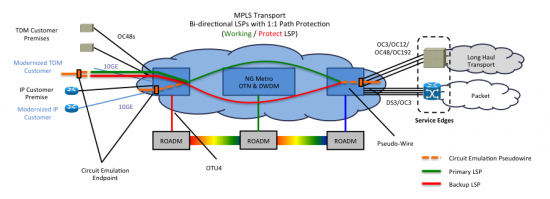
Cisco’s high-density circuit emulation technology allows TDM services to be migrated across an asynchronous IP/Multiprotocol Label Switching (MPLS) network with no errors and a constant delay. It provides the ability to terminate TDM traffic over SONET/SDH as an interface, continuing fault propagation between SONET/SDH and the IP/MPLS network using pseudowires running over dynamic label-switched paths (LSPs). LSPs are paths through MPLS networks set up by a signaling protocol.

The CEM solution is supported by multiple industry standards and deployed through control planes for both SONET/SDH and IP/MPLS. The CEM solution provides protection; operations, administration, and management (OAM); simplicity; and manageability on a par with those provided by SONET/SDH. It is predictable and deterministic, with sub-50ms resiliency. IP/MPLS packet services run natively over the network.

High-Density Circuit Emulation Technology
Cisco’s high-density circuit emulation technology

TDM traffic is restricted to the edges, and IP/MPLS is added as the major transport network. The scalable MPLS infrastructure is overlaid on top of the 100GB ROADM and reconfigurable OTN DWDM infrastructure. With a SONET/SDH look and feel, one-to-one path protection, and an A to Z provisioning system, the CEM solution lets you trim down your legacy transport network as part of a next-generation migration. DCSs can be eliminated right away, dramatically reducing costs. SONET/SDH ADMs may be eliminated now or later. With Gigabit Ethernet over SONET.SDH, Gigabit Ethernet routers may also be taken away or reduced. You’ll be able to use as little as 1/10 the space you’re using now in your central office and get rid of many electrical cables running between floors. No need to cannibalize other systems to keep other legacy gear running or buy expensive replacement parts, if they are even available.

Advantages of this approach: This solution is ideal for organizations that want their TDM services to be integrated along with IP services across SONET/SDH transport networks. You get SONET/SDH-like features, such as OAM and manageability, and IP/MPLS and other technologies help eliminate errors and delay. Your next-generation transport network becomes predictable and deterministic, with sub-50ms resiliency. The solution is supported by industry standards. And it’s invisible to end customers, with no new CPE required. Packet optical with CEM is a great way to modernize, scale, trim OpEx and CapEx, and future-proof your transport network. It lets you evolve towards Metro Ethernet, Layer 3 VPN, and full IP transport whenever you’re ready.

A Roadmap for Transport Network Modernization

In our recently published E-Book, A Roadmap for Transport Network Modernization, we cover the next-generation transport network solution options in more detail. In addition, we look at both the business and technology requirements of transport networks today and into the next decade. We conclude the E-Book with a look at the Cisco Transport Modernization Solution. We’ll show you how our next-generation approach, using Cisco’s high-density circuit-emulation (CEM) technology, provides you with a cost-effective network modernization path, while still supporting ongoing TDM services requirements.

If you are ready to modernize your network, find out how with A Roadmap for Transport Network Modernization. Download your copy today.

Save

Authors

Alison Izard

Marketing Manager

Avatar

Wendy Bahr said it best at Partner Summit: “to move with speed, we have to simplify”. But how can you cut through the clutter and not only reach your target audience, but reach them with something that spurs action and pushes results?

Our distribution partners at Comstor did just that. Through a laser focus on security and aligning their sales and marketing teams, they are driving enablement and awareness through targeted marketing initiatives and incentives.

They are enabling their partners to successfully build and expand their Cisco security practices by developing Comstor Security Initiative (CSI) – a multi-pronged, comprehensive business development offering focused on consulting, best practices, tools and training. CSI helps recruit and onboard a targeted group of high-potential security VARs, enabling those VARs to successfully win security deals and grow their Cisco security practice, in addition to grow Comstor’s security pipeline.

In addition, Comstor assigned a dedicated, cross functional Security team to execute CSI with a focus on partner engagement through a comprehensive training and enablement program.

Comstor didn’t just develop the program and hope it worked; they carefully designed a thorough, high-touch campaign that helped secure results. Here’s how they did it:

Executive Threat Strategy 

Comstor’s Executive Threat Strategy (ETS) is a holistic and collaborative approach to enterprise security.  Rather than a narrow, myopic view of cyber security, ETS takes aim at the entire organization, including: people, process, facilities and technology.

POV+
This combines Next Generation Firewall (NGFW) with Cisco’s Advanced Malware Protection (AMP) for Endpoints.  POV+ generates a comprehensive Network Security Risk report, showing clients what is really happening in their network, thus driving opportunities to close business.

CyberRisk Solutions (CRS)
Comstor has a dynamic value partnership with CyberRisk Solutions to deliver consulting services related to people, processes, and facilities that are complimentary to Cisco technology.

Digital Tactics

By developing a dedicated CSI website, developing a series of topical blog posts and taking advantage of their Comstory e-newsletter, the Comstor team is leveraging digital marketing tactics as lynchpins in the program. In addition, they delivered webinars via Webex on CyberRisk Solutions, OpenDNS and ISE in order to display thought leadership and expertise.

So what does the future hold for Comstor? Next steps are centered on enablement and implementation.  In addition, CSI will foster the implementation of two new lead generation programs and develop cross architectural programs in order to enhance security sales opportunities within each architecture.

Where can you find resources to help you pull off this type of program? Much of the content from Comstor’s effort was developed using resources from Partner Marketing Central (PMC), Sales Connect and Selling Security and Security Pitch Zone. Log on today to see how our partner-focused marketing resources can help you focus on your biggest opportunities and take your sales efforts to the next level.

Authors

Oren Singer

Sr. Marketing Manager

Global Distribution Organization