Avatar

Research shows that experiential and project-based learning is linked to significant improvements in student test scores, attendance and classroom engagement, as well as improved higher order thinking and problem solving skills and speaks to a broader range of learners.

Additionally, there is a great deal of information about learning modalities that suggest a combination of telling and demonstration work well for information transfer.

I recently participated in “Innovate Together,” a program organized and managed by Cisco’s Services Innovation Excellence Center (SIEC). The program was aimed at teaching students how to identify a problem impacting their community, complete research to validate it, brainstorm solutions, and effectively communicate a solution in a pitch format.

The goal is to positively impact the community by leveraging IoT technology, while allowing students to come out of the traditional classroom setting and asking them to solve real-world scenarios.

With 125 seventh graders from Bay Point Middle School’s Center for Advancement of the Sciences and Technology in Florida participating in the two-day event, sixteen teams were formed. The teams were thoughtfully composed based on test scores, cultural diversity, gender and complimentary skills. And the results were awesome.

The students addressed social conscious and conservation issues with their ideas. Among the problems addressed, which were identified by the students, were proper nutrition for children, feeding the homeless, the opportunity automation is creating for re-skilling the workforce and affordable transportation.

Ten mentors from Cisco, including myself, were on hand to get the creative juices flowing and to foster a problem-solving environment during the event.

The two-day event culminated in an evening award ceremony where the top four groups pitched their problem and solution to a group of their peers, faculty, staff, district administration and family.

IMG_8731

After much deliberation, the judging panel chose the winning group, which developed a program around proper nutrition, integrating a wearable component to scan and track food intake and nutrition information. There was also a gaming component included to incentivize kids to use the device for fun and for educational purposes.

The winning team won $250 for their school to either donate to the community charity of their choice or to use to further advance the winning team’s concept.

IMG_8849[3]

The value of learning through real-world experience is invaluable. This is Cisco’s SIEC’s second educational “Innovate Together” event and the reception at each of the schools by faculty, staff, administration and parents has been tremendous. We hope to continue spreading the program across the country.
Authors

Drew Rosen

Senior Director, Technical Support

Learning@Cisco

Avatar

This blog post was authored by Ben Baker, Edmund Brumaghin, Mariano Graziano, and Jonas Zaddach

Executive Summary

Floki Bot is a new malware variant that has recently been offered for sale on various darknet markets. It is based on the same codebase that was used by the infamous Zeus trojan, the source code of which was leaked in 2011. Rather than simply copying the features that were present within the Zeus trojan “as-is”, Floki Bot claims to feature several new capabilities making it an attractive tool for criminals. As Talos is constantly monitoring changes across the threat landscape to ensure that our customers remain protected as threats continue to evolve, we took a deep dive into this malware variant to determine the technical capabilities and characteristics of Floki Bot.

During our analysis of Floki Bot, Talos identified modifications that had been made to the dropper mechanism present in the leaked Zeus source code in an attempt to make Floki Bot more difficult to detect. Talos also observed the introduction of new code that allows Floki Bot to make use of the Tor network. However, this functionality does not appear to be active for the time being. Finally, through the use of the FIRST framework during the analysis process, Talos was able to quickly identify code/function reuse between Zeus and Floki Bot. This made sample analysis more efficient and decreased the amount of time spent documenting various functions present within the Floki Bot samples we analyzed.

Talos worked in collaboration with Flashpoint during the analysis of Floki Bot. This collaborative effort allowed Talos and Flashpoint to quickly communicate intelligence data related to active campaigns distributing Floki Bot as well as data regarding the technical functionality present within the malware. Additionally, Talos is making scripts available to the open source community that will help malware analysts automate portions of the Floki Bot analysis process and make the process of analyzing Floki Bot easier to perform.

Read More>>

Authors

Talos Group

Talos Security Intelligence & Research Group

Avatar

You’ve heard me say it. You’ve heard Karen Walker say it: the transition to digital marketing is a business imperative for businesses across the board. And distributors are no exception.

In my blog This Will Help You Sleep at Night, I outlined some of the key benefits and digital marketing offerings available throughout the ENGAGE Marketing Suite. Between connecting you to training, experts and best practices and giving you the campaigns to put them into action, you have the resources at your disposal to win more customers by putting digital first.

But are you taking advantage of them?

Distribution partner VSGi is a prime example of using the digital marketing services provided by Cisco to grow their business, particularly in the commercial sector. Now is the time to take an inventory of what you’re doing.

Do you want to capture more customers or drive existing ones to a landing page with offers? You can create email journeys from Partner Marketing Central (PMC), and customize based on your needs. Email directly reaches your customer base, and could be forwarded to others for expanded customer potential. Be personal, be concise and share how your solution will help them, and when they respond – act quickly!

Did you know that more than 67% of customers’ purchasing decisions are done online through their own research? Your website is a reflection of your brand. Keep your content fresh and up-to-date by syndicating our product showcases to your website. This will increase trust with your customers and keep you top of mind! 

Were you aware that staying in contact with your customers keeps you relevant in their minds? Supplement your social media efforts with Cisco generated content and extend your reach into your network.

Did you know you don’t need to waste time on perspective leads that may not deliver? To increase revenue potential and minimize waste try telequalification scoring. Access this capability in PMC, and see how reaching out and touching someone might be ideal for your organization.

Do you want to keep your customers engaged? Delivering relevant content is one of the best ways to keep your customers thinking of your company. Access the array of collateral we offer and use it to educate and entertain them. Integrate this content into your digital marketing tactics and see how we could help you go further by doing less.

In addition, the VSGi team also took advantage of purchased tactics, such as list purchase, monthly pipeline generator and custom ads in order to round out their digital approach.

What excites me the most about this VSGi example is the success that they have seen through using the tactics as a holistic and strategic marketing approach – not just a one-off tactical effort.

Looking for more digital marketing inspiration? Check out how the ShoreGroup team used these tactics to better identify qualified prospects and close deals faster in order to exceed expectations and realize double digit growth.

What can digital marketing do for your team? Share your stories with us, and we might feature them here! Stay tuned for the next two blogs in our 3 Days of Disti series, featuring Ingram Micro and Comstor!

Avatar

Fog computing is gaining traction across industries and academia, and across the world.  In just one year, the OpenFog Consortium has grown from six founding members to 53 members in 15 countries—and still counting! But it’s not just this flood of interest that is impressive—it’s the work our members are doing together to accelerate fog from the concept phase into full execution mode.

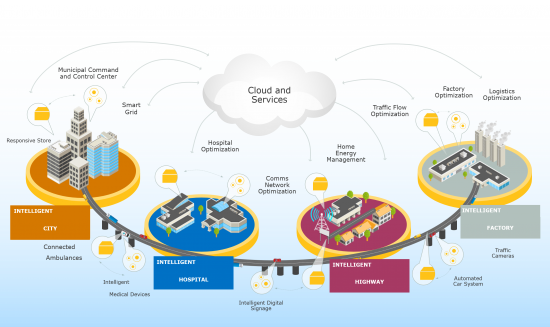
To sustain IoT momentum, the OpenFog Consortium is defining a new architecture—fog computing—that brings information processing closer to where the data is being produced or used.

The concept is simply to bring storage, compute and networking capabilities to the edge of the Internet of Things (IoT) to address such challenges as latency, bandwidth, reliability, and security—and to enable IoT to grow into its full potential. To really prove viability, you need maximum choice, interoperability, and an open architecture. And that’s exactly what we’re working on—a framework to create a secure and robust multi-vendor interoperable fog computing environment.

Year 1 of the OpenFog Consortium was focused on establishing the foundation for an open fog computing reference architecture. Seven working groups worked for many months to precisely define the requirements for each of eight architectural pillars: security, scalability, openness, autonomy, RAS (reliability, availability, serviceability), agility, hierarchy, and programmability.  A white paper was published and this work provided the baseline for the architectural direction of fog computing and will serve as a common starting place to create fog standards.

As we start our second year, we are completing the OpenFog Reference Architecture, which will be published during the first quarter of 2017. We are working to test the reference architecture through a wide variety of use cases, and will also begin the first fog computing testbeds. Later in the year we will begin working with our Standards Development Organizations alliances to start the process of creating standards.

As these frameworks and standards achieve widespread adoption, the industry will need the right talent and skills to implement the new technologies. So education is a third important area of focus for the Consortium. Next month we are starting an internship pilot program that will match promising Ph.D. students from member universities with OpenFog industry members.

This initiative is an extension of the collaboration that has developed over the last year between our academic and industry members. During our three meetings in the coming year, universities will continue to showcase their research to explore potential areas of synergy where industry members might want to adopt or invest in new technologies and processes. These meetings will also be an opportunity for all OpenFog member organizations to advance the work they are doing and expand new opportunities and personal networks.

Finally, as we continue through our second year, the OpenFog Consortium will expand our outreach activities to create awareness of the benefits of fog computing. Geographically, we are working to enlarge our global footprint by establishing a Greater China and a European Committee to complement existing work groups in the Americas and Japan.  Our global outreach efforts throughout the year will culminate in the inaugural Fog World Congress event in October, jointly spearheaded by OpenFog and IEEE.

As chairman of the OpenFog Consortium, I couldn’t be more excited and proud of all that we’ve accomplished this year. We head into our second year with growing energy and momentum for fog computing—and OpenFog.

Authors

Helder Antunes

Senior Director

Corporate Strategic Innovations Group

Avatar

Whew! Black Friday and Cyber Monday came and went quickly this year! With these two biggest annual shopping days coming earlier every year and more and more consumers taking advantage of outstanding online shopping opportunities, we decided to host a #CiscoChat just for those of you in the retail industry to discuss your discoveries.

During the Chat, we heard from retail experts and influencers about this year’s biggest shopping trends and how mobility impacts consumer behavior. Retail experts also shared insights on what they are doing to provide frictionless customer experiences and discussed the notable security challenges of being a retailer in a consumer world increasingly driven by online purchasing. If you missed our discussion, you can check out a recap on Storify.

https://storify.com/CiscoChat/black-friday-cyber-monday-protecting-your-data

To everyone who joined our #CiscoChat, thank you for your contributions. We hope you all give yourselves a little break before you start preparing for Black Friday and Cyber Monday 2017!

Follow us on Twitter: @CiscoRetail 


Authors

Kathryn Howe

Former Director, Healthcare Digital Transformation, Cisco Americas

Customer Value Acceleration/Business Transformation

Avatar

Friends,

The team is excited, especially our FindIT Product Manager, David Harper for the announcement of his Network Monitoring and Management Platform.

But why?

Today’s market offers businesses a wide range of networking options. There’s more than a handful of ways to provide your business backbone with a robust routing, switching and wireless solution. It starts with a basic router with built-in switch and wireless access point: An all-in-one-solution that we have all probably owned at some point. And from there, the sky is the limit.

Visibility.

Once upon a time, you or your IT Network Administrator set-up the network and pretty much waited until something happened. Sometimes it goes well for a while, even years. But not always. Time spent diagnosing, troubleshooting, maybe even a rip and replace. If everything worked out well, rinse and repeat started. But if the “fix” happened to break something else… If you only could take a view of what was going on.

Clarity.

Cisco FindIT is a Network Monitoring and Management (NMM) platform for our Cisco 100-500 Series including the WAP Wireless Access Points, RV Series Routers, and 200 Series and up Switching.

FindIT Network Management is a subscription-based network services solution composed of two applications: Probe and Manager. The FindIT Probe resides on a on-premise local network. The FindIT Manager is able to reside anywhere including in the cloud as long as the probes can communicate with it.

The Cisco FindIT platform allows for network monitoring and management. You can remotely set-up, configure and deploy our products by pushing configuration files remotely. Access our products as if you were sitting, connected to the products physically, but literally from anywhere. Yes, you can create VLANs, VPN tunnels, configure wireless settings, tweak QoS settings, you name it, but from your own office chair.

Featuring an intuitive dashboard, reporting capability, maintenance, lifecycle management, firmware management, and a whole host of features, that make remote network monitoring and management a reality.

Who?

Whether you are an internal IT Team or a Managed Service Provider, or anything in-between, this is an attractive tool for any IT professional looking to help simplify the process of setting-up, deploying, configuring and managing networks.

We have long-heard that this visibility and clarity would make our products better. An improved user experience. One thing we know, managed services can and will be expanded providing for an opportunity to increase revenue through enhanced SLA’s, while saving time and expense.

Please take look at a short Video for Cisco FindIT.

https://www.youtube.com/watch?v=N2lztknMKjg

For more information, go to cisco.com/go/findit.

Thanks for the time, and all the best,

Marc and the Cisco Business Team.


Authors

Marc Nagao

Product Manager

Small Business RV Series Routers

Avatar

Like many other industries, hospitality is undergoing a digital transformation. Guest WiFi access has gone from being an amenity–and something that would simply enhance the guest experience–to being just one of many services that are critical to meeting guests’ needs. Today, properties are swarming with devices, having grown more than 3X since 2012 to an average of 3.5 devices per room. Today, Cisco Meraki is announcing an expansion to our wireless and switch portfolio and solutions designed specifically for the hospitality industry, as well as new products applicable to the broader market.

In hospitality, it’s not enough to simply support the increased device density. Properties must differentiate by developing services such as rapid, personalized check-in, location-assisted experiences, and increased guest attentiveness. WiFi in particular, and the network in general, provide the critical backbone to innovate and deliver these services.

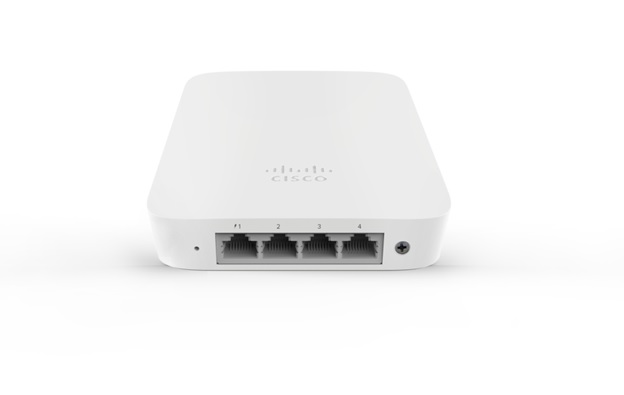
The new Meraki MR30H simplifies wireless for hotels, dorms, and multi–dwelling units. 802.11ac Wave 2 technology delivers robust wireless access in challenging RF environments, and its small form-factor with integrated four port gigabit Ethernet switch enables deployments in a range of environments without the need to deploy an additional tabletop Ethernet switch. Additionally, integrated location analytics deliver insights into client behavior such as foot traffic, dwell time, and repeat visit rates, and Bluetooth low energy (BLE) powers advanced location applications such as those leveraging beacons.

Meraki launch blog image 12_2016
The new Cisco Meraki MR30H Cloud Managed Wireless Access Point

Along with the MR30H, we are introducing the MR33, an 802.11ac Wave 2 2×2 MIMO access point. It’s similar to the MR32 (including built-in location analytics and Bluetooth low energy), but in a smaller form factor and at a lower price.

Meraki is also announcing a major expansion of our switch portfolio, with the introduction of the MS225 and MS250 families. Available in 24-port and 48-port models, both families support physical and virtual stacking, PoE+, and feature 10 GbE SFP+ uplinks. Both are fully compatible with previous generation Meraki switch families, and additionally the MS250 supports the same layer 3 routing technology featured in the Meraki MS350 line. Naturally, these new switches are ideal to support the increased device density seen in hospitality and many other industries.

All of these new products are available to order today. If you’re curious to learn more about them, register for a wireless webinar or switch webinar and see what they’re all about!

Authors

Pablo Estrada

Director of Marketing

Cisco Meraki

Avatar

Digital signatures are used to verify the authenticity of a message. For example, when a message is signed, the verifier can rest assured that only the signer could have signed it. ECDSA and DSA are two widely used, standardized digital signature schemes. In order to sign a message, internally both of them require the use of a per-message secret number k that is unpredictable to an attacker. The NIST specifications meet this requirement by generating k randomly and uniformly from a set of integers (modulo q, where q is a sufficiently large prime divisor of the curve order in ECDSA or of p-1 in DSA). It is critical to security that k is unpredictable, since otherwise an attacker could recover the private key. Any two different messages should always be signed with two different and unrelated random k values.

Signature schemes rely on a sound entropy source to generate random values. But in a world in which virtual machines are increasingly utilized, there is the risk that a full snapshot will be restarted more than once which results in a situation in which the entropy state is identical in two or more running instances. This scenario is an abuse of cryptography that should never occur, but in the world of virtualized software, it is a design goal that the guest software not even know that it is running inside a VM. It makes sense, therefore, to think defensively, and look for crypto algorithms whose security isn’t degraded by this failure mode.  For ECDSA and DSA, this means that it is important to have a process of generating k values that are distinct, even if the initial entropy state is exactly the same. In other words, we need to be certain that two distinct messages will never be signed by the same key k and that they will be signed by uncorrelated random k’s. RFC6979 describes such a process. It uses the message itself and the private key value x as inputs to a deterministic random key generation process using a pseudo-random function. This process is deterministic, in that if we sign the same message twice with the same private key, both signatures will use the same k value.  This is not a security issue, as it gives no information away; the attack on a reused k value requires two distinct messages to be signed.

NIST’s FIPS 186-4 (section 6.3), on the other hand, requires random generation of the key k used in a signature. RFC6979 defines a deterministic process for generating k which does not fall in the acceptable random number generation processes described in FIPS PUB 186-4 Appendix B.5. Until there is a FIPS update or NIST makes an explicit exception, implementations generating k as described in RFC6979 are not officially FIPS compliant.

Like most IT vendors, Cisco certifies the cryptography in many of its products as being FIPS-140 compliant. At the same time, we strive to constantly improve the security of our products, and so we sought ways to address the entropy-fail scenario outlined above within the FIPS framework. To ensure that different messages are signed by different private keys k even if entropy were to fail, we developed this strategy: the signing process introduces message specific pseudorandom information (‘additional input’ defined in NIST SP 800-90A and SP 800-90C) into the random number generation process used to produce k. Most Cisco products implement this process and thus support FIPS compliant deterministic ECDSA. The process of injecting message-dependent pseudorandom values complies with FIPS 186-4 since k is still generated randomly from the entropy source, and it solves the entropy-fail problem in essentially the same way that deterministic ECDSA/DSA does. Additionally, it avoids the ‘double use’ of the private key discussed in Section 4 of RFC6979, though admittedly that issue is more theoretical than practical. Of course, we are fans of RFC6979, even though we did not implement it as-is in this case.

Authors

Panos Kampanakis

Product Manager

Security & Trust Organization

Avatar

We launched Cloud Scale Networking about a year ago to address the initial wave of software and hardware innovations that were built to enable co-development with Web Scale companies. Last July I offered my views on how Service Providers can thrive in the future. Since that time I have had the privilege of meeting with Service Providers of all types (Telco, Cable, Web/OTT, etc.) to discuss their business objectives and I’m pleased to report that common ground exists!

Common ground exists in the form of the tools that are being used to achieve speed, flexibility and growth while mitigating risk. While it’s true that data center scale for a Web Provider and access network scale for a Telco are two very different scaling challenges, we are finding more commonality in the tools that we use to address both problem sets. And that’s only part of the challenge. With Cloud Scale Networking Cisco is also delivering the tools necessary to shift skill sets, and even culture, in traditional service providers. These capabilities open up new possibilities to take advantage of capabilities like Web Scale automation and Dev-Ops based rapid and flexible service creation. If you are asking yourself ‘What’s Cloud Scale Networking?” I’d encourage you to watch this video.

Business transformations typically need new solutions with dynamically different cost models and operational approaches. I’m proud to say that Cisco started early and is continuing to lead the industry in this transition. You are going to see more from us via new capabilities in IOS XR and extending these features across a broader product portfolio. We will also continue to evolve our hardware platforms to meet these changing business conditions.

1

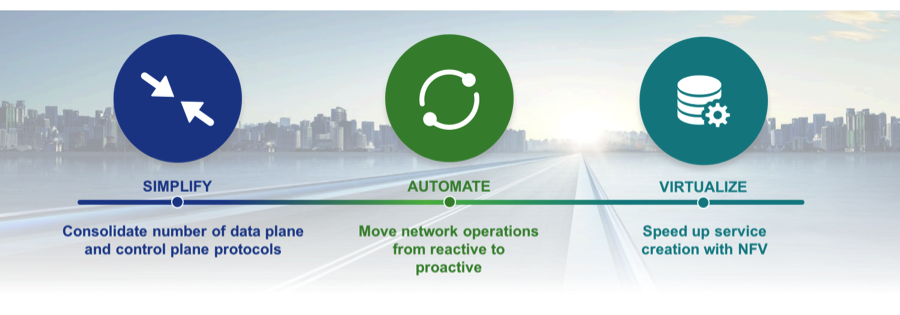
SP Transformation is a subject that’s near and dear to me, having been on the Service Provider side of the business for most of my career. Central Office Transformation is common ground in the discussion of how to evolve for Digitization. With a laser focus on providing ruthless ease of operation through network simplification, automation and virtualization we all strive for efficiency, agility and innovation across our businesses. And sometimes history is the best teacher. Understanding your current network and how to apply Cloud Scale capabilities is just as much a history lesson as it is a Dev-Ops project.

I’m proud of my team and I know that this set of Cloud Scale solutions becomes more compelling week by week. I still think that there’s never been a better time to be a Service Provider. As this journey shifts into overdrive, I’d ask you to shift your thinking about what’s possible. I’m dedicated to helping the broader industry reap the benefits of the transition to 5G, IoT, and Cloud. I’m also passionate about providing ruthless ease of operation, delivering new ways to automate and simplify networking and service delivery to improve profitability. The future has never been brighter!

Authors

Yvette Kanouff

Senior Vice President/General Manager

Service Provider Business