Avatar

Seeing our customers achieve exceptional business outcomes is what motivates us every day, and it’s central to our mission to create customers for life. That’s why sharing how distribution giant Tech Data puts the power of data and automation to work for its reseller partners and customers is such an inspiration.

First off, Tech Data continues to invest in the technology, people and processes that deliver high-value results for its reseller partners and customers. They are bringing data, analytics and automation to the forefront in many areas of their business, and in fact, these three pillars form the engine behind a transformative new recurring service renewal initiative anchored by the SMARTattach Opportunity Portal, powered by Cisco Impact.

How transformative? The results have been impressive: through the initiative, the distributor drove a 26 percent increase in low-dollar service renewal conversions since launching its recurring service revenue practice.

The SMARTattach Opportunity Portal is designed to maximize recurring revenue on service contract renewals, and ultimately, creates stronger customer lifetime value for Tech Data and its reseller partners. With visibility into the full scope of upcoming renewal opportunities, sales motions are more proactive and efficient. In addition, using the portal’s AutoQuote capability, low-dollar renewals are automated, which means manual quoting tasks are nearly eliminated— and the cost of sale is significantly reduced.

For reseller partners, the ability to quote – and book – more low-dollar renewals is what makes the SMARTattach Opportunity Portal so valuable. The portal sends notifications and reminders to better manage service contracts. This provides the ability to segment and quickly take action on low-dollar renewals that often go unaddressed. This small, but powerful benefit ensures that no opportunities will fall through the cracks. Lastly, with partner-specific pricing and branding, SMARTattach gives Tech Data’s reseller partners everything they need for a best-in-class services business.

Everyone Wins

Dana Reina, Cisco Services Marketing Manager for Tech Data, tells us that the platform available on www.techdata.com offers big benefits to their customers. It ensures contracts are renewed on time and on point, and they never have to worry about a lapse in service. And convenience is an important part of SMARTattach: customers can make service renewal or new service purchases in an instant with just a few simple clicks.

Dana says, “Tech Data has been able to use SMARTattach to reduce time-to-close ratios for reseller partners and enable them to transact quotes faster, while building and expanding their relationships throughout the entire customer lifecycle.”

With more than 7,000 quotes delivered per month, it’s estimated that Tech Data has saved hundreds of hours of time through Cisco Impact and its AutoQuote engine to date, and its reseller partners have saved even more. That’s a huge win and proof positive of the power of data to produce business outcomes.

It’s exciting to see Tech Data and its partners achieve such outstanding results. Big congrats to Dana and her team!

To find out how other industry leaders are using data to realize their goals, visit the SuccessHub.


Authors

Kelly Crothers

Director, Marketing

Global Customer Success

Avatar

We’re in the midst of an era of digital business transformation in which companies are innovating not only in what they are selling, but also in how it is sold, and how it is consumed by their customers. We’re seeing huge changes in the way buyers (consumer and corporate alike) define value. They’re no longer simply interested in buying point products, components or features and combining them themselves. They are looking for outcomes with improved experiences, and simpler, better ways to get things done.

The Shift to Subscription Models

One way in which the value equation is changing is through the growing popularity of subscription buying models. This June, in a clear indication of this shift, Apple made big changes to its App Store by making every product category available through subscription. (Previously, only a few categories, like streaming content, news, and cloud services, were sold this way.)

Apple’s new model has benefits for consumers, for Apple, and for its developers. Unlike one-time purchases, subscriptions provide consumers with price protection and ongoing access to new versions and the latest innovations for an agreed upon period of time. By subscribing to an app, they are buying more than a piece of software. They are getting ongoing access to an expanding set of desired capabilities that deliver a service in areas like finance, entertainment, or personal health maintenance.

For developers and for Apple, subscriptions yield a more predictable revenue stream and, provided quality of service, a long-term customer commitment to the product. This allows for more efficient investment in product development and innovation. Subscriptions also help companies develop deeper, more meaningful relationships with their customers, which leads to brand loyalty and products that better reflect buyers’ needs.

The Subscription Edge

Subscription innovation doesn’t just apply to digital products and services. The Dollar Shave Club, which sells monthly subscriptions to razors and shaving products, reached a $630 million valuation as of November of last year. On July 19 of this year, Unilever announced its intention to acquire Dollar Shave Club, reportedly for $1B in cash.

There are companies now offering subscriptions to things like fruit, vegetables, and flowers. Amazon’s Subscribe and Save allows consumers to subscribe to regular deliveries of groceries and home items like paper towels, eggs, and cleaning products. A number of clothing companies like Trunk Club are offering monthly deliveries of custom-selected items that consumers can either keep and pay for, or return.

Cisco Software and Subscriptions

Gartner says by 2020, more than 80 percent of software vendors will change their business models from traditional license and maintenance agreements to subscription-based services. As our customers digitize their businesses by reinventing their operating and business models, Cisco Software is assisting them by innovating in subscription models across our portfolio of solutions.

Our Security and Cisco WebEx meeting and collaboration products have long been sold by subscription. With Cisco ONE, customers can purchase software suites customized to deliver specific business outcomes in areas including collaboration, security, and data analytics. Many of these products are now available on a subscription basis, and the Cisco Enterprise License Agreement (ELA), a way for customers to license and subscribe to Cisco software that is aligned with their priorities and preferred purchasing models, includes subscription options.

With the flexibility and predictability of subscriptions, our customers can manage Cisco software products and services purchases as either operating or capital expense. This flexibility enables them to be more agile and helps accelerate the deployment of new capabilities and new business models.

Are you buying or selling via subscription in your business? Where do you see the most value in subscriptions? Are your customers asking for them?

As smart companies transform in response to customer demand for increased flexibility, and strive to differentiate through new business models, we’re going to see much more activity in subscription buying and other innovative models that benefit companies and consumers alike.

JB

Authors

John Brigden

Senior Vice President

Offer Monetization Office

Avatar

#CiscoChampion Radio is a podcast series by Cisco Champions as technologists. Today we’re discussing personal branding with social media.

Cisco Champion 2016Get the Podcast

  • Listen to this episode
  • Download this episode (right-click on the episode’s download button)
  • View this episode in iTunes

Cisco Champion Hosts
Dennis Heim, (@CollabSensei), Solution Architect
Ed Walsh (@veddiew), Director of Technology Vision

Moderator
Kim Austin (@ciscokima)
Lauren Friedman (@lauren)

Continue reading “#CiscoChampion Radio, S3|Ep. 20: Build Your Personal Brand with Social Media”

Avatar

I’d like to talk about Cisco Application Centric Infrastructure (ACI), and focus on one of the most important steps that Data Center IT teams take on the journey to achieve full automation and deliver agility, security, and efficiency deploying and managing applications.  This step – Network Automation – is a key piece in this journey because it connects every component required to run an application: the servers, storage, other networks, and necessary services to secure and scale applications.

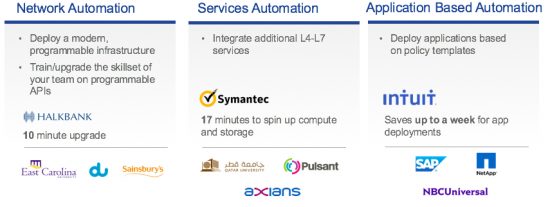
With Cisco ACI, customers can choose the operational model that suits them best – network automation, services automation, or full application based automation.(Figure 1).  When customers have existing applications and networks, the first step, a network centric operational mode for ACI, can be the simplest.  It’s easy to map existing network constructs to an ACI model and quickly yield benefits.

ACI Phases

Figure 1 Operational Choice in the Journey to Application Centric Automation

Every network engineer and network operations leader can benefit almost immediately from the centralized management, simplification, and efficiency that automating switch and network management tasks with ACI can bring.

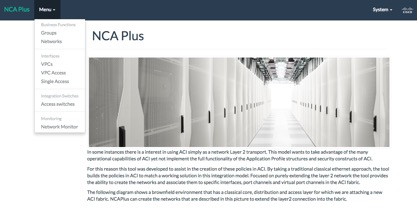
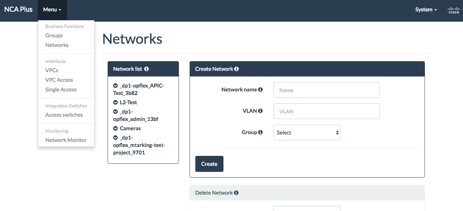
Let me provide you an example with an application written to simplify migrating legacy networks (using VLANs) onto an ACI fabric (which is better suited to today’s East/West data center traffic patterns).  VLANs are used for isolation in data center networks and network operations teams need a simple way to deploy classical VLAN networks. With that need understood, Cisco network engineers created an ACI application called NCAplus (Figure 2).

NCAplus

Figure 2 NCAplus

The purpose of NCAplus was to create a portal that simplifies Layer 2 network operations in the datacenter. Leveraging the programmatic philosophy of ACI, the tool is able to automate traditional network constructs like port channels, virtual port channels, VLAN assignments and more. Older API interfaces that just provide a “view” to the CLI are not as powerful. The ACI RESTful API interface is capable of manipulating all members of the fabric as one single entity that makes it possible to create applications quicker. Instead of the application having to deal with individual components in the network, everything sits under the control of APIC that provides a robust programmatic interface to your network. These different facts made it possible to simplify the code for the application and deliver the application at speeds that match todays DevOps timeframes.

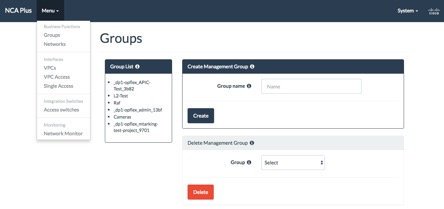
The tool can take network components and group them in such a way to provide the network operator visibility around business functions. Imagine being capable of seeing things instead of just VLANS, but in management domains as IP Phones, Cameras, IoT Sensors, wireless endpoints and more. These groups ( Figure 3 ) are associated in ACI as Tenants of the fabric and can then utilize the various domain management services inherit in the fabric to provide network status visibility to each of them.

NCAplusGroups

Figure 3 NCAplus Groups

Once you have established the management groups, NCAplus can now create and map interfaces, port channels, virtual port channels under these groups mapped to VLANS in your classical Ethernet networks. NCAplus utilizes higher level constructs for naming VLAN networks to associate things with business functions (Figure 4). Instead of VLAN254 NCAplus makes it possible to name it “IP Phone network Bldg10”. And this would be visible in the entire ACI fabric using all the tools that ACI provides for operational awareness, simplifying the work of day two operations.

NCAplusNetwork

Figure 4 Network abstractions to classical ethernet networks

NCAplus was written by Santiago Flores, Rafael Muller, and Cesar Obediente in a couple weeks. It is project available on github (https://github.com/datacenter/NCAplus) with all the documentation you need to use it yourself.  It was written using the ACI Cobra Software Development Kit (SDK) (https://github.com/datacenter/cobra) which provides a comprehensive set of open APIs for managing the 8,000+ managed objects available in the ACI object model.  Beginning developers may prefer to start with the ACI Toolkit which is a basic toolkit for accessing the Cisco APIC (https://github.com/datacenter/acitoolkit).  It is intended to allow users to quickly begin using the REST API and accelerate the learning curve necessary to begin using the APIC.

With the network automation approach, we can capture process knowledge in a repeatable model-based approach.  This improves operational efficiency and eliminates manual errors for  many tasks.

(Thanks to Cesar Obediente, Rafael Muller, and Mark Jackson for their inputs to this blog.)

For More Information

White paper on how to simplify adoption of SDN and migration to ACI: ACI – Network-Centric Approach.

Data Center open source applications at https://github.com/datacenter.

Cisco open source projects at  http://opensource.cisco.com/projects.html

See these Cisco Live 2016 Las Vegas sessions:

Simplify DevOps in Application Centric Data Centers

Dev-Ops for Networking: Application Centric Infrastructure – Open Standards and Open API’s

A Practical Introduction to DevOps Practices and Tools


Authors

Harry Petty

Director

Data Center and Cloud Marketing

Avatar

Following The Great East Japan Earthquake and Tsunami, the Ministry of Education was looking for a way to teach students in remote locations about disaster prevention. Their solution was Cisco TelePresence.

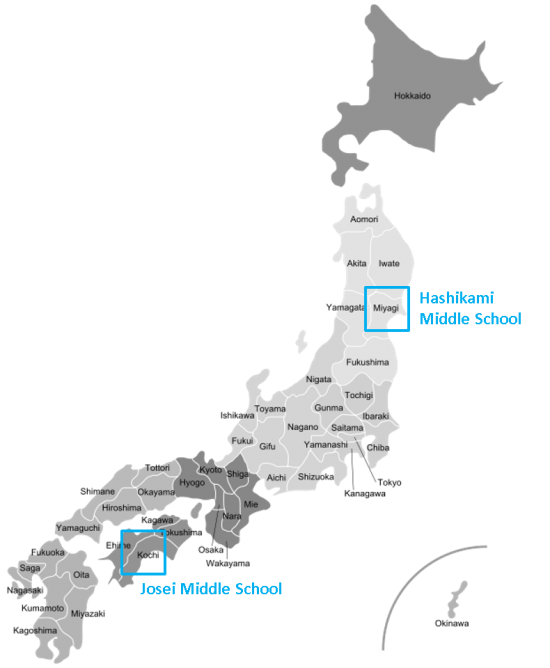
To test this method of learning, the Ministry of Education selected two middle schools, Hashikami Middle School and Josei Middle School.

JapanVideo

Hashikami Middle School in the Miyagi Prefecture suffered terribly in the Great East Japan Earthquake and Tsunami. The school had been promoting systematic disaster prevention education as a result of their experience.

The other school, Josei Middle School, is located in Kochi (which comprises the southwestern part of the island of Shikoku, facing the Pacific Ocean). The school has been promoting specific disaster prevention education in Kochi in a similar manner with regards to tsunamis because of their location.

Disaster+Prevention+-+Japan+-+Edu

Watch this video to learn more about the collaboration between these two schools and how Cisco TelePresence has helped prepare students for natural disasters.

https://www.youtube.com/watch?v=n5kLbrGwVfw&index=3&list=PLE9603246C9094F72

Authors

Lim Shui-Lyn

APJ Vertical Practices

Education & Government

Avatar

You need to act fast to avoid losing the pay-TV race. The new breed of over-the-top players aren’t messing around. Read on to discover your competitive edge…

Over-the-top (OTT) TV and video services are expected to generate $51 billion by 2020, according to a recent Global OTT TV & Video Forecasts report. The number is all the more impressive when compared to 2010 revenue results of just $4.2 billion.

Pay-TV providers (cable, fiber and satellite) have seen rising customer churn rates. And all the while OTT companies sign up ever-greater numbers of subscribers. So what can you do to stem the flow of cord cutters and attract more people back?

As the old saying goes, “If you can’t beat them, join them.”

Why go OTT?

As a provider, you’re in an enviable position. You have a wealth of content and the ability to aggregate and bundle it from many sources. You can apply analytics and form policies based on customer behavior. Using this you can provide personalization and quality of service (QoS) down to different device types.

Adding OTT TV and video services doesn’t mean replacing or cannibalizing your existing services. In fact, OTT can extend your reach. It gives subscribers access to content wherever they are. This will help to build loyalty and encourage new customers to sign up.

You can offer the service for customers when they are in places without normal access. A case in point is the college student who lives on campus. Sky launched Now TV in the UK to cater for such needs. It’s an OTT TV service with a host of purchasing options. With one-day passes, sport bundles and on-demand movies, it covers all bases.

There’s no need for skilled installation or network hook-up. Just sign up, log on and start watching. It’s proven a hit with existing customers. New subscribers have signed up in droves too.

ott

Cloud offers reach, speed, and a great experience

You can quickly add OTT video and TV services for your end user through the cloud. Don’t build out a new infrastructure in your data center. It’s faster and cheaper to get the resources you need with cloud services. The cloud provides three key benefits…

Reach

You can provide your service to people direct. On whatever devices they’re using and whenever they’re ready to start watching. Viacom research found that consumers watch content on an average of six different devices.

Experience

With the cloud, you can deliver a great user experience. It’s personal, optimal, and consistent. At its best, content delivery must be tailored to the context of viewing – on the go, at a WiFi hotspot or at home – and with the resolution best suited to the device used.

Navigation and search results can be personalized based on someone’s profile and usage analytics. These include vital factors such as age, gender, location, language, viewing history and preferences.

 Speed

You can deploy new services and features faster than ever before. With no need to deal with infrastructure issues you’re free. Free to focus on strategy, creativity, and competitiveness.

Are you launching a new OTT service, or extending an existing one? Are you a mobile operator or a broadcaster? Whatever the answers, the cloud is your fast onramp to join the OTT TV and video market. Why sit by and let OTT players suck up all the revenue?

Take on the OTTs

Want to find out how you can supercharge your network and make sure you cater to the needs of end users today and in the future? Click here to find out more.

Authors

Adam Davies

Technical Leader, Engineering

Service Provider, Video Solutions

Avatar

Last month, I got to attend MeriTalk’s fifth annual Cloud Computing Brainstorm at the Newseum in Washington, D.C. It was a great event that gathered more than 200 cloud thought leaders from both industry and government for a discussion on the state of cloud computing in the federal government. It’s crazy to think of how much change we’ve already seen when it comes to the cloud in government: it’s the five year anniversary of the FedRAMP program, and the two year anniversary of FITARAR. Cloud-based collaboration is no longer the future for federal agencies – it’s happening now.

27180953124_1aa65c9483_o

Photo of the “Unlock Collaboration for Your Agency” panel via MeriTalk.

I had the distinct pleasure in moderating one of the panels, “Unlock Collaboration for Your Agency”. The panel focused on who in the federal government is collaborating via the cloud well, what the cost and risk benefits of adopting cloud services are, and advice for agencies who still need to migrate to the cloud. We had great panelists: Karen Petraska, Service Executive in the Office of the CIO at NASA; Rusty Rickens, a senior advisor for digital platform at the State Department; and John Skularek, the deputy CIO at the FCC.

 If you weren’t able to be at the Cloud Computing Brainstorm in person, make sure to watch the video of the panel below to hear all the wonderful insight from these experts!

Authors

Alan Balutis

Distinguished Fellow and Senior Director

North American Public Sector for Busiiness Solutions Group

Avatar

Segment routing is coming to a competitor near you and it will be a key element of the network infrastructure of the future. But what is it and how will it offer tangible benefits for you, the service provider?

It promises to simplify network operation and ensure the best performance of vital applications on that network. So segment routing (SR) is something that should pique the interest of all service providers. And it’s not just providers who are taking up the baton. Enterprises and hyper-scale web providers are getting involved too.

At a recent Cisco sponsored Tech Field Day event a host of major players attended to wax about their SR journey and spread the gospel. Among them, Comcast, Walmart and Microsoft. They all told of the quiet revolution going on in their networks. So what does it actually do?

running

The path of least resistance  

It’s all about taking control over the network. With SR you can now control the way your network transports applications. And it all happens with no need to introduce a new protocol. It reuses existing routing protocols augmented by specific extensions.

Not all applications are the same. SR recognises that and acts on it. Consider a network application as a tourist who needs to take a trip… bear with me. In this scenario SR is a high end travel agent. It simply finds the fastest, most comfortable route across the network. One tailored to the needs of your tourist.

Supercharge your applications

For an example of a real world benefit, financial applications are a good place to start. For obvious reasons, they are very sensitive to latency. SR seeks out a certain path through the network with very low latency. This ensures the best performance of the app.

Another benefit is the option for you to have a disjoint path through your network. This creates two paths that never cross each other. They don’t even have to share the same optical fiber. This gives a higher level of availability. It means that if a primary path breaks, you have a second path that you can be sure will be up and running. A backup to ensure the safe passage of your applications.

The whole point of SR is to make the network and applications work hand-in-hand in a simple and scalable way. And that’s the vital point. It’s so scalable. Previous attempts to make this possible have been too complex. Complex to rollout. Complex to operate. Complex to scale up.

With high uptake expected in the next two years from service providers across the board, it’s time to act. If your competitors start to enjoy the cost benefits and operational ease of this technology soon, can you afford not to? So let your applications travel in style with segment routing.

Find out more

Discover how segment routing could supercharge the vital applications on your network with segment routing, here.

Authors

Frederic Trate

Marketing Manager

Service Provider Business Architecture, France

Avatar

I often meet with customers about the first and easiest way to use IoT in an industrial domain: by deploying wireless technology.

There is a lot of variety of Radio Frequency (RF) technologies being used in the industrial domain ranging from ZigBee to WirelessHART to WiFi to LoRa to LTE, etc. Unfortunately there is not a ‘one size fit all’ solution. When Cisco looks at this issue, we make sure our architecture supports all types of RF technology and will support future technology as well.

We have identified 7 main Oil + Gas use cases for the deployment of RF technology (especially WiFi):

Wireless Bridging

This is the most straightforward deployment of ‘point to point’ wireless connectivity. If a new area of an industrial site needs to be connected to the rest of the infrastructure of that location, it is more cost effective to do this wirelessly instead of running expensive cable runs to these (often) remote locations.

Mobile Workforce

This enables the workforce to bring wireless tablets and handheld bar code readers into the field to do regular and simple tasks in an online and automatic manner instead of using the ‘pen and paper’ way of working.

oil_blog_3

Wireless Sensors and Instrumentation

The deployment of more sensors providing more frequent readings with more data is becoming standard due to wireless technology. The time it takes to deploy these sensors (no cable runs needed) at multiple and changing locations has been dramatically reduced.

Personnel Health and Safety

The mobility aspect of wireless connectivity makes it possible to monitor the environment the worker is in. Are there dangerous levels of gasses in the area the person is in? Are there leaks or spillages of dangerous goods? By combining portable gas meter and active RFID tags for location determination, these health and safety issues can be addressed. Here’s a video of the demo we gave at this past Cisco Live:

Turnaround

This refers to deploying wireless sensors to monitor vital characteristics of expensive and crucial equipment (valves, pumps, etc.) continuously or with very frequent intervals. This lowers unplanned downtime significantly and saves up to 60%-70% of man-hours needed for inspecting.

Physical security

Access control, asset, and people surveillance in large and remote industrial facilities can be implemented cost effectively using wireless technologies like cameras and card readers.

Asset Location Tracking

Inventory, supply chain operations, and material management reduces the NPT (non-productive time) caused by searching for missing assets.

Once your wireless connectivity platform is in place, other solutions can make use of the wireless infrastructure. For example, hand-held radios and push-to-talk systems (Cisco Instant Connect) can be integrated with IP-based communication like telephones, Telepresence, and other video conferencing systems.

For more Connected Oil and Gas solutions, visit our website.

To take a deeper dive into these macro-economic developments, read our latest whitepaper “A New Reality for Oil & Gas” and visit our webpage www.cisco.com/go/oilandgas for the latest updates.

To receive future blogs straight to your inbox:

subscribe


Authors

Rene Pluis

Senior Manager, Global Industry Energy