Avatar

Only a few weeks remain for the Fall season to officially set in, and it’s still quite hot in Chicago. The fast approaching F5 Agility event is further adding a sizzle to the conference scene at the Chicago Downtown Hyatt Regency.  August is the most popular season to visit Chicago and we are seeing a sold-out attendance at the F5 Agility event this year. Join us to learn about the future of application delivery, share best-practices with influential decision-makers, connect with technology leaders, and have some fun at the Agility closing gala at the House of Blues.
chicagoagility

During Aug 2-4, we are going to hear F5’s leaders, customers, and partners share how the latest solutions from F5 are transforming what’s possible for today’s organizations. In about two years, Cisco ACI and F5 partnership has demonstrated significant success in our joint solution momentum and customer adoption. I am pleased to invite you all to attend this premier industry event and get insights on how F5 and Cisco are bringing the power of cloud, security, data centers, converged systems, and as-a-Service together to enable fast, efficient, and secure application delivery in today’s challenging hybrid environments.

F5 CEO John McAdam will kick-off Agility and share his worldview and how F5 is gearing up for future success in today’s increasingly app-centric world. Following John, F5’s EVP of Worldwide Sales, John DiLullo and SVP F5 Services Ian Jones will focus on the latest security issues and hybrid cloud potential. We then have F5’s Chief Technology Officer and Executive Vice President of Product Development Karl Triebes, who will take an in-depth look at F5’s vision and product roadmap.

This year we have two guest keynotes. Mike Ebeling, CEO of Not impossible Labs, and Mike Ditka, legendary football coach and TV commentator are here to entertain you and highlight the key characteristics people need to achieve their personal and professional goals.

And now let’s segue to Cisco Sponsor breakouts. Cisco Exec Daniel McGinniss is hosting a business breakout session titled “Deliver Application Agility with Cisco Application Centric Infrastructure” Aug 4, 1 pm local time. What’s unique about this Breakout Session? Well, you will get to not only hear Daniel eloquently walk you through the role of Cisco ACI in today’s Application-Oriented Economy, but also see Mark Wall from WWT join him on stage and share their success stories with ACI.  Daniel will discuss the challenges companies face to achieve successful digital transformation, and how the ability to develop, deploy, and fine-tune applications is critical in that journey. Daniel will then introduce Cisco ACI, an open, scalable, programmable SDN solution that helps address these infrastructure challenges. Daniel will illustrate how Cisco ACI enables rapid application deployment, reduces cost and complexity via a unified policy approach, delivers compliance, and accelerates customers along their cloud journey. Daniel’s breakout as I said earlier, also features a unique Partner segment towards the end. Mark Wall, Chief Architect from WWT, will join Daniel on stage to share their ACI experiences. How often do you get this comprehensive experience in a breakout session, one that is devoid of a sales pitch. Sounds great, doesn’t it?

For the technically oriented among you, we also have a technical breakout session by Cisco, Aug 4, 10.15 AM local time. This session covers the integration architecture, value-props, and openness of the platform that the joint Cisco ACI-F5 solution brings to customers and partners. We are also offering a 4 hour Lab session featuring Cisco ACI and F5, 1- 5 PM, Michigan 1B. Hands-on experts from Cisco and F5 will be present to help you get deep and technical.

That is not all. Cisco ACI brings you additional customer engagement opportunity in the solutions expo hall. We are featuring cool demos showcasing our joint solutions namely, ACI-BIG IP and ACI-iWorkflow on both Aug 3 and 4, during the duration of the expo hours. Stop by the Cisco booth where our product experts are available to engage in white-board sessions and to compliment the demos, we also run short duration presentations in the Cisco theatre at periodic intervals. Should you desire, we are happy to meet you in 1-1 meetings, so let us know how we can enrich your experience at the event

For all the hard work we all do at the event, there is plenty F5 offers to let us relax and enjoy. This year we are taking over the House of Blues in Chicago. This institution grew out of founder Isaac Tigrett’s love for the unique American art form known as “the Blues”. Join F5 Networks as we close the evening with good food and drink plus three great shows. Be there to get your special F5 Agility 2016: House of Blues Star Guitar t-shirt.

Entertainment includes:

Alonzo Bodden
Alonzo’s material is “cynically good natured”. Bodden, who won Season 3 on NBC’s Last Comic Standing, is a regular on NPR’s “Wait Wait… Don’t Tell Me” and “Comedy Congress” as well as being a panelist on the Game Show Network’s “Mind of a Man”.
Havana Brown
Havana Brown is a modern-day renaissance woman. Already you’ll be familiar with her quadruple-platinum hit “We Run the Night (Feat. Pitbull).
Heart by Heart
Heart by Heart was created to offer fans the unique experience that only those who were actually in the original band could offer.

Network with your fellow attendees while enjoying tasty food and drink, entertaining music, knowledgeable guides, and more are awaiting you on Aug 2.

I am eager to see you all in Chicago next week. There are some useful links for you to check out before your visit on how Cisco ACI and F5 work together on the innovation front.

For more information, Visit www.cisco.com/go/acif5

https://www.eiseverywhere.com/ehome/f5agilityamericas2016/368569/

Authors

Ravi Balakrishnan

Senior Product Marketing Manager

Datacenter Solutions

Avatar

It’s hard to believe almost two weeks have passed since Cisco Live US.

The public sector zone was full of customers and partners who were eager to see our innovative technologies in action. We showcased technical demos from each of the four major public sector verticals: Government/Public Safety, Smart+Connected Cities, Healthcare, and last but certainly not least, Education.

The five education solutions aligned to our digital campus and digital learning portfolios and demonstrated how Cisco and our ecosystem of partners are dedicated to the digitization of schools and universities. Watch these clips to learn more about each of the demos:

Extend Learning & Research with Cisco PresenterTrack

https://www.youtube.com/watch?v=jqkglkniKmU

Protect Your Campus with Video Surveillance and Notification

Ecosystem Partners: Singlewire, 2N, CyberData, Atlas, Sonim

https://www.youtube.com/watch?v=oPEdfUcOl10&list=PLE9603246C9094F72&index=4

Managing Your Network Policies with APIC-EM

https://www.youtube.com/watch?v=C-E0zOVdGFM&list=PLE9603246C9094F72&index=3

Secure Your Campus Network with OpenDNS

https://www.youtube.com/watch?v=O5hqYizfJYY&list=PLE9603246C9094F72&index=1

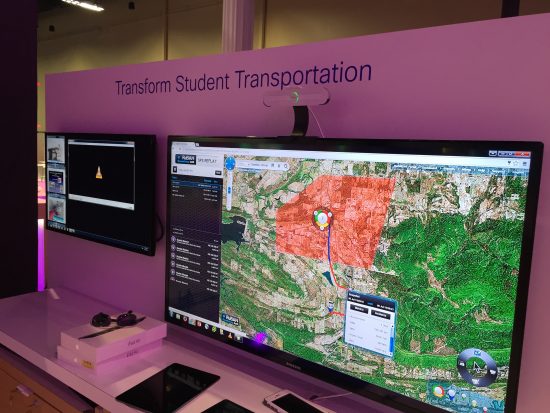
Transform Student Transportation with Geo-fencing & Wireless

Ecosystem Partners: RuBAN Software, Davra Networks

IMG_6840

More information about the Transforming Student Transportation demo can be found here. Plus, check out this recent EdTech article where the solution is featured.

Cisco and our ecosystem of partners are transforming the way students learn, teachers teach, and administrators manage. The solutions showcased at Cisco Live US show exactly how we are connecting peers across K-12 and Higher Education while creating a safe and secure learning environment.

Contact your Cisco account manager for an overview of how these solutions can be implemented in your school or university, and visit our Twitter and Facebook accounts for more about Cisco Live.

Authors

John-Paul Overton

Global Ecosystem Partner Manager

Corporate Marketing

Avatar

This summer, I started teaching Leadership and character building to my 8-year-old son. To get some structure to the plan, I bought a good book which was organized into value based chapters and exercises. I would read one chapter with him everyday and complete the exercises at the end of the chapter. I had no idea that this seemingly simple routine would turn out to be a leadership refresher and eye opener for me. When I thought of character, values like honesty, integrity, humility etc flashed through the mind. Finding “Best effort” and “Empathy” in the list of good character traits was attention grabbing if not surprising.

Continue reading ““People don’t want to buy a quarter-inch drill, they want a quarter-inch hole.” – Theodore Levitt”

Authors

Sadaf Fardeen

Engineering Manager, Software Development

CSG PI Services

Avatar

AM61631

People are much more susceptible to light than we imagine. For instance, tests have shown that natural light has a positive affect on people than staid, artificial light.

The Miami-Dade County Public Schools (M-DCPS) is putting that theory to the test and Cisco is helping them along the way. As the fourth-largest school district in the United States—there are over 35,000 students in the school system—M-DCPS’ Chief Information Officer (CIO) Deborah Karcher has long been a proponent of providing her kids better lighting. She feels that more natural light will sharpen the children’s minds in the morning and perk them up during the traditional post-lunch lulls.

She discovered a solution in the Cisco Digital Ceiling Framework that combines lighting, air conditioning and other building networks into one IP-based infrastructure. The framework is built over a Cisco infrastructure that includes Cisco Catalyst 3560 switches and Cisco 4431 and 3925 Integrated Service routers.

Not only can network power cut down on energy costs, but PoE-powered LED lighting can match natural light.

“The ease of the installation was incredible,” Karcher said. “At the front end, it was as simple as plugging in new lights.”

The bottom line was something to behold too, as classrooms went from using 750 watts to 350 watts. The money saving is incredible, Karcher said but the future is what she’s most excited for.

The lights are able to change color, so the school will be able to set up a code based solely on light color. For example: green lights could mean class changes and red lights could signal an emergency. Lighting sensors connected to the network can pick up wristband signals from student coming enter class. Say goodbye to the days of taking roll!

For more information on this customer case study, please click here.

Authors

Byron Magrane

Product Manager, Marketing

Avatar

There is always something of an air of anticipation in the Security community as we approach Black Hat and DEFCON. This is your official guide to what Cisco’s Talos Threat Intelligence team is doing at Black Hat 2016.

There are a lot of classes, great talks, technical deep-dives, late parties, fun activities, and important networking to squeeze into just a few days. Here is a quick run-down of where and how you can catch Talos speakers, Cisco events, and some fun stuff from OpenDNS, Lancope, and CloudLock as well.  Read on for the full details of what Cisco has in store for Black Hat 2016! Continue reading “The Official Talos Guide to Black Hat 2016”

Authors

Avatar

Ajantha

The most important part of running a marathon isn’t necessarily one foot in front of the other, it’s the networking and team building that takes place during training runs.  A lot can happen in those training runs on your way to the finish line. There will be days with bad weather, hills that seem to rival Everest, and moments of doubt.  There will be mornings where you’d rather stay in bed, evenings where you’re just too tired, and weekends that seem made for the beach over the pavement.

We learn a lot about our fellow runners – and ourselves – with each step. On the sidelines, spectators cheer for us.  Volunteers offer water and energy gel. All of it helps to keep us going.

For what many think is a solitary sport, is really a community effort.

And while many see running 26.2 miles as a never-ending challenge, with a good training program and strong network of support it can be an exhilarating experience as each mile creates a new memory.

I’ve had several long term running partners who have trained with me for various events.  Together we’ve run marathons, powered through Spartan obstacle course races, and sprinted to the finish line of 5ks. Time is translated into miles measured by the high-tech on my wrist that documents the run. The most rewarding part of running is all of that time spent with each person.

When you spend hundreds of miles with one person, you learn a lot about them but you also learn more about yourself and soon the footsteps – left, right, left, right – fade into the background.  Your breathing becomes less labored and more natural as you push through a ten or fifteen mile run; while emotionally telling your running partner every little detail of how your lunch went flying out of your hands, in the middle of the cafeteria, on your second day of work.  Lucky for me, the fellow Cisconian who I spilled my food on felt more sympathy for me than for her salsa-covered slacks.

Unloading the mundane details of my life over 10 miles helps to pass the time quickly and I’ve come to value the early morning runs as a way to get my day started.

Racing the World Marathon Majors is a huge motivator for me, but it is not my biggest motivation. What really pushes me is a more personal reason.

On September 27, 2014 I was paired with a buddy through the Irun4 program.  Avalon Chambers, a beautiful, 5-year-old girl from Australia who has Cerebral Palsy would help motivate and encourage me to complete my first marathon. She continues to amaze me as she powers through her own physical training. Side by side, through social media, we’d both train for our own goals. My goal is running marathons and her goal is recovering from the numerous surgeries that she would go through that year.  When #iRun4Avalon it makes me want to leave everything I have out on the course and put in 150% every time I lace up my running shoes.

Being a runner at Cisco I’ve spent many lunch breaks exploring the area and I’ve found that there are some “perks” to our campus. The Raleigh, North Carolina office – Research Triangle Park (RTP) – has a wonderful greenway system with over 100 miles of paved trails to explore. One of these trails, the Kit Creek Loop, runs right through Cisco! The trail is an up, down, up, down that winds through each of the 12 buildings.  And let me stress, it is not for the faint of heart.  Running one loop at Kit Creek leaves me pretty sore the next day but it’s a perfect area to train in for my upcoming Chicago Marathon.

I love that Cisco offers the flexibility to train during the day either on the trails or in the state of the art gym.  After a long summer run, I love to refuel with a healthy smoothie at one of our Cafés.  Fueling with the right nutrients is key to being a good runner. It helps prevent injury and is really important as my training program incorporates more long runs.

Cisco’s global presence allows me to connect with other employees from all over the world, just as running the World Marathon Majors unites all runners as people. The most amazing thing about being connected as a global entity through both running and work is that territories and time differences don’t serve to separate us. Instead we’re united behind a common goal, we’re motivated to do our best and work past language barriers or time differences to reach the finish line and create further innovation.

Here at Cisco, we’re all racing towards the future.


Want to join us? We’re hiring!

Authors

Ajantha Ramachandran

Senior Business Analyst

CPS GSAO

Avatar

To be competitive, to thrive—maybe even survive, disruptive change is required. And this need for change is seemingly non-stop across business, industry, and entire countries. But how do we keep up? At Cisco, we believe the answer is digital transformation. It’s the pathway for improving citizen services, increasing efficiencies—you name it.

But we can’t do it alone. The Cisco Innovation Grand Challenge is accepting submissions until August 31. If you’re an entrepreneur or startup, it’s your chance to help us find the most disruptive digital solutions to create new opportunities and advance game-changing trends.

Like last year’s competition, winners  get a share of $250,000 to jumpstart their ventures. They also get access to the Cisco Innovation Centers and receive mentoring and coaching from Cisco.

While we’re accepting submissions for this year’s Innovation Grand Challenge, I’m sharing a look back at how the winners from the first challenge are helping to change our world. In the final blog of my three-part “Innovation Grand Challenge: Where Are They Now” series, I spoke with Scott Everett, CEO of Eigen Innovations, a company dedicated to increasing productivity and lowering production costs for manufacturers.

Q: Scott, thanks for joining us. Let’s get right to it. As an engineer, how did your background influence your work with Eigen Innovations?

A: I earned my Masters in Mechanical Engineering, with a specialization in advanced controls and machine learning, which has helped influence my work. I’m also very interested in how the convergence of technologies, like industrial operational technology with computer and data science, can yield revolutionary advancements.

Q: That fits perfectly with Eigen Innovations’ work. How did you become aware of the Innovation Grand Challenge?

A: The Internet of Things inherently requires collaboration and connecting disparate technologies together. We look to Cisco for thought leadership, solutions, and even partnerships in the pursuit of our innovation in IoT. In our search, we became aware of the Innovation Grand Challenge and we were encouraged to participate after making contacts within the Cisco IoT program.

Q: Your company focuses on simplifying the quality inspection process. What was the heart of the problem you were trying to solve?

A: I spent a lot of time working in industrial environments and saw opportunities to improve process control and advance industrial automation. That led to my research of how artificial intelligence could be leveraged to achieve new efficiency breakthroughs for manufacturing.

Q: How did you and your team approach the development process for Eigen Innovations, and what obstacles did you encounter?

A: When you’re building a startup, you face an endless amount of obstacles. And working in advanced computing and IoT, it’s easy to become enamored with the technology and lose sight of the actual problems it can solve—creating a big obstacle to gaining traction in the market. I always check myself to make sure I’m staying focused on the customer’s pain before focusing on solutions.

As far as the development process, we had a small, multi-disciplinary team with backgrounds in operational technology, software development, and data science. We took a “factory floor first” approach, focusing on understanding what the customer’s pain is and developing something that complements the workflow of the customer’s operation.

Q: It sounds like your focus is just right. How have things in your world changed since winning the Innovation Grand Challenge?

A: For starters, being recognized for our ideas in front of visionaries, dignitaries, and technology leaders from around the world at the Internet of Things World Forum was incredible, and humbling, given the caliber of participants in the contest.

We’re a young company, and the fun thing about being at this stage is that every day is different. There is a rapid maturity happening in the technology, the market, and by the solution providers. The Internet of Things, especially for the industrial industry, is moving beyond theoretical applications, and more and more real-world use cases and applications are being realized.

Q: Specifically, how did working within Cisco’s network help you?

A: Cisco is a leader in IoT and has global reach. Getting to work with them has enabled us to learn directly from thought leaders about emerging technologies and trends within the space. In addition to that, Cisco has helped propel us by introducing us into the IoT community and contacts within it.

Q: We’re so glad to hear about all of the success you’re having. Any words of advice for future competitors?

A: I don’t think you should set out to “disrupt” by design. First, focus on the value you bring to the market and make sure you have the application experience to back up the potential of your innovation. It’s less about winning the competition, and more about how your IoT innovation is revolutionizing the world.

Do you have a disruptive idea that will transform an industry or impact societal change? The Cisco Innovation Grand Challenge is open for submissions through August 31. Enter it now and visit the FAQ page to learn more.

To see what our other winners have to say about their experience with the Innovation Grand Challenge check out part one and two of our series.

Authors

Alex Goryachev

Senior Director, Innovation Strategy & Programs

Corporate Strategic Innovation Group

Avatar

Sports broadcasting is on the cusp of a new era. One that will bring opportunities and challenges to broadcasters, content owners, athletes and fans. A once-simple landscape is now the territory of niche over-the-top (OTT) players and digital giants.

And there’s revolutionary technologies like virtual reality (VR ) and ultra-high-definition (UHD) to shake things up. Here we look ahead to a dynamic future, and consider how traditional broadcasters can adapt and thrive.

olympics

OTT platforms take center stage

Ofcom recorded a five percent drop in broadcast TV viewing in the UK over 2015. Mass migration to online TV is nigh. Subscription video-on-demand (SVOD) is consumers’ model of choice. Users across Europe rose by 56 percent last year.

In recent times, all-inclusive rights agreements between leagues and broadcasters have dominated sports delivery. But in 2015 OTT providers emerged as key players. This is the favored option for the cord-cutting youth who want cheaper, multi-device content. In the SVOD market, a host of providers cluster around the ‘big three’: Netflix, Hulu Plus and Amazon Prime.

Social networks become broadcasters

Social media sites have pounced on the inherent social aspect of watching sport. Facebook became a media owner and broadcaster with the launch of Facebook Live last year. Twitter will soon live-stream NFL’s Thursday night games. Broadcast by NBC and CBS, this creates new avenues for in-game commentary. Verizon’s ad-supported go90 app offers mobile content across sports, music and more. All of the content is integrated with social media features.

Advances like this could render the very term ‘broadcasting’ obsolete. Fans and athletes will compete with journalists as content creators . They will provide their own editorial voice and offer a ‘first person’ perspective, from deep in the action. Viewing experiences will draw closer to the emotion and urgency of real-life events. And for all industry players, the line between competitors and partners will take time to settle.

The VR vanguard builds links with big leagues

VR traffic quadrupled in 2015, and its potential in sports is huge. The NBA has already distributed a VR game. And superstar LeBron James is set to create a 360-degree film with Facebook, the owners of Oculus. Future fans may be able to buy virtual seats in stadiums, or watch entire games from the perspective of a favorite player. Sky Sports recently created VR footage in a Formula 1 pit lane. That sounds intense! According to Forbes, “over the next three years, VR could be sports’ biggest game changer for how fans consume content.”

A new ecosystem brings new opportunities

So how can traditional service providers demonstrate value and build their own OTT services?

  • Focus on apps for on-the-go streaming. Yahoo Flurry found that US consumers spent 90% of their mobile time in apps in Q2 2015. Partner with a software-as-a-service (SaaS) provider to avoid the risks of in-house development. They can help design, build and maintain apps.
  • Aim for exclusive, device-agnostic content that supplements TV programs.
  • Forge stronger bonds with leagues, players and fan-bases. Create services that play to their increased power.
  • Remember that SVOD companies still need strong relationships with big broadcasters. Savvy stalwarts can carve out lucrative new roles.
  • Be willing to experiment. You must be ready to adapt at pace if a new service doesn’t take off.

Traditional broadcasters have vital expertise in delivering high-quality content. Bringing this know-how to creative collaborations with OTT players is key. CBS sports chair Sean McManus welcomes Twitter’s NFL streaming. He sees it as an adjunct to TV viewing – one that will boost profits by bringing advertisers increased reach.

Find out more

Learn more about Cisco’s video expertise and the work it’s doing to help service providers here.

Authors

Adam Davies

Technical Leader, Engineering

Service Provider, Video Solutions

Avatar

Video traffic is soaring, and it’s shaking up the mobile marketplace – fast. With the arrival of 5G networks moving ever closer, the shift towards mobile video could be seismic. So how can you take full advantage?

The video revolution is happening all around us, and touching every part of our lives. According to the latest Cisco Visual Networking Index (VNI), global IP video traffic will grow threefold from 2015 to 2020 – a 26 per cent annual growth rate.

Facebook just announced that it’s paying $50 million to media companies for live video content. The social media giant has partnered with celebrities, media companies, and other partners for breaking news, live programming, and more.

Network video is playing a huge part in the Internet of Things (IoT), too. It’s appearing everywhere from connected cars to smart cities and retail environments.

5g2

A new, better network

How can mobile operators keep pace with the video explosion? Most of them are already looking ahead to the next generation of network technology – 5G. The most obvious advantage of 5G is bandwidth. Promising speeds of one Gbps or better, 5G will deliver more than enough power to handle even ultra-high-definition (UHD) traffic.

But there’s much more to video than just bandwidth. Mobile operators need a network that can deliver high reliability, plus very low latency. A 5G network will deliver both.

To get the most out of any new technology, you need a flexible, intelligent network architecture that will deliver the experience your customers want. Security can be an issue for mobile video content because you need to apply digital rights management (DRM). Your network security must be able to protect communications and data, as well as provide control over who can view it, and on which network. When demands change, your network needs to be automated and nimble so that it can scale up or scale down quickly.

The window of opportunity

Timing is all-important as well. Verizon and AT&T are expected to start rolling out their 5G networks in the U.S. in 2018, and the first handsets will start appearing in 2020. You’ll want to be ready to seize the opportunity, and start seeing a return on your investment as soon as possible.

Luckily, when it comes to mobile video, you aren’t faced with an ‘all or nothing’ choice. With careful planning, you can build a network platform that will be ready to deliver 5G features when the market’s ready. A creative approach to video can go a long way toward helping you maximize your market share and profits. T-Mobile has shown that it’s possible to give consumers affordable access to the mobile video apps they want, on the device they choose.

One thing that seems certain is that the demand for video will only grow, becoming 82 per cent of all consumer internet traffic by 2020. It’s up to you to make the most of it.

Find out more

To learn more about 5G and the awesome possibilities it offers all areas of your mobile provision, check out our video here. Want to know more about delivering great video? Find everything you need in our white paper.

Authors

Jim O'Leary

Sr. Manager Mobile Solutions Marketing